
Welcome to My Blog
How to See Word Count in Google Docs [FAQ]
Whether you’re writing a marketing report with a firm 500 word limit, or are just curious if your blog post hits your editor’s 1,000-word minimum requirement, the word count tool in Google Docs can come in handy.
It’s a simple tool to ensure your content is an appropriate length. You can use it for more than just total word count, too — you can also measure how many words you have within a section, how many characters you have, and your page count. To learn how to use word count in a Google doc, or to get a firmer understanding on what it offers, read on.
How to See Word Count in Google Docs
1. At the top of your Google Doc, click “Tools” and then select “Word Count”.
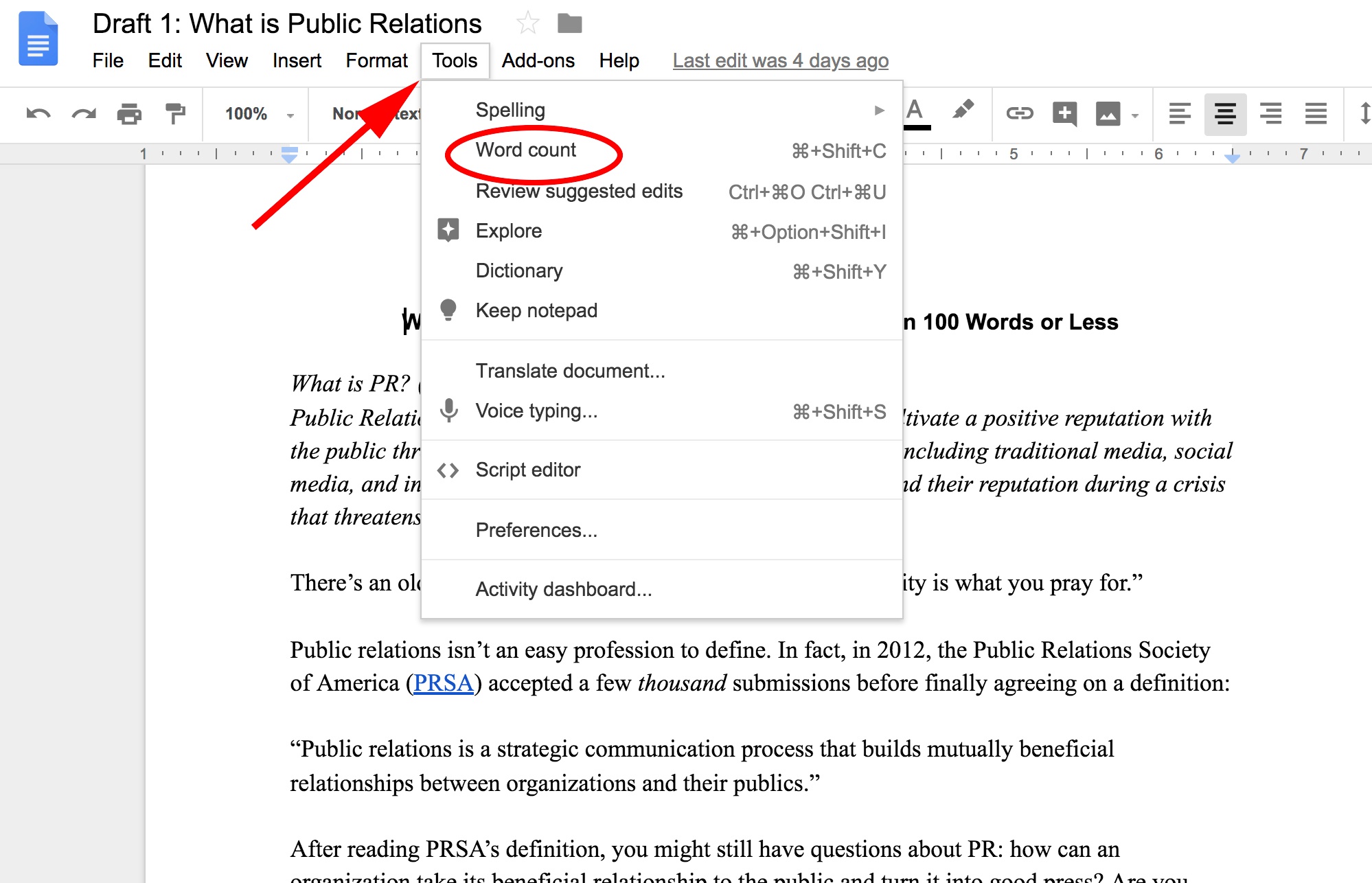
2. Here, you can see how many pages you have in your Doc (three), how many total words you have (777), how many characters you have (4992), and how many characters, excluding spaces, you have (4204). Characters are individual letters (“hey” is one word, but three characters), and typically only matters if a job or school application requires a character limit, rather than a word limit.

3. Next, let’s see how you can check the word count in a specific section. First, highlight the paragraph or section you want to measure. Below, I chose to highlight my third paragraph to get word count information on just that paragraph.
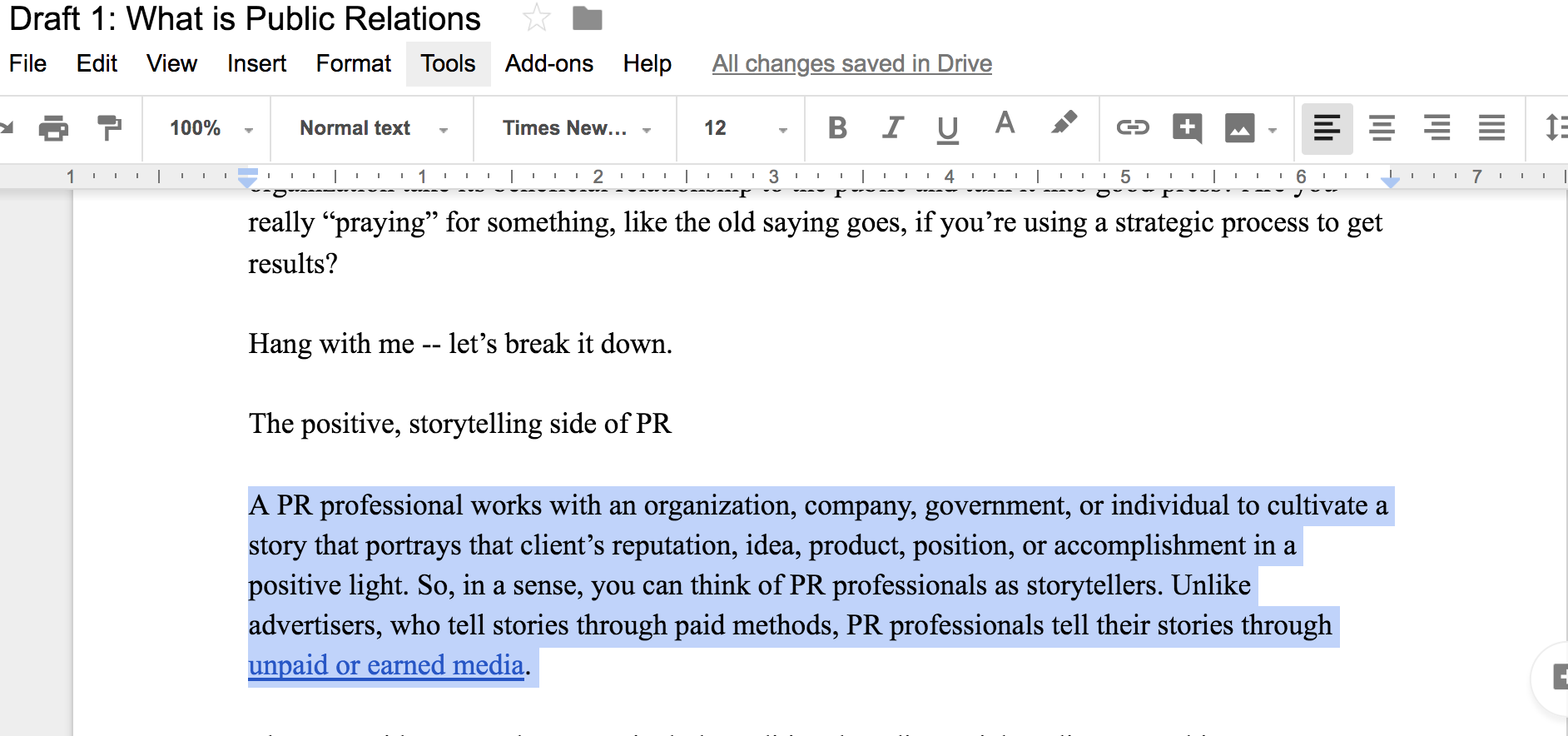
4. With a paragraph or section highlighted, click “Tools” and then “Word Count”. As you can see below, the Word Count now tells me how many words my third paragraph has compared to the entire Doc (59 out of 776), which page it’s on (1), and how many characters it has compared to the entire piece (400). This is useful if you need to cut down on word count for a specific section of your Doc.

There is also a shortcut to find your word count — click “command + Shift + C,” and it’ll pop right up.
Now, you’re equipped to measure the word count, character count, or page length of your Doc, which helps you hit word-limit or page-limit requirements. Word count is also an important tool to use when choosing your audience: 1,000 words is good for a blog audience, but 10,000 might be better as an e-book … or short novel.

Four more HomeKit-compatible air conditioners now available from GE

We learned a few days ago about the launch of the first US HomeKit-compatible air conditioner, and GE says that there are now four other models with HomeKit support, making five in all …
Photos claim to show redesigned iPhone SE 2 with glass back for wireless charging, headphone jack remains

The iPhone SE 2 rumor train has been a wild one. There are many conflicting reports about the device, ranging from rumors of a major chassis change to only a minor hardware revision.
These new photos purport to show a fully-built iPhone SE 2, with resemblances to some leaked shells first seen in March. They depict a device somewhere in between the two extremes of the rumored specs; a new glass back for wireless charging but a 3.5mm hole for a headphone jack remains.
Tim Cook’s follow-up meetings after Trump seemingly confirm China focus

A tweet by President Trump suggested that foreign trade would be a focus for yesterday’s Oval Office meeting with Apple CEO Tim Cook.
This now appears to be confirmed by follow-up meetings Cook had whilst in Washington …
Microsoft and Facebook last two big tech companies to follow Apple’s lead on gun emoji

Microsoft and Facebook have announced that they will be changing the pistol emoji from a realistic-looking handgun to a water pistol. Google yesterday made the same decision, all following the lead Apple set two years ago …
How to Protect Your Business From a Social Phishing Scam
Are you ready to respond if someone pretends to be you on social media? Wondering how to protect your customers and brand from a social phishing attack? From erroneous links to outright brand impersonation, social phishing is becoming more frequent. In this article, you’ll discover four ways to protect your business from social phishing scams. […]
This post How to Protect Your Business From a Social Phishing Scam first appeared on Social Media Examiner.
from https://ift.tt/2I1Kpf8
via socialmediaexaminer
The Staircase Guest Blogging Strategy
Our startup journey has proved it — guest blogging is king, queen and all the aces in content marketing. Guest blogging lets you share expertise and build authority in the industry, and the backlinks you receive to your own website helps your SERP rankings.
We started Chanty from scratch. Thanks to the staircase guest blogging strategy I’m about to share, we managed to get our monthly traffic from 0 to 5-digit numbers in less than a year.
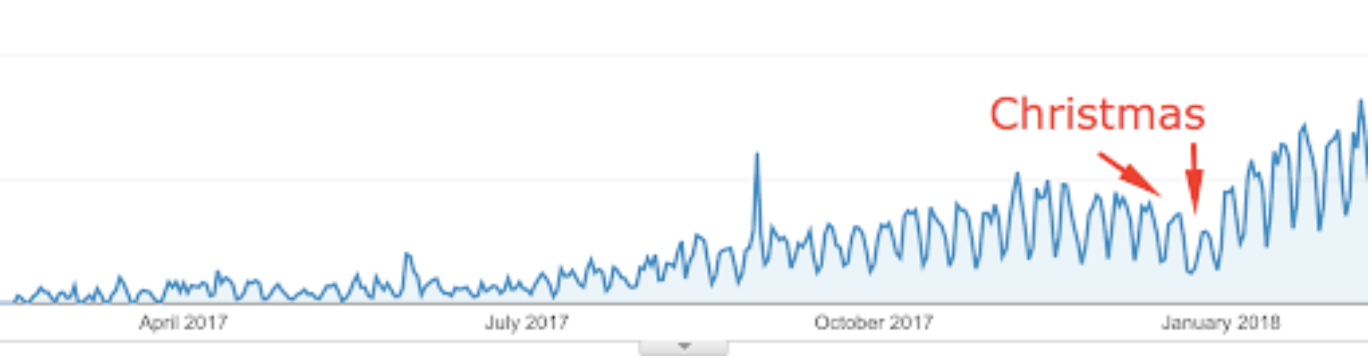
Chanty website traffic growth
Guest blogging is nothing new. There are tons of articles sharing guest blogging best practices. There are also plenty of posts teaching you how to write for top-tier resources. However, it’s hard to find resources that guide you through the entire process — from the moment you decide to benefit from guest blogging, to actually getting published on Forbes and Entrepreneur.
Luckily, our team has completed this journey from A to Z. Just a year ago, most of our team had no idea how to write a blog post. As of today, we’ve written for well-known blogs like Foundr, GoDaddy, Search Engine Journal, SemRush, Marketo and many more. We set the bar high in the very beginning. Our grand milestone was Entrepreneur. Thanks to the staircase guest blogging strategy, my guest post for Entrepreneur was published just a few weeks ago. Now that our mission’s completed, it’s time to share our step-by-step process with you.
What is the staircase guest blogging strategy?
In a nutshell, the staircase guest blogging strategy is about writing high quality content for third-party blogs while gradually increasing the quality of the platforms you are writing for (climbing the stairs). You start by picking the low-hanging fruit and pitching the ‘reasonably popular’ blogs. The competition and the editorial calendar for these platforms isn’t too intense. Once you build a writing portfolio, you’ll be able to raise the bar higher and pitch more popular blogs with your next article. Although it sounds simple there are plenty of pitfalls along the way. Therefore, let’s go into more details.
1. Start a loveable blog
When you are a no-name company writing your very first article draft, you obviously can’t just reach out to Entrepreneur with a pitch. Although you can try your luck anyway, there’s a good chance you won’t even get a reply (I know this because the first time we reached out, we failed). However, you’ve gotta start somewhere.
When pitching a blog with a guest article, the best practice is to include examples of your work. When we sent our guest blog pitch for the first time, our writing examples were actually the posts we had written for Chanty. Luckily, starting a company blog is a breeze these days — with platforms like Medium, you don’t need to be tech savvy or even know how to operate WordPress.
If you don’t know what to write about, start with your experience. As you launch a startup, your way will be paved with many obstacles, pitfalls, and difficult decisions. Your brain quickly falls into the knowledge-consuming mode, constantly searching for answers and solutions. Therefore, you’ll definitely have a few valuable lessons to share with readers, including issues you’ve solved and obstacles your company has successfully overcome.
For example, we’ve written a few posts on our blog covering SaaS pricing models and how we got the first 100 beta testers for our product, all based exclusively on our experience. As a result, we were able to write about similar topics for third-party websites. Another example of experience-based writing I love is Groove’s “From ‘Aha’ to ‘Oh, shit’” startup blog and Grow and Convert blog.
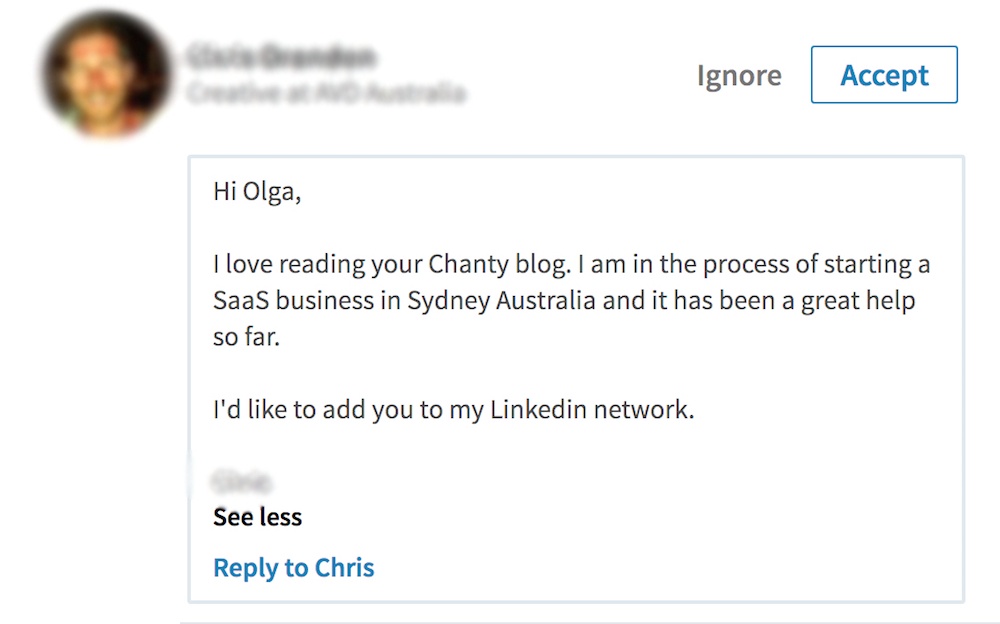
Our blog feedback from a reader
2. Put the content quality in the heart of your strategy
I must emphasize this — it’s hard to overestimate the power of content quality when it comes to climbing the guest blogging stairs. If you write some mediocre content, you’ll certainly be able to publish it on the same mediocre platforms. However, low-quality content will never let you climb to the top. With that said, how do you make sure to deliver excellent copy?
My first advice would be to analyze the leading blogs in your industry. Check out the style, tone, and voice they use. What makes their content engaging, appealing and resonating? Is it the personal experience they share? Is it the storytelling approach that makes you want to keep reading? Moreover, it wouldn’t hurt to analyze the top Google results for your target keywords. You’ll have to write content that is head and shoulders above your rivals if you decide to compete for these keywords.
It goes without saying, but you must make sure your content does not contain mistakes or typos of any kind. Run a check with Grammarly to see if your writing can improve in terms of grammar. Paste your texts into Hemingway App to make them simple to read. Speak the language of your audience. Consider their age, gender, nationality and education. If you are based in Europe (like we are) but targeting the U.S. population with your articles, little things like $9,99 rather than $9.99 could easily determine whether you are a pro or an amateur.
3. Find the low-hanging fruit
Once you have a handful of well-written blog articles to showcase your writing skills and expertise, it’s time to find the first guest blogging opportunity. There are a few ways to do this:
- Make a Google search for ‘guest blogging opportunities + keyword/industry’. You’ll find a number of articles like this one with a long list of platforms that accept guest posts.
- Make a Google search for ‘inurl:write-for-us + keyword/industry’ (e.g. inurl:write-for-us digital marketing). This will bring you directly to the writers’ guidelines page of those websites where guest writers are welcome.
Create an extensive list of all potential platforms where you can pitch a guest article. Next, I’ll show you how to check out these websites’ domain authority and traffic numbers.
4. Check the traffic and domain rating
Not all website are equal. The exposure you’ll get from an article published on a million-visits-per-month domain will be massive. However, with no previous guest blogging experience, you are unlikely to get into that boat. Therefore, let’s stay patient and take it one step at a time. You can get an idea on how popular a website is by checking the estimated traffic, as well as the domain rating. The tools you’ll need are Similar Web and Moz Rank Checker. There are browser plugins for these apps that you can download to conveniently use the tools.
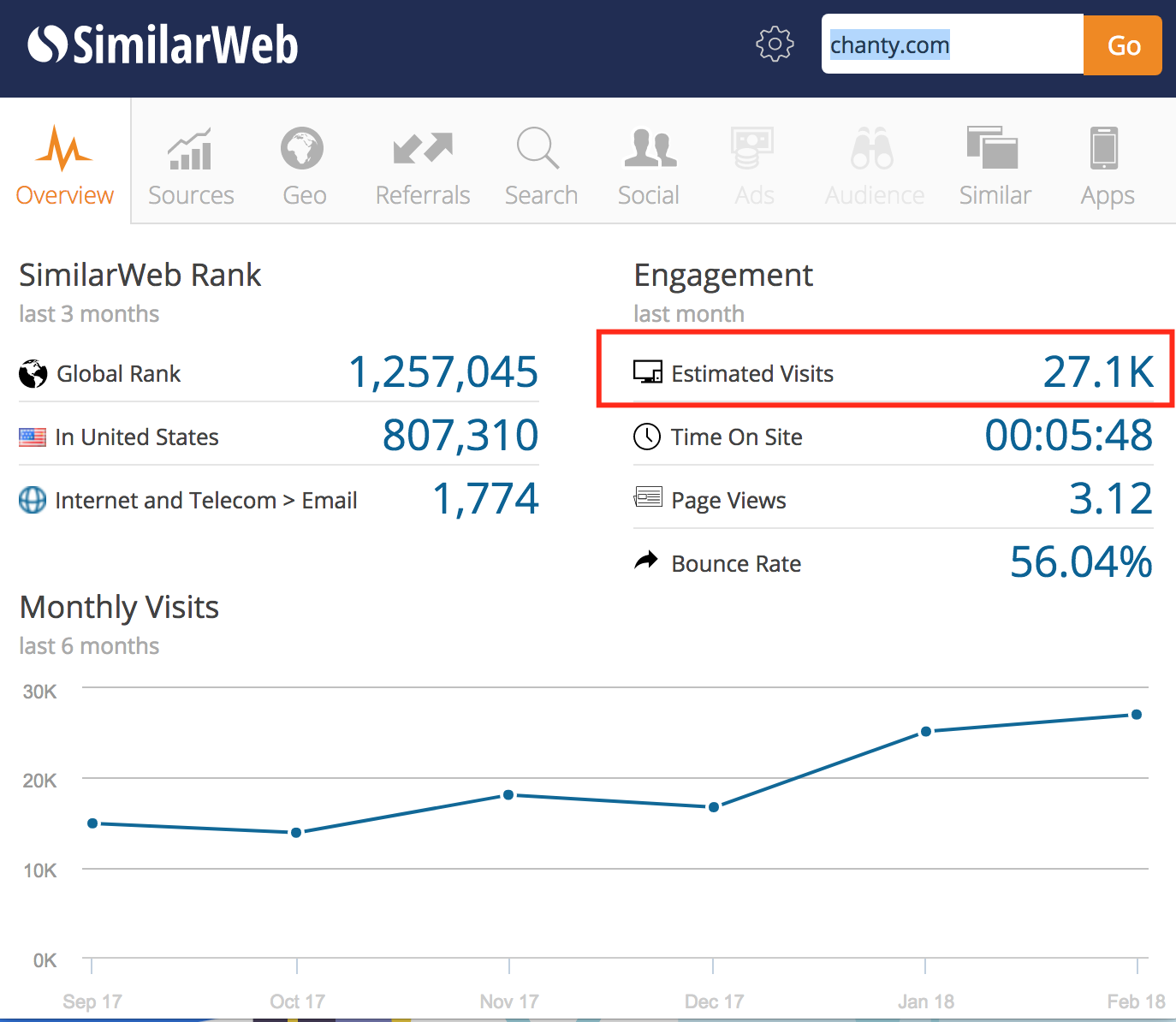
SimilarWeb Chrome extension data on website monthly traffic

MozBar Chrome extension data on website domain and page rating
Along with other useful information, SimilarWeb shows you the estimated traffic a website gets every month. MozBar indicates the site’s domain and page authority, which predicts how well a website will rank on search engine result pages. It ranges from one to 100 with higher scores corresponding to a greater ability to rank.
At this stage, you should have a list of websites with an estimated traffic and domain authority (DA) for each platform. Make sure to check the numbers for your own website as well. Now, go through the list and highlight the best candidates for a guest blogging outreach.
At that time, our Chanty domain authority was around 10 points, so we started contacting blogs with DA around 20-40 and estimated traffic of 10K+ per month.
5. Send a good guest article pitch
Once we started accepting guest posts to Chanty’s blog, I realized what a hard life editors must live. You can’t imagine how many low-quality pitches we’ve received. At some point, we even had to close down our guest blogging submission, as we started spending too much time going through bad pitches and inferior articles. Here’s just one example of how not to pitch an editor with a guest post idea:
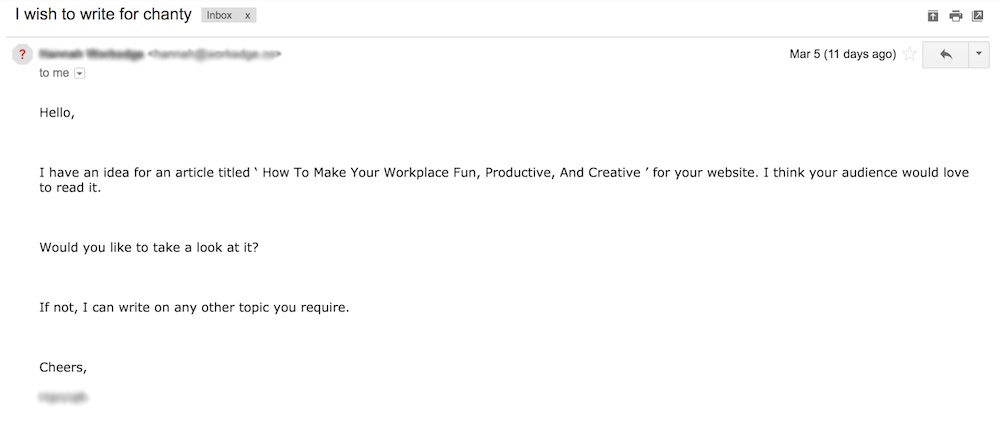
This writer doesn’t mention which company she works for, doesn’t give examples of previous work, and suggests only one topic for consideration. There’s also no image linked to that email account to see who is reaching out. Nothing in this email makes the writer look trustworthy. What happens to an outreach message like this one? Sadly, it goes straight to the trash.
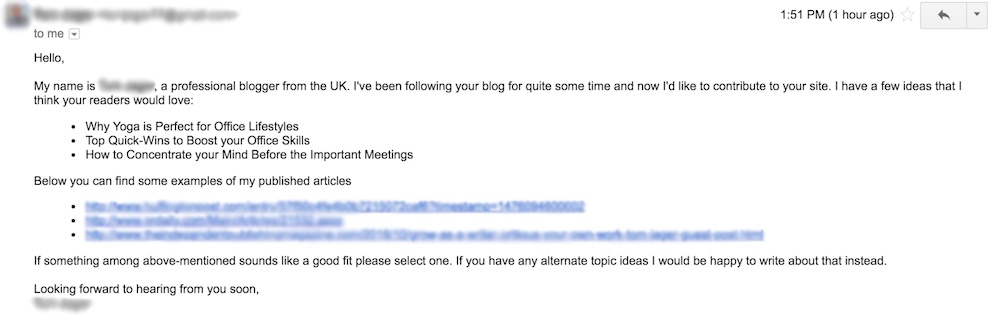
Many companies provide guest blogging guidelines that are an essential read before even sending a pitch. The key is to follow them precisely unless you want to upset an editor. Some websites require a specific form of a pitch, while others prefer to see a full article attached to the outreach email. If the blog you want to write for doesn’t go into detail on pitching requirements, follow this simple formula:
- Introduce yourself
- Make sure you have a full name and a photo next to your email
- Suggest several topics you wish to write about
- Include clickable urls to your writing examples
This should be enough to start a conversation with an editor.
Here’s an example of a good pitch:
6. Get published
Editors get a lot of guest post requests. Therefore, it might take a few follow ups from your side to ensure your message reaches the top of their inbox. Be ready to provide an outline for an article as well, since it’s a common practice for some blogs. Once you’ve agreed on the topic, make sure to specify the blog guidelines and follow them thoroughly.
Oftentimes, the article may require some editing or rewriting, especially if you are at the beginning of your writing journey. One of the guest contributors who wrote for our blog had to fix the article eight(!) times before we could accept it. However, I’d like to acknowledge this — our communication remained friendly and the writer was eager to polish the article to make it a perfect fit for our blog. Takeaway? Cooperating with an editor in a friendly and eager manner is key to a published article.
7. Raise the bar higher
Congratulations! You now have a few articles published to showcase some examples the next time you reach out to other blogs. Now, it’s time to start climbing the stairs. Go back to the list of blogs you initially put together, and take a look at the publications where SimilarWeb and MozBar numbers are a bit higher.
You can also reach out to blogs that look attractive to you as a guest blogging platform, even if you are not sure whether they accept guest posts (meaning, if there isn’t a page on their website dedicated to contributions). At this stage, our marketing team raised the bar higher and reached out to more popular blogs with MozRanking’s of 50-60 points.
Although numbers play a significant role in choosing the right website to write for, you should also trust your common sense and intuition. Sometimes, just from the way a website looks, we think: “Nah, I don’t want my article to appear here, despite all the cool numbers.” Or, it could be the opposite: “These guys are small, but they are doing a great job with their blog, and I’d love to contribute.”
8. … and higher
When you’ve published on some well-known websites, get ready for a big move. Don’t be afraid to climb the stairs even higher and pitch the top-tier blogs. However, you might want to use a slightly different strategy when outreaching extremely busy editors who get thousands of pitches every week. Usually, you’d follow the rules and send the article pitch in a form that a platform requires. However, more often than not, you don’t get a reply even after a few follow ups. This is when you should make a step back and think about getting to know your editor.
First off, find and follow the editor on Twitter or LinkedIn. See what their life is about, and what content they post. It doesn’t hurt to like, share or, even comment on their posts. Become the faithful follower of your editor so the moment you send out a pitch, your email account photo rings a bell. For example, here’s the pitch I sent to an editor at Entrepreneur.
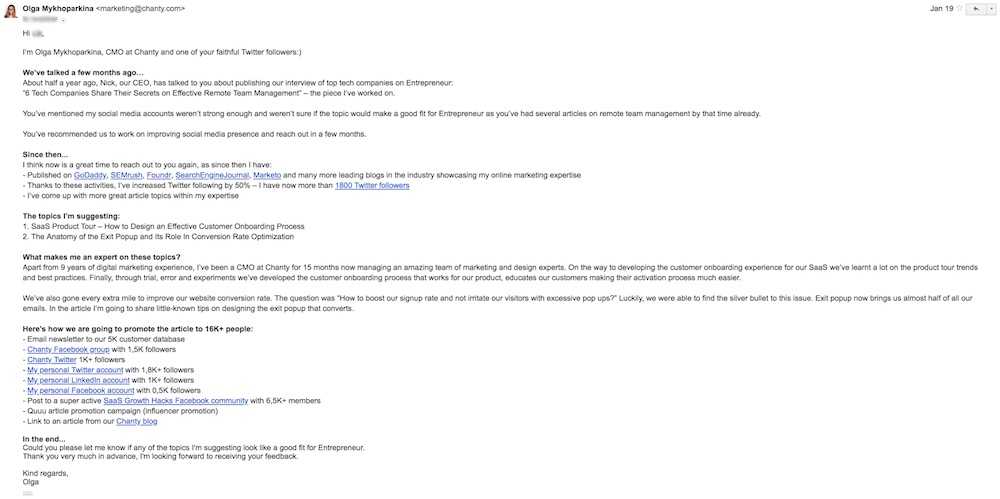
Persistence is key when it comes to top-tier platforms outreach. Despite the very detailed and personal email I wrote, it still took another three follow ups and about three weeks before I got the long-awaited “I’m interested in your article” reply.
Last words
You should always keep the content quality in mind, both when writing a guest post or an article on your company blog. The staircase guest blogging strategy is for those who have valuable insights to share with the world, not for blatantly building backlinks. It’s for those who are ready to invest their time researching topics in-depth, and reflecting their personal insights.
It’s not about hiring a $10-per-post freelancer — it’s about putting your heart into every article. At the end of the day, it’s the one and only way to get to the top-tier publications. Now, it’s your turn to make it to Entrepreneur. I’m confident you can do it. Good luck!

Apple Maps adds new indoor maps for three major international airports

Indoor mapping lets Apple Maps users explore the internal layout of buildings across multiple floors, with precise location positioning to help you find your way around places like airports and shopping malls.
Apple has today expanded its list of indoor mapping locations with a few new airports; iPhone and iPad can now explore Sydney International, Edinburgh and Hamad Internationl (Doha, Qatar) …
Samsung says it has seen ‘slow demand’ for the OLED panels it supplies for the iPhone X

Over the recent week, we’ve seen a handful of suppliers report slowing demand for parts purchased by Apple for the iPhone X. Now, Samsung is joining that chorus, saying that it has seen lagging demand for OLED panels used in the iPhone X…
Google says Inbox for iOS will be updated w/ iPhone X optimization ‘soon’

Since the iPhone X’s release back in November, developers have been updating their applications to take full advantage of the new 5.8-inch display. Some developers have moved faster than others at this, and now Google has confirmed that an update is coming “soon” to one of the most notable holdouts…
Facebook’s Q1 Earnings Call Reports Strong Numbers, High Hopes Despite Data Privacy Backlash
Facebook’s data privacy scandal has dominated the news these past few months. Today, the company is reporting something it’s likely more excited about.
On today’s Q1 earnings call, the Silicon Valley giant reported strong numbers for Q1 2018, with a total revenue of $11.97 billion and 1.45 billion daily active users. Both numbers outpaced estimates from Wall Street and Facebook’s slower growth in Q4 2017.
Positive Numbers Despite Negative Press
Such a positive earnings report might come as a bit of a surprise at first, on the heels of the revelation that 87 million Facebook users had their data misused by data analytics firm Cambridge Analytica — and Facebook CEO Mark Zuckerberg’s subsequent hearing before Congress earlier this month.
But these events, while significant, came late into the opening quarter of 2018, and likely had little influence on the Q1 data Facebook is seeing today.
Nonetheless, Facebook’s executive team didn’t hesitate to tackle the subject of data privacy during the live Q1 earnings call this afternoon.
“We have a responsibility to keep our community safe and secure,” Zuckerberg said at the start of the earnings report, reiterating his opening remarks to Congress during his hearing. Facebook’s Chief Operating Officer Sheryl Sandberg expanded on this sentiment later into the call, saying people should be able to control their advertising experience while using Facebook.
“At the same time,” Zuckerberg continued, “we also have a responsibility to keep moving forward.” To that end, the term that came up repeatedly during the call was “meaningful interactions.”
“This quarter, we’ve shifted from passive consumption to meaningful interaction,” Zuckerberg said.
The executive preceded Facebook CFO David Wehner’s financial report with data related to the new tools and trends the company believes will drive the future use of the Facebook platform.
While 200 million users belong to “meaningful” Facebook groups that connect users through common interests, said Zuckerberg, he expects to double the number of group users in the near future. Although 100 billion messages are sent every day between WhatsApp and Facebook Messenger, 3 billion are now using WhatsApp Business to communicate and collaborate with colleagues.
Financial Gains Abroad and in Mobile
Following the optimism of Facebook’s CEO, the CFO touched on numerous increases across the company.
Contained within the nearly $12 billion in total Q1 revenue, Wehner said, Facebook saw a $536-million increase in earnings outside of the U.S., from what he described as “international tailwinds.”
These global gains are likely to pique the interest of European advertisers who are concerned about what the upcoming General Data Protection Regulation (GDPR) could mean for the value of advertising on the Facebook platform. (More on the GDPR in just a minute.)
Wehner also reported that net income translated to $169 per share, and that the company hired 48% more people in Q1 2018 than it did in Q4 2017.
Another particularly intriguing figure is Facebook’s mobile ad revenue, which increased 16% from last year to $10.7 billion. Together with the company’s 1.45 billion users, whether or not this data indicates a promising year ahead or a high height to fall from in Q2 remains to be seen.
Questions Around the GDPR
Facebook’s executive team took a variety of questions following their earnings report, one being if the company has seen a change in user behavior or time spent on the site.
Wehner had no specific updates to how long users spend on Facebook, adding that “we’re not optimizing Facebook based on time spent” on the platform. However, he echoed Zuckerberg’s opening remark that they are observing more meaningful interactions taking place across Facebook’s tools — specifically, an increase in “certain types of sharing” and “declines in the more passive viewing of video content.”
The topic that dominated listeners’ questions, though, was the GDPR — which takes effect across Europe on May 25. Multiple people from major companies joined the Q1 earnings call to ask if the GDPR has or will change advertisers’ view of (or, perhaps, loyalty to) Facebook.
Facebook’s executives made it clear on today’s call that the company has begun rolling out GDPR’s controls to their European market. But, according to Wehner, it’s too early into the rollout to predict how advertisers will react — nor is the reaction of any one marketer the most legitimate measure of Facebook’s value as an ad-serving product.
“GDPR affects the entire online advertising industry,” Wehner said, explaining that relative performance of Facebook ads is much more important than the ad revenue of any one Facebook Business Page.
What Facebook can foresee, as stated by Zuckerberg and Sandberg, is the way in which marketers will refocus their efforts while staying on the Facebook platform.
“Messaging can be a more transactional medium than feeds [of Facebook Business Pages],” Zuckerberg said, suggesting that chatbots and similar emerging tech will allow advertisers to provide ongoing customer service through tools like Facebook Messenger and WhatsApp.
Reflecting on the quarter, Facebook is seeing some “nice experimentation” with the things that make advertisers more effective, according to Sandberg. Q1 produced impressive statistics, but Facebook’s Q2 earnings in July will show how resilient the company really is to the unsavory media attention it incurred earlier this year.

Snapchat to start testing non-skippable advertisements next month

Following a controversial redesign, Snapchat is planning another change that is sure to irk some of its users. According to a report from Digiday, Snapchat is beginning to test non-skippable advertisements in its mobile application… more…
New report says Apple won’t be able to fully drop Qualcomm as an iPhone supplier this year

As its relationship with Qualcomm continues to strain, Apple is looking to move away from the chipmaker entirely as an iPhone supplier. A new report from Fast Company today, however, says Apple won’t be able to ditch Qualcomm entirely this year…
How to invoke split screen on iPad with iOS 11

With iOS 11, Apple supercharged the way how users. It came with many additions including a revamp to split screen multitasking. Gone is the swipe over and pick from a hideous and unintuitive app picker.
Kanye West tweetstorms Tim Cook meeting request, says he has ‘some ideas’

Kanye West recently made his triumphant return to Twitter, sharing his thoughts on politics, fashion, and much more. Now, the rapper and fashion designer is turning his attention towards technology, publicly calling for a meeting with Apple CEO Tim Cook…
Sonos says AirPlay 2 will be supported by Sonos One, Play:5, and Playbase only

Sonos previously teased AirPlay 2 support for its speakers. In a new announcement to MacObserver, the story is a little bit more nuanced. The company has said that AirPlay 2 will only be compatible with the Sonos One, Sonos Play:5 and the Playbase. Older speakers will not natively support AirPlay 2.
The launch date for AirPlay 2 remains unclear. The whole-home audio solution continues to show up in developer seeds of iOS, but Apple has not provided a specific timeline since it was delayed. Clearly, Sonos are actively working on it however …
Concert tracking app Bandsintown adds integrated Apple Music streaming with MusicKit

Popular live music discovery application Bandsintown has been updated today with direct Apple Music integration. This means that you can now stream Apple Music directly within the Bandsintown app as you search for concerts…
How to set up or recover voicemail on iPhone

As iMessage and other communication options have become more and more popular, voicemail use has no doubt seen a decline. However, it’s still an important feature to have working properly for most people. Follow along for how to set up or recover voicemail on iPhone.