
Welcome to My Blog
Facebook makes it easier to delete apps, but won’t extend European privacy standards to US

Unriddled: “Alexa, Make a Donation,” and More Tech News You Need
Welcome one, welcome all to Wednesday — the day that marks not just the week’s halfway point, but another edition of “Unriddled”: the HubSpot Marketing Blog’s mid-week digest of the tech news you need to know.
This week, we continue to wade through the very crowded pool of tech news items to help you decrypt what’s happening in this vast, often complex sector. And, get this: It’s not all about Facebook.
It’s our Wednesday tech news roundup, and we’re breaking it down.
Unriddled: The Tech News You Need
1. An IRA Purge From Facebook
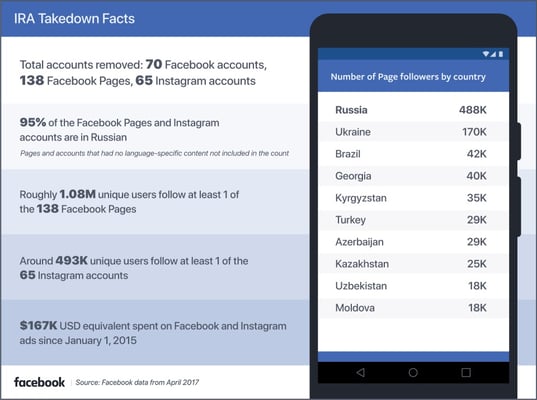
Yesterday afternoon, Facebook Chief Security Officer Alex Stamos issued a statement indicating that the company had removed 70 Facebook and 65 Instagram accounts, in addition to 138 Facebook Pages, that were controlled by the Russia-based Internet Research Agency (IRA). The announcement noted that many of these Pages ran ads that have also been removed from Facebook.
Roughly 95% of the Pages with content were in Russian, indicating that these pages were targeted toward Russia residents or people who speak the language in neighboring nations.
According to Stamos, the decision to remove these Pages had little to do with the content itself — and everything to do with the fact that they were controlled by the IRA, which “has repeatedly used complex networks of inauthentic accounts to deceive and manipulate people who use Facebook, including before, during and after the 2016 U.S. presidential elections,” he wrote. “It’s why we don’t want them on Facebook.”
Users can expect a further explanation from Facebook in the coming weeks, Stamos said. The company is looking to update its Help Center so people can find out if they liked any of these Pages.
Source: Facebook
2. “Alexa, Make a Donation”
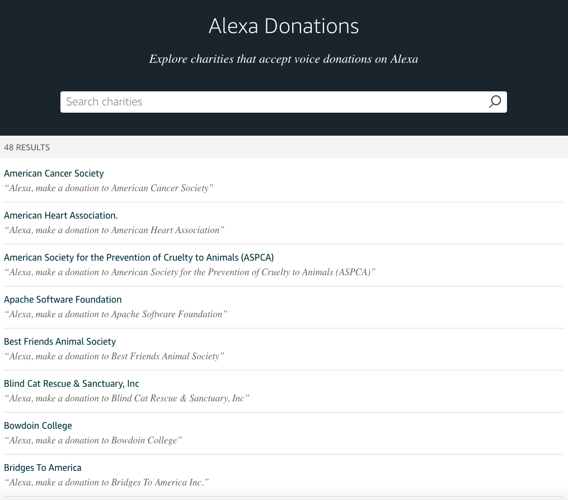
On Monday, it was revealed that Amazon Echo Users can now donate to 40 charities through Amazon Pay: a service, much like Apple Pay or Google Pay, that lets people use payment methods already associated stored in their Amazon accounts to purchase goods and services — and now, to make donations.
To make donations through Alexa, users need to have such a valid payment method set up in their Amazon accounts, and have voice purchasing enabled. And in order to prevent others from making unwanted donations, users can set up a four-digit voice confirmation code, which can be done through the voice purchasing settings.
It’s an interesting new feature for Amazon, and not the first that allows shoppers to use its technology to make charitable donations. In 2013, the company launched Amazon Smile, which lets users pick a charity that will receive 0.5% of what they pay for certain, eligible products.
Source: Amazon
But with the introduction of this Alexa skill, it allows users to make more spontaneous or impromptu donations just through an Alexa command — without reaching for their wallets or filling in several information fields.
To that end, organizations that receive donations through Alexa will also receive the user’s name, address, and email address, but not his or her credit card information. So, while there’s a chance that you’ll receive follow-up communication from the organization you donated to, the payment information itself is supposed to be secure.
3. Data Leaks Abound
Facebook wants to make one thing clear to users: The ongoing situation with Cambridge Analytica was not a data leak. Rather, it was the misuse of data — collected by an app developer as was allowed by Facebook at the time — by an analytics and profiling firm that never should have obtained information in the first place.
Keep that distinction in mind — because over the past several days, more than one consumer platform has experienced actual data leaks.
MyFitnessPal
One of them was MyFitnessPal: a free online calorie tracking site that’s owned by fitness apparel company Under Armour, which announced last week that the site had experienced a data beach impacting up to 150 million accounts. The data did not include information like Social Security or credit card numbers, according to the company’s statement, but was instead limited to things like usernames, email addresses, and hashed passwords (the kind that’s encrypted with something called bcrypt).
Panera
The second was a data leak from fast-casual restaurant chain Panera that included information like customer names, email and mailing addresses, dates of birth, and the last four digits of their credit card numbers. And according to information security blogger Brian Krebs, Panera knew of this leak for eight months before it addressed it.
It all began in August 2017 when security researcher Dylan Houlihan alerted Panera that customer data was leaking from its site — which according to emails supplied to Krebs, led to Panera’s director of information security Mike Gustavison largely writing off the report as a scam. And despite Gustavison verifying the problem soon thereafter and saying the company was working on a fix, eight months later, Houlihan discovered that the site was not only continuing to leak data, but that the estimated seven million jeopardized customer records could also be easily indexed and crawled by automated tools.
Since Krebs first reported the leak on Monday, Panera has issued statements indicating that it has fixed the problem — but several sources have said that the “fix” barely goes beyond requiring a valid user login to view these records (whereas before, anyone with the correct link to them could view them). Others have also reported that they have reason to believe more than seven million customer records have been exposed, and that Panera’s corporate client records may have also been affected.
Grindr
Finally, it was revealed by BuzzFeed earlier this week that dating app Grindr has been sharing personal user data with such third-party research firms — which included personal medical test results that users have the option of sharing on their profiles. Again, this incident is not to be confused with a data leak. Rather than this information being unintentionally exposed, the app says that this information is intentionally shared with research firms (namely, Apptimize and Localytics) to help improve the user experience.
According to the report, all of a user’s personal profile information is shared with these firms, which can include test results, if the user chooses to include it in his or profile. And while Grindr says this information is shared only with research partners and should, therefore, be secure, the news has left many wondering how easily that information could be abused if there was a data breach and it fell into the wrong hands.
Grindr has since issued a statement to BuzzFeed indicating that it will stop sharing medical test information from user profiles with these third-party firms — while also calling the negative response “a misunderstanding of technology,” according to the app’s Chief Security Officer Bryce Case, by the people who were unhappy to learn of this activity.
Why This Is Important
Okay, so, we clearly have a lot to learn from these three incidents — all in light of the fairly recent Facebook and Cambridge Analytica data news.
I’ll start with Grindr. While it’s possible that users did misunderstand the extent and intention of this data sharing, the point is: There was an outcry. To accuse this unhappy audience of “misunderstanding” how it works can easily (and understandably) be deemed as insulting. For any marketers who curious as to how they might want to handle a situation like this one, should they become responsible for responding to it, I would suggest explaining the situation clearly and in a non-condescending manner if you believe your audience might misunderstand the situation. But try to avoid labeling it as such, and instead, focus on a resolution.
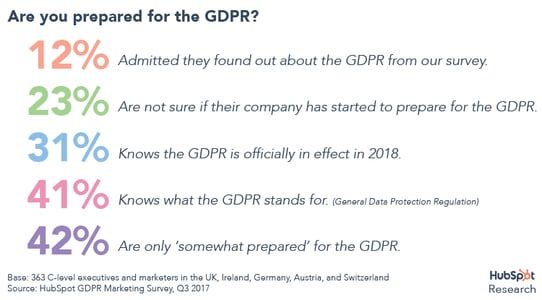
And you might be thinking, “There’s very little chance that I’ll find myself in that situation.” But think twice: With the General Data Protection Regulation (GDPR) coming into force next month (check out our primer here), it might soon apply to you more than you think. Don’t feel bad — our research shows that only 42% of marketers feel that they’re even somewhat prepared for the GDPR.
Plus, the noticeable volume of data- and privacy-related issues making headlines within the past year (we haven’t forgotten about you, Equifax) shows just how much more vulnerable businesses might be to these types of issues than they’re aware. Long story short: If you haven’t done one already, now might be a good time for a security checkup, to make sure you know how your (and your customers’) data is protected, and who exactly has access to it.
4. Apple Chips
Bloomberg reported this week that Apple will begin using its own chips in Mac devices as soon as 2020, rather than using the Intel processors it’s long relied on in the buildout of its computers. It’s a project reportedly known internally as “Kalamata”: one that illustrates another step toward making the Apple branded ecosystem iron-clad.
In February, I wrote about how this ecosystem can sometimes create a restrictive user experience, especially when it comes to Apple’s smart home speaker, the HomePod. In my experience, limiting the device’s music streaming options to Apple Music rendered the HomePod somewhat useless to those who use services like Spotify (which, side note, officially became listed on the New York Stock Exchange as SPOT yesterday) or Pandora.
But processor chips are different, and introduce a new type of vertical integration for Apple. While much of the company’s hardware — like the iPhone and Apple Watch, for example — runs on its own, internally-designed processors, its computers still rely on chips from Intel, often slowing down production due to the reliance on major pieces from external companies.
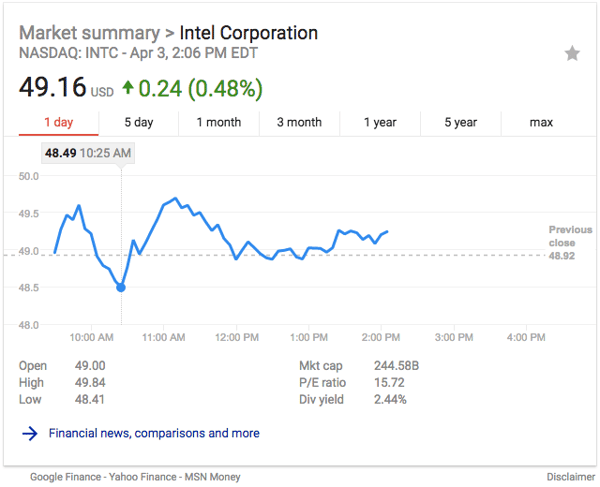
It’s not exactly welcome news for Intel, whose stock price dropped when this information was revealed — though it does appear to have slightly rebounded as of writing this post.
Source: Google
Apple certainly isn’t alone in its desire to create a product ecosystem that’s somewhat indestructible as a result of brand loyalty. Google, for its part, is building a growing portfolio of branded products, including mobile devices and computers, like Chromebooks, which currently run on Intel processing.
But this move has many — present company included — wondering if Google will be the next to vertically integrate machine processing capabilities. After all, Google and Apple have been known to become more than a bit competitive when it comes to similar products and capabilities (see: last fall’s #MadeByGoogle event) — so should Google follow suit, it wouldn’t exactly come as a surprise.
What Else Is Going Down in Tech Town?
More of the Latest From Facebook
On top of the ongoing data-related scrutiny Facebook is already receiving, the social media network is now coming under fire for archiving videos — like deleted multiple takes — that users thought had been removed, but were instead stored in personal data files, as per New York Magazine. A company spokesperson told TechCrunch that this happened because of “a bug,” and that the videos probably weren’t seen by the public.
Facebook has continued to respond to the fallout from allegations that personal user data was misused by analytics and profiling firm Cambridge Analytica, with announcements made last week that the company would be limiting the data available to advertisers on its platform. Meanwhile, new data shows that 31% of tech workers said they would delete Facebook.
In light of this data misuse, many are asking if or how Facebook will extend rules and practices required by the GDPR to U.S. users. In an interview with Reuters, Facebook CEO Mark Zuckerberg did not make that clear, though he did say that the social network is working on an internal “law” or version of the GDPR that would apply globally to all users. When asked which parts of the European regulation that would include, he answered, “We’re still nailing down details on this, but it should directionally be, in spirit, the whole thing.”
The company also announced last week its action plan to prevent the future weaponization of its platform to influence elections, outlining a four-tiered approach to protecting election security. Yesterday, that was followed by an announcement that Facebook will roll out changes to provide greater context around stories appearing in the News Feed. Read full story >>
Google Also Had a Busy Month
While Facebook was dominating many tech news headlines in March, Google was quietly having a busy month of its own. Learn more about these latest developments in this month’s edition of “What You Missed in Google.” Read full story >>
More (Unconfirmed) Changes From Instagram
Last week, we reported on changes that visual-content-sharing app Instagram would be making to its algorithm, with the possible introduction of a “New Posts” feature and more. Now, it seems that the company has made abrupt, unannounced changes to the way developers can use the app’s API to access data, with some losing access to it completely. Read full story >>
It’s a Dark, Pivotal Time for Autonomous Vehicles
Following recent fatal accidents involving both Uber and Tesla self-driving cars, the autonomous vehicle sector is going through a somewhat dark, but important phase. California has responded with new regulations imposed by its Department of Motor Vehicles, Arizona’s governor suspended Uber’s self-driving cars from its roads, and many other manufacturers have voluntarily paused its testing of these vehicles. But what does it all mean for the future of this crucial, highly-scrutinized industry? Recode’s Johana Bhuiyan breaks these issues down, and the implications they could have for the future of self-driving. Read full story >>
That’s all for today. Until next week, feel free to weigh in on Twitter to ask us your tech news questions, or to let us know what kind of events and topics you’d like us to cover.

Marketing to Gen Z: What Everyone Over the Age of 30 Ought to Know
You might assume young people don’t hear what you have to say, but they do — they just choose not to listen. Because a filter isn’t just for Instagram. The up-and-coming generation filters everything in the world around them because they have to, and that includes your marketing messages.
I admit it. I’m guilty of making assumptions about Gen Z. I think back to my own adolescence and casually project my experience onto them, but I’m wrong. The world is different now.
When I scrutinize the decisions young people make online every day, I’m surprised by what is revealed.
If you want to reach Gen Z, you’re going to have to rethink some of your marketing strategies. Here, we’ll explore the various ways you can shift your marketing tactics to appeal to a Gen Z audience.
Digital natives have a different perspective.
How many technology devices are you surrounded by right now? They’re everywhere, like a supply of digital oxygen. It’s all young people have ever known. Yet, in some ways, growing up with the internet is not that different from growing up without it.
Kids have to deal with hate on and offline. They see things they can’t un-see. At the same time, they’re trying to figure out what feels safe and how to navigate trust.
It’s tough.
But the difference is, everything is amplified online.
Hundreds of thousands of people lurk in your digital space, littering it with messages from their own agendas. Offline, you can go hide. Online, it takes willpower to put your hands to your ears and deliberately shut out the noise. Filtering becomes a lifeline.
If you want to reach Gen Z, you better have a convincing reason for them to let you in.
Your purpose is key.
A recent study from Google found that teenagers want brands to be “a representation of their values, their expectations of themselves and their peers.”
If they adopt the brand, what does it say about them as a person?
Are they part of something cool?
“When I think ‘cool’ I imagine companies that do great things for customers/employees or beautiful/unusual products.” ~ Female, 17, It’s Lit report
Gen Z use brands to help shape their world.
Take a look at YouTube. Teens love it, but it’s also one of the Top 100 brands in the world. YouTube’s mission? To “give everyone a voice” and “show them the world.”
According to YouTube, there are “four essential freedoms” that define who they are:
1. Freedom of Expression
We believe people should be able to speak freely, share opinions, foster open dialogue, and that creative freedom leads to new voices, formats and possibilities.
2. Freedom of Information
We believe everyone should have easy, open access to information and that video is a powerful force for education, building understanding, and documenting world events, big and small.
3. Freedom of Opportunity
We believe everyone should have a chance to be discovered, build a business and succeed on their own terms, and that people—not gatekeepers—decide what’s popular.
4. Freedom to Belong
We believe everyone should be able to find communities of support, break down barriers, transcend borders and come together around shared interests and passions.
Do teenagers seek out a video hosting platform, or do they want to connect with people who express creative freedom, share information, want them to be successful, and share their passions?
There are loads of alternatives to YouTube (who knew?). But teenagers aren’t looking for a more stable platform or a superior layout. They want to hang out in the place they feel they belong. Their choice of platform points to where that is.
How to communicate more effectively
Be careful of your words, for your words become your actions. Be careful of your actions, for your actions become your habits. Be careful of your habits, for your habits become your character. Be careful of your character, for your character becomes your destiny. — Chinese proverb, unknown author
In our emotionally-charged existence, and for every generation, words hold power. Words are part of what pushes us in one direction over another, influencing our moods.
In the Google study mentioned above, a few clear themes emerge. It seems the most popular brands all share the same outlook when marketing to Gen Z.
Here are three quick tips to instantly adopt their approach:
1. Speak human
When Apple promotes their watch, you’ll notice they don’t talk about time. They talk about freedom:
- “Answer a call from your surfboard.”
- “Stream your favorite songs on your run.”
- “Run your day. Right from your wrist.”
Think about how it feels to use a product or service and lead with that, rather than focusing on how the technology works. Nobody cares about that. Not when they’re about to ride the biggest wave, or listen to a song that reminds them of someone special.
2. Use inclusive language
YouTube wants to “give everyone a voice.”
Apple has “a watch for everyone.”
Spotify has “music for everyone.”
Whilst those who grew up writing letters to pen pals worry that technology drives us apart, young people appear to respond best when it brings people together. Celebrate the good in this community spirit because it’s this bond that counts when technology inevitably changes and moves on.
3. Show, Don’t Tell
Cold and inflexible brands are a turn-off for youngsters. They’re on the lookout for a more meaningful exchange. Like this one, described by Starbucks on their About page:
“It happens millions of times each week – a customer receives a drink from a Starbucks barista – but each interaction is unique.
It’s just a moment in time – just one hand reaching over the counter to present a cup to another outstretched hand.
But it’s a connection.
We make sure everything we do honors that connection – from our commitment to the highest quality coffee in the world, to the way we engage with our customers and communities to do business responsibly.”
Any brand can make a promise.
But Gen Z wants to see you keep it.
So to further delight people on the other side of the counter, Starbucks teamed up with Powermat.
They do away with “dependency on cumbersome cables” in celebration of freedom – something we already know makes teenagers froth with delight.
Mobile charging points in-store mean the young can roam free without fear of being disconnected from their friends and family. This is Starbucks’ way of “honoring the connection,” but, in less flowery terms, is simply a case of knowing what your younger clientele wants (me too, to be fair), and finding a way to make it happen. We know it’s the basis of all good marketing, but the most successful brands live by what they say.
Don’t hide your extra-curricular activities from your audience. If you do something besides sell coffee, include it in your marketing message. It gives young people an extra rope to swing from.
The Meaning Behind the Brand
According to a study by The National Retail Federation and IBM, young people are more inclined to follow brands that support a cause. They’re “more serious about this” than any other generation, so being able to communicate a strong sense of purpose should be top of your list.
“What do you plan on contributing to our future?” they demand to know.
Young people don’t want to hear brands say they’ll do better.
They want to see them do better, or the brand will be filtered out.
Companies have to stop treating customers like lab rats thinking, ‘how can we just get a click,’ and then stalking them around the internet endlessly with no shame. – Adam Kleinberg, CEO of Traction
Great companies are adopting smarter strategies than this.
Do better by doing your research.
It doesn’t matter who you’re marketing to: regardless of the age group, product, or location, words have always had the most impact when they echo what your listeners need to hear.
Nobody ever says jargon out loud (besides maybe that one deluded salesperson). People talk about things in a totally human way.
Consider cosmetics. I knew about make-up before I learned joined-up writing. Older buyers have been looking for a miracle cure for wrinkles for an eternity, yet marketers still don’t know how to sell them the solution. Andrea Leigh, a former category manager at Amazon, advises people to stop with the marketing spiel.
They’re not searching for “glowing, radiant skin” or “look younger in seven days,” which is the type of copy most brands put on their product detail pages on Amazon. Customers are searching based on needs – wrinkles, dark spots, acne, etc. – Andrea Leigh, former category manager at Amazon
Perhaps the younger generation are turned off from this kind of marketing, as well.
Gen Z wants you to get to know them a little better before they’ll turn your way to listen.
Start with a quick analysis.
If you want to know how young people respond to a brand, you’ve only got to ask.
- Find out why they make the decisions they do
- Recognize all the other things that influence their lives
- Know where they hang out online and why
- Consider why they do things the way they do, rather than absent-mindedly watch behavior
The result is being able to think more like the customer and less like a marketer.
This web copy for the Domino’s Easy Order service is evidence they did their research — they know who they’re talking to: “Setting up your Easy Order means I have your favorite order at the ready. All it needs is one click from you. Handy for when you’re exhausted from killing it at the gym, re-inventing the wheel or in the unlikely case that you are just CBA typing.” I bet from this one clip alone you can pinpoint three people you know who fit their target market.
Sharpen up your dialogue.
If you don’t want to be shunned by a younger audience, do things their way:
– Set up a survey on your website to ask about their experience.
– Interview real customers to find out what they’re thinking. (I’m sure an incentive wouldn’t go amiss – a voucher for their time or a gadget they can remember you by.)
The point is not to get a series of answers you can throw into a spreadsheet and forget about. You want answers that uncover emotions. Find out how young people feel about the brand. Because if they’re not convinced by the cause or are indifferent to the idea, it’s time to do better.
Give young people a reason to listen.
Only then might you be so bold as to suggest they try something new.

How to Create a Facebook Local Event for Your Business
Do you market a local business on Facebook? Have you heard about the Facebook Local app? In this article, you’ll discover how to use Facebook Local to create events that drive in-store foot traffic. What Is the Facebook Local App? Facebook Local (iOS and Android) was previously the stand-alone Events app before Facebook rebranded it […]
This post How to Create a Facebook Local Event for Your Business first appeared on Social Media Examiner.
from https://ift.tt/2IsfNSY
via socialmediaexaminer
5 SMART Goal Examples That’ll Make You a Better Marketer
When I was 14, my dream was to play college baseball. But I had one small problem: I only weighed 100 pounds. And even though I still had four years to bulk up and improve my skills, I knew I had a long way to go. Fortunately, my coach always knew how to keep my drive alive.
After a grueling practice or workout, he would harp on how the long-term is just a series of short-terms. And to hammer that mentality into our heads, he would make us write down our off-season training goals every year. But he didn’t just accept the first draft of your goal sheet. He never did. He would make you edit it until you knew exactly what your goals were and how you were going to achieve them.
Setting a goal like “improve upper body strength” and planning to lift weights three times a week wasn’t enough. You had to write down how much you would improve your bench press by and how many times you would work out your upper body per week.
Every year, I set concrete off-season training goals, and since I had a plan and clear direction, I always achieved them. By the time I was a senior in high school, I had gained 70 pounds of muscle and earned a baseball scholarship.
When I first learned about SMART goals, I had an epiphany. I realized the reason why I could keep improving my athleticism in high school was because my coach made me set SMART goals. And the reason why successful marketing teams always hit their numbers is because they also set SMART goals.
The thing I love about sports is the life lessons you learn playing them directly apply to your career. Setting SMART goals not only helps you get better at baseball, but it also makes you a better marketer.
Read on to learn exactly what a SMART goal is and how you can set one today.
What is a SMART Goal?
SMART goals are concrete targets that you can easily aim for. They’re realistic, quantifiable, and focused, so you know exactly how to accomplish them.
If you’re wondering what SMART means, it’s an acronym that helps you clearly define these goals, pushing you to produce real results. Check out the framework below.
Specific – In terms of marketing, you should choose the particular metric you want to improve, like visitors, leads, or customers. You should also identify the team members working towards the goal, the resources they’ll have, and their plan of action.
Measurable – If you want to gauge your team’s progress, you need to quantify your goals, like achieving an X percentage increase in visitors, leads, or customers.
Attainable – Make sure that X-percentage increase is rooted in reality. If your blog traffic increased by 5% last month, try to increase it by 8-10% this month, not 25%. It’s crucial to base your goals off of your own analytics, not industry benchmarks, or else you might bite off more than you can chew and burn out.
Relevant – Your goal needs to relate to your company’s overall goal and account for current trends in your industry. For instance, will growing your Facebook following lead to more revenue? And is it actually possible for you to significantly boost your organic reach on Facebook after their most recent algorithm change? If you’re aware of these factors, you’ll be more likely to set goals that are realistic, achievable, and beneficial to your company.
Time-bound – Attaching deadlines to your goals puts pressure on your team to accomplish them. And this helps you make consistent and significant progress in the long-term. If you don’t give yourself a deadline, accomplishing your goal will take too long to achieve long-term success. For example, what would you prefer? Increasing leads by 5% every month, leading to a 30-35% increase in half a year? Or trying to increase leads by 15% with no deadline and achieving that goal in the same time frame?
If you want a more concrete understanding of SMART goals, check out the examples below. You can always revisit this blog post and reference them when it’s time to set your goals.
5 SMART Goal Examples That’ll Make You a Better Marketer
1. Blog Traffic Goal Example
Specific: I want to boost our blog’s traffic by increasing our weekly publishing frequency from 5 to 8 times a week. Our two bloggers will increase their workload from writing 2 posts a week to 3 posts a week, and our editor will increase her workload from writing 1 post a week to 2 posts a week.
Measureable: An 8% increase is our goal.
Attainable: Our blog traffic increased by 5% last month when we increased our weekly publishing frequency from 3 to 5 times a week.
Relevant: By increasing blog traffic, we’ll boost brand awareness and generate more leads, giving sales more opportunities to close.
Time-Bound: End of this month
SMART Goal: At the end of this month, our blog will see an 8% lift in traffic by increasing our weekly publishing frequency from 5 posts per week to 8 post per week.
2. Facebook Video Views Goal Example
Specific: I want to boost our average views per native video by cutting our video content mix from 8 topics to our 5 most popular topics.
Measurable: A 25% increase is our goal.
Attainable: When we cut down our video content mix on Facebook from 10 topics to our 8 most popular topics six months ago, our average views per native video increased by 20%.
Relevant: By increasing average views per native video on Facebook, we’ll boost our social media following and brand awareness, reaching more potential customers with our video content.
Time-Bound: In 6 months.
SMART Goal: In 6 months, we’ll see a 25% increase in average video views per native video on Facebook by cutting our video content mix from 8 topics to our 5 most popular topics.
3. Email Subscription Goal Example
Specific: I want to boost the number of our email blog subscribers by increasing our Facebook advertising budget on blog posts that historically acquire the most email subscribers.
Measurable: A 50% increase is our goal.
Attainable: Since we started using this tactic three months ago, our email blog subscriptions have increased by 40%.
Relevant: By increasing the number of our email blog subscribers, our blog will drive more traffic, boost brand awareness, and drive more leads to our sales team.
Time-Bound: In 3 months.
SMART Goal: In 3 months, we’ll see a 50% increase in the number of our email blog subscribers by increasing our Facebook advertising budget on posts that historically acquire the most blog subscribers.
4. Webinar Sign-up Goal Example
Specific: I want to increase the number of sign-ups for our Facebook Messenger webinar by promoting it through social, email, our blog, and Facebook Messenger.
Measurable: A 15% increase is our goal.
Attainable: Our last Facebook messenger webinar saw a 10% increase in sign-ups when we only promoted it through social, email, and our blog.
Relevant: When our webinars generate more leads, sales has more opportunities to close.
Time-Bound: By April 10, the day of the webinar.
SMART Goal: By April 10, the day of our webinar, we’ll see a 15% increase in sign-ups by promoting it through social, email, our blog, and Facebook messenger.
5. Landing Page Performance Goal Example
Specific: I want our landing pages to generate more leads by switching from a one column form to a two column form.
Measurable: A 30% increase is our goal.
Attainable: When we A/B tested our traditional one column form vs. a two column form on our highest traffic landing pages, we discovered that two column forms convert 27% better than our traditional one column forms, at a 99% significance level.
Relevant: If we generate more content leads, sales can close more customers.
Time-Bound: One year from now.
SMART Goal: One year from now, our landing pages will generate 30% more leads by switching their forms from one-column to two columns.

Apple’s drama w/ Jennifer Aniston & Reese Witherspoon swaps showrunners over ‘creative differences’

One of the most highly-antipcated shows in Apple’s arsenal of original content is a morning show drama starring Jennifer Aniston and Reese Witherspoon. Variety reports today, however, that the show has undergone a leadership change due to creative differences…
Apple executives reap payouts of up to $22 million as restricted stock units vest

As reported in new filings with the U.S. Securities and Exchange Commission today, a handful of top Apple executives today received large stock awards due to the company’s continued strong performance.
Apple continues to tout Apple Pay in latest iPhone X + Face ID ad [Video]

Apple’s barrage of iPhone X ads continues today with yet another focused on Apple Pay on the iPhone X with Face ID. This ad focuses on using Apple’s mobile payment platform to pay for a grocery trip…
Apple releases macOS High Sierra 10.13.5 developer beta for Mac

Following the release of iOS 11.4 to developers and public beta users Apple this evening has pushed the first developer beta of macOS High Sierra 10.13.5. The update follows macOS 10.13.4, which included features such as enhanced eGPU support and more.
Apple bolsters AI team as it poaches Google’s search & artificial intelligence chief

According to a new report from The New York Times, Apple has hired Google’s chief of search and artificial intelligence, John Giannandrea. Tim Cook made the announcement in an email to employees, noting that Giannandrea will official be the head of “machine learning and A.I. strategy.”
How to restore the default Home screen layout on iPhone and iPad

Do you ever want to return to the default Home screen layout on your iPhone or iPad? Whether you’d like to use the iOS standard for a while or just use it as a starting point to switch things up, follow along for how to make it happen.
9to5Mac Daily 056: April 3, 2018

Listen to a recap of the top stories of the day from 9to5Mac. 9to5Mac Daily is available on iTunes and Apple’s Podcasts app, Stitcher, TuneIn, Google Play, or through our dedicated RSS feed for Overcast and other podcast players.
Apple talks gender pay gap in the U.K., says men are paid more than women in the country

Apple is pretty vocal about its stance on equality, often noting that everyone that works for Apple deserves equal pay, regardless of race or gender.
Facebook updates its News Feed with more background information on publishers and articles

Promised Apple Pay support in Brazil going live tomorrow

iPhone users in Brazil will soon be able to make payments in stores using Apple Pay. Apple announced the mobile payment service was coming soon to Brazil in February, and now it appears Apple Pay will be available in Brazil starting tomorrow.
Facebook Is Rolling out New Background Information Tools for News Feed Content
Facebook announced today that it will be rolling out new features to provide greater context around stories that appear in the News Feed.
The news follows tests that the company has been running since last year in the U.S. to determine how much background information on publishers and stories should appear alongside this content. Now, according to a written statement, the feature will be available to all U.S. Facebook users.
The details will include such information as any “official” Wikipedia entry on the publisher of the story, in addition to related articles on the same topic. It will also display the number of times that story (from that publisher) has been shared on Facebook and where, with a call-to-action to follow the publisher’s Page, if the user so desires.
And if the publisher doesn’t have a Wikipedia page, that information will also be displayed — which the statement says can add “helpful context.”
Facebook isn’t the first Big Tech company to announce the use of Wikipedia pages to supplement content on its site with additional information. Last month, YouTube CEO Susan Wojcicki announced at a SXSW panel that the video-sharing platform would be adding details from Wikipedia pages to conspiracy-related content: information that Wikipedia itself was unaware of at the time of the announcement. As of this post’s publication, it is unclear if Wikipedia is aware of Facebook’s plan to use information from the site in a similar manner.
“Facebook is interested in reversing the spread of misinformation and fake news,” says Henry Franco, HubSpot’s social campaign strategy associate. “This is one of the first times a feature like this has appeared natively in the Facebook app, and it’ll be interesting to see whether it has any effect on people’s interpretation of their News Feeds.”
The new tools will also include a “More From This Publisher” feature, allowing users to see what other stories the publisher has recently posted, as well as “Shared By Friends,” which will list anyone in the user’s personal network who have also shared the article.
The news comes on the heel’s of Facebook’s four-pronged outline unveiled last week to help protect election security on its site, one pillar of which was “reducing the spread of false news.” And while that outline didn’t delve into tremendous detail on plans to provide greater context around news items appearing in the News Feed, previous announcements from Facebook have alluded to this change.
“We’ll continue to look for opportunities to improve this experience,” the statement said, “and help give people more context about the news they see on Facebook.”

Apple releases first iOS 11.4 + tvOS 11.4 public betas with AirPlay 2

Following yesterday’s developer betas, Apple has seeded iOS 11.4 and tvOS 11.4 public betas. iOS 11.4 includes both AirPlay 2 and Messages on iCloud for testing, and tvOS 11.4 can be used for AirPlay 2 testing.
1Password Business launches with compliance controls, auto-provisioning, free Family accounts

Popular password and data manager 1Password is out today with an all new offering, 1Password Business. Launching today, developer AgileBits has taken what it has learned from its 1Password Teams product and created a robust business password manager.