Welcome to My Blog
Instagram listens to user feedback, making several improvements to its feed algorithm

Instagram today announced that it will be making several updates to its feed algorithm to help improve the experience for its users.
Instagram Might (Finally) Be Fixing Its Algorithm
Almost exactly two years ago, Instagram made changes to its algorithm that left some users, in a word, dissatisfied.
The changes would modify the algorithm so that posts no longer appeared in chronological order on a user’s feed, but rather, surface pictures and videos that it thought might be of greater interest.
This, like any other algorithm change, was likely based largely on a user’s behavior on Instagram — who the person followed, which posts the person liked, and so on.
It left content creators upset — including celebrity personality Kylie Jenner.
But now, Instagram might be backtracking.
Today, the visual content-sharing app announced that it would be changing its algorithm once again, so that more recent posts are could appear first in a user’s feed. These modifications, the statement said, will “give you more control over your feed and ensure the posts you see are timely.”
It’s also testing a “New Posts” feature, which is essentially a button that allows users to manually refresh their feeds, rather than having the app update it automatically. Want to see new posts? Tap the button. Otherwise, don’t touch it, and your feed will stay right where you left off, Instagram says.
The announcement comes on the same day that Instagram announced it will be allowing users to place hyperlinked hashtags and tagged profiles in their bios.
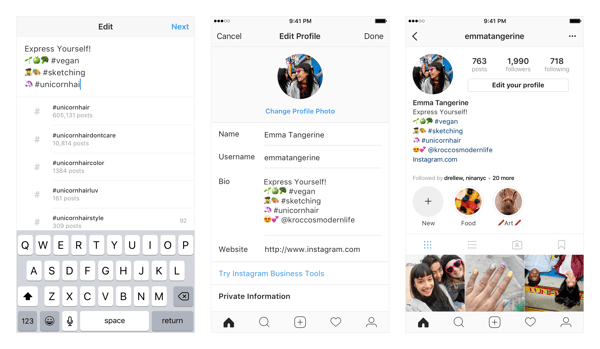
Source: Instagram
Instagram is owned by Facebook, which has been experiencing a host of PR issues following last week’s allegations that personal user data was misused by analytics company Cambridge Analytica.
Henry Franco, HubSpot’s social campaign strategy associate, points out that this shift is reminiscent of Facebook’s own algorithm changes in January to place a greater emphasis on content from friends and family in News Feeds.
“‘Newer’ versus ‘popular’ means preferential placement won’t be given to brands,” he says, “but to whoever has posted most recently.”
The announcements arrive among a host of issues for Instagram’s competing app Snapchat, which has been experiencing its own blowback following a redesign.
Earlier today, it was reported that Instagram might be working to emulate Snapchat’s Snapcodes feature, which allows users to scan codes to find profiles or content on the app.
Just when you though Instagram was done coping Snapchat! They are releasing a new ‘Nametag’ feature which would allow you to open profile just like it happens when you use Snapcode on Snapchat! Your thoughts on this feature? #InstagramLeak
(PS. You can DM for full pics, w/o WM) pic.twitter.com/cZwSQKevjj— Ishan Agarwal (@IshanAgarwal24)
March 21, 2018
Instagram’s version, which is rumored to be called Nametag, would permit a create a similar capability, giving content creators another method of gaining followers by letting them scan a visual code on print or other materials.
Starting today, users will be able to add hyperlinked hashtags and tagged profiles in their bios — with the caveat that any tagged profiles will receive a notification of such and can untag themselves if desired.
The New Posts feature and possible algorithm changes appear to only be in the testing stages at this point, though Instagram says it will announce more “improvements” in the coming month.
As for the rumors — I’ll be keeping an eye on that. Questions? Feel free to reach out on Twitter.

9to5Toys Lunch Break: Amazon Logitech Sale, MacBook Pros from $1,050, Amazon Alexa Devices 30% off, more

Keep up with the best gear and deals on the web by signing up for the 9to5Toys Newsletter. Also, be sure to check us out on: Twitter, RSS Feed, Facebook, Google+ and Safari push notifications. more…
AR app turns your iPhone X into a useful IKEA furniture instruction manual [Video]

A new app concept gives us a look at how AR can be leveraged to create a better experience than using paper instruction manuals. Specifically, AssembleAR shows what it looks like to use AR to help put together IKEA furniture.
Opinion: What I’d like to see Apple announce at the March 27 ‘education’ event

Apple set expectations for the March 27 event with the invite: ‘creative new ideas for teachers and students’. It’s going to be themed and directed at education markets, no question.
But that doesn’t mean the event will be irrelevant to an average consumer outside of a school. Whilst software announcements will almost certainly focus on things like Apple Classroom, any new hardware revisions affect normal customers just as much as schools. Here’s what I’d like to see happen.
Satechi releases new aluminum USB-C hub with dual video output, Gigabit Ethernet, more

Satechi has today released its latest USB-C hub, the Aluminum Type-C Multimedia Adapter. Packing in almost every I/O you could need, the new adapter even includes Gigabit Ethernet, HDMI, mini DisplayPort, and more.
Making of Apple’s Spike Jonze-directed HomePod ad detailed in behind-the-scenes video

Earlier this month, Apple began airing a new HomePod ad directed by filmmaker Spike Jonze and featuring dancer FKA Twigs. Today, AdWeek shares an interesting look at the behind-the-scenes work that went into making the ad.
The Walking Dead mobile game developer using iPhone X TrueDepth camera as motion capture tool

The developers behind the upcoming mobile game for The Walking Dead, Our World, are using the iPhone X’s TrueDepth’s camera system as a motion capture tool for facial expressions for characters in the game. The developers record actors in front of the iPhone X, using a specially-built app to export the facial motion into their 3D character modelling apps.
Going beyond simple cartoon figures like Animoji, the developers feel the iPhone X sensors are good enough that they can use them to animate realistic face rigs of human characters.
HQ Trivia app update adds native full-screen iPad layout

HQ Trivia continues to go from strength to strength bringing in hundreds of thousands of players every single day. They have started doing winner-takes-all special games on Sundays with even bigger jackpots too. Today, they pushed an update to their game in the App Store to bring a native layout for iPad players. Previously, iPad HQ players were resigned to using the iPhone app in 2x blown up mode.
Latest Apple Pay promotion promises free delivery on restaurant orders from Grubhub, Seamless and Eat24 apps

Sticking to the same as the previous giveaway, Apple has partnered with restaurant delivery apps to offer free delivery on meals ordered through Grubhub, Seamless and Eat24. Orders must be made through the website or the apps using promo code ‘HOOPS’ at checkout, and paid using Apple Pay of course. There are some strings attached though …
The Big Event: The Journey, Episode 22
The Journey, a Social Media Examiner production, is an episodic video documentary that shows you what really happens inside a growing business. //http://www.youtube.com/watch?v=JY4_n5diAjI Watch The Journey: Episode 22 Episode 22 of The Journey follows Michael Stelzner, founder of Social Media Examiner, as he continues to pursue what many will see as an impossible goal: to […]
This post The Big Event: The Journey, Episode 22 first appeared on .
– Your Guide to the Social Media Jungle
from http://ift.tt/2pyeHgt
via socialmediaexaminer
Why Is Everyone So Obsessed With Bots?
It’s so interesting to watch classic films, isn’t it?
I’m a big fan of the genre, and always have been. But as my time working in tech progresses, I’m particularly drawn to the ones that were, in their own way, predictive. Futuristic. What was then science fiction.
What’s behind my fascination is how much we are growing into and making a reality what was once thought to be fiction — something dramatically forecasted through art, literature, and film to be a world unlikely to be witnessed for many generations.
And yet, here we are.
Within this science fiction was a prevalence of robot characters, whether villains, protagonists, or those who supported the stories’ heroes — enough so that we once dedicated an entire post to them.
To this day, we’re still obsessed with bots — only now, most of us use them on a day-to-day basis, whether we realize it or not. That really came to the surface at SXSW, where I attended panel after panel on the topic, and was lucky to speak with the creators of some of the newest, most notable bots to hit the market.
I had to know: Why are we so infatuated with bots?
Here’s what I think — and what the experts had to say about it.
Why Are We So Obsessed With Bots?
The Difference Between Bots and Artificial Intelligence
First things first: It’s very easy to lump bots and artificial intelligence (AI) together as the same type of technology. But they’re not.
I sat down with Emily Withrow, Quartz Bot Studio editor, to clear things up. This bot was unveiled at SXSW, introducing a personal messaging experience for Quartz readers on Messenger to interact with news, projects, and content the brand calls “Obsessions”: magnified looks into the most interesting stories and events taking place in the world.
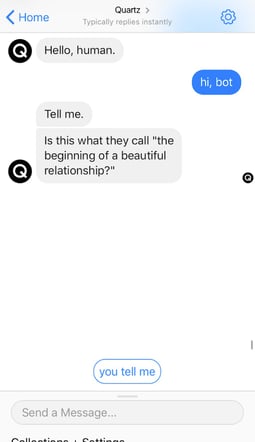
.jpg?t=1521716150255&width=255&name=obsessions%20(1).jpg)
When I asked Withrow how she would delineate AI from bots, she explained the latter is a type of technology that can — but doesn’t always — inform and enhance the former.
“AI is a tool that bots can use, but it’s not part of the package,” she said. “I think of a bot as the postal worker — the delivery of content, and the back-and-forth in the delivery and fetching of content.”
“How smart” you want to make that delivery and fetching of content, Withrow said, is where AI comes in, especially when it comes to how the bot will respond to user input. That’s where intelligence tools like natural language processing (NLP) can help the bot interpret what a user is saying.
But it also works with non-text user input. Let’s say, for instance, a user sends a photo to a non-human bot (which actually happens quite a bit — more on that later). “Having some [artificial] intelligence,” Withrow explained, can help the bot determine “what the photograph is when users send it in,” and respond accordingly.
So, now that we’ve cleared that up — let’s touch on why people are sending photos to non-human bots in the first place, and what that says about our growing obsession with them.
Non-Human Content Sharing
Hold up, I thought. Do people really send the Quartz Bot pictures?
Yes, explained John Keefe, a Quartz Bot Studio developer and product manager — but luckily, “Google vision API does a ‘safe scan’ of the pictures that people send to the bots … for free.”
Phew.
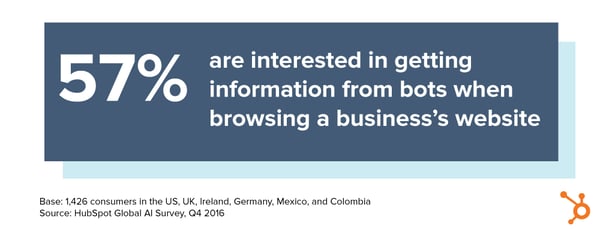
But it did raise an interesting point — why are people sending photos to the bots? Is it out of pure curiosity, or is it to actually engage with the bot?
As it turns out, it might be the latter. At a panel discussion around what’s next in how we interact with bots, Dashbot Co-Founder and CEO Arte Merritt noted that out of all the photos sent to bots, throughout his research, he’s found selfies are the most common.
What that tells us, he said, is that people treat something as seemingly superficial as a weather bot “like a person, and sent it pictures like it would to a friend.”
Which only led to more questions, including one from panel moderator Shara Tibken, a senior reporter with CNET. “What about emotional attachments?” she asked. “Do you see a day when these become our therapists or our friends?”
Well, maybe — and that’s where the AI comes in. Take self-driving cars, for instance, which could serve as one of the most extreme examples of AI-powered robots. Only, instead of chatting with you on a platform like Messenger, they get you from point A to point B on major roads.
And while it’s pre-programmed to be able to respond to certain inputs or detections, like a chatbot would be, it’s also predicted that autonomous vehicles will learn more about its user(s) to create a personalized, humanized experience — similarly to how a friend would, said Niveus co-founder Tim Cutting.
“If you truly have a friend in the car, it knows your body language, how warm it is outside, and your favorite music to recommend,” he said. “I think the AI should get to that.”
So maybe that’s why we’re so obsessed with bots — because it helps to humanize objects and brands and allows us to engage with them in a way we never could before.
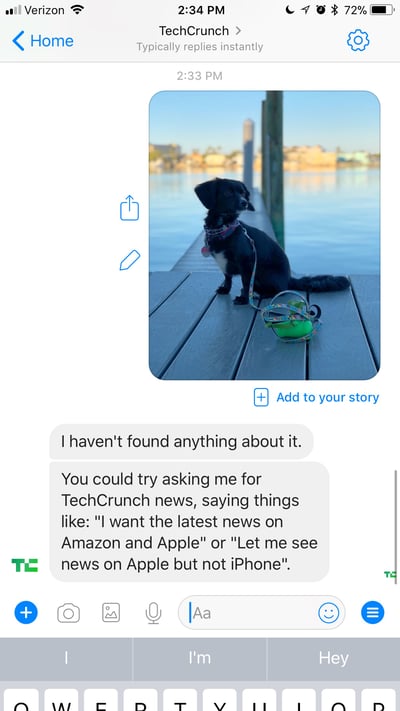
The result of sending a dog photo to the TechCrunch Bot
It’s a fascinating, but understandable, phenomenon for someone of my generation, who grew up watching movies like Brave Little Toaster — essentially a two-hour anthropomorphization of home appliances. That was part of the science fiction I alluded to earlier: the fantasy that non-human objects like toasters and electric blankets could be happy and sad, just like the rest of us.
As strange as it sounds, that type of story caused me to empathize with what were essentially machines. And while it could be dismissed as little more than an animated children’s film about the misadventures of a vacuum cleaner and its friends in the journey back home, it does appear that we’ve come full circle.
That’s because of the ways we humanize these machines today — in the form of conversational bots.
The Humanization of Brands — by Way of Bot
By humanizing inanimate objects and brands by way of bots, said Intuit CMO Lucas Watson at another panel discussion, you’re creating another method of building brand trust.
“As a brand, you have to think about where you sit on the friend spectrum,” he explained. “How deep a relationship do I want to have with my customer? What permission do I have to go there? What have I done to build that trust?”
And building a human engagement method, like being able to naturally converse with a bot, can help brands get to that point, added co-panelist Kristen Berman of Duke Common Cents Lab.
“You could get a bot to answer a question for you, and get humans to trust it,” she said. “I think we’re getting to that.”
Berman used the example of a human user prompting a bot with the query, “How to break up with someone.” For something like a search engine, those keywords are likely not new, nor is the human propensity to seek expertise and advice for doing so online.
But the idea of asking a chatbot how to do that — one that isn’t necessarily powered by AI, NLP, or machine learning — is fairly recent. And, said Keefe, by paying attention to this behavior, brands actually stand to benefit, especially when it comes to building a better, more humanized bot experience and interaction.
“We have an open white box where people can write anything — and people and other bots do,” he explained. “But, done well, you can learn a lot from that about what people are actually looking for.”
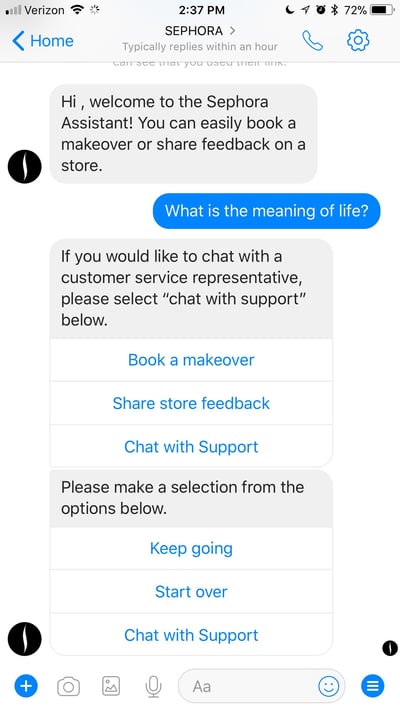
It turns out that “Sephora” isn’t short for “philosophy”
Okay, so maybe it’s not the responsibility of a weather bot to give advice to users on ending relationships. But it does signify the next phase of our increasingly digital habits of communicating and building relationships. What began as social networking and online dating has evolved into asking home speakers for nearby restaurant recommendations and, it seems, robotic meteorologists for personal advice.
And when I think about the idea of users sending selfies to bots, I have to wonder how different it is from, say, posting selfies on Instagram. Sure, we do that to get a response and engagement from a human audience, but what do we put more emphasis on: the audience itself, or the response and engagement?
At another panel discussion about what social media users want, Instagram Product Designer Josh Dickens emphasized the importance of the response to users.
“If you respond,” he said, “I know that you care about me and you’re with me.”
In full transparency, Dickens was speaking to that notion as a response from the people who users care about the most. But what that looks like for each person is different, whether it’s friends and family, or a crowd of adoring strangers. And when examining our evolving behavior with and around bots, it seems like that’s what’s most important to us: the response.
So, I’ll Ask Again: Why Are We So Obsessed With Bots?
Well, maybe that’s just it: the response. Bots almost always get back to us, and when they do, it’s typically in a way that was designed to be helpful, even if pre-programmed or it’s artificially intelligent.
But that’s key to remember when building a bot, Withrow says, especially when composing the copy it will automate to engage with users.
“The way you construct a sentence affects the way people respond,” she said. “I try not to leave room for interpretation in terms of tone. The bot is never sarcastic. And it’s never really negative, either.”
And for Keefe, that’s one of the biggest points of pride for the Quartz Bot: “A lot of the content is written by very talented humans. That’s super key.”
In fact, that’s where the team spends a good chunk, if not most, of its time.
“What we spend a lot of our time on is not training a model to answer the right way, completely, or to have a completely unmoderated conversation with a human,” he said. “Writing the scripts and the dialogue … that’s where the bulk of our work is.”
Which brings up another crucial point for marketers, especially those who are hoping to integrate a bot into its brand trust and humanization strategy. “If you’re having a really good experience with a bot,” Keefe said, “it’s because someone has written really good things.”
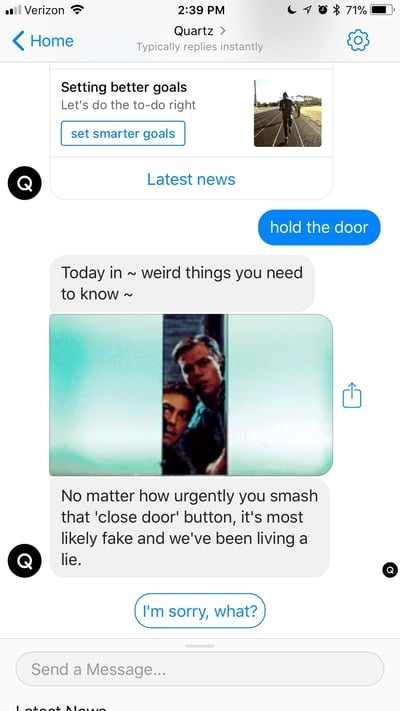
Around here, we’d call that a pretty “inboundy” concept. If you’ve read our work before, you know how much importance we place on quality content, including that which largely involves the written word. It’s content designed to be helpful and engaging — just like a good bot experience.
“Bots help us build better relationships,” Connor Cirillo, HubSpot’s conversational marketing manager, told me, “so humans can have valuable and delightful interactions.”
And if it seems weird, that’s okay — you’re certainly not alone. But Withrow encourages marketers, especially content writers, to embrace that.
“I personally love to lean into the weirdness of talking to a machine,” she said.
It’s truly stranger, as they say, than [science] fiction.

Report: Apple trialling 2018 iPhone production in Q2, aiming to avoid supply bottlenecks that plagued iPhone X ramp

Apple is apparently starting trial production of the 2018 iPhone lineup in the second quarter, according to a report published this morning by Digitimes. Apple is set to debut three new iPhones later this year, an update to the 5.8-inch iPhone X, a larger 6.5-inch device dubbed ‘iPhone X Plus’ and a cheaper 6.1-inch LCD iPhone.
All three models are designed to feature Face ID, eschewing a home button. Apple faced production bottlenecks last year with iPhone X from the 3D face sensing components, something the company is hoping to avoid second time around.
How to Create a Facebook Event Frame, Instagram Event Geotag, and Snapchat Event Filter
Does your business host live events? Would you like to turn event attendees into ambassadors? Facebook, Instagram, and Snapchat all allow you to create event-specific indicators that attendees can apply to their profile and messaging on social media. In this article, you’ll learn how to create an event frame, geotag, and event filter for your […]
This post How to Create a Facebook Event Frame, Instagram Event Geotag, and Snapchat Event Filter first appeared on .
– Your Guide to the Social Media Jungle
from http://ift.tt/2G8Tl3R
via socialmediaexaminer
10 Ecommerce Trends to Expect in 2018
According to Statista, global ecommerce sales are expected to increase 246.15% by 2021, from 1.3 trillion in 2014 to 4.5 trillion in 2021.
The ecommerce industry is booming and shows no signs of slowing down.
Nowadays, stores can’t compete without offering excellent ecommerce options, and 56% of in-store purchases are influenced by digital commerce. This means, if you aren’t reaching your customers online, you could be losing half of your potential revenue.
With ecommerce’s rapid growth, comes rapid changes. It isn’t enough to post product images to your site and hope your ideal customers will find them. In 2018, there’s a whole lineup of new trends that could kickstart major growth for your ecommerce company if you pay attention.
To help you reap the many benefits of ecommerce in 2018 and into the future, we’ve chosen the top 10 trends we think will change how people buy and sell online.
Ecommerce Trends 2018
- Shopping Natively
- Augmented Reality and Virtual Reality
- Automation and Chatbots for Online Ordering
- Voice Search
- Mobile First
- ROPO
- Machine Learning and AI
- Image Search
- High-Quality Product Videos
- Same-Day or Next-Day Delivery
1. Shopping Natively
In an experiment we ran in 2017, we found our Facebook audience favored native video content 160x more than non-native content.
That same preference for native content is true with ecommerce: there are great visual platforms being used by millions of people already, like Instagram and Pinterest, and a lot of those users don’t want to leave the platform to visit your site. So why not offer the option of purchasing your products from within those apps?
A great example of native shopping is Pinterest’s Shop the Look feature. When you see a picture of an outfit you like, you can click any part of the outfit you’re interested in purchasing, and find details about the item of clothing within the Pinterest app. You only need to exit the app when you’re ready to purchase (you can also pin it and return to it later).
2. Augmented Reality and Virtual Reality
You know what’s even better than seeing a product in-store before purchasing?
Seeing it in your home before purchasing.
Augmented reality and virtual reality are going to gain some serious traction in 2018. Eventually, it will become standard for companies to offer AR and VR options.
Houzz, a home design and interior decorator company, found AR made their consumers 11x more likely to purchase a product, and also kept them in the app 2.7x longer.
IKEA also offers an AR app that lets you place 3D products in your home. These products are true-to-scale, so you can see whether the product will fit and how it’ll look in your space.
Ultimately, these added benefits are worth the initial investment in new technology. As ecommerce grows, consumers are going to buy from companies that allow them the option of visually testing out products before purchase.
3. Automation and Chatbots for Online Ordering
With 1.3 billion people on Facebook Messenger, it makes sense to take advantage of chatbots for marketing, customer service, and sales.
With ecommerce, you can take it a step further.
Domino’s uses its Messenger bot, Dom, for full-menu ordering. The implications of this are huge: when fast and simple are priorities for consumers, Domino’s will beat out all the competition.
Plus, chatbot ordering is an opportunity for Domino’s to cater to its audience in a new way, proving itself to be a helpful and forward-thinking company.
If it makes sense for your business, I’d suggest creating a chatbot like Dom while it’s still an open field. In a few years, this could become a mainstream way of ordering, and lose some of its current novelty power.
4. Voice Search Compatabilities
As Amazon Echo, Google Home, and other voice-activated devices grow in popularity, voice search will become the preferred method of search. 40% of millennials are already using voice search before making an online purchase.
It’s critical to optimize your business for voice search in 2018, or you could lose the vast majority of consumers who choose to shop through voice-activated devices.
Walmart made it possible for consumers to order any of their items by voice on the Google Express, and in the future, they’re going to allow consumers to place in-store pickup orders via Google Home. Target, Costco, Kohl’s, Staples, Walgreens and many other stores are in the process of creating similar options for consumers.
Since voice search is 3x more likely to be local, it’s also important to ensure your business listing is updated on Google to reach those local searchers (with accurate hours, an up-to-date address, photos and reviews, etc.).
5. Mobile Primary, Desktop Secondary
62% of smartphone users have made an online purchase on their mobile device within the last six months. As mobile purchasing continues to grow, it’s important to create an ecommerce site that’s optimized for mobile.
Fingerprint and facial recognition technology, as well as one-click payments, will simplify mobile payments and further encourage consumers to switch from desktop to mobile. Mobile will soon become the preferred payment method for ecommerce transactions. It’s estimated that mobile will reach 70% of ecommerce traffic by the end of this year alone.
Starbucks created a Mobile Order and Pay app in 2015. By 2017, 30% of all Starbucks orders were paid via mobile. Starbucks said their Mobile Order and Pay app is so popular, it creates congestion in stores and extra-long wait lines, which they’re attempting to solve by hiring more baristas. If mobile ordering leads to a larger pool of in-store consumers, I’m thinking it’s a worthwhile investment.
6. ROPO (“Research Online, Purchase Offline”)
It can be tricky to track how your digital efforts translate to offline sales.
Luckily, ROPO (“research online, purchase offline”) is a tool that will become more advanced and reliable in the upcoming year, and can help retailers accurately measure how well their digital ads are contributing to in-store sales.
ROPO combines information from social media, mobile tracking/geolocation, mobile payments, in-store inventory, analytics tools, CRM systems, and more, to figure out which ads and site pages led consumers to in-store purchases.
This is invaluable information. By knowing which digital ads are most efficiently contributing to sales, ecommerce businesses can create higher-conversion, more targeted campaigns, and feel confident that what they’re doing online is meaningful to their consumers.
7. Machine Learning and AI
You come across machine learning and AI every day. You just might not realize it.
Take Netflix: rather than dividing viewers by age, location, or gender, Netflix created 1,300 “taste communities.” Netflix makes recommendations on similar movie or TV show preferences based on what’s most popular for the viewers in that community. This is the future of machine learning.
Other ecommerce platforms will soon see personal benefits from using machine learning and algorithms to uncover which content they should deliver to which audience. In the future, content will be divided by machine learning and AI, so consumers are fed only the content (or products), they’re most interested in.
8. Image Search
Picture this: you’re in a store and see a beautiful couch but don’t feel like paying full price, so you take a picture of it and use eBay’s image search to find similar products for a better deal.
As ecommerce transitions to mobile, companies will begin offering options to visually search for products by using personal photos, or photos found online. It’s estimated that image and voice search will make up 50% of all searches by 2020.
Since image search offers opportunities to find similar products at a cheaper price online, it could eventually drive consumers to shop online even if they started in a physical store.
A few ecommerce businesses have already successfully implemented image search functions into their online platforms. Pinterest, for example, has its own image search function. On Pinterest, you can zoom in on an object in a Pin image and find similar objects. Target will eventually integrate this same technology (“Lens”) to allow consumers to search an image and find similar products in Target’s online catalog.
9. High-Quality Product Videos
Even when consumers are online, they’re still going to have the same questions about a product’s functionality and design that they’d have in-store. To compete in ecommerce, you’re going to have to answer all their questions digitally, and one of the easiest ways to do that is through video.
A high-quality video addressing your product’s design and function is one of the best ways to sell your product. Your video can appeal to your consumer’s emotions, persuading them more convincingly than text.
Redsbaby, an Australian baby stroller company, does a great job of this. Their videos of baby strollers display actors using Redsbaby strollers throughout a “typical day,” so consumers can feel confident that they understand what they’re purchasing, despite having never seen it in-store.
10. Same-Day or Next-Day Delivery
Last year, Amazon opened a ton of new shipping centers near major cities so they could promise same-day delivery to Amazon Prime customers. TechCrunch reported that Google will launch a competitor same-day delivery service, “Google Shopping Express.” Google Shopping Express will offer same-day delivery from stores like Walmart and Target.
As these big-name ecommerce sites offer same-day delivery, they’ll win out with the majority of consumers who want their needs met, fast. As it becomes the norm, people will become comfortable paying extra for same-day delivery.
If you don’t give consumers the option of same-day or next-day delivery, they’ll turn to competitors who will.

Angela Ahrendts touts Apple’s investment in Japan, says ‘several’ new retail stores coming

Earlier this week, Apple officially announced that it will open its new Japanese store in Tokyo’s retail district of Shinjuku on April 7th. Now, Angela Ahrendts is teasing that Apple has a lot more planned for Japan customers, with this store only being the beginning…
The Definition of SEO in 100 Words or Less [FAQs]
Search engine optimization (SEO) seems pretty straightforward. You pick a few keywords, and voilà! Your page is optimized for SEO, right?
Not yet.
Many people understand the basic principles of SEO, but a lot has changed in the last decade.
The SEO that we know and love today is not the same SEO that we knew and loved (or hated) 10 years ago. And that’s why SEO is something marketers should continue to define, and redefine. Here’s a brief definition in under 100 words:
What Is SEO?
SEO stands for search engine optimization — that much has stayed the same. It refers to techniques that help your website rank higher in search engine results pages (SERPs). This makes your website more visible to people who are looking for solutions that your brand, product, or service can provide via search engines like Google, Yahoo!, and Bing.
What hasn’t stayed the same are the techniques we use to improve our rankings. This has everything to do with the search algorithms that these companies constantly change.
Here are some other frequently asked questions about this critical practice today.
How Does SEO Work?
SEO works by optimizing a website’s pages, conducting keyword research, and earning inbound links. You can generally see results of SEO efforts once the webpage has been crawled and indexed by a search engine.
Looking deeper: There are a ton of ways to improve the SEO of your site pages, though. Search engines look for elements including title tags, keywords, image tags, internal link structure, and inbound links (also known as backlinks). And that’s just to name a few.
Search engines also look at site structure and design, visitor behavior, and other external, off-site factors to determine how highly ranked your site should be in their SERPs.
What Is an Organic Search?
Organic search refers to someone conducting a search through a search engine and clicking on a non-paid result. Organic search is a search marketing channel that can be used as part of inbound marketing to increase website traffic.
Looking deeper: In present-day SEO, you can’t simply include as many keywords as possible to reach the people who are searching for you. In fact, this will actually hurt your website’s SEO because search engines will recognize it as keyword stuffing — or the act of including keywords specifically to rank for that keyword, rather than to answer a person’s question.
Nowadays, you should use your keywords in your content in a way that doesn’t feel unnatural or forced. There isn’t a magic number — it all depends on the length of your keyword and article — but if you feel like you’re forcing it, it’s better to ignore it and continue writing naturally.
What Is SEO Strategy?
An SEO marketing strategy is a comprehensive plan to get more visitors to your website through search engines. Successful SEO includes on-page strategies, which use intent-based keywords; and off-page strategies, which earn inbound links from other websites.
Looking deeper: Before you create a new site page or blog post, you’ll probably be thinking about how to incorporate your keywords into your post. That’s alright, but it shouldn’t be your only focus — or even your primary focus. Whenever you create content, your focus should be on the intent of your audience, not how many times you can include a keyword (whether it’s long tail or short tail) in your content.
To satisfy intent and rank well in the long term, build your SEO marketing strategy around topics, not keywords. If you do that, you’ll find you can naturally optimize for important keywords, anyway. Understanding your target audience (aka buyer personas) and what interests them is key to attracting relevant visitors to your website through search engines.
What Is Organic Traffic?
Organic traffic is unpaid traffic that comes from search engines such as Google or Bing. Paid search marketing does not increase your organic traffic numbers, but you can optimize your website using inbound marketing software to gain more visitors.
Looking deeper: One of the biggest changes in the last decade is the way other user behaviors shape the SERPs a user sees on search engines. And today, social media can have a big impact on your organic traffic trend line. Even just a few years ago, it didn’t make a difference who was finding your content through social search. But now SEO takes into account tweets, retweets, Google+ authorship, and other social signals.
Social search also prioritizes content and people that are connected to you. That could mean through a Facebook friend, Twitter follower, or connection through another social network. Sometimes social search will even prioritize content that has been shared by an influencer. Social search understands that you may be interested in content that your network feels is important to share, and therefore it’ll often get surfaced to you.
This all means when you’re thinking about your SEO strategy, you need to think about how your social media strategy fits into the puzzle, too.
What Is Direct Traffic?
Direct traffic consists of website visitors that come to your website by typing the URL into their browser, rather than coming from another website, a search engine, or social media.
Looking deeper: Think of search engine optimization as “search experience optimization.” It’s not just important for your users to find your website — it’s important for them to stay on your website, interact with your content, and come back later. Direct traffic doesn’t just increase your “page authority” in the eyes of Google; it creates more opportunities to turn someone, who first discovered you organically, into a customer.
SEO actually takes into account whether or not your visitors are staying on your website and engaging with other content. If you rank well for a keyword and attract a visitor who isn’t relevant, it won’t actually help your website.
Think about your visitors and the content they are looking for more than how many people you can attract to your website.
The Importance of SEO
SEO is important because it helps people find information and discover pages on the world wide web. SEO is especially important for businesses as it ensures they’re answering their audience’s biggest questions on search engines, while driving traffic to their products and services.
Looking deeper: In the past, SEO success was measured by whether or not you were ranked high on the first page of Google. But even if you ranked well for a term, does that actually mean you’re going to see results?
Not always. You might rank really well for terms that aren’t ideal for your business. So you appear high on search engines, get a ton of traffic, but then your website visitors realize your company isn’t what they were looking for. You don’t convert customers from this traffic, and ranking high for this particular keyword is essentially fruitless.
Also, you don’t necessarily need to be in the top three slots to be successful. In fact, if you rank well on subsequent pages, you may still have a high clickthrough rate, albeit less traffic. That’s great news for marketers who can’t seem to bring pages into those top slots or off the second page.
We said it before and we’ll say it again: The amount of traffic to your page is less important than how qualified that traffic is.
How Much Does SEO Cost?
SEO can cost between $100 and $500 per month if you do it yourself with a keyword research tool. It can cost between $75 and $150 per hour for a consultant, and up to $10,000 per month if you hire a full-service marketing agency. Small businesses generally spend less on SEO than big brands.
Looking deeper: An SEO cost can mean one of two things: the investment in your organic search strategy, or how much you pay for paid search engine marketing (SEM) services like Google AdWords. If you’re paying for a tool, consultant, or marketing agency to help you optimize your web content, your bill can vary wildly with the depth of the services you’re receiving.
Yes, $10,000 sounds scary, but 40% of businesses today are actually spending less than $1,000 a month on SEO.
What Is Paid Search Engine Marketing?
Paid search engine marketing refers to pay-per-click (PPC) advertising. This enables you to pay a search engine for text ads shown at the top and bottom of search engine results pages after someone conducts a search. It is used to increase website traffic and gain more customers.
Looking deeper: You can actually pay for top rankings on Google SERPs by registering for a free account on Google AdWords. You’ll then select various keywords you’d like to rank under, and pay Google each time a user clicks on your result. This is called PPC search engine marketing, and your ads will be noticeably different in their appearance than the organic results below them.
The average cost of a paid search campaign on Google can be less than $1 per click, but, naturally, the more popular the keyword, the more you might pay.
How to Do SEO
- Conduct an audit of your website content.
- Use keyword research tool to identify the keywords with which people are finding you.
- Target new keywords you’d like to rank for.
- Develop new content and optimize existing content.
- Monitor your website’s performance.
- Purchase inbound marketing or SEO software.
- Examine the web pages that are performing well.
- Look for opportunities to earn inbound links from similar websites.
- Monitor your change in rankings and traffic.
It’s still the same thing it was 10 years ago — a bunch of tactics that, if you employ them, will help you rank better in search engines. It’s just the tactics we now use that have changed.
It’s up to us to stay on top of the rapidly changing trends, and remember that ultimately, the goal of search engines is to deliver the best experience possible to their end-user — searchers. If you keep that goal in mind with your SEO strategy, you’ll find your choices pay off, even if you’re not totally up to date on every single nuance of search engine algorithms.