
Welcome to My Blog
13 years after Intel’s iPhone mistake, it might take the biggest ever tech deal to resolve it

Some 13 years after Intel turned down the opportunity to make the CPU for the upcoming iPhone, is it now considering the world’s biggest ever tech acquisition to deal with the threat that decision continues to pose today.
In 2005, when Apple was working on the first-generation iPhone to be launched in 2007, Steve Jobs invited Intel to pitch for the CPU business for the planned smartphone. Not believing Apple’s sales projections, and not seeing any way to make money from it, Intel turned him down …
Newly remodeled Apple store in UK’s Bluewater Mall to reopen March 24th

Image courtesy of @JoeWhiteLondon
After closing last July for an extensive expansion and renovation, Apple’s retail location at Bluewater near Kent, England is set to reopen on March 24th.
FAQ This! What Is Blockchain?
With every tech event I cover, there seems to be a central emerging trend that people just can’t stop talking about. Something like 5G. Or AI. Or VR.
Or blockchain.
If you’ve come across talks and headlines on blockchain lately but just can’t seem to wrap your mind around it — you’re not alone. According to HubSpot’s research, it’s one of the most confusing emerging technologies out there.
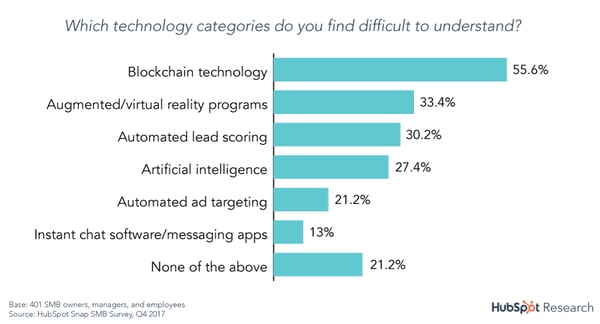
And while it’s still a fairly new concept, blockchain is one of those technologies that could shape the way marketers and businesses work in the not-so-distant future.
That’s why we’ve put together this explainer with answers to some of the most frequently asked questions about blockchain — from what it is, to how it could impact the work you do.
FAQ This! What Is Blockchain?
1. What is blockchain?
Blockchain is a digital method of economic transaction record-keeping — also known as a ledger. What differentiates it is its security. While blockchain records can be openly viewed by everyone within a given network, no one can edit or delete existing records.
Think of it as a public spreadsheet that can only be updated by solving a very complex math problem. To add a new record — “block,” as it were — to the ledger, an encryption must be solved.
That’s done with computing power — a machine uses its computing capabilities to mine for the answer to the problem. If that concept sounds familiar, it might be because you’ve heard the term “mining” before in a similar context.
Once an answer to the encryption problem is discovered, it’s verified by everyone within the network. If the answer is correct, the new block with transaction details or other new information is added to the ledger, and what’s essentially a receipt is generated as proof — often known in this case as a token or coin. (If you’d like to dive deeper on how blockchain ties into cryptocurrency, check out this explainer.)

2. Why is blockchain a big deal?
While there are various elements of blockchain that make it a rather important technology, its two key capabilities are:
- The recording of digital asset transfers — like secure files or cryptocurrency — that proves transactions took place and ownership exists.
- The inability to overwrite or tamper with its ledger.
Let’s take a closer look at the second item on the list. Because a blockchain ledger is distributed to everyone within its network, even if an individual party manages to falsify a block, the technology maintains several copies of the correct version. That also means the technology can reject a “fake” input like this one — since it recognizes that it doesn’t match the other records of it in existence.
That’s a key element that makes blockchain so unique. It’s unusually transparent, but that’s also what keeps it secure: the public, uneditable record of transactions.
What’s more, that public distribution lends itself to the decentralization of the ledger — which means that there isn’t a core database that’s vulnerable to attacks. That contributes to blockchain’s somewhat tamper-proof nature.
3. How does blockchain work?
When it comes to emerging technologies that are not quite easy to understand, use cases are often helpful to determine how, exactly, they work. We like to use the “banana shipment” example: the sequence of events in a shipment of bananas from the warehouse, to the delivery truck, to the grocery store.
.jpg)
As the shipment of bananas makes its way from Warehouse A, to Delivery Truck B, to Grocery Store C, its movement is captured and stored on the electronic blockchain ledger — which, as we’ve covered, it’s publicly accessible to all involved parties. All three institutions, as well as anyone else on the ledger, have access to that information online.
Delivery Truck B, for whatever reason, loses the bananas — but doesn’t want anyone to know that. So, it informs Grocery Store C that the bananas were, in fact, delivered, even though they were not.
Delivery Truck B might even go so far as to falsify its version of the ledger to create “proof” of a delivery.
But here’s the thing: Because of the public visibility and distribution of the “correct” ledger documenting the actual movement of the banana shipment — which Warehouse A and Grocery Store C both have — the other parties involved can inspect these records to determine whether or not the delivery actually happened.
That means that even if Delivery Truck B did manage to falsify its own ledger — which, as we explained about the encryption process earlier, is very difficult to do — there are systems in place to prevent a false block from appearing on the rest of the ledgers within the network.
4. How can I use blockchain?
Blockchain’s somewhat iron-clad ledger and security features underscore its potential benefits to any business that transmits secure, sensitive data.
But because blockchain is still widely misunderstood — not to mention, in its earliest stages of use — for the most part, its use cases remain niche in nature.
The technology shows great promise, however. And while it could be sometime before blockchain becomes mainstream, there are certain areas where it can impact and benefit small-to-midsize businesses (SMBs).
One such area is supply chain management. An SMB concerned with tracking the movement of goods through a supply chain — especially where things like environmental sustainability or fair labor are involved — will want to pay closer attention to improvements in blockchain technology.
The same principle applies to data storage, which is one of the biggest potential use cases for blockchain. Again, here’s an area where the inability to modify ledger-based storage makes blockchain methods superior to secure databases that, when considering recent data breaches, are often looked upon as questionable.
Within that same vein, blockchain shows strong potential in the area of password protocols. It’s one of the top two contenders in the possible disruption to the current, fragmented system of password management — the other being biorecognition methods (think: Face ID and digital fingerprinting).
If blockchain technology successfully addresses and works to remedy fragmented password management, SMBs may want to consider an investment — especially businesses with user accounts and login protocols.
“Blockchain technology is going to change consumer behavior around ownership and security,” says Matthew Barby-Howells, HubSpot’s Director of Acquisition. “Now, we feel much safer having a business own and manage our sensitive information, rather than bearing the burden ourselves.”
“The rise of decentralization and the ability to have more control over your own personal assets will change that mindset,” he continues. “More and more businesses will be pressured to shift data ownership back to their customers. Those that resist may get left behind.”
As this technology continues to emerge, we’ll continue monitoring it.

How to Brand Your Mobile Facebook Live Streams
Do you stream Facebook Live video on your mobile device? Wondering how to add a branded image to your live stream? In this article, you’ll discover how to easily add a logo and call to action to your mobile Facebook Live broadcasts. What Are the Benefits of Branded Live Video? Facebook Live is a great […]
This post How to Brand Your Mobile Facebook Live Streams first appeared on .
– Your Guide to the Social Media Jungle
from http://ift.tt/2p8nBB4
via socialmediaexaminer
New lower-cost 13-inch Retina MacBook reported to debut in June, iPad refresh coming

Digitimes is reporting that Apple will release a brand new ‘entry-level’ 13-inch Retina MacBook in June, with a lower cost than the current 12-inch MacBook. According to the report, the 13-inch MacBook will feature a 2560×1600 panel, with a 226 PPI density – the same as the 13-inch MacBook Pro.
This sounds like a compelling product, with better specs at a significantly cheaper price. The report says the 13-inch Retina MacBook will be priced around the current MacBook Air’s $999 price tag.
Want to Win at Social Media? Here’s What Followers Want, According to Experts at SXSW
People have a lot of feelings about social media.
Love it. Hate it. Use it for business. Build a brand on it. Quit it. Come back to it.
With so many mixed messages, how are marketers supposed to stay on top of the right way to use social media — and moreover, what users actually want from it?
To answer that question, a panel of social media experts — Teen Vogue‘s Rajni Lucienne Jacques, Facebook’s Tutti Taygerly, and Instagram’s Joshua Dickens — shared their insights on what followers want the most in today’s climate, in a discussion moderated by Work & Co’s Gene Liebel.
What Followers Want
1. Communities
Think back, if you can, to a time when the folks who managed a brand’s Facebook page were known as “community managers.” That’s because we once lived in an era when, not even that long ago, that was the purpose of pages like these.
And while there are still Groups available on Facebook — smaller, often private destinations designed for communication among smaller groups of people — it can be argued that they’ve lost a bit of their luster and are not the first destination for brands looking to build audience engagement.
But within the current global climate, the panelists appeared to agree that users are drifting back toward the idea of using social media to build a community: to give voices to a cause, to connect with others who care about the same issues they do, and to create a movement around it.
In fact, said Jacques, “Social media is the one thing that galvanizes a movement. [It] allows people to gather in a way that is faster and more efficient.”
And while galvanizing a movement might not exist within the strategic models of goals for a small-to-midsize, business-to-business organization, there are still ways to leverage your social media presence to build on the idea of a community.

Take, for example, something that was said by WP Engine CEO Heather Brunner at an earlier SXSW panel: Businesses need to ask themselves, “What’s right for your employees? What’s right for your customers?”
Once those questions are answered, marketers can determine the issues around which the brands they represent can build communities.
If nothing else, brands can provide a venue for connection, which Taygerly said she believes social media users still want.
“As a company, we’re not just trying to promote passive consumption of content,” she explained. “We’re trying to pay a lot of attention to that.”
That actually aligns with certain ranking factors resulting from the changes Facebook made to its algorithm earlier this year. While people’s News Feeds display less branded content overall, it does prioritize Page posts with more authentic engagement within the comments section (as opposed to such “share-bait” copy as “Tag a friend”).
It makes sense, then, that Taygerly says Facebook is trying to discourage the passive consumption of content on its network, by rewarding the kind that stirs and signals the direction of community-building activity and discussion.
At the root of potential success for marketers in this area, the panelists said, is solving problems for the people and humans in the audience first.
“Anchor on the core people problem, and then figure out, ‘What is the work?'” Taygerly advised. “What are the use cases?”
Solving for people, Dickens said, is likely to become a new success metric among marketers — and one that’s already used at Instagram.
“We’ve never solely measured time spent [on the network] as a metric of success,” he said. “Metrics are, ‘How close are we to solving a problem for a particular person?'”
2. Privacy. (Seriously.)
At one point in the discussion, Liebel asked, “Is anything private anymore?”
And while the response was mixed, the consensus did seem to indicate that users — even those trying to build a brand or share a story on social media — do care about privacy.
For her part, Jacques said that question could be answered with both “yes and no.”
“It depends on what you choose to show. You have your Insta … and you have your Finsta, which is your fake Instagram,” she explained, suggesting that some users create different social media accounts — or personalities, in some sense — to share different moments in their lives.
“In a way, you are private, depending on how you use [it],” she said.
That raises the question, Taygerly said, of when social media can add positivity to a user’s life, and when it “becomes too much.”
To illustrate that, she pointed to the ongoing challenge that Snapchat has experienced to the nature and degree of publicity user content should be.
“What should be shared just with friends and family, and what should be public?”
And what, she continued, “is the demarcation between those two worlds?”
In terms of how marketers can solve for that challenge, one of the best things they can do is respect their audiences’ need for privacy, and provide a way for them to engage with both the brand and others in the audience in a way that makes them the most comfortable.
And while it might seem redundant, that does go back to the idea of building a community for your followers, regardless of your industry. But it also involves a cultural element, and understanding what protocols can be put in place to provide the privacy that different members of your audience need in that context.
“We do research all over the world and in different cultures than North America, showing your face as a woman invites some negativity, to put it mildly,” Taygerly explained. “So having a mask [like different filters available on Instagram and Snapchat] and the ability to control the circle that you show your face to … helps you share your message.”
It also involves understanding when your users need to leave — or “detox” from social media, said Jacques.
“Social media [sometimes] becomes too much,” she said. “You’re not liking yourself because of this, or that. So users take a detox and live their lives.”
But that, Jacques explained, can actually make for better engagement, if marketers view this phenomenon in the long-tail. “To restart and reboot, you get better content,” she said. “It’s nice for anyone who devours social media to go through to realize your best self.”
3. A Place to Share Their Stories
To that end, marketers should also maintain an awareness of a core reason for using social media: to connect with others, by way of sharing something.
“People are sharing their creativity and expanding it to their audiences,” Dickens said. And the job of marketers, it seems, is to remind their audiences that social media is a place where they can do that — and encourage them to do so.
And while I’ll once again caution against the use of doing so in a click-bait manner — “share your photo and tag a friend in the comments” — it is possible for marketers to prompt a conversation and provide a platform for users to story-tell in a thoughtful way.
That could start by a brand sharing its own story, and asking if anyone else wants to share theirs: a way of letting your audience know that it’s heard.
Social media, explained Jacques, “gives a voice to those who never thought they had a voice.”
“So we don’t tap into that?” she asked. “Why don’t we say, ‘We’re inviting you in to tell your stories that you’re already telling your peers’?”
4. Smaller Networks
That said, there are likely users who are uncomfortable with the idea of amplifying their voices in such a public venue, like a branded Facebook Page that can be viewed by nearly everyone — which introduces the need for what Taygerly calls “smaller, more intimate networks.”
Keep in mind that the challenge for many Page administrators and creators, in light of Facebook’s refined News Feed, is to create the content that stirs the type of authentic engagement algorithm is said to favor. That’s “the hope” behind it, Taygerly said — that it “triggers a conversation.”
But she also pointed out that “sometimes, it’s easier to share more intimately in a group.” And the answer to that, she said, may lie in “smaller, more intimate social networks.”
To illustrate that idea, she raised the example of HQ Trivia: an app that hosts a live trivia game show that awards cash prizes to winners. And while arguably addicting, it’s also “something that’s happening real-time with a group of people,” she said.
So, how can marketers create such an experience? To answer that, I’ll float the same statistic that Facebook itself used when it first announced the changes to its algorithm in January: live videos receive 6X the engagement as non-live ones.
And what’s another word for “live”? Real-time.
Aha!
There’s a correlation, it would appear, between providing an audience to experience and comment on a live, real-time event as a community — and rates of engagement.
But that could very well go beyond live video, and while marketers can work with that statistic and create such content, they should also think about the ways it can create these small, intimate venues for followers to experience something in which they share an interest or passion, and in a way that allows them to discuss it as it takes place.
That goes back to one of the first philosophies mentioned in this post: to home in on a core issue shared by your audience, and figuring out how to allow it to connect and engage around it.
“You can look at what’s happening in the world, [and] what ends up happening is we build a sense of community,” Jacques said. “[We] want to do things, and make a difference in the world, in a full-throttle group.”
Do the panelists have a positive outlook on how that will ultimately play out?
“Yes, we’re optimistic,” Taygerly said. “We’re designers because we envision a better world.”
I’ll be at SXSW all week. What are the topics and events here that interest you the most? Feel free to weigh in on Twitter.

How to stream the NCAA Selection Sunday show on iPhone, iPad, and Apple TV

The most exciting time of the year for college basketball fans is about to begin. The NCAA March Madness tournament officially kicks off tonight with Selection Sunday, where the bracket for this year’s games will be set.
Read on to find out how to stream Selection Sunday on your iPhone, iPad, and Apple TV…
Instagram & Snapchat remove Giphy integration due to sticker w/ racial slur

Earlier this year, both Snapchat and Instagram added integration with popular GIF service Giphy, allowing users to add the stickers to their posts and stories. As first reported by TechCrunch, however, both social networks have now removed that integration due to a GIF with a racial slur…
Rumor Has It: Facebook Is Testing Disappearing Content (and More)
Messaging blog WABetaInfo released new information today indicating that Facebook has plans for major changes to Messenger.
Among them are a new design, auto-translate tools, and the addition of disappearing visual content.
While a new iOS version of the Messenger app was recently released, according to the post, these rumored features are not yet available.
Facebook’s Big Plans for Messenger
The Possible New Design
In January, Messenger Product VP David Marcus alluded to a potential new design, admitting that the application had become so oversaturated with features that a “Lite” version was released. Interestingly, Messenger added video chat to the Lite version earlier this month.
“Expect to see us invest in massively simplifying and streamlining Messenger this year,” he wrote.
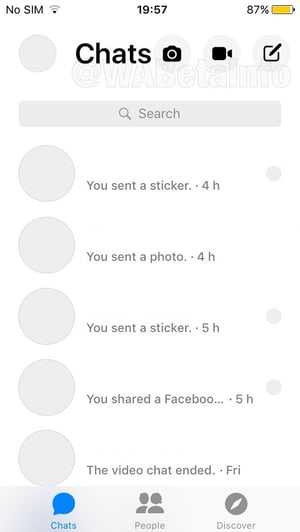
By the looks of the preview images provided by WABetaInfo, it appears that this new design could be the simplification that Marcus alluded to.
“This is a new slick user interface,” says Connor Cirillo, HubSpot’s conversational marketing manager. “It’s a step back to a product with clear value.”
Source: WABetaInfo
According to this report, the new design will also allow for quicker actions on a given conversation, like deleting or muting it. All users will have to do is tap and hold the conversation, and a non-intrusive interstitial will appear with those options.

Source: WABetaInfo
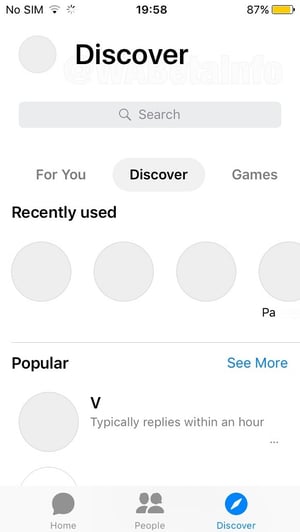
Finally, users can also expect a made-over Discover tab, making it easier to connect with brands for purposes like customer service, Cirillo says.
“Organic discovery for brands on Messenger has been tricky,” he explains. “A revamped Discover tab should make it easier for users to find companies that solve their problems.”
Currently, the Discover option is located below the user’s conversations.
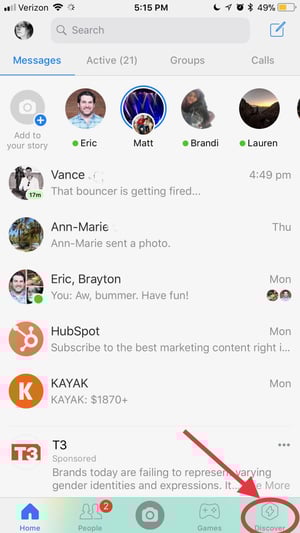
In this new version, it’s said that it will appear in a carousel above a user’s open chats, along with the Games option, which is also rumored to be making a move to the top of the screen.
Source: WABetaInfo
Auto-Translate Features
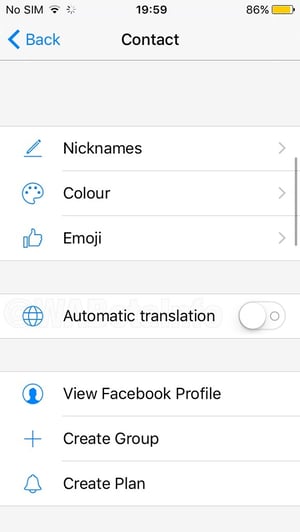
Users will also be able to automatically translate all of their messages into what WABetaInfo calls “the current local language,” though what that specifically refers to is unclear. Based on the simple on/off toggle appearance of the feature, however, it might mean that the conversation will be translated based on the user’s geographical location.
Source: WABetaInfo
“I’m skeptical of automatic translations,” says Cirillo, while also acknowledging the growing presence and importance of communication in different parts of the world.
“That’s an incredible step towards a globally-connected community,” he adds, “if they can pull it off.”
Disappearing Content
This potential addition to Messenger doesn’t exactly come as surprise, given Facebook’s penchant for emulating various Snapchat features since its 2013 (failed) acquisition attempt.
“Disappearing messages seem like increased pressure into Snapchat territory,” Cirillo says. And with users recently voicing their displeasure with changes made to Snapchat, “this could be a land-grab opportunity for Messenger to scoop up disgruntled users.”
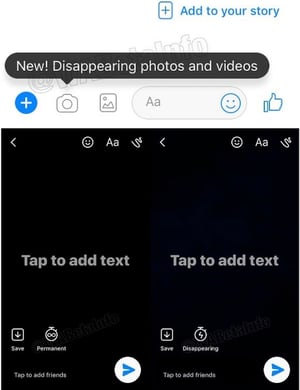
Allowing users to send photos and videos as disappearing — or ephemeral — content is one way to do that. The addition of tools like Stories within Messenger almost seems like a predecessor to a feature like this one, with WABetaInfo alluding to Facebook’s longer-term interest in it.
“Snapchat has become the Facebook R&D lab,” Cirillo says. “The Facebook platform saturated the market with stories on its portfolio of products — Facebook, Instagram, Messenger — and now, with its emphasis on things like video calls and filters, Messenger continues to push to be the way users build one-on-one relationships.”
Source: WABetaInfo
According to the post, Messenger will let users know that the new feature is available for all with a notification that will appear after opening a conversation.
I’ll be keeping an eye on this feature as future versions of Messenger are released. As always, feel free to weigh in on Twitter.
Featured image credit: “David Marcus, Head of Messenger” by Maurizio Pesce, used under CC BY / Cropped from original

Review: LXORY’s Dual Wireless Charger is an affordable and versatile option with USB-C and Lightning input

We covered the release of the LXORY Dual Wireless Charging Pad back in January. The new charger offers three input options — including USB-C and Lightning — and an affordable price tag. Now, we’ve had a chance to use the new wireless charger for several weeks, read on for our full review.
This week’s top stories: A notch-free iPhone, Apple Watch healthcare perks, new iPad Pros at WWDC, more

In this week’s top stories: Rumors suggest a cheaper HomePod and MacBook Air, new iPads at WWDC, and a notch-free iPhone in 2019. Furthermore, new healthcare perks for Apple Watch wearers, iPhone 6s battery testing, and more. Read on for all of this week’s top stories…
Apple patent imagines a MacBook keyboard that’s more resistant to crumbs & other debris

A 2016 patent from Apple has been made public this week, and it imagines a keyboard that’s more resistant to debris and crumbs As noted by The Verge, this patent was filed back in 2016, but only now has become public information..
Apple updates its Made-for-iPhone (MFi) branding for accessory makers

Apple’s Made-for-iPhone/iPad/iPod (MFi) licensing program is being updated with new branding that manufacturers will have to adopt over the coming months. 9to5Mac has confirmed the updated branding is now available for MFi partners, as first reported by Chargerlab.
Making The Grade: Apple needs an Identity Management Solution to take over schools

Making The Grade is a new weekly series from Bradley Chambers covering Apple in education. Bradley has been managing Apple devices in an education environment since 2009. Through his experience deploying and managing 100s of Macs and 100s of iPads, Bradley will highlight ways in which Apple’s products work at scale, stories from the trenches of IT management, and ways Apple could improve its products for students.
An e-mail account is one of the first things you get when you are hired at a school as a faculty member. It’s your identity. It’s how you contact people. It’s how they contact you. For all the other excellent communication services in 2018, e-mail is still essential.
It’s also an area that Apple continues to ignore for anything outside of personal use.
If you aren’t in the education world, I’m going to tell you something you may not know: G-Suite (Google’s enterprise server for Gmail-type services) is free for schools. It’s been free since at least 2009 (as far back as I’ve been working in education). On top of this, they include unlimited storage.
Why does this matter to Apple? For every iPad that is deployed to a staff member, that person also has an email account. The two most common providers in education today are Google and Microsoft.
YouTube Adds New Live-Streaming Tools and Features

Welcome to this week’s edition of the Social Media Marketing Talk Show, a news show for marketers who want to stay on the leading edge of social media. On this week’s Social Media Marketing Talk Show, we explore the new YouTube live tools and features with Amy Landino, new Facebook Messenger features, and other breaking […]
This post YouTube Adds New Live-Streaming Tools and Features first appeared on .
– Your Guide to the Social Media Jungle
from http://ift.tt/2Gbagjy
via socialmediaexaminer
Do We Trust Anything Anymore? Surprising New Data From SXSW
Events kicked off today for SXSW — a multi-day series of festivals and conferences in Austin, TX — with a jam-packed, star-studded lineup of interviews and panels on the convergence of interactive, film, and music.
Among those sessions was the “SXSW Report on Trust: Gov’t, Tech & Media” a discussion with none other than journalist Dan Rather, joined by a panel of experts to weigh in on the annual Trust Barometer: a flash poll of event attendees conducted by SXSW and communications firm Edelman to measure trust in future technologies, media, government, and business.
Rather was joined by SXSW Director Hugh Forrest, WP Engine’s Heather Brunner, and Edelman Digital’s Jess Clifton to discuss the results of the poll in a panel moderated by Edelman CEO Richard Edelman.
Here are the findings that stood out.
Live From SXSW, Day One: Do We Trust Anything Anymore?
The Majority of SXSW Attendees Trust the Media
What the Survey Results Say
The Trust Barometer indicates 61% of SXSW attendees trust the media (compare that to the global average of 43%), with a scant 14% believing that media, in general, cannot be improved or repaired.
However, the panel was sure to make a distinction between the media as a collection of reporters, publications, and news applications — and social media platforms.
“Social media and search [are] not media,” said Clifton, during the panel discussion. “Social platforms are not media publishers. It’s a community that’s publishing content, and we have to delineate.”
Apparently, the audience polled was able to make that distinction, with 98% responding that “media” meant journalists.
That could explain why 84% are more trusting of traditional media outlets, and significantly less so of search engines (44%) and social media (20%).
That low faith in social media, however, could be tied to the ongoing allegations of it being weaponized to spread misinformation by outside agents. Nine out of 10 members of that same polled audience seemed to have significant concerns in this area, saying they’re worried about false information or fake news being published with negative intent.
That aligns with new research from MIT which shows false news is 70% more likely to be re-tweeted than accurate information. So, while at first glance, a high rate of trust in the media may come as surprise, the distinction between traditional sources of news (and those who report it) and the platforms used to share it is crucial.
Trust in Business, Government, and Future Technology Is Down
What the Survey Results Say
While the Trust Barometer surprisingly indicated trust in the media is up, the audience also reported a declined level of faith in business (31% — 21 percentage points lower than the global average). Government is even lower, with 26% of respondents saying they trust it, which is 17 percentage points lower than the global average.
There wasn’t a great deal of context around these results discussed, though many of them echo the overall sentiment discussed around the trust in media and concerns about social platforms and search engines. The latter two are often managed by publicly-traded businesses, falling under the category 31% of respondents say they trust.
What was even more surprising, considering the interactive nature and enthusiasm at SXSW, is a fairly low percentage of the audience polled trusts future technology. The lowest was blockchain technology, which garnered only 27% of attendee trust.
That was followed by autonomous vehicles at 33%, and the same percentage reporting trust in virtual reality (VR) platforms. While blockchain and self-driving technology do raise concerns about security and safety (a Reuters/Ipsos poll from January indicated two-thirds of Americans are less-than-thrilled about the idea of riding in an autonomous vehicle), the wariness of VR is not quite as easy to explain.
It could come down to the idea many don’t see the practical relevance or applicability of VR. That might also explain why it has yet to become truly mainstream (we’ll be covering a SXSW session on that very topic next week), and why some marketers doubt its usefulness in campaigns and communications.
Self-driving technology and blockchain were designed to solve problems — like traffic management and driver safety — as well as the security of transaction-related information. VR, it seems, originated largely in entertainment, but hasn’t reached a price point that makes it accessible to all interested consumers.
Where We Go From Here
While most content creators are not frequently considered traditional journalists or members of the press, the panel believes brands, and those responsible for messaging, play a crucial role in this widespread distrust of social platforms often used for marketing purposes.
Consider the changes to Facebook’s algorithm made earlier this year, for example, surfacing less content from brands in the News Feed and more from individual users’ friends and family. Since those changes took effect, people are actually spending less time on Facebook — an aggregate drop in usership by about 50 million hours each day.
One must wonder if that’s due to the phenomenon that Edelman called “self-sourcing,” in which many consumers only engage with the news and information that aligns with what they already believe — a sentiment echoed by Henry Franco, HubSpot’s brand marketing associate, when YouTube began labeling state-funded content.
“It all boils down to psychology,” he said at the time. “People tend to believe what aligns with their existing values.”
And that, said Edelman, can make some content creators “more inclined to be in the thought bubble.” So, what is a brand to do to address this issue?
“The intersection of humanity and expertise is what people are looking for,” said Brunner. “A guide for that is: What’s right for your employees? What’s right for your customers?”
That begins, she explained, by building advocacy from within and building trust among your own team and employees. That advocacy is mirrored in the content the brand and employee advocates broadcast externally.
“If [employees] trust the business, they’re going to be more bought-in,” Brunner said, “and bring that level of authenticity to your customers.”
Even Rather weighed in here, agreeing brand consistency across all facets of communication is key.
“You can’t be one thing with your employees,” he said, “and another one with your clients and customers.”
I’ll be here throughout SXSW to cover the latest events, announcements, and insights. Feel free to weigh in on Twitter with questions, or let me know what type of news you’d like to read.

How to quickly share your current location on iPhone

There are lots of scenarios where you might want to quickly share your location with a friend or family member. Many people are probably aware of how to do this via Apple or Google Maps, but there is a slick shortcut built right into iOS for this feature.
9to5Mac Daily 044 | March 9, 2018

Listen to a recap of the top stories of the day from 9to5Mac. 9to5Mac Daily is available on iTunes and Apple’s Podcasts app, Stitcher, TuneIn, Google Play, or through our dedicated RSS feed for Overcast and other podcast players.