
Welcome to My Blog
Review: Living with Vitra’s Pacific Chair, Jony Ive’s choice for Apple Park

If I asked you to name a few common technology products, office chairs probably wouldn’t make the list. The act of sitting down is such a fundamental human activity that chairs are often overlooked entirely, and rarely thought of as technology. Yet, sitting has quietly become an art in itself. The engineering behind a chair can make or break your productivity and its design can compliment or ruin the appearance of room. Multiply that factor by 12,000 – the number of employees expected to occupy the new Apple Park campus in Cupertino – and suddenly choosing the right chair becomes vital.
With that in mind, upon hearing that Apple – with guidance by Jony Ive – had picked Vitra’s Pacific Chair as the seat of choice for one of the most creative workforces on earth, I knew I had to try one out myself.
HomePod still available for Feb 9 delivery, suggesting Apple may have over-estimated demand

Locations and digital maps of U.S. military bases overseas given away by Strava data

Apple’s Alderwood Mall store to close for renovations as restoration progresses on Carnegie Library flagship

Following the news just last weekend that Apple would be closing their Green Hills retail location in Nashville, Tennessee for renovations on February 11th, the company has posted a similar message on their retail website announcing the temporary closure of Apple Alderwood Mall in Lynnwood, Washington.
Bloomberg: Three new Macs with Apple coprocessors in development, new iPad in fall

Apple is said to be working on new Mac laptops and a desktop with Apple coprocessors, similar to the T2 chip seen in the iMac Pro and the T1 chip introduced with the 2016 MacBook Pro, according to Bloomberg.
The publication also reports that a new iPad will be launching towards the end of the year. Details on these machines are scarce as they are presented as tidbits as part of a larger article on Apple’s chip division.
Trump administration considering nationalised 5G network to protect against Chinese cyber security threats

The Trump administration is considering nationalising the 5G network in what has been described as ‘an unprecedented federal takeover of a portion of the nation’s mobile network.’
The proposal is said to be in response to perceived cyber security threats from China …
Streaming music copyright ruling could benefit Apple Music despite increasing costs

A federal copyright ruling will see streaming music services like Apple Music paying higher rates to songwriters and music publishers. The ruling by The Copyright Royalty Board was made in the light of evidence presented during a court case last year …
Apple boosted its spend on chips by more than a quarter in 2017, says Gartner

‘Disappointing’ sales see Apple cutting iPhone X production in half this quarter – Nikkei

A report today claims that Apple is cutting its iPhone X production targets in half in response to ‘disappointing holiday season sales.’
Apple is said to have notified suppliers that it has cut its production target for the first quarter of this year to 20M, after previously telling them to expect to produce 40M units …
3 Steps to Do Your Best Work, No Matter Where You Are in Your Career
I’ve worked at a number of different companies including private businesses, bootstrapped startups, venture round start-ups, and pre-IPO startups. And I’ve worked at these companies in a variety of capacities: recruiting, sales, and account management.
Along the way, I’ve noticed the same few situational factors influence employee performance at work. They are:
- The ability to have an impact on decisions
- Understanding how leadership is making decisions
- Opportunities for career growth and development
- Creating a clear understanding of expectation
You will never find a job where all of these factors are perfectly tailored to your liking. Which means there will always be things beyond your control preventing you from doing your best work.
Have you ever allowed situational factors to prevent you from doing your best work? I have. And it’s helped me realize I’m tired of not having a personal system that enables me to consistently work at peak performance.
This realization also inspired me to research how people do and think about doing great work. Based on that research, I’ve identified several steps that can be combined to create an effective system that consistently promotes great work. I’m confident that if you follow these steps and create your own system you’ll be able to excel beyond your wildest dreams.
Ready to dive in? Here are the steps that I’ll take you through:
- Establish Personal Values
- Define Your Workflow
- Identify & Automate High-Value Actions
3 Steps to Consistently Do Your Best Work
1. Establish Personal Values
In my opinion, doing great work begins with establishing personal values. We make ~35 professional decisions every single work day. That’s a lot of opportunity to make bad decisions and chances are many of us are making bad decisions — all the time.
Create personal values, and you’ll become a skilled decision maker who knows how to act under any circumstance.
Think of it like this: Personal values are the guiding light for architecting the future you want. If you define and live by your personal values, it’ll become second nature for you to make informed decisions that result in your values (and goals) being realized.
One of the main values that I’ve identified for myself is “act consistently.” At HubSpot, I help our hiring managers find talent that will pave the way for the future of the company and have a lasting impact on our mission.
That can be daunting at times, especially at a company where culture and people are core business values — and we’re growing at hyperspeed. I juggle a number of key pieces that contribute to our fast-growing company’s vision:
- Facilitating decision making
- Increasing the velocity of a search
- Establishing interview processes that surface candidate competencies, skills, and aptitude
- Engaging passive talent
- Building partnerships with hiring managers
- Nurturing a world-class candidate experience
- Closing candidates in a competitive market
The “act consistently” core value reminds me to prioritize my time, remain focused, make decisions faster, follow through, integrate learnings in my work, build partnerships with others, and maintain a high bar for myself.
These are the questions I use to define my personal values:
- What do I want my personal brand to be?
- What do I hate to compromise?
- What do I want the outcome of my decisions/actions to work in support of?
Here’s how you can immediately make better decisions:
- Define ~3 personal values, using the questions above
- Refine how you do your work so that it aligns with your personal values
Gary Vaynerchuk put it this way:
“The more trust you have with yourself in making decisions, the easier it’ll become to act when the time calls for it.”
2. Define Your Workflow
Now that you’ve defined your personal values, it’s time to define the work it’ll take to achieve a successful outcome. Psychologists have found athletes who visualize and mentally rehearse themselves performing their sport outperform athletes who don’t by 13.5%. So take the time to mentally rehearse your work and increase your self efficacy, states of flow, and overall confidence. Not to mention, you won’t be caught flat-footed when you’re faced with obstacles.
Here are the questions I use to define how I’m going to achieve a successful outcome:
- What is a successful outcome?
- What is the best way to work towards the desired outcome?
- What could go wrong?
- What has worked well in the past?
Here’s a rough diagram of my Recruitment Workflow:
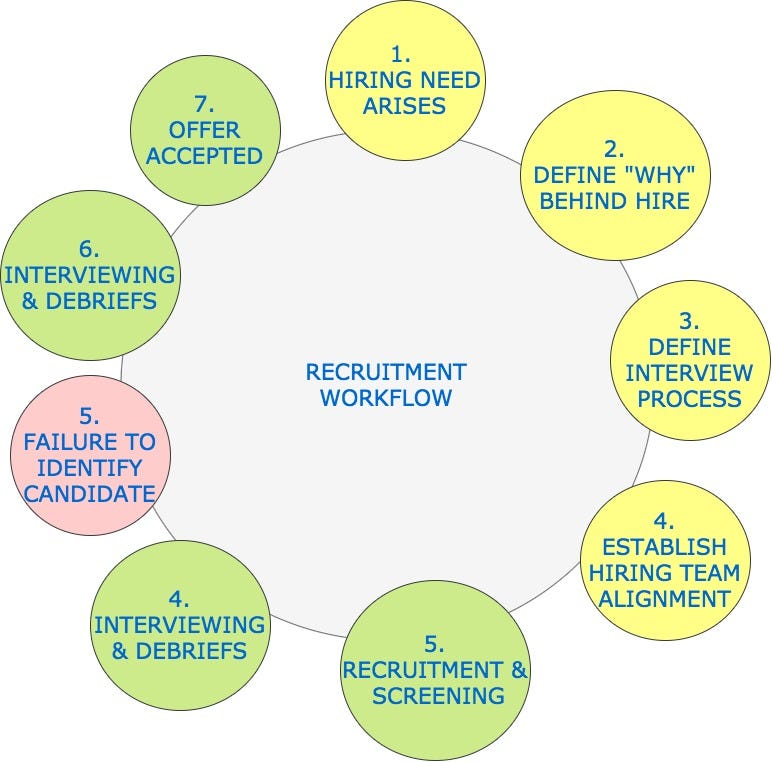
Key: Yellow = upfront work, Green = active work, Red = anticipated obstacle
Here’s how you can achieve a higher percentage of successful outcomes:
- Before you take action, establish the steps you need to take to achieve a successful outcome
- Define common obstacles and their solutions, so you’re prepared to address them proactively
- Contemplate previous success factors and recreate them where possible
Simon Sinek, author of “Leaders Eat Last,” similarly acknowledges the power of rehearsing success:
“Champions are not the ones who always win races — champions are the ones who get out there and try. And try harder the next time. And even harder the next time. ‘Champion’ is a state of mind. They are devoted. They compete to best themselves as much if not more than they compete to best others. Champions are not just athletes.”
3. Identify & Automate High-Value Actions
You’re more than halfway to consistently achieving your best work — keep going! Since you’ve established your personal values and mapped out the necessary steps to arrive at a successful outcome, you’ll want to focus on identifying high value actions.
Tired of spinning your wheels and not making progress? Identify high value actions that will help you progress.
According to Atlassian, 60% or less of work time is spent productively.Imagine a world where you rarely need to recreate the wheel, you’re executing on the work that matters the most, and you’re simultaneously empowering your customers to succeed.
If you take the time to identify and automate your high value actions, this could easily be reality. Decrease time spent on non-essential actions and free yourself up to access higher cognitive functions and develop tools that help your customers and your colleagues achieve their goals. If you’re not already, you’ll become a team hero!
Usually, high value actions fall into one of these four major buckets:
- Gives: Key tools and/or information you need to share with your customer/stakeholders
- Gets: Key tools and/or information you need to receive from your customer/stakeholders
- Questions: Key questions you need to ask your customers/stakeholders and vice versa
- Actions: Key actions you and/or your customers/stakeholders need to take
These are the questions I ask myself to identify my high value actions:
- What absolutely needs to be accomplished before I move forward?
- What enables me to partner successfully with my customers/colleagues along the way?
- What specific tools make it easier for me, my customers, and my colleagues to work towards our goals?
Here’s an example of an automated, high value give:
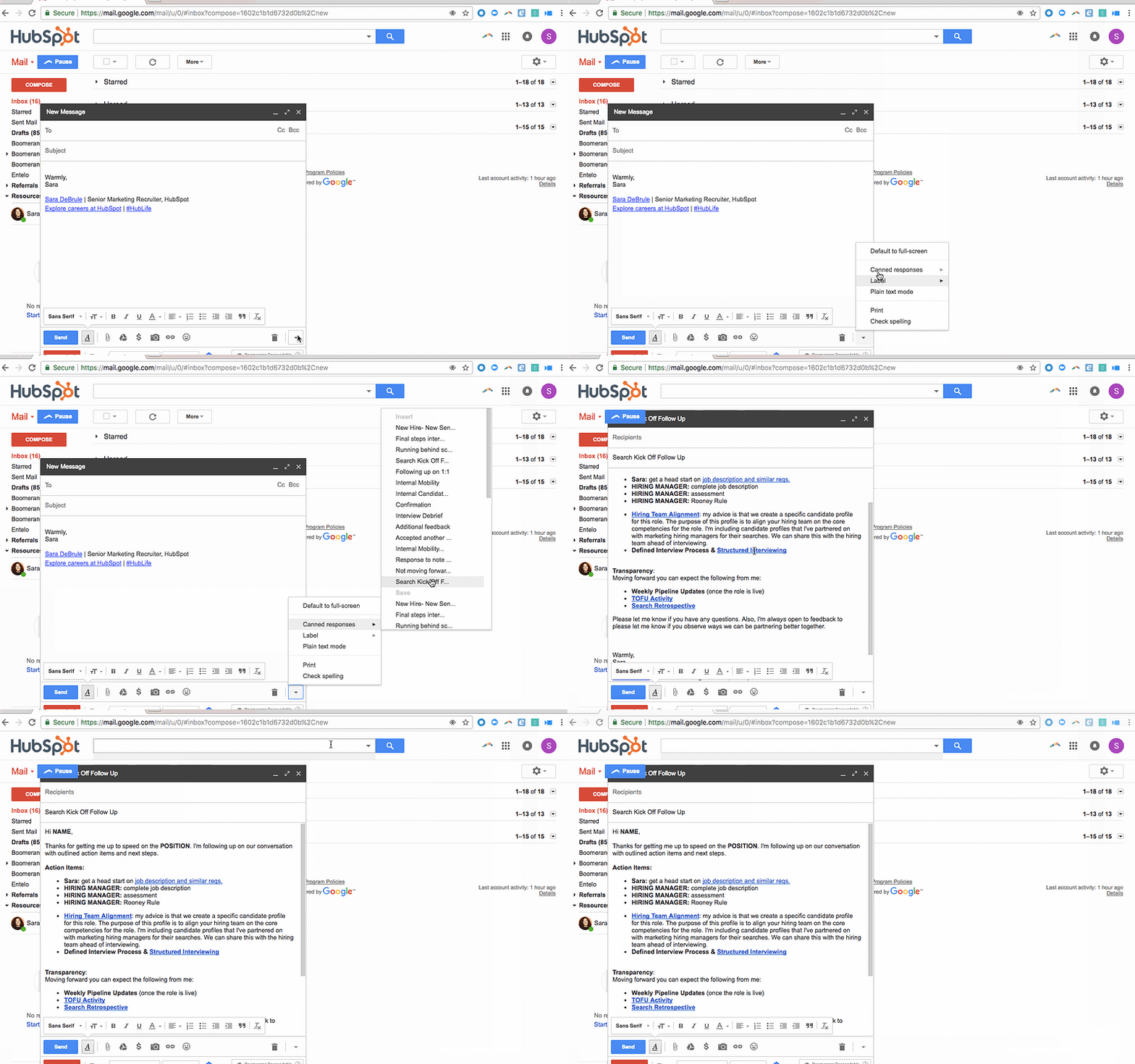
Here’s how you can routinely produce high impact work:
- Define your high value actions that facilitate forward progression: Gives, gets, questions, actions
- Actively return to and improve upon your high value actions
In Arianna Huffington’s book Thrive, she surfaces the dangers of not identifying what work is most important. She quotes the author Iain Thomas, saying:
“And every day, the world will drag you by the hand, yelling, “This is important! And this is important! And this is important! You need to worry about this! And this! And this!” And each day, it’s up to you to yank your hand back, put it on your heart and say, “No. This is what’s important.”
Now go do your best work.
I believe producing great work consistently is within reach for everyone. If you follow these steps, you’ll make great decisions, achieve a higher percentage of successful outcomes, routinely produce high impact work, and increase your productivity.
I won’t lie and tell you these steps are simple.
They’re not.
It takes committing to establishing and improving your personal values, workflow, high value actions, and values alignment. But, the benefits are far too great to ignore!
Commit to focusing on one step over the course of a month and then move on to the next one until you’ve seen all of the steps through to the end. Each of these steps are powerful on their own. When you return to the beginning and start the process of mastering the system you’ve laid out for yourself, you’ll find it’s much easier because you’ll already have a foundation.
I can’t wait to hear about your wild success!
A version of this article first appeared on ThinkGrowth.org.

WhatsApp adds CarPlay app for messaging whilst driving

With its latest update, WhatsApp users are finding a new icon app appear when they connect to CarPlay. A WhatsApp icon and basic on-screen app interface are now part of the CarPlay experience, beyond what was already offered by WhatsApp’s SiriKit integration.
You can’t browse a list of conversations, but you can tap on the icon to start sending a new message using dictation. Notifications from WhatsApp also appear in the CarPlay UI and users can tap to listen and respond.
How to Sell More With Facebook Custom Audiences

Want more sales from your Facebook ads? Wondering which type of Facebook custom audience works best at each stage of the customer journey? In this article, you’ll discover how to pair Facebook custom audiences with different types of prospects to create an effective Facebook marketing funnel. Structure Your Facebook Campaigns for Maximum Return When you […]
This post How to Sell More With Facebook Custom Audiences first appeared on .
– Your Guide to the Social Media Jungle
from http://ift.tt/2noqeOf
via socialmediaexaminer
Logic Pros: An in-depth look at the new LPX Step and Phat FX units

Apple continues to support Logic Pro X (and its other flagship software), and the latest update has even more than we expected after having some hands-on time for the last couple days. The completely free version 10.4 upgrade hit this week with loads of new content for the company’s professional audio recording suite. For those that may have missed our launch coverage, we aren’t just talking about enhancements and fixes here, this is new effects units and instruments along with nearly 1,000 new loops and sounds, among many other things.
This week on Logic Pros it’s all about the new LPX features/content starting with its first major jump into the multi-effects unit space… more…
KGI predicts 6.1-inch LCD iPhone will help Apple rebound from ‘lower-than-expected’ iPhone X sales

Reliable Apple analyst Ming-Chi Kuo of KGI Securities is today out with a trio of new investor notes that offer some addition color on the supplier breakdown for this year’s new iPhones. The analyst has previously stated that Apple will introduce three new iPhones this year, including two OLED models at 5.8-inches and 6.5-inches, and an LCD model at 6.1-inches…
PSA: Here’s how iCloud Music Library works (and doesn’t work) with HomePod

Despite the fact that HomePod went up for preorder on Friday, there are still a few details about the device left unknown. While we explained last week that HomePod can play purchased iTunes Music, podcasts, and stream Beats 1, we couldn’t confirm how the smart speaker handled iTunes Match content via iCloud Music Library…
This week’s top stories: HomePod preorders & new details, iOS 11.2.5 and betas, new iPhone rumors & much more

In this week’s top stories: Apple’s HomePod goes up for preorder as new details emerge, Apple pushes out the latest iOS, watchOS, macOS, and tvOS releases and betas, Logic Pro X gets a major update, and much more. Read on for all of this week’s top stories…
HomePod hands-on questions whether sound quality is worth $349, cites ‘distinct lack of mid-range’

Following a pair of hands-on looks earlier this week, Wired is the latest to share their initial thoughts on the HomePod following a “first listen.” Wired seems to have been given the same demo as other news outlets, but has slightly different thoughts…
First and foremost, Wired’s Jeremy White praises the bass on the HomePod, as well as the room-shaping sound. White explains that the sound stays constant as you walk around the room:
First up on our demo is Ariana Grande’s Side to Side. What becomes immediately apparent is the formidable bass the HomePod kicks out. What’s more, the sound remains constant as you walk around the room, no doubt thanks to those beam-forming tweeters. The vocals are clear as a bell, too.
White then notes, however, there’s a “distinct” lack of mid-range sound from the HomePod. For instance, in demos of “Let It Go” from Frozen and “My Shot” from Hamilton, White says the mid-range takes a “back seat to the high and low frequencies.”
For songs that rely on the high frequencies, such as Ed Sheeran’s “Shape Of You,” the HomePod is great:
Finally, Ed Sheeran’s Shape Of You is also much better than what has come before with loads of attack – but this tune relies heavily on the high frequencies, so perhaps it’s no surprise it sounds so good on the HomePod.
As for Siri integration, White praises support for identifying what track is playing and who it’s by, though he notes that Siri failed three times in the demo he was given.
Ultimately, White says that based first impressions, HomePod looks great and is easy to setup, but that the “sound produced does not immediately match up” to its £319/$349 price. White’s first impressions differ from two other articles from earlier this week, both of which praised the HomePod’s sound quality and Siri integration.
Of course, the true test will be when HomePod officially becomes available to everyone on February 9th. Does Wired’s first impressions piece worry you at all? Let us know what you think down in the comments.
Apple touts HomePod sound quality in first collection of ads [Videos]

Following the kickoff of preorders yesterday, Apple today has shared four brand new HomePod ads on YouTube. The ads are each 15 seconds long, focusing primarily on the speaker quality…