
Welcome to My Blog
Best Facebook Ad Software For Creating Effective Campaigns
In 2020, the number of monthly active users on Facebook was 2.74 billion.
Based on that statistic alone, it goes without saying that marketers need to be on Facebook.
And they are — in fact, in 2020, there were 10 million active advertisers using Facebook to promote their products and services.
But how can you ensure you’re targeting your unique audience while also breaking through the noise of all of the other ads on Facebook?
With the help of Facebook ad software.

Facebook Ad Software
Facebook ads are an effective way of getting in front of your target audience on the platform.
In this article, we’ll review 1) what Facebook ad software is, 2) why it’s important, and 3) popular ad tools to choose from.
Benefits of Facebook Ad Software
Here are examples of the beneficial features you get from using Facebook ad software.
- Targeting and customer segmentation to help you reach your audience based on their behaviors, characteristics, and traits (e.g. location, demographics, age, past actions or purchases, languages).
- Automation to expedite the processes of creating and sharing ads, data collection, and reporting.
- Reporting to share, visualize, and analyze all of your Facebook ad and contact data.
- Customization to create ads and CTAs that help you achieve your specific goals.
- Ad creation for different points in the buyer’s journey and for new and returning leads/ customers.
- Integrations to connect your Facebook ads and data with other business, marketing, and social media tools.
By incorporating Facebook ad software in your strategy, you’ll have the ability to tap into the benefits listed above and more.
1. HubSpot Ads Software
Best Facebook Ads tool for: Managing and creating personalized Facebook ad campaigns all within your CRM/ HubSpot.
Price: Free, $45/mo Starter, $800/mo Professional, $3,200/mo Enterprise
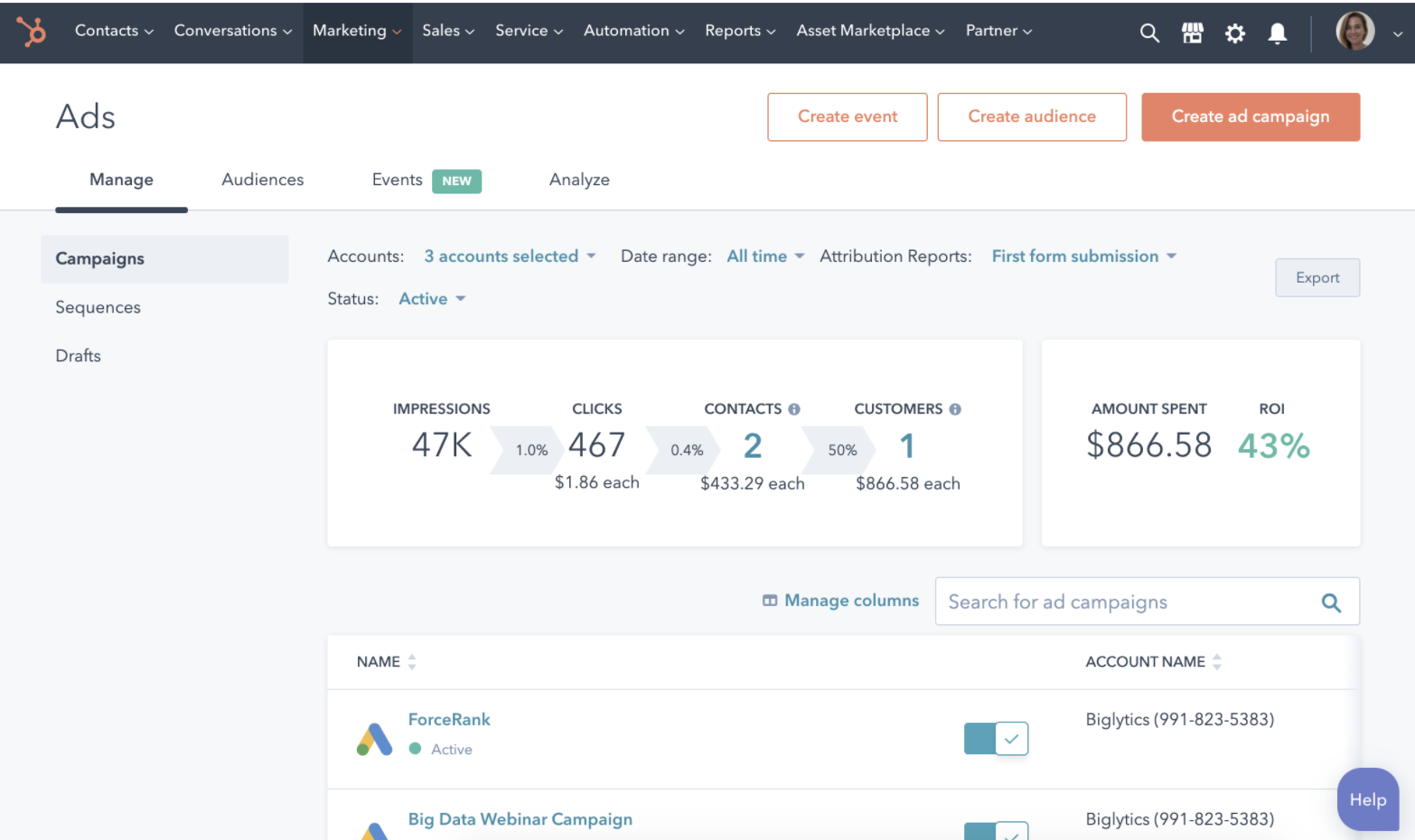
With HubSpot Ads Software, you can use your CRM data to create and optimize customized and highly personalized ads for your target audience. Report on those ads to determine which are converting audience members into paying customers.
HubSpot offers direct integration with Facebook, LinkedIn, Google, and Instagram so you can easily create, share, manage, and report on your ads all through one tool. Report on the ROI of individual ad campaigns across Facebook and those additional platforms.
HubSpot also has automated lead follow-up — meaning, once your ads do what they’re supposed to (convert leads!), it automatically saves their contact details and routes those leads to the right reps on your team.
Pro Tip: Use HubSpot Ads Software to manage and personalize your Facebook Ads with your CRM data.
2. Facebook Ads
Best Facebook Ads tool for: Creating ads tailored to your target audience within Facebook on a pre-determined budget.
Price: You determine the price of Facebook Ads by deciding 1) how much you want to spend on your ads or 2) the cost of each result of your ads.
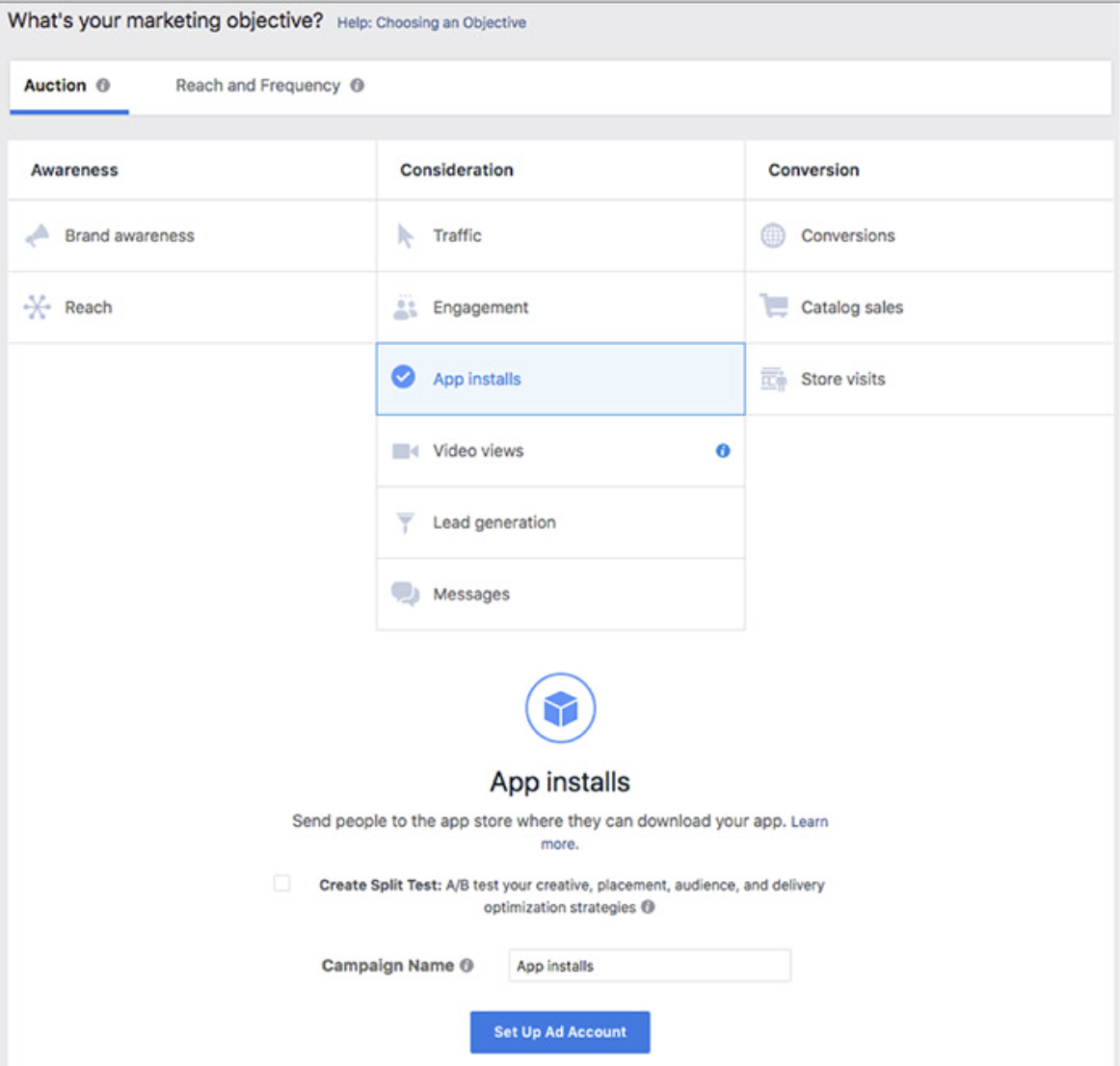
Use Facebook Ads to tailor ads to your target audience by first selecting your business type and goal.
Facebook makes it easy to then create, publish, and edit ads, as well as track and share their performance across any of their platforms (e.g. Facebook, Messenger, Instagram, etc).
Customize ads by selecting one of the six available formats as well as the specific audience you’re going after based on their behaviors, characteristics, demographics, and more on the platform.
Stick to your ad budget on Facebook by setting a daily and/or lifetime budget and determining the amount of time your ads will run. As a result, you’ll only spend the amount you set aside on your ads.
3. Qwaya
Best Facebook Ads tool for: Ensuring your target audience sees fresh ads on Facebook using the tool’s automatic ad rotation feature.
Price: Plans starting at $149/mo
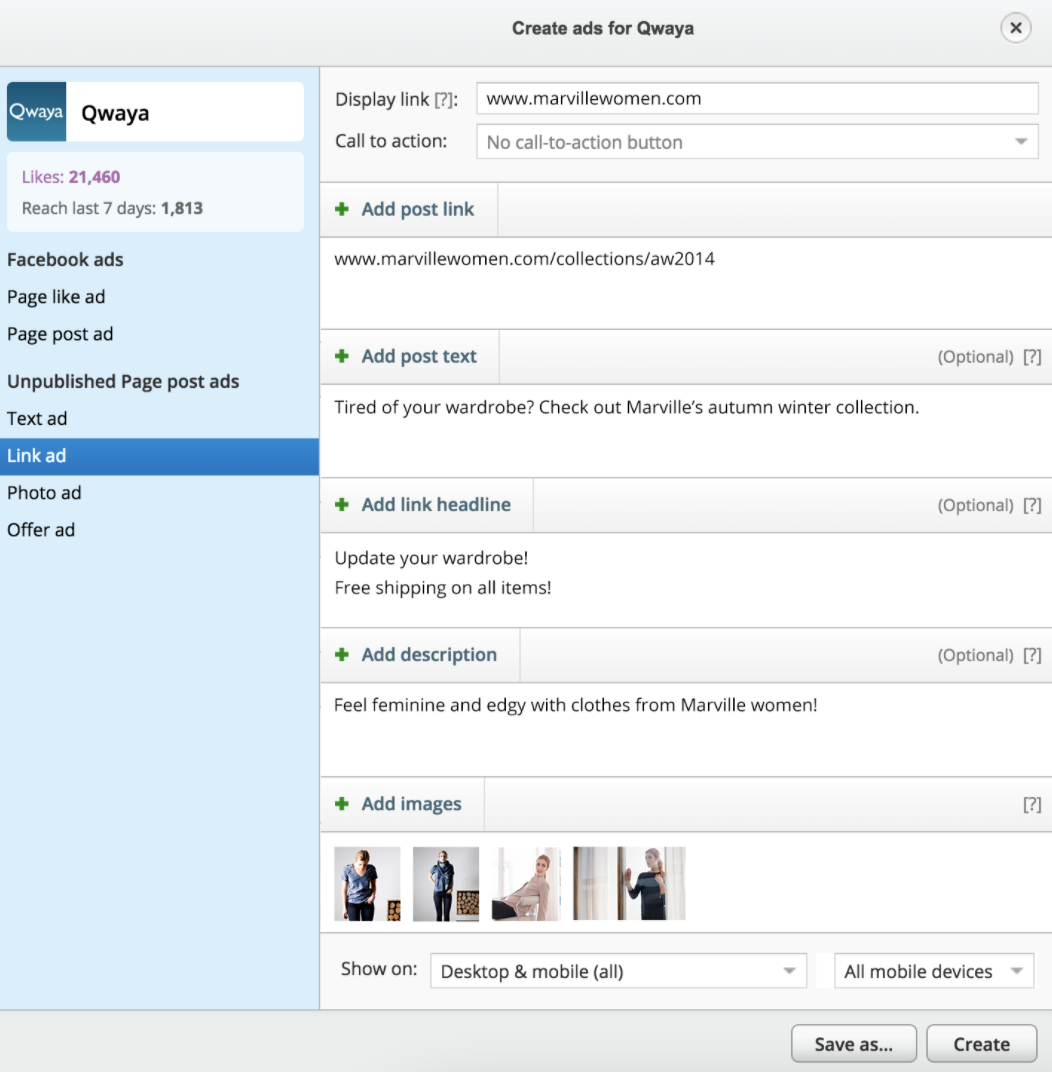
Qwaya is an ads tool for Facebook and Instagram. It allows you to identify the right audience segments for your ads with A/B testing and targeting criteria. The tool makes it easy to test ad types, ad placement, text, images, and more on Facebook.
Qwaya automatically manages your audience segments and ads for those segments¸— ads and audiences are placed in a “campaign and ad set” folder structure to keep all information organized accordingly. You can also automate the process of running your ads when your target audience is most likely to be on the platform (e.g. certain time of the day and/or week).
4. AdEspresso
Best Facebook Ads tool for: Split-testing Facebook ads and saving the most successful ads and creative elements for easy, future access.
Price: Plans starting at $49/mo (billed annually) for a $1,000/mo spend limit.
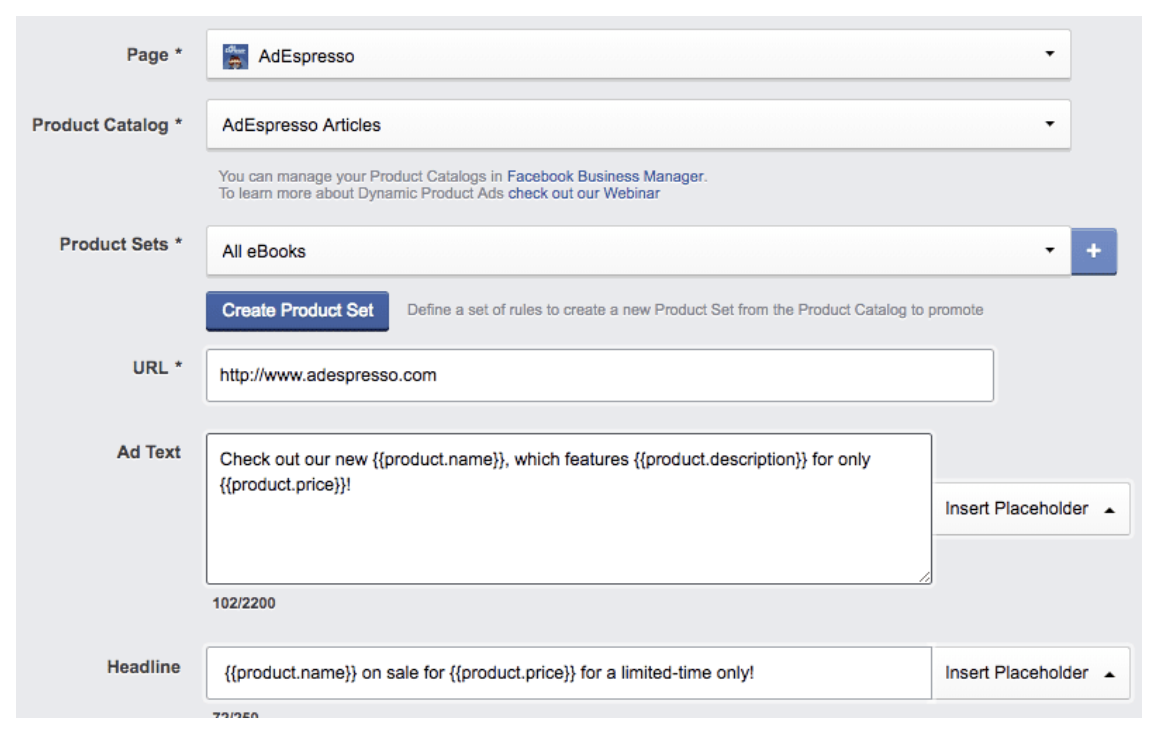
AdEspresso is an advertising platform by Hootsuite with features for ad creation and management across Facebook, Instagram, and Google Ads.
By making it easy to split test all aspects of your Facebook ads (e.g. creatives, headlines, images), AdEspresso helps ensure they’ll reach and resonate with your target audience so you can increase conversions.
Once you determine which Facebook ads work best through split testing, save ads and creative elements in the tool for easy access across your team.
You can also bring your product catalog into AdEspresso to create dynamic ads for your individual products that are tailored to your audience. These relevant product ads will then be placed in front of your audience when they’re most likely to convert.
5. SocialPilot
Best Facebook Ads tool for: Using a single social media marketing platform for Facebook ads and “boosting” those ads to increase their reach.
Price: Plans starting at $25.50/ mo for 10 social media accounts and one user.
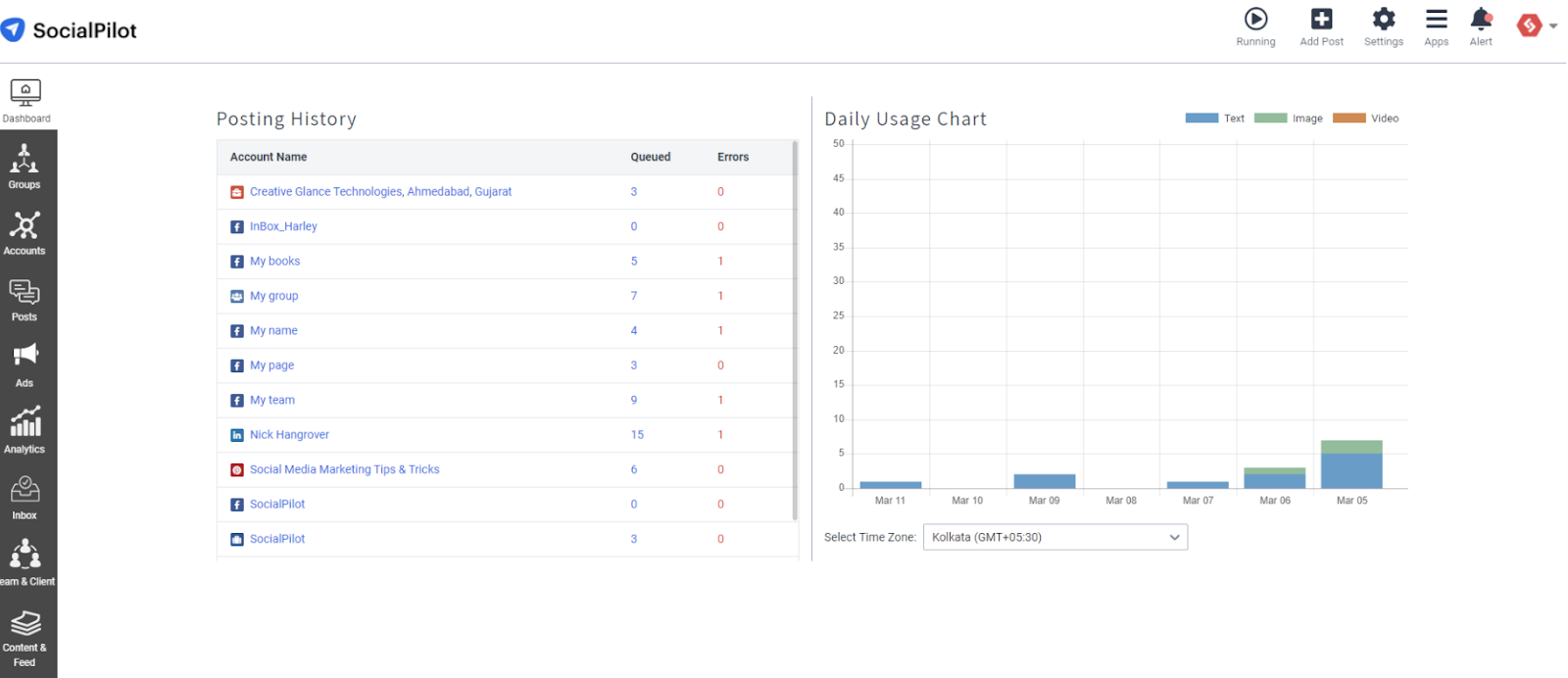
SocialPilot is a social media engagement platform with a tool meant specifically for Facebook ads. With this tool, you can create, schedule, and manage your Facebook ads.
With audience targeting, customizable CTAs, and dynamic ad content, SocialPilot helps you create Facebook ads that generate high-quality leads.
Use the “Boost Posts” feature (paid ads offered by Facebook) to increase the reach of your ads. Once you create your ad, select your audience, and set a budget, SocialPilot will publish the ad and immediately “boost” it for you to increase reach among your target audience.
Additionally, if the platform believes you’ve scheduled an ad that would do especially well with a “boost”, SocialPilot will give you that suggestion.
6. Revealbot
Best Facebook Ads tool for: Merging multiple actions into individual automations to save you time and increase productivity when it comes to your Facebook ad strategy.
Price: Plans starting at $83/mo for maximum ad spend of $10,000/mo.
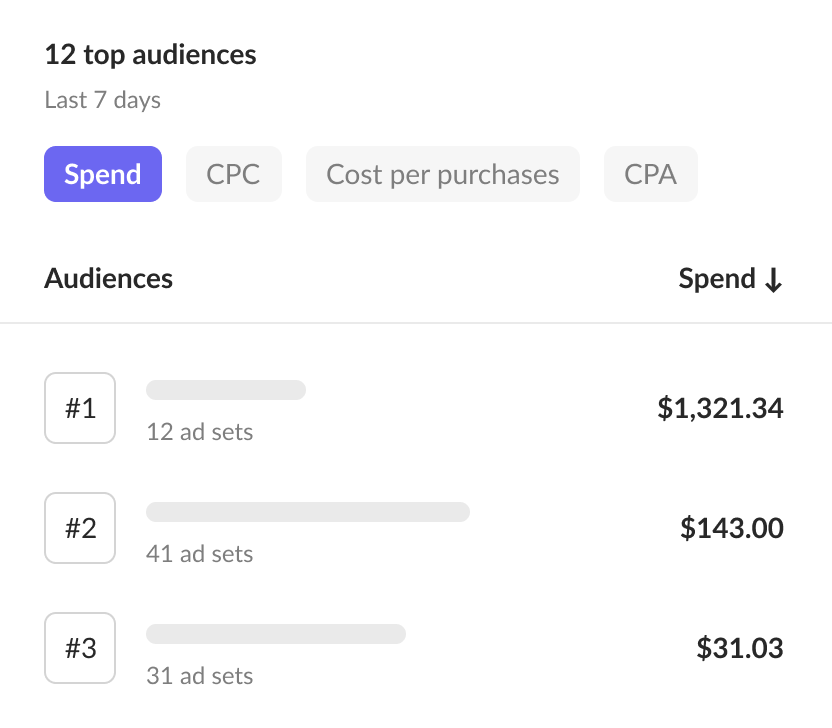
Revealbot is a Facebook ad automation and management tool. Use the drag-and-drop automation builder to establish automation for all parts of your Facebook ad strategy — you can set more than 20 actions for single automation to save you time.
Connect your external marketing and ad data to Revealbot to report on and analyze ads while maintaining a holistic view of your data.
Track and analyze ad data you care most about by creating unique and/or customized metrics and timeframes in your conditions. You can also use comparison conditions to compare and visualize metrics to better understand the performance of your ads.
7. Madgicx
Best Facebook Ads tool for: Using artificial intelligence (AI) to optimize and automate your Facebook ads.
Price: Plans starting at $49/mo for up to $1000/ mo ad spend.
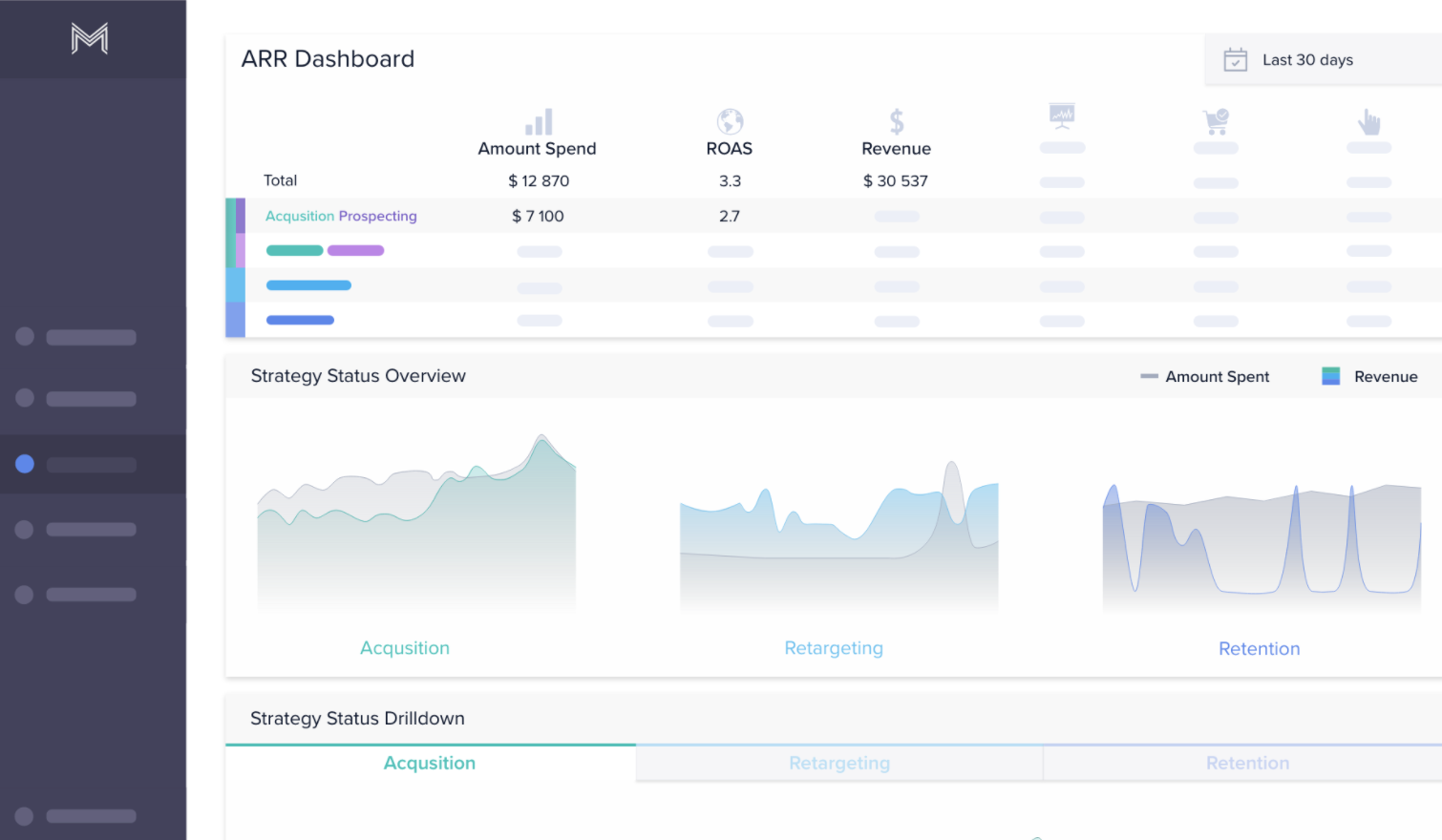
Madgicx is an AI-powered, omnichannel advertising platform with a Facebook ad optimization and automation tool. Over 100 audience targeting options exist to help you develop a customized advertising strategy that covers every stage of the funnel.
Input your KPIs targets in Madgicx’s PPC tool so it automatically optimizes your account. Meanwhile, the AI-powered creative intelligence feature analyzes the performance of your ads and creatives based on a variety of data points.
As a result, you’ll have the information you need to target all of your buyer personas both effectively and efficiently.
Improve Upon your Campaign Strategy With Facebook Ad Software
Facebook ad software has the ability to help you create, optimize, and analyze your advertisements and campaigns on the platform. Begin improving upon your Facebook ad strategy by incorporating one of these tools.

How to Conduct an Exit Interview: 7 Top Questions [Form Template]
To determine what causes employees to leave — and to create a better, happier employee experience moving forward — it’s critical you conduct productive exit interviews.
In this post, you’ll learn everything you need to know about exit interviews, plus the best questions you should ask. We’ll also go over an exit interview form template that you can copy and paste into a document and reuse for future interviews.

What is the purpose of an exit interview?
The purpose of exit interviews is to get valuable insight from employees who are leaving your company. When conducted correctly, these interviews tell you what, if anything, could improve about your company culture. You’ll then be able to improve moving forward and drastically reduce employee turnover.
Why are exit interviews important?
According to a study conducted by The Society for Human Resource Management (SHRM), on average it costs a company between six to nine months of an employee’s salary to locate and train a replacement for them. So if the employee who’s leaving makes 60K, that can work out to anywhere between 30K and 45K in recruiting and training costs.
Undoubtedly, a high turnover rate can hurt your company financially. Additionally, a high turnover rate can lead to less productive teams, and lower employee morale overall.
Luckily, you can reduce turnover rate by using the feedback you get from exit interviews. Many employees who are leaving can help you determine areas for improvement and provide valuable feedback. Additionally, it can be helpful to identify consistent patterns of discontent to figure out larger organizational issues.
For instance, let’s say you hire a new marketing director, and a year later, you see a severe increase in turnover rates. Out of 15 employees, only seven from the prior year remain. Undoubtedly, this change impacts your team’s productivity and morale, and leave you nervous about the future of your department.
So how do you figure out what’s going wrong, or how your marketing director can improve their performance to ensure higher job satisfaction for their team?
The answer is conducting an exit interview for every person who’s leaving. You’ll find out what your marketing director is doing wrong and help them improve in their leadership role.
You’ll also improve morale because you’ll show employees that you care about their experience. You’re not just letting people leave — you want to know why they’re leaving and stop anyone else from doing the same thing.
To ensure you’re asking the right questions during exit interviews, take a look at the questions you should ask below and what to look for in an answer.
1. How long have you been considering leaving our company?
This is a simple question that will tell you whether this was a rash decision or a decision that happened over time. If it seems sudden, then it was likely caused by a certain event, and you’ll be able to better tailor your questions to get to the motive behind the employee’s decision.
What to Look For
Look for a time range. A year versus a month is a big difference. Determine whether any major company changes happened at the time they considered leaving — an acquisition, a change in management, and so forth.
2. How did the job match expectations?
The job may have perfectly met the employee’s expectations, or maybe it wasn’t exactly what they were looking for when they were thinking about the next step in their career. Regardless, this question will help you determine where you could be clearer in your job postings and in your company image.
What to Look For
Listen for “I thought I would be doing more of X” or “I was looking more of an X type of company.” This will help you better refine your job postings and the way you represent your business online. If an employee was looking to work at a startup and you’re an enterprise firm, you’ll want to screen future candidates for these expectations.
3. What reason primarily describes your reason for leaving?
Was it a change in lifestyle, a career change, or a better opportunity elsewhere? While the last option may seem like the most common and useful answer, a change in lifestyle — such as becoming a stay-at-home parent — could tell you where else you could improve.
For instance, you could offer paid parental leave so that your employees no longer have to choose between their jobs and their children. Or if they’re switching careers, you could offer more interdepartmental mobility to current employees, so they don’t feel stuck in one role.
What to Look For
Dig into the specific reason for their leaving without letting the employee dive into anecdotes or frustrations. Focus on what attracted them to the new opportunity, new career, or new lifestyle, and use those answers to figure out what you could offer your current employees.
4. If you have accepted a new position, what is most attractive about your new role?
This is a fantastic follow-up to the last question if the employee has already accepted an offer elsewhere. It also helps you dig further into what convinced them to leave the company and see where, if anywhere, you may fall short.
What to Look For
Listen for standard answers such as “pay,” “benefits,” “industry,” and “location.” Only note those that you can improve. For instance, you can’t really move offices or change your industry.
5. What did you like most about your job?
Give yourself a chance to breathe — and your employee, too — by focusing on the positives. That way, you don’t accidentally overhaul the things that work. If the employee answers that they loved the people they worked with, for instance, continue attracting top talent to your firm.
What to Look For
Listen specifically for the people aspect and the project management aspect of this answer. If the employee loved the projects they were working on or the people in their team, you’re doing the core things well. If they only mention surface-level things, such as the snacks or the free parking, you’ll want to revise your recruiting strategy.
6. What did you dislike about your job? What would you change about your job?
This is your opportunity to truly dig into what prompted the person to leave as it pertains to their role. Employees will likely “skirt around” the true reason here — or they may launch into an anecdote. Either way, listen carefully, and remember that this is only one employee’s experience. Only when you see repeated patterns do you need to take action, which is why it’s important to ask the same questions every time.
What to Look For
Search for answers that allude to the people in the team, because as the old saying goes, people don’t quit companies — they quit managers. If they don’t directly mention a person, listen for emotional words that show how the employee felt working in that team, which would show how the team operates under its manager.
7. How would you describe the culture of our company?
With this question, you can identify the gaps between your employees’ experience and the culture you aim to promote. Hopefully, you’ve already defined an organizational culture that upholds your values. (Pro tip: If you’re in need of inspiration, you can take a look at our Culture Code and steal some ideas from there.)
What to Look For
Don’t look for direct antonyms to what you’ve defined as your culture, because employees won’t be as up-front. They might use seemingly positive terms, such as “fast-paced” or “structured,” but these may hint at a high level of stress and a sensation of immobility. Listen carefully for these seemingly positive adjectives.
Don’t let it stop here. To ensure you’re employing best practices to get optimal feedback from your employees, take a look at our exit interview form template. It includes even more exit interview questions that will help you understand why the employee is leaving.
Exit Interview Form Template
Once an employee has given their resignation letter, you’ll want to send them a form with some (or all) of the following questions. Give them time to submit their answers through the form before meeting with them to discuss their answers, face-to-face.
Below are some of the questions you’ll want your exit interview form to include. Simply copy and paste them into your preferred word processor.
Exit Interview Form
1. How long have you been considering leaving our company?
2. How did the job match expectations?
3. What reason below primarily describes your reason for leaving?
a. New industry (significant career change)
b. Compensation
c. More opportunities for learning and growth
d. Personal Reasons
e. Manager / leadership quality
f. Day-to-day work environment / culture
4. If you have accepted a new position, please select all the items that are more attractive about your new role:
a. Better pay
b. Better culture
c. Better location / commute
d. Different industry
e. Manager
f. Better work-life balance
g. More career advancement opportunities
5. What did you like most about your job?
6. What did you dislike about your job? What would you change about your job?
7. How would you describe the culture of our company?
8. How would you describe the general atmosphere in the office?
9. The quality of supervision is important to most people at work. How was your relationship with your manager?
10. What could your supervisor do to improve their management style and skill?
11. We try to be an employee-oriented company in which employees experience positive morale and motivation. What is your experience of employee morale and motivation in the company?
12. Please provide any context to further describe your reasons for leaving. Was there an event that led to this decision?
13. What were your reasons for joining our company originally? How have your feelings changed?
14. Do you believe your manager supported your professional development?
15. What are 1-2 things our company could do to promote a better workplace?
16. Please provide context and any additional feedback you’d like to provide on your manager.
How to Conduct an Exit Interview
Now that it’s time to conduct the interview, you’ll want to take the following steps to make sure the conversation is productive, amicable, and neutral.
1. Send the exit interview form to the soon-to-be ex-employee.
First, send the person who is leaving a form or document with your standard questions. This would happen the same week that they put in their resignation letter — ideally within one to two days. They should already know a form is coming their way, because you would have expressed that verbally.
2. Choose an interviewer and set up the meeting.
After you’ve given the employee time to thoughtfully respond, it’s time to choose an interviewer and set up an in-person meeting.
The interviewer should be an unbiased third party, such as a staff member from your HR team. Don’t set up the exit interview meeting with their manager or with anyone whom the person has worked with before. This may impair their ability to be honest during the interview.
3. Ask the same questions in every exit interview.
Ensure you ask the same questions in each exit interview so you can gather actionable data and insights.
Prepare a handout for yourself that prompts you to jot down similar notes for every person you or your HR staff member interviews. If all of the notes are highly disparate or seemingly disconnected, it will be difficult to glean insights and improve moving forward.
4. Keep the tone of the conversation neutral.
In person, do not ask targeted questions regarding specific people or departments — keep your questions general and don’t input your own opinion into the conversation. Don’t prompt the employee to over-share about their frustrations with the job.
This is not constructive to you as a company. Rather, you want to find out areas of improvement in more general terms, so that you can create company-wide change.
If the employee only gives personal anecdotes, that would only help you create a better experience for them. The problem is that they’re already leaving. What you want to find out is how you can improve the employee experience for those who are staying.
5. Distill the answers into insights.
Identify patterns you see from different exit interviews, and use that data to draw conclusions on which feedback you should use to improve the employee experience moving forward. As mentioned, take similar notes for each exit interview. To make it easier, you could use a survey software that helps you collect the employee’s written answers.
Exit Interview Best Practices
Ultimately, an exit interview doesn’t just help you understand why your talent is leaving — it also helps you ensure you can implement strategies or cultural changes to improve the satisfaction of employees who stay.
However, it’s not always easy to discern what a highly productive exit interview looks like.
To learn more about exit interview best practices, I spoke with Winston Tuggle, an HR Business Partner at HubSpot. Here are some of the best practices he suggests.
1. Always ask the same questions.
When it comes to exit interview best practices, Tuggle suggests, “For conducting productive exit interviews, I think one key is asking the same questions of all people who leave. This structure allows us to codify the exit responses so we can extract actionable data around why people are leaving, and how we can improve the employee experience.
We do this by having a standard exit interview form that leavers submit, and then have an unbiased third-party follow up in-person to go deeper on the answers the person filled out in the exit interview. Exit interviews aren’t necessary unless you plan on using them to gather as much data as possible that can be coupled with employee survey data to understand the employee experience.”
2. Understand the “why” behind the person’s resignation.
Tuggle also notes, “[It’s critical you understand] the ‘why’ behind someone leaving … to gather trends over time. As an HR team, it helps us to not overreact to one person’s experience and conversely helps us identify trends that we can proactively address before they lead to more unwanted attrition.”
3. Explain the purpose behind the exit interview.
It’s important you explain the purpose behind the exit interview to each employee before you begin. You might say, “We hope to use your feedback to continuously improve our culture and business processes, so we are interested in your honest opinion on how your experience has been.” That way, they don’t feel they’re taking part in a conversation that won’t be used to create change.
4. Ensure interviews stay confidential.
You’ll also want to make sure your exit interviews are confidential between the HR team and employees. While data or general insights can be used to improve employee experience and should be shared with leadership, your employee needs to know their exact complaints won’t reach their old manager or coworkers.
5. Thank the employee for their time.
Finally, be sure to thank your employee for taking the time to provide feedback during an exit interview. While one individual likely can’t pinpoint issues regarding an entire team or department, you’ll likely see commonalities over time that can help you determine how you can improve your workplace for the long-run.
Exit Interviews Will Improve Your Company Culture
Exit interviews are the key for improving your business from the inside out. Knowing what makes some employees leave can help you keep the employees you already have. As a result, you’ll improve your company culture, reduce turnover, and boost productivity — leading to a better and better workplace over time.
Editor’s note: This post was originally published in January 2019 and has been updated for comprehensiveness.


How to Clean Up Your Email List With These 5 Tips
Email marketing is continually evolving as subscriber preferences shift toward more personalized experiences. On average, 99% of people check their email every day, and the average email open rate is 17.61%.
However, that doesn’t guarantee your email will make the cut. Several factors impact email deliverability, opens, clicks, and conversions. So, what’s the first step to keeping your email KPIs strong? A clean email list. Clean email lists (with a great email marketing strategy behind them) will keep your email engagement high and your unsubscribe and spam rates low.
1. Limit unsubscribes.
The more people on your email list, the higher the likelihood that some have lost interest in your email. It happens. It could be a good idea to review engagement and remove any subscribers who no longer seem interested before they hit the unsubscribe button.
2. Decrease spam complaints.
Spam complaints are bad for your reputation with ESPs. If your emails are constantly marked as spam, your ESP might flag your account for sending unwanted solicitations. If this happens too often, your deliverability rate can suffer.
3. Improve deliverability.
The cleaner your list is, the greater the number of subscribers who want to open it. On the other hand, a list full of people who don’t engage, have changed their email address, or worse, never opted in will result in spam filters and bounces — both of which can hurt your deliverability.
4. Improve a reduced open rate.
Quality over quantity is the goal here. If you start to see your open rate decline, take a look at your list and check for inactive subscribers. Of course, you’ll want to attempt a reengagement campaign before removing them. If that doesn’t work, you should consider retaining only your active subscribers.
5. Keep costs down.
Many ESPs tier their pricing by the number of emails you send. In order to keep your costs down, you’ll want to remove the subscribers who are receiving your emails and never opening them.
All of these add up to one big red flag — your email subscribers aren’t engaged (or aren’t getting your emails). When people unsubscribe from your email list they are actively opting out of receiving your emails. If several of your emails get marked as spam, your deliverability rates will suffer.
Open and click through rates tell you how many of your subscribers are opening the email you sent, clicking on a link, and ultimately, if they’re interested in the content you’re sharing.
Making sure your email lists are clean and targeting the right audience increases your ROI and decreases the chances of your marketing emails being flagged as spam. Cleaning up your email lists gives you a better chance to reach and engage your audience.
You also want to consider the number of subscribers coming in every quarter — if it’s high, you might want to check your lists more often. If you’re seeing a high number of bounces, then that’s an indicator that it’s time to clean your email list.
Every company is different so clean up can happen monthly, quarterly, bi-annually, or annually but it should be done at least once a year.
1. Identify disengaged subscribers.
Before you scrub your list, you’ll want to identify whether a subscriber is truly inactive or simply disengaged. The former could mean you’ll need to remove them, while the latter might mean you still have a chance to win them over. A disengaged subscriber might just need some more targeted marketing to refresh their interest in your emails. After all, they did subscribe to your list at some point.
To do this, you’ll need to set some criteria for what “disengaged” means. Have they not opened an email in three months? One year? Have they not engaged with any campaigns? Have they not clicked on any links in six months?
Once you’ve identified your disengaged subscribers, you’ll want to place them in a separate list, filter for common themes, and identify a strategy to pique their interest. That could mean a discount code, a personalized subject line, or some other engagement strategy. The point is: before you write off these subscribers, give reengagement your best shot.
If reengagement doesn’t work, then you can truly mark the subscriber as disengaged and inactive.
2. Identify reasons for bounces.
Bounce rates are terrible for email deliverability, but not all bounces are created equal. There’s a difference between a hard bounce and a soft bounce. The former is a permanent issue, like an inactive email, and the latter is a temporary problem, like a full inbox.
You’ll need to remove emails that have a hard bounce, but keep an eye on soft bounces, as the problem could resolve over time.
3. Check for spam filters.
You’ll want to remove any subscribers that mark your email as spam immediately. Spam filters hurt your deliverability and your reputation. If a subscriber no longer finds your emails helpful, or worse, sees them as spam, then it’s best to part ways by removing them from your list.
4. Clear out inactive subscribers.
The final step in cleaning out your email list is to create separate lists for all the categories above and remove the emails from your list that are no longer active. It might be hard to part ways with these emails, but, in the end, you’re doing your deliverability and engagement rates a huge favor.
1. Make sure your list has good hygiene.
The key to a squeaky clean list is to have a great routine and stick with it. Create a schedule for cleaning up your lists by looking at your data quantity and quality. This will determine how often you will have to clean your list. No matter how big your list, if most of your subscribers are not interacting with your emails, it is time to assess why.
When looking through your email lists, check for duplicates, typos, and email addresses that have the word “spam” in them so that your emails are getting sent to the right person and are not bouncing. ”
2. Consider using double opt-ins.
A double opt-in is a way to ensure that your subscribers truly want your email. Here’s how it works: once a user submits their information to a form on your site, an email is sent to confirm their subscription. This does a few things: it gets them used to opening your emails, it signals to their email provider that your emails should not be automatically marked as spam, and it gives you an opportunity to ask them to save your contact info so emails don’t get lost. All around, a win.
3. Manage bounce rate.
Bounced emails happen when there is a typo in the email address, if the email no longer exists, or for a number of other reasons. Checking for bounced emails can increase your deliverability and email ROI. Email bounces are broken down into two categories: soft and hard bounces.
A soft bounce is a temporary deliverability problem, such as a full inbox or a server that is down. Resending emails to these addresses can be beneficial because they can go through eventually.
A hard bounce happens due to permanent deliverability problems, such as an invalid email address. When you have hard bounces it is imperative to remove these addresses from your lists to keep your Email Service Providers (ESPs) happy. ESPs track the number of bounces you generate with each send and use it when determining your email credibility. Getting too many hard bounces is equivalent to people automatically putting your emails in the Spam folder.
4. Use automation.
Marketing automation is for emails, too. You can have your CRM automatically send subscribers to certain lists (or tag them) based on their actions. Remember when we discussed moving inactive subscribers to a separate list? Well, instead of doing this manually, you can set up an automation that does this for you and triggers a reengagement campaign. Another way you can use automation is to remove subscribers from email workflows or campaigns that are no longer applicable to them.
5. Provide an “opt down” option.
Have an “opt down” option in addition to an “opt out” option. An “opt down” option lets your subscribers choose how often and which emails they want to receive from you. Unfortunately, subscribers can forget that they subscribed to your email lists, increasing the chance that they will delete, unsubscribe, or put you straight in the Spam folder — all undesirable outcomes. Providing an “Opt Down” option provides an opportunity for the subscriber to stay on your list without the overwhelm of receiving correspondence they don’t want.
6. Understand your email audience.
Before cleaning out your email list, take stock of how much your current audience aligns with your ideal audience. Look for ways to re-engage inactive subscribers by separating them into lists based on their interests and demographics. For example, you could create engaging welcome emails for new subscribers or whip up a discount campaign for older subscribers. Having multiple lists helps you to create campaigns that’ll drive conversion rates up.
All in all, the success of email marketing campaigns should not be measured by the number of subscribers but by the quality of the subscribers and the actions they take as a result of your email. Therefore, it’s better to deploy campaigns to 20,000 active and engaged people than it is to blast the email to 30,000 people if half of them don’t care, will delete it, or worse, report it as spam.
7. Remove inactive subscribers.
Inactive subscribers are those who do not open, click, or engage in your emails in any form. Having engaged subscribers will always be beneficial to your conversion rates, so by removing inactive subscribers you will drive up your open and click through rates for your campaigns.
Before you remove inactive subscribers permanently you can try sending them one last email campaign that could be a feedback campaign to see what will re-engage them. If all fails you’ll need to permanently delete them as subscribers to not hurt your email deliverability and conversion rates.
Start Cleaning Out That Email List
Email marketing is essential to any industry and doing a routine clean up can be beneficial to your company’s data reports and conversion rates. As long as you’re performing routine clean ups, maintaining your open and click through rates, managing bounce and spam rates, and engaging your lists with targeted emails of their interest, you will always have a squeaky clean email list.
Editor’s note: This post was originally published in October 2011 and has been updated for comprehensiveness.

How to Outsource SEO Correctly & Avoid the 5 Most Common Mistakes
If you want to grow your business, great search engine optimization (SEO) is a must: Recent survey data found that 53 percent of all trackable website traffic originated from organic search, which means that if you want to get noticed, you need to show up at the top of search rankings.
The challenge? Many small businesses don’t have the time, skills or expertise necessary to handle everything that comes with a solid SEO strategy. From keyword research to content evaluation, from page optimization to internal linking, it’s easy for companies to end up with a generic web presence that doesn’t inspire engagement or drive conversions.
![→ Download Now: SEO Starter Pack [Free Kit]](https://no-cache.hubspot.com/cta/default/53/1d7211ac-7b1b-4405-b940-54b8acedb26e.png)
The result? It’s worth considering an SEO consultant or agency to help manage this process and maximize your impact. In this piece, we’ll tackle key outsourcing operations, including how it can benefit your business — and why SEO can’t be entirely outsourced. Then, we’ll break down top SEO pitfalls and offer actionable advice to find an SEO agency that best fits your brand.
Why Outsourcing SEO Can Be a Good Idea
Designing an effective SEO strategy isn’t a simple task. Companies have to consider how search engines are evaluating content, what aspects of SEO offer the most impact, and where they could change their current content to better align with search engine expectations.
This is especially critical as search engines like Google continually refine their ranking process. For example, page loading speed is now a factor in search result rankings. In practice, this expands the role of SEO; it’s not enough to simply weave in popular keywords and deliver high-quality content. Brands also need to consider the entire user experience.
As a result, it’s often worth outsourcing SEO services to ensure that your digital presence is generating maximum impact and capturing the highest volume of prospective customers. In much the same way that companies outsource their marketing efforts to experts, outsourcing SEO provides a way for brands to identify key strategic goals and then leave the complex process of meeting those goals to industry experts.
For small businesses and entrepreneurs, outsourcing offers the big benefit of time: Instead of learning about the ins and outs of SEO, testing new strategies, and refining results, business owners and managers can focus on customer conversions, product improvements, and new ideas.
Why Your Business Can’t Fully Outsource SEO
While it’s possible to outsource much of your SEO strategy to an agency or consultant, there are aspects of the process that still rest within your business. These include:
Your Keywords
Although an SEO expert can help pinpoint specific keywords of opportunity, you’re often the authority on the core keywords that define your business and operations. You know that if you stray too far from these keywords, your brand simply won’t be the same — and customers that do end up on your site may be there looking for something else. As a result, you always have a role to play in choosing ideal keywords.
Your Content
The content on your site is unique to your brand. And while SEO agencies have gotten much better at creating targeted content designed to attract your market, there are some aspects of your onsite content — such as information about the history and mission of your business — that you’re best-suited to create and manage.
Your Relationships
No matter how good your SEO provider may be, they can’t replicate the relationships you have with other businesses, suppliers and partners. This means that while they’re able to provide strategy for your SEO framework, you provide the connective tissue that makes it possible for your content to be posted (and reposted) across your industry network.
Your Brand Perspective
The unique nature of your brand perspective is what’s taken you this far — and it’s what will continue to drive your growth. Even the best SEO agency can’t be in your head; they don’t know what your brand means to you or how you want to communicate your message to the world. As a result, outsourcing SEO is ideal for laying a foundation for conversion and revenue, but it only works when paired with your perspective.
Your Growth Strategy
While you provide general goals to your SEO agency — such as increasing your rankings for a specific keyword by X amount or boosting total website visits — you’re still responsible for your overall growth strategy. Where do you want to be in a month? A year? Five? And how can your SEO partner help you get there?
Five Common Pitfalls to Avoid in SEO
Every business is different, but the principles of SEO remain the same: Rank higher in search engines for popular keywords to drive more traffic to your site. The challenge? Reaching this goal isn’t easy, leading some brands and SEO agencies to make potentially costly mistakes. Here are the top five pitfalls to avoid.
Keyword Stuffing
If there’s a cardinal rule of modern SEO it’s this: Don’t keyword stuff.
Stuffing is the practice of adding the same keyword over and over to your content with the intention of ranking higher. The problem? Search engines are now smart enough to detect this practice and will down-rank your site if keyword stuffing is detected. Generally speaking, one instance of your primary keyword per piece of content is enough to get noticed.
Duplicate Content
Next up is duplicate content. While more content on your site with keywords can help you rank higher, simply copying and pasting content — or slightly changing content to include a new keyword — lowers the overall value of your site and in turn your ranking.
Put simply? New content is always better than old.
Low-quality Backlinks
Backlinks can help increase the relevance and authority of your content — but only if they link to high-quality sites. If your content links out to sites that are continually keyword stuffing or don’t receive many visitor views, you won’t enjoy a bump in search rankings. In fact, links to these sites may hurt your overall standing.
Unoptimized Images
Images help capture user interest, but it’s not enough to simply put pictures on your site: You also need to ensure they’re optimized.
This starts with the image itself. Make sure it’s relevant and easy to understand. For example, if you run a construction company, use an image that’s related to the services that you offer and that’s high enough quality that users can immediately tell what it is. If the image is low-resolution or confusing, users won’t bother sticking around.
It’s also a good idea to look at the size of your images. Here’s why: The more images you have on your site, the slower it loads. Optimizing images for size (without losing quality) can help improve the user experience and your search rankings.
Muddled Meta Descriptions
Meta descriptions are snippets of text that offer a quick description of content on a specific page. Here, clear and concise descriptions are critical. Muddled or vague meta descriptions make it easy for users to overlook your site. Ideally, you want to use your primary keyword and provide a quick overview of the page in question so users know what they’re getting into.
Simply put? Ask questions. Not sure which ones to ask? We’ve got you covered.
Let’s explore each question in more detail.
1. What makes you different?
While the process of SEO is fairly straightforward, approaches differ significantly. Some companies rely solely on specific metrics, while others opt for a more organic approach or a more middle-ground stance. As a result, it’s worth asking agencies and consultants what sets them apart from the competition — what can they offer to boost your rankings and drive traffic?
Quick tip: Listen to what they say and then fact-check it against their own site’s SEO rankings. If they don’t show up near the top of their page for their own targeted keyword, consider looking elsewhere for help.
2. What’s your process?
Your prospective partners should be able to lay out their process in a way that’s clear, concise, and understandable. If you find yourself on the receiving end of too many buzzwords or big promises with no underlying proof, other choices may be a better fit.
3. What are your tools?
From the HubSpot Website Grader to Ahrefs, from SEMRush to Moz Pro, there are a host of SEO tools available. Many agencies will also have their own proprietary tools they use alongside these popular offerings — look for a provider willing to specify what tools they use, why, and how.
4. How long will results take?
Beware any company that promises instant results. SEO rankings don’t increase until search engine “spiders” have crawled the web to assess site changes and their impact. Generally speaking, substantive results start showing up around the 4-to-6 month mark.
5. What are your metrics?
Metrics matter in SEO. These include new referring domains, text readability, keyword rankings, organic search volumes, lead conversions, bounce rate, and click-through rate. All are relevant depending on their context and all measure different aspects of SEO impact. Always ask your potential provider what metrics they use and why, and ask for an explanation of how they impact results.
6. How often do you report data?
Data reporting is key to tracking SEO success. Some companies report results weekly; for others, this frequency is every other week or even monthly. Here, go with whatever you’re comfortable with — while longer reporting periods may show more change, they may also miss key indicators that strategies aren’t working or need to be adjusted.
7. Who have you helped?
Finally, ask for references. If your prospective SEO provider is as good as they say they are, they should have data that shows how they’ve boosted the impact of other brands. If they’re short on specific data and big on promises, tread carefully.
Solving for SEO
A solid SEO strategy can help your brand rank higher in search engine results and drive more traffic to your business. Outsourcing is a great way to jumpstart this process — the right agency can give you the advantage when it comes to getting noticed and capturing customer interest.
But outsourcing alone isn’t enough. Your brand perspective is critical to drive success and avoid common pitfalls. Not sure where to get started learning SEO? HubSpot has you covered.
Editor’s note: This post was originally published in June 2008 and has been updated for comprehensiveness.

7 External Linking Best Practices for SEO
Content. Links. RankBrain.
These are the top-ranking factors Google considers when it comes to showing results on the search engine result page (SERP). Given that much of search engine optimization centers around getting lots of good links to and from your website, it’s essential to learn how to make these links work for you.
In this article, we discuss what external linking is and why you should do it. We also reveal seven external linking best practices. At the end of this article, you’ll know how to use external linking to help your content appear higher on the search engine results page.
When should you link to other sites in SEO?
External links are hyperlinks that direct readers to a website other than your own. On the surface, using external links seems counter-intuitive—these links take people away from your website, after all. However, as we shall see later in this article, it’s one of the most essential sources of ranking power you can ever use.
Four Benefits of External Linking
Linking to outside websites, when done right, offers several benefits:
1. External linking improves your credibility.
When you add trustworthy and relevant website links to your content, it improves the credibility of your website. In addition, valuable external links provide your readers with references, which will enhance your website’s authority.
External linking is similar to the way you cite sources in a bibliography for an academic paper—it shows that you’ve created your content based on sound research.
2. External linking improves your SEO.
The external links you add can assist search engines in determining the usefulness and quality of your pages. High-quality pages usually link to other high-quality pages; thus, search engines will look at your content favorably, helping you rank higher.
If you link to an interesting article on a critical topic of interest to your business, Google uses this as one way to know what your website is about.
3. External linking is an easy way to create connections.
Other websites can tell when you’re linking to them. And the chances are that they might return the favor and link back to your website if the opportunity arises, which is great because the more quality backlinks you get, the better.
It’s an easy and positive way to reach out, make connections in your industry, and get your content in front of the right audience.
4. External linking offers readers more value.
Adding external links provides a better user experience for readers. These links lead to related information that adds to the value in your content without duplicating content. When readers see that you consistently link out to resources that’d help them understand a topic better, they’ll begin to associate more value with your website.
External Linking Best Practices
According to Google, linking is one of the most important factors for achieving high rankings, you must understand how to use external linking to your advantage. Here are key external linking best practices to adopt.
1. Make the links relevant.
When adding external links, don’t just add links for the sake of it. Instead, add links that direct readers to relevant content.
Good external links tend to point to related content. Examples of what you might link to include statistics, infographics, videos, etc.
Google and other search engines value users and want to show the most relevant results to their query. Therefore, when external links come from websites in the same niche, Google better understands the relevance of your content and its popularity, leading to a higher SERP ranking.
Example
2. Link to reputable sources.
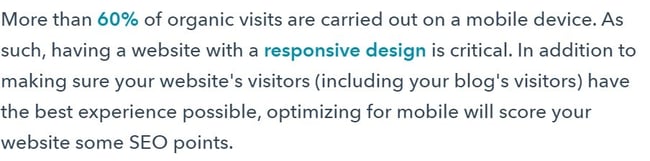
The external link in the image above has 60% as its anchor text. It leads to a website that contains that statistic and other relevant information.
When linking externally, only link to sites that are authoritative and trustworthy. If you link to websites that promote clickbait content or aren’t professional, you’ll diminish your reader’s trust. And it could negatively affect how search engines rank your content.
If you have no choice but to link to websites where you don’t trust the content, use a no-follow tag. This tag indicates to search engine crawlers that the linked page shouldn’t be associated with your page.
Example
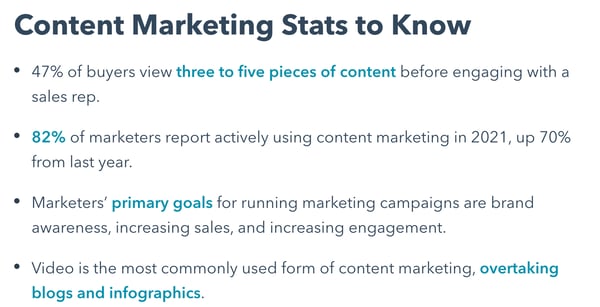
The latest content marketing report compiled by HubSpot is full of external links to reputable sources in the content marketing industry.
3. Use anchor text correctly.
Let’s examine a practical example of what makes a good and bad anchor text.
We’ve got an article on HubSpot that talks about how to write a blog post. You can click here to read that article.
See what I did there? The word “here” is what is known as the anchor text for the link. And this anchor text is essential for search engines to read your website. Unfortunately, by using “here” as an anchor text, I’m giving Google very little help or hints about the content of the page I’m linking to.
Instead, here is a much better (and right) way to do this:
The right way: We’ve got a previous article on HubSpot that talks about how to write a blog post.
The second way is much better than the first for multiple reasons.
First, the link is easier for readers to click on (and know that it’s a link). But, more important is the fact that we now have the anchor text as “how to write a blog post.” So, when the search engine spiders “see” this link, they factor in the anchor text when determining what the target page is about.
So, use descriptive keywords in anchor text or keywords the linked page is trying to target. However, don’t shoehorn anchor text into sentences because it can look like spam, and readers might find it annoying.
After including anchor text, read it again. Does it look forced? Does the link look helpful and natural? You want the latter to be true.
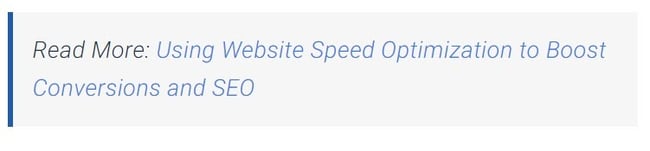
Here’s an example where Google gives more information about how to write good link text.
Example
4. Add helpful links.
How many external links should you use in your content? There’s no conclusive answer.
However, you shouldn’t overwhelm your reader with too many external or internal links. Your goal when linking should be to provide the best reader experience possible. You might end up losing readers if they feel they’re merely being used as part of your SEO strategy.
Example
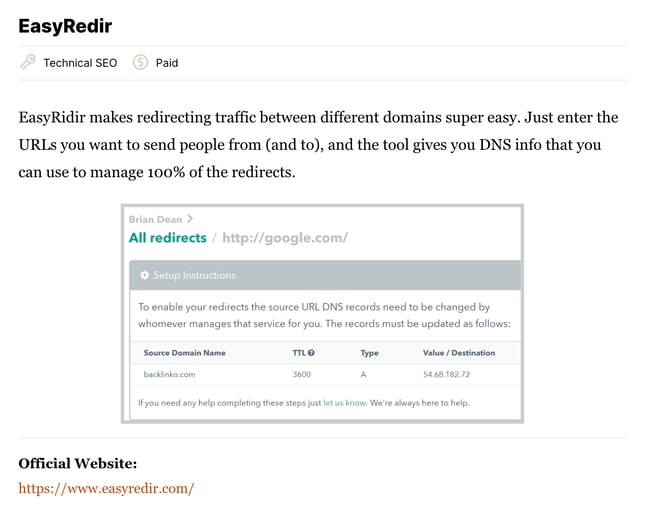
This page from Backlinko has at least 150 external links and ranks #1 on the Google SERP for several queries. Therefore, you can have as many external links as you like as long as it makes sense to add them.
5. Open external links in a different tab.
Your external links should open in a different tab, and there are various reasons why this is important. However, the most significant reason to have links open in a new tab is that this gives the visitor as much control as possible with their experience on your site.
Example
This article about statistics that prove why link-building is important contains external links that open in a new tab. This lets the reader continue reading the article while also taking a look at the information you linked to without losing one or the other.
6. Don’t link to competing websites.
It’ll be detrimental to link to sites competing for the same keywords. For example, if you’re targeting the keyword “Best toys for dogs,” you shouldn’t link to a site that is already ranking #1 for this keyword.
Instead, link to websites that offer value to your content, like pages that contain general information. Using the “Best toys for dogs” example, you can link to a video about a specific dog toy you’re promoting that’s not on a competitor’s website.
Example
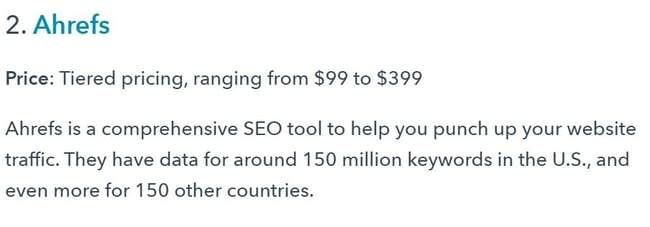
In the image above, HubSpot’s article about the best digital marketing tools doesn’t link to a competing article but links to specific tools like Ahrefs that support the article.
7. Conduct a link audit.
Spend some time every quarter (or within regular intervals) to audit your content for any outdated or broken links. Why’s this important?
When readers encounter broken or outdated external links in your content, it diminishes their experience, and they might begin to lose faith in your credibility.
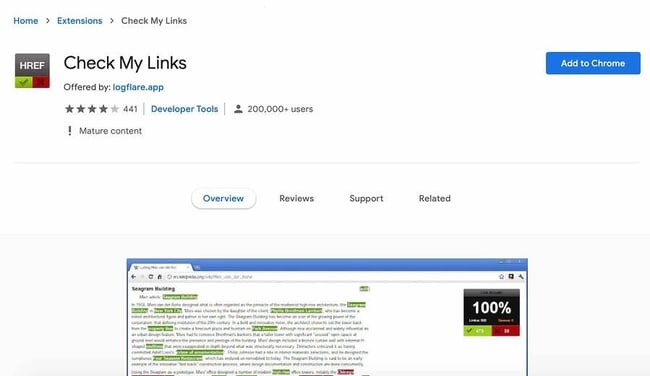
You can use a tool like Check My Links to find broken links on your website.
Build a Successful External Linking Strategy
Quality external links in your content provide more resources to your readers while building your content and website’s authority. When done right, external linking can even boost your ranking on the SERP.
So now is the time to implement all you’ve learned from this article and make external links work for you.
Editor’s note: This post was originally published in January 2007 and has been updated for comprehensiveness.


How to Post to Instagram From Your Computer [12 Easy Steps]
Posting to Instagram from your computer is a great choice if you don’t have your phone on hand or need to access company assets on your laptop. Or you might simply prefer to use a wider screen.
For these reasons and others, you might be wondering, “Can I post to Instagram from my computer?” We have some good news.

Why post on Instagram from your computer?
Instagram is a popular social media network for sharing photos that’s most commonly accessed through a mobile app. It offers a web version that makes it easy to post assets you may only have on your laptop and not your phone.
For example, let’s say you’re a social media manager for a prominent brand. The last thing you want to do is have an absentminded mishap where you accidentally post brand content to your personal Instagram account (or, worse, vice versa) simply because you’re logged into both on your phone.
Alternatively, it might be easier to upload company posts and videos via your desktop, rather than having your smartphone open at work.
Plus, your company’s files might be more easily accessible via desktop than mobile. For instance, if you use Photoshop to edit company photos, it’s likely easier to click “Upload” from your desktop when you’re done editing, rather than sending that same photo or video to your personal phone.
Perhaps you simply prefer the larger screen of desktop. Or, maybe you don’t have access to a smartphone so you can’t download the app on your phone.
So there are plenty of good reasons to use Instagram on your computer instead. Here’s how.
While the social platform is primarily meant to be consumed in-app, it offers a nearly identical experience if you access it on your computer.
On Instagram’s web version, you can:
- Watch and reply to other people’s Stories
- Search for hashtags and other users
- Browse your feed
- Comment and like posts
- Reply to direct messages (DMs)
- View your notifications
- Access the Explore tab
- Post photos and videos to your profile
In other words — Yes, you can post to Instagram from your PC or Mac desktop instead of on your mobile device’s app or browser.
Now, let’s explore how you can post images and videos from your desktop computer.
Whether you’re on a Mac or a PC, you can post from your desktop computer. Instagram’s web version allows you to upload an Instagram post the same way you would via mobile, regardless of the platform you use. Below, we’ll discuss how to do it on:
Once we discuss how you can post photos, we’ll also discuss how to upload a video to Instagram from your desktop.
1. Open up your Chrome browser.
The first thing you’ll want to do is open up Google Chrome. If you’re on Windows, you can do so by clicking the Windows icon in your task bar. Then, search through the applications you’ve already installed on your computer until you find Chrome.
2. Navigate to Instagram’s website.
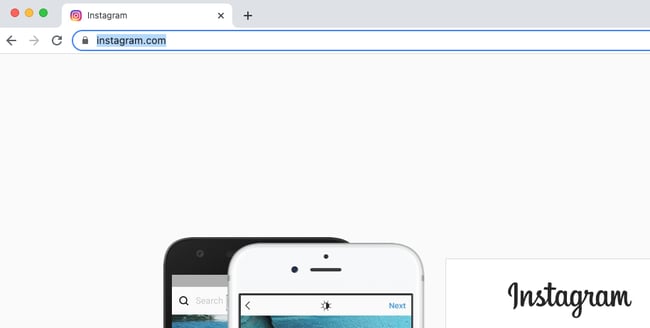
Next, navigate to https://www.instagram.com by typing it into the navigation bar. Log in using your Facebook credentials or by inputting your email, phone number, or username. If you’ve logged into Instagram’s web version before, it might include an option to “Continue as [username],” and you’ll be able to automatically log in.
3. Click the “+” button next to the DM symbol.
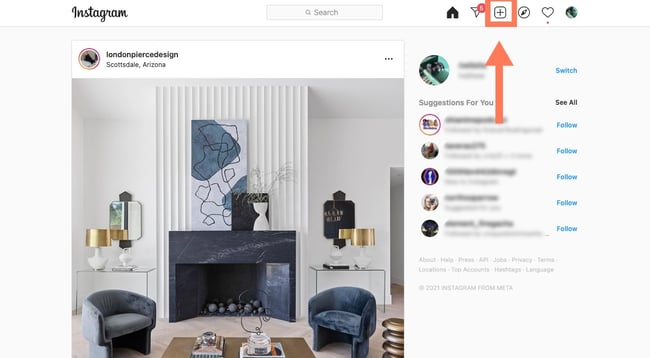 Instagram’s web version has a top navigation bar that mirrors the navigation bar on the mobile app. It includes a search bar, a home symbol, a DM symbol, a plus sign, a heart, and a circle with your profile picture. Click the plus sign next to the DM symbol.
4. Click “Select from computer” to upload your media.
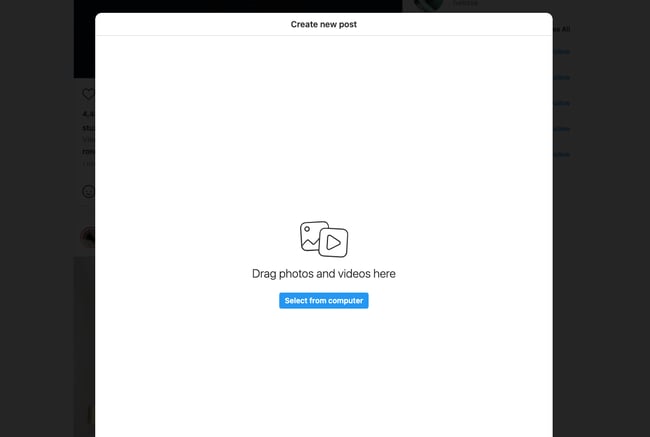
A popup box will appear with a blue button that says “Select from computer.” Browse until you find the file you’d like to upload.
5. Crop the image, zoom in, or add more media if needed.

Instagram gives you several options for editing the image prior to publication. You can change the aspect ratio, zoom in, or add more media to the same post.
The zoom-in option is right next to the aspect ratio button:

You’ll find the “add more media” button on the lower left-hand corner.

Click the plus sign to add more images to your post, if desired.
6. Choose a filter or make adjustments.
 Next, choose a filter, just like you would in the app. You can also adjust brightness, contrast, saturation, and other features.

Once you’re done, click Next in the top right of your screen.
7. Add a caption, location, alt text, and tags.
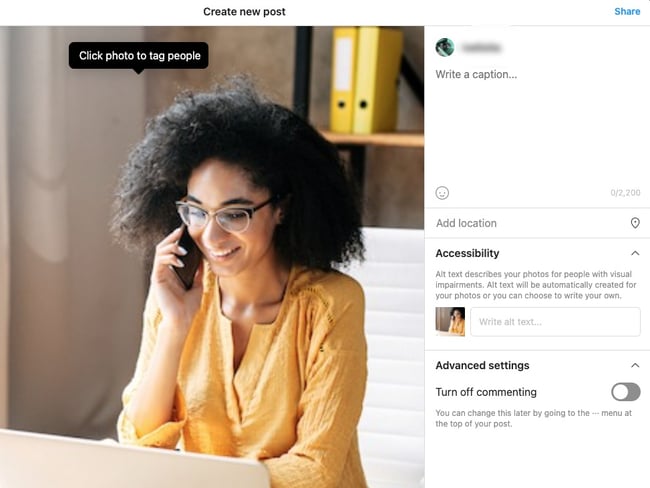 On the next screen, you’ll be able to add a caption, add a location, or tag people.
8. Click Share.
When you’re ready, click Share in the top right of your screen.
Done! You’ve now posted on Instagram using Chrome.
1. Open up your Safari browser.
The first thing you’ll want to do is open up Safari. To do so, open up Launchpad and find Safari in your list of applications. Alternatively, if you have it pinned in your task bar, you can open it from there.
2. Navigate to Instagram’s website.
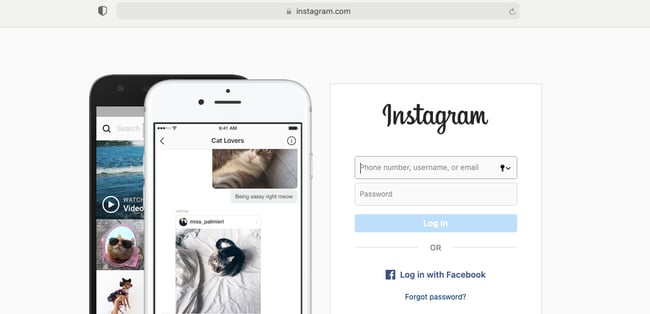 Next, navigate to https://www.instagram.com by typing it into Safari’s navigation bar. If you visit the site often enough, Safari may also have a shortcut in your “New tab” page.
Once you get there, login with your preferred credentials. If you’ve already used the web version in the past, Instagram will allow you to log in with one click.
3. Follow steps 3 to 8 from the instructions above.
Once you are able to view Instagram from your Safari browser, you can upload an Instagram post the same way you would on Chrome — by clicking the “+” button, adding a filter or editing the photo, adding a location and caption, and clicking “Share” when you’re ready for your post to go live.
Want to upload a video instead?
How to Post a Video to Instagram Using a Desktop Computer
You can upload videos to Instagram from your desktop — which makes it easy to share professionally-shot videos that may not be readily available on your phone. That means you can share marketing videos and shoots you received from a freelancer or your in-house videographer.
Here’s how to post a video to Instagram on any web browser.
1. Head to the Instagram website on your preferred browser.
Once you’re there, log in using your credentials.
2. Click the “+” button next to the DM symbol.
Just like you would if you were posting a photo, click the + button in the top navigation bar of your Instagram feed.
3. Click “Select from computer” to upload your media.
Select your video file from the computer. We recommend uploading an MP4 file to avoid compatibility issues.
If your video is less than 10 minutes long, your file size should be no bigger than 650 MB. For videos between 10 minutes and 60 minutes (which is the maximum length), you should aim for a file size smaller than 3.6GB. Read more about Instagram’s video requirements here.
4. Resize your video and add more media if desired.
 Instagram gives you two options for adjusting your video: Changing the aspect ratio and adding more media. For photos, Instagram also allows you to zoom into the picture. The option isn’t available for videos.
If you’re uploading a horizontal video, we recommend using a 16:9 aspect ratio so that it’s not cut off. If you’re worried about the aesthetics of your feed, stick to a 1:1 ratio. That way, there isn’t any white space when visitors visit your profile.
5. Choose a cover photo, trim the video, and toggle sound options.

Next, you can choose a cover photo (the image users will see before they click “Play”). You have the option of uploading a custom cover photo for the video, and you can also trim the video and turn the sound off if desired.
6. Write a caption, tag other users, add alt text, and toggle commenting options.
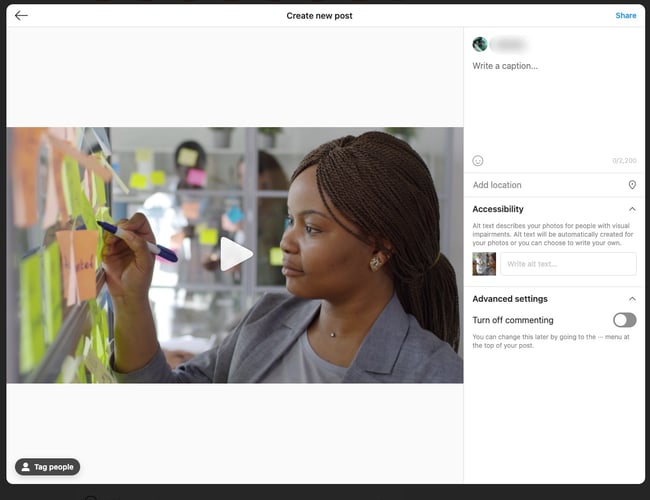 In the next screen, you can write a caption for your video, tag anyone who appears in the video, add alt text, and disable commenting.
7. Click Share.
Done! You’ve now posted your video on Instagram.
Alternative Ways to Post to Instagram from Your Computer
You don’t have to access Instagram’s web version to post on Instagram. If you find the web version to be too lacking for your day-to-day tasks, especially if you’re a social media manager, you can use a third-party service that offers social media scheduling software.
HubSpot’s social media management tool is one of the best options you can use to schedule Instagram posts from your desktop — no need to access the Instagram app or website itself.
Here’s one example of us scheduling a video post for Instagram using Social Inbox:
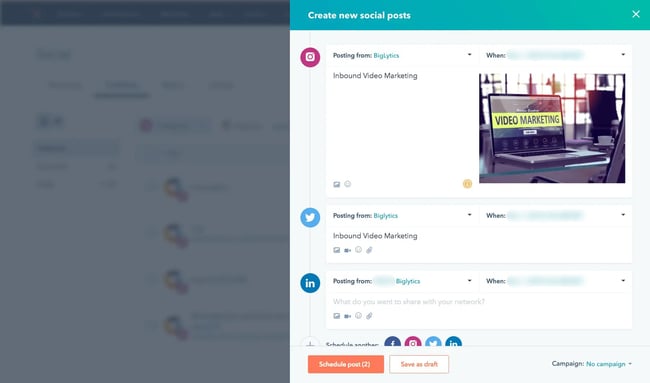
The great benefit of using this method is that you can schedule posts well in advance. You don’t have to access Instagram every time you want to add new media to your profile.
If you’re doing this regularly for your job, it might be worthwhile to explore all the social media scheduling tools at your disposal to choose the one best-suited for your business’ needs.
Using Instagram Like the Pro You Are
Now that you don’t have to worry about transferring photos to your mobile device or juggling your work’s social media account on your own device, you’ll be able to grow on Instagram efficiently and effectively. From there, the sky is the limit for creating posts and growing your audience in a scalable way.
Editor’s note: This post was originally published in October 2020 and has been updated for comprehensiveness.

Website Traffic Down? How to Diagnose and Fix Traffic Drops
Website traffic represents the volume of users visiting your site. Higher is better because more people visiting your site means more opportunities for advertising, engagement, and eventual conversion.
Ideally, you want to steadily increase website traffic, or at least keep it stable over time. But what happens if your traffic starts to drop? Whether it’s slow or sudden, the results are the same: A smaller pool of users who are seeing your content and potentially generating revenue for your brand. Even more worrisome for site admins is that traffic drops may not have an obvious cause. With multiple traffic sources and factors that influence your site ranking and accessibility, even small drops may be the result of several independent or codependent conditions.
While there’s no quick fix for these drops, we’ve got you covered with actionable tips to pinpoint, diagnose and address falling traffic.

Why is my website traffic down?
To boost traffic levels, site owners must first discover why traffic is down. With multiple traffic sources such as email, social media, organic, and referral, it’s not enough to simply know that traffic is falling — you need to identify the source of the drop itself and then take steps to specifically address the problem.
There are several ways to determine which traffic source is driving your numbers down. Let’s take a look at those next.
How To Identify the Source of Traffic Drops
HubSpot Sources
If you’re using HubSpot’s CMS, you can leverage HubSpot Sources to determine where your traffic is coming from. Here’s a step-by-step guide on how to do this.
Step 1: First, you need to install the HubSpot tracking code on your site. Head to your HubSpot account and click the Settings icon in the main navigation bar.

Step 2: Next, head to Tracking & Analytics and then Tracking Code on the left sidebar.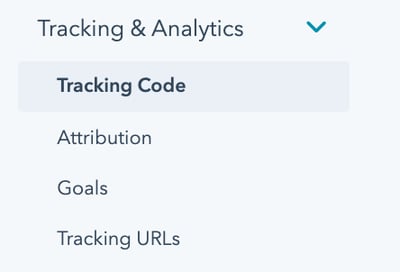
Step 3: Now you should see the tracking code.
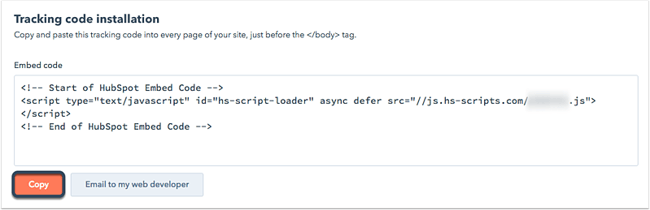
Copy the code and then paste it before the </body> tag in the HTML code on each page of your site you want to track.
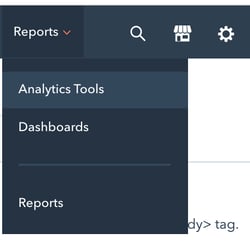
Step 4: Once that’s done, head to the Reports section of your account and then Analytics Tools.
Step 5: Next, select Traffic Analytics.
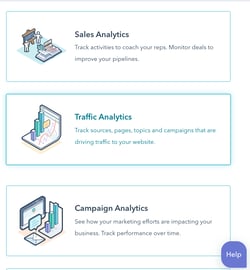
Here, you’ll see the Sources tab, which displays total sessions as a line chart broken out into different colors by traffic type including referrals, social media, email marketing and direct traffic.This gives you a visual representation of where your traffic is coming from and how it’s changed over a specific period of time.
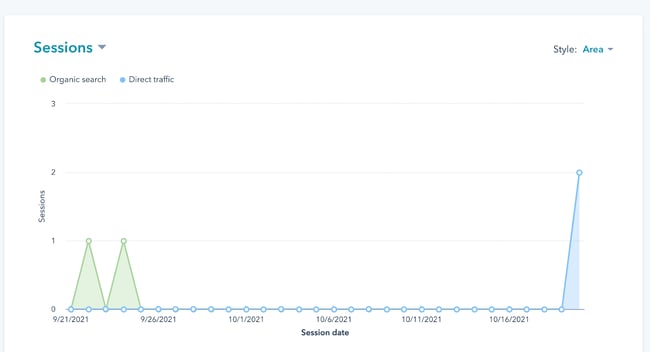
Google Analytics Acquisition Channels
You can also identify traffic sources using Google Analytics.
Step 1: Start by logging into your Google Analytics account and selecting the Acquisition tab.
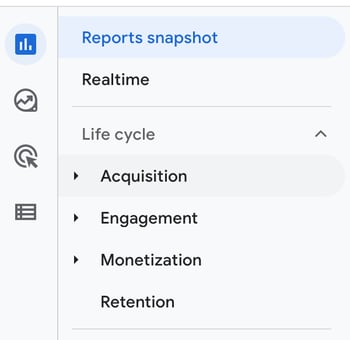
Step 2: Then, select All Traffic followed by Source/Medium. 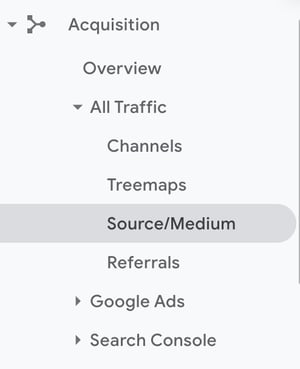
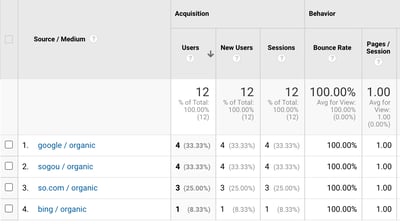
This will provide you with a list of traffic sources to your website along with the number of users they’ve brought.
Diagnosing Traffic Drops
Once you’ve determined the source of your traffic drops, you need to diagnose the problem in-depth: What conditions or actions are causing traffic to fall?
Let’s take a look at some common traffic categories and some questions you can ask to determine what’s going on.
Organic Traffic
Organic traffic refers to visitors who land on your site after conducting a web search and clicking on links from the search engine results page (SERP). It’s called “organic” traffic because it doesn’t come from paid advertising or marketing but instead occurs naturally — or organically — as a result of search queries.
If you notice that your organic traffic is down, ask yourself:
Where is my site in the search rankings?
The higher you rank on the SERP, the more likely you’ll earn organic traffic. Do a quick search for your site’s primary keyword and see what comes up. If you’re not on the first page of the search results, then your site is struggling to get visibility in the SERP.
How is my SEO?
Search engine optimization (SEO) is the process of optimizing your website so search engines will find it and rank it highly against similar sites. If each of your webpages isn’t strategically targeting keywords related to your business, you could be missing opportunities to bring traffic to your site.
Direct Traffic
Direct traffic arrives at your site after typing in the name of your site directly, navigating to it through a bookmark or clicking on a direct email link. If you see direct traffic taking a dive, consider:
What do my URLs look like?
Your URLs should be as simple, clean and concise as possible. If you have pages with long and convoluted URLs, users may be attempting to reach your page but find a 404 error instead because they typed your website address into the web browser incorrectly.
Have I recently updated pages?
If you’re recently updated webpages, look for any changes in URLs. If you’ve made changes without properly redirecting the old links to the new ones, visitors may be seeing error pages which will result in traffic drops.
Referral Traffic
Referral traffic typically comes from other sources such as site lists or blogs. This type of traffic is often part of link building campaigns. For example, you might draft and submit a guest blog to a popular website and include a link back to your site at the end.
If you suddenly see a dropoff in previously consistent referral traffic, ask yourself:
Are backlink sites ranking well?
Blogs and site lists can drive referral traffic, but only if they’re getting visitors as well. If you’re seeing a drop, search for your referral sites and see how they rank.
Do my links point to the right page?
Just like the in direct traffic example above, make sure your links are pointing visitors to the right page. If you’ve made recent URL updates, contact blog or site list owners to have them amended.
Paid Search Traffic
Paid search traffic is exactly what it sounds like: Paid ads within the search engines that display advertisements for your website in search results. The more you spend, the more often your ad will appear and the closer it will be to the top of search results.
If you see paid traffic stalling, ask yourself:
Are my ads in the right place?
Ads only work if they’re targeting the right audience. If you own a window-washing company, then it’s not a good idea to display ads on fashion advice blogs because the quantity and quality of traffic probably won’t match your expectations.
Email Traffic
Email traffic comes from links in emails you send to current and prospective customers. These might be newsletters, sales flyers, or targeted advertisements based on customer preferences. If your email traffic starts to decline, consider these questions:
Do I have the right market?
Effective email campaigns target the right market. You need to know who your customers are, how they prefer to interact with brands, and how much they’re willing to spend to create effective emails. If your target market is loosely defined — or absent — start with email marketing tools to help identify your ideal customers.
Are current emails effective?
Not all emails are created equal. Information alone isn’t enough to capture consumer interest — brands must also include actionable next steps that encourage users to click through. To help boost email efficacy consider A/B testing: Create two versions of a marketing email and see which one produces better results, then repeat the process to refine as necessary.
Social Media Traffic
Social media traffic comes from sites like Facebook, Twitter and Instagram when customers click through on one of your posts and arrive at your website. If your social traffic starts sliding, ask yourself:
Do my social media posts drive action?
Social media posts need to do more than get users to stop scrolling — they must provide enough information to get users interested but leave enough left unsaid to prompt action. In practice, this means creating optimized social posts that convince customers to click through and see what you have to offer.
Am I using the right platform?
Image-driven platforms such as Instagram are great for brands that use images to highlight popular products. Service-based brands, on the other hand, often see better performance from sites such as Facebook. Drilling down to see which platforms are driving your traffic can help pinpoint ideal marketing channels.
While there’s no single way to fix traffic drops, there are general steps that site owners can take to help remedy these issues:
1. Run traffic reports to identify recent changes.
In most cases, traffic drops are the result of multiple factors that combine to lower the number of unique visitors that arrive on your site. Your best bet in this situation is to look at any recent changes to your website, linking strategy or advertising goals.
For example, if you’ve just done a site-wide update to improve the overall design and user experience (UX) and traffic has dropped as a result, run reports to see where your traffic is coming from and if there are specific sources and mediums that have seen a sudden drop. If you notice that direct and referral traffic are down, this may be an indication that URLs are no longer pointing to the right pages.
In order to keep your traffic up, you’ll want to make sound decisions on this data. If you notice one source or medium, in particular, is contributing to the drop, take a look at your processes and workflows there for any gaps that are causing your site to perform poorly.
2. Be better than the competition.
Sometimes it’s not your site that’s the issue. If your competition has managed to corner the SEO market for your industry or have changed their marketing techniques to better target shared customer segments, you may see a drop in traffic.
To determine if this is the case, start by searching for your site’s primary keywords across popular search engines and see what comes up. If you notice competitor sites have pushed yours down the list, they may be outperforming your search optimization. It’s also worth checking your sources to see if social media traffic is down — if so, your competition may be doing a better job driving organic interest across social platforms
To fix this problem, you’ll need to write content and design webpages that are better than every website ranking above yours. This means targeting a specific buyer persona with each page and having clear calls to action.
3. Keep your site healthy.
Site conditions have an impact on how your website is indexed and ranked by search engines. If you see traffic sliding, take a look at current conditions and how they may impact users.
For example, if your site is slow to load because of large image or video files, users won’t stick around and search engines will penalize your ranking. Issues around layout and functionality are also problematic. Broken links or content that’s all fluff and no function may be increasing the number of users who arrive at your site and immediately leave, in turn dropping your site in search rankings.
Using a content delivery network (CDN) can help videos and images load faster while a tool like Ahrefs’ SEO toolbar can spot broken links on a page so you can fix them quickly.
For even more tips on how to boost traffic to your site, check out HubSpot’s free website optimization course.
Tackling Traffic Slowdowns
Traffic drops may be slow-and-steady or sudden and substantive. In either case, however, they have the same result: Fewer visitors on your site and fewer opportunities for customer conversion.
To address these traffic issues, start by identifying the likely source, then consider potential issues tied to specific traffic mediums. Finally, take action to address common traffic concerns — with any luck, you’ll soon be back up to speed.
Editor’s note: This post was originally published in January 2011 and has been updated for comprehensiveness.

How to Sell on Twitter With These 13 Tips
Connecting with your audience on social media might seem as simple as a post and a follow, but it’s actually a lot more complex. Twitter as a marketing tool can apply to PR, thought leadership, brand building, and lead generation. Selling on Twitter takes some skill and practice, but it’s a viable platform for growing your business that is definitely worth the effort.
![Download Now: How to Use Twitter for Business [Free Kit]](https://no-cache.hubspot.com/cta/default/53/190da11f-58c6-41d5-a397-843618741e09.png)
What can I sell on Twitter?
The short answer is: Anything! The great thing about social media marketing is that it can be used to sell such a wide variety of products. There’s a lot of business to be done on the internet across many channels. There is a niche somewhere on the web for anything you may have to sell. To tap into your niche and sell on Twitter like the pros do, follow these best practices.
The internet can be unpredictable, but there are some specific actions you can take to make sure you get a positive ROI from using Twitter. No sale is guaranteed, but utilizing some of these best practices will help you get the most out of Twitter as a tool for sales.
1. Interact with your audience.
Social media was created for people to be social, so don’t be shy! Respond to your mentions and retweets, do Q&A sessions, and be active with not just your followers but other relevant people in your industry. This helps build interest and trust that will encourage your audience to participate in the conversation, too.
2. Share things your market is interested in
Your stream of tweets shouldn’t only be about what you are selling. Users will be more likely to follow you if they see that you are sharing content they want to see and posts they can relate to. And the more eyes you can get on your profile, the more potential leads you’ll have.
3. Monitor your company’s reputation.
Keep track of what users are saying about your business online with routine social listening. Anytime you or your product is mentioned, check out what is being said so that you’re aware of how people are discussing it. Analyze the information for any helpful insight to improve what might be preventing leads from becoming customers.
4. Be consistent.
The Twitter algorithm favors users who tweet frequently and consistently. To help you do this, there are a lot of social media management tools that allow you to schedule posts in advance. This way, you don’t feel pressured to open the app everyday and think of something new and insightful to say. A scheduling app can keep your Tweets consistent, which means your leads will stay consistent, too.
5. Take feedback.
Don’t just watch what users are saying about your business or your product, actually listen. Customers who have had a negative or positive experience may voice their opinion on Twitter. Take the free feedback you would usually need to pay a focus group for and apply changes that can improve your sales.
6. Stay updated on industry news.
Stay on top of big (or small) changes in your industry by checking Twitter frequently. For example, if you heard that your competitor made a big announcement but you don’t know the details, search on Twitter for the competitor’s name to find out the latest news and what people have to say about it. Twitter’s real-time updates are great for getting wind of big news before it’s even published across the web. This upper hand will inform you of ways to gain more sales over the competition.
Social media has grown immensely as a business tool which means you will always be behind the competition if you’re not using it. In fact, Twitter’s monetizable daily active users (mDAU) amounts to 206 million people. That’s a ton of opportunities to sell on the platform. Some of those users could fall within your target audience. Unfortunately, a large following alone doesn’t guarantee sales, so use these tips to best take advantage of the platform for business revenue.
Using Twitter as a platform for selling your product can be really effective if you do it right. It’s not just about building a big following or promoting the most content. Focus on the following tips to improve your sales through Twitter.
1. Have a plan.
Don’t dive into selling on Twitter blindly. Create a strategy for Twitter marketing that works for you and your product and then execute it.
2. Determine which trends and hashtags will benefit you.
You don’t need to go viral in order to be seen, but you do need to put yourself in a position to be found. Following relevant popular trends and using hashtags will put your profile in front of the users that are seeking your content.
3. Build a great profile.
It’s easy to completely customize your Twitter profile with adjustments that fit your product. Even your “handle” doesn’t necessarily have to simply be the name of your business, it could be related to your product or your branding. And this also includes having a special pinned tweet that you want to call attention to as part of your profile.
4. Establish a personality.
Are your tweets going to be humorous? Serious? Lighthearted? Memes? Decide what you want users to see from your brand and how you want your Twitter profile to express it.
5. Connect with influencers or relevant followers.
Find people who are changemakers in your industry and keep up with them. Continuously check on what they are saying and decide what collaborations could benefit your business. For example, co-branding partnerships are a mutually beneficial offer you could make to another successful brand that you connect with on Twitter.
6. Mind your following to follower ratio.
Believe it or not, the myth that users care about your follow-back ratio is actually true. It’s a signal of the success of your account, so be more selective about which users you choose to follow.
7. Don’t be afraid of promotions.
Twitter ads are an awesome tool that you should take advantage of. They are a smart way to promote your brand and your product once you target the correct audience.
Use Twitter Effectively as a Selling Tool
Different social media platforms require different strategies to be effective. For instance, Twitter is focused on text while Instagram is focused on media. Consider the unique aspects of Twitter as a platform and use them to your advantage as you’re developing a strategy. Social media is an important tool for selling your product that can’t be ignored as you continue to grow your business.
Editor’s note: This post was originally published in October 2009 and has been updated for comprehensiveness.

How to Find, Choose, & Hire the Best B2B Marketing Consultant or Agency
Marketing is an umbrella term for a wide variety of methods and strategies meant to benefit your business. Your business has different needs that will require different types of marketing efforts. For instance, engaging with your audience and improving sales are related, but still separate goals, so you can’t apply the exact same strategy for both. And if your need is to connect your business and product to other businesses, it will require business-to-business (B2B) marketing.
Growing and expanding your business will require a strong marketing plan. Running a business doesn’t require the exact same skillset as marketing a business. Many marketing professionals will specialize their focus on a specific sector, such as B2B marketing. These consultants or agencies utilize their specialization to help businesses improve their marketing strategies.

The Benefits of Hiring a Consultant
Focusing on a specialty has a lot of benefits compared to having surface-level knowledge of a general topic. Hiring a consultant will give you more time to focus on your business while they build you an effective marketing strategy. A consultant will also bring a fresh perspective and a new angle to your marketing. As well, they only have one role that they can dedicate their full time to. It’s also easier to teach one person your business needs and style versus a group.
How much does B2B consulting cost?
According to ZipRecruiter, the national average pay for a marketing consultant is $26 per hour. That may be a good starting point for you to configure your budget. Figuring out your budget will determine how much you can spend on a B2B consultant or agency. These marketing professionals may charge a fixed fee, invoice their materials and time spent later, or request a base fee with an added risk/reward element based on the achieved outcomes. For a longer project, they may ask for a monthly or annual retainer that guarantees them a fixed fee.
The Benefits of Hiring an Agency
Consultants may only offer strategy, planning, or execution, while an agency can accomplish all three. An agency may also be able to give you more individualized attention because they have more (wo)manpower. Hiring a marketing agency is especially necessary for businesses that don’t have a large in-house marketing division. Outsourcing the entirety of your B2B marketing efforts will take the burden off of you and your employees.
Choosing the right agency or consultant for your business will take some searching. Hiring the wrong marketing help could end up being a waste of resources and your budget if they end up not making progress toward any of your goals. Follow these steps to hire the best one for your business.
1. Define the outcomes you want to achieve.
There’s a reason why you’re seeking the help of a consultant or agency for your B2B marketing. Pinpoint what you want to be improved, whether that is improving something specific within your current marketing strategy or developing a brand new strategy. These goals should be structured in a way that allows them to be tracked so that you can monitor progress toward achieving them.
2. Decide whether you want an agency or a consultant.
The outcomes you previously defined will help determine whether you need an agency or a consultant. If you have a smaller budget and a more specific need, then a consultant would be a good choice. If you have a larger budget and a more broad need, you may do better with a consultant.
3. Choose a budget and stick to it.
When configuring a budget for your marketing efforts, don’t forget to weigh the risk versus the reward. If the reward that you stand to gain is substantial, then it may be fair to advocate a bit more of the budget to your B2B marketing efforts. Then, search for agencies or consultants within your budget.
4. Establish what specialties your hire should have.
Narrow the list even further by focusing on the professionals that have experience in your industry, ideally with exact B2B marketing experience in your industry. Use your desired outcomes to choose what work history and skill set your top candidates should have.
5. Create a shortlist.
Once you’ve found some candidates within your budget that have a skill set that aligns with your goals, you can start naming some to a shortlist. Choose candidates that you believe are worth interviewing that might be a good fit for the role.
6. Pick 10 insightful interview questions.
What do you really want to know about a potential B2B consultant or agency? Have they accomplished your specific needs for another organization in the past? Do they have creative ideas? Ask them about how they handled certain situations or what strategies they’ve developed with other businesses in the past.
7. Begin the partnership!
The most exciting part comes when you see one agency or consultant stand out among the rest and you can confidently choose them as your top pick. Get the paperwork written up and start the process! Confirm the goals of this partnership with your new hire and start working on your new B2B marketing plan.
Hire a B2B Marketing Consultant or Agency
Before you hire your B2B marketing agency or consultant, you should have set clear goals to accomplish with their help. After the decided strategy is implemented, continue tracking progress toward the desired outcomes. This will help you see how valuable or effective the help of the consultant or agency ended up being for your business. As well, ensure that any strategies or methods that were implemented for the long-term continue to be maintained if they are working well.
Editor’s note: This post was originally published in February 2009 and has been updated for comprehensiveness.

7 Problem Solving Skills Marketing Managers Need & How to Improve Them
Think back to a time you had to solve a problem but didn’t have all of the right information. What did you do? Situations like this pop up all the time at work and put your problem solving skills to the test.
As a marketing manager, one may think your job doesn’t revolve around problem solving. But it’s an essential part of putting out fires at work — and making sure there’s a process in place to prevent issues from happening again.
![→ Click here to download leadership lessons from HubSpot founder, Dharmesh Shah [Free Guide].](https://no-cache.hubspot.com/cta/default/53/4e634041-e1ce-4a85-8e65-aea12fc10b84.png)
Whether you’re making decisions that affect an entire team or simply creating solutions for yourself, strong problem solving skills can help you grow as a person and a professional.
In this post, we’ll cover what it means to come up with creative solutions and how to hone the skills to approach problems like a pro.
What are problem solving skills?
Problem solving skills allow you to notice an issue, identify the root cause, design an effective solution, and successfully implement it. This includes the skills to evaluate whether or not your plan achieved the results you wanted.
The best problem solvers can anticipate problems before they arise and take action to prevent them or lessen the impact. They use logic to define what needs to change and creativity to propose innovative solutions.
Having strong problem solving skills can help you impress your manager, contribute unique ideas, and achieve your goals. It also means you can work through the core steps of solving a problem:
- Identify and define the problem.
- Come up with possible solutions.
- Evaluate the options.
- Choose the best solution.
- Implement the solution.
- Evaluate the outcome.
While there are many types of problem solving skills, many are considered soft skills that you develop over time. Think communication skills, people skills, social skills, and personality traits. For example, a marketing manager needs to be able to solve a conflict between team members or devise a plan to keep their campaigns going if the company marketing budget is cut.
While problem solving skills can require you to use your technical ability, you have to establish a number of specific soft skills to identify issues and implement solutions.
Problem Solving Skills Examples
No matter your career path, being an effective problem solver is beneficial for personal and career growth. Here’s a look at the skills you may use when solving a problem:
- Analysis
- Creativity
- Judgment
- Communication
- Organization
- Teamwork
- Evaluation
Problem Solving Skills Marketing Managers Need
A marketing manager who notices issues and makes decisions to solve them is a valuable addition to any company. This type of person gets things done and motivates others to do the same.
The further you grow in your career, the more problem solving skills you need to have in your toolkit. The higher up you get in an organization, decisions become riskier, solutions are often more vague, and the potential impact can be monumental to the company.
Let’s look at the top problem solving skills you need to be a successful marketing manager.
1. Analytical Skills
Solving any problem starts with analyzing the issue — you have to go beyond the symptoms of the problem to find the root cause.
Maybe your team is routinely going over budget on social campaign spend. Instead of micro-managing every detail, analytical skills help you dig into the problem to see what may be going wrong. You find that your social media coordinators can set up campaigns correctly, but they lack the basic budgeting skills to keep spending on track. So you devise a training program to teach them about profit, loss, and financial forecasting.
Being analytical can include a number of essential problem solving skills for marketers:
- Attention to detail
- Data collection
- Forecasting
- Research
- Fact-checking
- Historical analysis
2. Creativity
Once you discover the true problem, you can come up with the ideal solution. This is where you put your creative problem solving skills to the test. And for those who question whether creativity plays into solving problems, creativity is one of Indeed’s top 20 in-demand skills for 2021 across all industries and fields.
Sometimes the solution to a problem is not always straight-forward, and can require creative thinking and other points of view to be resolved.
Creativity comes in many styles. Engineers can create innovative code, and writers can come up with new blog styles. For marketing managers, creativity plays out in a number of problem solving skills:
- Brainstorming
- Curiosity
- Project design
- Project planning
- Editing the aesthetics of marketing materials
- Creating new promotional methods for products
- Planning and executing events
3. Judgment
With dozens of solutions before you, how do you choose the best one? Through exercising sound judgment. Developing good judgment lets you consider the nature of a problem, possible setbacks, costs and resources, decision makers, and how to implement a solution. You can compare between options and select the solution that’s right for each unique situation.
As a marketing manager, you can showcase your judgment skills through:
- Critical thinking
- Deduction
- Prediction
- Decision-making
- Discussion
- Corroboration
- Test development
- Authenticity
- Leadership
4. Communication
Communication skills are the foundation of problem solving and one of the top leadership skills. As a manager, you need to be able to articulate your opinions, brainstorm with a colleague, and give feedback to a direct report. Being a good communicator also helps you relay your decision on a solution and align everyone to tackle it together.
Without specific problem solving communication skills, issues can’t be resolved quickly and efficiently. That’s why to be an effective leader and expert problem solver, it’s important to make sure you have the following communication skills:
- Active listening
- Patience
- Persuasion
- Negotiation
- Mediation
- Clarity of expression
- Public speaking
- Reading body language
- Verbal communication
- Written communication
- Building rapport
5. Organization
Once you’ve chosen a solution to a problem and communicated it to your team, you still have to create a process to carry out your plan. Organization skills help you implement the steps everyone needs to take, which can improve alignment and efficiency.
Setting up a strategy for your solution uses a number of problem solving skills including:
- Prioritization
- Initiative
- Project management
- Project planning
- Time management
- Meeting facilitation
- Recording and filing information
- Creating strategic schedules
6. Teamwork
No marketing manager is an island. Teamwork is essential for working with others and contributing to a company’s mission. It’s necessary for exchanging ideas, delegating tasks, and working toward a solution.
Even if your role is largely independent work, you still need teamwork to collaborate with colleagues in different departments and keep your goals on track. But as a marketer, your role usually involves interacting with multiple people (if not dozens) per day. So you need to develop the skills that will make everyone want you on their team.
- Collaboration
- Delegation
- Giving and receiving feedback
- Goal setting
- Dependability
- Resource allocation
- Prioritizing tasks
- Setting expectations
- Assessing employee strengths and weaknesses
- Setting expectations
- Performance evaluation
- Identifying outcomes
- Trust
- Respect
7. Evaluation
When problem solving, evaluation skills let you assess if a solution is working and help you make the necessary adjustments. These are similar to analytical skills, but often require more patience and flexibility in case your strategy didn’t go as planned. It’s important to know whether or not your plan is working as quickly as possible so you can pivot and try another solution.
- Data analysis
- Adaptability
- Creating and evaluating surveys
- Customer feedback
- Follow-through
- Troubleshooting
- Resilience
- Integrity
- Identifying patterns
- Open mindedness
How to Improve Problem Solving Skills
Developing your problem solving skills isn’t as straightforward as mastering Excel. But marketing managers can take several steps to improve their skills and advance their careers.
Question your decisions.
Relying on your gut instinct isn’t the path to expert problem solving skills. Instead, try taking time to consciously question why you make decisions and what the outcomes may be if you choose one option over another. You can ask yourself:
- How important is this decision?
- How will this impact me a year from now?
- What’s the worst thing that could happen?
- What effect will this decision have on my team and the company?
- What can I do if I make the wrong decision here?
Look for opportunities to solve more problems.
Many experiences in your personal and professional life help you hone your problem solving skills, often without you even realizing it. You can gain or improve your skills by doing any of the following:
- Figuring out a technical problem with your phone or computer.
- Taking up a DIY project you’ve never tried before.
- Resolving a customer or employee complaint.
- Organizing a team bonding activity, overcoming obstacles along the way.
- Acting as a mentor for direct reports and helping them tackle their problems.
- Re-budgeting your finances to fund an out-of-the-blue trip.
- Finding out why there’s been a dip in activity on your company’s social media channels.
Find models and games to improve your problem solving skills.
A combination of proven models and fun mental games can help you develop problem solving skills. Some can hone your decision-making abilities, while others let you determine the cost of the possible solutions. Depending on which set of skills you want to improve, look to options like:
- 5 Whys (root cause analysis)
- Fishbone diagram (cause and effect analysis)
- Brainwriting (brainstorming technique)
- Starbursting (exploratory brainstorming)
- Hurson’s Productive Thinking model (creative problem solving)
- Lego Master (decision-making and communication)
- Escape Room (group communication and collaboration)
- Line-Up (non-verbal communication)
- Hackathons (brainstorming and creativity)
Demonstrating Problem Solving Skills
Knowing how to solve problems at work is not only crucial for contributing to company goals — it’s also a must-have for moving to management positions. That’s why it’s important to highlight the skills you already have. This includes adding problem solving skills to your resume and showcasing your abilities during job interviews.
Whether you’re looking for a marketing manager role or wondering what to say next time an opportunity to advance at your current company opens up, start with the STAR method. It’s designed to help you think through your experiences so you can articulate your specific problem solving skills. Make sure to give an overview of a challenge you had to overcome, how you approached it, what solution you found, and what outcome you achieved.
Honing your problem solving skills makes you more valuable as a manager and team member. So putting in time to develop the skills most relevant to your current (and future!) roles can make it easier to climb the ladder and come up with efficient, effective solutions.


What Are Remarketing Lists for Search Ads (RLSA)?
Have you ever visited a website, looked at a product, left the site, but then seen an ad for that exact same product you were looking for on Google? I come across ads like this multiple times per week.
The reason we see these ads is because we’re placed on remarketing lists — we’ve shown interest in a product and a business wants to remind us that it’s still available for purchase if we’re interested.
As a business, using remarketing lists helps you make contact with pre-qualified prospects in an attempt to drive a conversion. In this post, we’ll explain how, as a business, you can leverage remarketing lists for search ads to draw in interested site visitors for conversion, and best-practices for using these lists.

RLSA Audiences
RLSA audiences are created by adding a snippet of code (called a tag) to your website that automatically adds your audiences to specific lists based on the action taken on your site. Once the tags are placed, you can bid on these segments and add them to your marketing campaigns. Here’s a guide from Google on how to set these up.
Creating specific RLSA audiences helps marketers leverage the already interested highly-valuable audience members, as it may not be as difficult for them to convert. As a result, you’ll increase conversions, revenue, and profits. You’ll also make the most of your budgets because these users are more qualified, so you’ll spend less on brand awareness.
If you’re feeling a bit confused, consider this example: you sell fiberglass pools and a user on your site has started a work order for pool maintenance, but then they bounce. Since they came so close to conversion, you can add them to a remarketing list and serve them ads for your business every time they query “fiberglass pools,” or related keywords.
Let’s go over some best practices for using RLSA campaigns in your marketing.
RLSA Campaign Best Practices
1. Know your audience before beginning.
As with any marketing process, it’s critical to understand your audience before creating your RLSA lists and running your ads. Consider creating buyer personas and customer journey maps to learn what customers are thinking about in different stages of your journey for better targeted ads.
An additional step could be to modify your bids based on audience demographics. If your users are signed in to Google when making their searches, you’ll be able to further segment and adjust your bids and lists based on available information, like age and gender.
2. Change bids by user stage.
If you’ve created accurate journey maps, you likely know which customer actions are most critical to driving conversions for your audience — this is where you should use RLSA. Use your website codes to track where your users are in their journey, and bid higher for those closer to conversion, a.k.a the closer they are to completing a purchase.
3. Match messaging to user action.
Ensure that the messaging in your RLSA ads matches the action you want the user to take or the action they have already taken that got them placed on your list.
For example, if a visitor landed on a pricing page, you can share an ad with them that calls attention to an upcoming discount.
To do this, you can create specific tags within your Google Ads account that note which action a user took and modify your bids to show relevant copy based on the action taken.
4. Upsell to converted users with related products and services.
You may not think to use RLSA on converted users, but it’s a worthwhile strategy if you sell products or services that enhance experiences if used together.
For example, if you sell cameras, you won’t advertise camera equipment to users that haven’t checked out on your site. Once a user has made a purchase, though, and you have a unique list for those that have taken that action, you can serve them ads for camera equipment in an attempt to upsell.
With this tip, it’s important to note that not all converted users are worth retargeting with RLSA. For example, suppose you have a user that is currently in negotiation with a sales rep. In that case, it could be a waste of money to retarget them because they may be ready to convert after conversations with your team.
5. Bid for broad terms.
While it’s important to bid for terms directly related to your business, it’s also worthwhile to bid for broad search terms related to your business that your audiences may search for as well. For example, if you sell SaaS, your audiences may be searching for your competitors before deciding, so you can bid on competitor brand names.
If you choose to go this route, ensure that you’re not spending all of your money on broader terms, as your business-related keywords are the most relevant.
RLSA Campaign Example
A few weeks ago I was working with my friend’s mom to surprise him with a birthday present. He likes to travel, so we decided that a TSA-approved suitcase was the way to go. I spent a lot of time doing research on different sites and visiting multiple pricing pages.
I placed a product from a brand called Away in my cart, but we ended up purchasing from a different company. Away likely tracked how close I got to conversion and added me to an RLSA list. Now I see this a paid targeted ad from Away in search results for the words “luggage” and “TSA suitcase,” as shown in the image below.
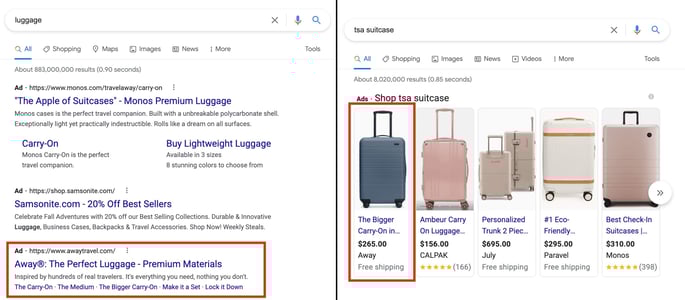
Over To You
The users that you choose to place in your remarketing lists should help you drive conversions.
Take the time to create detailed customer journey maps to know critical points of conversions and create corresponding lists. As a result, you’ll likely find your RLSA campaigns drawing in leads and increasing business revenue.

17 Marketing Job Descriptions for Hiring Managers & Job Seekers
Looking to grow your marketing team? As you embark on the hiring process, don’t neglect the importance of providing clear, well-written job descriptions for your team’s open roles.
Having accessible and easy-to-understand job descriptions can make or break the quality of candidates that apply for a job. According to Indeed, 52% of job seekers say the overall quality of a job description is an influencing factor when they decide to apply for a job. That means if you want a pool of high-quality applicants, it’s imperative to provide a high-quality job description.
![→ Click here to download our free guide to hiring and training a team of all-stars [Free Ebook].](https://no-cache.hubspot.com/cta/default/53/c42148d7-13dd-4c38-b907-cff1602ee62f.png)
 As you embark on writing job descriptions for open roles on your team, make sure you include the following pieces of information.
Marketing Job Requirements and Qualifications
What kind of experience will the ideal candidate have? Factor in the level of seniority needed for the role, as well as realistic asks for your candidate pool given your compensation budget.
Job requirements and qualifications can include desired education level, and areas of previous experience a candidate would need to have to be successful in the role. It’s worth noting that the requirements and qualifications section can be intimidating for some job applicants, and if it’s too extensive you could scare off candidates who may be a good fit for the role even if they have a different level or type of experience.
Marketing Job Responsibilities
This section should clearly outline what tasks and duties the person in this role will be responsible for. When a candidate reads the job responsibilities section, they should be able to clearly understand what the role entails and how the role fits into the broader organization.
Marketing Job Skills
Similar to job requirements and qualifications, this section should state what technical and/or soft skills are needed for a candidate to perform in the role. For example, if you’re looking to hire a content marketer you may list “strong writing skills” as a mandatory skill. Or if you’re hiring a marketing analyst, you may list “data analysis” as a skill needed to be successful in the role.
Now that you understand the basics of crafting a marketing job description, let’s discuss the ways a job description will need to be customized for a particular role.
Types of Marketing Jobs
The job description you craft will need to be highly tailored to the role you’re hiring for. After all, if you’re hiring for a technical SEO role you don’t want to create a description that will attract aspiring social media managers. Here are some of the most common types of marketing jobs available for modern marketers:
- Digital Marketing
- Content Marketing
- Product Marketing
- Brand Marketing
- Event Marketing
- Marketing Analysis
Ready to write a job description that attracts stellar candidates? Check out this list of sample descriptions for common marketing roles.
1. Marketing Assistant Job Description
The marketing assistant role is key to helping a marketing organization run smoothly and effectively. Individuals applying for this role should have demonstrated the ability to handle a variety of administrative tasks efficiently and independently.
Job Description:
Our team is hiring a marketing assistant to keep our organization running smoothly. The ideal candidate will have experience managing multiple projects for key stakeholders and maintaining excellent communication.
Responsibilities:
- Support the marketing leadership team through the organization and administrative support for various projects.
- Maintain strong communication between marketing executives and internal and external stakeholders.
- Coordinate employee meetings and communications for the marketing department.
- Maintain executive schedules and oversee project load.
- Plan, prepare and deliver presentations on behalf of the marketing team.
- Conduct research for key marketing campaigns.
Requirements:
- High School Diploma or equivalent experience. BA/BS is a plus but is not required.
- Experience managing multiple projects and adhering to deadlines.
- Clear copywriting and editing skills.
- Strong organizational, communication, and customer service skills.
- Proficiency in Microsoft Office or Google Workspace.
What Hiring Managers Look for in a Marketing Assistant
An effective marketing assistant should be organized, communicative, and able to prioritize while working on various projects. Candidates who can demonstrate these abilities through work experience could be a good fit for a marketing assistant role.
2. Marketing Coordinator Job Description
Do you have someone on your team making sure marketing activities are organized and cohesive? If not, consider hiring a marketing coordinator. In this role, an individual is responsible for managing various projects within the marketing organization to ensure they are on time and within their budget.
Job Description:
Our team has a suite of exciting projects underway and we are looking for the right candidate to help us execute them in the marketing coordinator role. With various campaigns and initiatives on the horizon, we’re hiring a skilled marketing coordinator to design and oversee marketing campaigns across platforms to reach company goals and increase brand awareness.
Responsibilities:
- Work directly with project managers, designers, social media, and content teams to design and implement key marketing campaigns.
- Perform competitive research to understand what’s happening in the market, and incorporate your findings into each campaign for better results.
- Facilitate cross-functional communication among project stakeholders.
- Conduct analysis to determine the effectiveness of each marketing campaign, and report key findings to stakeholders.
Requirements:
- BA/BS or equivalent working experience.
- Working knowledge of customer relationship management (CRM) and content management system (CMS) platforms.
- Demonstrated project management experience.
- Research and analytical skills.
- An understanding of digital marketing tools and tactics.
What Hiring Managers Look for in a Marketing Coordinator
A qualified candidate for a marketing coordinator position should have experience supporting marketing campaigns and conducting research to understand the company’s customer base and ability to reach campaign objectives.
3. Graphic Designer Job Description
If your content isn’t designed well, you risk detracting people from reading and enjoying it — even if it’s beautifully written. Someone on your team may have a natural eye for design, but hacking designs together in PowerPoint isn’t scalable. Professional graphic design is an investment that goes a long way.
Plus, there’s a lot more to great design than making things look good.
Job Description:
We are seeking an experienced graphic designer to own the creation and maintenance of both our marketing assets and content created to support the product and other marketing goals. From concept through execution, this candidate will improve our user experience by bringing our brand to life and keeping it consistent across all our various touchpoints:
Responsibilities:
- Collaborate with marketing and product marketing teammates to support our website design and content marketing (blog, social media assets, and more).
- Help bring new ideas for design and content creation to the team using your expertise and eye for great design.
- Scope and create templates for our marketing team to be more efficient in their posting on social media, the blog, email, and other channels.
- Manage other design needs such as presentations, signage, and trade show collateral as needed.
Requirements:
- BA/BS or equivalent working experience.
- Past experience as either an in-house designer or at a marketing agency. (We require work samples to apply for this position.)
- Experience designing for a content management system (like the HubSpot CMS). This person must create assets for our web team that are mobile-, tablet-, and desktop-friendly and provide a user experience that fits on all three screens.
- Expert in Adobe Creative Suite or similar technologies.
- Knowledge of HTML, CSS, and JavaScript is a major plus.
What Hiring Managers Look for in a Graphic Designer
A great graphic designer is also really good at solving problems. They use their creativity and skills not just to make marketing materials more attractive, but to improve user experience, create brand consistency, and get specific results.
4. Social Media/Community Manager Job Description
Social media has become an integral part of business, with over 91% of retail brands having an active presence on at least two platforms.
So if you aren’t yet using social media marketing to your advantage, it’s time to start. And to do so, you need a social media manager who not only knows social media platforms like they know the alphabet, but who also knows how to develop strategies specific to various social networks, track the right metrics, and integrate the best tools and practices on those platforms.
Job Description:
Do you tweet, share, and post to social media in your sleep? Do you know what it takes to grow an online community? We’re looking for a social media manager to manage our social media accounts by implementing strategies and tactics that grow our followers, engage and retain them, and help convert them into leads, customers, and active fans and promoters of our company.
You should have command of best practices and trends in social media marketing, enjoy being creative, and understand how to both build and convert a digital audience.
Responsibilities:
- Build and manage the company’s social media profiles and presence, including Facebook, Twitter, LinkedIn, TikTok, and additional channels that may be deemed relevant.
- Create shareable content appropriate for specific networks to spread both our brand and our content.
- Monitor and engage in relevant social discussions about our company, competitors, and/or industry, both from existing leads and customers as well as from brand new audiences.
- Run regular social promotions and campaigns and track their success (e.g., Twitter chats, LinkedIn discussions, etc.).
- Work alongside other marketers and content marketers to help distribute content that educates and entertains our audience and supports marketing goals.
- Drive consistent, relevant traffic and leads from our social network presence.
- Explore new ways to engage and identify new social networks to reach our target buyers.
- Track, measure and analyze all initiatives to report on social media ROI.
Requirements:
- BA/BS degree or equivalent work experience.
- Active and well-rounded personal presence in social media, with a command of each network and their best practices.
- Excellent communicator and creative thinker, with an ability to use both data and intuition to inform decisions.
- Proficiency in using social media software (e.g. HubSpot’s Social Inbox) to monitor social media conversations. You will be our ear to the ground to route the appropriate marketer, sales rep, and/or support rep to social conversations.
- Bonus experience and skills include Adobe Creative Suite, demand generation, inbound marketing, and blogging.
What Hiring Managers Look for in a Social Media/Community Manager
A genuine interest in the latest social media trends, and the ability to implement and carry out relevant social media campaigns.
5. Blog Manager Job Description
Did you know that, according to HubSpot’s State of Inbound Report, marketers who have prioritized blogging are 13X more likely to enjoy positive ROI? If you aren’t taking business blogging seriously enough, now would be the time. And hiring a dedicated blogger or blog manager is crucial in creating remarkable content.
You need someone who is not only a great writer and editor, but who can also keep your brand’s voice consistent across daily published content and understand how to use your blog to generate qualified traffic and leads for your business.
Job Description:
We are seeking a savvy wordsmith to join our blogging team. Candidates must have a knack and love for writing, a comprehensive understanding of the industry, and experience in blogging to achieve business goals. The blogger will be expected to sustain and develop the company’s voice across all blog content.
Responsibilities:
- Writing various types of articles on a wide range of topics for our blog.
- Providing feedback to other contributors, and editing other writers’ content.
- Optimizing content for search engines and lead generation.
- Contributing to long-form content projects such as ebooks.
- Conducting analytical projects to improve blog strategies/tactics.
- Growing blog subscribers, converting visitors into leads, and expanding our blog’s overall reach.
Requirements:
- A passion and strong understanding of the industry and our business’ mission.
- Exceptional writing and editing skills, as well as the ability to adopt the style, tone, and voice of our business’ various types of content.
- An analytical mind and interest in using data to optimize/scale blog marketing strategies and tactics.
- Excellent organizational skills to work independently and manage projects with many moving parts.
- 2-3 years of marketing and content creation experience.
What Hiring Managers Look for in a Blog Manager
An ideal blog manager will understand your buyer personas so well that published content addresses their needs, wants, and problems.
6. Inbound Marketing Manager Job Description
If your marketing department is just starting to make the shift to an inbound approach, it’s possible you’ll still need to prove the success of your inbound marketing program.
If this is the case, you’ll likely be looking to hire an all-in-one inbound marketer — someone who can build and grow your inbound marketing strategy from the ground up.
Job Description:
We are looking for an amazing, data-driven inbound marketer to own the majority of the marketing funnel for our company. You will be in charge of attracting site traffic, converting that traffic into new leads for the business, and nurturing those leads to close into customers, the latter of which sales leadership will help you accomplish.
Responsibilities:
- Build and manage a rich content/editorial calendar that attracts a qualified audience to our owned properties (including blog posts, whitepapers, ebooks, reports, webinars, infographics, etc.).
- Grow new leads, including marketing-qualified leads, by converting site traffic through calls-to-action, landing pages, and lead generation content (including offers).
- Optimize our marketing automation and lead nurturing processes through email, content, and social channels.
- Establish closed-loop analytics with sales to understand how our inbound marketing activity turns into customers, and continually refine our process to convert customers.
Requirements:
- BA/BS degree or equivalent work experience.
- Some past experience in marketing is preferred.
- Excellent communicator and creative thinker, with an ability to use data to inform all decisions.
- Proficiency in marketing automation and blogging software in order to generate traffic, convert visitors into leads, and then nurture them (using dynamic workflows) into converted customers.
- Bonus skills: HTML/CSS, Adobe Creative Suite.
What Hiring Managers Look for in an Inbound Marketing Manager
Look for someone who is very self-motivated and versatile…and gets stuff done. (And if you’re still trying to convince your boss to make the shift to inbound in the first place, download these 100 stats, charts, and graphs to help you get inbound marketing buy-in.)
7. Content Marketing Manager Job Description
Marketing offers and downloadable content are the backbone of inbound marketing, serving as the fuel for all your inbound marketing strategies, including email, social media, search, lead generation, etc. Without marketing offers, your website visitors would have no reason to convert on your website and provide you with the contact information you need to segment, nurture, and close them into customers.
Marketing offers can include everything from educational ebooks to webinars, to free trials … the list goes on. Designing and creating this type of content is time-consuming and specialized. Time to call in a new member of your dream team to support your content marketing efforts.
Job Description:
We are looking for a prolific and talented content creator to write and produce various types of downloadable content and blog regularly, to expand our company’s digital footprint, awareness, subscribers, and leads. This role requires a high level of creativity, attention to detail, and project management skills.
Responsibilities:
- Create 1–2 free resources each month to drive leads, subscribers, awareness, and/or other important metrics (examples include ebooks, whitepapers, infographics, guides, templates, etc.).
- Blog on an ongoing basis to support and promote your offers and to attract site visitors through search, social media, and email subscribers.
- Grow our subscriber base by providing them with regular, helpful content that’s aligned with their needs and interests.
- Collaborate with designers, product marketers, sales professionals, and external influencers, and industry experts to produce relevant content that meets the needs of both key stakeholders and our audience.
- Convince others that your creative ideas are worth investing time and effort in. This role is at the core of the marketing team, and others will rely on your work every single day.
Requirements:
- BA/BS degree or equivalent working experience.
- Past experience producing content for the web specifically, as well as channel-specific knowledge (blog, SlideShare, Facebook, Twitter, etc.).
- Past experience building audiences either online or offline.
- A dual-minded approach: You’re highly creative and an excellent writer but can also be process-driven, think scale, and rely on data to make decisions.
- Proficiency with Adobe Creative Suite (particularly Photoshop and InDesign).
What Hiring Managers Look for in a Content Marketing Manager
Ideal candidates for the content marketing manager role should have experience creating and implementing effective content strategies. For candidates seeking this role, have a portfolio of content you’ve created and be prepared to talk about how the content performed and supported overall business objectives.
8. SEO Manager Job Description
Today, there are more than 5.6 billion Google searches per day. That means keywords are your new best friend…or the right search engine optimization manager at least.
Job Description:
We are hiring a talented SEO manager to join the marketing team. You will be responsible for identifying and executing opportunities to improve our company’s and our content’s search rank for key terms at the top, middle, and bottom (branded) of our marketing funnel.
Responsibilities:
- Manage both on-page SEO and off-page SEO for the company.
- Collaborate with content marketing and blog contributors to create high-quality content around important, relevant terms.
- Manage and improve organic search engine performance and goal-setting based on clickthrough rates, traffic, and conversions.
- Stay up-to-date with the latest trends and changes with SEO and major search engines.
Requirements:
- BA/BS or equivalent working experience.
- Thorough knowledge of search ranking and optimization factors and key algorithm updates.
- Proficiency in web analytics software and keyword tools.
- Experience with data-driven SEO analysis and optimization.
- Excellent written and oral communication skills.
What Hiring Managers Look for in an SEO Manager
Your future SEO manager should be obsessed with checking and tweaking your keyword strategy. Moreover, they should be able to develop a solid on-page SEO strategy from scratch if need be. They should also be able to execute strategies and tactics to improve your off-page SEO, such as building inbound links. A valuable SEO pro will keep up-to-date with SEO blogs and best practices, through resources like Moz and Google Webmaster Tools.
9. Email Marketing Manager Job Description
When it comes to email marketing, there are a lot of moving parts. On top of making sure your emails are CAN-SPAM compliant, you also have to optimize for mobile devices, nail timing, and frequency, organize your segmentation and personalization strategy, and craft great email copy (just to name a few).
With so many email obstacles, you really need a professional on the job to make sure your emails are being delivered, opened, and clicked on. Or you need someone to figure out why they aren’t being delivered, opened, and clicked on. An all-star email marketer will get jazzed up about optimizing and building a top-notch email marketing program.
Job Description:
Do you have a knack for getting the right emails into the right inboxes at the right times? Do you live to see those open and click-through rates climb higher and higher? We’re seeking an expert email marketer to join our team. You’ll be expected to develop and track email campaigns to ultimately increase our business’ email marketing success.
Responsibilities:
- Grow our email list organically, not through bought or rented lists.
- Manage various email campaigns, including the template designs, calls-to-action, and content used in our email sends.
- Segment lists based on behaviors like past email engagement and website interactions (content downloads, site page visits, etc.).
- Measure results and optimize the lead nurturing workflows for these segments to convert leads into customers.
- Work to minimize list decay and unsubscribes while increasing the productivity of our email sends.
- Develop documentation and road maps for processes, A/B tests, and promotions that succeed through email.
Requirements:
- BA/BS or equivalent working experience.
- Past experience with email marketing, lead nurturing, marketing automation, and web analytics.
- Excellent understanding of email marketing concepts and metrics such as Sender Score, deliverability, and sender reputation.
- Proficiency in email marketing and marketing automation technology.
- Highly analytical and able to derive meaning from data through A/B testing and email optimization.
- Excellent writer and communicator (in both written and verbal form).
What Hiring Managers Look for in an Email Marketing Manager
An email marketing manager should have a unique set of skills. They must be able to craft and edit enticing content, while also understanding the data and analytics behind email performance. The ideal candidate will be constantly looking for ways to experiment with new email marketing strategies to find what works best for their audience.
10. Product Marketing Manager Job Description
Whether you manufacture lawn mowers, sell software, or offer bowling lessons, your customers are customers because your product or service makes a difference in their lives. That’s pretty special. Product marketers play a crucial role in positioning products/services the right way to the right people because they have a deep understanding of your target customers and how your products and services fulfill their needs.
Job Description:
As a product marketing manager, you will be a leader on the team responsible for telling the world (and company) the story of our product. You will be expected to be our chief advocate for a specific feature set and its benefits. Additionally, you will be charged with crafting the strategy around the messaging and marketing for new launches.
Responsibilities:
- Together with the product team, educate both internal and external stakeholders about our product features and their benefits.
- Create product content (e.g. sales enablement documentation, case studies, product videos, website copy, blog posts, Quora/forum responses) to articulate the benefits of our products to the world.
- Assist members of our sales team on calls with prospects when appropriate to provide deeper dives into the product.
- Speak and present both internally and externally to promote the story of our product.
- Measure and optimize the buyer journey as it relates to product feature adoption and usage.
Requirements:
- BA/BS degree or equivalent working experience.
- Past experience in digital marketing, product marketing, and/or product management.
- Excellent written and verbal communication skills — there is a heavy amount of writing and presenting/selling ideas in this role.
- Proficiency in content management systems. You will be expected to build product pages, optimize the conversion paths on those pages, and use dynamic calls-to-action to create and test buyer stage-specific calls-to-action.
- Prefer working in a collaborative, cross-team capacity. This role requires you to work across functions and departments to bring the product to life. You are at the center of our entire organization, constantly interacting with teammates and prospects.
What Hiring Managers Look for in a Product Marketing Manager
Since product marketing managers work with cross-functional stakeholders, they must be collaborative. Candidates seeking a product marketing manager role should be prepared to share examples of times they have successfully worked on project teams across an organization.
11. Paid Marketing Manager Job Description
While you may be building up your inbound marketing team, paid marketing strategies, in moderation, can help you grow and scale your organic inbound marketing efforts. And a paid marketing professional is exactly what you need to cover all your bases, since paid marketing tactics like pay-per-click (PPC) advertising and retargeting can involve a lot of day-to-day maintenance.
Job Description:
We are seeking a paid marketing manager to help acquire new leads and customers through online pay-per-click and cost-per-acquisition campaigns. You will be in charge of all external, online acquisition marketing, managing the strategy, execution, and optimization across channels.
Responsibilities:
- Manage the strategy and setup of all paid campaigns.
- Measure and optimize our paid marketing using vendor-specific dashboards, Google Analytics, and marketing analytics reports.
- Research and test partnerships with new vendors to expand our reach and/or lower our cost-per-acquisition.
- Collaborate with marketing teammates to maintain a consistent brand voice and message across all paid programs.
- Craft landing pages and lead generation forms for our content to distribute through relevant paid programs.
- Stay up-to-date with digital marketing trends and potential new channels and strategies to keep us ahead, including updates to social media marketing, attribution, and programmatic media buying.
Requirements:
- BA/BS or equivalent working experience.
- In-depth knowledge of the various paid marketing channels and technologies, including paid search (Google AdWords), retargeting, social network advertising (Facebook, Twitter, LinkedIn, Pinterest, and more), and content distribution and placement networks like Outbrain and Taboola.
- Excellent communicator with the ability to sell and convince. You will manage all relationships with vendors and ensure we get the most efficient cost possible.
- Experience handling marketing budgets and forecasting/reporting results.
What Hiring Managers Look for in a Paid Marketing Manager
A thorough understanding of pay-per-click strategies, and experience creating consistent brand messaging across multiple marketing channels.
12. Public Relations/Media Relations Manager Job Description
That’s right: One of the oldest marketing tactics, public relations is still alive and kicking — even within inbound marketing. But to make sure you’re executing a modern public relations strategy that’s not stuck in the dark ages, you need a modern-day public relations manager.
Job Description:
We are seeking a media relations manager to play an integral role in public/media relations, corporate communications, and content creation for our company.
Responsibilities:
- Connect with influential media outlets and journalists to place stories about company news and other initiatives.
- Assist with event planning, including working with vendors, event coordinators, and design teams for on-site collateral.
- Create content regularly to grow the company’s footprint (press releases, corporate announcements, and creative content).
- Collaborate with prominent members of the company, including executives, to craft and pitch press releases and thought leadership columns.
- Establish a sustainable, strategic approach to PR based on adding value to media outlets and event managers, not just asking for it.
Requirements:
- BA/BS degree or equivalent working experience.
- Past experience in public relations, corporate communications, content marketing, or relationship management.
- Skilled in creating, editing, and promoting written and visual content.
- The ability to work and thrive in a fast-paced, rapidly changing work environment.
- Ideal candidate will have experience pitching, crafting, and placing content externally through guest blogging or op-ed development and experience with event management and sponsorships.
What Hiring Managers Look for in a Public Relations/Media Relations Manager
To be considered for a public or media relations role, candidates must have expertise in developing strategic PR campaigns. Having a strong network of media connections is also a plus.
13. Marketing Operations Manager Job Description
You know how every group of friends has that one person who serves as the glue that holds everyone together? Every marketing team needs glue, too. Reflective, analytical, strong, strategic Gorilla Glue.
Marketing operations professionals are charged with monitoring, measuring, and analyzing the effectiveness of marketing initiatives as they relate to the overall company’s goals. Marketing operations staff work closely with sales teams, and sometimes also have a sales operations counterpart. Together, they manage the relationship between marketing and sales to ensure that both sides are optimized to deliver (marketing’s role) and work (sales’ role) the highest quality leads, something we at HubSpot have grown fond of calling “smarketing.” Marketing operations staff make predictions about the quality of the sales and marketing pipeline and spot efficiencies that will make the company work better as a whole.
Job Description:
As a marketing operations manager, you will work to create scalable processes that ensure best practices in lead generation and database management. You will also conduct complex data analyses that will be used to inform strategic decisions by stakeholders from across the company. You will be working in a fast-paced environment managing multiple projects at once.
Responsibilities:
- Manage technical aspects of key marketing systems (marketing automation, CRM) used to generate, distribute, and report on leads.
- Establish and maintain scalable processes that ensure best practices in campaign and lead management.
- Create and maintain metrics reports on marketing and sales activities, effectiveness, and business impact.
- Analyze marketing and sales data to develop insights and make recommendations on areas for optimization.
- Monitor and maintain data quality within the marketing database.
- Evaluate new technologies and add-on applications to improve and optimize marketing team performance.
Requirements:
- BA/BS or equivalent working experience.
- Strong analytical skills (including mastery of Microsoft Excel) and experience with reporting and data analysis.
- Proficiency in marketing automation systems (like HubSpot) and integrating those systems with other technologies.
- Ability to manage multiple projects at the same time in a fast-paced environment.
- Technically capable, excellent communicator, and a desire to improve processes.
What Hiring Managers Look for in a Marketing Operations Manager
Strong analytical skills and confidence working with large sets of data is a plus. When applying for a marketing operations role, be sure to call out experience creating and optimizing systems and processes for improved business outcomes.
14. Web Developer Job Description
Maintaining and innovating on an effective, lead-generating website requires a dedicated developer. DIY solutions don’t work for professional brands, so having an expert on your team to improve website functionality and UX is a must.
Job Description:
We are seeking a web developer to work on our company website and other projects as needed. This role is expected to bring an eye for design, along with practical web development abilities. You will work closely with our graphic designers, product marketers, and other internal stakeholders to bring to life our brand, product information and collateral, and other website content, via the code you write.
Responsibilities:
- Develop and implement front-end web code and design standards for writing clean, semantic code.
- Wireframe and mockup revamped or brand new site pages and present to senior management.
- Collaborate with marketing teammates, senior management, designers, and other project stakeholders.
- Create and optimize our web project management, hitting all deadlines and improving efficiency while maintaining the highest standards of quality web development.
- Proactively scope and present new ideas to improve our website experience for prospects, leads, and customers.
Requirements:
- BA/BS degree or equivalent working experience.
- Strong background with HTML5, CSS3, JavaScript, and jQuery.
- Domain expertise in UI/UX best practices. You are a problem solver with everything you develop to improve our site’s experience and drive action.
- Certified on our Content Management System, used to create automatically responsive webpages for mobile, tablet, and desktop. Your work must appeal to all three.
- Personal interest in staying up-to-date on the latest trends, including agile methodology and emerging best practices in the UI community.
What Hiring Managers Look for in a Web Developer
Look for someone who has expertise in building sites on the platform or CMS you use, maintains an attractive portfolio, is deadline- and detail-oriented, and can work well with your graphic designers and product marketers.
15. Director of Marketing Job Description
Effective marketing teams need insightful leadership. As your marketing team grows and your business scales, consider hiring a director of marketing to oversee all marketing plans and promotional activities.
Marketing director candidates should have a combination of hands-on marketing and people management skills, as they will need to develop and motivate a team to create and implement successful campaigns.
Job Description:
Our team is hiring a skilled marketing director to drive the creation of promotional strategies and manage the team that will execute. The director of marketing will be tasked with understanding our audience and offerings to deliver effective marketing solutions and ultimately grow our business. This individual will lead a team of talented marketers to raise brand awareness and generate quality leads.
Responsibilities:
- Work with marketing teams and stakeholders to oversee the development of strategic marketing plans.
- Lead the execution of agreed-upon marketing plans and campaigns from concept to final analysis.
- Manage a team of senior marketing managers to ensure all campaign and employee development activities are on track.
- Conduct regular meetings with company leadership to report status on all marketing-related activities and how they perform in relation to overall company goals.
Requirements:
- BA/BS degree or equivalent working experience. A Master’s degree is a plus, though not required.
- Strong background in senior marketing and campaign-driven roles.
- Refined communication, management, leadership, and analytical skills.
- Proficiency using marketing and content management systems.
- Experience working cross-functionally with content, event, and social media marketing teams.
What Hiring Managers Look for in a Director of Marketing
The ideal candidate for a marketing director role should have a variety of marketing roles under their belt, with experience leading capable marketing teams and delivering results-driven campaigns.
16. VP of Marketing Job Description
This is a senior executive role for an experienced marketing professional. The vice president of marketing should have an extensive background in marketing and demonstrated ability to set long-term strategic goals for their team.
Job Description:
We are seeking a talented, experienced vice president of marketing to lead our marketing organization. In this role, you will oversee all marketing activities to ensure the growth and long-term success of the organization.
Responsibilities:
- Manage the development of a strategic, multi-prong marketing plan to support company-wide initiatives.
- Work with fellow company leaders to determine long and short-term goals and key metrics.
- Determine headcount and staffing needs for the marketing team.
- Oversee all marketing projects and activities to ensure they stay on track and on budget.
- Create and maintain the company’s marketing budget, allocating resources to each project and department as appropriate.
Requirements:
- BA/BS degree or equivalent working experience. A Master’s degree is a plus, though not required.
- Prior experience as a VP of marketing, or senior executive role.
- Effective leadership, communication, analytical, and decision-making skills.
- Hands-on experience creating, implementing, and analyzing marketing campaigns.
What Hiring Managers Look for in a VP of Marketing
Those who are successful in a VP of marketing role are typically career marketers who have a variety of experience in the field, and who have spent time driving results in a marketing director role.
17. Chief Marketing Officer (CMO) Job Description
The chief marketing officer is the most senior role within a marketing organization. To be considered for a CMO role, the ideal candidate should have demonstrated experience leading marketing campaigns that directly support a company’s business objectives.
Job Description:
Our company is growing rapidly and we are looking for the right chief marketing officer (CMO) to join our dynamic leadership team. This individual will be in charge of creating the marketing strategy for the company and building a robust, capable team of marketing professionals.
Responsibilities:
- Management of all marketing operations within the company.
- Design, plan and implement all marketing campaigns across the company.
- Hire and develop a team of marketers to execute the marketing strategy.
- Work closely with other members of the executive team to ensure the marketing function is contributing to company goals.
- Represent the company during public-facing events and initiatives.
Requirements:
- BA/BS degree or equivalent working experience. A Master’s degree is a plus, though not required.
- Expert-level industry knowledge and competitive analysis skills.
- In-depth understanding and working knowledge of key marketing systems and platforms.
- Demonstrated experience leading and implementing effective marketing campaigns.
What Hiring Managers Look for in a Chief Marketing Officer
When applying for the role of chief marketing officer, candidates should have proven experience driving revenue through marketing-related activities.
Marketing Job Description FAQs
Here are some commonly asked questions you may get from applicants during the hiring process. Try incorporating these explanations into your job descriptions to minimize confusion for those applying for roles.
What’s the difference between sales and marketing?
Sales and marketing are two different functions that work in tandem with one another. Put simply, marketing is responsible for raising awareness for a brand and generating viable leads who may be interested in their company’s products and services, and sales is responsible for converting the leads to paying customers.
Once marketing has generated leads, the leads are then connected with the sales team. The sales team then nurtures potential customers until they are ready to make a purchase.
What’s the difference between advertising and marketing?
Advertising is a facet of marketing and advertising roles often sit within marketing organizations. However, it is worth noting there are differences between advertising and core marketing roles.
The primary goal of advertising is to increase brand awareness, promoting a company’s offerings through various channels for exposure. On the other hand, core marketing roles focus on the unique needs of the ideal customer for their product and carry out tactics to position their product as the solution to the customer’s problem.
What makes a great marketer?
Since marketing and marketing channels are constantly evolving, great marketers are those who love to learn and experiment. What worked for one campaign may not work for the next campaign, and great marketers are constantly looking for data and information to support the best possible outcomes for their efforts.
Who does a marketer report to?
Depending on the size of the organization, a marketing professional will often report to a marketing manager or marketing director.
Building Your Marketing Dream Team
For those currently looking for work, a well-written job description can be an early indication of the amount of time and care a company is willing to invest into the role.
If you’re looking to hire a stellar marketer on your team, having high-quality job descriptions is a non-negotiable part of the hiring process, and our templates are designed to streamline your efforts.
Editor’s Note: This post was originally published in January 2014 and has been updated for accuracy and comprehensiveness.


3 Tips to Create a Brand Archetype for Your Business [+ 4 Examples]
When I start a TV show, I immediately try to identify each archetype.
Who’s the protagonist? Who’s the villain? Who’s the unsung hero saving the day at the last minute? Sometimes, it’s clear from the very beginning and others, you can’t tell until the very last scene.

The point is that these archetypes are universally known personas that are used to tell a story. They help us as viewers understand what’s going on and help us get emotionally invested in the characters.
In real life, brands use archetypes to shape their narrative. Let’s cover the 12 brand archetypes, how to define yours, and review some examples from popular brands today.
The archetype model is credited to Author and Thought Leader Carol S. Pearson, who outlined the 12 archetypes in her book “Awakening the Heroes Within.”
An archetype is more than just a persona or character – it’s tied to a larger theme, concept, or emotion that transcends time and culture.
For instance, everyone, regardless of culture or generation, can identify with the concept of a hero. Brands like Nike embody that archetype because it tells a scalable and sustainable story, tapping into human nature.
It’s easy to confuse a brand archetype with a brand identity. While the two may seem similar in concept, their compositions are completely different.
Your brand identity is a holistic view of how your brand presents itself to the world, from logos and colors to messaging and promises. An archetype, on the other hand, is the personification of your brand values, mission, and story.
In simpler terms, your identity says “Here I am.” Your archetype says, “Here’s my story.”
Why should you use brand archetypes?
Brand archetypes are helpful for all brands, regardless of size and success.
For emerging companies, an archetype can help mold your brand perception. Because an archetype is tied to a theme, it’s easier for consumers to wrap their heads around.
Too often, brands seem far away from their target audience. An archetype can help bridge that gap and create an emotional tie between you and your audience.
Now let’s say you’re an established brand that’s having trouble connecting with its target audience. In this case, building an archetype can help you create a narrative around your brand that your audience can rally behind.
In addition, archetypes help you set expectations for interactions with your brand at every touchpoint.
Brand Archetypes Wheel
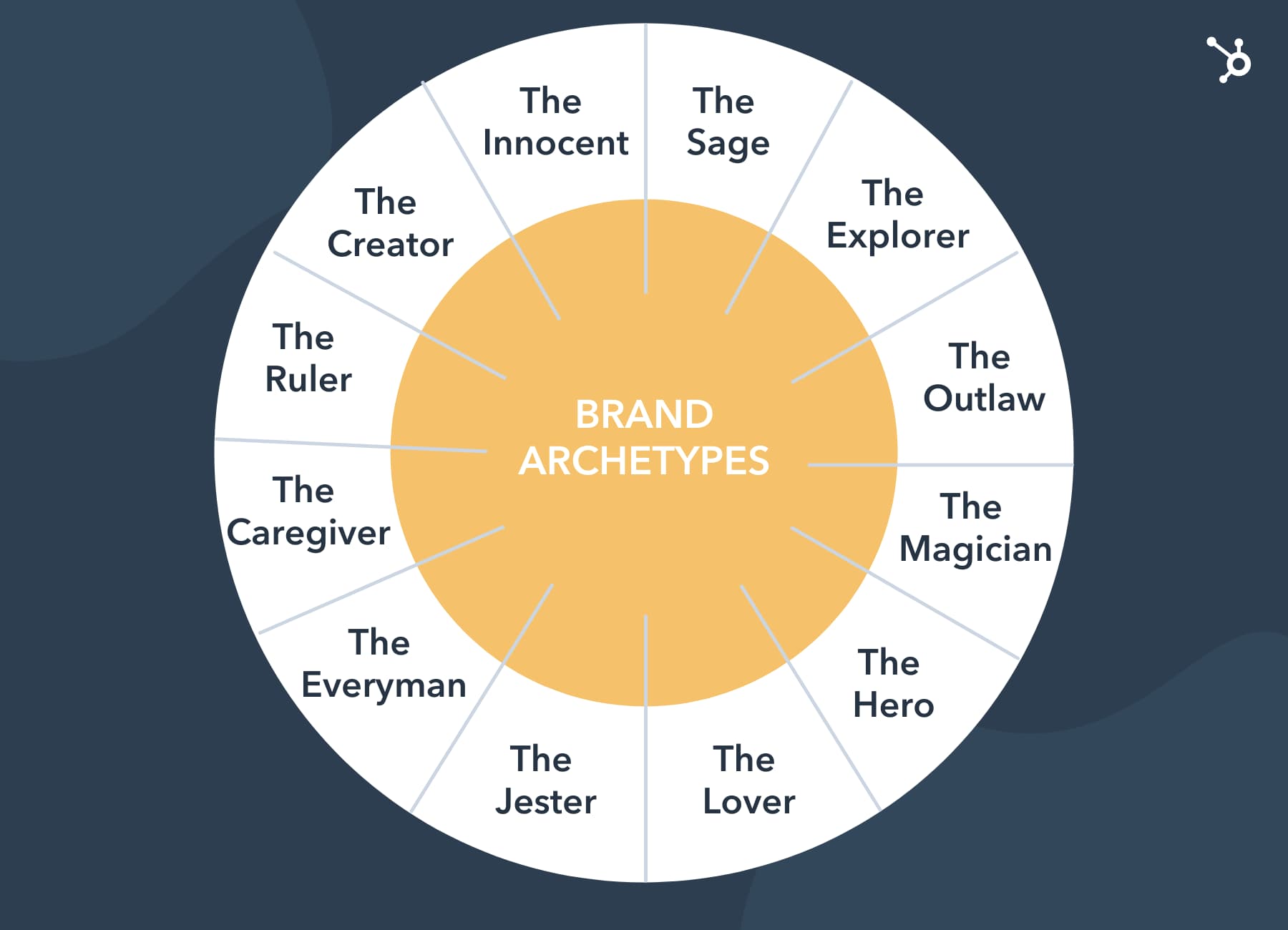
- The Innocent craves safety and looks at things from a glass half full. The main themes for this archetype are happiness, trust, and purity.
- The Sage craves understanding. For them, the pursuit of knowledge is the priority. Education-focused companies, like Coursera and Discovery, typically exhibit this archetype.
- The Explorer craves freedom. With this archetype, it’s all about what’s daring and exciting. Think of outdoor and adventure brands.
- The Outlaw craves liberation. They believe in the saying, “Rules are made to be broken.” The main themes for this archetype are rebellion and disruption.
- The Magician craves power. They’re dreamers who believe anything can happen. You’ll also find this often in entertainment brands as well as beauty.
- The Hero craves mastery. They don’t back down from a challenge and display courage, honesty, and bravery – a common archetype in sportswear brands.
- The Lover craves intimacy and focuses heavily on the senses. Popular lover archetypes are found in indulgent brands like chocolate, wine, fragrance, and cosmetics.
- The Jester craves enjoyment. They bring the fun to the party every time, and they’re not afraid of a little mischief.
- The Everyman craves belonging. They are warm, friendly, and humble. This is perhaps the most flexible archetype and you can see it in a variety of industries.
- The Caregiver craves service. The main theme of this archetype is altruism. Nonprofit and sustainability brands depict this archetype often.
- The Ruler craves control. They value organization, power, and status. You’ll often notice this archetype in luxury vehicle brands.
- The Creator craves innovation. They’re bold, creative, and aren’t afraid to try new things. Technology brands like Apple and Adobe are perfect examples of this archetype.
How to Define and Create Your Brand Archetype
1. Look at your values and mission.
The industry you’re in may inform how easy it is for you to define your archetype.
For instance, if you’re a camping gear company, your archetype can easily tie back to the “Explorer” archetype, as that’s all about adventure. Or if you’re a non-profit, the “Caregiver” is a natural fit. However, it’s not always that easy.
In most cases, you’ll have to dig deep and refer to your values and mission statement for some direction. They serve as the thematic pillars of your brand and will help you determine which archetype fits you best.
For instance, say you’re a jewelry brand with a sell-one-give-one model and your mission is to empower
They tell us the “why” behind your business. Perhaps it’s sustainability, empowerment, celebration, or something entirely different.
Answering these questions will help you determine which archetype makes the most sense for your brand.
2. Build on emotion.
We know through research that emotional appeal works. And storytelling is the perfect vehicle for conveying emotion.
That’s why archetypes can be so successful — they’re tied to emotion.
With that in mind, consider what emotions you want your audience to feel when connecting with your brand.
Chocolate is often associated with love. As such, many chocolate brands embrace the “Lover” archetype and create commercials that emphasize texture, building sensory experiences.
That leads us to the next tip below.
3. Think of your audience.
While your brand archetype can be strongly influenced by your company values and mission, it’s also important to consider your audience in this process.
Will they connect with this archetype? Do they see themselves in it? How will they respond?
Asking these questions will help you shape your brand archetype and mold it to fit your target audience.
For instance, you might find that your brand displays both “Jester” and “Everyman” archetype qualities. However, based on your understanding of your audience, you may decide to lean more on one for a particular campaign.
If your company is going through a rebranding process, you may also reconsider which brand archetype fits your brand the best.
Brand Archetypes Examples
1. Godiva
This one is an easy one.
Godiva is a chocolate brand that represents the “Lover” archetype.
Their brand, as reflected in their commercials, is all about intimacy, indulgence, and feeling the senses.
Take this commercial.
It’s filled with pinks and reds, colors commonly associated with sensuality and intimacy. The shots play with different textures meant to arouse the senses.
And if by the end of the commercial, you’re still not clear on the archetype, they lay it out in the tagline: “Chocolate never felt so good.”
2. Hanahana Beauty
Brands that are socially conscious often fit into the “Caregiver” archetype. Hanahana Beauty is no different.
This beauty and wellness brand has a clear mission: Disrupt the beauty industry with clean products and sustainable practices that improve the shea trade.
In their latest video ad, Hanahana Beauty introduces a new product called “skin nutrition.”
One standout line from the ad is this: “For me, one thing you can do to show love is through giving.”
The narrator goes on to say that self-love is also a form of giving, it’s giving to yourself.
Overall, the ad is inviting and warm – mirroring the archetype beautifully.
3. Saysh
“Like so many of us, I was told to know my place.”
When you hear this quote from Olympian and Saysh founder Allyson Felix in the company launch ad, you’re immediately invested in her story.
This ad tells the story of a “Hero” archetype, facing challenges and addressing them head-on. Felix explains how her journey as a female athlete and mother showed her that her biggest competitor is inequality.
With her brand, she fights against it.
It’s everything you expect in a hero archetype: Candid, brave, and inspiring.
4. Netflix
If you follow this streaming channel on any social media platform, you probably would have already guessed that they follow the “Jester” archetype.
Whether it’s in a Tweet or in an ad, Netflix relies heavily on humor to attract and captivate its audience.
The brand is based entirely on enjoyment – specifically sitting back and relaxing to watch your favorite TV show or movie. So, it’s only right that their archetype match.
If you want to create video commercials like these based on your brand archetypes, consider tools like Wistia, Vidyard, and Hippo Video. These tools help you create high-quality videos to reach audiences in both B2B and B2C.
Building your brand archetype is just another way to connect with your audience. As your brand evolves, many things may change, including your products or services, your messaging, and even your target audience. Your archetype ensures that you tell a story that can resonate with any consumer.


20 Holiday Marketing Campaign Examples + Marketing Tips for 2021
Every year, as soon as Halloween is behind us, it seems like the floodgates open. Without warning, there are holiday marketing campaigns everywhere, with countless businesses rushing to cash in on a spending frenzy. There are holiday emails, social media posts, and TV ads — oh, my.
It might seem like holiday marketing is out of control. But some brands do it very, very well.
How? Well, these brands create campaigns that actually delight customers instead of adding to holiday noise. They evoke emotions and promote sharing, sometimes even connecting people with their loved ones, or partnering with a charitable organization.
Great holiday marketing campaigns come in many different shapes and sizes. Check out our favorites below, and use these ideas to fuel your own holiday marketing ideas.
What To Expect This Holiday Season
Before we get into the examples, let’s talk about what this holiday season will bring for marketers.
A June 2021 survey by Google and Boston Consulting Group revealed that this year, online shopping will play an important role in consumers’ buying journeys.
In 2020, there was a sharp shift toward e-commerce due to the COVID-19 crisis. However, in 2021, over 80% of consumers are seeking out in-person shopping experiences.
With this new balance, brands have to create marketing campaigns that cater to the omnichannel shopper – building offline and online touchpoints.
When it comes to social media, Sprout Social estimates that retailers across all business sizes will receive about 18% more messages per month.
To prepare, brands should develop a strategy to account for the increase in communication, such as:
- Making FAQs readily available to your followers, whether it’s on your Instagram Highlights, pinned on your TikTok page, in your profile link tree.
- Having a system in place for social media managers to field requests and concerns.
The holiday season is also a perfect time to engage your audience through gifts. With Sendoso, you can nurture your audience with custom e-gifts, company swag, handwritten notes, and more. The platform automates prints, delivers, and fulfills orders for you so you can focus on the results.
Another great tool to nurture your customers in the holiday season is Rybbon. The digital rewards management system allows you to automate your rewards program with a user-friendly dashboard, advanced workflows, reporting tools, and more.
Now, let’s get to some examples of great holiday campaigns from recent years.
1. Apple: Make Someone’s Holiday
This commercial gives all the feels.
It starts out in a very relatable way, showing a family traveling during the holiday to visit family.
The magic of the commercial is that throughout their entire journey, the iPad seems to be the one thing helping to maintain the peace.
And just when you think that’s the point of the commercial, it takes a bittersweet turn as the product is used to create a gift for a loved one.
Why it works: Apple often creates feature-heavy commercials, highlighting function over all else. In this ad, they prioritize emotional appeal and use the product as a vehicle to tell the story.
2. Coca-Cola Canada: Give Something Only You Can Give
In a recent holiday commercial, Coca-Cola brings us the story of a dad doing everything possible to deliver his daughter’s letter to Santa.
The dad enjoys a Coke while deciding what to do with the letter. We can sense that he’s not sure whether he’ll get there in time.
We see him sail through a sea, hike through a forest, ride across a desert, and climb a snowy mountain as he searches for Santa. Finally, he gets there, but Santa’s closed for Christmas. Just when we think the situation’s hopeless, Santa saves the day by cruising in on a Coca-Cola-branded truck and taking the dad home.
His little girl’s wish? For him to be home for Christmas. (This ad will definitely make you cry.)
While we’re always tempted to give expensive gifts, the best thing that you can give to your loved ones is your presence and time.
This installment is just one of the latest in the Coca-Cola company’s legendary holiday marketing campaigns — I mean, who doesn’t love the annual debut of the Coke-drinking polar bears?
3. Microsoft: Find Your Joy
The year 2020 was difficult for many of us. We spent more time on Zoom than ever before, and we heavily relied on technology to distract us from the COVID-19 pandemic. But that doesn’t mean we still shouldn’t celebrate the holidays and make the most out of it with our loved ones and pets.
Microsoft’s holiday commercial takes a fun spin on this theme. The commercial begins with a puppy named Rufus. Rufus longs to play and approaches each member of the family, but everyone, from the mother to the grandpa, is enjoying a Microsoft product and doesn’t pay attention.
Rufus grabs his best bud, a puppy from next door. Together, they go on an imaginary adventure involving the games and activities their humans had been enjoying. The ad not only showcases Microsoft’s offerings, but reminds us to cherish our loved ones (and to pay attention to our pets!).
4. Macy’s: In Dad’s Shoes
Macy’s campaign offers a new spin on what might be considered an overdone gift: socks.
“In Dad’s Shoes” takes a little girl through a “Freaky Friday“-like adventure, where she finds herself literally walking in her dad’s shoes for a day. Even though we see her as the daughter, everyone else, from neighbors to passerby, greets her as if she’s her dad.
Throughout the ad, she realizes how much work her dad does and how many places he frequents throughout the course of the day. He spends a lot of time walking. That’s how she gets an idea for what she’ll get him: socks. We all know that you can’t get anywhere without a good pair of socks.
We love that Macy’s showcases a simple gift borne out of empathy. This ad tells us that gifting doesn’t have to be complicated, expensive, or over-the-top.
5. Airbnb: Airbnb Hosts Ring Our Opening Bell
This is a great example of an ad that doesn’t explicitly allude to the holidays, but rather emphasizes the value of community and gratitude.
Airbnb celebrates the season by thanking its four million hosts for opening their homes to strangers all over the world. The video shows various hosts from different countries ringing the bell and opening the door. We go from the United States to Japan, from Kenya to New Zealand, from Brazil to Spain. (We love that each of these countries were listed in their original languages!)
This campaign demonstrates that you don’t need string lights or artificial trees to create an amazing campaign that embodies the holiday spirit. You can uplift your company’s values, celebrate your wins, and appreciate those who’ve played a role in your success.
6. Amazon: The Show Must Go On
If you lived through the 2020 pandemic (which you most likely did if you’re reading this), then you know how much it derailed any and all plans. Being quarantined keeps us from achieving things, it turns out. Unless it requires alone time.
In this ad, Amazon effectively punches us in the gut with the story of a ballerina who was chosen to play the lead in her dance school’s winter show. The girl is thrilled to be chosen, but as the months pass and the pandemic gains traction, the event is canceled. Ballet classes are moved online. The girl’s initial thrill fades, a feeling we can all relate to.
Her little sister remedies the situation by putting together a DIY event next to their apartment building. All of the tenants look down on her as she dances. The event is socially distant, and the girl gets to dance the ballet she’d been practicing for since the beginning of the year.
What we love most is Amazon’s tasteful product placement. Rather than showing everyone ordering all supplies from Amazon, the ad showcases the purchase of a single product: a flashlight. The flashlight is the critical piece that allowed the tenants to watch the show from their balconies.
7. Woodie’s: #WereAllHomemakers
This one made us cry. Woodie’s, an Irish home improvement store, reminds us of what the holidays are about through the story of Mrs. Higgins, an elderly woman who’s beloved in her neighborhood.
Throughout the ad, we see multiple people greet her. Neighbors and passersby are fond of her. Even the rowdy teens who loiter in front of her house love her. She has one problem: the door that leads to her yard is missing a hinge. In the United Kingdom, homes typically have a fence with a gate. Every time she leaves and comes home, she struggles opening and closing that door, as one corner drags across the ground.
When Mrs. Higgins comes home on one particularly snowy day, she finds that her door opens smoothly. The picture focuses on the new hinge that had been installed.
Who fixed it? It turns out it was one of the teenagers who loitered in front of her home. With this advertisement, Woodie’s not only subverted expectations but also effectively communicated what’s so wonderful about the holidays.
8. Hinge: See What We’re Thankful For
This holiday season, what are you thankful for? Recently, dating app Hinge sent around an email posing the same question to its members, using the opportunity to talk about its recent rebrand and subsequent growth — something for which Hinge itself has enormous gratitude, according to the email.
The timing for this sort of marketing is impeccable. The holidays are notorious for the sentimentality they invoke among the masses, and the desire to spend them with “someone special.”
Hinge used this email to harness the holiday spirit and redirect attention to an app that helps people find meaningful relationships, instead of, well, shorter-term alternatives.
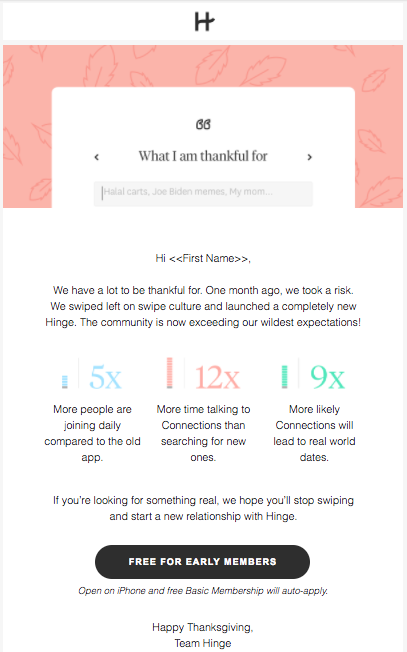
[Click here to see the full email]
9. Lagavulin: Nick Offerman’s Yule Log
This one is an oldie but a goodie. Actor, writer, and humorist Nick Offerman loves his whisky. He’s sung about it before, and during a previous holiday season, he joined his favorite whisky brand, Lagavulin, to film a 45-minute video of — wait for it — Offerman sitting in a leather chair next to a crackling fire, drinking whisky and looking calmly at the camera. Where do we sign up for that gig?
“This is smart branding on Lagavulin’s part,” Kristina Monllos wrote for AdWeek. “Creating an extended ad that can serve as a conversation starter — should consumers swap the traditional Yule Log video for Offerman’s at parties — will also get everyone talking about the brand.”
Since the video was initially released, a new 10-hour version of it became available. Consider it our gift to you.
10. BarkPost: Yappy Thanksgiving Eve
Holidays are traditionally a time to be spent with family. For many of us, that includes our dogs.
BarkPost is no stranger to marketing campaigns that help “dog ruvers” include their furry friends into day-to-day life. In November, the pet-friendly brand showed how to do that at Thanksgiving, with a clever email that included holiday-themed cartoons and videos, feeding safety tips, and other holiday survival techniques — which, of course, involve your dog.
Plus, check out that adorable call to action at the bottom of the email: “Stop getting cute dogs in your email. Unsubscribe.” I mean, who would want to unsubscribe from that?

11. reMarkable: Keep Your Goals for the New Year
You may not have heard of reMarkable, but no matter: this company is the definition of cool and simple. Their single offering is a tablet that acts as a “digital notebook.” When you jot anything down, the reMarkable tablet automatically turns your writing into typed notes. Pretty cool, huh?
In its New Year email ad, reMarkable embodied the simplicity of its product by creating an equally simple campaign. In the email, they entice you to splurge with a $50 discount. Everyone knows that New Year is a time to make plans, set goals, and get your things in order.
reMarkable presents its product as the way to do that. They want to help you save time, which will help you spend more time with your loved ones and pets in the upcoming year. And who likes transferring notes from a notebook to a tablet?
12. Kool-Aid: All I Really Want for Christmas feat. Lil John
In a music video-style ad, rapper Lil John quietly sits down to drink a glass of Kool-Aid as the Kool-Aid man smashes through his wall.
At that moment, the bass drops as a festive music video begins, showing Lil John rapping in front of a family Christmas gathering. The video goes on to show Lil John, the Kool-Aid Man, and Santa dancing along with shots of holiday food, presents, and Lil John’s Christmas list.
By launching a full-fledged music video with a prominent rapper, Kool-Aid both entertains prospects and demonstrates how “Kool” their brand is. Along with being humorous and entertaining, this ad also reminds you that you can still drink Kool-Aid during a time of the year where you’re mostly thinking about hot beverages.
13. Resy: Where to Spend New Year’s Eve
Don’t want to cook for New Year’s Eve? We don’t want to, either—mostly because washing dishes is a chore.
That’s what Resy bets on in a recent New Year email campaign. In a short but effective email, the company invites its subscribers to the best places to dine in the San Francisco Bay Area for the New Year. (If you’re not in San Francisco, you have the option to look for local eateries near you, also curated.) Like OpenTable, Resy allows you to make effortless reservations for you and your loved ones.
We love that this simple email keeps the focus on what we can do to celebrate New Year’s Eve. And what better way to do that than through delicious, local food that we don’t have to cook ourselves?
14. Erste Group Bank: #EdgarsChristmas #believeinlove #believeinchristmas
You might not recognize this company, but you’d definitely recognize their holiday ad from 2018. Remember the cute porcupine who couldn’t get any friends because his spikes were, well, spiky? The short film has more than fifty million views on YouTube and touched millions of people’s hearts on other social media platforms.
Erste Group Bank did it again during their 2020 holiday campaign. This time, they made it just a little bit more clear what they offer: loans that can help you purchase something that may feel out of reach, but that may help bring your family together.
The ad begins with a granddaughter handing her grandfather his hearing aids. Throughout the video, the grandfather seems unhappy. We later find out that it’s because he’s been wanting to play music, but has no way to because he doesn’t own a piano.
The granddaughter purchases a piano for him. In the end, the grandfather gets to play a song he’d written for his mother. The entire family joins in, and they play the song together.
15. Sonos + Spotify: #PlaylistPotluck
One great way to celebrate the holiday season is with an event. And with events typically come music. Spotify is aware of that tradition, which is why it created #PlaylistPotluck.
It started with a partnership with Sonos. The brands got together to turn playlists into something like a potluck in which everyone contributes something to bring the event together (the tagline of the campaign is “One home. One host. Everyone brings a dish.”) Only, instead of contributing food or drink, everyone contributes a tune to a collaborative playlist.
Oh, look. That feature is available with Spotify!
The idea is delightfully interactive. Instead of using traditional invitations, guests RSVP to the potluck by adding songs to the collaborative playlist. And the cherry on top? Both brands also partnered with the PBS series “Mind of a Chef” for a televised holiday special, in which various celebrity chefs will be using the feature for their own meals.
What we love about this campaign is the fact that it incorporates several different elements and media formats to make it cohesive — a speaker system, a music-streaming app, and a televised special. Plus, if you participate, you’re entered for a chance to win your very own dinner party, hosted by a world-renowned chef. Bon appetit — and rock on.
16. Google: Santa Tracker
While Google’s Santa Tracker has been around for a few years now — and we recommend checking out the back story here — its features have evolved over time. Now there are interactive mini-games such as “Santa Selfie,” “Wrap Battle,” and “Build & Bolt.” Additionally, you can watch delightful short films such as “A Day at the Museum,” so you can see what Santa’s day-to-day looks like.
It’s hard to narrow down what makes the Santa Tracker so delightful, but if we had to summarize it, we’d say this — it combines the holiday wonder of a belief in Santa with real-life technology. What a wonderful way to teach kids about the web, while also allowing them to be kids. (Although, we adults certainly appreciate it, too.)
Google even introduced a B2B element of the Santa Tracker by sharing the code with developers and releasing other elements of the tool as open source. Why make all of that information public? To inspire developers to create their “own magical experiences based on all the interesting and exciting components that came together to make Santa Tracker,” writes Google’s Developer Programs Engineer Sam Thorogood.
Up until Christmas Eve each year, visitors can have a peek at the “North Pole,” to see what Santa’s elves are up to as the holiday approaches.

17. Disney: From Our Family to Yours
Culture, history, and holiday cheer come together in this holiday advertisement from Disney. The media giant takes advantage of their long-standing name to take us back to 1940, when a young girl gets her first Mickey Mouse plush toy.
As the video goes on, we see the little girl grow older until she becomes a grandma. She hands down the plush toy to her granddaughter, who doesn’t appreciate it as much as she becomes a young adult.
The granddaughter realizes how much it means to her grandma and restores the toy back to its former glory. We definitely did not cry when the grandma opened her holiday gift and saw her old toy fixed and restored.
We expected something quite touching from Disney, and this one did not disappoint. We especially love how Filipino culture has been showcased to three million viewers and counting.
18. Black Owned Everything: Jingles and Things (with “Jingle Jangle: A Christmas Journey”)
Black Owned Everything, an Instagram curator of Black-owned businesses and brands, creates the perfect gift guide in Jingles and Things.
Done in partnership with Netflix and the musical “Jingle Jangle: A Christmas Journey,” Jingles and Things curates the very best gifts for the holiday season, including items ranging from fragrance to dishware to dolls. There’s truly something for everyone here—and the best part is that we can support Black businesses while completing our holiday shopping.
Zerina Akers, the owner and head curator of Black Owned Everything, introduces us to the shop by explaining that it’s not just a marketplace but an inclusive platform.
There’s nothing more that encapsulates the holiday spirit than inclusivity, community, and belonging, and we love that Jingles and Things uplifts that theme.
19. Heathrow Airport: The Heathrow Bears Return
This adorable holiday commercial from Heathrow Airport shows the journey of two grandparent teddy bears as they decide to pack up, leave their sunny home, and go visit their teddy-bear grandchildren for Christmas.
At the end, you see the bears reunite with their family in London’s Heathrow Airport.
For many, these bears are both nostalgic and relatable. They remind you of the bears you might have played with as a child and the average grandparents.
When you see the teddy bears join their family, you might also remember the happiness you felt when your grandparents came and brought you gifts or hugs during the holidays.
This commercial is a sequel to a similar ad Heathrow Airport launched a year before, titled “Coming Home for Christmas.” This ad follows the bears riding and exiting the plane to meet up with their family at a Heathrow Airport Gate:
This series of commercials has all the great aspects of an ad campaign because it’s relatable, nostalgic, and incredibly heartwarming.
20. Walkers: All Mariah Carey Wants for Christmas
While the holiday season is a time for caring and sharing, Walkers shows musician Mariah Carey doing the exact opposite.
After filming a music video for her famous song, “All I Want for Christmas Is You,” Mariah Carey gets angry with an elf for taking her Walkers chips. To fend him off, she sings a high note which makes him block his ears and let go of the chips.
This is a hilarious commercial because it shows that the only thing you might not want to share on Christmas is Walkers products. It also shows how even stars, like Carey, enjoy the brand.
Go Forth and Be Merry
Out of all the things that we appreciate about these campaigns, there might be one thing we like the most — the fact that they put the fun back into holidays. This season, don’t let the stress get to you. Have a laugh or a cry with these examples, and please, be merry.
From our family to yours, happy holidays.
Editor’s Note: This post was originally published in December 2015 and was updated in January 2021 for freshness, accuracy, and comprehensiveness.


15 Businesses to Admire for Stellar Branding Consistency
When searching for a soul mate, you look for someone that’s smart, funny, caring, but above all — consistent. Because if you’re going to invest your life in a person, you want someone you can trust, right?
Falling in love with a brand isn’t all that different. Brands pull us in with witty slogans and timely discounts, but that’s not the only reason we stick around. Think about it, inbound marketing is all about content and communication that people love. The key to being your leads’ and customers’ soul mate, then, is providing brand consistency they can count on.
But how? What’s at the heart of brand consistency is your message, and marketing plays a huge role in that. In this post, we’ll dive into what branding consistency is, its importance, benefits, and share 15 businesses that have done a stellar job showing it.

The Importance of Branding Consistency
Branding consistency sets the stage for a business to gain and maintain credibility and trust. You have to position your brand and its content in a way that appeals to its target audience and carry that same messaging over time. After all, your customers are putting their trust in you, and like any relationship, you want the foundation to be dependable and consistent.
So, not only is this concept important in business strategy, but the benefits speak for themselves.
Benefits of Brand Consistency
Maintain customer expectations.
When creating marketing content, your team can share collateral that delivers the same visual cues from logo, color, and tone that won’t negatively impact customer perception. This standardization of branding let’s them know exactly what to expect every time they come across your business.
Align separate business units.
In creating a uniform brand identity, business teams create varying forms of content across departments that still ring true to clearly specified brand guidelines. While each team won’t be working on the same projects directly — the brand’s story will still shine through.
Establish a more visible, uniform identity.
Brands that are consistently presented are 3 to 4 times more likely to experience brand awareness and visibility. Just think about the iconic Nike swoosh, or Adidas’ signature stripes, these consistent visuals let customers know what brand a product comes from in the blink of an eye.
Now that we’ve gone through the importance and benefits of branding consistency, let’s look at some brands that have used it successfully.
Branding Consistency: 15 Brand Examples
1. GymIt
Fitness centers can be intimidating to the average person. GymIt gets it, and takes the intimidation out of the equation by talking to its clientele like real people. The Boston-based gym calls itself “hassle-free” and keeps working out simple.
One of the brand’s slogans is “Get In, Work Out” — clean, to-the-point, and clever. To prove that GymIt doesn’t cater to protein-shake, bodybuilder types, its marketing doesn’t take itself too seriously, either. Below are some snapshots of GymIt’s playful copy across social media, merchandise, and unintimidating website.
2. Dropbox
The cloud-based file sharing platform, Dropbox, is great at consistent design and personalization across channels.
You won’t find any Dropbox communication or platforms without its signature open, blue box logo nearby. This style is behind all of the brand’s designs, whether it’s a sleek homepage or a creative error page. Dropbox’s email marketing aligns with that fun, artsy messaging. See the screenshot below of some colorful collateral found across.
3. charity:water
This organization donates 100% of its donations to building water wells in Africa where women and children use yellow jerry cans to carry water back to their villages. charity:water’s logo is a stylized jerry can and not only keeps the branding present across channels, but keeps the issue the charity is helping solve top of mind, as well.
While many traditional nonprofits stick to old-school marketing tactics, charity:water recognizes that in order to inspire people to support a cause, you need to have inspired marketing. The organization’s birthday campaign has attracted supporters in fashion which charity:water uses to show how nonprofits can be trendy — using jerry cans in annual Charity Ball runways. This brand consistency makes it a leader in reinventing nonprofit marketing.
4. Naked Pizza
Naked Pizza — a revealing name for an honest brand. This business offers healthier pizza than the average chain by using only all-natural ingredients and a crust packed with grains and probiotics. Naked Pizza’s promise of all-natural is enforced by its refreshing style and tone seen across its marketing assets.
Like GymIt, Naked Pizza suggests it doesn’t take itself too seriously and that pizza can be guilt-free and fun. The brand is lovably sarcastic and keeps its design clean and appealing while communicating its delicious message.
5. Wells Fargo
You don’t have to use conversational tones or playful designs to be a lovable brand. Wells Fargo, a leading bank worldwide, keeps its messaging traditional and old-school — in a good way!
The brand is committed to its core values, including ethics and putting customers first, and they communicate this consistently through font, colors, layout, and keeping its logo ever-present across channels. Its slogan “Together we’ll go far” inspires copy that is rooted in family and building relationships.

6. World Wildlife Fund
This organization fights for a great cause with great marketing. The WWF’s style and imagery create a mood across channels that forces you to reflect for a moment on how we treat our wildlife and ecosystems.
Below are three examples of how the brand communicates that same strong message in creative, thought-provoking ways. Its logo, print ad, and interactive piece all have a darkness to them through suggestive messaging or tone because of how serious the issue is.

7. Warby Parker
Warby Parker “creates boutique-quality, classically crafted eyewear at a revolutionary price point.” The brand communicates this boutiquey vibe through all its promotions and marketing assets.
For example, Warby Parker offers a luxurious touch to prospective customers by sending five pairs of glasses to try on for free (top left). Attention to style is also evident across channels: its website (bottom left) is clean and easy to navigate. Even its annual report (bottom right) feels “classically crafted.” The brand calls its style “vintage,” and its Citizen’s Circus event at SXSW was dripping with vintage touches from signage to tents.

8. Lush
The international handmade cosmetics company, Lush, believes in “making effective products from fresh organic fruits and vegetables,” and in “happy people making happy soap.” Lush stores, products, packaging, and employees (top right) all tell that story.
Lush’s commitment to natural, organic ingredients is totally aligned with how it displays its products (bottom left); Lush’s soaps, powders, and shampoos sit in their raw form in-store until the cashier wraps the product up once it’s purchased. Foregoing packaging oozes a natural vibe. Products that require packaging, like face masks (top left), don’t hide the ingredients and encourage customers to recycle after use. All packaging also has a sticker on it with the face and name of the employee who packed it. Every piece of marketing collateral at Lush has a personal, no-frills approach.

9. Boloco
Boston-based burrito company, Boloco, pays attention to consistency in detail in its online and offline marketing. The brand’s slogan is ‘inspired burritos’ and its menus, flyers, napkins, events, website, and other collateral all have a playful, hand-made touch that suggests the business is fueled by more than tortillas and guacamole. Boloco partnered with Life is Good by making a yummy Life is Good burrito with 50 cents of each purchase donated to the company’s charity, Life is Good Playmakers; this partnership fits with Boloco’s inspired brand perfectly.
Boloco keeps branding present by using a playful signature font. No matter the marketing channel, we go loco for Boloco’s consistency.

10. Museum of Fine Arts Boston
Boston’s Museum of Fine Arts promotes its brand throughout the city and under its own roof with such finesse in execution, that the brand’s presence is always incredibly recognizable, yet still subtle. All MFA Boston marketing assets are easy to connect to the source.
The brand has a two-tone color palette on all collateral, with red being the MFA’s signature color. Below are examples of its use of color, as well as its consistently minimalist design on an employee’s apron, outdoor banners, website, and brochure. With a museum full of colorful exhibitions and impressive canvases, the MFA keeps its own branding simple but strong.
11. Intercom
Intercom is a web-based customer service platform. “Treating customers with respect will always be good for business,” the brand says. “And we believe that making customers jump through hoops to try to get help is incredibly disrespectful.” Looking at Intercom’s various forms of communication and marketing tactics, it’s visually apparent how much it doesn’t want its customers to “jump through hoops.”
The brand presents information in a clear, comprehensive way by using imagery instead of written explanations. After all, a picture says a thousand words. Intercom introduces its company with photos other content with simple graphic design. Enticing me with visuals definitely takes hoops out of the equation.
12. Innocent Drinks
Innocent Drinks is a playful smoothie and juice brand from England that keeps its innocent reputation strong with marketing that will make you feel like a kid again. The meta description reads: “hello, we’re innocent and we’re here to make it easy for people to do themselves some good (whilst making it taste nice too).” How cute is that?
Below are examples of more lovable approaches to branding like its Facebook game (top left), product images (bottom left), and inventive website navigation for the brand’s annual event, Fruitstock. Innocent Drinks stays true to its personality in its tone and creative execution.

13. Zendesk
Zendesk is a cloud-based customer service software system that has built a charming brand through sleek, bright design. The “zen” in this company’s branding can be seen through its mellow yellow and natural color palette.
It’s important to communicate a consistent brand image to the world, but Zendesk recognizes that consistency comes from within as well. Its office carries the theme to keep the feeling strong within company walls. The brand’s signature green is used consistently across channels and compliments the brand’s identity.
14. Lululemon Athletica
Sportswear brands often promise that their products will make you a better athlete, but the process and hard work it takes to get there is sometimes forgotten. Lululemon Athletica, a yoga and sportswear brand, keeps the act of working out alive across its assets. The brand hosts free yoga classes in its stores, as well as public outdoor classes.
Its confirmation email (top left) for joining its mailing list is a large image of a woman doing yoga, and the brand’s Twitter profile (top right) displays yoga mats waiting to be rolled out. The brand designs yoga clothing and gear, so why skip to the gratification of doing it when you can cultivate a feeling around the process?

15. ZocDoc
ZocDoc is an online service for finding and booking appointments with physicians in your area. The brand aims to improve access to healthcare, and it communicates the ease of the process with cartoon mascots across all of its marketing communication channels.
After all, cartoons make us feel like kids again, and boy, were things easy when we were kids. See ZocDoc’s charming collateral on the website’s personal account page.

Build Better Branding Consistency
Now that’s soul mate material, right? A lot of these brands use playful, creative, and conversational tones, while others prefer more serious, thought-provoking approaches. Whatever the tone, be sure to keep it consistent across all channels to give your customers a brand they can count on.
Editor’s note: This article was originally published in March 2013 and has been updated for comprehensiveness.


The 14 Best WordPress Email Plugins in 2021
If your business has a blog, sending out an email newsletter is essential. Not only is it a simple way to distribute your content, but it can also help you better understand what type of content is resonating with your target audience so you can optimize your content strategy.
Beyond content distribution, an email newsletter can also help generate paying customers for your business. 31% of B2B marketers report that email newsletters are the best way to turn leads to customers, and 64% of small businesses use email marketing to reach customers once converted.
So, you’re cranking out content on your WordPress site, and you know you can grow your business through an email newsletter … Wouldn’t it be great if you could send this newsletter directly within WordPress?
With plugins, you can. Some of the most popular WordPress plugins available are for email marketing. With an email plugin, you can generate leads, segment your contacts, and nurture them into customers, all within WordPress.
To ensure you’re able to use WordPress for all your content distribution and email marketing needs, we’ve made this list of the best WordPress email plugins.

1. HubSpot WordPress Plugin
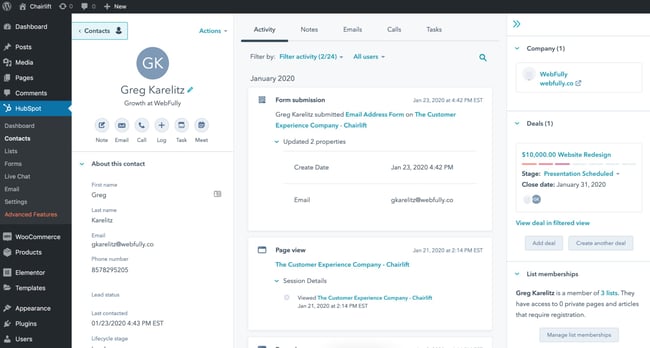
Sure, the HubSpot WordPress Plugin includes forms and pop-ups, but that’s just the tip of the iceberg. On top of the ability to develop forms and pop-ups with a simple drag-and-drop interface, HubSpot collects submissions from any form you have on your WordPress site and automatically adds those leads into your CRM, so you can begin nurturing them into loyal customers immediately.
The plugin includes a live chat tool, so you can begin engaging with site visitors, and even generate leads off of those conversations. You can also deploy bots to answer simple questions that your visitors have, ensuring that you’re supporting your website visitors even when your team is offline.
Once someone submits their information on one of your pop-ups, you can automate a simple kickback email to get in touch with that lead and deliver the content you promised them. You can also upgrade to a paid version of Marketing Hub to begin emailing those contacts right away.
Best for: We recommend the HubSpot WordPress Plugin for anyone. Between forms, pop-ups, live chat, and a fully integrated CRM, there’s no better free email subscription plugin available for WordPress.
2. MailPoet
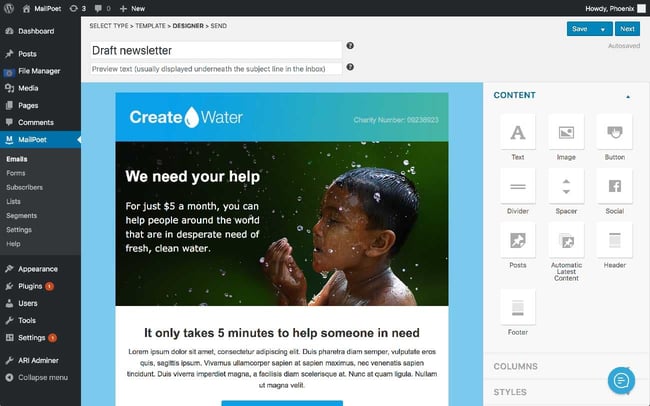
MailPoet is one of the most popular free newsletter plugins for WordPress. To manage your subscribers, you can easily import an existing list from your CRM or another marketing automation tool, or create forms and add them to your site using widgets. Plus, the drag-and-drop email editor lets you quickly create responsive emails that look great on any device or email service.
MailPoet is free for anyone with less than 1,000 subscribers but becomes more powerful upon upgrading. Premium users can see exactly which subscribers have opened an email and what links people are clicking on within your email, among a number of other advanced features.
Best for: Those who want a popular, free, and versatile email newsletter plugin for WordPress should try MailPoet and experiment with its subscriber management, email builder, and automation tools. Those with smaller lists can leverage premium features for free as well.
3. Newsletter
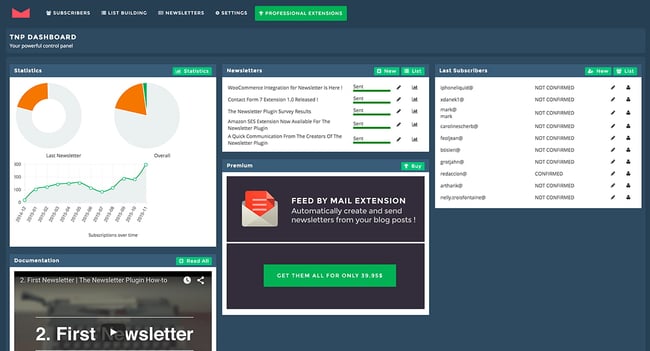
Newsletter is an email marketing tool built specifically for WordPress, and everything you need to get started is included. The plugin allows you to add a subscription form or pop-up to your site, compose emails in a drag-and-drop builder, segment your leads using multi-list targeting, and send newsletters to distribute your blog content.
Additionally, the tool has built-in reporting, so you can see exactly how your emails are performing. You can even automate newsletters to go out on a regular cadence to ensure you are consistently engaging with your subscribers. Newsletter also integrates with other tools, such as Mailgun and Spark Post, so you can optimize your email strategy based on your needs.
Best for: The Newsletter plugin is best for WordPress bloggers looking to automate their newsletters and track performance. It’s another popular, well-received option that’s worth trying out for free.
4. Sendinblue
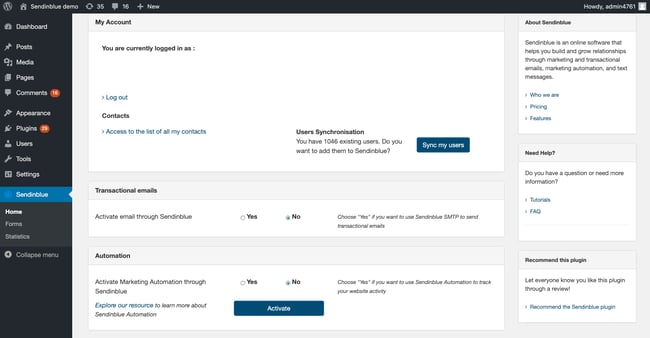
Sendinblue offers cloud-based digital marketing tools to over 50,000 growing companies around the world, and its WordPress plugin brings the power of the platform directly into WordPress.
With the Sendinblue WordPress plugin, you can create forms to capture leads, manage lists of subscribers, create and send email marketing campaigns, and measure your success over time using the included reports. The plugin features a drag-and-drop email editor, and you’re able to personalize components of your email to increase engagement with subscribers. The free version lets you send up to 300 emails per day.
The Sendinblue WordPress plugin also includes transactional email. Using the wp_mail function, you’ll be able to send transactional emails using Sendinblue’s SMTP. This feature is great for sending order confirmations or updating your customers on important changes to their accounts.
Best for: WordPress business owners in need of a simple but inclusive email marketing plugin will enjoy Sendinblue for its tools, support, and integration with its other advanced marketing tools. You can get decent mileage from the plugin for free before reaching your send limit.
5. Sumo
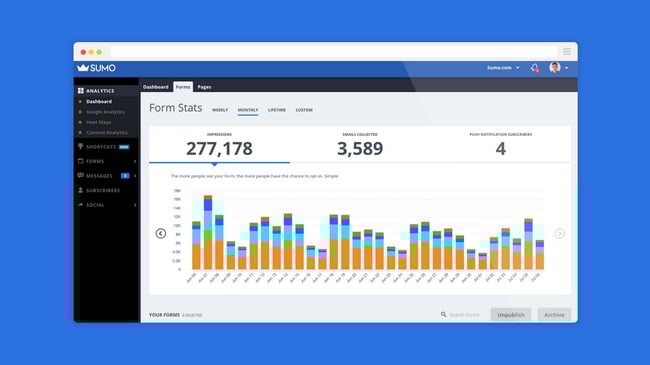
Sumo has over 60,000 active installations within WordPress — and for good reason. Beyond just pop-ups, welcome emails, and automated drip campaigns, they also have a number of other features to help you grow your business.
The plugin features a “share” button that you can add anywhere on your site, which allows your site visitors to easily share your content on social. The plugin also integrates directly with WooCommerce so you can create discounts and unique offers to increase your order value, and minimize the number of abandoned carts you have.
On top of all the plugin’s features, Sumo offers free customer support, and even one-on-one onboarding for all customers (free and paid) to ensure you’re getting the most out of the plugin.
Best for: Sumo works great for ecommerce websites and WooCommerce that run regular email campaigns. New businesses will appreciate the generous free version, which allows up to 10,000 emails per month and unlimited subscribers.
6. Email Subscribers & Newsletters
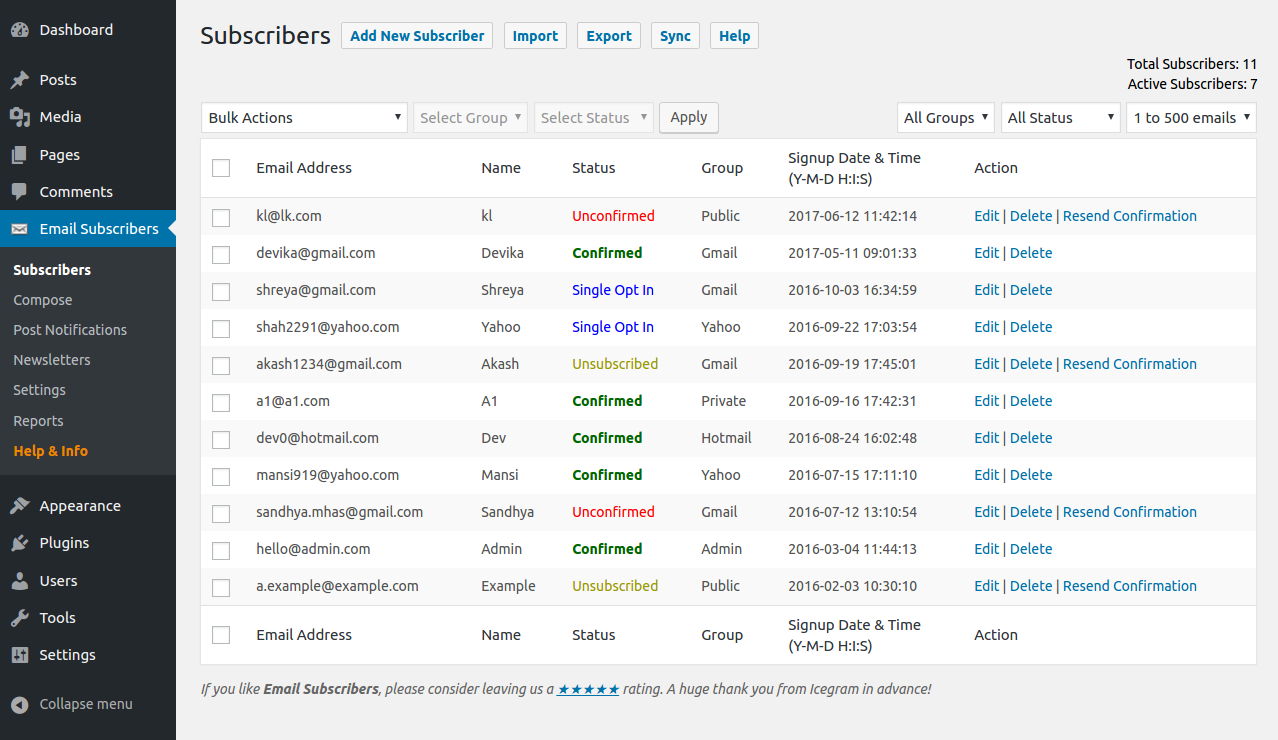
Email Subscribers & Newsletters is a plugin that lets you easily notify your subscribers when you have new blog content available. With it, you can add a subscription box to your site and get notified every time someone signs up for your newsletter. You can then notify your subscribers whenever a new post is published, or create a custom newsletter to share your content.
Email Subscribers & Newsletters is also serious about the health of your email lists. They offer double opt-in functionality so you can ensure that you’re only reaching out to people interested in what your website has to offer. You have the option to add captchas to your subscription box to prevent bots from ruining your email lists. The tool offers list cleanup and spam testing services too.
Best for: Email Subscribers & Newsletters is best for bloggers who want a simple plugin to notify readers when a new blog post is published, along with some simple metrics and a custom newsletter option.
7. Subscribe2
Subscribe2 lets you send either simple notifications to your blog subscribers whenever you post new content, or a recurring digest of posts. Through the plugin, you can also exclude specific categories of posts from being included in your emails, or even exclude posts on an individual basis.
The tool lets you create simple plain text emails, or create custom HTML emails. You can also upgrade to its paid service (MailOptin) to send emails to your contact lists in Mailchimp, AWeber, or other email service providers.
Best for: Subscribe2 is another WordPress email plugin that’s ideal for bloggers who want to send email alerts to subscribers, or to compile their most recent blog posts into a digest.
8. SendPress
SendPress is a simple, easy-to-use email newsletter plugin. With it, you can import contacts and content from your WordPress site directly into the plugin, making it easy to create a blog notification email.
SendPress features several styling and editing options so you can send professional emails without any coding skills. They also have a service called AutoCron, which will check your site on a regular schedule to make sure your scheduled emails are being sent.
Note that for features like advanced analytics, bounce handling, and campaign tracking through third-party software like Google Analytics, you’ll need to upgrade to the paid version.
Best for: SendPress provides a simple email automation subscription for small WordPress sites that want to grow their audiences.
9. OptinMonster
The widely popular and powerful OptinMonster plugin, as the name suggests, helps you grow your WordPress email list and get more subscribers through a variety of pop-ups and static forms. The tool comes with a drag-and-drop editor that lets you build your form from scratch, or select from a pre-built template.
What sets OptinMonster apart from other plugins is its targeting options. Using exit intent technology, OptinMonster will deploy a pop-up based on when a user is getting ready to leave a page. The plugin also has page-level targeting options, so you can tailor your content offers to a visitor’s location and behavior on your site. You can then use this information to tailor your email campaigns using any one of OptinMonster’s many integrated email service providers.
Best for: Marketers who want to implement popups in their marketing strategies (especially for exit intents), and implement advanced tracking on their forms and email campaigns to drive conversions.
10. Thrive Leads
Like OptinMonster, Thrive Leads is focused on growing your subscriber list, and growing it fast. This tool includes a long list of pop-up types, including full-screen overlays and even multiple-choice forms. It also includes the targeting options that you’d expect out of an email subscription plugin.
Additionally, Thrive Leads offers A/B Testing so you can see whether a different design, or an entirely different content offer performs better — allowing you to greatly increase your conversion rates.
Best for: Thrive Leads is a comprehensive tool to help online businesses grow subscribers, increase conversions, and target the right visitors at the right time. If that’s you, try it out. Also note that Thrive Leads is more of a form tool than anything else — email is just one part, and the plugin works best when integrated with another email tool.
11. WP Subscribe
WP Subscribe is built by MyThemeShop, a company that builds WordPress themes and plugins that are fast, reliable, look great on any site, and are SEO-friendly. WP Subscribe checks off all those boxes. They have optimized the code on the plugin to ensure that it loads fast, and doesn’t slow down your site.
With WP subscribe, you can add your subscription form anywhere on your site, and feel rest-assured that it will be fully responsive to whatever screen size your site visitor is viewing your site on. The plugin is also compatible with several popular email service providers, such as AWeber and MailChimp, so you can begin leveraging your email lists immediately.
Best for: Use WP Subscribe to build custom forms and grow your email list — for anything else, you’ll need to integrate with another email automation tool.
12. Ninja Forms
Ninja Forms has over one million installations on WordPress, making it one of the most popular form plugins available. Ninja has all the features you’d expect in your email subscription form builder, plus a few extra features that make it stand out. Namely, its acclaimed builder tool lets anyone make professional-looking forms without touching any code.
The plugin features several different anti-spam options, including Google’s reCAPTCHA, to ensure the validity of your form submissions. They also let you collect payments via integrations with PayPal Express, Stripe, and Elavon. The plugin integrates with a long list of the most popular mailing list tools, so you can start emailing your new leads right away.
Best for: WordPress users who need a reliable form builder tool to grow their email subscriber list should put Ninja Forms on the list — it’s one of the leading options available, and it’s flexible enough that you can use it for other cases beyond email signups.
13. Email Template Customizer for WooCommerce
The Email Template Customizer for WooCommerce plugin extends the functionality of the WooCommerce plugin by allowing you to customize the email template. Build out emails with a library of useful elements specific to WooCommerce, like order, billing, and shipping details.
Everything is drag-and-drop, and the plugin can be used by anyone who already knows WooCommerce. Thanks to the tool, sending transactional emails, order confirmations, and shipping confirmations. With the paid version, you can also recommend products in emails, give coupons, and send target emails based on orders that match certain criteria.
Best for: WooCommerce site owners should try Email Template Customizer for WooCommerce as a solution to build custom emails to customers.
14. WP Mail SMTP by WPForms
The developers behind the popular WPForms plugin have also created an email-specific plugin, WP Mail SMTP. This plugin aims to solve email deliverability issues by configuring WordPress to follow SMTP (Simple Mail Transfer Protocol), the standard for sending emails, instead of PHPMailer, the WordPress default.
With over 2 million downloads to date, WP Mail SMTP has helped improve deliverability for many WordPress sites. It helps authenticate your emails to email clients, avoiding the spam folder or a failed delivery. The plugin works by reconfiguring the wp_mail() function to integrate with a credited SMTP provider.
If that sounds like gibberish, don’t worry — the plugin walks you through the process and provides documentation in case you’re stuck.
Best for: WordPress marketers who are experiencing email deliverability issues may consider trying this plugin.
Upgrade your WordPress emails.
It’s important to choose the plugin that works best for you. Whether you need a plugin that is highly customizable, or one that simply drives submissions so you can get your email newsletter off the ground, the options here provide a great starting point for you to explore as you consider how you can start building out your subscribers list.
Editor’s note: This post was originally published in May 2019 and has been updated for comprehensiveness.

The Top 5 B2C Marketing Trends of 2022 [New Data]
In 2022, 51% of B2C marketers plan to increase their marketing budget.
The question is where is that budget going? Will marketers reinvest in the same strategies or try new trends?
From influencer marketing to virtual events, there are so many efforts brands can focus on. Let’s see what our latest research says about what worked well for marketers this year and where they plan to invest in 2022.
To understand what trends B2C marketers are leveraging in 2022, we surveyed 1,067 global marketing professionals working in B2B and B2C companies. Here’s what we found.
1. Short-form video will be a priority.
Short-form video took off in early 2020 and shows no signs of slowing down.
Back then, TikTok was the number one place to go for short-form content. Today, Instagram Reels and YouTube Shorts are also competing for users’ attention.
This is good news for brands, as the short-form video trend content offered the second-highest ROI for B2C marketers in 2021, behind influencer marketing.
Despite coming in second for ROI, it’s the trend marketers plan to invest in the most in 2022. The second surprising fact is that for many marketers, about 32%, 2022 will be their first time leveraging it.
Why now? Well, short-form video is such a key feature in social media today. And according to the data, social media takes the lead in marketing investments for businesses.
That’s likely because, in 2022, there are three key goals brands have running marketing campaigns, according to the study:
- Increasing brand awareness (49.3%)
- Increasing revenue (43.3%)
- Advertising products (42.1%)
With social media, you can accomplish at least two out of three. Brand awareness was always the main benefit of using social media but things have evolved. Today, with so many platforms offering in-app shopping experiences and advanced ad formats, brands can meet more of their marketing goals.
2. Influencer marketing will still be a key lead/revenue driver.
For most B2C marketers, the power of influencers is clear.
In 2022, 61% of B2C marketers surveyed in the study plan to leverage it in 2022. In fact, it’s the third-highest trend they plan to prioritize, behind short-form video content and inbound marketing.
This is because in 2021, it offered the ROI.
What might be different in the future is the type of influencer brands focus on. Historically, brands have focused on the biggest and most popular influencers to partner with.
However, some data suggest that micro-influencers with under 100K followers may be more effective.
While the verdict is still out on that, one thing is clear: Influencer marketing isn’t going anywhere.
3. Audio content will take a front seat.
Data suggests that video is the leader when it comes to content marketing. However, audio is slowly creeping up into the mix.
According to the survey, only 19.1% of B2C marketers use podcasts or other audio content in their marketing. Of those who do use it, 37.4% find it to be one of their most effective trends.
Even though adoption was seemingly low in 2021, the data suggests that more B2C marketers will add audio content to their marketing efforts in the new year.
Roughly 43% of B2C marketers plan to increase their investment in podcasts in 2022 while 38.4 plan to keep it the same. Another interesting fun fact is that this particular piece of data is virtually the same for B2B marketers.
This suggests that across all industries, brands recognize the power of audio content.
4. Social responsibility will be more important.
Now more than ever, consumers want and expect brands to be more transparent and take a stand on social media.
In fact, a 2020 Edelman Trust Barometer survey revealed that many consumers see trust as a leading factor in their purchasing decisions.
In the past two years, particularly in the height of the COVID-19 crisis and calls for social justice, consumers have started holding brands more accountable. In 2022, brands will be addressing that demand.
Currently, only a third of B2C marketers surveyed find social responsibility to be an effective marketing trend. Despite that fact, 45% plan to increase their investment in 2022.
5. Brands will continue to apply inbound marketing strategies.
Inbound marketing is all about meeting consumers where they are. Instead of marketing efforts that push messaging out to consumers, this focuses on attracting them toward you.
Behind short-form video, inbound marketing is the top trend marketers will invest in next year.
In fact, over 80% of marketers plan to keep the same budget or add more for this strategy.
This is done by following the “Attract, Delight, Engage” model that leverages content marketing, SEO, marketing automation, social media, and more to nurture consumers at every stage of the buyer’s journey.
There you have it – some of the top trends B2C marketers will invest in 2022. Between publishing regular video/audio content on social media and developing a strong inbound marketing strategy, marketers have a busy year ahead.
To keep up with the latest trends in marketing, download the 2021 HubSpot Not Another State of Marketing report.

What is a Brand Personality, According to Marketers Who’ve Developed Them
If I could go out to dinner with any brand, I think I’d have to choose Trader Joe’s.
Now, I know that may sound weird, but stay with me. Nike, as you know, would be too energetic, which would embarrass me — let’s play it cool here, okay, Nike?
Apple, on the other hand, would be both sophisticated and a little pretentious, which would make me nervous.
And Timberland is just too outdoorsy and gritty. We wouldn’t have much in common.
By comparison, Trader Joe’s is unique, earthy, and a little playful. We could discuss its fantastic seasonal selections, like its Pumpkin Alfredo Sauce or Butternut Mac & Cheese Bites, and I would thank TJ (because we’re at the nickname level by now) for its generous cheese prices.
While we all know I can’t actually go out to dinner with Trader Joe’s (or any brand, for that matter), I’m willing to bet you’re able to picture what it would be like to hang out with your own favorite brand — or how a dinner with Peloton might differ from a dinner with Netflix.
That’s the power of brand personality. It helps you relate to certain brands that mirror the characteristics you value most. And it also inspires you to connect with certain brands that demonstrate characteristics you hope to develop.
Here, let’s explore why brand personality matters. Plus, how to create your own brand personality, examples of powerful brand personalities, and tricks of the trade from HubSpot’s Brand Strategy team.
What is brand personality?
Simply put, a brand’s personality is the set of human characteristics you attribute to that brand. Or, put another way — it’s how you’d describe a brand if it were a person.
A brand’s personality shines through in brand messaging, images, and overarching marketing campaigns.
Additionally, consistency is key. If your brand’s personality differs on your company website compared to your social channels, it will be more difficult for consumers to learn who your brand is, and what it stands for.
As Ben Harmanus, EMEA’s Head of Brand Marketing, puts it, “A brand’s personality is a set of human traits that define a brand. These traits set one brand apart from others, and make it unique.”
Harmanus adds, “These characteristics should be chosen wisely, since they help build an emotional connection to a specific target group.”
Harmanus told me, “Brand personality is the essential foundation for brand identity and brand marketing — and has a huge impact on the sales process.”
To understand how brand personality infiltrates a brand’s marketing materials, let’s take a look at a few examples.
Brand Personality Examples
1. Nike
Nike’s marketing materials – from its slogan “Just Do It”, to its mission statement “To bring inspiration and innovation to every athlete in the world — embody excitement, passion, and energy.
You know who Nike as-a-person would be: A passionate sports fan, an avid athlete, and someone who is innovative and forward-focused. Nike as-a-person is interested in the newest and best when it comes to wellness and fitness.
Consider how this plays out in Nike’s marketing strategy. The caption of a recent Nike Instagram post begins, “No more waiting…”
The images and videos across Nike’s website and social pages are colorful and fast-paced, with Olympic athletes running and Serena Williams swinging a racquet.
And if you watch a Nike ad on TV, you’ll be shown the same personality — someone who is excited, active, and ready-to-go.
2. Chanel
If you’re looking for a brand personality that exemplifies sophistication, look no further than Chanel.
For starters, take a look at the brand’s mission statement: “To be the Ultimate House of Luxury, defining style and creating desire, now and forever.”

Additionally, let’s consider their Instagram page – the Chanel team uses soft blues, light yellows, and plenty of black space to draw attention to one focal point.
Their minimalist, vintage theme effectively suggests a sophisticated brand personality.
You know who Chanel is — Chanel as-a-person is someone who cares deeply for fashion, is highly polished and never says the wrong thing, and is both refined and worldly.
3. REI
There aren’t many brands as polar opposite to Chanel as REI, so let’s dive into their personality next.
REI is rugged, outdoorsy, and tough.
Their website’s homepage currently reads, “Celebrate the power in you”, and the About Us page says, “At Recreational Equipment, Inc. (REI) we believe a life outdoors is a life well-lived! We believe that it’s in the wild, untamed and natural places that we find our best selves, so our purpose is to awaken a lifelong love of the outdoors, for all.”
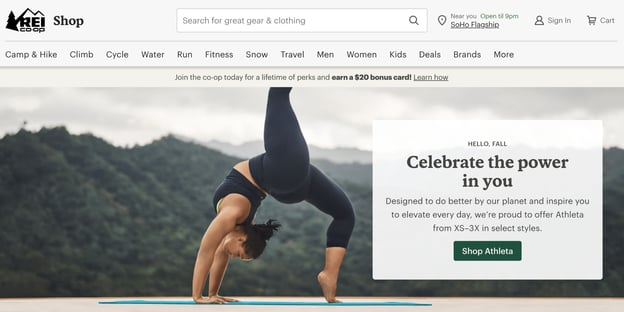
REI as-a-person is your “Earthy-crunchy” friend who enjoys camping, hiking, swimming — you name it, as long as it takes place outdoors. Because of their love for outdoors, REI is also dedicated and focused on the environment, and solely purchases sustainable products.
4. Volvo
Volvo as-a-person is reliable, sturdy, and dependable. Volvo prides itself on “their years of leadership in automotive safety”, and is disciplined, responsible, and principled.
Take a look at the following Volvo commercial, which highlights the safety of the cars above all else:
Additionally, if you take a look at Volvo’s About Us page, you’ll read statements like, “For nearly a century we have been making life easier, better and safer with cutting-edge technology”, and “Volvo Cars is a brand for people who care about the world we live in and the people around us” — all of which suggests a personality of dependability.
While other car dealerships might focus on a car’s fancy features, Volvo stays committed to one key value: Safety.
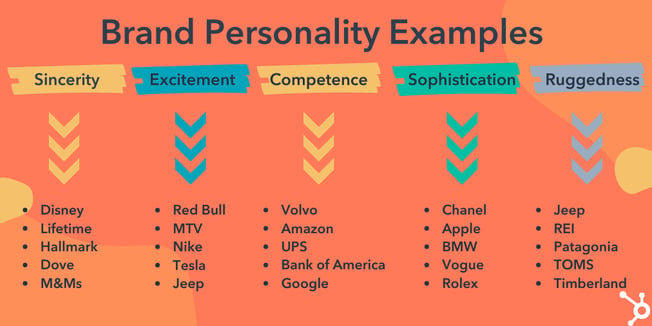
Dimensions of Brand Personality
In The Journal of Marketing Research, Jennifer Aaker outlines five dimensions of brand personality: sincerity, excitement, competence, sophistication, and ruggedness.
These five pillars can be jumping-off points when identifying your own brand’s personality.
However, there will be unique personality traits that fall under each broader dimension, and the more specific you can be when identifying which traits belong to your brand, the more authentic and unique your brand’s personality will become.
Let’s explore some specific personality traits that fall under each dimension, now:
Traits that relate to sincerity:
- Wholesomeness
- Trustworthiness
- Honesty
- Authenticity
- Cheerfulness
Traits that relate to excitement:
- Passion
- Adventurousness
- Enthusiasm
- Boldness
- Imagination
- Daring
Traits that relate to competence:
- Intelligence
- Dependability
- Success
- Principled
- Conscientious
Traits that relate to sophistication:
- Elegance
- Composure
- Worldliness
- Confidence
- Tact
Traits that relate to ruggedness:
- Toughness
- Athletic
- Sturdy
- Outdoorsy
- Reliable
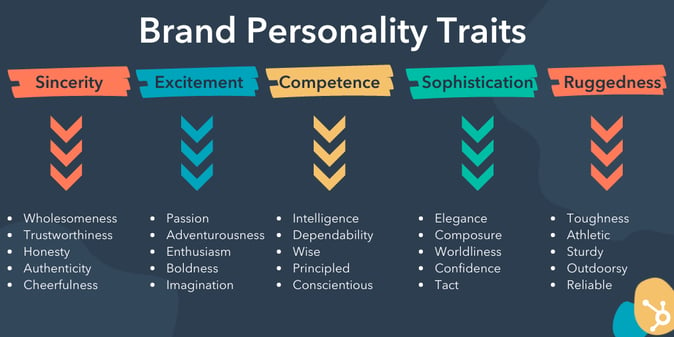
How to Create a Brand Personality
Now that we’ve explored some examples and traits of brand personalities, you might be wondering how you can create your own brand personality.
Ultimately, you’ll want to do this as early as possible. A brand personality can help guide your marketing team’s decisions and ensure your entire team remains consistent across channels — and consistency is key for brand recognition and long-term customer loyalty.
Whether you’re creating a personality for the first time or interested in re-vamping your existing brand personality, we’ve got you covered. Keep reading to learn the six steps you’ll need to take to create a strong, lasting brand personality.
1. Figure out your values.
Like any real human being, values can shape who your brand is, the decisions your brand makes, and how your brand acts.
So you’ll want to start by outlining your core values. What matters most to your brand? (Hint, hint: It should be whatever matters most to your target audience.)
Once you’ve identified your brand’s values, write them out in a value statement. Your value statement will be the foundation of your brand’s personality.
For instance, consider Life is Good’s mission statement: “To spread the power of optimism.” I’m willing to bet Life is Good’s mission statement helps drive all marketing decisions — for instance, as a marketer for Life is Good, I’d want to ensure my Instagram captions or ad copy were positive and hopeful.
2. Use your audience as inspiration — since they already are who your brand should be.
REI’s brand personality works because its target market is an audience of outdoors enthusiasts. The brand’s personality would be entirely ineffective, on the other hand, if the brand was targeting office employees.
This is why it’s vital you consider, first and foremost, your audience’s preferences, behaviors, and expectations.
You’ll want to conduct qualitative and quantitative research on your target audience to ensure you have a strong understanding of your buyer persona.
To begin understanding your buyer persona, you’ll want to ask questions like these:
- Does my audience care more about luxury, or affordability?
- Are they driven by emotions, or logic?
- When purchasing products, what matters most to them? Sustainability? Safety? Entertainment?
- What does my audience do in their free time?
- What do they care about?
- What do they like? What do they dislike?
The deeper you understand your audience, the easier it will be to construct your brand’s personality. Your brand should reflect and reinforce who your buyer persona is — or who they want to be.
Chanel’s brand personality, for instance, resonates so strongly with its audience because it reflects traits that matter to its audience, including luxury and sophistication. If Chanel was targeting an audience that cared more about affordability, then it wouldn’t succeed.
3. Ask yourself questions as if your brand were a human.
Once you’ve constructed a loose outline for your brand’s personality, you can refine it by asking yourself (and your team) questions as if your brand already were a person.
This might sound silly, but consider asking yourself:
- How does my brand act when they go to a party?
- What does my brand talk to its friends about?
- What excites my brand? What scares my brand?
- Why does my brand behave X way? What drives it?
It’s critical you’re able to describe, in great detail, who your brand is. This information doesn’t have to be public-facing — in fact, it most likely won’t be. Instead, this information will be used on the back-end so your marketing team can create materials that resonate with your audience and begin building strong brand loyalty. If done effectively, your audience will begin connecting to your brand without realizing why they feel as emotionally compelled as they do.
4. Create a brand style guide for your team.
Over time, your team will change. New people will join, others will leave. If you don’t have strong guardrails that outline who your brand is … and who it isn’t … you risk diluting the brand personality over time.
To combat this, ensure you create a brand style guide that outlines how the brand personality will display itself through your marketing materials. For instance, what font demonstrates your brand’s personality? What about colors? Language, voice, tone? Visuals?
The more specific you can be with your brand style guide, the more likely you are to see consistency across channels. Additionally, you’ll want to take the time to outline who your brand isn’t. These guardrails will ensure your brand doesn’t sound and act different on your social channels compared to your website.
As HubSpot’s Global Head of Brand Marketing Amy Marino puts it, “A brand personality can inform everything from how you write marketing copy to how you design your website to where your brand shows up in real life.”
Marino adds, “Developing a brand personality is an important element that can guide your company’s brand marketing … and ensure prospects and customers feel elements of continuity across every brand interaction.”
5. Iterate.
Over time, as you conduct market research, you’ll want to remain open to iterating on your personality if it no longer serves your audience or meets your audience’s needs.
For instance, perhaps in market research you find audiences feel your brand is a little too aggressive. To fix this, you might soften your brand’s personality and use more calming language across your channels.
With these tips in-mind, you’re now well on your way to developing a strong, unique brand personality that works best for your brand.
Ultimately, your brand’s personality has a direct impact on how emotionally invested your consumers are in your business — and how willing they are to stick around for the long-haul.
