
Welcome to My Blog
New App Store guidelines crack down on iOS ‘virus scanners’, offer alternatives to Face ID for under 13’s
Apple has updated its developer app review guidelines for the iPhone and iPad App Store this week with new clauses addressing the appropriate usage of Face ID, ARKit and more.
Apple says that ARKit apps must provide a rich experience; they don’t want the store flooded with simple apps displaying single objects. There are also limits on how developers can use Face ID and a new crackdown on scammy iOS apps like so-called virus scanners …
People treat Siri as a therapist, says Apple job ad, as it seeks an unusual hire
An Apple job ad notes that some people treat Siri as a therapist or counsellor, and it wants to help the intelligent assistant do a better job of helping people.
People have serious conversations with Siri. People talk to Siri about all kinds of things, including when they’re having a stressful day or have something serious on their mind. They turn to Siri in emergencies or when they want guidance on living a healthier life. Does improving Siri in these areas pique your interest? Come work as part of the Siri Domains team and make a difference.
If you’re thinking of applying, you’ll need an unusual combination of skills …
The Internet Had a Busy Week. Here’s What You Missed.
The drama of this week’s Apple event is hardly over.
Despite many of the announcements having been leaked in the days leading up to it, the tech world is still positively a-Twitter about what was unveiled, and what will come of it.
Many are wondering if the iPhone 8 models are really that different from the iPhone 7. And even U.S. Senator Al Franken has joined the conversation, in his questioning of Face ID’s possible violation of privacy protections. (He actually makes quite a compelling point. Check out his letter to Apple CEO Tim Cook here.)
But hold the (i)phone, people. There was so much else that happened this week — and we’re not about to let it go unnoticed.
Uber’s Got Some ‘Splainin to Do
The Alphabet Lawsuit
Yes: Uber is currently in the throes of a lawsuit with Alphabet Inc., Google’s parent company. Let’s take a step back for a minute for a look at everything that led to this point.
Some Background
Back in 2016, Anthony Levandowski, an engineer for Alphabet’s self-driving division, left to create his own autonomous vehicle startup called Otto. A mere six months later, Uber acquired Otto to create its own internal self-driving department, which Levandowski would oversee.
But that was far from a happy ending. Not only was this move rumored to cause a high degree of contention among Uber’s executive leadership, but it would also result in some major litigation down the line.
This February, Google’s self-driving division — now called Waymo — filed a formal complaint claiming that Levandowski had stolen 14,000 files containing confidential intellectual property from Alphabet, prior to his departure. One of the biggest pieces of information within those files was something called the lidar, which stands for “Light Detection and Ranging.” It’s the technology at the core of all self-driving vehicles, which uses a combination of lasers and radar to sense movement. NOAA has used it for some time to sense movement on the Earth’s surface, but in this case, it’s used to detect things like pedestrians and surrounding traffic.
In other words: Lidar is unequivocally essential to self-driving technology. And it doesn’t come cheap — but Alphabet claims to have reduced the costs by 90% by vertically integrating its build-out. Uber allegedly had access to the details behind it, and Waymo filed an injunction against Uber to keep it from using this information.
The entire situation continued to escalate (Recode has a great summary of what happened up to April 2017), leading to even more accusations from Alphabet, Levandowski’s firing in May, and Uber’s then-CEO Travis Kalanick’s June resignation. Dara Khosrowshahi, previously at Expedia, formally replaced Kalanick as CEO in August.
Where We Are Now
Uber suffered some additional, significant blows this week. A federal circuit judge denied its request to move this case to private arbitration, and on top of that, the company was ordered to turn over a document that Alphabet has been trying to obtain almost since the mess began: a report prepared for Uber when it first began exploring the option of acquiring Otto.
Alphabet claims that what is now known as the “Stroz Report” (since it was prepared by Stroz Friedberg, a law firm specializing in cyber security) contains information that could be pivotal to its side of the case. It’s essentially a due diligence report that includes data captured from an interview with Levandowski, who has been exercising fifth amendment rights to remain mum throughout the ordeal. Much of what he is refusing to say, Alphabet believes, could exist in this document.
These developments have all surfaced among a leaked memo from Uber’s Chief General Counsel Salle Yoo confirming her imminent resignation, which New York Times tech reporter Mike Isaac tweeted:
memo here: http://pic.twitter.com/8m3aBEydwM
— ಠ_ಠ (@MikeIsaac)
September 13, 2017
This lawsuit is just one of many ongoing legal battles currently faced by Uber, including allegations that it tracked Lyft drivers to obtain competitive data, as well as high-level international bribery accusations. As Yoo said herself in the memo, after five years with the company, her work has become “incredibly hard.”
And Speaking of Self-Driving Cars …
Earlier this month, the U.S. House of Representatives passed the The SELF-DRIVE Act, which essentially approves the placement of self-driving cars onto public roadways. Since then, several parties have proudly announced their own movements in the autonomous vehicle space, including Samsung, who yesterday announced a €75 million (just over $89 million USD) investment in TTTech, a maker of digital safety platforms. The move is part of the overarching Samsung Automotive Innovation Fund, which will dedicate $300 million investment in autonomous vehicle technology.
It’s a move that shows an interesting dichotomy between the industries that are investing in self-driving vehicles.
There are the old-school automakers, like Ford (who invested $1 billion in Argo AI), General Motors (who invested $500 million in Lyft), and Volkswagen (who invested $180 million in Mobvoi).
Then, there are the tech sector players. In a somewhat bizarre turn of events, Bloomberg reported yesterday that Alphabet may be investing $1 billion in Lyft, as well. What’s especially odd, the story points out, is that Alphabet’s Google Ventures (GV) also has some stake in Uber, despite the ongoing Waymo battle.
Apple has also hinted at a delve into this type of technolog — CEO Tim Cook revealed to Bloomberg Television in June that the company would be “focusing on autonomous systems.” Check out the video of that interview below.
Samsung is hardly the first — or the last, we anticipate — of the tech giants to announce a throwing-of-its-hat into the self-driving vehicle ring.
More Trouble for Facebook
Following the September 6 revelations that Russian groups had purchased about $100,000 worth of politically-charged ads on Facebook, the social media platform yesterday announced it would further modify its ad guidelines to prevent targeting to hate groups.
When advertisers create targeted content, they’re able to do so by including interests in the criteria. ProPublica recently tested those interests by creating ads and seeing if targeted interests could include anti-Semitic interests. It could — here’s a look at the criteria used by ProPublica to test the process:
Source: ProPublica
ProPublica created three promoted posts using this criteria, and “Facebook approved all three ads within 15 minutes.”
But how did it happen? To be clear, Facebook did not create those categories. Rather, because the platform allows people to add customizable interests to their personal profiles, enough users — roughly 2,300 — included this language for Facebook’s algorithm to interpret them as targeting criteria available to advertisers.
However, ProPublica contacted Facebook with this discovery before the story ran, and the social media channel removed these categories with a formal announcement of changes to its ad targeting policies.
“To help ensure that targeting is not used for discriminatory purposes, we are removing these self-reported targeting fields until we have the right processes in place to help prevent this issue,” the statement reads. “We want Facebook to be a safe place for people and businesses, and we’ll continue to do everything we can to keep hate off Facebook.”
The Equifax Hack Is a Giant Dumpster Fire, but It Taught Us About Marketing
When we use the colloquial term “dumpster fire,” well, we mean it. Bear with us, as we work our way through the saga of events.
Some Background
Last week, Equifax announced that it had experienced a massive data breach somewhere between May and July 2017, when hackers obtained the personal information (things like Social Security numbers, addresses, and license plate numbers) of roughly 143 people in the U.S.
That timing is important: The company was aware of the breach since July, but waited over a month to alert the public. To add insult to injury, three executives sold close to $2 million of their stock in Equifax sometime within that window, which was not part of any 10b5-1 scheduled trading plans.
Once the announcement was made, it was clear that Equifax was completely unprepared to handle the response. Though it made a website available that claimed to let you know if you were affected by the breach, it didn’t provide any tangible information.
I tried it myself and compared my results to a friend’s. Mine told me that my “personal information may have been impacted by this incident,” while her results said that it wasn’t. We were both prompted to enroll in its TrustedID credit monitoring system, which the company said it would offer for free after the breach.
But it turned out that the results were meaningless. To test the system, TechCrunch reporter John Biggs entered “Booger” as his name and “123456” as the last six digits of his social security number, only to receive the same result that his “personal information may have been impacted”.
Then, someone discovered that TrustedID’s terms of service would bar its users from entering any sort of class action against the company if they enrolled in its credit monitoring service. People left with no clear answer on the extent to which the breach may have affected them, and they were left with no solution moving forward. Equifax later went on to state that it wouldn’t bar users from lawsuits related to the hack, and that language appears to have been removed from TrustedID’s terms.
What It Taught Us About Marketing
This is not a tough one to figure out, folks: Transparency is everything.
When I first found out that Equifax sat on this realization for so long, I wanted to give the company some benefit of the doubt — this was a big crisis to deal with. There was a PR firm to hire, and a system to establish that would provide users with answers to the myriad questions they were sure to have.
But in the end, that wasn’t the case. As one of my friends put it, “Everyone is scared, and it’s impossible to get information.”
That’s unacceptable in a world where most businesses with a digital consumer-facing presence collect some semblance of information from customers.
While information like an email address or newsletter preference isn’t as high-stakes as a Social Security number, the reality is that we willingly submit and collect personal data with the same casual attitude with which we sneeze. And when that information is compromised, businesses have to be prepared for an avalanche of responses from unhappy users.
It also opens a path for false solutions, such as a chatbot developer that earlier this week claimed it could automatically sue Equifax for $25,000 on your behalf. (TechCrunch promptly put those claims to rest here.)
As marketers, it’s our job to develop honest, thorough messaging that answers their questions, as quickly and comprehensively as possible. Moreover, it’s our job to understand and be prepared to address their fears, and come up with the communication tools to reassure them as much as possible during a crisis — the exact opposite of how Equifax handled the situation.
There Was Also Non-Apple Mobile Stuff
Mobile World Congress Americas
This week also hosted Mobile World Congress Americas (MWCA): an event dedicated to the mobile industry that features, among other things, product launches. This year’s edition, in what turned out to be the most unfortunate timing possible, overlapped with Tuesday’s Apple event.
But if I’m being honest, even if the event’s timing didn’t parallel Apple’s, its highlights still may have seemed a bit lackluster. Among them:
- Apple wasn’t completely absent from the event — Lumion debuted its special iPhone X case … before the phone’s launch was even formally announced. What makes the case special, the unveiling said, is its ability to protect the new and all-glass device.
- Lenovo Motorola unveiled its MotoX4 smartphone.
- During his opening keynote, FCC chairman Ajit Pai did not once mention net neutrality.
And Then, There’s Google
Yesterday, Google put some promotional content into the universe that hints at an October 4th debut of the Pixel 2. That pending release has been rumored for awhile now, given that what looks an awful lot like a future edition of the device was leaked by Android Police in July.
Here’s a look at the teaser images from the dedicated landing page:
… as well as the nifty video implying some of the next edition’s features and improvements:
Odds and Ends
No More “The”
Parent company New York Times has combined The Wirecutter and The Sweethome to create a hybrid, rebranded Wirecutter — no “the.” It was mentioned during an interview with GM David Perpich during Code Commerce, which was loaded with tons of great content. Check it out here.
The People Have Spoken, and They Want Mobile
Adobe released some cool new data on consumer preferences — but It doesn’t really surprise us. Among the findings, are that “smartphones are the preferred method for consumption,” and that “Facebook is the leading social platform for mobile referrals.” Read the full report here.
Slack, Strides, and Teams … Oh, My
We’re witnessing a showdown among workplace communication apps. Major announcements came both Microsoft Teams and Atlassian of new products and features that seek to rival Slack — the timing of which was suspiciously close to the kickoff of this week’s Slack Frontiers.
A Troubling Trend
It’s worth mentioning this week’s
New York Times profile SoFi scandal, which documents months of harassment allegations and the way it was handled by the company’s board. Its publication aligns with last week’s settlement in the
harassment case filed against UploadVR by a former employee. This year has seen a ton of cases like these — from
Uber to
Lowercase Capital, more employees are coming forward about inappropriate incidents, and companies are trying to correct it. We’ll keep you in the loop on how these discussions are evolving in the industry.
Face ID will work with most sunglasses, and can be instantly disabled, says Craig Federighi
Apple covered the sophistication of Face ID in some detail during this week’s launch of the iPhone X, showing that it worked with make-up, hairstyle changes, hats, scarves and glasses. But questions are still being asked, and Apple has answered a couple of them.
Just as Face ID works with normal eye-glasses, Apple’s SVP of software engineering Craig Federighi confirmed that it works with most sunglasses – even ones which appear to be opaque from the outside …
iPhone 8 shipping slips to 1-2 weeks, Apple Watch Series 3 to 2-3 weeks
Twitter users are noting that shipping times for the iPhone 8, which started slipping within a few minutes of pre-orders opening, are now shown as 1-2 weeks for most models. Apple Watch Series 3 models are typically showing 2-3 weeks at the time of writing.
If you want to get yours earlier, there are a few things you can try …
How to Work With YouTube Influencers
Want your ads to reach an enthusiastic niche audience? Have you considered collaborating with YouTube video influencers? To discover how to work with influential YouTube creators, I interview Derral Eves. More About This Show The Social Media Marketing podcast is an on-demand talk radio show from Social Media Examiner. It’s designed to help busy marketers, […]
This post How to Work With YouTube Influencers first appeared on .
– Your Guide to the Social Media Jungle
from http://ift.tt/2jtTftu
via socialmediaexaminer
iPhone 8/X pre-order hub: How to get the phone & all the essential accessories
The iPhone X and iPhone 8 are official and today is the day the phones begin to go up for preorder from Apple. Will you preorder direct from Apple’s website for your first chance at the device? Or will carrier deals and upgrade programs prove tempting enough to wait and take your chances at lining up for the official retail launch day later this month?
Below is our iPhone 8 preorder hub where we break down everything you need to know about where and how you can get your hands on the new phones first.
Thanks to our sponsor Speck and its brand new line of iPhone X and iPhone 8 cases available now.
iPhone 8, Apple TV 4K, and Apple Watch Series 3 now available for preorder with Sept. 22 arrival
Six hours after originally taking its online store down, Apple has now made the iPhone 8, Apple TV 4K, and Apple Watch Series 3 available for preorder. All three devices can be purchased via the Apple Online Store with the earliest arrival date being September 22nd, but that varies by SKU…
Hands-on: The new Apple Watch Series 3 w/ LTE, performance improvements, and more [Video]
Apple this week officially unveiled its new Apple Watch Series 3, brining a host of changes to the device. Following Apple’s special event, we got the opportunity to go hands-on with some of the announcements.
Head below for our look at the new Apple Watch Series 3…
Apple starts rolling out 4K HDR content to iTunes, upgrading prior purchases free of charge
Apple this evening has started rolling out 4K movies to the iTunes Store. While the Apple TV 4K is only going up for preorder tonight and won’t actually be released until next week, Apple is seemingly prepping the iTunes Store for the debut….
Apple Online Store goes down ahead of iPhone 8, Apple TV 4K, and Apple Watch Series 3 preorders
The Apple Online Store has gone down this evening ahead of the preorder release of Apple’s latest products. Once the store comes back up, users will be able to preorder the iPhone 8 and iPhone 8 Plus, the Apple TV 4K, and the Apple Watch Series 3.
Comparison: How the new Apple TV 4K stacks up against its predecessor
Apple will officially release the Apple TV 4K later tonight after months of rumors and speculation. On the surface, the new Apple TV is largely the same as the previous-generation model. If you dig a bit deeper, however, there are several notable changes.
Read on for our full comparison of the new Apple TV 4K and the non-4K version…
17 Data Visualization Resources You Should Bookmark
Whether you’re writing a blog post, putting together a presentation, or working on a full-length report, using data in your content marketing strategy is a must.
Using data helps enhance your arguments by making your writing more compelling. It gives your readers context. And, it helps provide support for your claims.
That said, if you’re not a data scientist yourself, it can be difficult to know where to look for data and how to best present that data, once you’ve got it.
And sometimes, the best way to present the data is visually. There’s a term for that: data visualizations. Those consider of any type of graphic content that visually communicates data to the viewer. (After all, pictures “say 1,000 words,” right?)
To help, we put together the following list of resources. Below you’ll find the tools you need to source credible data, and to create some stunning visualizations. Check ’em out below.
17 Data Visualization Resources You Should Bookmark
Resources for Uncovering Credible Data
When looking for data, it’s important to find numbers that not only look good, but are also credible and reliable.
The following resources will point you in the direction of some credible sources to get you started, but don’t forget to fact-check everything you come across. Always ask yourself: Is this data original, reliable, current, and comprehensive?
1) Statista
Price: Free. A Premium version is available for $49/month.
Statista is a portal of statistics, studies, and forecasts focused on market research and opinion polling. Meant for businesses and academics, Statista makes it easy to find reliable market data based on industry, topic, or country.
One of the best features of Statista is its easy-to-navigate interface and its automatic visualization features. You can easily download statistics and charts you find to PDF, PNG, or Office file formats, to customize and use them accordingly.
2) Google Trends
Price: Free
Ever find yourself looking for data about popular topics, online trends, and current events? If you haven’t already discovered it, Google Trends will be your new favorite resource.
Google Trends gives you data on what people are searching for, how trends change over time, and how search interest differs by area, region, country, and so on. It’s easy to search for specific trends or simply browse current trending topics.
The best part about Google Trends? It’s completely free — and super easy to navigate.
3) Zanran
Price: Free
Google is great when you’re looking for lots of broad information, but when you’re trying to find specific charts or data points, you might try using Zanran.
Zanran is a search engine designed specifically for finding tables, charts, and graphs online. Keep in mind that Zanran works by first examining images found online, not text. In other words, it’ll only pull up information found on actual tables, graphs, and charts. This gets you to raw, original data fast — but you might find it lacking if you’re looking for short-and-sweet interpreted facts and figures.
4) Pew Research Center
Price: Free
The Pew Research Center, one of the leading think tanks in the U.S., publishes tons of information and data on public opinion, social issues, and demographics in the U.S. and worldwide.
It’s an amazing resource for finding credible data on topics like politics, the media, internet and tech, social trends, and so on. Bookmark this page when you want to search for specific data, but don’t forget to follow them on social media. This is a great way to stay up-to-date on current trends and continually generate content ideas.
5) SocialMention
Price: Free
Similar in function to Google Trends, SocialMention is a search and analysis tool that allows you to monitor user-generated content trends online. If you’ve ever wanted to monitor what people are saying about your brand, SocialMention is a great tool. (HubSpot customers: You can also do this in Social Inbox. Check out this resource for more information.)
The real strength of SocialMention lies in its analysis feature. Simply type in any keyword (like your brand name), and SocialMention tells you the strength (likelihood of being discussed), sentiment (ratio of positive to negative mentions), passion (likelihood of repeat mentions), and reach (measure of influence of unique authors) of that keyword.
Gathering this kind of data about your brand can be useful internally, or you can use it to find data for social-related content.
6) Think with Google
Price: Free
It’s no secret that Google has a lot of insights and information to share. Luckily, Google put together a free tool for marketers to find the latest data surrounding current trends called Think with Google.
This is a great tool for browsing, and I highly recommend subscribing to it. Since it’s made specifically with marketers in mind, it does a great job of keeping you up-to-date on the latest information you need to know.
7) HubSpot Research
Price: Free
Another great resource for free marketing, sales, and business data is our very own HubSpot Research. HubSpot Research is the place where we publish new and original reports, statistics, charts, and thought leadership ideas.
If you’re looking for specific stats or charts, it’s easy to browse by category, or use search terms to find the data you’re looking for. And if there are certain topics you want to hear more about, we’ll send you an email when we publish a new report or new data piece about it.
Resources for Creating Data Visualizations
Now that you know where to find credible data, it’s time to start thinking about how you’re going to display that data in a way that works for your audience.
At its core, data visualization is the process of turning basic facts and figures into a digestible image — whether it’s a chart, graph, timeline, map, infographic, or other type of visual.
While understanding the theory behind data visualization is one thing, you also need the tools and resources to make digital data visualization possible. Below, we’ve collected 10 powerful tools for you to browse, bookmark, or download to make designing data visuals even easier for your business.
8) Excel
Price: Packages start at $8.25/month per user (as a part of Office Suite Package).
Chances are, you might already have access to Excel at home or work through the Microsoft Office suite. Microsoft Excel is a classic tool used to both analyze and visualize data. Whether you’re doing the analyzing yourself, or just trying to repurpose data into a visual content, Excel is an insanely powerful tool that you can use to create all kinds of graphs, charts, and tables.
Excel can seem like a bit of a beast to figure out at first, so if you’re interested in learning to use Excel, check out these resources here.
9) Infogr.am
Price: Free for Basic. Paid packages fall into three categories: Pro $19/month, Business $67/month, and Team $119/month.
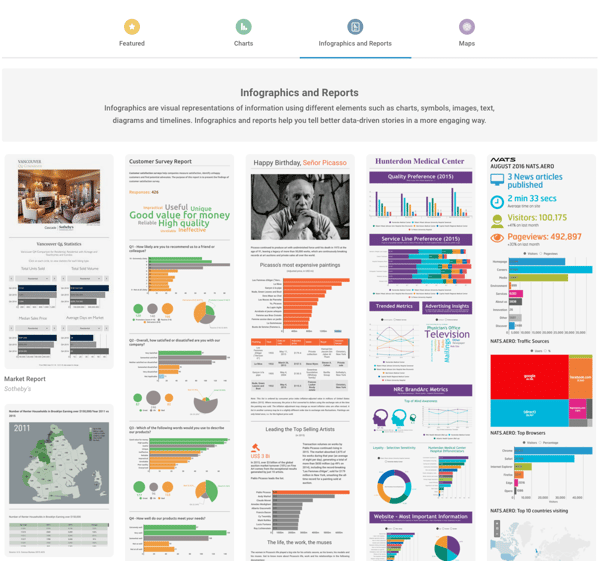
Infographics are a great way to interpret your data by turning it into something that tells a visual, memorable story.
If you have little to no design experience, Infogr.am is a great tool for you. It offers different infographic templates and tools for customizing your infographic. You can use charts, graphs, maps, images, and icons to really spice up your data and make it visually appealing.
10 & 11) Photoshop & Illustrator
Price: Pricing models start at $19.99/month for a single app.
If you’re more experienced with data visualization or design, using Adobe products can be a great way to create more elaborate, creative data visualizations. Both Photoshop and Illustrator allow you to create charts and graphs, and they’re both great tools if you want to create longer form infographics.
12) Tableau
Price: Subscriptions are offered at two price points: $35 per user per month (Personal) & $70 per user per month (Professional).
If you’re looking for some really sophisticated data visualization capabilities, Tableau is the king of data visualization software. By connecting with other data tools like Excel, Tableau makes transforming your raw data into stunning visuals really easy.
Note: Tableau is not the kind of software you would use for designing visuals every now and then. It’s a powerful, expensive tool meant for organizations that are working with lots of raw, big data all the time. Still, if you’re looking for a step up from Excel’s visualization capabilities, Tableau is definitely a tool you should check out.
13) ZingChart
Price: One-time fees range from $199 (Website) to $9,999 (Enterprise).
Ever wanted to create animated graphics and charts, but weren’t really sure where to start? ZingChart might be the tool for you.
Using Javascript, ZingChart gives you a full library of different types of charts, graphs, and maps that you can animate and use to create awesome visuals for your website and blog posts.
The best part about ZingChart is its flexible and adaptable capabilities. All of its charts have responsive design, ensuring that your charts will look great on any screen.
14) Timeline JS
Price: Free
One type of data visual that often gets overlooked: timelines. They’re a great way to display your data by looking at changes or events over time.
While you could design a timeline on various graphic design platforms such as Illustrator, this free tool makes it easy to create slideshow-based timelines to embed on your website or blog.
15 & 16) Google Charts or Google Sheets
Price: Free
If you’re looking for a tool like ZingChart that lets you embed graphs and charts onto a web page, check out Google Charts.
Google Charts is an API tool that lets you create custom charts for embedding. These charts can be animated, but they have a similar look and feel to the .png charts you can create on Google Sheets (Google’s version of Excel).
If you like the look and feel of Google’s charts, but really just need to create graphics for a .jpeg or .png file (to upload or embed in a document), you can also use Google Sheets to create graphs and charts much like you would use Excel.
17) Piktochart
Price: Free lifetime account. Paid options are offered at two levels: Lite $15/month & Pro $29/month.
A similar tool to Infogr.am, Piktochart makes it easy for you to create and customize infographics within its templates. This tool is meant for users with little design experience who want to create awesome infographics.
Note: If you’re going to be using one of these two tools often, try using them in combination with one another. That will give you access to more templates, which you can use to vary your content.
Creative solutions from developers working with the iPhone X notch
Earlier today, Ben Lovejoy noted the difficulty in finding positive reactions to the iPhone X’s “notch”. Many 9to5Mac readers have shared the same sentiment over the past few days. While the notch can introduce some annoyances in viewing video or photo content for consumers, it also presents challenges to iOS app developers.
Parrot launches new Parrot Mambo FPV race mini drone
Have you always wanted to try out drone racing? Well, today is your chance! Parrot, the French drone company, just launched the Parrot Mambo FPV (First Person Race) drone. It promises to be a compact, ultra-light, agile and fun to fly mini-drone, that also provides a First Person View (FPV) race experience.
We have not yet had a chance to try one ourselves but we’re hoping to do so soon and report about it here. If it is anything like the DJI Spark in sports mode that we did a first impression of earlier, it should be a lot of fun to fly.
YouTube TV now available in eight more cities, nears 50 markets across the U.S.
Late last month, YouTube TV launched in 12 more markets around the United States. That brought the $35 per month cord cutting service to 41 cites, a fast ramp up since its late February launch. Today, the cable competitor is launching in eight more cities.
Happy Hour Podcast 138 | iPhone 8 / X, Apple Watch Series 3, and Apple TV 4K event
This week Benjamin and Zac react to Apple’s September event announcements including the Apple Watch Series 3 with LTE, Apple TV 4K, iPhone 8 / 8 Plus / X, and much (much) more.
9to5Mac’s Happy Hour podcast is available for download on iTunes and Apple’s Podcasts app, or through our dedicated RSS feed for Overcast and other podcast players.
macOS High Sierra GM now available to developers and public beta testers
Following the GM releases of iOS 11, tvOS 11, and watchOS 4, Apple is now seeding macOS High Sierra’s GM to developers and public beta testers. macOS High Sierra includes the new Apple File System, HEVC video playback, Metal 2, Photos and Safari upgrades, and more.