
Welcome to My Blog
Huawei’s plan is to take on Samsung and Apple to become the “world’s biggest smartphone maker”
Huawei has told a Hong Kong conference that it is aiming to overtake both Apple and Samsung to become the world’s biggest smartphone maker within five years, reports the WSJ. Huawei director Richard Yu made the statement at the Wall Street Journal and f.ounders-held Converge technology conference.
“We want to be the number-one smartphone maker in the world. It’s a long distance race, and we have the patience,” said Yu.
Filed under: iOS Devices Tagged: china, Huawei, iPhone
7 Tech Predictions That Totally Missed the Mark
How far will technology advance in the next 20 years? That’s kind of a difficult question to wrap your head around, isn’t it?
Of course, that hasn’t prevented people from offering up their own (sometimes bombastic) claims for what the future will hold.
From forecasting the demise of certain companies and technologies, to predicting the mass adoption of particular products, tech fortune-tellers have long been waxing philosophical about what’s to come.
But in many cases, these predictions have proven to be categorically, unequivocally, wrong.
Here are some of our favorite examples of tech predictions that completely missed the mark.
7 Tech Predictions That Totally Missed the Mark
1) “I predict the Internet will soon go spectacularly supernova and in 1996 catastrophically collapse.” – Robert Metcalfe (1995)
Image Credit: Ohio University
This is one of the most well-known failed tech predictions. And the person who made the prediction, Robert Metcalfe (who co-invented Ethernet, FYI), even acknowledged how off the mark he was a few years after making the prediction. During a keynote speech at the International World Wide Web Conference, Metcalfe put a print version of his InfoWorld column that featured the infamous prediction in a food processor and — quite literally — ate his words.
2) “Even if there were a trustworthy way to send money over the Internet — which there isn’t — the network is missing a most essential ingredient of capitalism: salespeople.” – Clifford Stoll (1995)
Image Credit: Newsweek
It turns out that Metcalfe wasn’t the only seemingly intelligent person to predict the demise of the internet back in 1995. In an article for Newsweek, astronomer Clifford Stoll explained why the internet wouldn’t be as transformative as many had been claiming. Specifically, Stoll called out the idea of “cyberbusiness” (read: ecommerce) as being totally impractical. As Stoll wrote:
We’re promised instant catalog shopping — just point and click for great deals. We’ll order airline tickets over the network, make restaurant reservations, and negotiate sales contracts.
Flash forward to today and … yep, we can do all that. What’s more, in Q1 of 2016 alone, total ecommerce sales in the U.S. were around $92.8 billion. Needless to say, we’ve solved the whole “sending money over the internet” thing.
3) “I’d shut [Apple] down and give the money back to the shareholders.” – Michael Dell (1997)
Image Credit: Inc.
This one isn’t really phrased like a prediction, but it definitely hints at Dell CEO Michael Dell’s vision of the future. The quote above was given in response to a question about what Dell would do with Apple if he were in Steve Jobs’ shoes. (Jobs had just rejoined Apple at the time.)
Of course, when we look back now — knowing that Apple is currently the most valuable brand on the planet — Dell’s plan for Apple’s future seems incredibly foolish. But to be fair, lots of folks were discounting Apple at the time. Case in point, this quote from a 1996 Fortune article: “Apple’s erratic performance has given it the reputation on Wall Street of a stock a long-term investor would probably avoid.”
4) “Two years from now, spam will be solved.” – Bill Gates (2004)
Image Credit: Tech Insider
I mean, come on. This one was just wishful thinking. At the 2004 World Economic Forum, Bill Gates made the bold claim that spam email would be gone in two years.
Bad news, Bill. It didn’t happen. A report published in 2014 — 10 years after Gates’ prediction — showed that, on average, 54 billion spam emails are sent everyday.
5) “Everyone’s always asking me when Apple will come out with a cell phone. My answer is, ‘Probably never.'” – David Pogue (2006)
Image Credit: The New York Times
In 2006, the above quote from tech journalist David Pogue appeared in The New York Times. In 2007, Apple released the first generation of its iPhone. Sooo yeah, a definite swing and a miss.
But even after the iPhone was released, tech soothsayers still weren’t sure it’d be a success …
6) “There’s no chance that the iPhone is going to get any significant market share. No chance.” – Steve Ballmer (2007)
Image Credit: The Telegraph
Back in 2007, then Microsoft CEO Steve Ballmer thought the iPhone would be too expensive to earn widespread adoption. In an interview with USA Today, Ballmer even put a number on it. He argued the iPhone might end up with “2% or 3%” of the market share, but no more.
Ballmer was wrong. Apple ended 2015 claiming around 16% of the global smartphone market. And when we look at just the U.S., that market share figure jumps to 40%.
7) “There is no reason anyone would want a computer in their home.” – Ken Olsen (1977)
Image Credit: Boston.com
From the 1960s through their acquisition by Compaq in the 1990s, Digital Equipment Corporation (DEC) was a major player in the American computer industry. But for founder and former president and chairman of DEC, Ken Olsen, the computer didn’t seem like it would ever become a household consumer good (at least not in 1977, when Olsen made the comment above).
Today, more than 84% of U.S. households have computers.
Know of any other famously inaccurate tech predictions? Share them in the comments section below.
Former Apple ad guru Ken Segall says company is losing touch with its heritage of simplicity
Ken Segall, the former Apple ad consultant who coined the iMac name, wrote the copy for the famous ‘Think different’ campaign and authored the book Insanely Simple, says that Apple is beginning to lose touch with its heritage of simplicity. He gave his assessment of Apple’s ‘state of simplicity’ in a piece for the Guardian.
Though Apple’s customers remain fiercely loyal, the natives are getting restless. A growing number of people are sensing that Tim Cook’s Apple isn’t as simple as Steve’s Apple. They see complexity in expanding product lines, confusing product names, and the products themselves.
While the Guardian‘s headline makes the piece seem entire critical, it’s actually very balanced …
Filed under: AAPL Company Tagged: AAPL, Apple Inc, Insanely Simple, Ken Segall, simplicity, Steve Jobs, Tim Cook
Food delivery apps Grubhub and Seamless now accept Apple Pay for faster checkout
If you’re of the view that life’s too short to fetch your own take-out food, you’ll probably appreciate anything that speeds up the ordering process too – which is why Grubhub and Seamless now offer Apple Pay in the iOS apps. TechCrunch estimates that using Apple Pay instead of a credit card will save you about a minute per order …
How to Build Trust Online: 7 Little Ways to Create a Trustworthy Website
When it comes to establishing trust, it doesn’t matter how compelling your calls-to-action are, how engaging your content is, or how quickly your pages load on mobile screens. If visitors to your site have any doubts about how trustworthy you are, they’ll bounce right out and never come back.
Especially in the B2B sector, where the customer journey is increasingly self-service and often involves several months of careful deliberation, trust is a deal-breaking prerequisite for any sort of relationship building process. For B2B buyers to be open to engaging with you, they need to feel confident that you’ve got their best interests in mind for the long haul.
People’s guards go up when it comes to marketing and sales, simply because there have been too many cases of high-pressure, exploitative tactics over the generations.
In fact, while nearly half of us trust doctors and firefighters, only 3% trust salespeople and marketers, according to a new HubSpot Research study.
What’s more, our profession barely outranks stockbrokers, car salespeople, and politicians when it comes to trust. Even lawyers and baristas command more trust than we do.
Understanding NPS and the Trust Index
“How likely are you to recommend our brand to a friend or colleague, on a scale of 0 to 10?”
If you asked your customers — both existing and potential — to answer this questions, what would their responses look like?
This question serves as the basis for a metric known as net promotor score, or NPS. And it’s incredibly important for marketers to keep a pulse on.
But before we dive into how it can be used to measure the trustworthiness of your brand or website, let’s explore how it works. Essentially, the responses to this question get sorted into the following buckets:
- Those who respond with a score of 9 or 10 are considered loyal enthusiasts, or promoters, who are likely to fuel your growth through continued purchases and referrals.
- Those who respond with a score of 7 or 8 are considered passives. They are satisfied, but they’re also going to be open to offers from your competitors.
- Those with a score falling anywhere from 0 to 6 are considered detractors. They are relatively unhappy customers who risk damaging your brand and harm your growth through negative word-of-mouth.
You can now arrive at your NPS by simply subtracting the percentage of detractors from the percentage of promoters. So if your entire roster of clients consists of detractors, your NPS is -100, and if they’re all promoters, your NPS is 100.
Your NPS is, of course, strongly linked to your perceived trustworthiness. Customers who trust your business are more likely to be promoters, and those who don’t trust you are much more likely to be detractors. If you have a higher NPS than your competitors, then your marketing is more likely to yield results, too.
What kinds of brands do your customers trust most? A quick perusal of Alignable’s SMB Trust Index — a report based on 7,500 ratings across 45 different SMB brands according to local business owners — reveals some interesting patterns. For example, apparently small business owners deem Facebook (NPS 25) to be more trustworthy than LinkedIn (NPS 0). Verizon (NPS -12) over Comcast (NPS -59). QuickBooks (NPS 31) over FreshBooks (NPS 14).
What is it about these brands that makes one competitor more trustworthy than another? The data doesn’t offer any definitive answers, but there are plenty of measures you can take right now to maximize the impression of trustworthiness that your website exudes.
Here are seven tactics to try.
How to Build Trust Online: 7 Little Ways to Create a Trustworthy Website
1) Use authentic images.
Horribly generic and formulaic stock photos are everywhere. While there’s nothing wrong with using carefully curated stock imagery in the right places, it’s much better to favor website visuals that look like they were actually taken of you and your team in real situations.
Stock photos can get expensive, too. To truly maximize your site’s visual authenticity, you may want to consider hiring a professional photographer to take photos of your staff, products, and office. This way, you still get quality that will display well on your website and work well for other content assets, but authenticity will shine through to your audience.
There are also some great free online libraries of stock photos out there. The images on offer here are generally not going to be as specific to your content concept as something original or purchased, but they’re certainly visually compelling and have plenty of distinctive flavor. Three especially useful sites in this regard:
- Igor Ovsyannykov’s Fancy Crave. This resource boasts seven categorized archive sections and two new photo posts per day
- Death to Stock. Check out this resources for themed monthly downloadable photo packs and “maker” movement ethos.
- Unsplash. Look here for highly curated images that favor elegant still lives and serenely stark landscapes.
2) Provide social proof via testimonials.
Social proof plays a big role in creating trust. Reach out to your clients every time you complete a project and ask them to provide feedback for display on your website.
Whenever possible, include a photo of the person, which helps to drive home the authenticity to the testimonial. Here’s an example of a visually compelling testimonial from the homepage of Sisense, a leading business intelligence software provider.
3) Create helpful content resources.
No one likes a constant sales pitch, and most visitors won’t be anywhere near ready to buy the first time they visit your website, anyway.
Instead of content that screams, Buy these products now, because they’re the most awesome things ever!, aim to publish resources that show the benefit of your product or service, without overtly selling. Creating helpful content, designed to help solve audience problems and address their pain points, is critical when building trust.
Many of your prospects will be looking for the same information, so use your website to provide it to them. Use your blog to explore the issues that matter most to your buyer personas and to showcase interesting ways to use your solutions. Share case studies to demonstrate how your other clients and customers have benefited from your offering to solve their issues.
A particularly excellent example is BuzzSumo’s Knowledge Base, which features a “Use Cases” section, allowing the social media analysis platform’s audience to learn more about the app in the context of how they’re likely to actually benefit from it:
4) Provide social proof via media logos.
Earned media commands more trust than messages on paid or owned properties. Sure, we all know that in the age of “native advertising,” the lines between journalism and sponsored promotions have blurred, but there’s still a certain mystique in being able to say that The Washington Post, for example, has found your company noteworthy enough to mention it in an article.
Those “as seen on” montages of publisher logos that you see on many B2B websites are great for boosting confidence at a glance. Are you getting any decent press? Make sure your website visitors know about it.
Below we can see the power of media logos in a screenshot from entrepreneur John Rampton’s website.
5) Provide social proof via client and partner logos.
We’ve already touched on how important social proof is, but the opportunities here extend well beyond testimonials and media logos. You can also use client and partner logos to show who your allies are. People will recognize larger brands, but even unknowns can make an impression.
Knowing you’re good enough to work with those partners goes a long way in convincing someone you’re good enough to work with them, too. Check out how renowned growth consultant Sujan Patel uses all three types of trust-building social proof at the top of his homepage:
6) Include microcopy that sets expectations intuitively.
Behind all mistrust is fear of the unknown. Make it abundantly clear to your site visitors what’s going to happen when they click on your site’s various tabs, CTA buttons, and links. And make sure your navigation labels are extremely intuitive.
Quick disclaimers and labels below buttons are useful, too. If a prospect chooses to opt in to your email list, how often should they expect to hear from you? Will you sell them out to a telemarketing agency, or will you keep their contact information under wraps?
When the experience of interfacing with your business matches what you say it’ll be — a button takes people where you said it would and you email them only as often as you pledged to, for example — people will allow themselves to trust what you have to say.
Below is a prime example of trust-amplifying, expectation-managing microcopy from the newsletter signup page of inbound marketing agency IMPACT Branding & Design.
7) Put the audience in the center of stories you tell.
When you write content, or have someone write your content for you, make sure to use the word “you.” It works as a placeholder for the reader’s name, which helps to disarm people and help them be more receptive to your message.
Research suggests that some people were more likely to marry someone with the same initials as them — that’s how powerful your name is. On the other hand, using a person’s name too much comes off as creepy, so you have to be careful with it. “You” places the reader in your content as if you are speaking directly to them and involving them, without the risks of using their name too much.
This principle extends well beyond word choice. Instead of turning people off by making your content all about your company and its solutions, publish stories of empowerment where the audience is the hero.
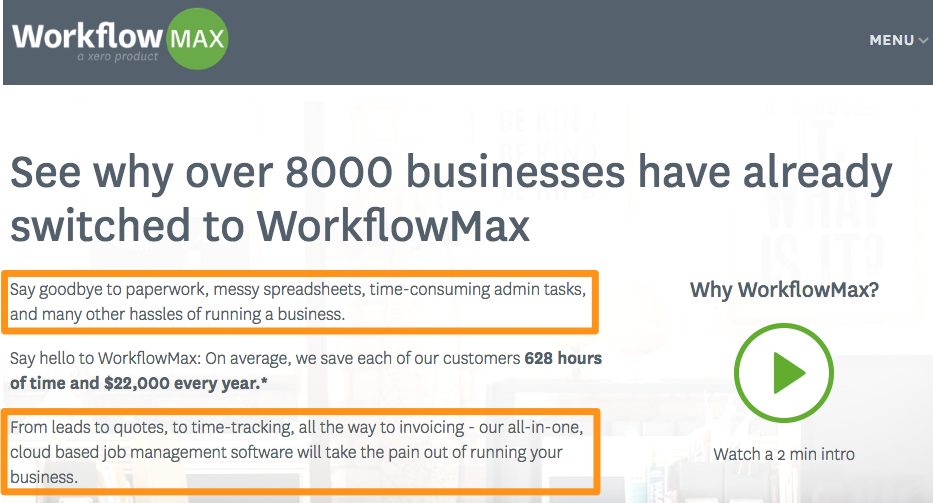
Business management platform WorkflowMax does this extremely well with their website messaging, which emphases the product’s benefits to the audience:
Avoid Tripping Those Trust Alarms
Build your website and other brand presences with these tips in mind, and you’ll have a leg up on building customer trust. By amping up on your company’s credibility, your visitors will feel safe engaging with you.
How do you inspire trust on your website? Share your tips and tricks in the comments below.
Launch Strategy: A Case Study in How to Move People to Action
Are you planning to release a book, podcast, or other product? Want to make your launch a success? To discover how he launched his latest bestselling book, I interview Michael Hyatt. More About This Show The Social Media Marketing podcast is an on-demand talk radio show from Social Media Examiner. It’s designed to help busy marketers and […]
This post Launch Strategy: A Case Study in How to Move People to Action first appeared on .
– Your Guide to the Social Media Jungle
from http://ift.tt/1XVlTim
via socialmediaexaminer
The Demographics of Developers Around the World [Infographic]
If there were 100 developers in the world, how many would be women? Which countries would they live in? How many would be pros, and how many would be hobbyists? What coding language would they speak?
These are the kinds of questions the folks at VisionMobile wanted to know — which is why they surveyed over 30,000 developers for their annual Developer Economics survey, and then illustrated their findings in the infographic below.
Their findings are pretty interesting. For example, a whopping 94% of developers are male. And while 77% of developers are professionals, a significant minority are creating software just for the fun of it.
Check out the infographic below from VisionMobile to see what other interesting statistics they uncovered about developers around the world.

Project Managers Can Now Save a Huge Chunk of Their Time by Stopping Micromanaging
As a first time founder of a startup, you might be under the notion that the only way to succeed is by taking control of every little aspect related to your organization. This is undoubtedly true to a certain extent, but you should be smart enough to let go some things.
Micromanagement poses a huge challenge and can be dangerous at times. Besides impacting your daily routines and habits, it also has an ill-effect on your employees and business in general. Michael Pryor, CEO of Trello, states that micromanagement kills the satisfaction of workers, which usually stems from self-direction and one’s own effort.
The key for overall success and happiness lies in making a move to a macromanager from a micromanager. Here are five pragmatic tips to help you achieve this workable feat.
Hire the Right Person
The success of your startup begins by hiring the right person. You’ll give responsibilities to your employees only when you start trusting them. On the contrary, if you don’t have trust and faith on your workers, the only natural solution is to micromanage things. So do your due diligence in hiring the right people.
Have an Established Procedure in Place
There has to be an established procedure in place so that every important task taken up by your team bears fruitful results. This will help prevent chaos among your employees.
By giving your workers appropriate input, you’ll find that they are comfortable with what’s going on. After establishing a set procedure and guidelines, put it in writing so that everyone sees.
Assign Bit by Bit
The transition to minimal involvement from 100% micromanagement can be onerous to many. Even if you craft a perfect move, natural delays are bound to happen. In order to reduce the difficulty level, begin by assigning tasks bit by bit. By moving out gradually instead of totally moving away, you will get relatively improved results.
Close the Door
This may sound as if it’s opposed to everything else, especially when it comes to being a terrific leader; however, it generates astounding results. Taking a break on a periodic basis like shutting your office door, taking breaks from social media and other extended escapes pressurizes your employees to function in your absence. They now realize that they have to work without your help. As a result, they put in more initiatives and become productive.
Give your Workers a Stake in Ownership
Do you want your workers to have a feeling that they own the organization? Try to give them a stake in the firm. By doing so, you’ll be encouraging them to put in more efforts and make wise decisions. Moreover, it gives them a sense of being a part of the company and not just individuals working for that particular organization.
There are two fundamental challenges as far as entrepreneurship is concerned. These include ideation and implementation. Ideation comes on its own accord to some people. If you belong to this lucky group, there is no need to brainstorm for coming up with innovative ideas. However, chances are that you may struggle with implementation.
Why Micro-Management is Bad?
Final Thoughts
To conclude, abandoning micromanaging can prove to be a very effective strategy for the well-being of your employees and yourself too. You’ll also be able to lay more emphasis on your role as a Founder.
The post Project Managers Can Now Save a Huge Chunk of Their Time by Stopping Micromanaging appeared first on Project-Management.com.
from Project Management Articles – Project-Management.com http://ift.tt/1PpeaaO
via Project-Management.com
iTunes 12.4.1 now available with VoiceOver improvements, other bug fixes
Two weeks after the release of iTunes 12.4, Apple this evening has pushed an updated build of the software bringing it to version 12.4.1. Apple says the update addresses a “number of problems” concerning VoiceOver working properly with iTunes.
Unicode Consortium officially approves 72 new emoji, including bacon, selfie, and a clown face
It’s been essentially confirmed in the past, but today the Unicode Consortium officially unveiled the 72 new emoji that will be made available in Unicode 9. The latest batch of emoji include a variety of new foods, faces, objects, and sports. Unicode 9 is set to be released on June 21st, which means we may see these new emoji in iOS 10 when it ships to the public this fall.
Filed under: iOS Devices Tagged: emoji, iOS
Opinion: Is the iOS vs Android battle headed down the same path as Mac vs PC?
Yesterday, well-respected venture capitalist Mary Meeker released her annual Internet Trends Report. Inside the over 200 slide PowerPoint were some interesting numbers relating to the continuing battle between iOS and Android. As we reported last night, Meeker’s report showed iOS continue to decline in marketshare, while Android continues to gain. In many ways, the current split between Android and iOS in terms of market share and unit shipments is very similar to the split between Mac and PC shipments and marketshare. And it’s been a long time coming for Apple.
App Store, Apple Music, iTunes and other iCloud services currently unavailable for some users
As noted by Apple’s system status page, a multitude of Apple services are currently experiencing instability and downtime for some users. The affected services include the App Store, Mac App Store, Apple TV services, iTunes In The Cloud and the Volume Purchase Program. We have also had a few reports of Apple Music downtime, seemingly repeating the outage yesterday, but Apple’s official status report does not mention any problems with Apple Music at this time.
Filed under: AAPL Company, Apple Music, iOS, iOS Devices, Mac, Tech Industry Tagged: App Store, iOS, Mac App Store
Opinion: Apple’s Back to School 2016 promotion is latest signal for future without headphone jack
Earlier today Apple announced the start of their annual Back to School promotion for 2016. This year eligible purchases of a Mac, iPad, or iPhone will come bundled with a pair of wireless Beats headphones. This is reminiscent of last year’s Back to School promotion, save for the fact that during this year’s promotion for the wireless headphone is the default and doesn’t require an extra $100 expense. The small, but obvious connectivity choice signals a new direction in which Apple wants its customer to think.
Filed under: Opinion Tagged: Apple, Back to School
Review: Speck iGuy case is a must-have when kids inherit iPads
It happens all the time. Parents upgrade old iPads with new ones and lucky kids inherit magical (and expensive) tablets. But kids aren’t nearly as careful with pricey pieces of glass and somehow always messy hands. That’s what happened in our house late last year, and Speck’s iGuy case for iPad has made a world of difference.
Filed under: iOS Devices, Reviews Tagged: iPad, Speck
Apple not unveiling new or updated external display at WWDC, announcements will focus on software
Apple won’t have a new external display to show off at its WWDC 2016 event later this month despite limited inventory as the company plans an event that will mostly focus on new software, according to sources.
Filed under: Mac
Apple re-releases iOS 9.3.2 for iPad Pro after previous version bricked some devices
Apple has re-released last month’s minor iOS 9.3.2 software update after pulling it due to customer complaints of bricking iPad Pros. The updated version features build number 13F72 and is available through official channels now.
Filed under: iOS, iOS Devices
9to5Toys Lunch Break: 11″ MacBook Air from $600, Beats Solo2 $80, iPad Pro 128GB LTE refurb $650, more
Keep up with the best gear and deals on the web by signing up for the 9to5Toys Newsletter. Also, be sure to check us out on: Twitter, RSS Feed, Facebook, Google+ and Safari push notifications.
TODAY’S CAN’T MISS DEALS:
Apple’s latest 11-inch MacBook Air is on sale from $600 shipped w/ .edu, 13-inch 128GB as low as $800, more
Apple 13-inch Retina MacBook Pro (latest version) 2.7GHz/8GB/256GB $1,200 shipped (Reg. $1,499)
Best Buy’s 3-Day Sale includes Beats Solo2 On-ear Headphones for $80 (Reg. $120), more
Save $429 on Apple’s 12.9-inch 128GB iPad Pro Wi-Fi + Cellular by going w/ a refurb for $650 shipped
Apple’s 12.9″ 128GB iPad Pro Wi-Fi + Cellular is all the way down to $800 (Reg. $1,079)
 VPN Unlimited: Lifetime Subscription for $29 ($500 value)
World Class Mac Bundle: 8 outstanding apps for $25 w/coupon (Orig. $401)
Pay what you want for 26.5 hours of photography tutorials and 100 stock images
Get 83 hours of coding tutorials with the Comprehensive Android Development Bundle: $40 (Orig. $727)
App Store $1 Amazing Apps & Games Sale: Halo, Runtastic, Lifeline, djay 2, Runstastic, more
App Store Free App of the Week: Octagon arcade-runner free for the first time in over a year ($2 value)
KAMI paper puzzle game goes free on iOS for the very first time today (Reg. $2)
MORE NEW GEAR FROM TODAY:
NBA 2K16 for iOS now matching lowest price ever in celebration of NBA Finals: $4 (Reg. $8)
- Smartphone Accessories: Anker SoundCore Bluetooth Speaker $25 (Reg. $30), more
- Daily Deals: Insignia 24″ 720p Smart RokuTV $120, Onkyo Network Receiver $300, more
- Amazon announces upgraded Fire HD 10 tablet w/ aluminum design & increased storage
- Raspberry Pi 3 bundle haseverything you need to get started: $70 shipped (Reg. $90)
- Games/Apps: PlayStation Plus 1yr. $40, iOS freebies, more
- Shed those winter pounds w/ EAS Nutrtition: 5lbs Whey $34 Prime shipped, more
MORE DEALS STILL ALIVE:
AmazonBasics Felt Sleeves for MacBooks up to 15-inches are on sale from $8 Prime shipped
Bring HomeKit control to your lights w/ Philips’ 2nd Gen Hue LED Starter Kit: $170 + varied shipping (Reg. $200)
Philips Smart Lighting: Hue Go Portable LED $80, Wireless Hue Tap Switch $50
- Give open-air headphones a try with Audio-Technica’s ATH-AD900x for $115 (Reg. $150)
- Here’s how you can score a free Chick-fil-A Sandwich throughout the month of June
- Smartphone Accessories: Aukey Bluetooth Speaker $22 (Reg. $28), more
- Ditch your computer’s speakers for the best-selling Mackie CR3 Studio Monitors: $85 (Reg. $100)
- Kindle First eBook freebies for June: Intrusion, Cold, Journey’s End, more
- Samsung 55-inch Curved 4K 3D Smart Ultra HDTV w/ 4 HDMI inputs: $1,199 (Reg. $1,600)
- Dump your old backpack for Timbuk2’s Ace 15-inch Messenger $45 (Reg. $70), more
- Take your summer parties up w/ a Hawaiian Shaved Ice/Snow Cone Machine Kit: $45
- Keep your kids learning with two Kindle Fire Kids Edition Tablets for $110 (Reg. $160)
- Xbox One official price drop brings 1TB bundles down to just $319 shipped, more
- Fulfill your dreams of owning a Mercedes-Benz for $175 (Reg. $230), more
- Free PS Plus Games for June: NBA 2K16, Gone Home, Echochrome, more
- Wired and Popular Science Magazine Bundle: 1yr. sub for $8 shipped ($25+ value), more
- Schwinn’s mini hand pump will keep your bike tires & more filled for $7 (Orig. $16)
- Target’s Beauty Box for men delivers $19 worth of grooming products for just $5 shipped
- Many acclaimed Bose speakers on sale, SoundLink Mini II $179 shipped (Reg. $199)
- Cabela’s $100 Gift Card for $85 shipped (15% off), more
- Amazon is handing out $5 in-app credits when you download select Android games
- Google Play MP3 Albums for $1 (Reg. $12+): Goo Goo Dolls Greatest Hits, Deftones, more
- Gold’s Gym XRS 20 Olympic Multi-Workout Bench for $97 shipped (Reg. $200+)
- Get a two-pack of Mini 7W LED Flashlights for only $7 Prime shipped (Reg. $9)
- Black+Decker Mini Rice/Food Cooker for under $15 Prime shipped (Reg. $20+), more
- OLALA’s 13000mAh portable iPhone charger packs a lot of juice for just $28
- Goat Simulator heads to outer space in its latest must-see iOS release [Video]
Review: Pelican’s impressive Elite Luggage is built like a tank, but is it worth the price tag?
NEW PRODUCTS & MORE:
SodaStream gets tipsy with its new Beer Bar homebrew beverage maker
- This gorgeous $1,100 SmartBike cannot be stolen according to its creators
- iDevices’ latest creation brings HomeKit control to nearly any lightbulb in your house
- This record player has Don Draper-style, AirPlay connectivity and a secret bar
- Olympus wants you to beat the hell out of its new Tough TG-Tracker 4K Action Camera
- Grado Labs latest Brooklyn-made set of headphones blend mahogany & maple woods
- Xiaomi’s first drone records 4K video, lasts 27mins, costs $460
- LG’s new OLED 4K Ultra HDTVs are still lustworthy, just as expensive
- Jaybird’s new Freedom Bluetooth earbuds have an Apple-inspired metal design
- The second generation Boosted electric skateboard promises longer range
- National Streaming Day: I finally cut the cord and haven’t looked back, here’s how I pulled it off…
- Roboterra’s K’NEX-like coding system aims to empower young engineers
- TRNTBL is a modern day vinyl-lovers dream w/ built-in AirPlay, SONOS and Bluetooth
- Black + Decker launches app-connected Bluetooth batteries w/ USB port
- Garmin’s new vívosmart HR+ opts for GPS-tracking and heart rate monitoring over battery life
- The Tap Bluetooth wearable turns nearly any surface into a functioning Bluetooth keyboard
Filed under: Tips and Tricks Tagged: 11″ MacBook Air, 12.9-inch 128GB iPad Pro, 9to5Toys, Amazon, app deals, Beats Solo2, Best Buy, Daily Deals, free apps, Gold Box, iPad Pro 128GB LTE, video games
Apple Watch Diary: Native apps or not, my usage pattern remains the same
It’s been a while since my last Apple Watch diary piece, prompted by the experience of losing access to Apple Pay for a couple of days. Unless you get excited by straps, we haven’t seen much in the way of new developments of late, but one thing did change yesterday: that was the date from which only apps using the native SDK would be accepted into the App Store.
The sluggish performance of the Watch was our most immediate complaint when a few of us here looked back at our experience of the wearable over the year. All too often, you open an app or select a Glance and then spend several seconds – and sometimes much longer – staring at those spinning dots. Less a Glance and more an Impatient Stare.
I’d hoped that the switch to native apps might improve things notably, but so far I can see no evidence of this – which means that, of the eight different ways in which you can use the Apple Watch, I’m only using a subset of them …
Filed under: Apple Watch Tagged: Apple watch, Apple Watch diary, native apps