
Welcome to My Blog
9to5Toys Lunch Break: 12″ Retina MacBook $1,099, Portable 3TB HDD $100, Logitech Bluetooth Keyboard $20, more
Keep up with the best gear and deals on the web by signing up for the 9to5Toys Newsletter. Also, be sure to check us out on: Twitter, RSS Feed, Facebook, Google+ and Safari push notifications.
Today’s can’t miss deals:
12-inch MacBook w/ Retina display 1.1GHz/8GB/256GB: $1,099 shipped (Reg. $1,299)
13-inch Retina MacBook Pro (newest) 2.7GHz/8GB/256GB: $1,280 shipped (Reg. $1,499)
 Toshiba Canvio Connect II 3TB Portable USB 3.0 Hard Drive $100 shipped (Orig. $170)
Logitech K480 Multi-Device Bluetooth Keyboard (refurb) $20 shipped (Orig. $50)
PSA: Best Buy and others launch new Apple TV pre-orders, offer potential savings
The best accessories for the new Apple TV: MFi game controllers, keyboards, cables, more
Target ad leak reveals planned Apple Watch discount for iPhone purchasers
Giveaway: Polk Audio’s Omni Whole Home Music System – Soundbar w/ subwoofer and S2 Speaker ($880 value)
More new gear from today:
Adobe Photoshop Elements 14 (Mac/PC) is on sale for Prime members: $40 shipped (Reg. $70+)
- Games/Apps: Call of Duty Strike Team & Zombies for iOS $2 ea, more freebies
- Men’s Watches up to 70% off: Rip Curl Midnight Matte $140, Nixon Stainless Steel $45, more
- Daily Deals: Insignia 55-inch 1080p Smart HDTV w/ Roku $450,more
- AirPrint Laser Printers: Canon All-in-One $80 (Reg. $109), Samsung $55 (Orig. $160)
- Amazon offers over $70 worth of Android apps for free
More deals still alive:
Monoprice 15% off sitewide: MFi certified Lightning cables as low as $4, more
A Dark Room — the best-selling iPhone/iPad RPG is now available for free (Reg. $1)
- Freebies: NBA League Pass + Supergirl TV episode + Toca Life: Town for iOS + More!
- Free Xbox Live Gold Games for November: Pneuma Breath of Life, Dungeon Siege III, more
- WD Elements 2TB Portable Hard Drive: $66 shipped (Reg. $80)
- Leaf RSS News Reader for Mac drops to $1 (Reg. $8)
- OLALA 6,000mAh Power Bank w/ MFi Lightning Cable $24 Prime shipped (Reg. $30)
- TOTU Dual Layer iPhone 6s Case in gold, silver or gray $3 Prime shipped (Reg. $12+)
- Storage: Seagate Expansion 4TB Desktop Hard Drive $100 shipped (Reg. $120), more
- Ricoh Wireless Color Laser Printer $70 shipped (Reg. $149)
- One year Sam’s Club membership + food coupons: $25 w/ email delivery (Reg. $45+)
- 9to5Toys Specials: MiFi 500 plus 1 year of LTE $149.99, more
- Fashion: Gap Fall Sale up to 75% off + extra 40% – 1969 Jeans from $10, more
- Media: That 70’s Show Complete Series on Blu-ray $70 (Reg. $100+), more
- Fitbit Charge HR Activity Tracker $115 shipped (Reg. $150), Fitbit Surge $195 (Reg. $245)
- GoPro HERO4 Session Action Camera: $249 shipped (Orig. $400)
- ChugPlug External Battery Pack for MacBook Air and MacBook Pro $40 shipped (Orig. $130)
- App Store Free App of the Week: Dr. Panda’s Mailman ($4 value)
- Gift Cards up 20% off: JCPenney, Sports Authority, more
- Fashion – extra 20% off fall athletic/outdoor shoes: Caterpillar boots $52, more
- Protect your new iPad mini 4 with this folio smart case: $3 Prime shipped (Reg. $10)
- proXPN VPN: Premium Lifetime Subscription for $39 ($375 value)
- Best-selling Acer Chromebook 2.6GHz.2GB/16GB SSD (refurb) for $120 (Orig. $170)
New products & more:
The Altwork Station cures the standing desk blues with its reclining design
Can a $99 Windows PC that connects to your iPad be any good?
- Gibson’s Neat podcasting microphones mix fun and color
- Blue’s new Lola headphones drop some weight but keep the retro look
- Toys R Us Holiday Catalog Leak: Apple TV for $54 in-store, much more
- LEGO nailed the famous Ghostbusters Firehouse set
- The eora 3D scanner uses your iPhone to create 360-degree models of anything
- Belkin’s new lightweight QODE Ultimate Keyboard Case for iPad Air 2 is now available
- Dyson’s pricey 360 Eye robo-vac finally sees the light of day
- Use your smartphone as a controller for these AirConsole Mac/PC browser games
- Best Buy lands the first major blow in this year’s battle for holiday shoppers
- Dell Black Friday Ad Leak: Gears of War Xbox One w/ Fallout 4 + controller $300, more
- Amazon thinks leaving your house is over-rated, expands Prime free same-day delivery service
- Marvel’s limited edition Phase Two Blu-ray collection arrives just in time for the holidays
Filed under: Tips and Tricks Tagged: 12-inch MacBook, 9to5Toys, Amazon Gold Box, Amazon Prime, app deals, apple deals, Best Buy, Black Friday, coupon codes, eBay Daily Deals, free, free apps, Freebies, itunes deals, MacBook, New Toy of the Day
Check out 9to5Mac for more breaking coverage of Tips and Tricks, 9to5Toys, and free apps.
What do you think? Discuss “9to5Toys Lunch Break: 12″ Retina MacBook $1,099, Portable 3TB HDD $100, Logitech Bluetooth Keyboard $20, more” with our community.
TarDisk Pear promises to double your MacBook’s HD by creating an SD card-based fusion drive
TarDisk is launching its new ‘Pear’ product today, a customized SD card solution for MacBook users that can double the device’s storage capacity while using software to create a hybrid drive that works hand in hand with your built-in drive.
There are a lot of SD card products on the market that make adding extra storage to MacBooks easy, but TarDisk Pear is different in that it merges with your built-in drives to create a new logically merged volume managed by OS X, meaning you’ll be able to tap into the storage just like a built-in drive:
“Unlike most external hard drives, where manual file allocation is necessary, this SD card creates a hybrid drive, combining the card and the internal hard drive into one. When installed, the hard drive is increased by up to 256GB and the product lies flush with the side wall of the laptop.”
TarDisk walked us through what makes the product different after the Pear is merged with your internal drive:
- The new logically merged volume is managed by OSX.
- Internal SSD is primarily used before data is sent to the product.
- More frequently used files are maintained on SSD hardware.
- TRIM enabled SSDs maintain original speed benefits of Trim.
- Read/Write buffer (“swap-space-equivalent”) is maintained on SSD to buffer writes to files located on the product.
- Failure modes, if ever encountered, allow for direct restoration from TimeMachine backups.
TarDisk is hoping consumers consider the Pear as a permanent ugprade, meaning once it’s installed you’ll have some of the likely expected issues if you remove/lose it. The company explained:
While TarDisk can be removed, its recommended use is as a permanent upgrade. This is comparable to the level of involvement required to replace a hard drive. Because it creates a hybrid drive, removing it will cause files to appear as missing. Re-inserting the TarDisk remedies this problem. As with any storage device, a backup should be a part of your routine. TarDisk Pear becomes part of your hard drive, and just like your regular hard drive if it fails, you lose that data. While read/write cycles are estimated at 3000 vs. the 5000 of your SSD, the logic used by Pear caches frequently read files in your SSD to reduce wear. That said, two hard drives increases the potential of one failing. Back up your computer normally using Time Machine. In our testing, we’ve had a very low failure rate.
The company originally launched a similar product on Kickstarter and raised over $100,000, but the new product is its first to create the hybrid, fusion drive. We haven’t been able to test the product, but we plan on doing so shortly once our review unit arrives.
The company is selling the product starting today through its website in two models: a 128GB version for $149 and 256GB for $399. Compare that to standard 256GB SD cards that on average sell for around $100 -$200 on Amazon.
Filed under: Mac Tagged: Fusion, hybrid drive, MacBook, pear, SD Card, SSD, Storage, tardisk, TRIM
For more news on Mac, MacBook, and SSD continue reading at 9to5Mac.
What do you think? Discuss “TarDisk Pear promises to double your MacBook’s HD by creating an SD card-based fusion drive” with our community.
21 Essential Strategies for Growing Your Business With Inbound Marketing [Infographic]
From content creation, SEO, and social media to lead generation, lead management, and analytics, marketers who follow the inbound methodology have a lot of different channels and tactics to manage and master.
But the great thing about inbound marketing is that it pays off over time. It sets businesses up to get found by their target buyers more easily, and then helps them through every single stage of the buying process — from stranger to brand advocates.
Which of these channels and tactics are involved in which stage of the buying process? What do inbound marketers need to do — and when — to attract, convert, close, and delight?
Check out the infographic below from ELIV8 to learn about 21 inbound marketing strategies that can help move future customers down the funnel and accelerate the growth of your business. (And click here for an interactive guide to inbound marketing.)

How have these inbound marketing strategies helped you grow your business? Share with us in the comments.
Apple’s giant flagship Dubai & Abu Dhabi stores in UAE officially open [Photos]
Apple’s giant new Dubai Apple Store at the Mall of the Emirates has officially opened its doors today as scheduled. Angela Ahrendts, Apple’s head of retail, tweeted the photo above showing the new store’s staff that will be able to “serve in 26 languages.” Ahrendts previously shared multiple photos showing off Apple’s latest flagship retail stores (below) in Dubai and Abu Dhabi which both open today.
Dubai’s store launch follows several years of effort to bring the Apple store experience to the region. Early last year, Apple CEO spent time visiting local electronics vendors after meeting the UAE Prime Minister. Rumors of Apple’s plans to open a retail store at the Mall of the Emirates date back several years.
Then earlier this year media in the region pegged the launch to this fall, although a couple months too soon possibly due to foreign ownership laws. Earlier this month we got the official dates for both stores opening today. We’ve also shared more photos plus video of what the new stores.
Filed under: AAPL Company Tagged: Abu Dhabi, Apple Store, Dubai, Mall of the Emirates, uae
For more information about AAPL Company, Apple Store, and Dubai continue reading at 9to5Mac.
What do you think? Discuss “Apple’s giant flagship Dubai & Abu Dhabi stores in UAE officially open [Photos]” with our community.
Mini-review: OWC’s Thunderbolt 2 Dock maxes out on ports, footprint to expand your Mac’s connectivity
Other World Computing doesn’t just dabble in Mac accessories — it’s one of the most popular third-party Apple RAM and SSD vendors, and sells some of the only Blu-Ray drives marketed at Mac users. So it wasn’t a surprise to learn that OWC had developed its own Thunderbolt 2 Dock ($228), entering an accessory category that was simultaneously worthwhile and fairly stagnant. Almost all of the best Thunderbolt 2 docks have the same core features and design elements, mixing silver aluminum, black plastic, an external power supply and a bunch of ports together to make one-point connectivity hubs for Macs. OWC’s design is similar, but it’s functionally unique.
Measuring 9″ wide by 3.5″ deep by 1.1″ tall, OWC’s Thunderbolt 2 Dock is the largest such accessory I’ve seen, looking like an elongated Mac mini with a glossy black top. The right side has two always-powered USB ports, while the back includes a collection of 10 additional audio, video, and data ports, plus wall power. That means OWC’s design is both the biggest and most capable Thunderbolt 2 dock out there, but does that also make it the best? From my perspective, that depends on your Mac’s needs…
|
Key Details:
|
OWC ships the Thunderbolt 2 Dock with only one pack-in: a large wall power supply that separates into a cabled box and a detachable wall power cable. Like some of its rivals, you’ll have to buy a Thunderbolt 2 cable separately, or purchase a bundle for $31 more with a 1-meter cable included. (A shorter 0.5m cable can be purchased separately for $25.)
The single most standout feature of OWC’s Thunderbolt 2 Dock is its collection of USB 3.0 ports. Two of them are on the unit’s right side, and guaranteed 1.5A of wall power even when a computer’s not connected — a boon for keeping iPads or iPhones fueled no matter what. Three more are on the back with regular charging capabilities, alongside separate 3.5mm headphone and microphone ports, a FireWire 800 port, a Gigabit Ethernet port, two Thunderbolt 2 ports, a 4K-compatible HDMI 1.4b port, and a wall power port.
To the best of my knowledge, there are no other Thunderbolt 2 docks on the market with 5 USB ports, which is the single biggest difference compared with Elgato’s same-named accessory (shown above); the FireWire 800 port provides compatibility with Apple’s old high-speed hard drive standard, introduced in 2003 and effectively discontinued in 2014. Of the Thunderbolt 2 docks I’ve seen, the only other one with FireWire support is Akitio’s Thunder2 Dock.
Speed-wise, OWC’s Thunderbolt 2 Dock worked as expected. I saw no obvious degradation in USB 3.0 performance relative to a direct connection, with 208MB/second read and 155MB/second write speeds. But like some of the other docks I’ve tested, I noticed a small fall-off in write speeds using Thunderbolt 2 — consistent 370MB/second read speeds, but only 280MB/second write speeds, down from 317MB/second speeds through a direct connection to the Mac. The extent to which speeds are compromised may depend on how many devices you’re simultaneously connecting to the Dock, though the speeds mentioned above remained the same even when there were multiple USB devices, an HDMI monitor, headphones, and a Thunderbolt drive connected and being used at the same time.
As mentioned in my Best Thunderbolt 2 dock for your Mac guide, OWC’s Thunderbolt 2 isn’t the only “best” option out there, but it’s one of several top picks. Its large size and matching collection of ports makes it a particularly good pick for Mac users who need lots of USB and optional FireWire 800 compatibility, though at a modest price premium, while Elgato’s version sells for less and takes up less room, and Akitio’s version gives up A/V connectors and ports to achieve an even smaller form factor. Go with the one that best suits your personal needs and budget.
| Manufacturer: Other World Computing |
Price: $228 / $259 (with cable) |
Compatibility: Mac with Thunderbolt 2 |
|---|
More From This Author
Check out more of my editorials, How-To guides, and reviews for 9to5Mac here! I’ve covered a lot of different topics of interest to Mac, iPad, iPhone, iPod, Apple TV, and Apple Watch users. I’ve recently discussed how to safely prepare and wipe your iPhone for resale or trade-in, and how to get the best iPhone trade-in price to help buy an iPhone 6s, amongst many other topics.
Filed under: AAPL Company, Mac, Reviews Tagged: 12-port hub, Ethernet, Firewire 800, HDMI, OWC, Thunderbolt 2, Thunderbolt 2 Dock, USB 3
Check out 9to5Mac for more breaking coverage of AAPL Company, Mac, and Reviews.
What do you think? Discuss “Mini-review: OWC’s Thunderbolt 2 Dock maxes out on ports, footprint to expand your Mac’s connectivity” with our community.
Opinion: By the iPhone’s 10th anniversary, China will be Apple’s biggest market
The old world was a simple one. Apple needed two things to succeed: a well-off market willing to pay a premium price for its products, and a low-cost manufacturing base to build them. The U.S. and Europe provided the former, China the latter.
The idea that China could become Apple’s biggest market in less than a decade would have seemed unimaginable back when the first iPhone went on sale in 2007. It now looks inevitable.
Let’s run the numbers …
China has already overtaken Europe. Apple’s Q4 revenues from Greater China (comprising mainland China, Hong Kong and Taiwan) were $12.51B – dwarfing the $10.57B it earned in Europe (a region comprising around 50 countries, depending how some of them are defined). And you can pretty much ignore Hong Kong and Taiwan: Apple has reported that 96% of its Greater China sales are from mainland China alone.
At first glance, it might seem that the U.S. remains comfortably ahead, at $21.77B. But that lead isn’t as comfortable as it looks, for two reasons. The minor one is that the number is actually for North and South America combined, and Brazil is becoming an increasingly important market for Apple. The number for the U.S. is thus smaller than it appears.
But the bigger reason is the pace of growth in China. Apple has doubled its year-on-year revenues from Greater China two quarters running (technically, the Q4 increase was 99%, but I don’t think we need quibble over a single percentage point).
iPhone sales in China are growing even faster than revenue: they were up 120% year-on-year. The iPhone 6 is now the best-selling smartphone in China; the 6 Plus is number 3.
Nor is it a case of selling lots of low-end iPhones. While Apple hasn’t broken down the numbers, the company’s SEC filing gives a clue. As the WSJ notes, Apple’s profits in China are growing at an even faster rate than its revenues and sales. Its gross margins in the country have grown from 31% in fiscal 2013 through 35% in 2014 to 39% today.
But could Apple’s China sales really overtake those of the U.S. by the 10th anniversary of the iPhone? The numbers say yes. With revenue doubling year-on-year, one more year would comfortably do it.
The analysts say yes. Two analysts interviewed by CNBC earlier this year see it happening within six months.
Tom Kang, research director at Counterpoint Research, expects China could overtake the U.S. as its biggest sales market even sooner – by the January-March quarter of 2016.
And Tim Cook has very nearly said yes. He hasn’t ever put a date on it, but his statements that it will happen have grown increasingly frequent.
Against that, there is China’s sluggish economy. But as I argued back in August, that isn’t necessarily an issue for Apple, as it isn’t subject to the performance of the economy as a whole, only that of the growing middle class. Cook recently confirmed my view, stating that “you can’t really tell a difference if you look at our daily and weekly numbers.”
With the numbers, analysts and Cook’s statements all falling in line, I’d wager good money that long before June 29th, 2017 — the 10th anniversary of the release of the first iPhone — China will be Apple’s largest market.
Photos: Shanghai (Apple); Hong Kong (Daily Venture); Zhongjie Joy City (Leopold Fan); Hangzhou (Apple)
Filed under: AAPL Company, iOS Devices, Opinion Tagged: AAPL, Apple China, Apple Inc, china, Greater China
For more news on AAPL Company, iOS Devices, and Apple Inc continue reading at 9to5Mac.
What do you think? Discuss “Opinion: By the iPhone’s 10th anniversary, China will be Apple’s biggest market” with our community.
5 Tips to Help Make a Killer Marketing Video
Creating a video (or video series) to help market your product or service is a no-brainer. It’s an easy, shareable way to communicate your company’s core message.
Chances are though, you don’t have the in-house resources to create a clip or much time to waste on learning video editing software yourself.
If you don’t have a ton of experience in video production, it may seem like your only options are to pay a lot of money for someone else to do it, or hack together a bad video on your own.
Good news: there’s a third option. Even with limited resources, companies launch with great video campaigns all the time. Read this post and take away five tips to create a great video to market your business.
1) Showcase Your Personality
Whatever it is you’re producing, you’re likely not the first one to do so. The number one marketing challenge you’ll face during launch is standing out from competitors in your field. What sets your productivity app or hilarious slogan t-shirt or handcrafted eco-friendly wooden rocking horse apart from the pack?
Approximately zero potential customers will likely read your thousand-word written explanation about why your wooden rocking horse is more eco-friendly than the next guy’s. Visual content is much more digestible, accessible, and shareable to the average person. Infinite bonus points if you can figure out a way to showcase the personality of your product (or your company, or just yourself) in a way that’s relatable and memorable.
Have you ever made a purchase just because you loved the personality of the brand? Chances are, it was a piece of visual content—perhaps a video—that you instantly connected with because it was just so likable. Aim to create that kind of video content. If people decide they like you, they’ll show you by becoming customers.
How to do it
Be honest with yourself about your on-camera skills. Is your business partner more charismatic? Put him or her in front of the camera, instead. Talking into a mic and speaking to an unseen audience may seem easy, but it often is not. Do several takes, upload them all, and edit out awkward pauses. Practice trimming and splitting clips until your transitions look natural.
People love to learn about the personality of a brand by getting a glimpse behind the curtain. If you’re making a physical product, some footage of the manufacturing process is an excellent way to make your product relatable. Don’t be afraid to whip out your cell phone if you’re missing a moment, be it putting the final touches on a great-looking product or your lead developer falling asleep at his desk.
Example: Dollar Shave Club
2) Explain What You’re Doing
Have you ever joked about being married to your work? Like a regular marriage, you’re incredibly familiar with your “spouse”. You know things about each other that no one else knows.
You know your product better than anyone else. That’s great, but you may make the mistake of assuming everyone else knows the ins and outs of your product, too. Don’t jump right to marketing Awesome Thing About My Product #5 just because you assume Things 1 through 4 are obvious.
Take a look at your product as if you know nothing about what it is, what it does, or what kinds of problems it can solve. Tell yourself the story of your product as if you know nothing. Then, take that story and tell it to everyone else.
How to do it
If you’re marketing a digital product, it’s time to learn how to create a quality screen capture video. Demonstrate the typical use of your product, but don’t jump right into it—use screen capture to demonstrate a problem or pain point that your product solves. If the viewer can identify with the problem you’re showing them on-screen, they’ll be much more engaged when you introduce your product. Use repetition, and don’t go too fast. This is the first time they’re seeing your product in action, and you want to give the viewer the chance to experience the full effect of its genius.
If your product is physical, focus on showing them what your product does and how it can help. Think about demo videos or commercials you’ve seen for popular pieces of technology. They don’t spend two or three minutes talking about battery life and storage capacity. They use that valuable video real estate to show the product in action, being used as the average consumer wants to use it.
Be helpful in your video, and err on the side of over-explaining. Use captions or video annotations (think Pop-Up Video) to explain anything that isn’t obvious, or use them to supplement your voice over narration.
Example: PadMapper
3) Add Some Value
Believe it or not, not everyone will want to sit through your video, even if it is short. Why should they? There are millions of other videos on the Internet, and some of them even have cats in them.
Figure out what value your video is going to offer to your audience. Does it tell a great story? Does it explain how to solve a problem? Does it give them an insider reward, like a discount code or a clickable link to a free trial? Or is it just three minutes of you ranting into the camera about why non-eco-friendly wooden rocking horses are the worst thing ever invented?
Add some value to your video, and watch it get shared beyond just your inner circle of friends and fellow rocking horse enthusiasts. Believe it or not, most people are altruistic—if they see a clear benefit to be gained from watching your video, they’ll want to share that benefit with their friends and connections.
How to do it
Think back to the last video you shared. Why did you share it? Chances are, if you’re like most people, you wanted to establish your authority on the topic. You wanted to be the first to present that piece of information to the people in your circle. It’s why most content is shared—for the social cred.
You can give people the social credibility they want by creating smart, informative videos for them to share. If your product solves a problem, present the solution in a way that sounds revolutionary. For example, if your product speeds up a task that your target customer must perform often, use picture-in-picture editing features to demonstrate how much quicker they can accomplish the task using your product. It’s great to tell someone that they can save 30 seconds searching for the best rate on their next flight, but if you can show the typical process side-by-side with your innovation, you can actually make them sit through those 30 seconds. It will be excruciating. They will buy your app.
If you decide to go with a more tangible benefit such as a discount code or a free trial, make it easy for the viewer to get. Put a clickable link right in your video. Don’t tell them to go to another website (or do anything else at all). They won’t do it, and you’ll lose that opportunity. Keep it simple if you want your videos to convert leads.
Example: Moov
4) Tell A Story (That Goes Somewhere)
Think back to high school English class, when you learned about the components of a story—there’s an introduction, conflict, climax, and resolution. If you leave out any of these crucial parts, you’re left with a collection of sentences that have been smashed together for no apparent reason.
Not only should you tell a coherent story (and this will require some pre-planning, writing, and editing), but you should make sure it goes somewhere. A nice, tidy ending is great, but building suspense is better. Are you going to produce another video to continue the story? If so, why should your viewers be excited to watch it?
How to do it
You thought this would be all visuals? You’re going to have to write. If you don’t plan your story, it won’t materialize out of the ether. Make a plan for your video content, and look beyond video number one.
Rather than one explainer video, is your product suited to a series of instructional videos? Can you help people create something with your product? Break that “something” into pieces, and create a series of short videos. You can even record the entire series in one go, and use an easy editing tool to break the footage out into logical sections. Keeping your audience waiting for more (as long as it’s great content) is an excellent way to stay top-of-mind.
If you’re more of a storyteller, you can keep a video series looking cohesive (and cut down on your workload) by reusing clips. Remind your viewers of the product benefits you explored last time, and build on the story you’ve already told. Just be sure to store your edited video somewhere safe—the cloud is your best bet—so you don’t have to repeat all your hard work each time you make a new video.
Even if your story doesn’t end at the end of the video, that chapter does. Make sure you leave your viewer with something concrete to do. There should be a call-to-action at the end of every video, even if you set an expectation that another video will follow. You never know when a viewer will disengage from your content, so give them opportunities to become a customer or subscriber while you have their attention.
The Example: WatchSuperFoods
5) Get It Out There
You’ve created a great piece of video content that showcases your personality, explains what you’re doing, has a clear benefit, and tells a great story. What do you do next?
Okay, this one is painfully obvious—you promote the heck out of it. We don’t have to tell you why you want to do this step. We do, however, want to help you do it well.
How to do it
The best way to ensure people watch your video is to give it a great title. Regardless of how the saying goes, nearly everyone does judge a book by its cover. After Google, YouTube is the second-largest search engine in the world. You put a ton of research and consideration into your landing page titles—do the same for your video, or your clickthroughs will be dismal. Same goes for your description and tags. Try using hashtags in your title to ensure you’re getting found with the right keywords.
Speaking of covers, you’re going to want to put some time into selecting the right thumbnail for your video. This is all the potential viewer will see before they decide whether or not to hit the “play” button, so make that one image extra-compelling.
Export your video to more than one platform. Some people watch on YouTube, some will only watch videos on Facebook. Don’t limit yourself to one platform, or you’ll miss out on a huge number of potential viewers.
This should go without saying, but don’t put out a bad-looking video. You don’t need a huge budget and a team of professionals to make a great video anymore. Learn how to use the editing tools you have to work with and export your finished product in HD, and there’s no reason your video can’t look pro.
That’s it! With these five tips in mind, you can market your business like a seasoned video producer. Go forth and convert!
Apple refuses to sell Adele’s new album as a physical CD in Apple retail stores
Adele has been turned down by Apple as the company is refusing to sell her new album in its stores. Whilst that may sound surprising, it turns out Apple actually declined from stocking physical CD album copies of her album in Apple retail stores as per Adele’s representative’s request (according to The Daily Mail). Apple declining to stock physical media … shocking right?
For the company that revolutionized digital music and released a streaming music service with much fanfare earlier in the year, it’s quite hilarious that a top artist’s team even tried such a request. You can, of course, get the debut single ‘Hello’ from Apple’s digital stores including Apple Music … but getting the Apple Store to sell physical media, especially when practically none of its products include optical disk drives, is a step too far in the past.
Adele’s new album ’25’ will be available to buy and stream from Apple Music / iTunes in late November. If you want a jewel case CD, well … maybe you can still buy that online on Amazon.
Filed under: General, iOS, iOS Devices, Tech Industry Tagged: Adele, Apple, Apple Store, CD, humor
For more news on iOS Devices, Apple, and Tech Industry continue reading at 9to5Mac.
What do you think? Discuss “Apple refuses to sell Adele’s new album as a physical CD in Apple retail stores” with our community.
Top 7 Habits of Effective Sales Person
Sales Person, if defined in general is the man who represents not only the product company created, but the company as well (Could be vice versa). Out of a group of sales person any company hires, they have a handful (maybe one or two) who perform brilliantly outstanding While the rest look at them thinking about, what made them achiever?
These lacking behind group of individuals plan their schedule thoroughly and visit more client to hit the record deals, but fail to reach the level they are supposed to. Again the question arises, what makes them a better salesperson? Or say what the habits of an effective sales person are? Believe me,there isn’t any chemical formula behind or any nuclear physics theory. However, you’ll find 500 pages compilation tagged as ‘way to be an effective sales people are’ but we disagree, as for us, all you need is, these seven habits in you, that’ll make you the leading sales person. Let us have a look at them:
1. Know all you are supposed to
I’ll call this as a basic requirement and by ‘supposed to’ I mean everything that begins with your product/service and gets covered till your buyers/competitors. A successful sales person, not only keeps his personal company’s Knowledge or details about his product but also keeps himself well acknowledged about what his competitors offer and what his buyers need.
2. First impression
For a sales person the quote, ‘first impression is the last impression’ is like right hand thumb rule. Your appearance, communication skills, dressing sense and presenting the product and its details in front of potential buyers is what creates a healthy first impression. And type it in bold as your ‘to be fulfilled’ requirement.
3. Positive attitude
By positive attitude we mean each and every gesture and posture you portray from meeting your potential buyer till introducing the product/service and till you make your way out. An effective sales person must also be a good listener.
4. Keep your commitments
Never ever make any fake promise to make a sale. That might make you happy for the moment, but will hang you upside down in coming future. Stick to your promises and words.
5. Use pen and paper
Every salesman before leaving his office must keep a check of his diary and pen. These two stationery materials will help you stay updated especially with appointments. An on-time salesperson is always appreciated and trusted.
6. Be prepared for complaints
Learn the fact, ‘nothing is this world is perfect’. Not every person you meet will buy your product or for an instance presume will appreciate your product. You must always be prepared for the complaints related to your company or your product (make sure it isn’t you become a reason).
7. Don’t give up
Winning and losing is part of business, if you are having a bad day and first two appointments turned to be a disaster (in terms of sale), don’t get disappointed, you have a world ahead waiting for you.
The post Top 7 Habits of Effective Sales Person appeared first on Project-Management.com.
from Project-Management.com » Project Management Articles http://ift.tt/1jU3Fy2
via Project-Management.com
Apple’s share of global smartphone market grows year-on-year at Samsung’s expense – Strategy Analytics, Counterpoint
Two separate market share reports show that Apple increased its share of the global smartphone market year-on-year, with Samsung’s share declining. Strategy Analytics estimates that Apple grew its market share from 12.2% in Q3 2014 to 13.6% in Q3 2015, while Counterpoint has the numbers at 11.9% to 13.1% …
Both agree that Samsung’s share fell in the same period, from 24.5% to 23.7% according to Strategy Analytics, while Counterpoint reports 23.9% to 22.9%. It wasn’t all bad news for Samsung: its shipments did see an increase in absolute numbers, though this was achieved in part by cutting the costs of the Galaxy S6 Edge+ and Note 5 phablets.
Chinese brand Huawei was the other winner, both showing the firm’s market share climbing from 5.1% to 7.5%. Lenovo/Motorola and Xiaomi both lost share.
The trend echoed that reported last month by ComScore for U.S. market share, where it showed Apple climbing to 44.2% in July as Samsung fell to 27.3%.
Apple this week reported a record year, with revenues in excess of a quarter of a trillion dollars, and is predicting that it will set a new record in the holiday season.
Filed under: AAPL Company, iOS Devices Tagged: AAPL, Apple Inc, Huawei, iPhone, iPhone global market share, iPhone market share, Samsung, Xiaomi Tech
For more news on AAPL Company, iOS Devices, and iPhone continue reading at 9to5Mac.
What do you think? Discuss “Apple’s share of global smartphone market grows year-on-year at Samsung’s expense – Strategy Analytics, Counterpoint” with our community.
Phil Schiller talks MacBook design and why official market share stats aren’t reflected in coffee shops
A joint Mashable interview with Apple’s SVP of worldwide marketing Phil Schiller and VP of Mac and iPad engineering John Ternus reveals a few interesting details of the 12-inch MacBook design.
The little strip of black along the two back edges of the MacBook’s twin speakers could easily have been mistaken for a bit of shielding or a vibration dampener. Except, that’s not what it is.
Some like to call it the “Speaktenna.” The black strip along the back edge of the MacBook speakers is a never-before-tried combination of speakers and antennas for Wi-Fi and Bluetooth. It’s a fairly ingenious bit of space-saving technology that teardown artists ignored …
It was, says Schiller, something that wouldn’t have been possible without Apple’s design approach of having disparate teams work together to solve problems.
From the beginning, the Mac has been about Apple taking responsibility for the whole thing: hardware, software, how applications can work and, increasingly, Internet services. But that means something different today than it did 20 years ago,” Schiller said.
“Today, those teams are not only integrated and designing something together, they’re actually thinking of features that could only exist because of that integration and solving problems that could only be solved because of that unique advantage.”
The speaktenna was one of the problems that needed to be solved in order to make the MacBook so small: both speaker and antenna need space to resonate, and combining them allowed both to work effectively in an extremely small space.
When the machine was launched, Apple made much of the terraced battery design with matching cutouts in the body, allowing it to pack a lot of battery capacity into a small space. But the cutouts had a secondary job – there are additional ones there only to reduce the weight of the chassis.
Apple is famously secretive about its supply chain, and Schiller says that’s not just for reasons of commercial confidentiality, but also because ascribing components to particular suppliers can give a misleading impression of what’s inside the devices.
The most common scenario is simply that what we got from a supplier basically has been created so uniquely for Apple that implying it’s an off-the-shelf part like others may get would be really misleading. So it’s best not to even talk about the source because that implies things that aren’t true.
Schiller says the company was aware of the controversy that was likely to greet the company’s decision to replace conventional ports with a single USB-C socket, but feels that Apple needs to be bold.
“We found that the best thing we could do is push boundaries beyond what’s expected, beyond what’s comfortable sometimes,” he said.
Schiller contends that people expect a little bit of daring when it comes to the MacBook. “It’s a little counterintuitive to people, that doing what people don’t expect, ends up being what people do expect.”
Schiller also argues that Apple’s official 6% share of the PC market doesn’t reflect what you see in the world around you.
“There are endless numbers of stats out there, you can quote any of them to tell any story, but the number that closest reflects what we all experience and see as we travel around is actually a U.S. market share approaching 25 percent,” he said. “That closer reflects what we see when we go to the airport, when we go to the coffee shop, when we go to schools. You increasingly are seeing more Macs than PCs.”
Filed under: AAPL Company
Check out 9to5Mac for more breaking coverage of AAPL Company.
What do you think? Discuss “Phil Schiller talks MacBook design and why official market share stats aren’t reflected in coffee shops” with our community.
How to Use LinkedIn: 35 LinkedIn Tips for Professional Networking, Business & Marketing
With more than 380 million members, LinkedIn is the most popular social network for professionals and one of the top social networks overall. But are you using LinkedIn to its fullest potential?
With new social networks sprouting up constantly, LinkedIn is a platform that often gets underutilized or put on the back burner. But the truth is, LinkedIn can be extremely powerful — especially when you’re aware of all the platform’s hidden features that don’t get nearly as much attention as they deserve.
So to help you learn how to use LinkedIn effectively, this post is chock full of LinkedIn tips you may be overlooking … but definitely shouldn’t.
Download the full guide here to learn how to use LinkedIn for professional networking, business, and marketing.
What Is LinkedIn?
About LinkedIn
Before we dive in, here’s a quick little primer on LinkedIn for those of you who may be new to the social network. LinkedIn launched in 2003 and is currently the third most popular social network in terms of unique monthly visitors — right behind Facebook and Twitter. Think Facebook, but with a more professional feel and a ton more features. The social network is primarily centered around careers, and it enables users to connect and share content with other professionals, including colleagues as well as potential employers, business partners, and new employees. If you’re a business on LinkedIn, it can also be a fantastic marketing tool.
Now, are you ready for a treasure trove of LinkedIn tips? Let’s get our hands dirty …
We’ve divided our ultimate list into three main categories depending on your goals for using LinkedIn. First we’ll share several LinkedIn profile tips so you can optimize your personal LinkedIn presence. Then we’ll share tips for how to use LinkedIn for professional networking, and lastly how to use LinkedIn for business and marketing. Click these links to jump to individual sections.
LinkedIn Profile Tips
1) Customize your public profile URL.
Make your personal profile look more professional (and much easier to share) by customizing your LinkedIn public profile URL. Instead of a URL with a million confusing numbers at the end, it will look nice and clean like this: http://ift.tt/WKXu1Q. Customize your URL by clicking here and modifying your public profile URL on the right-hand side.
2) Add a LinkedIn background photo to your personal profile.
In June 2014, LinkedIn finally jumped on the cover photo bandwagon and starting rolling out the ability for users to add a background photo to their personal profiles. Give your LinkedIn profile a little bit more personality by adding a background photo of your own. Just keep in mind LinkedIn is a professional social network, so choose your photo accordingly.
To add a background photo to your profile, click Profile >> Edit Profile in LinkedIn’s top navigation, then click Add a background photo at the top of your page (or modify an existing background photo by hovering over it and clicking Edit Background). LinkedIn specifies that your cover photo must be a JPG, PNG, or GIF file under 8MG in size and should have a resolution of 1400 x 425 pixels for the best look. Download our free guide to using LinkedIn to get a background photo template in PowerPoint optimized for these dimensions.
Check out how Sam Mallikarjunan, head of growth for HubSpot Labs, uses his background photo:
3) Create a Profile Badge for your personal website or blog.
If you have your own personal website or blog, you can promote your personal LinkedIn presence and help grow your professional network by adding a Profile Badge that links to your public LinkedIn profile. LinkedIn has several different badge designs to choose from, and you can configure your own here.
4) Optimize the anchor text for the blog/website links on your LinkedIn profile.
Instead of using the default anchor text links in the Websites list within your LinkedIn profile’s Contact Info section, you can choose to modify the anchor text to make those links more appealing to people who view your profile. So if you want to increase clicks on the website links you display there, change those links’ anchor text to something more attention-grabbing than the standard options LinkedIn provides.
For example, if you want to include a link to your blog, rather than choosing LinkedIn’s standard “Blog” anchor text, customize it to include keywords that indicate what your blog is about (for example, “HubSpot’s Marketing Blog“). Each profile can display up to three website links like this, and they can be customized by editing your profile (click Profile >> Edit Profile from the site’s top navigation), clicking the Contact Info section, clicking the pencil icon next to your website links, and selecting Other in the drop-down menu.
5) Search engine optimize your LinkedIn profile.
You can also optimize your profile to get found by people searching LinkedIn for key terms you want to get found for. Add these keywords to various sections of your profile such as your headline or in your summary.
6) Show work samples.
Did you know LinkedIn allows you to add a variety of media such as videos, images, documents, links, and presentations to the Summary, Education, and Experience sections of your LinkedIn profile? This enables you to showcase different projects, provide samples of your work, and better optimize your LinkedIn profile. Learn more about adding, removing, and rearranging work samples here.
7) Add, remove, and rearrange entire sections of your profile.
LinkedIn also enables you to reorder entire sections of your profile in any way you prefer. When in edit mode, simply hover your mouse over the double-sided arrow in each section. Your mouse will turn into a four-arrowed icon, at which point you can click, then drag and drop to another position on your profile.
You can also customize your profile with sections that apply only to you. Find a full list of sections to add to and remove from your profile here.
8) Take advantage of Saved Searches.
LinkedIn allows users to save up to ten job searches and three people searches. After conducting a search, clicking the Save search option at the top right allows you to save a search and easily run it again later. You can also choose to receive weekly or monthly reminders (+ daily for job searches) via email once new members in the network or jobs match your saved search criteria.
9) Quickly convert your LinkedIn profile into a resume.
Job seeking is one of the most common — and beneficial — uses of LinkedIn. Were you aware that LinkedIn enables you to turn your profile into a resume-friendly format in seconds with its Resume Builder tool? Just choose a resume template, edit it, and export it as a PDF that you can print, email, and share.
10) Find a job through via LinkedIn’s job postings.
Now that you’ve generated that awesome new resume from LinkedIn’s Resume Builder tool, you can use it — and LinkedIn Jobs — to help you land an awesome new position. Using its Advanced search feature, LinkedIn allows you to search for jobs by keyword, title, industry, location, company, function, experience level, and more. It even suggests jobs you might be interested in based on a brief survey that gauges your job preferences relating to location, company size, and industry.
You can also save job searches like we suggested in tip #8 to get alerted when new job openings are posted, too!
11) Get endorsed for your skills.
Back in 2012, LinkedIn launched a feature called Endorsements, which enables users to endorse their connections for skills they’ve listed in the Skills section of their profile — or recommend ones they haven’t yet listed. These endorsements then show up on your profile within that same Skills section, as you can see in the screenshot below.
Okay, so you can’t guarantee your connections will endorse you for those skills, but because it’s so easy for your LinkedIn contacts to do (all they have to do is click on the + sign next to a particular skill on your profile), you’ll find that many of them will do it anyway. Just make sure your profile is complete and you’ve spent the time to list the skills you want your contacts to endorse you for. It will definitely give your profile a bit of a credibility boost.
You can also remove endorsements if you find people are endorsing you for skills that don’t accurately describe your strengths — or are just plain silly or bizarre, like “fire eating.”
How to Use LinkedIn for Professional Networking/Business Networking
12) Use Open Profile to send messages to people you’re not connected to.
With the exception of your fellow group members (more on this in tip #18), LinkedIn only allows you to send messages to people who you share a first-degree connection with. But did you know some people let you send them messages anyway, even if you’re not connected? The ability to be part of the Open Profile network is only available to premium account holders, but it allows those users to be available for messaging by any other LinkedIn member (regardless of their LinkedIn membership level) if they choose to be.
To send an Open Profile message, visit the member’s profile and click Send an InMail. If you don’t see this option, hover over the down arrow in the top section of the user’s profile and select Send an InMail. (For premium account holders, click the Send [member’s name] a Message button.)
13) Check your Network Updates (or share your own).
Found on your LinkedIn homepage, Network Updates are essentially LinkedIn’s version of the Facebook News Feed. Check this feed periodically for a quick snapshot of what your connections are up to and sharing, or share updates of your own, such as noteworthy content related to your industry/career, content you’ve created yourself, etc. You can also sort by Top Updates or Recent Updates to filter your feed in one way or the other.
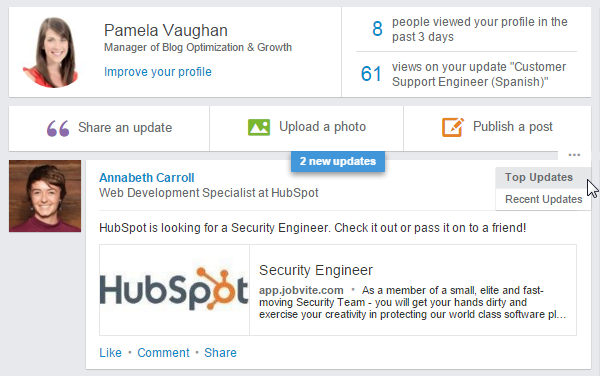
14) Be identifiable.
Allow others to see who you are if you view their profile. To enable this, visit your Settings (click your thumbnail image in the top right and click Manage next to Privacy & Settings) and click Select what others see when you’ve viewed their profile under Profile >> Privacy Controls. Make sure you check off the Your name and headline (Recommended) option. This allows you to take advantage of the next feature on our list …
15) Check out who’s viewed your LinkedIn profile.
How? With the Who’s Viewed Your Profile feature, of course! This tool, which is accessible in the main navigation via the Profile dropdown, enables you to identify which other LinkedIn users have visited your profile page (so yeah, exactly what it sounds like). In fact, LinkedIn gave this coveted creeper feature a facelift in February 2014, so the information it provides is even better than ever. You can also see how you stack up against the profile views for your connections, people in your company, and other professionals like you.
Has someone been checking out your profile that you might want to connect with? This might be the “in” you’ve been waiting for to connect. (Remember, if you don’t make yourself identifiable via tip #14 above, you won’t have access to this feature. It’s a two-way street!)
And if you’re interested in trying to boost the number of views to your own LinkedIn profile, we wrote a little tutorial about how to do just that here.
16) Export connections.
Want to transfer your LinkedIn connections to another contact management system? Luckily, LinkedIn enables you to easily export your connections. Click Connections in LinkedIn’s top navigation, click the settings gear icon in the top right, and click Export LinkedIn Connections under Advanced Settings on the right. You’ll have the option of either exporting them as a .CSV or .VCF file.
17) Easily find new connections — or connect with old ones!
Speaking of connections, the Connections tab in the top navigation offers a variety of other tools to grow and connect with contacts in your professional network. Click Add Connections in the drop-down menu to import contacts from your email accounts and get suggestions for other connections, connect with other alumni from your alma mater using the Find Alumni feature, and use the Keep in Touch feature to stay in touch with current connections, keep track of your communications, and get notifications when contacts in your network change jobs, have birthdays, or when you’ve fallen out of touch. LinkedIn even has a Connected mobile app so you can take advantage of these features on the go.
18) Leverage the perks of LinkedIn Groups.
Did you know that if you’re a member of the same group as another user, you can bypass the need to be a first-degree connection in order to message them? As long as you’ve been a member of LinkedIn for at least 30 days and a member of the particular group for at least 4 days, LinkedIn allows you to send up to 15 free 1:1 messages to fellow group members per month (across all groups you belong to). (Note: Your 15 message allotment excludes any back-and-forth replies that are the result of an original message. Learn more about LinkedIn’s specifications for communicating with fellow group members here.)
In addition, group members are also able to view the profiles of other members of the same group without being connected. Join more groups to enable more messaging and profile viewership capabilities.
For those of you who have been leveraging LinkedIn Groups for a while, you may be aware that LinkedIn recently made some pretty big changes. Groups are now private and membership must be approved (though once you’re in, your conversations no longer require moderation), and there is no longer a promotions tab or subgroups. Learn more about LinkedIn’s changes to Groups here.
19) Take advantage of Advanced Search options.
LinkedIn’s Advanced Search feature provides a much richer search experience. For example, say you want to find out if you’re connected to anyone who works at a specific company. Type the company name in the company field in Advanced Search, then filter the results by “Relationship” to see if you have any first- or second-degree connections to any employees.
20) Share your LinkedIn status updates on Twitter.
Ever since the big LinkedIn/Twitter breakup of 2012, you can no longer automatically sync your tweets to publish on LinkedIn (or even selectively by using the hashtags #in or #li in specific tweets). But don’t fret — as long as you add your Twitter account to LinkedIn, the opposite is still possible. So if you’re ever posting an update to LinkedIn that you’d also like your Twitter followers to see, you can easily syndicate that update to Twitter by selecting the Public + Twitter option in the Share with dropdown within the LinkedIn update composer.
21) Leverage @mentions in your status updates.
In 2013, LinkedIn rolled out the ability to tag or @mention other users and companies in status updates — much like the way it works on Facebook, Twitter, and Instagram. Want another LinkedIn user or company to see your status update? Include the @ symbol immediately followed by the user’s/company’s name in your status update. As a result, that user/company will get alerted that you mentioned them, and their name will also link to their profile/page in the status update itself.
How to Use LinkedIn for Business & Marketing
22) Optimize your LinkedIn Company Page.
The design of LinkedIn Company Pages has changed a lot over the years. Make sure yours is set up correctly and optimized for the latest layout, featuring a compelling and high-quality banner image (see examples of awesome LinkedIn Company Page banner images here). We’ve published an entire free guide about how to optimize your page for the latest design, and you can also view some examples of fantastic LinkedIn Company Pages here. Here’s how HubSpot’s Company Page currently looks, featuring our recently released 2015 State of Inbound Report …
Keep in mind that as of April 2014, LinkedIn no longer supports the Products & Services tab on Company Pages. This means you may want to set up and take advantage of LinkedIn’s Showcase Pages instead, which leads us to our next tip …
23) Create targeted LinkedIn Showcase Pages.
LinkedIn Showcase Pages are niche pages that branch off your main Company Page. Think of them as extensions of your main Company Page that allow you to promote specific products or cater to your individual marketing personas, providing a more personalized experience for your Company Page visitors. LinkedIn users can also follow specific Showcase Pages without having to follow a company’s main page or its other Showcase Pages, allowing your business to tailor the page closely to the audience specific to the page.
To create a Showcase Page, click the Edit dropdown at the top right of your Company Page and choose Create a Showcase Page. LinkedIn allows you to create up to 10 Showcase Pages per each parent Company Page. Find more information about Showcase Pages here.
24) Post Company Status Updates (and target them!).
Make the most of your LinkedIn Company Page by publishing Company Status Updates for all your page followers to see. This will give LinkedIn users even more reason to follow your Company Page, growing your LinkedIn reach. To learn how to enable LinkedIn Company Status Updates, read this post. Then learn how to create successful LinkedIn status updates in this blog post.
Been using Company Status Updates for a while? Why not step it up a notch and leverage the power of segmentation with LinkedIn’s targeting options, which enable you to target your status updates to specific users. As long as the target audience consists of at least 100 users, Company Page administrators can target their updates using criteria like company size, industry, job function, seniority, geography, language, or by including/excluding company employees. These targeted updates will appear on the Company/Showcase Page itself for those users as well as in the users’ Network Updates feed on their LinkedIn homepage.
25) Use LinkedIn Pulse to keep track of industry news.
Pulse is an awesome section of LinkedIn where you can discover popular articles and trending content tailored to your interests. You can find it under Interests in LinkedIn’s top navigation.
Browse Top Posts to monitor the most popular content on LinkedIn Pulse, or click the Discover more link found via the hamburger menu to find and follow specific influencer contributors, publishers, or topic-related channels to stay on top of news and stories in your industry. You can also sign up for daily or weekly email summary notifications of Pulse news (found in the Updates and news section of your Email frequency settings), or instant notifications when influencers you’re following post something new.
26) Check out LinkedIn’s Content Marketing Score & Trending Content resources.
If you’re a LinkedIn Business Solutions customer, you can learn how impactful your organic and paid LinkedIn content is with the Content Marketing Score and Trending Content resources. Your Content Marketing Score measures user engagement with your Sponsored Updates, Company Pages, LinkedIn Groups, employee updates, and Influencer posts (when applicable). It then provides recommendations for how you can improve your score, and thus the effectiveness of your LinkedIn content.
You also can get a sense of which types of content are most popular on LinkedIn in your industry with LinkedIn’s Trending Content resource. It highlights the most popular content being shared on LinkedIn for various audiences and topic segments. Monitor this to understand what content your company should be creating and sharing on LinkedIn to generate the most engagement.
To learn more about these resources, Business Solutions customers can contact their LinkedIn account executives.
27) Use LinkedIn to generate leads.
In an internal study of HubSpot’s customer base, we found that traffic from LinkedIn generated the highest visitor-to-lead conversion rate (2.74%) of the top social networks, almost 3 times higher than both Twitter (.69%) and Facebook (.77%). So yes — LinkedIn can help you generate leads. To get the most out of LinkedIn for lead generation, promote and share links to your blog posts and landing pages in your Company Status Updates, where appropriate in LinkedIn Groups, on your Showcase Pages, and in calls-to-action placed in posts you publish via LinkedIn’s publishing platform, Pulse (see tip #31 coming up).
28) Experiment with LinkedIn Ads and Sponsored Updates.
If you’re looking to complement your organic LinkedIn marketing efforts with some paid advertising, LinkedIn Ads are a smart choice. One of the biggest benefits of LinkedIn advertising? The targeting options! LinkedIn’s PPC ads let you target specific job titles, job functions, industries, or company size, to name a few — you know, the people who are more likely to want/need what you sell.
If you want to get started with LinkedIn’s advertising platform, check out our free guide to advertising on LinkedIn here.
29) Create your own industry LinkedIn Group, and join other relevant groups.
Consider creating a LinkedIn Group of your very own, like HubSpot did with our popular Inbound Marketers Group. Create a group based on a relevant industry-related topic, and become a LinkedIn Group administrator. You can then use this group to establish yourself as a thought leader in your industry, grow a community of advocates, generate new marketing content ideas, and even generate new leads (more on that next)! You should also consider joining (and getting executives from your business to join) other relevant groups and participating in discussions to exhibit thought leadership in your industry.
30) Email your LinkedIn Group.
“Generate new leads’from that group, you say?” That’s right! One of the perks of managing a LinkedIn Group is the fact that you can literally email the members of your group — up to once per week. These emails take the form of LinkedIn Announcements, which are messages sent directly to the email inboxes of group members (if they’ve enabled messages from groups in their settings).
This is a prime opportunity for generating leads from LinkedIn, particularly if you’ve built up a robust group of users. In fact, at HubSpot, our best performing LinkedIn lead gen days are usually the days on which we’ve sent a LinkedIn Announcement. Here’s how to get the most out of your LinkedIn Group emails.
31) Experiment with publishing content on Pulse (LinkedIn’s publishing platform).
Good news! You no longer have to be a LinkedIn Influencer to publish new articles to LinkedIn Pulse. Publishing is available to all users, ever since a February 2014 feature announcement. Experiment with how this feature can support your marketing goals by creating content for the platform and promoting it via your Company Page. For example, you could experiment with syndicating content from your business blog to LinkedIn Pulse and using it to promote subscription to your full blog.
To publish an article, click the Publish a post button on your LinkedIn homepage, or access Pulse via the Interests dropdown in the main LinkedIn navigation and click the Publish a post button in the top right corner of the page.
Use the main navigation to navigate to Pulse:
Or publish directly via your LinkedIn homepage:
For more tips about publishing on LinkedIn Pulse, check out this blog post. And if you’re looking for some inspiration, check out some popular LinkedIn Pulse articles here.
32) Recruit new talent via LinkedIn Careers.
Looking to fill a position or two on your marketing team — or another department within your company, for that matter? Then be sure to build out the Careers section of your Company Page, which you can use to promote your available job openings. For more robust customization options for your Careers section, you can also purchase a Silver or Gold Careers package, which allows you to add a large, clickable cover image that can be transformed into a call-to-action.
This image can direct users to a specific job, a list of jobs and opportunities located on your website, or examples of your company’s culture. The Silver or Gold packages also enables dynamic, customizable modules (that display different version of the page based on viewers’ LinkedIn profiles), analytics about who is viewing the page, direct links to recruiters, video content, etc.
The look and feel of your Careers page depends on what information and images you choose to include, such as a list of jobs, people at your company, a summary section for your careers, what employees are saying about working at your company, and recent updates. Furthermore, if you’re actively recruiting candidates with specific skills and expertise, don’t forget about LinkedIn’s Advanced Search feature (see tip #19 above).
33) Use LinkedIn for sales prospecting and social selling.
LinkedIn can be a powerful tool for sales professionals, too! Some of the LinkedIn features we’ve already touched upon in this cheat sheet — e.g. Saved Searches (tip #8), LinkedIn Groups (tip #18 and #30), Skills (tip #11), etc. — can also be great tools for sales prospecting and social selling. Check out this post on our Sales Blog to learn more about how to use LinkedIn for social selling, and this post to learn how to send a great sales message on LinkedIn. (Then subscribe to our Sales Blog for more great social selling content here.)
34) Add the Company Follow and LinkedIn share buttons to your website/content.
Promote your company’s LinkedIn presence and help grow the reach of your Company Page by adding the Company Follow button to your website. Also consider adding the LinkedIn Share button to your various content assets like blog posts, emails, and landing pages to extend the reach of your content to LinkedIn users. To learn how to build and use these buttons and more, check out our cheat sheet for creating social media buttons.
35) Analyze your LinkedIn marketing performance with the Analytics tab on your Company Page.
So … how are your LinkedIn marketing efforts faring? Use the Analytics tab for Company Pages to evaluate the performance of your Company Page. This tab offers data about the effectiveness of your page’s status updates, engagement, and reach, as well as information about your page’s followers — demographics, where they came from, how your following has grown over time, how your data compares to other companies, etc.
Access your page’s analytics by clicking the Analytics tab in the top navigation of your Company Page. For even more analytics about how your LinkedIn marketing efforts are helping you generate traffic, leads, and customers, you’ll need a closed-loop marketing analytics tool like HubSpot.
Want to see how HubSpot uses LinkedIn? Follow our LinkedIn Company Page here.
Editor’s Note: This post was originally published in August 2011 and has been updated to reflect the latest LinkedIn features as of October 2015.
Apple confirms Siri is coming to Apple Music on the new Apple TV from early next year
While early reviews of the new Apple TV are somewhat muted, Apple isn’t finished yet. It has confirmed to Buzzfeed that the new device will add Siri support for Apple Music from the beginning of next year.
This means that using the Apple TV remote control, people will be able to say, “Play ‘Hotline Bling’” or “Play the newest Taylor Swift album,” and Siri will take it from there.
Reviewers have praised Siri’s universal search feature, which allows system-wide searching for video content, and the box will now be capable of carrying out similar searches for music. The move should be good news for Apple as well as for its customers …
By extending Siri search for music to the TV platform, it provides an additional incentive to hand over the cash for an Apple Music subscription. Apple recently revealed that so far 6.5M users are paying for the service at the end of their three month free trial.
The new Apple TV has started shipping, and we learned yesterday that it will also go on sale in Apple’s retail stores as of tomorrow.
Siri has already been spotted trying to encourage customers to sign up to Apple Music.
Filed under: Apple Music, Apple TV Tagged: Apple Music, Apple TV, Siri
Continue reading more about Apple TV, Siri, and Apple Music at 9to5Mac.
What do you think? Discuss “Apple confirms Siri is coming to Apple Music on the new Apple TV from early next year” with our community.
Setting Your Publishing App Up For Success
So you’ve just invested time, money, and a lot of faith in a new publishing app. If all goes as planned, it’ll increase content consumption, give you a new channel for advertisers, and build loyalty among your readers. But what about getting people to use it in the first place? Just because you build it, doesn’t mean they will come.
With 1.2 million apps in the iTunes Store, getting eyeballs and driving adoption rates to your own app can feel just as hard as building the app itself. Sending out one launch email to your database won’t be enough.
So how can you drive adoption rates as well as increase engagement levels of the users who’ve already downloaded your app?
Increasing Publishing App Adoption
The first step is to convince people that your app is worth downloading in the first place. To help your app stand out from the rest, start by…
- Making the benefits clear: In order for anyone to want to download any app, they need to understand what’s in it for them. Why shouldn’t someone just visit your site for content? Make the benefits, relevance, and value-add abundantly clear to your readers by clearly listing the extra functionality or features that your app provides. Will they be getting exclusive content on the app? Will articles be served to them based on their preferences? Can they enjoy content offline? Or without ads? All of these should be talking points you incorporate in the app store, on your website, and in email communication.
- Using smart content: Fish where the fish are. Use smart content to your advantage to highlight app download calls-to-action to anyone visiting your website via a mobile device. This catches people in the very behavior—reading on their mobile—that warrants the use of your new app. The same techniques can be used for email. Consider smart content that allows you to add a special PS to any email read on a smartphone or tablet.
- Getting social: Analyze your company’s performance on each social channel you use to determine where users are most engaged. From there, ramp up on organic content promoting your app, or consider running app-install ads to extend your reach. Focus targeting on users who are on mobile, already follow or like your account, and have interests relevant to your publication. For more on what to consider before launching an app-install campaign, check out this post.
- Using segmentation: If a certain set of on-site actions indicate download intent, use those to your advantage and create audience segments and workflow lists based on those criteria. Then set up CTAs “retargeting” those groups.
Increasing Engagement with Publishing Apps
How many times have you downloaded an app, only to stick in a folder and forget about it several days later? Don’t let your app be forgotten. Instead…
- Keep content fresh: For readers to use an app on a regular basis, they need to feel like they’re getting new, updated content each time they log in. Put an editorial calendar in place, and give your development team deadlines to ensure regular, consistent content gets shared. Use analytics to understand users’ average time between repeat visits, and use that to inform your calendar.
- Don’t stop promoting: Don’t stop promotion efforts right after you launch your app. Continue app promotion on your website, social accounts, and in email, highlighting any updates, upgrades, or new content. Fatigued users can be re-invigorated by the promise of something new.
- Use workflows: Use app data and user behavior to create re-engagement workflows with email. For example, you could send users who have download your app an automatic feedback survey after one week, or have a set of social ads displayed to readers who haven’t logged in after a certain amount of time.
- Answer FAQs: Give readers a tool to help them navigate your app more easily, and ensure they have something to reference to use the app to their fullest advantage. This can come in a variety of formats, from FAQs to in-app tutorials. You’ve worked hard to get users. Don’t let a poor in-app experience or unrealized features to be the reason people don’t come back.
- Pay attention to analytics: Regularly measure how readers are using your app. Which features do they engage with most? Which articles lead to reading other articles? What keeps users engaged the longest? Take these findings into account when you are planning to release new content or develop upgrades for your app.
Increasing adoption rates and engagement with your app shouldn’t be an afterthought, but it also doesn’t need to be an overwhelming process. By using what you have in place and putting together a sound release strategy, you’ll increase your ability to attract and keep app users.
Most Websites Are Failing Optimization 101. Is Yours? [New Data]
Chances are, your website’s performance is high on your list of priorities. It’s an asset that works around the clock to draw in visitor, convert them, and help you hit your goals, after all.
But have you ever stopped to wonder how your website stacks up when it comes to performance, mobile optimization, SEO, or security?
Thanks to HubSpot Research’s latest report, Does Your Website Make the Grade? Chances Are, It’s Barely Passing, you can generate a better understanding of whether or not your website is making the grade, keeping pace with the average, or trailing far behind.
In this report, we analyzed over 26,000 websites using our Website Grader tool, and the results … well, they’re nothing to write home about. In fact, websites today scored just 60 points out of 100 for the key factors that determine website success. Take a look for yourself:
For more insights, check out (and share) some of these noteworthy takeaways for our research:
- The average load time for the reviewed websites was 3.9 seconds. [
Tweet This]
- Only 77% of the reviewed websites had page titles, 61% had heading tags, and just 42% had meta descriptions. [
- The website review process revealed that only 1 in 5 websites have SSL. [
See the detailed breakdown of our website benchmark data and how to improve your website by downloading Does Your Website Make the Grade? Chances Are, It’s Barely Passing and then find out what grade your site gets here.
5 Ways to Create Infographics for Instagram
Want more engagement on Instagram? Have you considered posting infographics? Introducing infographics into your Instagram marketing campaigns will attract more viewers and set you apart from other companies. In this article you’ll find five ways to create infographics for Instagram. #1: Build a Video Infographic From a Series of Charts Videos overwhelmingly beat photos on Instagram. […]
This post 5 Ways to Create Infographics for Instagram first appeared on Social Media Examiner.
Social Media Examiner – Your Guide to the Social Media Jungle
from Social Media Examiner http://ift.tt/20ciJaC
via socialmediaexaminer
BBC iPlayer coming to the new Apple TV
Fellow Britons, the wait is almost over. iPlayer is finally making its way to the Apple TV. The BBC announced via its official Twitter handle that its popular catch-up and live-streaming service is making its way to the brand new Apple TV in the coming months. The company didn’t confirm exactly when the iPlayer app for new Apple TV would arrive, and from the looks of things, it won’t be coming to the current Apple TV. Although it doesn’t say explicitly that iPlayer won’t be coming to the 2nd and 3rd generation Apple TVs, the fact it states ‘new Apple TV’ suggests pretty strongly that it will only be on the new, 4th gen model.
BBC iPlayer will be coming to the new Apple TV in the coming months…
—
BBC iPlayer (@BBCiPlayer) October 29, 2015
For UK Apple TV owners, the lack of a native iPlayer app has been a constant source of frustration. Right now, customers are forced to use AirPlay from their iPhones or iPads if they want to view iPlayer content on their Apple TVs. Once the app launches for tvOS, we’ll be able to put our iPhones and iPads down, and just watch great programming right from the Apple TV. More important than the convenience is that we’ll undoubtedly save precious battery life.
Filed under: Apple TV Tagged: Apple TV, Apps, BBC, iPlayer, tvOS, tvOS apps
Visit 9to5Mac to find more special coverage of Apple TV, Apps, and Apple TV.
What do you think? Discuss “BBC iPlayer coming to the new Apple TV” with our community.
Nintendo announces its highly anticipated first smartphone game ‘Miitomo’ for iOS
As was reported earlier today, Nintendo tonight has taken the wraps off of its first mobile game during a press event with investors and the media in Japan. The game, called Miitomo, will be available in March of 2016 and is the first of five games the company plans to release by March of 2017 (via WSJ).
Nintendo says that Miitomo will be free to download with popular add-ons that will (presumably) be available to purchase via in-app purchases. The game will allow users to create their own Miis – or avatars – that can communicate with one another in a virtual world. While this doesn’t sound too much like a game, but rather just another way to communicate, Nintendo brags that it will help “to encourage people who are hesitant to talk to share things about themselves.”
Nintendo says that the reason for the game’s delay into March of 2016 is it wants to fully educate and make people aware of what Miitomo is and does before releasing it. For the upcoming holiday season, however, the company would rather focus its marketing efforts on other games currently in the pipeline.
It’s unclear what the other four mobile games Nintendo has in the pipeline are, but we’re hoping there’s more of a gaming aspect to them. The company said that the other games will be pay-to-download as opposed to in-app purchase based.
Nintendo made no mention of Apple TV support for any of its upcoming games, which is to be expected considering the company’s resistance to support any non-Nintendo hardware.
Filed under: Apps Tagged: game, Games, gaming, Miitomo, Nintendo
For more news on Apps, Games, and gaming continue reading at 9to5Mac.
What do you think? Discuss “Nintendo announces its highly anticipated first smartphone game ‘Miitomo’ for iOS” with our community.