
Welcome to My Blog
How to Manage Multiple Projects
What is a website taxomomy?
The structure users want is called taxonomy. Scientifically, a taxonomy is a classification scheme that dictates how things are organized and classified based on their characteristics.
A website’s taxonomy can dictate the user experience, and can also influence search engine rankings. This post will go over what a website taxonomy is, and give you the resources to create a successful organization system for their site.
Website taxonomy is also related to URL structure, which is how URLs are organized to reflect content within specific site pages. Every website domain stays the same for every URL address, but subdirectories and URL slugs change as page content gets more specific.
For example, say your website’s primary domain is www.samplewebsite.com.
Your taxonomic structure will include subdirectories within your domain that are relevant to the page’s content. So, if your samplewebsite has a ‘Contact’ or ‘Announcements’ page, the URLs would change to reflect the information displayed on each page. The URLs for these pages would be https://ift.tt/34kt9hU and https://ift.tt/34nDBW0, respectively.
Why is a website taxonomy important?
A well-planned taxonomy can transform how users interact with your site, especially when your content is organized logically. If users can get to your site and find what they’re looking for, they’ll view you as a reputable source and they’ll stay longer.
Websites that don’t have a specific structure tend to be difficult for people to understand. In fact, an average of 38% of site visitors will leave a site if it’s poorly organized.
A carefully crafted taxonomy is also crucial for search engine optimization (SEO), as a taxonomic organization is easier for search engine bots to recognize as they analyze and index your site.
Let’s put all of this in context with a hypothetical website. Say you own www.recipes.com. Since you know that your visitors are coming to your site for specific recipes, you want to set up categories that help them find what they’re looking for as quickly as possible. If they’re looking for desserts, for example, they likely want to find those recipes through the corresponding category page, not by browsing through a list of unrelated meals.
The URL for this page would be https://ift.tt/3kpyvOe. A user knows what they’ll find within this subcategory of recipes. For search engine bots, the URL subdirectory helps them understand what the page is about and when they should show the page in search results.
Best Practices for Creating a Website Taxonomy
Ultimately, you want both users and search bots to understand your site. You don’t want them to be bombarded with content that isn’t going to fulfill their needs. While it may seem clear cut, various factors go into creating a successful website taxonomy.
Know your audience.
Just like all types of marketing, the key to creating your taxonomy is understanding your users.
You’ll want to know who they are, why they’re visiting your site, and what they want to find on your site. It’s essential to understand what their specific needs are so you can structure your content accordingly. To better understand your users, you can do things like create buyer personas.
Continuing with the recipes.com example, whoever runs the site knows that their visitors are coming because they want help with their cooking. It’s great to know this, but is there anything else they’ll want from your site? They may also want you to recommend kitchen supplies that will help them make these recipes, or recommend brands to buy ingredients from.
If you take the time to get to know your future users, you can design your site accordingly.
Conduct keyword research.
When you know who your users are and what they want, you want to make sure you have the necessary information to keep them on your site.
You can use your site’s primary purpose to rank in search results, but it’s essential to have multiple keywords for the additional categories you’ll create within your site. These keywords should be directly related to the content that users will find on those specific pages.
For instance, if you run a blog on travel tips, travel tips can be your main keyword. However, your research may show that users also associate travel tips with travel packing tips and travel insurance tips. You’ll want to use that information when creating your structure.
Be consistent.
Consistency with categories and the content within those categories makes it easier for users to understand your site. It also makes it easier for those executing your content strategy to create relevant content. For example, on the HubSpot Blog, we have four different properties: Service, Sales, Marketing, and Website.
Blog posts are categorized based on their relationship to each property, and this organizational consistency makes it easier for visitors to find relevant information. For example, a user would know to search within blog.hubspot.com/website rather than blog.hubspot.com/service for a tutorial on how to use WordPress.
Consistency is also important for SEO, as bots dislike poorly organized websites, and sites with jumbled and unrelated content is considered spammy. Bots also recognize contextual relationships between categories and content, and they’ll learn how to index your site for specific search queries.
Keep it simple.
While there are certainly hundreds of categories and subcategories you could come up with to sort content on your site, less is more. The ideal web taxonomy is focused and straightforward.
With recipes.com, there are so many different types of dishes that it would (and will) become overwhelming for users to sift through hundreds of different categories.
Keeping it simple means creating fewer high-level categories that can house lower-level categories. You can have a high-level category page dedicated entirely to baking recipes, and the content you post within that page will be specific to baking recipes.
The URL for this category would be recipies.com/baking rather than recipes.com/pie-recipies and recipes.com/scone-recipies. Then, if a user goes on your site to find a blueberry pie recipe, the page URL may be https://ift.tt/3mbM0BR.
Leave room for growth.
Taxonomy can, and should, change as your business scales.
If you create new forms of content, you may need to shuffle categories to ensure that they still relate to each other and have room for new content.
Say you’re running a blog about content marketing, but you cover the topic generally. It’s unlikely that you’ll have multiple page categories or subfolders within those pages. However, suppose you decide to hire new team members who are experts in specific types of content creation. In that case, you’ll want to create different taxonomic categories to distinguish between the different types of content.
You may also realize that certain categories and subcategories aren’t as intuitive as you’ve hoped, per user feedback. Taking the time to understand what is and isn’t working for those who interact with your site is essential.
Types of Website Taxonomy
Once you know your audience and have created your keyword-relevant categories, it’s essential to decide on the taxonomic structure that works best for your site. Since taxonomy is a classification system, it may seem like the logical structure is a hierarchical one, organized by importance. However, this isn’t always the case. Let’s review the different types of website taxonomies so you can select the one that works best for your site.
Flat Taxonomy
A flat taxonomy, sometimes called unlayered taxonomy, is a simple list of top-level categories. All categories on this site carry equal weight in comparison to each other. It’s a perfect structure for smaller websites that don’t have a large amount of content.
For example, a veterinarian’s office likely doesn’t have many needs to fulfill. Their homepage may only have three to four categories, like ‘About Us,’ ‘Book an Appointment,’ ‘Location,’ and ‘Services.’ Users visiting the site won’t need much more than that.
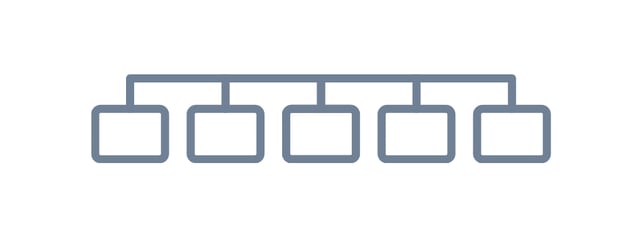
Image Source
Hierarchical Taxonomy
A hierarchical taxonomy is an arrangement of categories by order of importance. Larger websites typically use it, and top-level categories are broad.
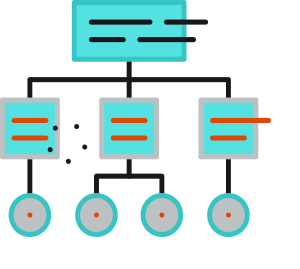
Moving down a hierarchical structure means getting more specific. This allows users to quickly identify and navigate between different sections and categories. Search engines will recognize these relationships as well.
For example, hubspot.com displays three main categories at the top of the page: Software, Pricing, and Resources. Each of those categories is broad and overarching. If a user mouses over them, they’re then shown more specific categories.
In turn, our URLs for these categories look like this: hubspot.com, hubspot.com/products, hubspot.com/products/marketing, and hubspot.com/marketing/seo.
It’s important to note that there shouldn’t be too many high-level categories or subcategories, as excessive groups can become confusing for users and SEO crawlers.
Network Taxonomy
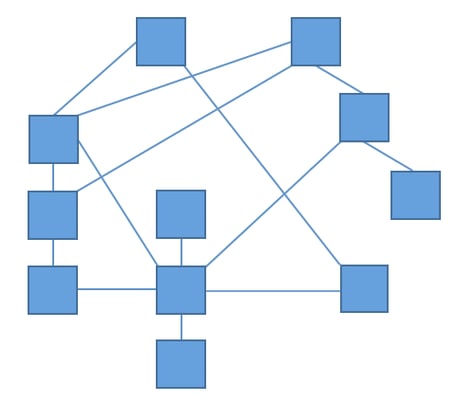
A network taxonomy involves organizing content into associative categories. The relationships and associations between categories can be basic or arbitrary, but they should be meaningful to users.
For example, a ‘Most Popular’ category within a website may contain lists of different articles covering a broad range of topics that are popular among that audience. Still, they’re all similar in the sense that they are highly rated, viewed, and visited by others.
Facet Taxonomy
A facet taxonomy is used when topics can be assigned to multiple different categories. Sites that typically use this structure allow users to find content by sorting for specific attributes. It’s also great for users who will likely arrive at certain content by different means.

For example, Nike sells a variety of different products. While there are specific categories for shoes and clothing, there are also subcategories for color, size, and price. A shoe that shows up on a search for ‘blue shoes’ may also show up on a list of cheap shoes because they’re currently on sale.
Put time into your website’s taxonomy.
Creating and maintaining a successful website taxonomy that makes sense for users and search engines essential to your marketing strategy.
If other elements of your site are already optimized for other SEO ranking factors, the addition of a structured taxonomy will help your site rank highly in search query results, not to mention, it’ll keep users on your site.
If you want to learn more about website best practices, consider taking the HubSpot Academy Website Optimization course!

Live Video Simplified: An Easier System to Success
Want to do more with live video? Wondering how to simplify the process of going live? To explore creating better systems for live video, I interview Tanya Smith on the Social Media Marketing Podcast. Tanya is a video strategist who helps service providers demystify the video creation process. Her site is GetNoticedWithVideo.com and her course […]
The post Live Video Simplified: An Easier System to Success appeared first on Social Media Examiner | Social Media Marketing.
from Social Media Examiner | Social Media Marketing https://ift.tt/31zTAhK
via socialmediaexaminer
60 Best Free Online Courses For Whatever You Want to Learn
Benjamin Franklin once said, “An investment in knowledge always pays the best interest.”
That’s never been truer than it is today. With new technology emerging at breakneck speeds, there’s a palpable pressure to continuously upskill.
Whether you want that job promotion or to sidestep into a new field, you’ll need to commit to learning new skills.
However, learning new skills can be both time-consuming and challenging. In fact, according to Josh Kaufman, international bestselling author of The Personal MBA, it takes 20 hours to go from knowing nothing about a particular subject to being pretty good at it. Of course, if you want to become an expert — well, that takes even longer.
Blog posts and podcasts are great starting points for exploring a particular topic. But online business courses will provide you with the time and space you need to go deep and truly master a new skill. Plus, most courses are made up of on-demand videos and exercises that you can progress through at your own pace.
Below, we’ve gathered 60 of the best free online business courses. These cover the main business skills you’ll need to advance in today’s rapidly changing workplace — from digital marketing and coding to selling, leadership, and more. Keep reading to become an expert in whatever subject you feel can best help you succeed.
If you’d prefer, click on one of the following topics to jump straight to courses regarding that topic in particular:
- Fundamental Marketing
- Content Marketing
- Social Media Marketing
- Email Marketing
- SEM
- Sales
- Ecommerce
- Coding & Developer Courses
- Personal & Professional Development Courses
- Design
- Business & Finance
Free Online Courses
Fundamental Marketing Courses
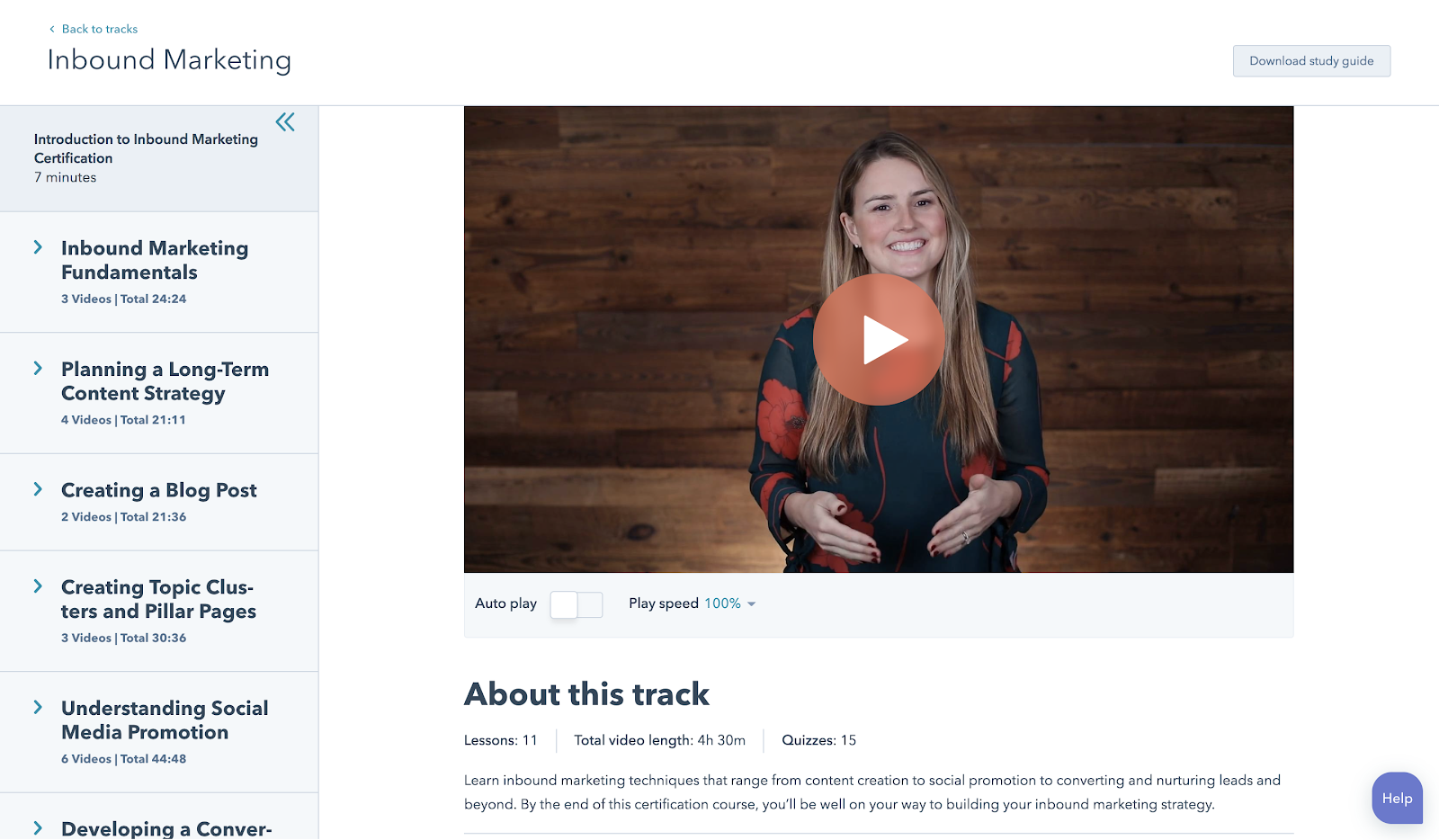
1. Inbound Marketing Certification by HubSpot Academy
Length: 4:12 Hours
From attracting leads to engaging prospects and delighting customers, this course covers the fundamentals of what inbound marketing is all about.
2. Marketing Fundamentals: Who Is Your Customer? by EdX
Length: 4-6 Hours / Week (4 Weeks)
Discover how to acquire the right customers and grow your business.
3. Build Your Web Presence by Google Garage
Length: 40 Minutes
Learn the basics of websites, local business listings, review sites, social media, mobile apps, and more.
4. Google Analytics for Beginners by Google
Length: 4-6 Hours
This course shows new Google Analytics users how to create an account, implement a tracking code, and set up data filters. You’ll learn how to navigate the Google Analytics interface and reports, and set up dashboards and shortcuts.
Content Marketing Courses
5. Content Marketing Certification by HubSpot Academy
Length: 6:20 Hours
Power your business with remarkable content. This course will teach you how storytelling, content creation, repurposing, and promotion come together to build a content marketing machine that grows your business, and your career.
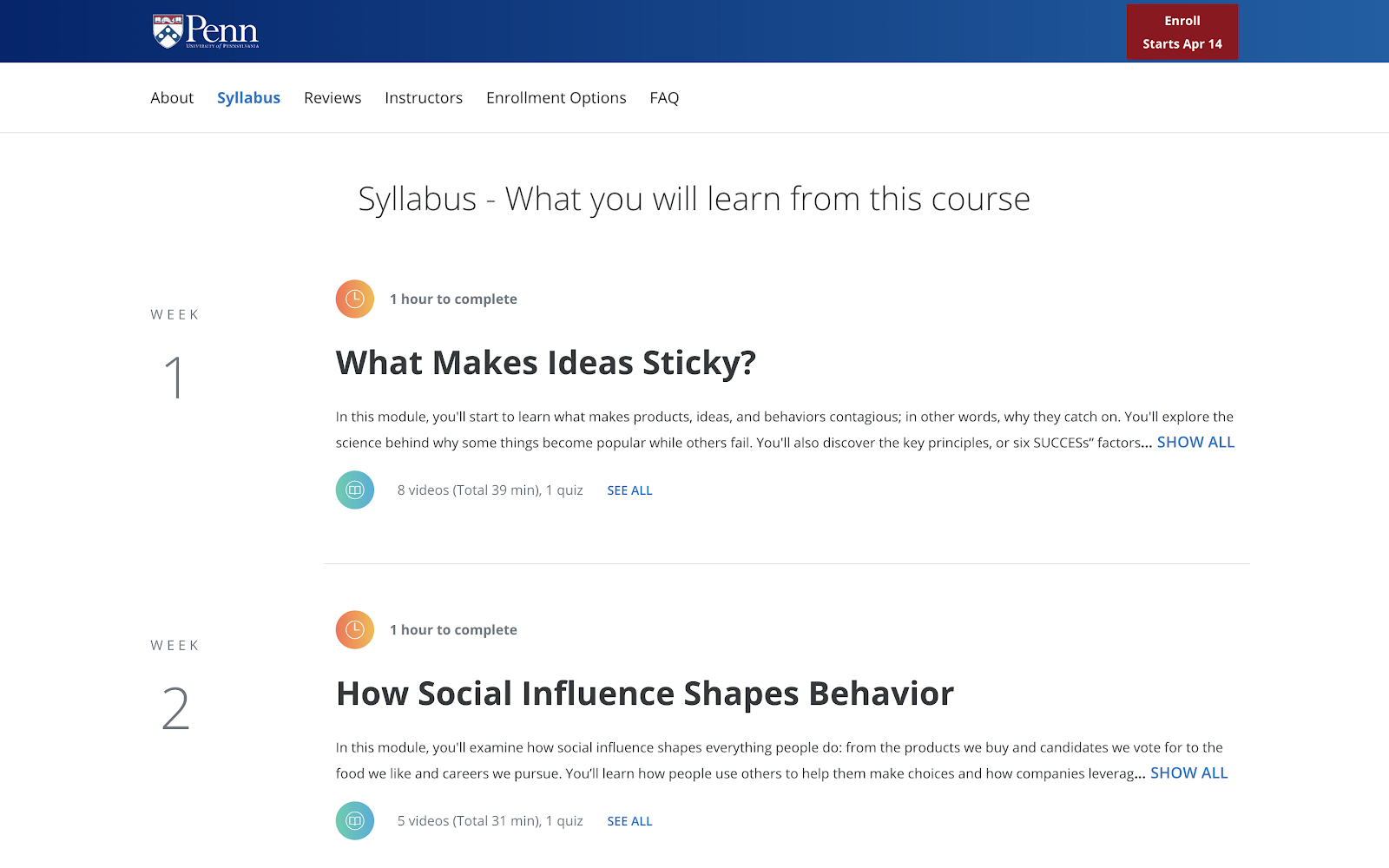
6. Viral Marketing and How to Create Contagious Content by Coursera
Length: 4 Hours
Ever wondered why some things become popular, while other things don’t? This course explains how things catch on, and can help you apply those ideas to become a more effective marketer.
7. Business Blogging by HubSpot Academy
Length: 1:57 Hours
Business blogging is more than just writing and publishing content in the hopes you’ll attract customers. In this course, you’ll learn how to craft a blogging strategy that drives business growth, create quality blog content that customers love, and build a guest blogging strategy that’s powered by SEO.
8. Online Video Marketing Course by HubSpot Academy
Length: 2 Hours
This online video marketing training will teach you how to get started with online video marketing to better attract, engage, and delight your audience.
Social Media Marketing Courses
9. Social Media Course by HubSpot Academy
Length: 5 Hours
This course provides you with everything you need to build a social media strategy — including tools to help you attract new customers, build loyalty, and shape a positive conversation around your business. The course is free, but it’s $199 to take the exam.
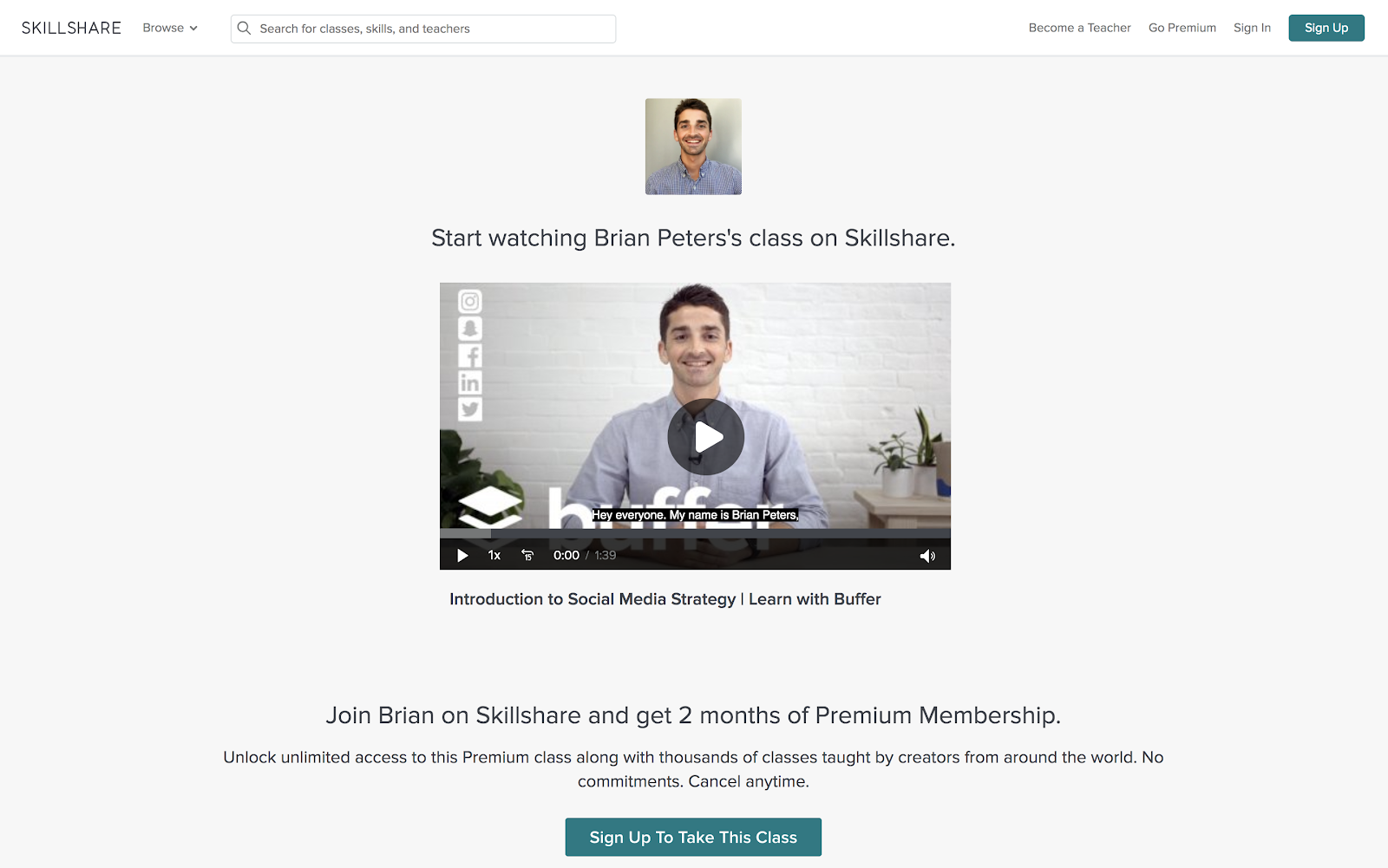
10. Introduction to Social Media Strategy by Skillshare/Buffer
Length: 45 Minutes
Whether you’re looking to foster brand awareness, increase website traffic, or drive sales, this course can teach you how to craft a social media strategy to achieve your goals on Facebook and Twitter. From finding your voice to paid advertising, Brian Peters (Digital Marketing Strategist at Buffer) walks through his process for custom social strategies.
Note: Skillshare offers community members 14 days of Skillshare — you’ll need to sign up as a member to access the class for free.
11. Facebook Blueprint by Facebook
Length: Various
This huge resource of free, self-paced social media classes will cover best-practices and top strategies used by some of the world’s largest brands.
12. YouTube Marketing by HubSpot Academy
Length: 1:20 Hours
HubSpot’s course in YouTube Marketing is an in-depth, expansive set of tools and lessons that offer successful strategies to grow a monetizeable, optimized YouTube channel.
13. Video Storytelling for Social Media by Social Creators
Length: Self-Paced
This crash course is set up like a challenge. The goal? Help you make high-quality videos with your iPhone or Android device so you can start vlogging and share engaging videos on your social media accounts.
14. Developing an End-to-End Facebook Marketing Strategy by HubSpot Academy
Length: 1:18 Hours
Facebook is a huge platform, ripe with marketing opportunity…and can be confusing. Learn how to develop an effective marketing strategy using Facebook that covers all the bases.
15. How to Build an Advanced Twitter Strategy by HubSpot Academy
Length: 2:04 Hours
You know Twitter beyond the basics, now it’s time to bump it up a notch. In this course from HubSpot Academy, you’ll learn the advancements in building and launching a successful Twitter marketing strategy.
16. How to Create an Instagram Content Plan by Later
Length: Self-Paced
This video series is a great introduction to the Instagram world. You’ll learn how to gain more followers, build a community, and create content that drives true engagement.
17. Free Social Media Analytics Course for Beginners by Quintly
Length: 10-11 Hours
This class will cover the basic principles of social media analytics, and is helpful both for beginners and for marketers who want to refresh their knowledge. It aims to help anybody involved in social media analytics, whether you’re working for a brand, an agency, or the media.
18. Flight School — Video Ads on Twitter by Twitter
Length: Various
Whether you’re a traditional TV Buyer, a Digital Buyer, or a Social Strategist, these two courses will help you build the knowledge and skills you need to meet your clients’ video advertising goals. The courses have been designed to help you level up your expertise with video advertising on Twitter, so that you and your clients can succeed.
19. Developing an End-to-End Instagram Marketing Strategy For Your Business by HubSpot Academy
Length: 1:35 Hours
Social media advertising is one of the most powerful ways to connect with customers and drive marketing impact. This course takes you from the beginning to the end of planning an Instagram marketing strategy.
Email Marketing Courses
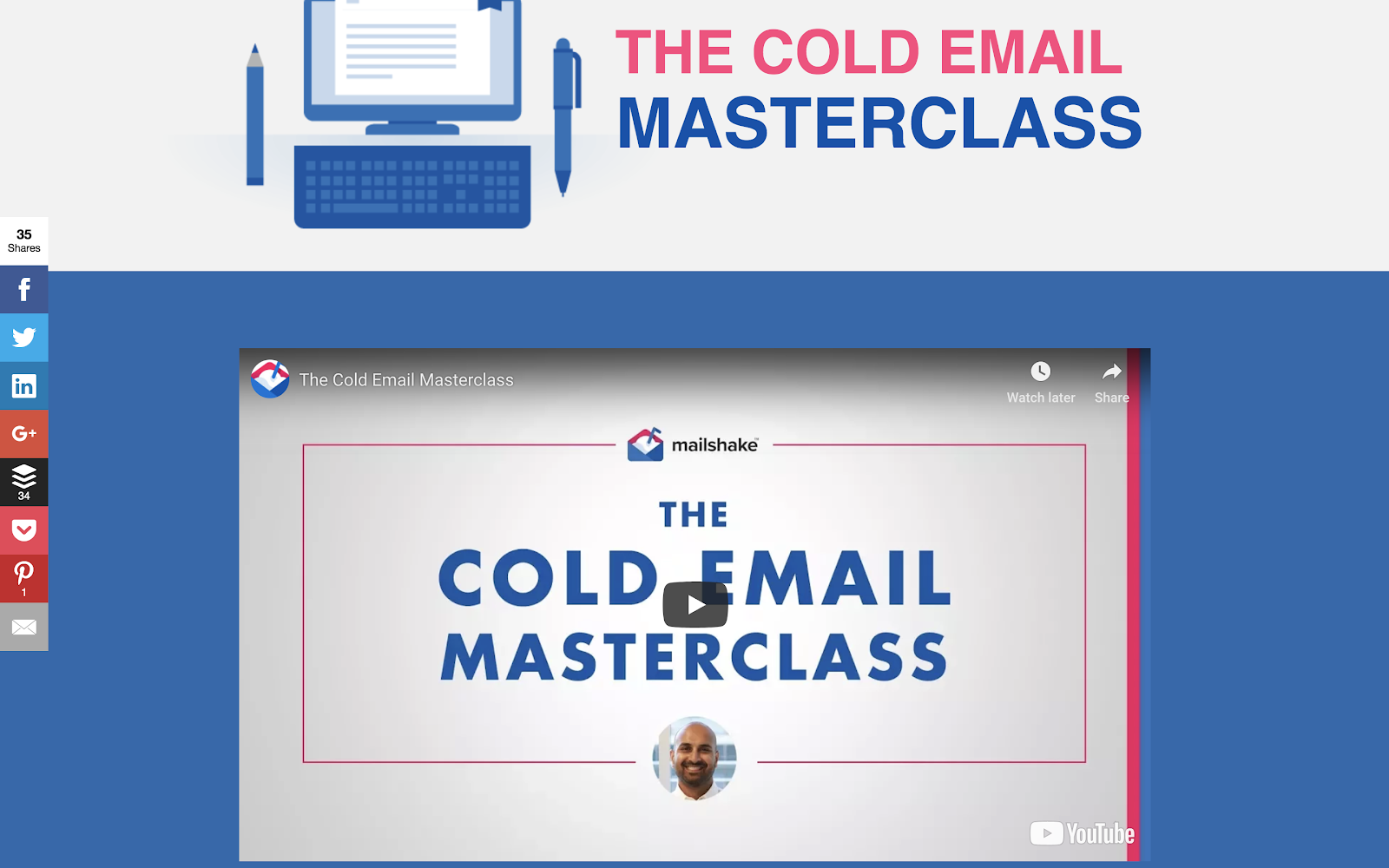
20. Cold Email Masterclass by Mailshake
Length: Self-Paced
Whether you use cold email to connect with influencers, build your personal brand, find mentors, or grow your network, there’s no underestimating its power. Sujan Patel reveals eight lessons that will show you how to turn theory into practice, tapping into existing cold email best practices and deploying them in a way that’s both efficient and effective.
21. Email Marketing Certification by HubSpot Academy
Length: 3:18 Hours
Email marketing is a necessity to learn. By completing HubSpot’s course, you’ll walk away with an expansive knowledge in all things email marketing, from templates to testing, as well as a certification to add to your resume.
SEM Courses
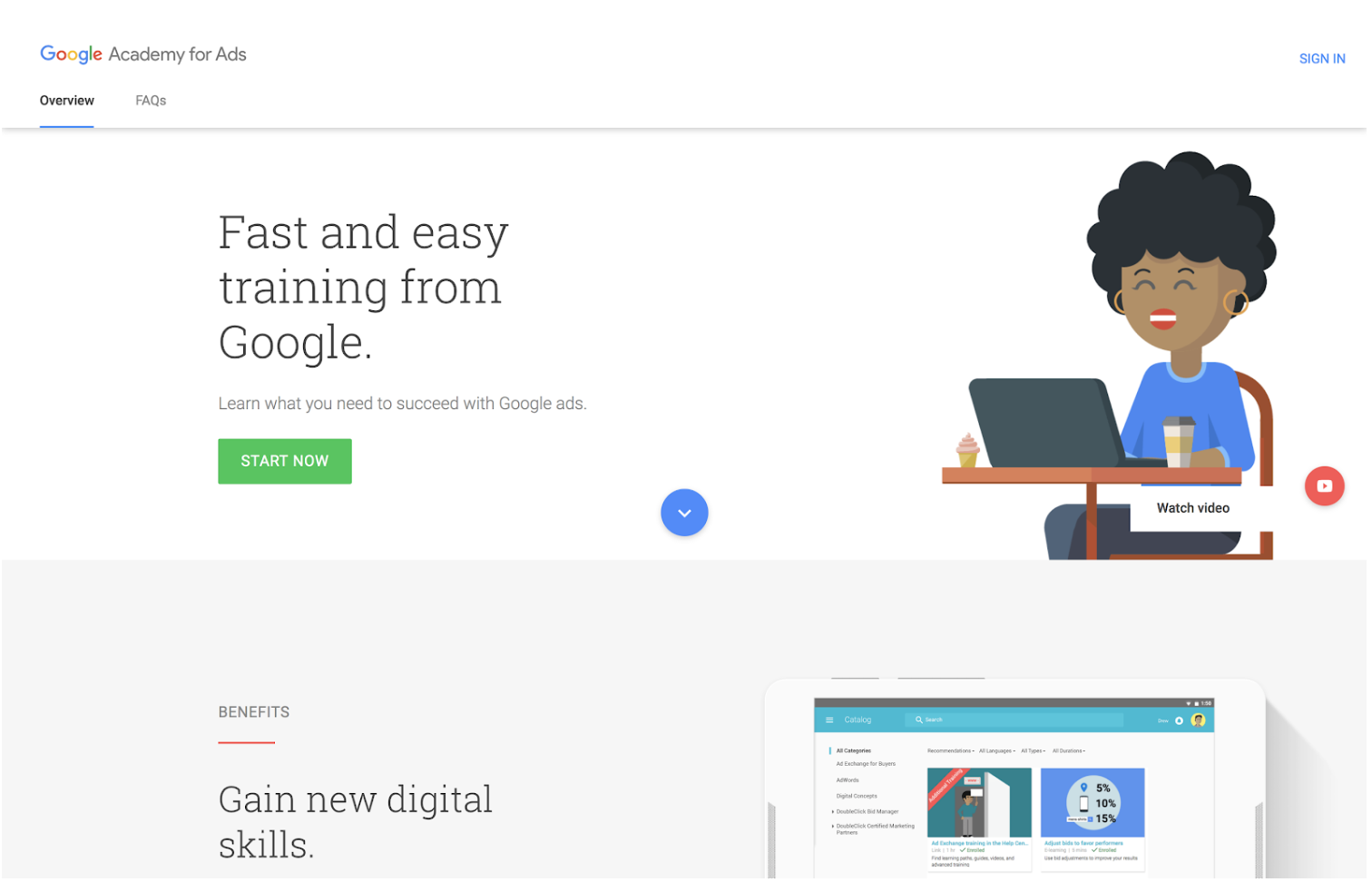
22. Paid Ads by Google
Length: Various
If you don’t know where to start with Google’s ad products, Academy for Ads may be for you. You’ll figure out where to get started in mini, bite‐sized lessons. Topics include programmatic ads, Google Ads, double-click and video ads.
23. SEO Training Course: Building Sustainable Traffic for Business by HubSpot Academy
Length: 1 Hour
Interested in building traffic, but unsure about a successful strategy? Our SEO crash course eliminates the pains of navigating a concrete SEO strategy and provides you with the tools to implement a winning one.
Sales Courses
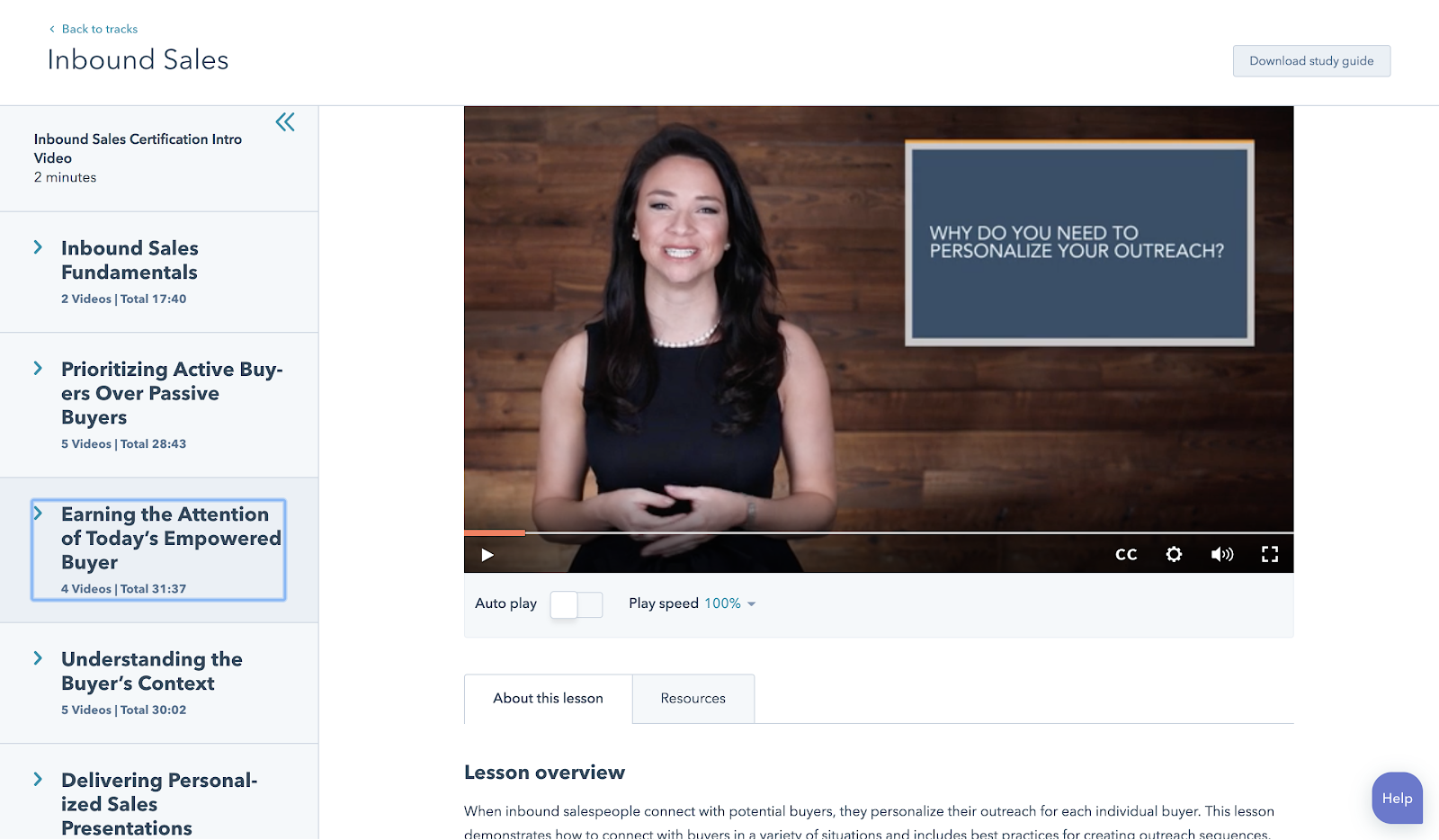
24. Inbound Sales Certification by HubSpot Academy
Length: 2:11 Hours
In this certification course you’ll learn how to grow your sales pipeline, close more leads, and grow your career.
25. The Art of Sales: Mastering the Selling Process Specialization by Coursera
Length: 6 Months
This course is designed to make you more effective and efficient as you pursue your sales goals. Understand how to stand out in the crowd, attract customers, and build support for initiatives within your company.
26. Sales Enablement Certification by HubSpot Academy
Length: 4:29 Hours
In this self-paced online course and exam, you’ll learn how to align marketing and sales for optimal efficiency. Bridge the gap between marketing and sales teams with strategies and tactics from over 25 world-renowned leaders.
27. Sales Manager Training by HubSpot Academy
Length: 2:59 Hours
Learn how to define your target market, create a scalable sales process, and build training, coaching, hiring, and on-boarding programs to help your sales team grow.
28. Sales Prospecting Advanced Techniques by SalesScripter
Length: 21 Modules
This program is designed to give you a strategy-backed process. It covers building a value proposition, asking the right questions, closing more effectively, and more. You’ll sell more, and even better — selling will become more fun.
29. The Art of Sales by Coursera
Length: 3 Hours / Week (4 Months)
Perhaps the most important art in sales is knowing how to get a “yes.” This course teaches this as well as methods to improve efficiency as a salesperson and earn buy-in for your initiatives.
30. Sales Courses by Class Central
Length: Various
Class Central offers over 50 sales courses and MOOCs from a variety of institutions and organizations. You’ll be able to hone your skills from prospecting to sales management.
Ecommerce Courses
31. Dropshipping 101 by Shopify Academy
Length: 1:33 Hours
Corey Ferreira shares his methods for finding a product to sell, testing its popularity, and building an unforgettable brand. 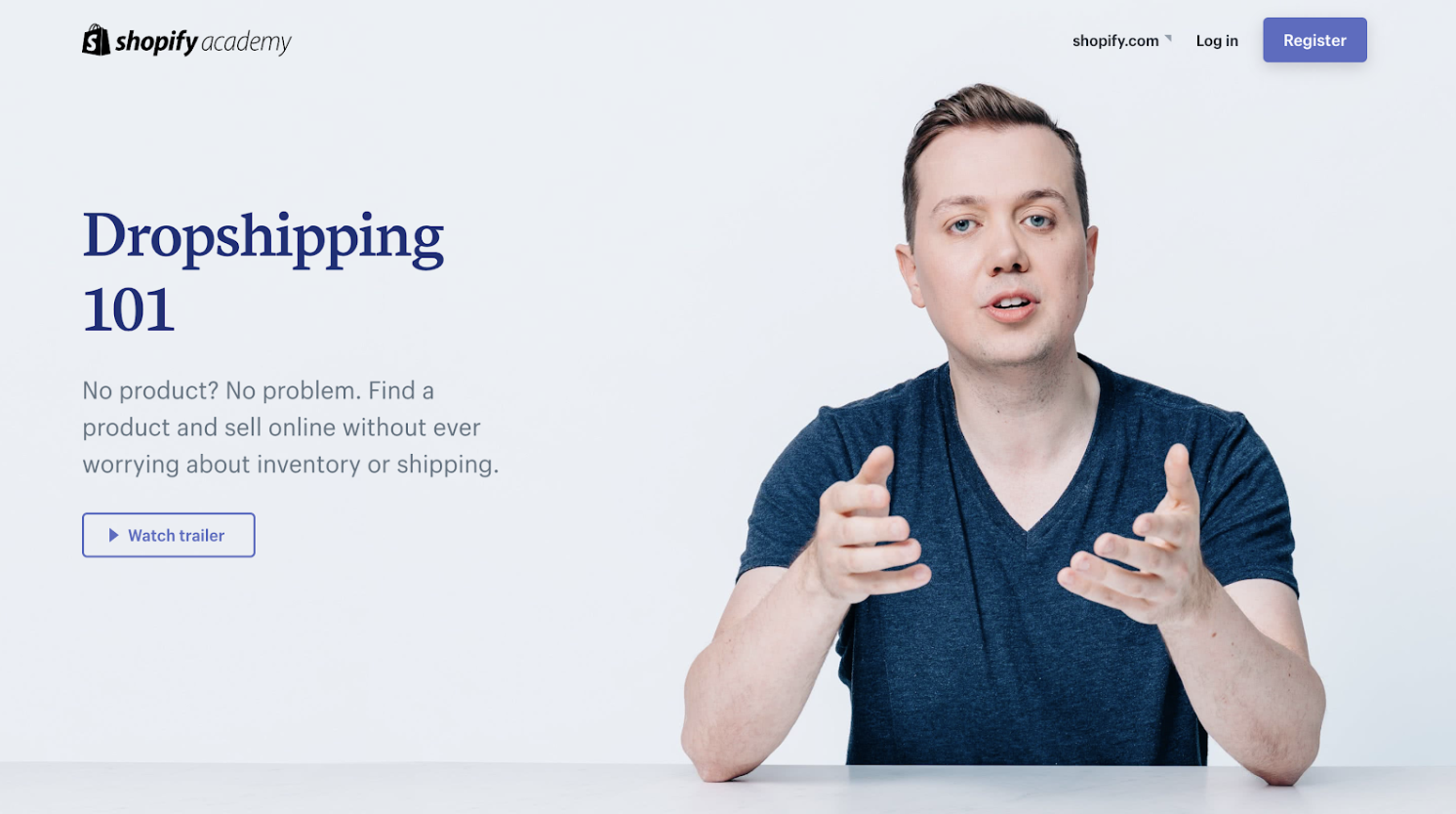
32. Product Photography for Ecommerce by Shopify Academy
Length: 1:58 Hours
In this course, you’ll learn how to set-up your own home studio and take product photos with your smartphone or digital SLR.
33. Learn Ecommerce Marketing and Sell More Online by HubSpot Academy
Length: 34 Minutes
If you work for an ecommerce business and want to implement an inbound marketing strategy, this is a good course for you. In this 30 minute crash course, you’ll learn the basics about selling more online, and how that fits into an inbound strategy.
34. Email marketing for Ecommerce by Skillshare
Length: ~26 Minutes
Learn how to use automation, optimization, and personalization to boost your business through email.
Coding & Developer Courses
35. Learn to Code by Codecademy
Length: Various
Online coding tutorials with easy-to-follow instructions, immediate feedback, and a tested curriculum that can help anyone learn how to code.
36. Intro to Computer Science by Udacity
Length: ~5 Weeks
Get to grips with key computer science concepts in this introductory Python course. You’ll learn by doing, and will build your own search engine and social network.
37. Intro to HTML and CSS by Udacity
Length: ~3 Weeks
In this course, you’ll learn the fundamentals of web development, along with best practices and professional problem-solving techniques using Developer Tools.
38. App Development for iPhone by Alison
Length: 10-15 Hours
This iPhone app development course will give you all you need — from how to use Objective C programming to creating multi-touch functionality. With clear video tutorials that are easy to follow, this course will get you up-to-date with the latest in iPhone app development trends.
39. Algorithms, Part I by Coursera
Length: ~53 Hours
This course by Princeton University covers the essential information that every serious programmer needs to know about algorithms and data structures, with emphasis on applications and scientific performance analysis of Java implementations.
40. Self-Driving Fundamentals: Featuring Apollo by Udacity
Length: ~4 Weeks
Through this course, you’ll be able to identify key parts of self-driving cars and get to know Apollo architecture. You’ll be able to utilize Apollo HD Map, localization, perception, prediction, planning and control, and start the learning path of building a self-driving car.
41. Machine Learning by Coursera
Length: ~60 Hours
Machine learning is the science of getting computers to act without being explicitly programmed.
Personal & Professional Development Courses
42. Conquering the Fear of Public Speaking by Udemy
Length: 37 Minutes
Understand the fundamental techniques to get over the fear of public speaking.

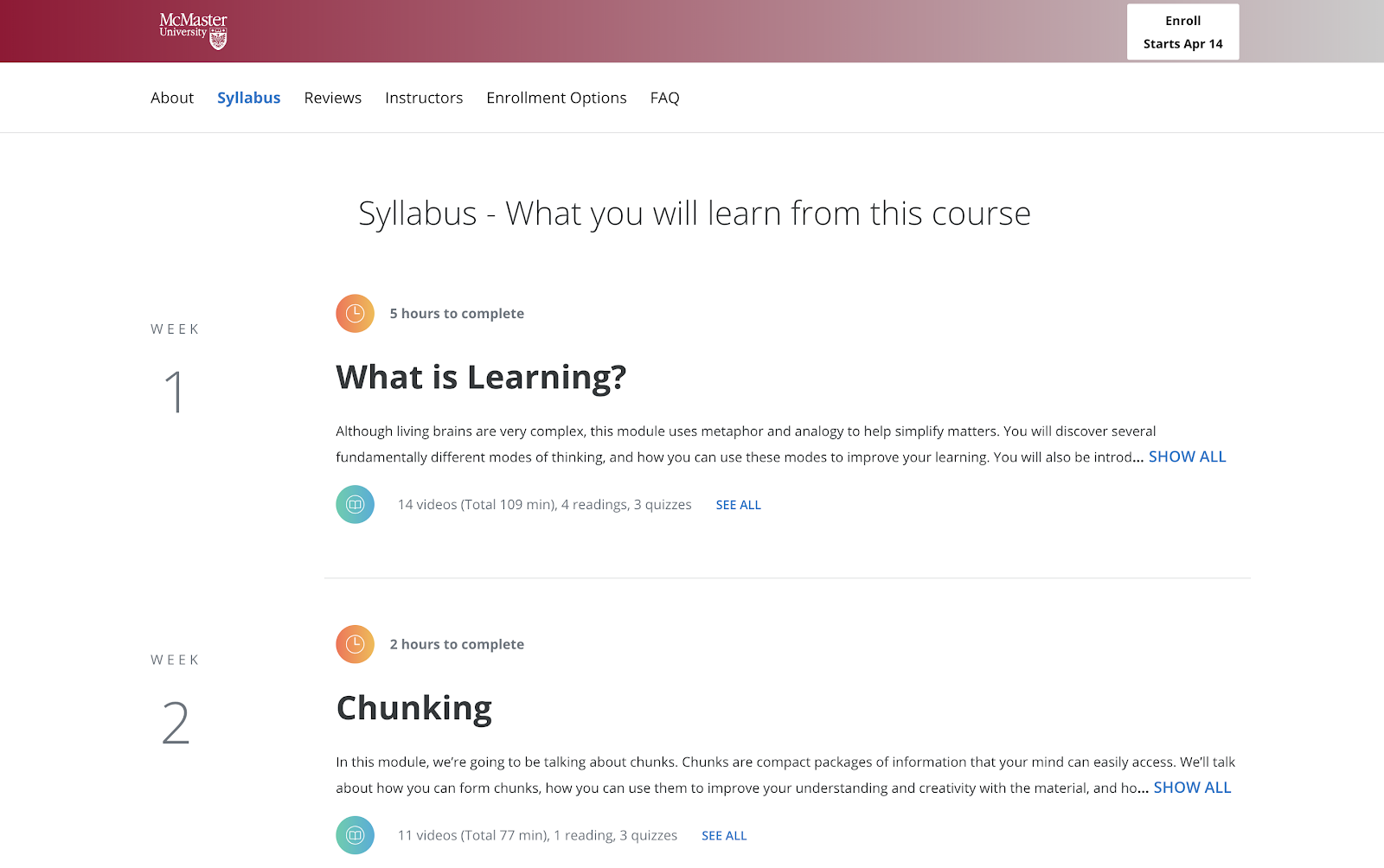
43. Learning How to Learn: Powerful Mental Tools to Help You Master Tough Subjects by Coursera
Length: ~15 Hours
This course gives you easy access to invaluable learning techniques used by experts in art, music, literature, math, science, sports, and many other disciplines.
44. Communication Skills – Persuasion and Motivation by Alison
Length: 1.5-3 Hours
This course will introduce you to the essential communication skills that aid persuasion, guide you through the differences between persuasion and manipulation, and show you how to use strong communication to motivate the people around you. These abilities will be a great boost for both your career and personal relationships.
45. Successful Negotiation: Essential Strategies and Skills by Coursera
Length: ~16 Hours
In the course created by the University of Michigan, you’ll learn about and practice four key steps to a successful negotiation.
46. The Manager’s Toolkit: A Practical Guide to Managing People at Work by Coursera
Length: ~29 Hours
This course gives you a practical guide to managing people at work. It doesn’t matter whether you are a first time manager in a shop or a middle manager in an office environment — the same skills apply to every work place.
47. What Great Leaders Do by Alison
Length: 1.5-3 Hours
Professor Bob Sutton outlines the hallmarks of great leaders, why leaders need to hear the truth, and how to deal with team disagreements. You will learn the types of habits practiced by those who fail to lead, and gain a strong understanding of how to become a better group leader.
48. Introduction to Project Management by Udemy
Length: 1:37 Hours
This course offers essential project management tools and techniques.
49. Conflict Resolution Skills by Coursera
Length: ~4 Hours
Learn listening skills, verbal and non-verbal communication skills, and how to assemble a conflict management plan likely to yield positive resolutions.
50. Career Success Specialization by Coursera
Length: ~1 Hour / Week (11 Months)
Build essential skills for the workplace. Improve your employability and advance in today’s dynamic workforce.
51. The Science of Happiness by EdX
Length: 4-5 Hours / Week (11 Weeks)
A free eight-week Science of Happiness course that will offer practical, research-backed tips on living a happy and meaningful life.
52. The Science of Wellbeing by Coursera
Length: ~19 Hours
The purpose of this course is to not only learn what psychological research says about what makes us happy, but also to put those strategies into practice.
Design Courses
53. Graphic Design Essentials by HubSpot Academy
Length: 44 Minutes
Need to become a graphic designer? Have less than an hour? This course by HubSpot Academy offers basic concepts in graphic design that have proven to be excellent marketing strategies.
54. Adobe Illustrator for Absolute Beginners by EduOnix
Length: 5 Hours
Learn how to master Adobe Illustrator with real world examples.
Business & Finance Courses
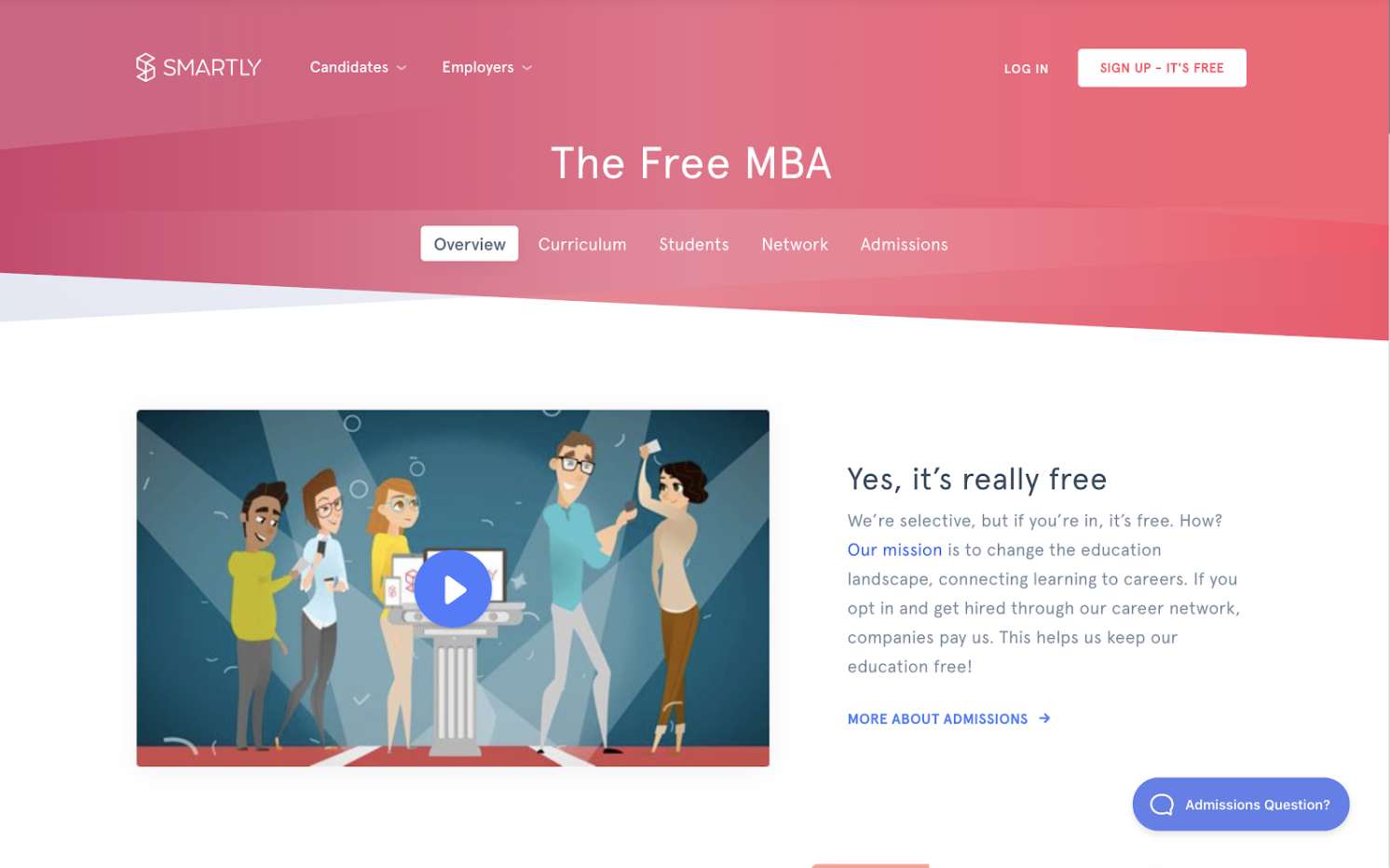
55. Free Online MBA by Smartly
Length: 5-15 Hours / Week (11 Months)
Designed with business professors from top residential MBA programs, Smartly’s proprietary curriculum combines a self-guided software approach with collaborative online case studies and group projects. It’s flexible, yet structured for the modern professional.
56. Foundations of Business Strategy by Coursera
Length: ~9 Hours
Develop your ability to think strategically, analyze the competitive environment, and recommend firm positioning and value creation. In this course, you’ll explore the underlying theory and foundation of a successful business strategy, and gain the tools you need to understand that strategy.
57. How to Build a Startup by Udacity
Length: ~1 Month
In an introduction to the basics of the famous Customer Development Process, Steve Blank provides insight into the key steps needed to build a successful start-up.
58. Alison Free Diploma in E-Business by Alison
Length: 6-10 Hours
This course is designed to boost your understanding of what e-business involves and how to implement a successful e-business strategy, so that the website you manage truly delivers.
59. Stock Market Investing for Beginners by Udemy
Length: 1:29 Hours
Learn the basics of the stock market through comprehensive, interesting and fun lectures.
60. Corporate Finance by New York University by iTunes
Length: Self-Paced
Corporate Finance is a big picture class. It looks at the financial principles that govern how businesses raise funds, invest those funds in assets and projects, and return those funds to investors.
Learning is an investment that continues to pay
We hope you find the online business course you need to take the next step in your career — whether you’re looking for a promotion or a sidestep into an entirely new field.
Whatever your reason, learning new skills will give you a competitive advantage in today’s rapidly changing workplace. Plus, the more you invest in your learning, the better you’ll grow.
If you’re looking for one single place to learn how to take your career to the next level and/or grow your business, check out HubSpot Academy. It contains tons of free certified courses on everything from inbound and content marketing to social media and sales.
Editor’s note: This post was originally published in January 2020 and has been updated for comprehensiveness.

Crear un GIF: di lo que piensas con mensajes animados (Lista de Herramientas + Ideas)
Volvernos memorables en Internet cada vez es más difícil. El scroll ha desplazado al zapping y para captar la atención debemos ser más astutos. Por eso, muchas marcas optan por crear un GIF.
Seguramente lo habrás leído por todos lados: un post con imágenes genera más interacción que los de texto.
En ese sentido, los GIF se han convertido en una tendencia porque permiten:
- Detener el scroll. Como captan la atención, el usuario permanece más tiempo viendo tu contenido.
- Generar empatía. Puedes usar el humor o una reflexión para conectar con tu audiencia.
- Aumentar el engagement. Si el GIF le hace sentido a la audiencia es más probable que interactúe (ponga like, comente, comparta).
- Explicar en pocos segundos aspectos complejos. Como la imagen se repite, es más fácil fijar conceptos en la memoria del usuario.
En este post te contaremos cómo diseñarlos desde la idea, es decir, qué mensajes se pueden convertir en un GIF.
Además, abordaremos una serie de herramientas para crear un GIF sin necesidad de saber usar photoshop.
>>> 8 herramientas de diseño gráfico para crear ADS de impacto.
¿Por qué crear un GIF y no un video?

Sí, creemos que la respuesta es obvia. Crear un GIF no sustituye a un video.
Son mensajes complementarios que no se contraponen. Pero cada uno tiene su función.
Los videos son maravillosos para explicar algo. Sin embargo, no siempre necesitamos dar mensajes largos.
Por ejemplo, el GIF que acabamos de compartir. Lo único que queríamos era acentuar una reacción.
Para explicar mejor en qué situaciones usar un GIF y en cuáles un video, utilizaremos un ejemplo.
Si quieres que un personaje entre en escena, haga piruetas y baile la Macarena mientras usa tu producto para demostrar lo fácil que es, lo que necesitas es un video.
Por el contrario, si quieres que el personaje se sorprenda con tu oferta, entonces haz un GIF.
La ventaja de estas piezas para redes sociales es que son rápidas de ver, no tardan en cargar y pueden ser vistas sin wifi.
Formato para crear un GIF

Para crear un GIF debes saber su definición. Son imágenes animadas de entre 10 y 20 segundos que se repiten sin parar. Otra cosa, no tienen sonido.
Algunas de sus características son:
- Se guardan en archivo .gif.
- Pesan aproximadamente 2 megas.
- Tienen un registro de colores más reducido que el video, por eso algunos se ven como sicodélicos. Para crearlos se recomienda usar colores contrastantes.
- Generalmente, su formato es cuadrado.
Crear un GIF para posicionar en Google
Crear un GIF es una forma de mejorar tu posicionamiento en Google, pero debes saber cómo optimizarlo.
Si insertas el GIF en el contenido de tu blog o sitio web captarás la atención y el tiempo de permanencia de los usuarios podría aumentar. Eso le dirá a Google que el contenido es relevante.
Ahora te contaremos dos trucos para posicionarlos:
- Agrega una descripción en la que utilices palabras clave.
- Nombra tu archivo con palabras clave cortas y sin acentos.
Aprende a crear un GIF con Objetivos de Marketing

Si eres un emprendedor o tienes un eCommerce y quieres crear un GIF, recuerda que debe tener un objetivo de marketing.
Algo que hemos aprendido en Socialancer es que cualquier estrategia que se implemente, debe darle valor a la marca.
Puede ser que el objetivo de GIF sea informar algo, llamar la atención o cuidar la relación con los clientes.
>>> Para fidelizar clientes también puedes usar campañas de email marketing. Aquí te enseñamos.
A continuación desarrollaremos algunas situaciones en las que recomendamos crear un GIF.
Crear un GIF para explicar una campaña
Crear un GIF es una buena idea para explicar la dinámica de alguna campaña o promoción.
Te compartimos el ejemplo de lo que hizo un refugio para perros.
Realizaron stickers para Whatsapp que promovían la adopción de los perros que viven en el refugio El Campito, en Argentina.
Por lo tanto, necesitaban explicarle a la audiencia cómo obtener los stickers.
Hicieron un GIF recreando una conversación de Whatsapp, de esta forma, la gente podía ver los stickers en acción.
Haz clic en el pequeño video que creamos para que puedas ver la campaña.
GIF para mostrar productos con diferentes estilos

Ciertamente las galerías de fotos podrían ayudarte a visibilizar varios productos. Sin embargo, crear un GIF es una forma más creativa de mostrarlos.
Hay otra ventaja, nadie te asegura que tus usuarios harán clic para ver todas las imágenes.
Si se los muestras desde un mismo golpe de vista, aumentas las probabilidades de que los vean todos.
Un GIF de esta naturaleza lo puedes insertar tanto en tus redes sociales, campañas de ads como en tu sitio web o campañas de email marketing.
Destaca con un GIF un Call to Action
Un buen Call to Action debe ser imposible de pasar desapercibido. Además, es necesario que sea claro.
Por eso se recomienda que esté en la parte superior de las landing page. Bueno, una forma muy creativa de destacar los Call to Action es con un GIF.
Lo que te recomendamos es que la animación sea sencilla, porque si le añades mucha información puedes confundir.

Súbete a una conversación para aumentar el engagement
¿Conoces el término de escucha social?
Se trata de una técnica de monitoreo de marca en redes sociales para determinar lo que se está diciendo de ti, de tu producto o algo relacionado al sector.
>>> Conoce aquí herramientas para facilitar la escucha social de tu marca.
Crear un GIF para subirte a una conversación en redes sociales es una forma de conectar con tu público de una manera más cercana.
Si hablas de lo que a la audiencia le importa, es más probable que te escuche.
Debes tener cuidado de encontrar el tono adecuado, no estimular mensajes de odio ni aspectos negativos.
Usa los GIF para vincular a tu marca con situaciones positivas.

5 Herramientas para crear un GIF gratis y de pago
Hay varios métodos para crear un GIF, desde hacerlo a través de lienzos de Photoshop hasta realizarlo a través de herramientas online gratis y de pago.
Acá te contamos las que hemos probado y nos encantan:
#1. DesingBundle: es un software de diseño que tiene 10 herramientas en una. Además de crear un GIF podrás hacer landing pages, logotipos, portadas para ebooks y más.
#2. Youzing: transforma en GIF los videos que tengas en mp4, YouTube, Vimeo o, incluso, tus grabaciones de pantalla. Lo obtienes gratis como Bono exclusivo de Socialancer si adquieres la suite para crear embudos de venta de GrooveFunnels.
#3. Stockkosh: es una biblioteca con más de 3 mil imágenes de alta calidad que podrás usar para crear un GIF muy creativo.
#4. Canva: te vamos a contar uno de nuestros secretos. Si quieres crear un GIF convirtiendo uno de tus videos, súbelo a Canva (¡con la cuenta gratuita puedes hacerlo!). Después, descárgalo en formato .gif. Así de fácil, además lo tendrás sin marcas de agua.
#5. Tenor: es un repositorio de GIF populares. Te permite personalizar los textos, descargar tus creaciones en formato .gif o embeberlos directamente en tu sitio web o blog.
¿Cómo crear un GIF en Whatsapp?
Si quieres crear un GIF directamente desde tu aplicación de Whastapp, los pasos son los siguientes:
#1. Abre tu aplicación de Whatsapp y selecciona a la persona a la que quieres enviarle el GIF. Después presiona en el botón de la cámara como si fueras a enviar una foto o video.

#2. Mantén presionado el botón de la cámara y graba un video.

#3. Cuando sueltes el botón y detengas la grabación de video, pasarás a la pantalla de edición.

#4. Recorta el video para que dure menos de 6 segundos. Entonces te aparecerá el botón de GIF. Al pulsarlo, se enviará en ese formato.

#6. Puedes agregar textos, emoticones y stickers como en cualquier otro GIF.

Conclusión para crear un GIF: aprende a pensar en movimiento
Crear un GIF debe ser parte de tu estrategia de contenidos. Es un formato más que afianzado en el consumo de tus usuarios.
El reto ahora es ¿cómo pensar los mensajes que difundes a través de un GIF?
Nosotros recomendamos lo siguiente:
- Sé coherente con el tono de comunicación de tu marca. Si tu tono es formal, tus GIF también deben serlo.
- Realiza tus GIF de acuerdo a los valores de tu marca. Si uno de tus principios es la amistad, muéstralo en tus GIF.
- Usa el humor de forma inteligente. Burlarse de alguien no es una buena idea. Evítalo aunque todos los demás lo estén haciendo.
- Evita transmitir mensajes de odio o que inciten cualquier tipo de discriminación.
- Sé lo más simple que puedas. Piensa que el GIF es un pantallazo, no lo cargues con contenido. Si necesitas decir más de 2 ideas, mejor crea un video.
Ahora sí llegó el momento de lanzarse al vacío y crear un GIF. Cuéntanos cómo te fue y los resultados que obtuviste.
from Socialancer https://ift.tt/31wDoxO
via
7 Australian Companies with Great Taglines [+What Marketers Can Learn From Them]
It’s no secret that people who live in startup-filled cities have seen some of the wildest brand names.
And, that variety in company names makes sense. When many startups in similar industries are founded in one geographic area, brands need to come up with a name that grasps attention, lightly hints at their mission, differentiates them from competitors, or encourages prospects to learn more about them.
This is especially true in Australia, which hosts startups from Sydney to Melbourne. These cities are the founding place of uniquely named startups and major brands like Sukin, Canva, and Billabong.
While the successful companies listed above have made their names noteworthy and easy to recognize, their company titles only hint at what their brands offer. This is why successful brands like these also lean on taglines to give prospects a quick, clear view of a brand’s overall mission or purpose.
With a great name and an effective tagline, prospects will remember your brand’s uniqueness, mission, or what types of products you offer. Then, when they’re looking for a product in your industry or space, they might think of your brand’s name and catchy tagline.
If you’re working in a busy startup hub like Australia, or are starting a business in an already crowded business landscape, take note of these seven Australian companies with taglines that stand out and set them apart from the competition.
7 Australian Companies With Great Taglines
“More than Money” – National Australian Bank (NAB)
During a rebrand in 2016, National Australian Bank changed its tagline from “More give, less take” to “More than money.”
The new tagline came with a series of commercials led by NAB’s agency — Clemenger BBDO. Each ad highlighted the bank’s history, credibility, and how their financial institution still plays a positive role in impacting countless Australian lives.
In the ad below — which was part of the “More than money” campaign — NAB invokes nostalgia by showing home video-like clips that follow a new-born baby as she grows into an adult, as well as the milestones her parents will need to budget for, such as violin lessons, schooling, and travel:
In an interview with CMO, Andrew Knott, NAB’s Chief Marketing Officer, said the pivot aimed to be more customer-centric.
“We felt it was time to move on from what has been a very effective brand expression around fair value, and ‘more give, less take’, to something that’s far more reflective of what we stand for today, but that’s also consistent with our heritage,” Knott explained. “When we are at our best is when we take time to understand customers and understand where they are at in their lives and to help them with the financial aspects of doing so.”
By linking money to major life milestones, NAB’s tagline and campaign effectively place emotion behind logistical offerings. To prospects unsure of where to place their money, the tagline makes the financial institution seem more relatable and potentially more trustworthy than other banks with basic emotionless marketing.
“Life’s better in boardshorts.” – Billabong
When it comes to taglines, Billabong keeps there’s short and sweet. Knowing that most of its customers are looking for swimwear for surfing, beach vacations, or summer sports, Billabong created a tagline just to remind people how much fun they can have in bathing suits.
Throughout Billabong’s history, it has embraced this tagline in a number of its online and print campaigns. Beginning in 2017, the brand began producing a YouTube surf series with the same phrase as its title. Here’s one of its chapters:
Billabong’s tagline is a great example of how a bold statement in a tagline can persuade a prospect to buy a product to make their lives more enjoyable. But, depending on the prospect who hears it, the tagline could also either play up a sense of vacation-related FOMO or seasonal nostalgia.
For example, if someone lives in a cold climate and hears that life could be better in boardshorts, they might yearn to go surfing somewhere warm. Or, if someone has been working long hours, they might remember a time they spent on the beach as a child. The emotions or memories invoked by this tagline might not convince someone to buy a ticket to a beachy destination. But, if they do go on vacation, Billabong might be the first brand they remember when making beachwear purchases.
“Skincare that doesn’t cost the Earth” – Sukin
As a budget-minded, environmentally conscious shopper, I can attest to the fact that it’s hard to find environmentally-friendly products that meet your skin’s health needs and don’t cost a fortune.
Sukin, a Melbourne-founded skincare brand, aims to solve for the dilemma above, by selling affordable, sustainably produced skin products. It’s tagline cleverly reflects this mission with a play on words: “Skincare that doesn’t cost the Earth.”

Aside from cleverly explaining the brand in just one sentence, Sukin’s tagline also lines up well with its overall mission.
“Here at Sukin, we’re committed to providing skincare that doesn’t cost the earth. This isn’t merely a commitment to creating affordable products, but also with minimal cost to our precious environment. We achieve this by thinking and acting sustainably wherever possible. Keep reading for our environmental initiatives,” Sukin’s Brand Values page notes.
“Design anything. Publish anywhere.” – Canva
While Canva seems like a giant global company now, it was once a startup founded in Sydney, Australia.
For those who haven’t used Canva, the website allows individual users or teams to easily create and publish aesthetically-pleasing graphic designs for websites, social media, and other platforms.
Because Canva is artsy by nature, the brand could’ve gotten away with an overly creative tagline. But, instead, the company keeps things simple — but still incredibly effective — with, “Design anything. Publish anywhere.”
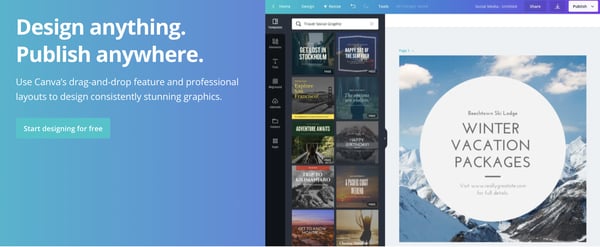
In just four simple words, Canva describes its minimum viable product and entices both designers and artistic novices to try its tools.
“Australians Wouldn’t Give an XXXX for Anything Else.” – XXXX
Today, XXXX beer’s tagline simply reads “Pride of Queensland.” But, before the brand became globally known, they had another great tagline that caught attention from Australian masses due to the light curse-related controversy around it.
For decades, XXXX — formerly known as Castlemaine XXXX — embraced Australia’s edgy sense of humor and slang with the memorable tagline, “Australians Wouldn’t Give an XXXX for Anything Else.”
The tagline, which cleverly uses XXXX to insinuate a four-letter curse word, dates back to 1985. At that time, commercials would present a longer, TV-friendly tagline of “Australians Wouldn’t Give a Castlemaine XXXX for Anything Else.”
These early commercials often showed rural Australian residents, farmers, and construction workers getting into humorous, but dangerous, situations just to get XXXX beer. After a wild scene, a narrator would read the tagline, insinuating that Australians wouldn’t care so much about any other beer. Here’s one classic example:
Moving into the 1990s, the brand began using the shortened headline to express a more eye-popping message.
Although the tagline was scrapped in a 1996 rebrand, it’s still a historically great example of how a company can be cheeky, attention-grabbing, and memorable while still tastefully marketing a product.
“Tastes like Australia.” – Vegemite
For generations, many Australians and Australian visitors have spread on Vegemite on to bread and sandwiches for extra flavor.
Not only is Vegemite a common snack in Australia, but it’s also been featured in global content such as films or TV shows that discuss the continent. And, when people who aren’t from Australia see or taste Vegemite, they might ask, “What is this made of?”
Knowing that people link Australian to Vegemite, while also wondering what’s in the iconic snack, the brand launched, “Tastes like Australia.” — a new tagline and commercial in 2018.
The commercial, which explains the tagline, opens with a confused person wondering how Vegemite is made. A narrator with an Australian accent then presents videos of Australian scenes — such as sporting events, crocodiles, and destinations — along with photos of fruit-based ingredients. Ultimately, the ad insinuates that Vegemite is metaphorically made of fruits, vegetables, cheese, and iconic scenes of Australian pride.
“Find your thing.” – Redbubble
Redbubble is a store chain and online store where people, organizations, or small businesses can sell clothing, art, or other items that might be considered zany, humorous, or unique. When scrolling through the site, you might find T-Shirts with pizza cat memes on them, strangely decorated pottery or pants with sparkles or brightly colored patterns.
Because you can buy all sorts of unique or funny independently-made treasures on the site, Redbubble keeps its tagline broad — but still motivating.
With, “Find your thing,” Redbubble insinuates that there’s something for everyone on the site. It also embraces that everyone has an independent style and can look to this site for the clothing or items that will allow them to embrace their inner uniqueness.
Aside from including “Find Your Thing” in videos like the one below, Redbubble also includes a section with the same name on its website.
“Find your thing.” is a great example of how a company with many offerings can create a broad tagline that hints what their company is about without being too vague.
Crafting a Great Tagline
If you’ve been inspired to change or create your own tagline, here are a few themes you can take from the Australian examples above:
- Keep it simple: You don’t need to be vague or overly clever to persuade someone to check out your brand. Sometimes, simply reiterating your MVP — as Canva does — is effective enough to win over an audience.
- Be Bold: Is your company or product known by locals, award-winning, or potentially iconic. If so, you can try incorporating your company or product achievements into a bold phrase, like Vegemite’s “Tastes like Australia.”
- Get clever: If you can’t cram your entire mission into a short concise phrase, consider using an easily recognized metaphor or play on words, like Sukin’s “Skincare that doesn’t cost the Earth.”
Want to learn more about brainstorming and crafting catchy taglines or slogans, check out this helpful guide or download the free resource below.

B2C Marketing Automation and 5 Top Software Tools to Power It
Any B2C marketer can attest to the total relief that comes right after setting up successful email automation. To know that your customers will receive personalized emails without you having to manually write each and every one … whew, that’s powerful stuff.
Did you know that segmented (a.k.a. personalized) email campaigns can drive a 700+% increase in revenue? And that’s just email.
From text reminders to cart abandonment emails to multi-channel campaigns that span social media and in-app messaging, B2C marketing automation marries the power of personalized messaging and hands-off marketing. It simultaneously saves time (and money) while delighting your customers wherever they are.
What is marketing automation?
Marketing automation refers to any marketing efforts, campaigns, and tasks that are managed, executed, and measured with software versus manually. These efforts and campaigns are typically triggered by actions taken by leads or customers.
Marketing automation has many benefits. It can help save your resources, nurture your leads, and increase your revenue — all at once and with minimal manual effort. Amazing, right?
It’s important to note, however, that marketing automation shouldn’t replace human touch. This is especially true for B2C — unlike B2B, the B2C sales cycle is much shorter and the customer journey much more personalized.
What is B2C marketing automation?
B2C marketing automation encompasses any automated marketing messages and campaigns targeted to individual consumers versus business audiences. This type of marketing automation must be much more personalized and data-driven to best appeal to the individual in his or her specific customer journey.
Both B2C and B2C marketing automation work to send relevant messages, increase efficiency, and drive revenue, but let’s further unpack their differences.
B2B vs. B2C Marketing Automation
B2B marketing automation delivers more mass-oriented content that’s focused on educating and nurturing leads through a pre-established sales funnel. Since there are typically more stakeholders involved in B2B purchases, B2B marketing automation also works to provide action-triggered information that can help influencers educate their decision-makers.
Let’s say a junior social media strategist is searching for a new social media management software for their entire team. They download an ebook on social media strategy from a prominent SaaS company, thus prompting the company’s B2B marketing automation software to send them nurturing emails about building a social media strategy and how to use its tool to do so.
The junior strategist is now equipped to bring this information to his or her director, who will make the final decision about which social media SaaS tool to purchase.
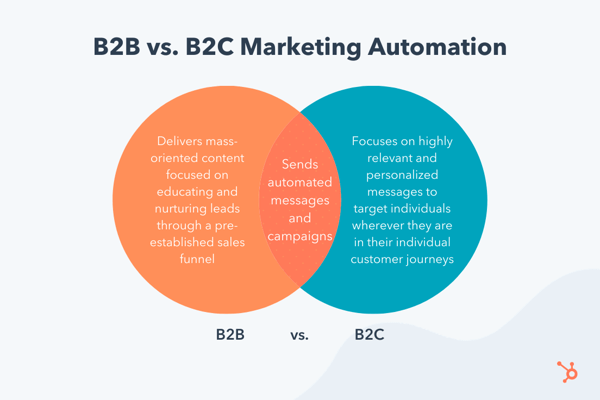
On the other hand, B2C marketing automation typically focuses on highly relevant and personalized marketing messages. B2C marketing automation also targets individuals wherever they are in their individual customer journeys and attempts to deliver customized product or service recommendations based on action triggers and captured data.
For example, one type of B2C marketing automation is cart abandonment email. By tracking shopper behavior and capturing personal information like email addresses, B2C companies set up a marketing automation “rule” to send an email to consumers who leave un-purchased products in their shopping carts.
Typically, abandoned cart emails include the specific products left behind — a dose of personalization that may motivate shoppers to return to the website and complete their individual purchase.
Benefits of B2C Marketing Automation
Marketing automation sure has its perks — for both marketers and their audiences. These marketing automation benefits include:
- Keeping your brand top-of-mind with potential customers
- Allowing your team to send personalized, targeted messages without having to manually track users and repeatedly write content
- Increasing efficiency amongst your marketing team
- Closing the gaps in your marketing analysis by removing human error
- Tracking user data that can be used to better serve up personalized product or service suggestions
- Delighting site visitors, leads, and customers with customized content
Now, let’s discuss some B2C marketing automation tools software tools that can help you reach, engage, and convert your shoppers and customers.
There are countless marketing automation tools on the market. According to our research, the following five are a great fit for B2C marketing automation.
However, when comparing what tool may meet your B2C marketing automation needs, consider 1) how complex each tool is and what onboarding resources are offered, 2) what integrations each tool offers and how they may fit into your current tech stack, and 3) how each tool is priced and how much your marketing automation needs may cost.
1. HubSpot Marketing Hub
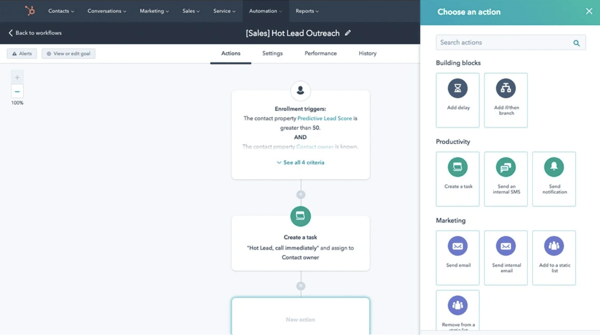
Built on the foundation of the free HubSpot CRM, HubSpot Marketing Hub holds a wealth of B2C marketing automation tools that allow you to use your lead’s behavior to personalize emails, content, and outreach at scale. From email to SMS, and even internal automations like lead scoring and CRM updates, HubSpot is easy to get accustomed to and can quickly become your team’s marketing automation best friend.
Onboarding support: HubSpot’s award-winning customer support is available 24/7 through email and chat, as well as over the phone for Professional and Enterprise subscribers. You can also access a knowledge base and various HubSpot Academy courses.
Integrations: HubSpot Marketing Hub integrates with over 500 third-party applications.
Pricing: HubSpot Marketing Hub offers a Free plan as well as multiple subscription options. Note that the marketing automation features are only available for paid subscribers.
2. Mailchimp
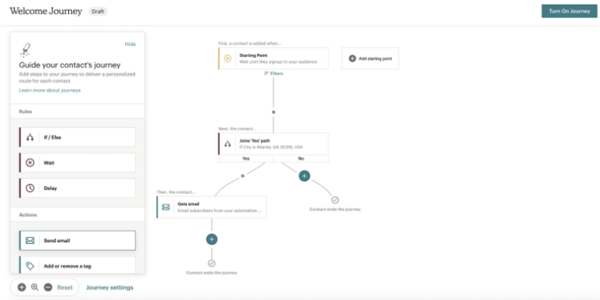
Mailchimp is an industry leader in email marketing automation. Use the Mailchimp tool to deliver transactional emails, such as order confirmation emails and other personalized messages. The tool also allows you to build visual customer journeys so you can provide the best possible experience to each customer — or convert your leads and prospects into one.
Onboarding support: Mailchimp has a large library of resources, including guides, tutorials, and case studies. Free users get 30 days of email support, and paid subscribers get unlimited email and chat support.
Integrations: Mailchimp integrates with over 200 third-party applications.
Pricing: Mailchimp offers a Free subscription, but the more in-depth marketing automation tools aren’t available unless you invest in the Essentials subscription or higher.
3. ActiveCampaign
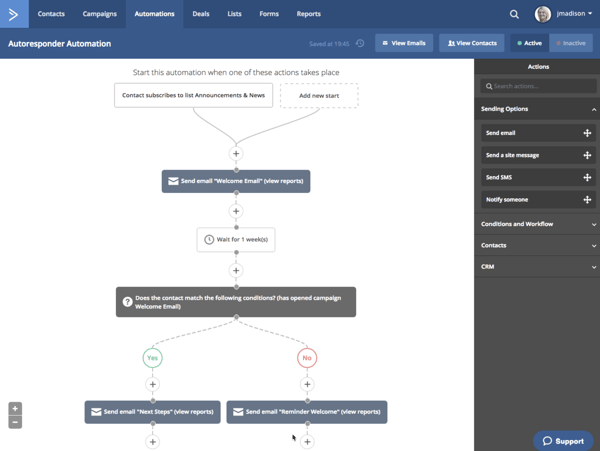
ActiveCampaign is a renowned marketing automation software and was the first to develop the visual automation workflow builder. (You know, the one with the boxes and labels and lines going everywhere — like the one above.) In addition to email, it offers site tracking, lead scoring, attribution, and more.
Onboarding support: ActiveCampaign offers a free demo and a whole slew of resources, such as a blog, developer documentation, and a library of pre-written automations. All subscriptions include data migration and implementation services, and more expensive subscriptions include limited one-on-one training.
Integrations: ActiveCampaign integrates with over 300 third-party applications.
Pricing: ActiveCampaign offers a free trial. From there, you can pay for a Lite subscription at $9 per month or more.
4. AutoPilot
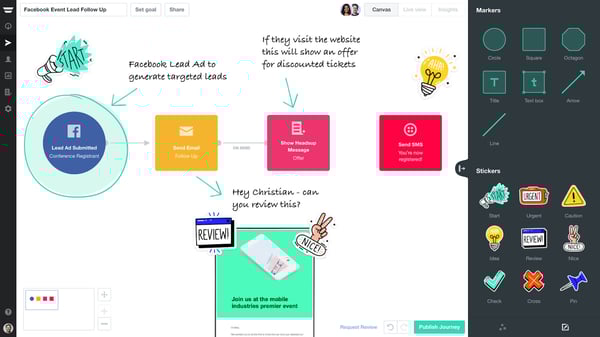
AutoPilot, like others on this list, offers a visual automation workflow builder … but with a twist. It sets itself apart with emojis, stickers, custom notes, and other details that help your team collaborate and, well, have fun building your marketing automation sequences. Although the tool doesn’t offer its own built-in CRM, it is fairly intuitive, easy to use, and offers fantastic reporting features.
Onboarding support: All AutoPilot subscriptions include unlimited emails and access to support. You can purchase an Expert Setup and Training add-on for $1699.
Integrations: AutoPilot integrates with dozens of third-party applications.
Pricing: AutoPilot offers a free trial, after which you can join at as little as $49 per month.
5. Omnisend
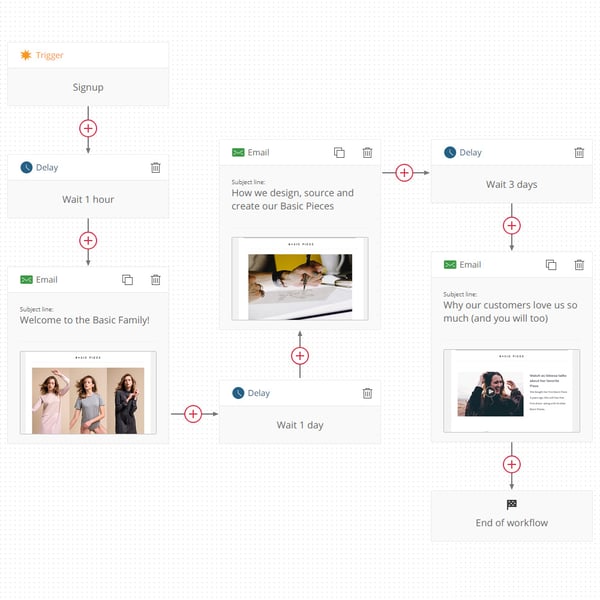
Omnisend is a leading marketing automation tool specifically tailored for e-commerce businesses. Not only does it offer dozens of pre-written templates for all e-com automation scenarios, but it also integrates with nearly every possible e-commerce-related tool, including both email and SMS automation software.
Onboarding support: Omnisend offers a library of resources, including an onboarding course. Unfortunately, live support is only offered to paying subscribers.
Integrations: Omnisend integrates with hundreds of third-party applications, although most aren’t available with the Free plan.
Pricing: Omnisend does offer a Free subscription option, although most automation features aren’t available unless you’re paying.
These five tools are among the most powerful for B2C marketing automation efforts. Whether you’re sending time-triggered birthday emails or following up with prospective customers with automated SMS messages, try these B2C marketing automation software tools to reach, engage, and convert your customers.

35 Office Costume Ideas for Marketing Nerds & Tech Geeks
Halloween is a fun holiday, and it doesn’t get the attention it deserves. It doesn’t have recognizable songs or vacation days associated with it, and it falls on a busy time of year for most people in the workforce.
But that doesn’t mean you should skip the festivities at your office Halloween celebration.
How many days of the year are you encouraged to dress up and goof around at work? Probably just one — Halloween — and even then, it can be hard to know what’s office-appropriate.
We want you to have fun this Halloween, so we’re taking the work out if it for you. We’ve compiled a list of DIY Halloween costume ideas that are easy to put together, inexpensive, and perfect for the digital marketer or tech professional.
If your family and friends don’t get your costume, your colleagues definitely will.
35 Office Costume Ideas for Marketing Nerds & Tech Geeks
Computer or App-Related Costumes
1. Alt Text
Alt text isn’t just the metadata of an image published on the web — you could also say it’s an “alternative” fashion statement with the text to describe the era. This was HubSpot Director of Content Corey Wainwright’s office Halloween costume a few years ago. It’s great because you don’t even look dressed up if you have a casual office dress code, so you can just blend in.
To dress as alt text this halloween, break out your best 90s alternative garb — our coworker Corey went with black jeans, combat boots, and a flannel. Then, tape hyphenated text that best describes what you’re wearing, much like an image of your outfit would do online to help search engines read the file.
We edited a sash of alt text on to the alternatively dressed girl below, just to help you picture your awesome costume.
 Source: That’s Life
2. SEO Ninja
Speaking of dorking out on SEO, you could be everyone’s favorite LinkedIn title — the SEO ninja. Dress in all black, buy a black ski mask, and tape keywords all over yourself. Voila … you’re an actual ninja — just one much more concerned with search engine optimization than lurking in the darkness.
 Source: Pinterest
3. Mobile App
Wander around holding an appetizer — candy, cheese and crackers, chips and dip … whatever you have on hand. Boom. You’re a mobile “app.”
This costume also doubles as a great way to introduce yourself and make friends at a party.
 Source: Opportunity Max
4. Instagrammer
Want another way to turn handing out food into a costume? Dress up like a hipster and hand out graham crackers. You’re an “instant” “gram” cracker server — or, for short, an Instagrammer. Pun absolutely intended.
5. Ghostwriter
Have you ever written something for somebody else’s byline? Such is the life of a “ghostwriter.” Turn your author-less accomplishment into this year’s office Halloween costume.
To dress up as a ghostwriter, grab a white sheet and cut a hole for your head and arms. Dob some black ink spots on the sheet, get a book and one of those feather quills (or just get a feather, I suppose), and boo — you’re a ghostwriter.

6. Whitespace
Whitespace on the internet might just denote all the blank space you use to help your design stand out, but on Halloween, “whitespace” isn’t just the absence of space.
Dress in all white — add white face paint and a white wig if you’re ultra-committed. Then add a hint of color somewhere on the outfit, like a colored tie or scarf, or even a paint splotch. That color splotch will make the white space more prominent, transforming you into “whitespace.”
7. Error 404 Code
You’ve most likely encountered a funny error 404 page before, and you can make it a funny costume, too. Grab a sheet of paper, write “Error 404: Costume Not Found,” and tape it to your outfit.
8. (Monty) Python
If you’re into programming code, British comedy, and low-effort costumes, being (Monty) Python is perfect. Dress up in anything remotely snakelike in your closet: olive green clothing, snakeskin accessories, and fake vampire teeth that can serve as your fangs.
Then, to amp up the dork factor on this costume, add two coconuts or a gold chalice to embody Monty Python on his quest for the Holy Grail.
9. Facebook
Grab face paint or eyeliner and write “book” across your cheeks. Just like that, you’re the world’s biggest social network for Halloween.
And for your sake, we hope your colleagues actually get it:
 Source: AndPop
10. Unicorn
Here’s another tech-friendly, double-entendre costume: Be your own version of a tech unicorn. Here at HubSpot, we love this tech icon, and you can easily make your own version of a unicorn horn with help from this article.
 Source: WikiHow
11. Phishing Emails
Phishing emails are nothing to joke about — they can seriously threaten your technology and data security. But on Halloween, you can dress up as a play on phishing emails for an easy DIY costume. All you need are a stick, a piece of string, and an envelope. Bonus points if you own a bucket hat and vest to complete the ensemble. Check out an amusing version of this costume below.
 Source: Car and Driver
12. Copycat
“CNTRL + C” is the popular keyboard macro allowing you to copy items from one place to another on your computer. Well, here’s a technology spin on a classic Halloween costume. All you’ll need are cat ears, eyeliner-drawn whiskers, and a sheet of paper. Write “CNTRL + C” on the paper, tape it to your outfit, and you’re a “copycat.”
 Source: BuzzFeed
13. The Blue Screen of Death
You know the screen, even if you don’t know the morbid nickname the tech world has given it. This classic error screen is known for signaling the end of a computer’s useful life, and you know it when you see it. It causes so much stress on site, in fact, that the color alone is scary enough for October 31.
Believe it or not, there are official T-shirts you can get with the blue screen of death copy printed on them. Want to make your own? All you need is a royal blue t-shirt and a printed version of this horrifying error message to pin to it.
 Source: Spreadshirt
14. GPS Costume
This will work best with two people. You can cut a Point A and Point B pin shape out of cardboard, paint both red, and simply write A and B on it. From there, you can personalize the costume whichever way you’d like. You can even get more intricate by finding a T-Shirt with a map on it.
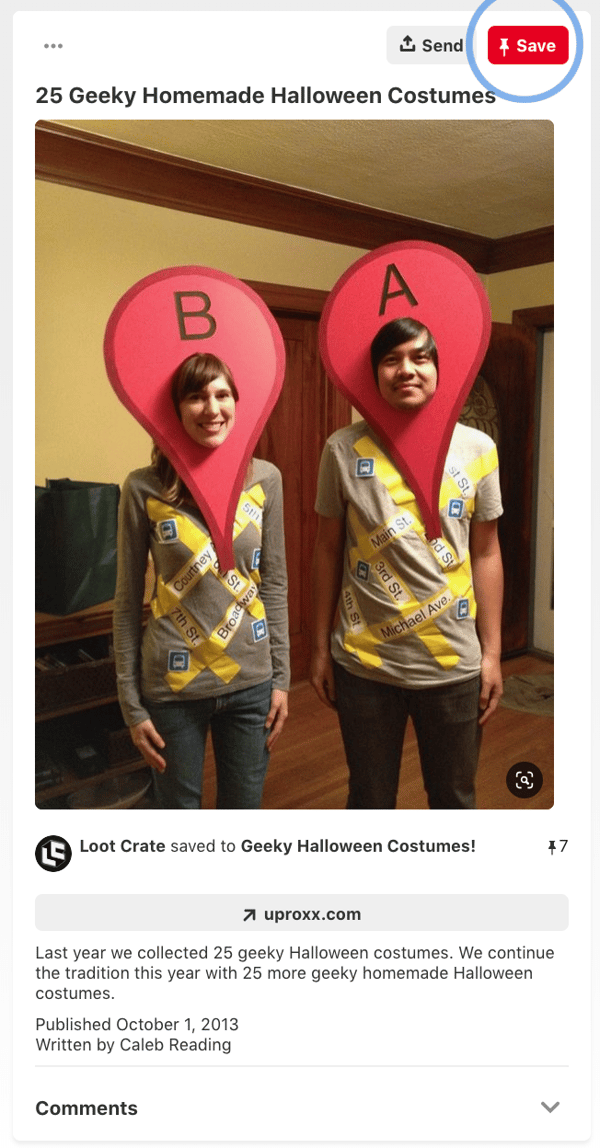
Source: Pinterest
15. Dead Battery and Low Wi-Fi
Nothing is more terrifying than a dead battery or no Wi-Fi. This costume brings all of techy’s fears to life. It’s also pretty simple to create. Just tape or glue images of dead Wi-Fi and low battery signals on to a black shirt. To emphasize the low-connectivity fears, put on some zombie or skeleton makeup.
Although this can work as a couples costume, this could also be a fun option for office colleagues. Since both costumes within the set don’t rely on each other to be understandable, an individual could also wear either the Dead Battery outfir or the No-Wi-Fi suit and still be easily recognized.

Source: Pinterest
Emoji Costumes
16. Information Desk Girl
This genius professional found a golden (or, rather, purple) opportunity to be the “information desk emoji, the many gestures of whom we’ve all come to know, love, and use at some point in a text conversation.
The best part about this awesome tech reference is that you don’t need to alter your regular attire to make it work. As Naomi shows us below, it’s all in the hand gestures.
17. Dancing Girls Emoji
If you’re the owner of one of the nearly more than 1 billion Apple iPhones sold worldwide, you’re probably familiar with the dancing girls emoji, shown below.
The easiest version of this costume is to find a buddy and dress all in black together. If you’re committed to emoji authenticity, buy black bunny ears to complete the look.
 Source: Brit + Co
18. Heart Eyes
Are you just in love with Halloween? Prove it with this passionate emoji face. You don’t have to paint your entire face, chin to hairline, to get the Heart Eyes Emoji just right, but it certainly helps. It’ll also disguise your stress when you’re at your most focused during the day.
“This employee just seems to love her job, I can’t put my finger on why,” your manager will think … See how to paint this emoji onto your face below (you’ll need some help for this one).
Topical Office Costumes
19. Fully Vested
At work, “fully vested” usually refers to one’s ability to earn all matching funds of a 401(k) retirement plan. But for some, you just can’t help but picture someone wearing lots of sleeveless jackets at the same time. Now’s the time to personify that image.
If you work in a company where people would get the joke, put on a bunch of vests (at least three, but even more is encouraged), and that’s about it. You’re fully vested.
20. Nerd
What I love about the nerd costume is that it’s effortless and always unique — there are many ways to be a nerd in this day and age. Are you a tech nerd, a video game nerd, or a book nerd? The sky is the limit with this costume. Show up wearing glasses with your favorite accessories, such as a magic wand, book, or lightsaber, to complete the effect.

Source: Pinterest
21. A Solar Eclipse
Last year, the solar eclipse took over the internet — and the country. As millions of people flocked to the path of totality to (hopefully) catch a glimpse of this rare event without burning their corneas, millions more made jokes about it on social media.
To dress up as a solar eclipse for Halloween, you’ll need a work pal to dress up as the sun and the moon with you. One of you wears black, the other wears yellow, and you both wear dark sunglasses. Then, at the Halloween party, the one dressed in black spends the whole time standing in front of the one in yellow.
 Source: Pinterest
22. The ‘Evil Kermit’ Meme
If you haven’t heard of this mega-popular meme this year, you’ve probably seen it somewhere: It features Kermit the Frog, face-to-face with his evil twin, Evil Kermit. Evil Kermit looks identical, except for the black cloak.
For this costume, you and a coworker can keep it simple: You both wear green shirts, and one of you wears a black hoodie or jacket on top. If you really want to commit to the costume, you’ll spring for some green face paint to complete the ensemble. Walk around the party together, facing one another, for maximum effect.

23. Fifty Shades of Grey: PG Paint Swatch Costume
Want to do something cheeky, but still office friendly? This is PG pun costume shares the name of a popular romantic novel and film, “50 Shades of Grey.”
Go to your local paint or hardware store and buy 50 grey paint swatches. Then, tape them to a black shirt and tell your colleagues you’re, “50 Shades of Grey.”

Source: Fox 24 of Kansas City
24. The “But That’s None of My Business” Meme
If you love Kermit the Frog, but don’t have a colleague to team up with for the “Evil Kermit” costume, consider going solo with a costume based off of the “But That’s None of My Business” meme, where Kermit is seen judgmentally drinking coffee.
All you have to do is stick a pair of eyes on a green hoodie and start sipping your tea or coffee. For an added effect, you can cut a white photo frame to hold in front of you so you can look like an image posted on social media.
 Source: Pinterest
25. Eleven from Stranger Things
Eleven from Netflix’s hit series Stranger Things is universally beloved, and it’s a bonus that her signature look is a comfortable and easy-to-assemble costume. Rock your best Eleven with a dress, a denim jacket, and a box of Eggo Waffles.
 Source: Business Insider
26. Scoops Ahoy Employee from Stranger Things
While Eleven, noted above, is an absolute classic Stranger Things character, 2019’s season inspired another great costume opportunity. During the newest installment of episodes, Stave, a main character played by Joe Keery, worked at an icecream shop called Scoops Ahoy. As a server, he had to wear a goofy sailor uniform alongside his coworker Robin.
Since the season aired, the uniform has been regularly worn by cosplayers and at Comic Con as people mimic Steve and Robin.
Since it’s a pretty generic sailor uniform, you might be able to easily find one that’s similar in a variety of Halloween shops. This costume could work for both individuals or two colleagues.
27. Pokémon GO Trainer
Pokémon GO had roughly 45 million people walking around in cities glued to their phones last summer (I, among them). To pay homage to the explosion of this tech trend, you’ll need a t-shirt that’s red, yellow, or blue. Using fabric paint or permanent marker, write Valor (for red), Instinct (for yellow), or Mystic (for blue) on your shirt.
Spend Halloween walking around pointing your phone at objects, and you’re the spitting image of a Pokémon GO trainer. Gotta catch ’em all, right?
Group Office Costumes
28. The Sales Lifecycle
At HubSpot, we love embracing team costumes. In 2018, a handful of HubSpot employees grabbed some T-Shirts and wrote the stages of the sales lifecycle on them. Then they lined up accordingly and passed a fake prospect listing around to symbolize the process of making a sale. This was such an easy costume to coordinate that the team could even include an out-of-office employee over a video call.
 Source: Maggie Bomze, Principal Customer Success Manager of Strategic Accounts at HubSpot
29. Social Media Channels
While this Pinterest image shows classmates posting as the major social media networks, this could easily be modified to fit the office setting.
Simply pick out a solid list of the hottest social networks, then by blank T-Shirts that match the colors of each platform. From there, you can either draw, tape or glue the logos on to each shirt. If you’re not interested in the tutus worn below, you could also find matching pants, or just wear jeans and keep things simple.

Source: Pinterest
30. Google Algorithm Update
Find a couple of office buddies for this one — one panda, one penguin, and one pigeon. You might be thinking, “what the heck is the pigeon algorithm update?” 1) It’s a thing, and 2) we checked Amazon for hummingbird costumes and there aren’t any cheap ones available.
 Source: Opportunity Max
31. Black Hat and White Hat SEO
This is another SEO-related costume, and I think you can figure this one out on your own. I recommend wearing a black hat for one, and a white hat for the other, and having “SEO” embroidered on each one — which you can easily custom order.
 Source: SEO-Hacker
32. Snapchat Filters
Here’s another group costume idea that pays tribute to Snapchat’s filters feature.
There are numerous options that you and your team can choose from to embody this costume. You could dress up as vomiting rainbows, cat and dog ears, a flower crown, or a face swap, and this could be as DIY or store-bought as you’re interested in pursuing. For example, here’s some inspiration for a couple of the dog filters:
 Source: PopSugar
33. Snapchat Ghosts
Put a marketing spin on a classic Halloween costume by arriving as a Snapchat ghost. You’ll all need a white sheet and to pick which ghost you like the most.
 Source: YouTube
34. PAC-MAN and Company
Here’s yet another awesome ghostly costume idea your whole team at work can get in on. Have your team lead wear the yellow pie-shaped garb of PAC-MAN, with each team member dressed as the multi-colored ghosts that roam the screen in this vintage arcade game.
Just make sure the team lead doesn’t actually try to eat the ghosts — you’re in an office, and you’re all technically on the same team.
 Source: Meningrey
35. Instagram Filters
For this group costume, you’ll need white t-shirts and fabric markers. Draw an Instagram photo frame on the front of your shirts, and each team member can write a different Instagram filter‘s name inside the photo frame. Or, create frame props with different filters on them like the group did below:
 Source: Nails Magazine
The clothes don’t make the marketer, but the costume can certainly make the culture at your company. Find out what it takes to hire and train the best fits for your open roles in the free ebook, available below.
Editor’s Note: This post was originally published October 21, 2018 but was updated in October of 2019 for comprehensiveness.

How to Make a Quality Management Plan
The Ultimate Guide to Amazon Advertising
I’m willing to bet, whenever you have marketing strategy discussions with your team, you typically discuss the same three or four social platforms — Facebook? Check. Instagram? Check. Pinterest? Check.
But — what about Amazon?
In 2018, Amazon launched “Amazon Advertising”, (formerly Amazon Marketing Services, or AMS), as a search advertising solution for Amazon vendors. Similar to pay-per-click ads on Google, sellers only pay when shoppers click on ads.
AMS is rapidly growing. In fact, Amazon’s ad revenues are projected to amount to 12.75 billion in 2020, with an impressive 23% growth since 2019.
If you’re already not using AMS, your team should consider it. Amazon Advertising could become a core advertising platform for many businesses, as well as a good alternative to Google and Facebook.
To help you get started advertising on Amazon, we’ve created this ultimate guide that fleshes out each type of ad you can run on Amazon and some of their best practices. Read on to learn how to advertise on the ecommerce platform in 2020.
Keep reading, or jump to a specific type of Amazon advertising:
Amazon Advertising Strategy
Even though we’ll be describing five unique types of Amazon advertisements that all have different best practices, here are seven general tips for shaping a successful Amazon advertising strategy:
1. Determine your goals.
Whether you want to drive more sales or boost brand awareness, Amazon allows you to align your targets with your goals. For instance, you can deem your Advertising Cost of Sales (ACoS) as your metric of success if you’re focusing on driving more sales.
Alternatively, you can deem impressions as your metric of success if you’re focusing on boosting brand awareness.
Fortunately, Amazon divides its product page up into “Objectives” if it’s easiest for you to figure out which Amazon ad product works best for you depending on your goals. For instance, video ads, display ads, audio ads, and custom advertising solutions are recommended if your goal is to grow brand awareness.
By working backwards from your goals, you’ll ensure the strategy you implement on Amazon is best-suited for your business needs.
2. Choose the right products to advertise.
Advertising your most popular products gives you the best chance to convert clicks into purchases. You should also make sure these products are in stock and priced competitively.
Alternatively, perhaps you have a new product or service for which you’d like to increase awareness. When choosing the right products or services to advertise, you’ll want to keep your goals in-mind, and also ensure you’ve done your research to determine whether Amazon is the right platform to showcase your products in the first place.
3. Craft clear, concise, and compelling product detail pages.
Amazon ads can entice shoppers to visit your product detail pages, but the product detail page is what will ultimately turn those shoppers into customers. To craft a persuasive product detail page, consider including accurate and descriptive titles, high-quality images, and relevant and useful product information.
4. Choose where you want to place your ads.
Amazon offers a variety of products within its full advertising suite — for instance, you can create voice ads to display across Alexa-enabled devices, video ads to stream across Fire TV or Amazon-exclusive sites like IMBD, or display ads to attract Amazon users to your brand.
Once you’ve determined whether voice, video, or search is right for you, you’ll want to investigate various options, including sponsored brand ads versus sponsored product ads (which we’ll discuss in the next step).
Keep in mind, there are tons of opportunities to place your ads on various devices or sites with Amazon, so consider getting creative. Perhaps an audio advertisement that plays on Alexa-enabed devices is best-suited for your business, or maybe you’ll find the highest ROI with Amazon DSP, which allows you to reach Amazon audiences on both Amazon-owned and third-party sites and apps.
5. Test out sponsored brands versus sponsored products.
To explore the differences between sponsored brands versus sponsored products, let’s consider the following example.
When I search “baby food” on Amazon, the first sponsored placement I see is Gerber’s sponsored brand post, which highlights a few different Gerber products to increase brand awareness and drive sales:
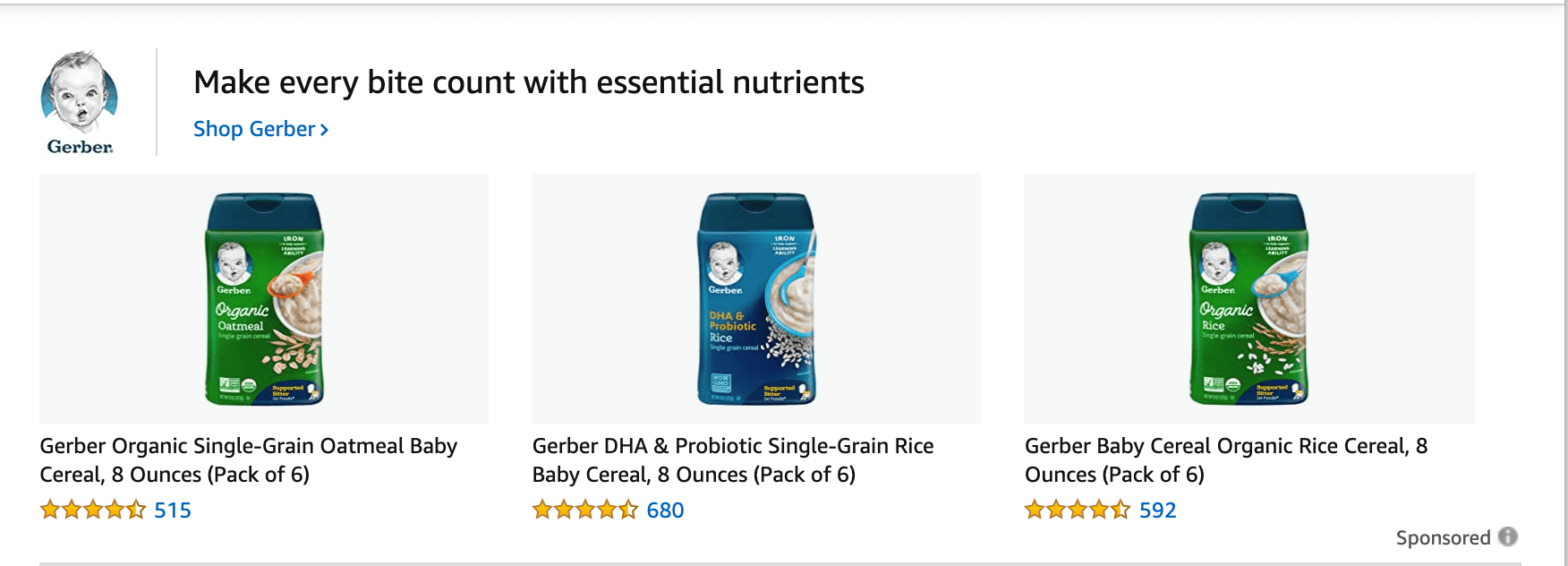
However, consider what happens when I click on an individual Gerber baby food product. In the bottom right of the product screen right below the “Buy Now” button, I see a Happy Family Organics advertisement for an individual product — Stage 4 Fiber & Protein baby food pouches:
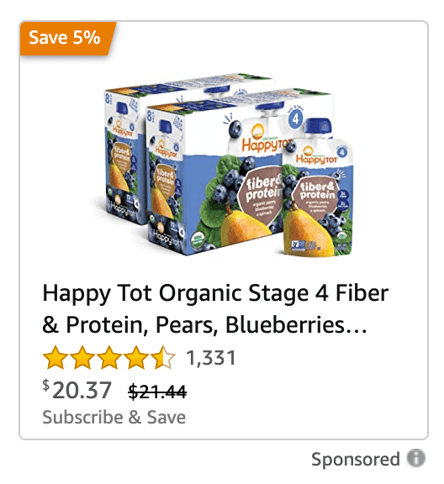
This is the difference between a sponsored brand versus a sponsored product post. Simply put, a sponsored brand post can display a few of your products or services, and is ultimately best-suited for companies aiming to increase brand awareness around an entire product line.
Alternatively, a sponsored product post is a cost-per-click (CPC) ad that promotes individual product listings on Amazon. If you’re hoping to drive sales to a specific product or you’d like to target a niche audience (for instance, anyone who’s already clicked on a competitor’s product), this might be the better option for you.
6. Use category-specific targeting.
Amazon offers advanced targeting functionality to help you display your products alongside top-rated products, or even alongside tangentially-related products — for instance, if you sell K-cups for a keurig, you might serve your ad to Amazon users who’ve searched for “keurig”.
By using Product Attribute Targeting, you’re able to show ads to shoppers who’ve shown interest in other products within your industry. This advanced targeting capability helps you maximize effectiveness of your ads. Plus, it allows you to increase brand recognition with a high-intent audience.
For instance, when I search for basketballs on Amazon and click on a Wilson product, I can scroll down and see a section labelled “Sponsored products related to this item”:
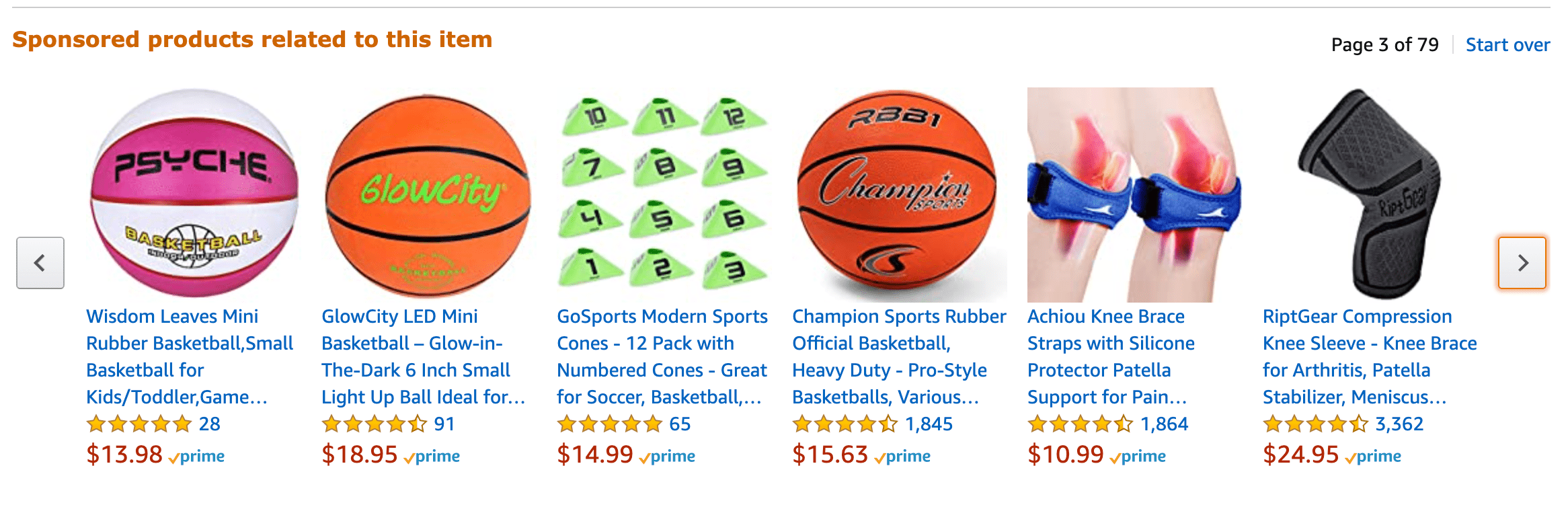
Avid basketball players are likely more inclined to take a look at knee braces or sports cones, making this an effective ad placement. Even if shoppers arent’ in the
even if I’m not in the market right now, I’ll ideally keep these brands in-mind for the future.
7. Take advantage of negative keywords to reduce wasted spend.
It’s important you avoid wasting ad spend by including negative keywords — or which keywords you don’t want to appear for — to avoid serving your ad to people who won’t convert.
Consider, for instance, the difference between a search for “granola bars” and a search for “KIND granola bars”. You don’t want to appear in a search for “KIND granola bars”, when the user is clearly determined to find a specific granola brand.
For this reason, you might want to include brands like “KIND” or “Chewy” in your negative keywords list, so your ad can be served to users with a more general interest in perusing various granola brand products.
You’ll also want to include negative keywords if they don’t relate to your product to avoid wasting your ad spend towards people who aren’t interested in your product. For instance, if your product isn’t gluten-free, you’ll want “gluten free” on your negative keywords list.
Additionally, you might consider getting more specific to target your ads at a smaller, more high-intent group of people. Rather than simply targeting “granola bar”, you might try targeting “low-sugar granola bar”, for instance.
Amazon Sponsored Ads
Amazon Sponsored Product Ads are pay-per-click, keyword-targeted display ads for individual products that appear on the search results and product detail pages. With Sponsored Product Ads, there are three types of keywords you can bid on if you decide to leverage manual targeting — broad, phrase, and exact.
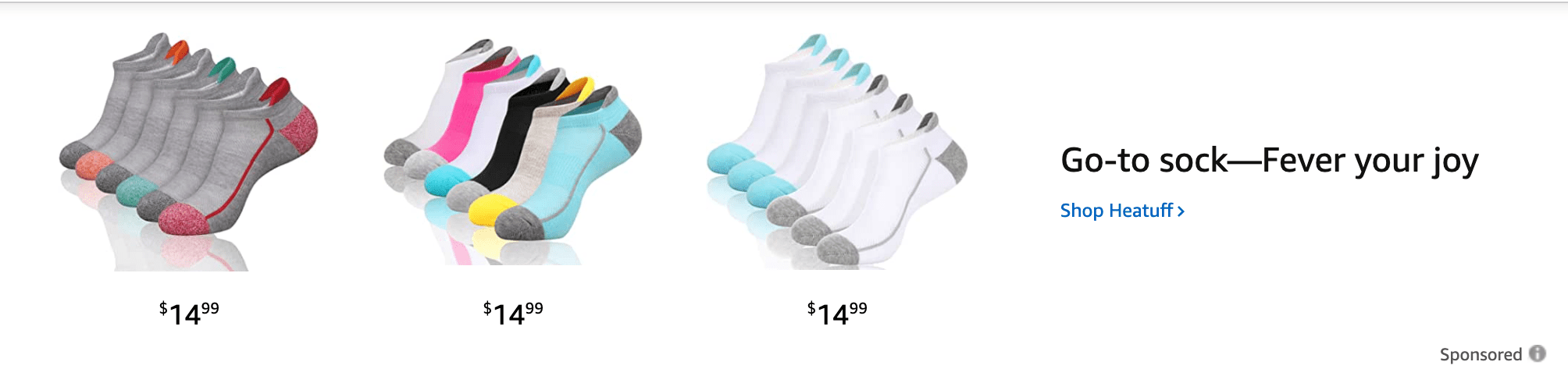
Broad keywords can include words before and after the target keyword, like “white hand mixers”, if you sell hand mixers. Targeting these keywords will expose your ads to the greatest amount of traffic.
Phrase keywords focus on how the sequence of the words you use changes the context of a query. For example, “stainless steel hand mixer” indicates you sell hand mixers. But “hand stainless steel mixer” indicates you sell stainless steel mixers, but not necessarily stainless steel hand mixers.
Exact keywords are the most constraining type of targeted keyword — a shopper’s search query must contain the exact keyword for your ad to show up and no words can come before or after the keyword. For example, if you choose to target exact keywords, you can target an ad for “hand mixer”, but it won’t show up for the query “electric hand mixer”.
Using Sponsored Product Ads, you can also use automatic keyword targeting, which leverages an algorithm to target the most relevant keywords for your product ads.
To gauge the performance of your ads, Sponsored Product Ads offers a reporting tool that displays your ads’ clicks, spend, sales, and advertising cost of sales (ACoS).
Amazon Sponsored Ads Best Practices
Targeting
With Amazon Sponsored Product Ads, you can find keywords that have low conversion rates and flag them as negative. This way, Amazon will stop showing your ad to shoppers who search for those queries. Ensuring you flag certain keywords as negative is critical — even if these keywords have a high click-through-rate, their low conversion rate means they’re probably not reaching the right type of shoppers.
Bidding
Available in Manual Targeting ad campaigns, you can leverage Bid+ to boost the odds of your ad appearing at the top of search results. You can only use Bid+ on ads that are eligible to appear at the top of search results, but when you do, you can increase your default bid by up to 50%, keeping your top performing campaigns competitive, without having to constantly adjust your bids manually.
Amazon Headline Search Ads (a.k.a. Sponsored Brand Campaigns)
-12.png)
Currently known as Sponsored Brand Campaigns, this type of Amazon advertising allows you to promote keyword-targeted ads of multiple products above, below, and alongside search results.
Using Sponsored Brand Campaigns, you can target three types of keywords — branded product keywords, complementary product keywords, and sponsored products automatic targeting keywords.
Branded product keywords are a combination of your brand name and a product you sell.
Complimentary product keywords are a bundle of two individual products that influence the demand for each other and can be sold together (like ketchup and mustard).
Sponsored products automatic targeting keywords are search queries that you’ve already experienced success with while running automatic targeted sponsored product campaigns.
Sponsored Brand Campaigns also lets you feature up to three unique products in your ads, customize your ads’ image, headline, and landing page, and even tests these elements.
Below is an image from Amazon that details the keywords that you can use for your sponsored brand campaigns:
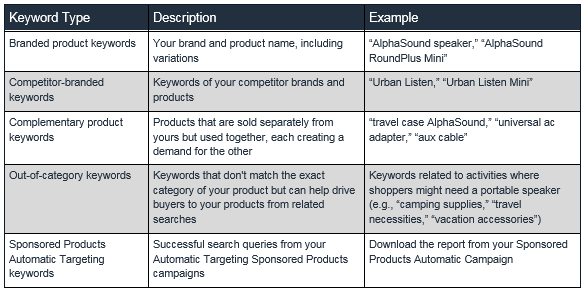
To determine how much you pay for Sponsored Brand Campaigns, Amazon uses a pay-per-click, auction-based pricing model, so you’ll never pay more than you bid per click. In addition to manual bidding, you can choose automated bidding, which will optimize your ads for conversion.
If you want to know how well your advertisements are performing, Sponsored Brand Campaigns offers a reporting feature that displays your ads’ clicks, spend, sales, estimated win rate for keywords, and ACoS (Advertising Cost of Sales).
Below, Shirt Invaders promotes three of their T-shirts. Clicking on each of the shirts goes specifically to the product page. However, clicking on the “Shop Now” button below the copy takes you to its Amazon Store:
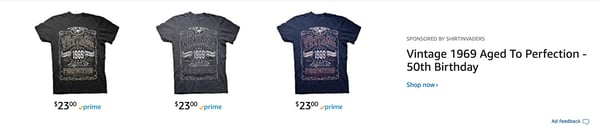
Sponsored Brand Campaigns Best Practices
Ad Creative
It’s a good idea to feature three top-performing products in your Sponsored Brands Campaign to increase the amount of clicks and sales your ads generate.
Amazon also recommends including your product’s top benefit in your ad’s headline because mobile shoppers can only see the ad’s main image and headline.
Additionally, when describing your product, try not to claim your product is “#1” or a “Best Seller” — your ad won’t get approved.
Testing
To run the most accurate and fruitful tests, consider only changing one variable at a time, run them for at least two weeks, and anchor the success of your tests to business goals.
Landing Page Design
With Sponsored Brands, you can direct shoppers to your Amazon store or a customized product page. Consider testing how different product pages convert visitors into customers, as well as the order in which your products appear.
Amazon Product Display Ads
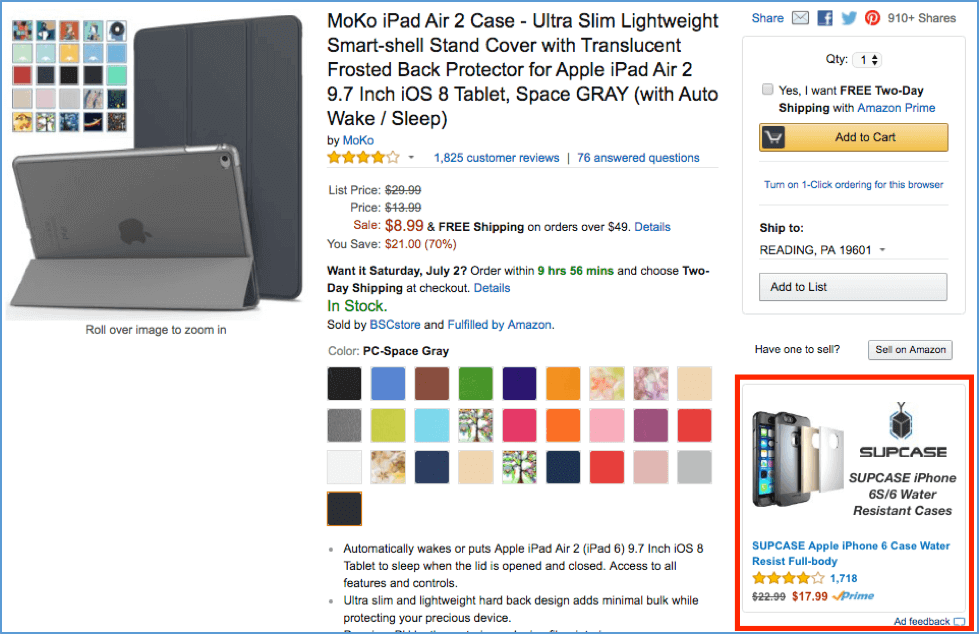
Product display ads are pay-per-click ads that appear on product detail pages, customer review pages, on top of the offer listing page, and below search results.
You can also place these ads on abandoned cart emails, follow-up emails, and recommendations emails. Their main objective is to cross-sell or upsell your customers.
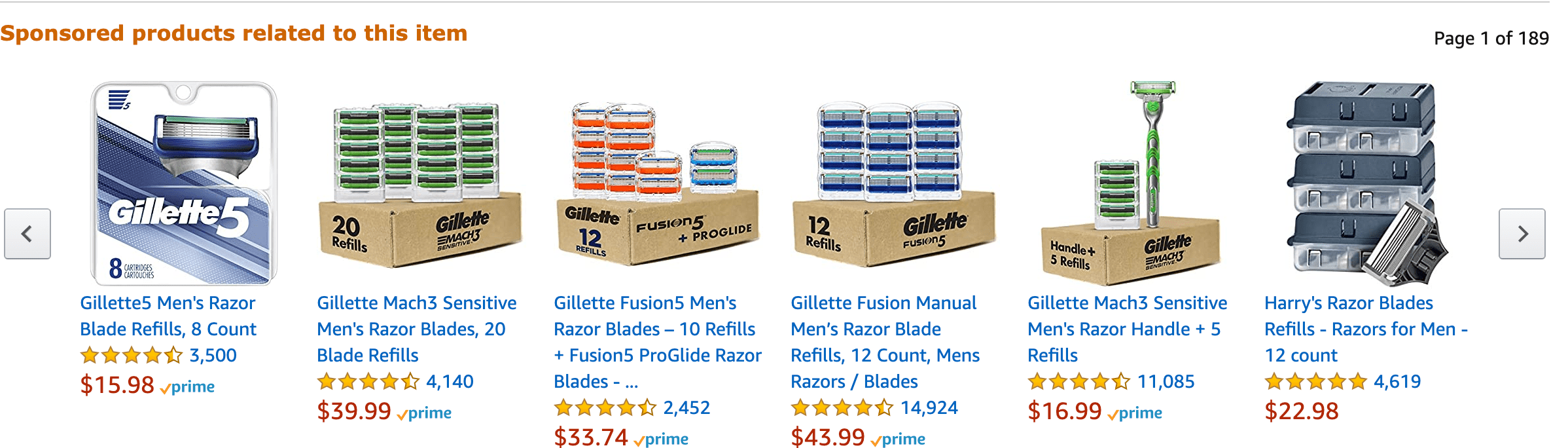
Using product display ads, you can use two types of campaign targeting: product and interest. Product targeting is a contextual form of targeting, so you can target specific products and related categories. Interest targeting is a behavioral form of targeting, so you can target shopper interest and reach a larger audience.
Product display ads also let you choose which in-category detail pages you want to advertise on, customize your creative, and offers a reporting tool that displays your campaigns’ clicks, spend, sales, advertising cost of sales (ACoS), detail page views, spend, units sold, total sales, and average cost-per-click (ACPC).
Amazon Product Display Ads Best Practices
Targeting
Use product targeting on competitor pages, complementary product detail pages, and your own product detail pages to cross-sell and upsell similar products. Using product targeting on related categories also extends your reach to sections of Amazon’s catalogue that are related to your products.
Ad Creative
When crafting your headlines, Amazon allows you to include phrases like “Exclusive”, “New”, “Buy Now”, and “Save Now”, but making claims like “#1” or “Beat Seller” will get your ad rejected.
Amazon Native Ads
Amazon Native Ads are ads that you can place on your brand’s own website. There are three types of native ads: recommendation ads, search ads, and custom ads.
Recommendation ads are ads you can place in product article pages on your website. These ads are dynamic, so Amazon will populate your most relevant product recommendation based on your web page’s content and visitors.
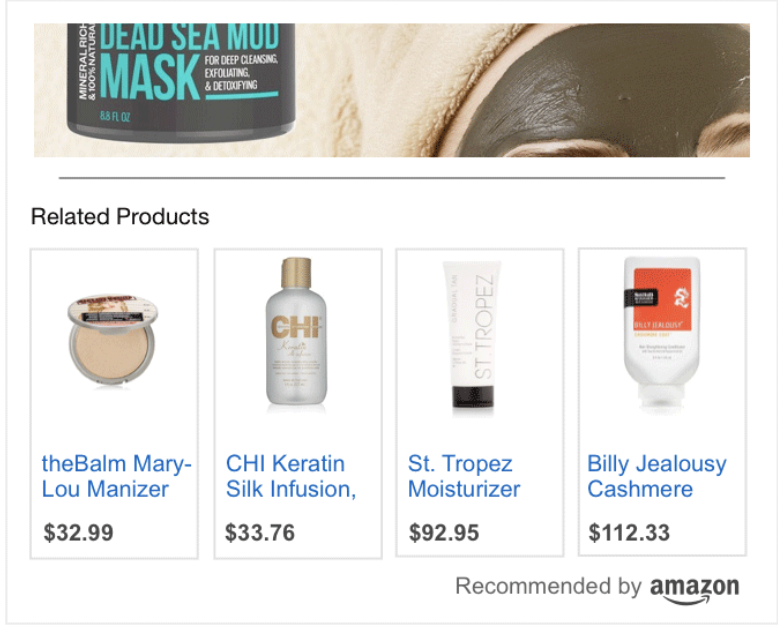
Search ads are ads that populate on your website based off keywords that your customers search for on Amazon or on your website.
-8.png?width=600&name=pasted%20image%200%20(3)-8.png)
Custom ads allow you to select your own assortment of products you’d like to promote and place them on your product article posts.
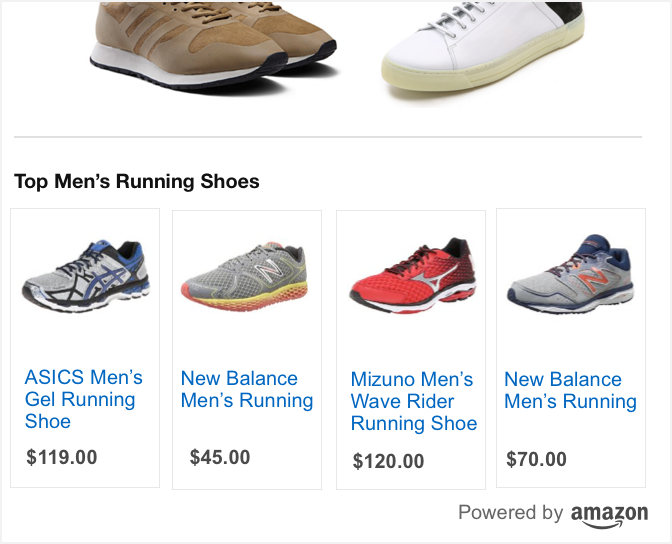
Amazon Native Ads Best Practice
Just like a call-to-action on a blog post, make sure your native shopping ads are extremely relevant to the pages you place them on. This way, when your website visitors finish reading your post, the ads are a natural next step and can lead to more conversions.
Amazon Video Ads
Amazon Video Ads are ads that you can place on Amazon-owned sites like Amazon.com and IMDb, Amazon devices like Fire TV, and various properties across the web. You can buy Amazon video ads regardless of whether you sell products on Amazon or not, and you can set your ad’s landing page as an Amazon product page, your own website, or any other web page on the internet.
-7.png)
If you want to work with Amazon’s video ad consultants, you can sign up for their managed-service option, but to be eligible, you usually need to spend a minimum of $35,000 on video ads.
Amazon Stores
Users can promote their brand or product on your own multi-page Amazon Store. Using Amazon’s templates or drag-and-drop tiles, you can showcase your brand’s products or portfolio of work.
With Amazon Stores, brands get an Amazon URL and can view traffic analytics, which enables them to keep track of sales, traffic sources, and ad campaigns.
Additionally, creating an Amazon Store is free.
Amazon Stores Best Practices
Once you create an Amazon Store, you can use the analytics tool to find the top performing keywords which have converted to sales. Additionally, the analytics tool will let you know which products sell.
This lets you know which products you might want to consider for a paid ad campaign. Plus, it also shows what potential buyers are interested in.
Below is an example of an Amazon Store:
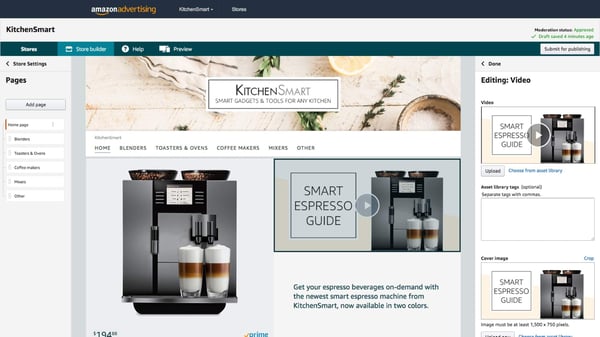
When you create an Amazon Store, the best practices are similar to best practices of any landing page — use clear photos, easy-to-read captions, and clear pricing. Additionally, make sure you showcase your highest performing products. Or you could opt to introduce new products on your Store as well.
Before you craft your Store, come up with the products you want to feature on your navigation. Then, list all your products that you will showcase on those pages. Lastly, gather the clear, professional photos of your product, write your captions, and list your prices.
Ultimately, selling on Amazon can be an impactful marketing strategy for ecommerce brands. As consumers continue to lean into online shopping, Amazon advertising can play a large role in your online sales.
Editor’s note: This post was originally published in February 2019 and has been updated for comprehensiveness.

50 Lucrative Blog Niches & Finding One That Works for You
There’s a fairly obscure album by a guitarist named Duck Baker called There’s Something for Everyone in America. I don’t know a ton about it apart from the fact that it came out in 1975 and that its cover art is absolutely next-level.

Neither of those facts is particularly relevant to this article, but the album’s title is. That idea that “there’s something for everyone” doesn’t just apply to America — nor does it have anything to do with what appears to be Lady Justice stabbing a tiger in the heart while Duck Baker casually looks on and smiles from a nearby window.
No, that concept is also relevant to niche blog topics. Everyone has something that’s meaningful and interesting to them in its own right, and in a lot of cases, those kinds of passions and pursuits can be channeled into a well-crafted, consistently maintained blog property.
Here, we’ll go over what you need to consider when choosing a niche blog topic and look into 50 potential blog niche ideas you can choose from.
How to Choose Your Niche Blog Topic
So what should you blog about? How do you land on the topic that will resonate most with readers and keep you fulfilled in the long run? Well, first and foremost, you need to consider your areas of expertise.
Where are you an authority? What can you talk about comfortably and compellingly? If you write a blog in some niche you only halfway understand, readers won’t be receptive to it. They want to hear from an expert — someone who can demonstrate that they’re qualified to offer tips or trustworthy opinions. But it doesn’t end there.
Writing a blog is a personal pursuit, so you need to write about something that bears personal significance. What do you like to write about? There has to be some degree of joy and enthusiasm behind your blog.
It takes a lot of work to maintain a blog. It’s tough to keep that effort up if you don’t actually enjoy what you’re writing about. You have to start your blog under the assumption that it will take a while to get off the ground.
You’re probably not going to be able to monetize your site or sell ad space immediately, so you need to be in it — in large part — for the love of the sport.
Your niche has to reflect your passion because you’ll probably be writing for the sake of writing for a while. Attracting an audience neither easy nor a given. If you don’t care about your preferred topic, you’ll be less inclined to stick it out.
Careers and Education
1. Career Advice
There’s always a market for professional guidance — particularly in uncertain times.
2. Learning Employable Skills
Job seekers can always use an edge on their competition. If you can offer the insight or resources to give them that leg up, you can find a solid audience.
3. Professional Social Media Tips
Business owners often look for advice on how to bolster and enhance their presence on social media. If you have some experience in this arena, you can likely find a solid readership.
4. Study Hacks
There will always be a base of students looking to improve their study-game. If you’re particularly savvy when it comes to tips and tricks to boost your grades, consider this niche.
Entertainment
5. Acting Tips
If you’re an experienced actor who can share stories and insight that’ll help newbies refine their craft and prepare for auditions, consider giving this niche a shot.
6. Card and Board Games
There’s a lot of material to draw from card and board games. It’s a fun niche with an active base.
7. Concert Reviews
This niche is particularly fun and active. If you can reliably make it to shows and offer meaningful criticism, look into it.
8. Film or TV Reviews
There’s a sizable audience for an aficionado who can dish out some compelling opinions about new movies or TV shows. If you’re an outspoken film connoisseur, try this niche.
9. Music Criticism
This point is similar to the one above. An articulate music buff can rein in a sizable audience by offering their takes on new albums.
10. Stand-Up Comedy Instruction
Newer stand-up comics can always use a little (or a lot) of guidance as they’re starting out. There’s definitely an audience for a comedy veteran to offer some tips, tricks, and anecdotes.
11. Video Game Tutorials
There’s a solid population of gamers looking for walkthroughs and assistance through the trickier parts of certain games. If you’re an experienced gamer who can provide that help, look into this niche.
Finance
12. Budget Shopping
Everyone loves a bargain. If you’re a particularly deal-savvy shopper, check this niche out.
13. Frugal Living
People are always after ways to live a little smarter financially. This niche lets you demonstrate exactly how cost-conscious you are day-to-day.
14. Investment
Do you have a knack for calling all things Wall Street? If so, consider creating a blog up this alley.
15. Personal Finance
People will always need to know how to balance a checkbook and do taxes, so there’s a good chance you can generate readership by covering those kinds of financial fundamentals.
Food and Beverage
16. Coffee
Coffee enthusiasts are always looking for information on new blends. There’s a market for someone who can offer some astute coffee reviews and bean referrals.
17. Craft Beers
Similar to coffee, there’s an audience that loves craft beer and wants to be pointed towards hot new breweries.
18. Exotic Cuisine
Big-time foodies are active online. A lot of traffic can come with some interesting culinary exploits and tales of exotic cuisines.
19. Kitchen Equipment
Consumer electronics and accessories — specifically, those related to cooking — are always a big draw.
20. Meal Planning
Writing about regimented meal prep can bring in all kinds of readers — from cost-conscious consumers to health nuts.
21. Recipes and Cooking Tutorials
People are always looking for fresh new ways to prepare meals and snacks. If you have a knack for cooking, you might want to look into this idea.
Hobbies
22. Gardening
Green thumb readers can always use some tips, tricks, and new plants to incorporate into their gardening repertoire.
23. Makeup
Makeup tutorials have become a big hit across most social media platforms — a blog that capitalizes on that trend can be lucrative if done right.
24. Photography
Whether it’s a forum to offer tips to aspiring photographers or a place to post your own art, a photography blog can draw a solid crowd.
25. Technology
Compellingly writing about new and emerging tech can attract a forward-thinking base looking for the next big thing.
26. Writing
It might be slightly meta, but writing about writing can be a big hit. Many aspiring authors and columnists love a source for new prompts and pointers.
Personal Relationships
27. Blending Families
It’s a touchy, tricky subject to handle, but it’s a tough challenge a lot of people face. They stand to gain a lot from some sound advice on the topic.
28. Dating
Dating can be a minefield, and if you know how to help people navigate it, you can build a sizable, dedicated following.
29. Parenting
It’s arguably the hardest part of life — if you can make it that much easier for people, you’ll attract a solid audience.
30. Relationship Advice
Love ain’t always easy. That’s why plenty of potential readers are looking for someone who can help them figure it out as they go.
31. Weddings
Almost everyone looks forward to their big day, but planning a wedding means having a lot of balls in the air. Anyone who can help soon-to-be newlyweds successfully juggle them can find an audience.
Politics
32. Current Events
In the modern age, people need to stay on top of the news. If you can keep them posted with some eloquence and integrity, you can find readers.
33. Ethics
We could all use a refresher on basic human decency and morality every now and then. A well-crafted ethics blog can rein in a crowd that wants to do that consistently.
34. Political Opinions
Do you have some incisive, compelling political takes to offer? There might just be an audience that wants to hear what you have to say.
35. Political Satire
Sometimes, we need to see the humor in the modern political landscape. If you can tastefully (or not-so-tastefully) find it, there could be some a solid readership for it.
Self-Care
36. Meditation
There are plenty of readers looking to be a bit more mindful and a lot more centered. A meditation blog can tap into that population.
37. Mental Health
It’s an important topic that is (deservedly) getting a lot more attention nowadays than it has in recent years. If you can offer some meaningful insight on how to improve readers’ mental wellbeing, you’ll find an audience.
38. Self-Care
A more general, catch-all self-care blog can register with plenty of potential readers looking to improve every facet of their wellbeing.
39. Skincare
Skincare is a hot topic. There’s a massive crowd looking for the best products and techniques to keep their pores small and skin smooth.
Sports and Exercise
40. Extreme Sports
Out-there, wilder sports can be extremely entertaining in their own right, and there’s always a market for “extremely entertaining.”
41. Personal Training
Hardly anyone can afford a real personal trainer. Posting workouts — no matter how rigorous — can attract an audience composed of everyone from dedicated fitness nuts to out of shape newbies.
42. Running
Running is one of the most fundamental, popular fitness pursuits. There are plenty of readers who would want to hear about your running exploits and anecdotes.
43. Specific Sports
Football, baseball, basketball, soccer — sports are a staple of modern life. If you can consistently break news or offer interesting takes on a given sport, you can find a base.
44. Weight Loss
A lot of people are looking to shed some weight. If you can publish workouts or provide inspiration for weight loss, you can find a fairly dedicated audience.
45. Workout Trends
People want to stay hip to emerging workout trends, so providing news about and guidance for bold new ways to get can help you wrangle in some readers.
Travel
46. Hotel Reviews
Whether they’re looking to book rooms or just want to live vicariously through your incredible hotel stays, there will always be a base interested in hotel reviews.
47. Language Instruction
Nesvarbu, ar tai būtų praktiniai, ar asmeniniai tikslai, yra daugybė žmonių, kurie norės išmokti naujų kalbų. That’s Lithuanian for, “Whether it be for practical or personal purposes, there are plenty of people who will want to learn new languages.”
48. Travel Stories
Travel stories are some of the best ones you can tell. If you have some wild, outlandish exploits to share from your time in Bangkok, Paris, or wherever else, consider maintaining a travel blog.
49. Traveling for Work
Sometimes, travel is for business — not pleasure. There are plenty of readers interested in learning how to do that right.
50. Trip Reviews
A lot of people want to know which destinations are worth their time, and they might find a nicely maintained trip review blog entertaining and appealing.
As you can assume, this list of blog niches isn’t exhaustive. There are more than the 50 potential topics I’ve listed to choose from. If you’re looking to start a blog but don’t know what to write about, consider your passion and areas of expertise before anything else.
It comes down to a matter of want. You need to consider both what people will want to hear and what you will want to talk about.

How to Post to Instagram From Your Computer [6 Easy Steps]
I’ll admit it: this post is incredibly timely for me.
I recently watched The Social Dilemma on Netflix, a docu-drama that explores the potentially addictive qualities of social media.
Considering I spend 3+ hours a day on Instagram, I was already all-too-familiar with the habit-forming nature of social media apps.
As a result of watching the film, I immediately deleted the Instagram app from my phone — but not my computer. I’m still allowing myself to check out friends’ posts, or post my own content, via my desktop. I just don’t want it within easy reach on my phone.
If you’d prefer to post your Instagram content from a computer, you’re in luck. Here, we’ll explore how you can post images and videos from your desktop computer.
Can I post to Instagram from my computer?
Yes, you can post to Instagram from your PC or Mac desktop, as well as a browser on your phone instead of in-app.
Instagram doesn’t offer an official desktop desktop version, however. The social platform is primarily meant to be consumed in-app, which means some features can be a little trickier from your computer.
Having said that, it’s absolutely possible to post to Instagram from your computer. There are a few different reasons you might want to do this — for one, if you work as your company’s social media manager, it might be easier to upload company posts and videos via your desktop, rather than having your smartphone open at work.
Plus, your company’s files might be more easily accessible via desktop than mobile. For instance, if you use Photoshop to edit company photos, it’s likely easier to click “Upload” from your desktop when you’re done editing, rather than sending that same photo or video to your personal phone.
Alternatively, perhaps you simply prefer the larger screen of desktop. Or, maybe you don’t have access to a smartphone so you can’t download the app on your phone.
Whatever the reason, don’t worry — there’s a solution for you. Let’s dive into that, next.
How do I post to Instagram from my computer? [PC and Mac]
How to Post a Photo on Chrome Browser
1. Go to https://www.instagram.com/ in your Chrome browser. Click on your Settings (click the three dots in the top right corner of your browser).
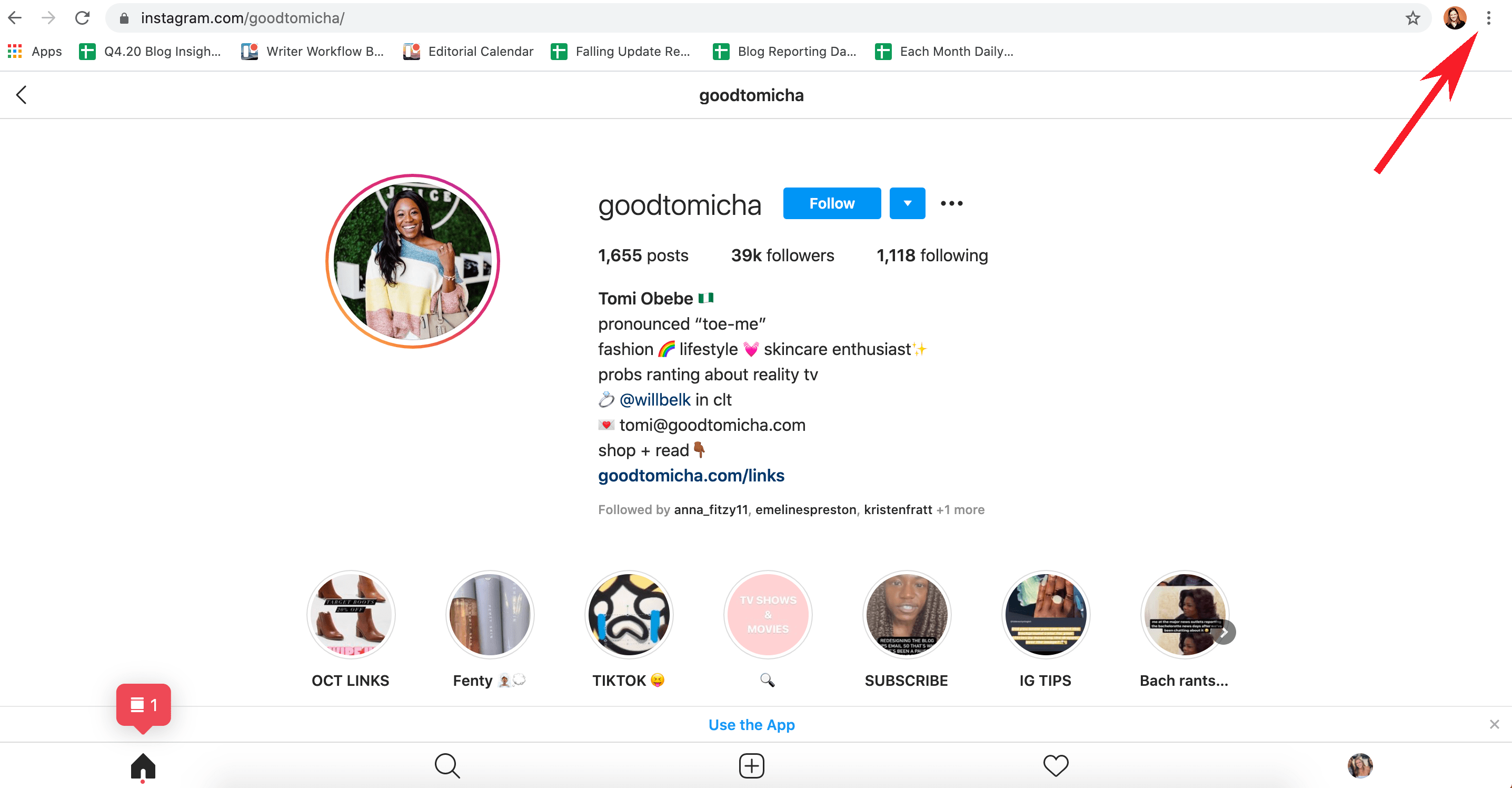
Instagram Account Credit: @Goodtomicha
2. Scroll down to “More Tools” in the drop-down menu, and then click “Developer Tools”.
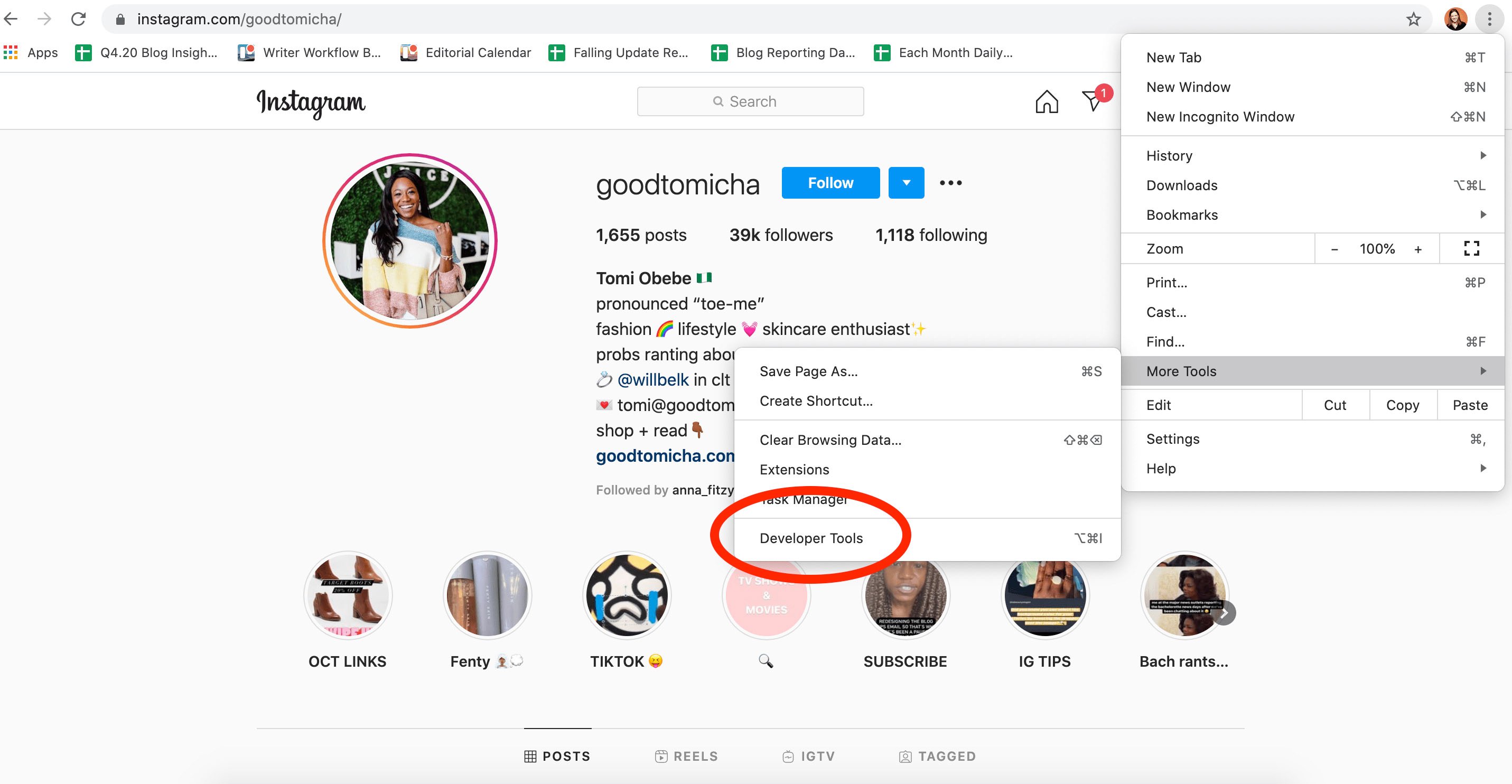
3. Click the “Toggle Device Toolbar” mobile button.
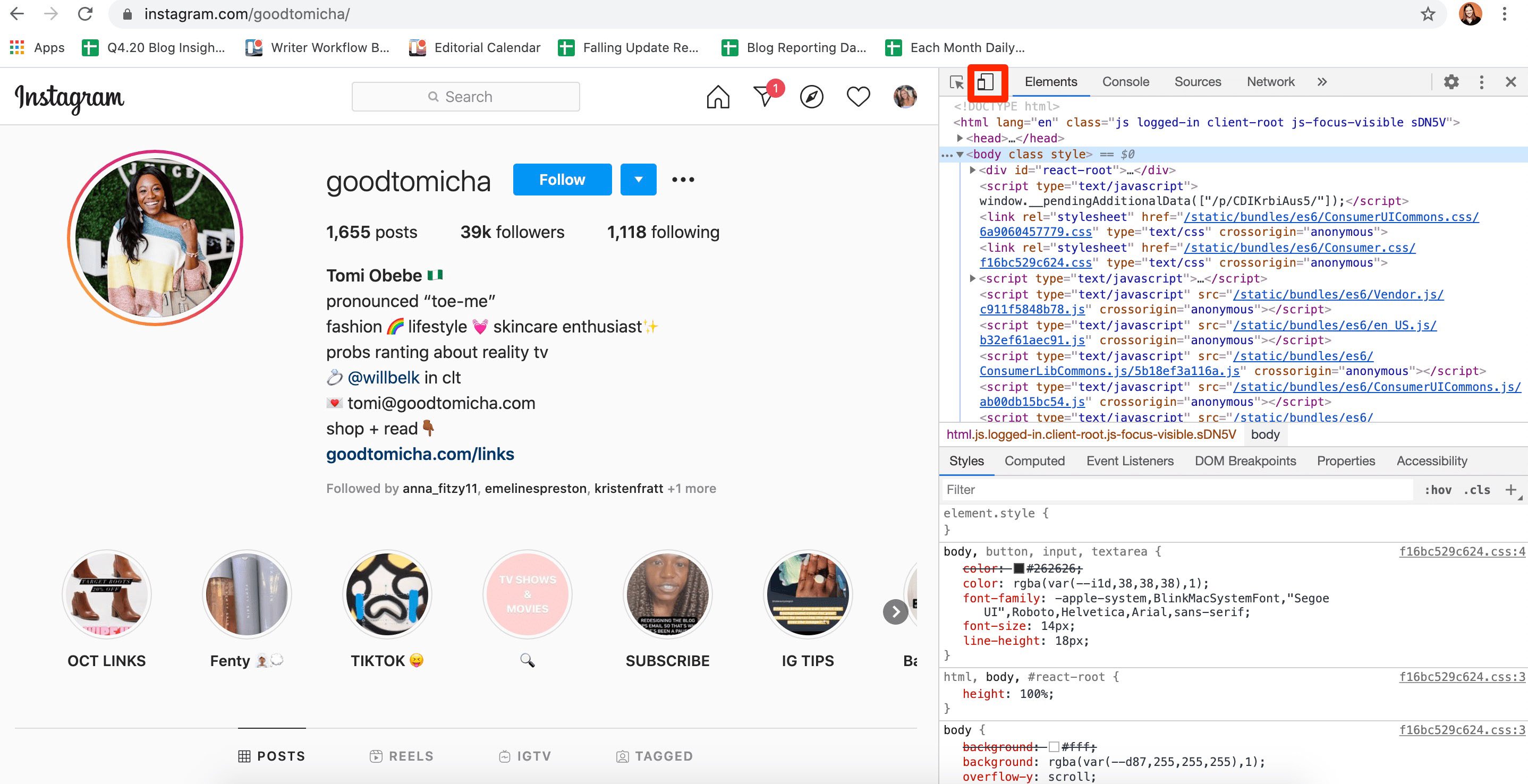
4. Choose which mobile device you’d like on the drop-down menu, as well as how zoomed in you want to be. Then, refresh the page. Now, you’re seeing the mobile interface of Instagram from your browser.
5. You can upload a Instagram post the same way you would via mobile — by clicking the “+” button:
Then, choose filters or other editing features like you would normally, then click “Next” in the top right of your screen:
Finally, add a caption, location, or tag people. When you’re ready, click “Share” in the top right of your screen.
How to Post a Photo on Safari Browser
1. Go to https://www.instagram.com/ in your Safari browser. Select “Safari” and then “Preferences” in your menu bar.
 2. Toggle over to “Advanced Features” and check the box that reads “Show develop menu in menu bar”.
3. Click “Develop” in your menu bar and then scroll to “User Agent”. Choose which mobile device you’d like on the drop-down menu.
4. Refresh the page. Now, you’re seeing the mobile interface of Instagram from your browser.
(From here on, the instructions for posting an image to Instagram are the same as they are for the Chrome browser instructions, listed above. You can upload a Instagram post the same way you would via mobile — by clicking the “+” button, adding a filter or editing the photo, adding a location and caption, and clicking “Share” when you’re ready for your post to go live.)
How to Post a Video on Desktop
To upload a video to Instagram from your desktop, you’ll need to use a third-party service that offers social media scheduling software.
There are a few you might try, including the Flume App for Mac (Pro version is $20) or Lately Social ($14 per user per month for Agency plan).
For our purposes, I used Lately Social’s free personal plan to upload and post a video directly to my Instagram:
Of course, if you’re doing this regularly it might be worthwhile to explore all the social media scheduling tools at your disposal to choose the one best-suited for your business’ needs.

How to Use Self-Liquidating Offers in Your Facebook Ads
Do you sell costly products, services, or courses? Wondering how to sell more by lowering the barrier to entry? In this article, you’ll discover how to use Facebook or Instagram ads to promote a small, self-liquidating offer that leads to an upsell. What Is a Self-Liquidating Offer? Essentially, a self-liquidating offer (SLO) funnel delivers an […]
The post How to Use Self-Liquidating Offers in Your Facebook Ads appeared first on Social Media Examiner | Social Media Marketing.
from Social Media Examiner | Social Media Marketing https://ift.tt/3jqmUxr
via socialmediaexaminer
The Ultimate Guide to Integrations and Why Your Business Needs Them
Have you ever found yourself working on a project in which you had to toggle between different software and applications? Perhaps you had to plug data from one system into another or rewrite the same content over and over again to ensure it was in multiple locations.
Although few people have the time or patience for this type of tedious work, it’s common and often critical to your business’s success — these mundane tasks need to get done.
What if there was a way to connect your software to the applications you use in a way that successfully brings them together? This would mean all of your information and data would live in a central location with no manual entry required, even if those applications don’t actually come with the software itself … sound nice?
Well, good news! This type of solution exists … it’s called an integration.
Integrations are a complex topic to understand. So, let’s simplify the concept with the help of an analogy we can reference throughout this guide.
Let’s pretend you want to plug your MacBook laptop into your TV using a connector cable so you can watch reruns of Friends on Netflix on the big screen. And integration kind of works like this — I’ll explain more as we go.
Back to our analogy: If your software is your laptop, you’ll use a connector cable, or integration, to then watch Friends on the TV, or application.
Now, let’s run through some commonly asked questions about integrations to help you get a better grasp on what they are, how they work, and why your company needs them.
Why use integrations?
Integrations solve and simplify your need for new software as your business grows and evolves. They allow you to keep the system you’re currently using by simply adding connections to third-party applications to enhance system functionality and provide additional features you may need but aren’t able to build within your software. You can keep your current laptop and TV, and simply use the connector cable to watch Friends on the big screen.
By leveraging integration connections across your systems, you can power your business to achieve a much wider range of tasks on your software as you enhance its functionality. This is especially helpful as your business expands since your needs are bound to change.
Although your software may have the functionality you need when you start your business, you’re likely going to want additional applications to provide the features you end up needing later on, as you grow.
There are many types of integrations, each of which has specific functions to help meet different needs. The easiest way to think about the various types of integrations is by category. Some integrations have several functions, meaning they could technically fit into many categories because they serve more than one main purpose. Other integrations have one specific function.
Who needs integrations?
Integrations are helpful tools for virtually every business, no matter the size or industry. There are integrations suited for every type of company (startups, SMBs, and enterprise companies) with any purpose (advertising, analytics, or content).
If you sell software, as we do at HubSpot, you’ll find yourself not only using connections for your internal software but also for your customers to use along with your software. This is because your software may not have every feature and function your customers need to run their business. So, by adding an integration, they’ll get that added feature or function while continuing to use your software.
Referring back to our analogy, without the integration, or connector cable, your laptop wouldn’t be able to communicate with your TV to allow you to watch Friends on the big screen. You need that integration, or cable, to allow for added functionality and watch the show on TV — without it, this wouldn’t be possible.
How do you get integrations?
Integrations are almost always located in some type of marketplace, where customers can review and browse all of their options. The HubSpot App Marketplace is an example of this. Our marketplace allows visitors to search and learn more about the various integrations and their functions, and then connect HubSpot to their integration of choice.
(No, you can’t go to Best Buy to pick up your integration as you would with your connector cable to watch Friends on your TV… you’re right, the example doesn’t quite work here.)
How do integrations work with APIs?
API stands for application programming interface. An API is an interface that software uses to receive information (whether that’s data, servers, applications, etc.).
All of the integrations we’re going to discuss below are built on APIs. By building integrations on APIs, you can connect your integrations to your software and use them in tandem with one another. The integration allows for the flow of information to and from apps and devices in real-time — APIs allow them to talk to one another.
Think about this in terms of our analogy from above: The application is the TV, the programming allows your laptop to communicate with the TV, and the interface is how you (the user) are able to interact with the application (by watching Friends on your TV). In this example, the API is the port on the side of your laptop in which you actually insert your integration (the cable) to then connect your laptop to your TV.
Integration vs. iPaaS Solution
If you’ve heard of integrations before, chances are you’ve also heard about iPaaS, or Integration Platform as a Service. The difference between the two is an important distinction to make when determining which one you need for your business. While an integration is a one-to-one, direct connection solution, an iPaaS solution is not.
Instead, iPaaS is a cloud-based platform that connects your applications and systems — whether that’s in the cloud or on-premise — between an organization and third-party software without the use of middleware.
So, if you look for an integration solution on your software’s marketplace and don’t find the connection you’re looking for, then you’d turn to an iPaaS solution to solve your need for that connection. There are a few integrations available today (called “connector integrations”, which we’ll look at an example of below) that can help you build custom integrations..
So, which integrations should you actually use? Let’s look at a list of some of the most popular integrations available.
Popular Integrations
The following integrations are categorized by business need to help you browse through your options. (Almost all of these integrations fit into multiple categories, as they have functions that allow them to do multiple things. Below, we placed them in the category they’re best suited for.)
It’s important to note these are just some of today’s popular integrations — there are hundreds of more integrations to learn about and choose from as your business grows.
The list we’ve compiled below is of integrations that connect with HubSpot. This isn’t to say these HubSpot integrations don’t also work with other software. In fact, most of these integrations are compatible with dozens of programs in addition to HubSpot.
Let’s take a look.
Advertising Integrations
Advertising integrations help you market to and reach your target audience. Data about the success of your ads and/ or the leads obtained from them is automatically added to your HubSpot CRM so you can learn more about the people who interact with your ads and nurture them into customers.
1. Facebook Ads
The Facebook Ads integration allows you to connect your Facebook Ads account to HubSpot. This integration gives you the ability to attribute your ads directly to the contacts who interact with them. It also allows you to review real data about which ads impact your bottom line. This simplifies the reporting process for all of your Facebook Ad efforts.
2. AdRoll
Different businesses and products have various buyer personas. The AdRoll integration gives you the opportunity to create personalized retargeting ads for different lead segments in your HubSpot contacts. You can personalize several parts of the ads, such as content and formatting, that will best relate to your prospect.
This allows you to focus on your audience’s attributes so you can effectively reach your prospects — you can gather intricate details about your prospects from your CRM via the integration so you’re able to successfully retarget them.
3. Instapage
If you’re not a developer, creating your website’s landing page might sound like an overwhelming task. The Instapage integration provides a straightforward option for anyone who wants to create and personalize their landing page and then send lead information straight to HubSpot. These details are automatically placed under the associated contact in HubSpot for you— meaning, there’s no need to perform this transfer manually.
Account-Based Marketing (ABM) Integrations
ABM stands for account-based marketing. ABM integrations help you leverage your account and audience data so you can tailor your messaging, CTAs, and marketing strategies to close deals and attract customers.
1. OrgChartHub
The OrgChartHub integration allows you to efficiently build customer organization charts without ever leaving HubSpot. You can create customer organization charts while in HubSpot so you’re able to easily identify unknown contacts, visualize key stakeholders, and customize your sales personas without manually sending any of this information back and forth.
2. CaliberMind
With the CaliberMind integration, you’ll be able to look at your cross-channel account engagement and create alerts for your reps about which deals they should focus on closing to meet quota. The integration takes your contacts directly from HubSpot and automatically matches them to their associated accounts so you don’t have to.
3. Metadata
The Metadata integration provides account-based advertising services. You can automatically identify specific target accounts and contacts from HubSpot to create personalized advertisements at scale to help you close more deals and reach your target audience more effectively.
Analytics and Data Integrations
These integrations help you measure your success across a number of analytics platforms. You can look at your data in different ways and ensure all of this information is well-organized in HubSpot so your team can review it at any time. These integrations help you learn more about which of your efforts are working and which ones need to be modified.
1. Databox
With the increase of remote employees across businesses and the number of people who access their work while on-the-go, having the ability to review and manage your key performance indicators (KPIs) from anywhere can be quite helpful.
The Databox integration provides you with access to all of your analytics data in HubSpot from a wide variety of sources including Google Analytics, SEMRush, mobile, desktop, Facebook, and more.
2. Hotjar
In a world where many website visitors are uninterested in completing forms and providing their personal information, Hotjar is a great way to learn about who your visitors are and what they’re looking for on your site. The Hotjar integration gives you insight into who your website and mobile visitors are and what their needs consist of directly from HubSpot.
3. Klipfolio
The Klipfolio integration shows you your most important metrics in real-time and creates easy-to-read dashboards in HubSpot so you can track and analyze performance across all of your platforms from one location. This allows you to improve your data transparency and reach your targets faster.
Calling Integrations
Whether it’s a meeting with fellow employees or your prospective and current customers, calling integrations will make all phone and video call interactions simple. Your contact’s information and details about the call will be recorded in HubSpot for easy access. This also provides sales reps and support team members with the necessary background information to assist the prospect or customer appropriately.
1. UberConference
With UberConference, it takes just seconds to schedule your meetings with colleagues and prospective customers so you can focus on tasks that require more attention. The integration allows you to schedule meetings quickly and easily without ever having to leave your HubSpot portal.
2. Aircall
Phone calls remain one of the most effective ways to interact with your prospective and current customers. Whether it’s a sales or support call, the Aircall integration allows you to manage your call flows and attentively assist your leads and customers all within HubSpot so your contact’s information lives in one, central location.
3. CallRail
The CallRail integration is a call tracking and analytics system which allows you to customize segments and actions based on your specific calls with prospects and customers. All of your call and text data will automatically be added and organized in HubSpot under the associated contact so you don’t have to manually enter any data.
Connector Integrations
Connector integrations provide you with access to dozens of applications which sync to HubSpot to save you time and add functionality. Some connector integrations offer a wide range of applications and some have more specific types of applications. Additionally, some connector integrations can assist in creating a custom integration to suit your needs.
1. Automate.io
The Automate.io integration connects to HubSpot to give you access to over 80 applications. By syncing with these apps, you’ll be able to transfer data to them to create customized integrations so you can manage all of your data in a way that works for your business all within HubSpot.
2. Zapier
The Zapier integration allows you to automatically connect your software to over 1,000 applications. It links your apps to HubSpot for you in just a few clicks to save you time. There’s no coding required and your apps will be able to begin sharing data in an easy-to-read workflow format in your HubSpot portal.
3. PieSync
The PieSync integration provides real-time, two-way contact sync. This means every time you add a contact to HubSpot, it automatically syncs to an application (such as Google Contacts or Outlook), and vice versa — you don’t need to worry about any importing or exporting, expediting and simplifying your contact syncs.
Content Integrations
Content integrations help you create, design, and share custom content for your website. They also help you learn about who’s interacting with the content and how they’re interacting with it. That information is then synced to HubSpot so you can organize it and add it to specific contacts.
1. Beacon
If your website has a collection of blog posts, the Beacon integration might be a good option for you. The integration ensures your content looks professional and allows you to drive more leads by getting more value out of your existing content — it connects to HubSpot to automatically convert your blog posts into downloadable content such as eBooks.
2. briX
The briX integration connects to HubSpot so you can design and personalize web pages for your site. You don’t need a background in web design or coding to create beautiful pages — the drag-and-drop template and 100+ customizable features make it easy to organize your content in any way you choose. This integration is ideal for easily designing and personalizing web pages directly from HubSpot.
3. Belch.io
Customized landing pages, web pages, and emails provide a professional look and feel for your visitors, leads, and customers while interacting with your business online. The Belch.io integration connects to HubSpot so you can personalize and brand all of these things in just minutes.
It’s a great option for anyone without a background in coding or web development who wants to design and customize their site pages and emails to complement their brand all from HubSpot.
Customer Success Integrations
Customer success integrations connect to HubSpot to make your internal and external interactions with employees (cross-team) and customers straightforward. They simplify communication and help you share information and/or data when you need to.
1. Slack
The Slack integration is a digital workspace and communication tool that allows you to connect and talk with your team members. The integration is ideal for team collaboration and coordination from anywhere.
By connecting the integration to your software, you can use Slack’s and HubSpot’s features in either the application or the software so you don’t have to waste time toggling back and forth — the same information will be found in both locations in real-time.
2. Zendesk
Zendesk offers a ticketing system to keep track of customer inquiries and allows you to keep details about all of your customer interactions in one place. It helps you provide consistent customer experiences among your fellow employees and customers.
By connecting HubSpot to the Zendesk integration, you’ll be able to bring the work of your sales, marketing, and support teams together in a central location. It also allows these departments to communicate with each other while in HubSpot as well.
3. LiveChat
The LiveChat integration allows you to communicate with potential customers in real-time when they need assistance or guidance while on your website from HubSpot. Whether it’s a question about your product or the need for help in the checkout process, LiveChat allows you to walk them through the information they need to help you boost conversions and build strong relationships with prospects and customers.
Ecommerce Integrations
If you have an online store, ecommerce integrations are a great way to learn about what your customers and visitors are doing while they’re on your website. By connecting these integrations to HubSpot, you’ll know when your visitors are most frequently abandoning your site or their carts so you can create re-engagement content to regain their interest.
1. Shopify
The Shopify integration allows you to easily incorporate all of your ecommerce data and customer data within HubSpot. It automatically syncs customer, product, and deal information in HubSpot under the associated customer’s profile, so your entire team can view all of these details in one location. You can also create cart abandonment nurturing tactics, re-engagement ads for your website from HubSpot once you connect the integration to the software.
2. Typeform
The Typeform integration helps you create and design web and mobile forms for your leads. You can create contact forms, sign up forms, quizzes, and more, and all of your responses will automatically be sent directly to HubSpot so you can easily review your results and responses and compile them under the associated contact in HubSpot.
3. Magento
The Magento integration helps you create and send upsell, cross-sell, and reorder emails as well as develop abandoned cart nurturing tactics to boost your conversions. It automatically sends all of your customers’ ecommerce-related data, as well as emails between you and your customers, straight to their respective HubSpot contact record.
Email Integrations
Email integrations help you track a prospect’s interactions with sales reps, personalize your email automation with certain contacts, and measure the success of your email campaigns among your target audience — all from HubSpot.
1. MailChimp
The MailChimp integration allows you to sync HubSpot with your email service provider. You can build email campaigns and rest easy knowing the Intelligent Error Handling feature will continue engaging your contacts even if a syncing error occurs between the software and application.
By connecting MailChimp to HubSpot, you’ll have the ability to automatically add contacts from HubSpot into your application’s email lists and vice versa so you never have to do it manually.
2. Privy
Privy helps you make more sales and turn more prospects into delighted customers. The integration uses targeted pop-up ads, banners, bars, and more to help you boost conversions and decrease page abandonment. It also automatically syncs all of your new leads from your website to HubSpot so the software can help you nurture them and convert them into customers.
3. Front
The Front integration is a collaborative inbox, meaning all members of your team can see and access your contacts, review deals, and see all activity history while working in HubSpot. All of these details are automatically synced in Front and your CRM. This helps you improve your customer experience and ensure it remains consistent no matter which employees your customers work with.
Event and Webinar Integrations
Whether it’s an in-person event, a webinar, an online meeting, or a video conference, the following integrations simplify every aspect of hosting an event. They allow your contacts to book meetings with you and you can update all information related to your contacts post-event or meeting in HubSpot.
1. Eventbrite
Eventbrite helps you use inbound marketing tactics to attract more prospects and customers to your in-person events. Once connected to your software, the integration automatically takes data from your contact lists in HubSpot to help you uncover effective ways to connect with your target audience, face-to-face.
2. GoToWebinar
No matter the type of event you’re hosting, the GoToWebinar integration automatically syncs all of your registrant and participant information in HubSpot under the associated contact. You’ll never have to worry about manually importing data about your webinar contacts again — instead, you’ll have more time to focus on the event itself.
3. Setmore
The Setmore integration simplifies appointment scheduling for you. It automatically imports your booked appointments (and information about the customer who booked the appointment) to HubSpot under the correct contact’s profile so you don’t have to do it manually.
Lead Generation Integrations
Lead generation integrations help you transition early-stage leads into delighted customers. All of your leads’ information will automatically be synced to HubSpot so you can view it at any point during the buyer’s journey. This is helpful to learn more about your target audience and to manage customer information so your sales and support teams can refer to it if needed, all from one location.
1. WordPress
The WordPress integration helps you optimize and align your WordPress website with the data about your contacts and business goals you have in HubSpot. Your HubSpot account and all of your growth tools will automatically be connected to your WordPress site so you can work to attract, engage, and delight site visitors and customers on your site from either WordPress or HubSpot.
2. Unbounce
The Unbounce integration helps you with the lead capturing and nurturing processes. You can create lead generation forms and send all data collected about your leads directly to HubSpot. At any point in time, you can take this data about your leads and use it to create campaigns. You’ll also have the ability to export any data in just seconds from your Unbounce account and share it anywhere.
3. SurveyMonkey
With the SurveyMonkey integration, you can create and distribute custom surveys to your prospects and customers, collect all data obtained, and view your responses within HubSpot. This is ideal because you can then segment and organize all your contacts based on their survey responses to easily manage the type of content and/or follow up they receive.
Live Chat Integrations
By adding live chat integrations to your website, you’ll be able to communicate with prospects in real-time and nurture them into customers. You can answer their questions, respond to their concerns, and assist them in their purchase decisions. Then, this data is compiled into HubSpot under the specific contact it belongs to so you can follow up appropriately.
1. Intercom
The Intercom integration allows you to capture new leads and prospective customers with the help of live chat on your website. Intercom allows you to convert more leads by actively engaging with them at any time while they’re on your website once connected to HubSpot. You can then qualify your leads with custom bots, talk with them directly, and track them — then, all of this information is automatically organized under their contact in HubSpot.
2. ManyChat
Once connected to HubSpot, the ManyChat integration allows you to automate your messenger marketing so you can easily organize, nurture, and track your leads from the software. You can also take any HubSpot form and submit information obtained from it by sending custom field data to HubSpot Form Submissions.
3. Drift
The Drift integration provides live chat for your website so you can assist your leads in real-time form HubSpot. The integration allows you to watch and save all of the lead’s activity on your site in HubSpot under the correct contact. Additionally, your sales reps can use Drift to customize their outreach and follow-ups based on that activity to improve the chances of conversion.
Sales Integrations
Sales integrations help you bring your sales tools, tactics, and prospects’ information together using HubSpot. You’ll be able to keep your marketing, support, and sales details in a central location for all teams to access, analyze, and refer to as needed.
1. HelloSign
Once connected to HubSpot, you’ll automatically be notified of any action a prospect takes on any document you send them with the HelloSign integration. Examples of the actions you’ll be notified about include when a prospect or customer receives, opens, or signs the document.
Then, this activity data is sent to the contact it belongs to in HubSpot so reps know where the prospect or customer is in the buyer’s journey and how they should go about following up with them.
2. Salesforce
If you’re a Salesforce user, you can automatically sync all of your contacts’ information from the database into HubSpot once connected to the Salesforce integration. This allows you to work with reps to get strong lead intelligence and revenue reporting. You can mesh your marketing and sales work, content, and information so you and your team can access any information from either system at any point in time.
3. PandaDoc
When it comes to sales work, there are many tasks involved that don’t necessarily include the process of actually closing a deal. The PandaDoc integration automatically organizes and reviews information from HubSpot about your prospect to help you with non-selling tasks like creating and sending quotes, proposals, and contracts.
Social Media Integrations
Understanding your social media following is a huge part of successful marketing. Social media integrations help you learn about your followers, understand the type of content they interact with and share, and automate specific parts of your social media strategy.
1. Facebook
With the Facebook integration, you can automatically connect your business’s Facebook account to HubSpot. Schedule Facebook posts ahead of time analyze and measure post’s performance. This integration is ideal if you want to manage your Facebook marketing strategy alongside your other social media marketing strategies directly from HubSpot.
2. LinkedIn
By connecting your LinkedIn account to HubSpot through the LinkedIn integration, you can easily engage with your network and communicate with all of your contacts from HubSpot. You can also auto-publish your blogs and share specific content with your followers to nurture them into leads and customers. This integration is also great for tracking engagement along with all of your other social media channels and marketing efforts all from HubSpot’s social media tool.
3. Twitter
Schedule Tweets ahead of time, monitor Twitter streams, view Tweets and Twitter interactions of your competitors, and monitor accounts that are important to your brand from HubSpot with the Twitter integration. All information about your current and new followers will be added to your contact lists in HubSpot so everything is organized appropriately.
Video Integrations
With the rise of video and video marketing in business today, integrations that help you incorporate this media on your website have become quite useful. They allow you to create and implement videos on your site pages and forms as well as measure the success of your video marketing efforts.
1. Wistia
The Wistia integration provides you with the ability to integrate videos on your website, and then incorporate HubSpot forms with those videos to improve video engagement (and hopefully, conversion) rates. If any lead converts on a video, their information is automatically sent to HubSpot so you’ll have their video-viewing data paired with their contact details.
2. YouTube
The YouTube integration connects your YouTube channel to HubSpot. This way, you can easily report on your video and channel success and compare this data to that of your other social platforms using HubSpot’s analytics and social media tools and dashboards.
3. Promo
With the Promo integration, you can choose from over three million clips, templates, and music options to use to create a video for your site directly from HubSpot. You can easily throw in custom messaging, branding, or logos to personalize the video for your business based on a specific prospect’s needs and interests, found under their specific contact in HubSpot.
Get Integrated to Grow Better
Integrations have the power to enhance all aspects of your business. No matter the software you use to run your company, you can find integrations that can help simplify your processes, optimize your efforts, and empower your fellow employees. So, find the right integration marketplace for your software and begin connecting to the applications suited for your business needs.
Editor’s note: This post was originally published in July 2019 and has been updated for comprehensiveness.

Integrations: The Newest Addition to Your Marketing Ops
Marketing isn’t just about campaigns, content, and creativity. There’s a whole lot of “getting things done” that needs to happen behind the scenes for campaigns to roll out on time and performance to scale.
This is where marketing operations comes in — also called marketing ops or MOps, marketing operations is how a marketing team is run. It’s the processes, technology, data, and people that power a marketing strategy.
Of these key pillars of marketing operations, data sounds like the most abstract one. But getting the data right in your marketing ops is crucial.
How do you do this? By cleaning, organizing, and enriching the data in every app as well as integrating data between your apps.
An increasingly important role for any team or Marketing Operation Manager is maintaining data quality and connectedness. This not only includes marketing apps but also bridges to other departments in the organization.
Let’s dig into how to make this happen so you can scale the impact of your marketing ops.
What are integrations?
An integration brings different pieces of software together and enables their data to interact.
When done well, integrations enable your marketing team to:
- Create the most holistic marketing ops strategy across your software ecosystem.
- Allow data to seamlessly flow between key platforms and enrich each one.
- Automate more tasks and free up time.
- Provide stronger customer experiences with more accessible and insightful data.
- Remove data silos and other barriers to collaboration.
- Deliver accurate insights, reporting, and decision making.
As an example of a valuable integration, think of your CRM and email marketing app. A good email list is a marketer’s most treasured possession, but for your email marketing to be successful, you need accurate and in-depth insights into each contact’s interests, behavior, and communication preferences. You can solve this by integrating data from your CRM.
The integrations that matter most to your marketing operations depend on your organization and industry.
That said, there are certain integration best practices that businesses with strong marketing operations follow. Let’s explore those.
1. Understand the ecosystem your marketing data lives in.
A strong marketing stack that your team loves using is a pivotal part of your marketing operations management.
This can include an all-in-one marketing platform or individual systems for:
- Content management
- Marketing automation
- Lead Generation
- Email marketing
- Analytics and reporting
- Project management
- Communication
One of the first steps to perfect your marketing ops is understanding the ecosystem your marketing data lives in. Some valuable questions to ask are:
- What data are we collecting in each app?
- How should data interact with other apps?
- How can we sync apps to enrich the data in each one?
With answers to these questions in mind, you can decide how best to integrate your apps and allow data to flow between them.
2. Ensure clean, up-to-date data in every app.
To get the best results from integrations, you need high-quality data in every app. Dirty data in one app is bad, but the negative impact is multiplied for every new app it enters.
To prevent this, clean up the data in every app before adding new integrations. This includes:
- Duplicate contacts
- Inaccurate contact data
- Unsubscribes
- Bounced email addresses
With clean data in every app, you can seamlessly integrate your marketing platforms and create the most streamlined and effective marketing ops.
3. Make your CRM the heart of your marketing ops.
There’s a high chance your sales team is already using a CRM to store all of the key insights about your customers and their interactions with your business. That’s because centralizing your data in your CRM is one of the best things you can do for strong contact management.
One way to test the strength of your CRM is by checking if anyone in your business can answer questions about a contact and their interactions with your business – whether in sales, support, marketing, or billing – just by glancing at their contact record.
To make this happen, you can use integrations to bring data from other apps into your CRM. The inverse is also valuable: syncing your CRM data with your marketing apps to enrich the data in those places.
Alongside syncing names and emails, you can choose which other information makes sense to have available in your other marketing apps. This could include:
- Lead status/stage
- Location
- Industry
- Customer Success Owner
- Business size
- Communication preferences
4. Use contact segmentation.
Segmenting your contacts using lists, tags, and properties is a fantastic way to deliver the most personalized customer experience. But it’s also a key ingredient for effective integrations.
With an iPaaS (Integration Platform as a Service) solution like PieSync, you can create customized workflows and sync data based on specific conditions. That way, you maintain the segmentation of your database across tools. These specific conditions could be configured according to If-this-then-that rules. For instance:
- IF a contact’s Lifecycle Stage is ‘Lead’
- THEN sync the contact to your email marketing tool and add to the list ‘List of leads’
If the contact stops being a customer, you can automatically reflect that in your email marketing app, remove the ‘Customer’ tag, and no longer send relevant communications.
To create powerful if-this-then-that rules, first segment data in individual apps, and then create connections across your ecosystem.
5. Create strong alignment with Sales via integrations.
Your marketing operations strategy isn’t just about marketing. It’s essential to look at the other teams in your organization and understand how to create the strongest alignment.
The most important bridge for marketers to maintain is with sales. By working collaboratively instead of in silos, marketers can deliver the perfect leads for sales and both teams can share what’s working as well as opportunities.
To optimize your bridge with sales, you can integrate your marketing software with sales apps such as:
- Sales CRM
- Contact Management
- Live chat software
- Sales automation software
- Integrations between your marketing apps and customer support software
With your marketing and sales apps in sync, both teams are in the best position to exchange data, deliver unified reporting, and do their best work both independently and together.
6. Integrate customer data with your marketing apps.
Although marketing usually has the strongest alignment with sales, make sure not to forget about your service team.
If your data is siloed, you run the risk of the nightmare scenario of sending a promotion offer to a customer who subscribed a week ago at full price.
With integrated apps and data, you can keep your customers in mind for every marketing campaign and create personalizations based on the products, services, and upgrades that are most relevant to them.
You can align your Marketing and Service team with either:
A good starting point is to make sure that all customer interactions and support requests are synced with your CRM. Marketers can then easily use this information to personalize campaigns and workflows.
Measure the Effectiveness of Your Integrations
You can measure the impact of integrations in your marketing operations strategy by asking if:
- Your data is accurate, enriched, and reliable in every app.
- You have a centralized contact database that quickly gives you a 360-degree view of each contact.
- Your marketing team is aligned with sales and can quickly collaborate.
- You have removed all data silos.
- You can personalize marketing campaigns for customers or exclude them from certain messaging.
- You have clear marketing reporting that brings together data from all channels and apps and highlights key areas for optimization.
As you optimize your marketing operations, remember to look at the holistic view of your marketing stack and the individual pieces of the puzzle. By paying attention to the two in tandem, you can understand where to connect the dots for the best overall outcomes in your marketing team and throughout your organization.
Editor’s note: This post was originally published in July 2020 and has been updated for comprehensiveness.

The Ultimate Guide to Platforms and How They Can Benefit Your Business
Once upon a time, the typical business tool belt was sprinkled with digital tools: email marketing software here, website CMS there, and perhaps software for accounting and tracking sales.
In the last decade or so, software has become more intelligent, consumers have become more engaged and easier to learn from … and business owners have become overwhelmed. What was once a manageable tool belt has become an overflowing tool box akin to what you’d find in a construction worker’s pick-up truck.
According to a recent marketing technology study, the average marketer is using around 12 software tools a day — with some using over 30.
And this doesn’t even consider any sales, support, HR, or finance tools those businesses are using, too. Wow.
As versatile as technology can be, it doesn’t necessarily doesn’t solve the challenge of how to manage, connect, and align all of these different tools. With the sheer amount of software and technology on the market today, is it even possible to return to that convenient tool belt our entrepreneurial forefathers once knew and loved?
Yes — with a platform. Platforms are the key to creating a centralized home base for all of your marketing technology and more.
We compiled this guide to teach you all about platforms, their various applications, and why your business should consider adopting one.
The concept of platforms isn’t new. In fact, platforms are practically as old as civilization itself — dating back to the marketplaces and bazaars of Ancient Rome. In more recent years, shopping malls and auction houses have taken over this brick-and-mortar representation.
Thanks to the rapid rise of technology, platforms have become mainly digital. Scott Brinker, HubSpot’s VP of Platform Ecosystem, defines this type of platform as “a hub, with spokes connecting other products to its center. The hub binds those disparate products together and orchestrates them in a common mission.”
A platform makes it possible to connect tools, teams, data, and processes under one digital roof — it creates that tool belt we discussed above. It’s the nucleus of all systems and allows you to connect all your favorite tools seamlessly using integrations.
Take a look at HubSpot’s Integrations and Applications Marketplace to see some of the integrations that work with your HubSpot software.
Keep reading to learn how platforms work and how they can benefit your business.
How Platforms Work
Traditional businesses follow a linear model of business, where they manufacture products or services and conduct transactions with other businesses or consumers. These businesses also own their inventory, and consumers access them to purchase their inventory.
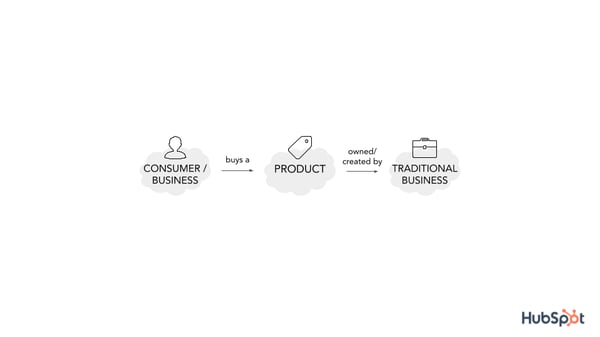
Platform businesses, on the other hand, follow a circular model of business, where they enable and facilitate transactions between two parties without creating, manufacturing, or owning inventory. Consumers use platforms to purchase products or services from other platform users.
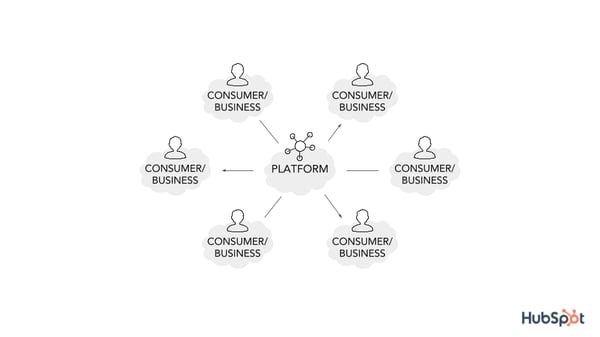
Platforms businesses have proven to be highly valuable — to consumers and investors alike. Did you know that six of the top 10 companies by market capitalization are platforms? That’s right: Apple, Microsoft, Amazon, Alphabet (Google), Facebook, and Alibaba.
It’s clear that in today’s economy, who a company connects with is more important than the product or service they own and sell.
Like we said above, platforms enable interactions and transactions between interdependent groups. These direct interactions inherently create supply (from a seller, service provider, or producer) and demand (from a buyer, service seeker, or consumer) — benefiting both parties.
While traditional businesses create value by creating products or services, platforms create value by enabling these transactions.
Here’s what that transaction typically looks like:
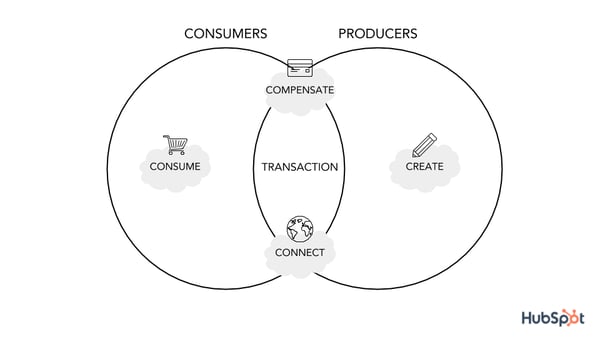
A platform’s success is dependent on more than these transactions, though. Platforms must also attract consumers and producers, enable matches between these two groups, and provide the right technology to aid a transaction — all while maintaining rules and standards that protect both parties as well as the platform itself.
Here’s what the cycle of these four functions typically looks like:
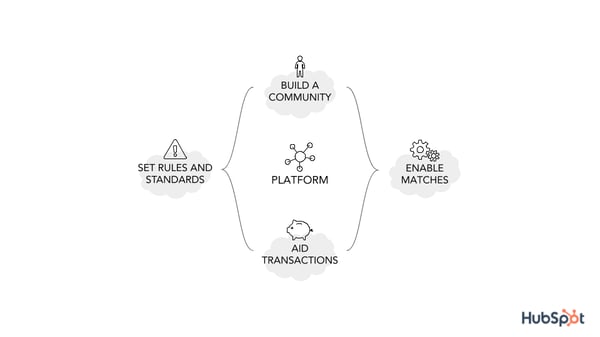
Platform Benefits
The platform business model has revolutionized business and technology as we know it. Here are a few reasons why.
1. Platform business models grow faster and scale better.
Platforms that follow the platform business model can grow or scale rapidly because they don’t own the resources that create the value, i.e. the applications, content, service providers, or products. Their growth isn’t contingent upon resources or capital.
2. Platform business models build a reciprocal, self-sufficient community.
Platforms that follow this business model enjoy “two-sided network effects,” meaning that demand is created from the supply of both buyers and sellers, providers and users, or creators and consumers.
This equates to fewer advertising dollars (to attract either buyers or sellers) and stronger word-of-mouth marketing. It also creates a “win-win” situation that allows both the platform business and service providers or sellers to profit from users.
3. Platforms solve for connection and efficiency issues.
As marketers (or salespeople or support representatives), we tap into dozens of tools each day. In fact, as of 2018 there are over 7,000 marketing technology vendors globally. Platforms create a centralized location for the tools and applications we use to grow our businesses, reach our customers, and collaborate with our teams.
Time and energy are two things that businesses don’t have to spare. Platforms that follow the platform business model become a one-stop-shop for user’s day-to-day processes.
We’ve defined a platform, and we’ve talked about how platforms have important business ramifications. Next, we’ll cover some real-life platform business model examples, their impact, and how they’ve become successful.
Platform Business Model Examples
How do platforms play out in everyday life? Surprisingly, you’re regularly using more platforms than you realize. Let’s dive into some platform business model examples that will help round out your understanding of the topic.
Airbnb
When planning a vacation and deciding where to stay, the first thing I do is hop on my Airbnb app. I could visit a website like Hotels.com or Google to search for places to stay (which are both platforms, too), but I always choose Airbnb. Why? Not only does it allow me to “live like a local” wherever I’m visiting, but it’s relatively affordable and provides me with a wide variety of lodging.
Airbnb has revolutionized the hospitality and lodging industry. For a company that owns no property, it has beat out some of the most popular hotel chains.
Airbnb has also become successful because of its suppliers — normal people like you and me. Airbnb buyers (guests) attract Airbnb suppliers (property owners), therefore fostering a reciprocal ecosystem that benefits both Airbnb and its users alike.
Uber
Similar to the way Airbnb doesn’t own any properties, Uber doesn’t own any cars … yet it’s given the taxi industry a run for its money. Sure, it’s almost always cheaper, but it also provides a much more modern and arguably safer experience. Riders can pay digitally, split the fare with other riders, and track their ride all the way to the destination.
Uber drivers also receive perks. They control their driving schedule, have access to frequent bonuses, and can find passengers wherever they are — without having to wait at a taxi stand or long queue.
The Uber platform supports both parties. By managing payment, ratings, and all dispute resolutions, Uber makes it easy to be both a driver and rider — and only takes a small percentage of earnings.
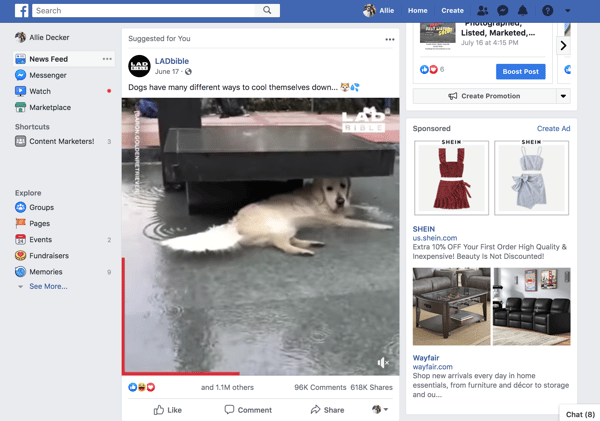
Chances are, you didn’t realize Facebook is a platform. Think about it: Facebook produces no original content and owns no media … yet, it collects data and brings in tons of advertising revenue. Talk about brilliant. In fact, you can consider almost every other social network to be the same.
By creating a fun, interactive place for people to connect and share content, Facebook has built one of today’s most influential platforms. Content created by Facebook users attracts other Facebook users who create more content … so on, and so forth. Facebook is a great example of a platform’s reciprocal network effects that create monetization opportunities for the platform itself.
Amazon
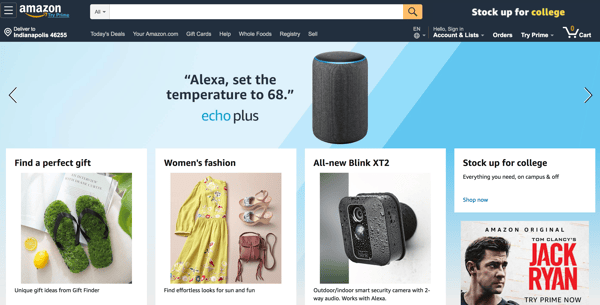
Amazon currently sells over 12 million products to over 200 million unique visitors per month — and that product count doesn’t include books, wine, media, and services.
What’s even more fascinating? Amazon doesn’t own the vast majority of the products they sell. Sure, it owns warehouse space, advertising space, a handful of product lines, and now transportation fleets … but it primarily sells other companies’ inventory. It enables (easy, quick, and cheap) transactions between sellers and buyers.
On top of that, Amazon brings in billions from advertising, seller fees, and Prime membership subscriptions.
Medium
Medium rocked the online publishing world when it was released in 2012. Bloggers, writers, and journalists could publish content online (without cost) without having to worry about hosting a website or getting their work approved by editors. In fact, large news sources and companies — including Sports Illustrated and the White House — started publishing content on Medium, too.
It became a content free-for-all, and readers benefited all the same. Readers could visit Medium and access a variety of fresh content from thousands of writers. As a platform, Medium manages its website … and that’s about it. The corporation doesn’t publish any content of its own, nor does it employ any writers. It simply connects readers and writers to produce and consume great content.
HubSpot
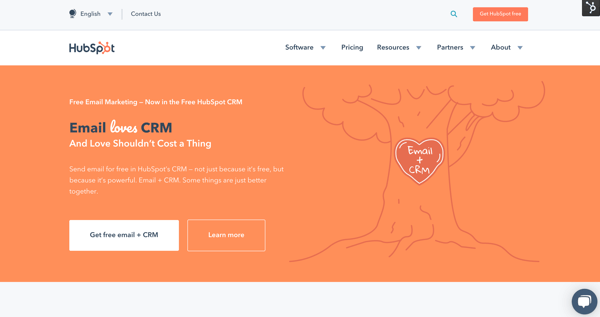
Last year, HubSpot announced that it’s transitioning from an “all-in-one suite vs. all-on-one platform”. This means that it’s expanding to adopt hundreds of more integrations to benefit customers and help them easily expand their tool belt — instead of requiring them to add and master even more disparate systems.
In short, more disconnected software means more friction (and frustration) for customers. Folks are used to either using too many tools that don’t connect or using archaic platforms that don’t solve for today’s buyer (a.k.a. your customers). HubSpot plans to fix that.
The HubSpot platform will allow you to seamlessly connect your tools, teams, data, and processes so you can power frictionless experiences for your customers.
Grow Better With Platforms
Platforms business have revolutionized the economy and how other companies conduct business. Not only do they bring together consumers and producers and create a valuable network, but they also solve countless connection and efficiency issues.
If you’re juggling dozens of marketing tools, consider working with a platform to help streamline your tools, teams, data, and processes. In the meantime, keep an eye out for the platform businesses around you — you might be surprised by how many you already use on a daily basis.
Editor’s note: This post was originally published in July 2019 and has been updated for comprehensiveness.

How to Use Visual Storytelling in Your Marketing: 5 Ways
Want a deeper connection with your audience? Have you considered communicating stories visually in your marketing? In this article, you’ll discover five ways to use visual content to tell stories that engage your audience. What Is Visual Storytelling? It’s common knowledge among psychologists, visual marketers, and behavioral specialists that around 93% of communication is nonverbal, hence […]
The post How to Use Visual Storytelling in Your Marketing: 5 Ways appeared first on Social Media Examiner | Social Media Marketing.
from Social Media Examiner | Social Media Marketing https://ift.tt/31kbrZZ
via socialmediaexaminer
What Is a Landing Page? All Your Questions, Answered
If you could do one thing to dramatically improve your marketing ROI today, would it be to use landing pages on your website?
If you’re trying to generate leads for your business, and you don’t have at least a few landing pages on your website, you’re missing out on a key opportunity to turn website visitors into something more.
Here, we’ll explore what a landing page is, the myriad of landing page benefits and how you might use a landing page to reach your business goals, and how to make your landing pages as powerful as possible.
What is a landing page?
A landing page is a page on your website where you can offer a resource from your business in exchange for a visitor’s contact information. Marketers can capture this contact information using a lead-capture form, where visitors can enter details like their name, email address, and job title.
A good landing page is focused on a particular stream of traffic — say, from an email campaign that’s promoting an ebook. Because the landing page is targeting just people who are (presumably) interested in this ebook, and because this ebook has exclusive information that elaborates on a topic your audience cares about, you can convert a higher percentage of your website visitors into leads whom you can then follow up with.
How to Create a Landing Page
To create a landing page, you’ll want to start by exploring various landing page builders — unless, of course, you’re using a content management system that already provides landing page templates, like HubSpot.
Once you’ve determined the right tool for you, explore pre-built templates or consider whether it’s better to build your own. You might also use this as an opportunity to A/B test two different designs to explore which design elements result in the highest conversions.
Additionally, it’s critical any landing page you design effectively communicates the value you’re providing visitors in exchange for contact information. And, of course, you’ll want to include a form you’re asking visitors to fill out in exchange for whatever offer you’ve provided on your landing page.
To learn more about how to create a landing page in detail, take a look at How to Create a Landing Page: The Simple Step-by-Step Guide.
Landing pages have one chief purpose: to generate leads for your business. However, you can define those leads in a number of ways and offer more than one type of content or experience through this landing page.
Here are some of the ways you can use a landing page to start a relationship with your future customers:
1. Ebooks and Whitepapers
If you wrote a blog post that introduces a topic relevant to your audience, you can satisfy deeper interests in that topic by elaborating on the subject in an ebook or whitepaper. Using a landing page, you can “gate” this resource behind a lead-capture form for people to download.
2. Email Newsletter Subscription
Let’s say you write a lot of blog content on a similar topic. Sure, you can develop an ebook or whitepaper that elaborates on specific details, but you can also offer your readers an email newsletter they can subscribe to for the latest content around your industry. On various blog posts, use a call-to-action (CTA) to invite readers to subscribe to your blog. This CTA can link to a separate landing page where they enter their contact information for addition to your email list.
3. Online Course Enrollment
Whether you’re in the education industry or you offer various skill-based certifications to your audience, online courses should have their own landing pages, too. Using these pages, you can invite new students to sign up for a class you offer and capture information on them that can lead to a customer relationship that goes beyond the courses they take with you.
4. Event Registration
Similar to online courses, industry events require you to collect information on your audience so they can receive updates prior to the event. An event, as well as its various sessions and keynotes, can have their own individual landing pages to turn event goers into event attendees and business leads.
5. Free Trial of a Product
Offering people a free demo of your product? Your demo offering could use its own landing page. Bring users to a page where they can sign up for a free trial of your software using their name, email address, job title, and any other information you deem necessary to give them the best customer experience.
6. Community Membership
If your business thrives on conversation among your audience — perhaps you have a website dedicated to dialogue between users — there’s no harm in making it invitation-only. In fact, it’s a great way to generate leads through the people who want to become members of your community. Create a landing page that lets website visitors sign up to become a bigger part of your business.
7. App Download
Developing a mobile app for your product doesn’t just improve your customer experience — it also gives you another avenue to capture leads from your audience. A lead-optimized landing page that invites users to download an app is quite common in the app-maker community.
Landing Page Benefits
1. Landing pages can lead to increased conversions.
Having a targeted page that directly ties into a certain offer or next step is critical for providing value upfront, and can encourage new site visitors to provide their information in exchange for an immediate, tangible reward.
For instance, let’s say you’ve landed on a business’ website and you’re immediately greeted with a pop-up form asking for your name and email. A bit jarring before you even know what the company is about, isn’t it?
Alternatively, imagine you’ve found a business’ free e-book on social media, which outlines ten immediate solutions to your problem. I’m willing to bet you’re more likely to provide your email and name for that valuable content, right?
Ultimately, a landing page can help increase conversions while providing a better user experience. Plus, a landing page can help you determine which types of content to serve certain visitors for faster, more effective lead generation.
Too many companies send their advertising, email, or social media traffic to their homepage. This is a huge missed opportunity. When you know a stream of targeted traffic will be coming to your website, you can increase the likelihood of converting that traffic into leads by using a targeted landing page.
For instance, those users who convert on your social media e-book landing page are clearly interested in social media. To further nurture those leads, you might follow-up with a personalized email, detailing additional content you can provide related to social media.
2. Landing pages can provide additional insights into your target audience.
By creating various landing pages with segmented offers, you can track which topics convert at the highest rate. This can give you valuable insights into your audience’s interests.
You might use the data you collect from your landing pages to create a more targeted, personalized marketing strategy. Plus, landing pages don’t just tell you which content your audience likes best — they also tell you which channels your leads prefer. This can enable your marketing team to refine your strategy further, promoting content and engaging with your audience on the channel(s) they’re already using.
For example, let’s say you notice your landing pages related to e-commerce perform exceptionally well, and most of those users find your landing page from your paid ads on Facebook and LinkedIn. This information can help you target future campaigns primarily towards your social audience, and consider how you might incorporate additional e-commerce content into your marketing strategy as a whole.
3. Landing pages can grow your email subscriber list.
In exchange for the content offered on your landing page, you’ll typically ask users to provide their email and name. This can help you quickly grow your email subscriber list, and segment that list to provide more personalized follow-up emails.
People who’ve filled out a form in exchange for content, or information on your product or service, have shown an interest in what you have to offer — which ensures your subscriber list is filled with potentially high-quality leads.
Consider how you might further nurture them by sending a kick-back “Thank you” email after they download your landing page offer, with additional resources related to the content in which they’ve shown interest.
4. Landing pages are testable.
A landing page is oftentimes a fantastic opportunity to get creative and test out various designs to determine which visuals and text perform best with your target audience. Additionally, it’s often lower risk to test out a new landing page, rather than making major design changes to your entire blog or website infrastructure.
For instance, AJ Beltis, HubSpot’s Content & Acquisition Manager, told me, “If you’re using a content management system with a built-in A/B testing tool (like HubSpot), you can easily set up and run a test to see which copy, design featured, imagery, and page elements yield a stronger conversion rate. This means you can quickly uncover new ways to drive more leads and contacts for your business.”
5. Landing pages allow you to measure metrics directly tied to business goals.
If you’ve created a specific landing page to market your new product or service, you can then use that landing page to measure metrics directly tied to your business goals.
For instance, let’s say your marketing team is tasked with increasing sales for your new email tool. To accomplish this, your team creates a campaign with a landing page offering a free demo of your tool.
You might measure conversion metrics on that landing page to determine how well your campaign is performing, or whether you need to make tweaks to communicate the true value of your new product. Additionally, you can measure which sites drive the highest conversions to your landing page, and put more resources into marketing your email tool on those sites — or social media apps — in particular.
6. Landing pages add context to your offer.
AJ Beltis told me one of the biggest benefits of a landing page is the opportunity to add context to your marketing offer. “Marketers feel motivated to bypass the landing page process and skip right to the conversion by encouraging form fills in other methods, such as through a chatbot,” Beltis told me.
Beltis adds, “However, this process eliminates the opportunity to add more context to what it is you’re offering. Imagery and essential information that can only be shared with a landing page provide content to those who need it before deciding to convert.”
7. Landing pages increase brand value and help make a good first impression.
Ultimately, a sleek, well-designed landing page can impress new visitors and turn them into leads by demonstrating the valuable content your company can deliver. A landing page is space you can use to tell your visitors what you’re offering, and how it can positively impact them. Even if a viewer doesn’t immediately convert, a well-designed landing page can increase brand recognition and help nurture leads for future sales.
For instance, take a look at this impressive landing page created by Talisker, a whisky brand. Using Ceros’ landing page product to design an immersive experience, Talisker is demonstrating brand value and, ideally, making a fantastic first impression on new visitors.
This is proof a landing page doesn’t have to be boring — in fact, it shouldn’t be. Take the time to create an engaging, interactive, interesting landing page that convinces visitors in the value of your brand.
What makes a landing page most effective?
Ready to create your first landing page, or improve on a landing page you already have? Here are some of the most important elements to make sure your landing page is working hard for you:
1. Limit Navigation
You’ve brought your targeted traffic to a page where they can take your desired action. Don’t distract them! Limit the number of exits from your landing page so that your visitors are focused on filling out your form. A key part of this is to remove the website navigation elements on landing pages. This helps put the focus back on the content you’re offering.
See how the landing page below does this — aside from the HubSpot logo, there are no navigation buttons to confuse or distract visitors.
2. Enable Sharing
Tap into a huge community of your best (and free) marketers: your audience. Add share links to your landing page to encourage your website visitors to share your content with their audiences.
3. Deliver Value
First and foremost, if you have a valuable offer, your visitors will give up their contact information in exchange for your offer. Ask yourself if your offer is compelling to your audience and make sure your landing page demonstrates that value. One way to ensure your landing page adds value is to show your audience the content they’re going to receive — directly on the page. See how this can look in the example landing page below.
4. Keep it Short
The longer your landing page and form, the more friction you add to the lead-generation process. Keeping your lead form short and straightforward will increase your conversion rate.
Here’s a tip: Put as many contact fields as you can on the same line. Shortening the height of your lead-capture form helps you limit the more trivial fields you might be tempted to include, and prevents your landing page visitors from getting spooked by a form that’s asking too much of them. As shown below, sometimes all you need is a first and last name, followed by an email address.
5. Test, Test, Test
As many best practices as you may read about online, your landing page can always use more testing and improvement. Make sure you have a landing page creation tool that allows you to create and test many different landing pages to see what works best for your business. Additionally, if you’re a HubSpot customer, consider some of the landing page tool integrations, such as briX.
Are you a landing page guru? Check out some of our advanced tips and data around landing page best practices on effective calls to action and the best/worst button text (hint: don’t use “Submit”). Do you need to make any of these 10 Quick Fixes to Build Killer Landing Pages?
If you’re working hard to drive traffic to your website, don’t make the mistake of not capturing that traffic as leads.
