
Welcome to My Blog
Everything You Need to Know About Ecommerce Marketing
With nearly every marketing operation now taking place online, it can be tough to distinguish between the various types of digital marketing people use today.
For example, take ecommerce marketing — what is it and how does it compare to practices like social media, content, search engine, and email marketing?
Ecommerce marketing and digital marketing are not mutually exclusive. Ecommerce websites can use all of the above digital channels to promote a product and grow their business.
This ecommerce marketing guide will explore all of the digital media available today.
Ecommerce marketers can use social media, digital content, search engines, and email campaigns to attract visitors and facilitate purchases online.
Before we dive into more detail about what ecommerce marketing is and how to implement a strategy of your own, let’s review the definition of ecommerce advertising and advertising’s parity with marketing for an ecommerce business.
Ecommerce Advertising
In similar fashion to the way advertising falls beneath the umbrella of marketing, ecommerce advertising falls beneath ecommerce marketing — and when used in tandem, you have the ability to more effectively reach your audience members to boost conversions and improve brand awareness.
As mentioned in our definition above, ecommerce marketing is about driving awareness and action towards your product or service.
Meanwhile, ecommerce advertising includes the methods through which you actually promote your product. In terms of online or ecommerce marketing and selling, these ads may come in the form of display ads, banner ads, or rich media ads.
The main takeaway here is that ecommerce advertising is a highly-effective method to implement while developing your ecommerce marketing strategy to focus your product or service promotion.
Now, let’s get back to our in-depth discussion about ecommerce marketing.
Types of Ecommerce Marketing
To give you a sense of what an ecommerce marketing strategy looks like, here are some common marketing channels and how you’d use them to build an online store.
Social Media Marketing
Brands, publishers, contractors, and growing businesses all launch pages on today’s most popular social networks to connect with their audience and post content that the audience is interested in.
As an ecommerce marketer, you can do the same thing, but the campaigns you run might look a bit different, and not every social network is a good fit for your needs.
Ecommerce websites are highly visual — you have to show off the product, after all — so your success on social media depends on your use of imagery to drive attention and traffic to your product pages.
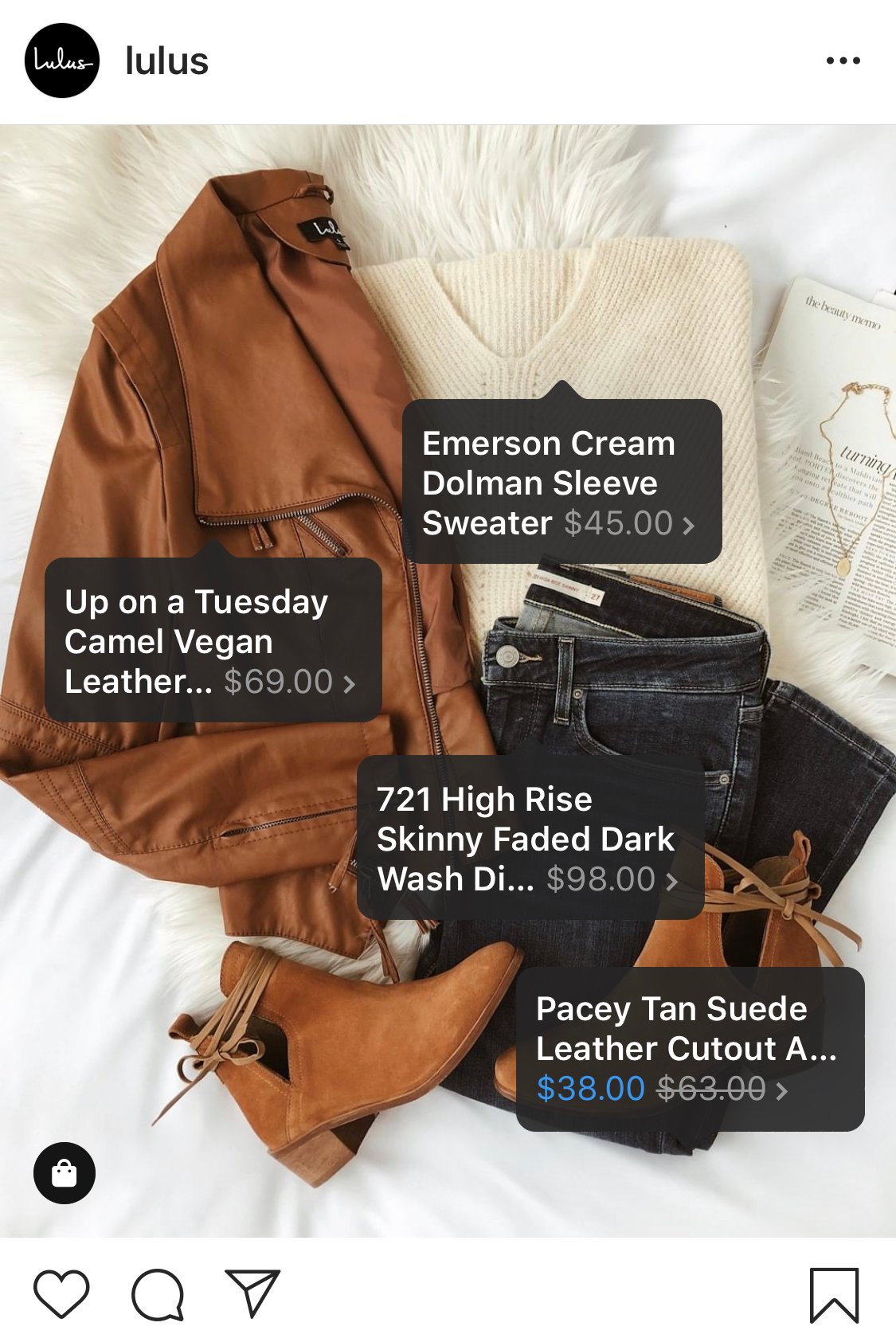
Instagram is an appropriate platform for ecommerce businesses because it enables you to post sharp product photography and expand your product’s reach beyond its purchase page.
You can take your social media posts a step further by creating shoppable content, which is content that enables visitors to buy right away. That can include anything from strategically placed display ads within a social feed to additional tags that take users directly to a shopping cart. These methods help you eliminate friction from the buying process.
An ecommerce business is no stranger to product reviews, either. Using a Facebook Business Page to share product praise is a perfect fit for businesses that already solicit customer reviews across their online store. We’ll dive deeper into product reviews below.
Content Marketing
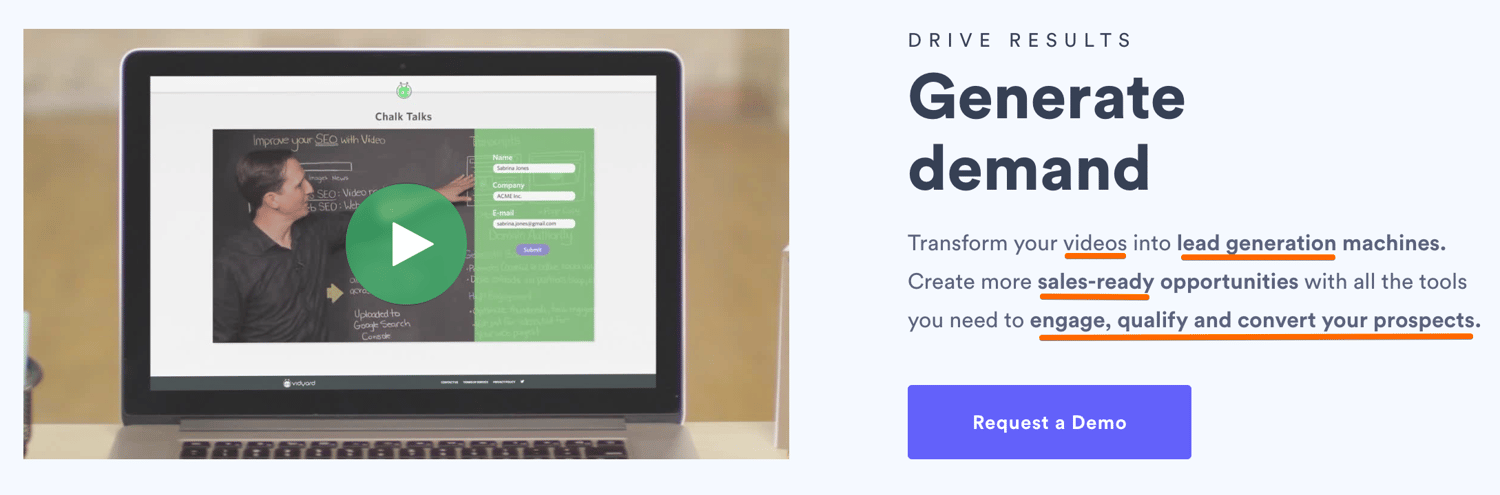
When you hear “content marketing” you might think of blogging and video marketing — content that is meant to improve your website’s ranking in search engines and answer questions related to your industry. But if you’re selling a product online, do you really need articles and videos to generate transactions? You sure do.
Here are some ways to use content to market your ecommerce store.
Optimize your product page copy.
Optimize your product pages for short, product-driven keywords that include the name of the product. If you sell wedding dresses, for example, a Google search for “brown bridesmaid dress” is more likely to produce product pages like yours if you’ve included that term on the page.
Also, make sure that your page titles, headers, and image alt text focus on the right keywords so search engines know to return your ecommerce store for the right query.
Write relevant blog posts.
If you manage an online wedding dress store, writing blog posts about “how to plan a wedding” can attract everyone involved in wedding preparations no matter where they are in the planning process.
As visitors become more engaged, you can create posts that will move them into consideration, like “how to select the right wedding dress”, and turn them into leads, like a downloadable “wedding planning checklist”.
Create guest posts for external websites.
Guest posts can get you and your products in front of relevant audiences (oftentimes for free). Submitting guests posts will also help you get more domain authority for your ecommerce site, thereby telling search engines that you have a reliable site.
You’ll need to search for sites that rank for keywords related to your product. Sometimes you won’t even need to create an entire post. If a site already has a relatable post, offer to expand on it by providing additional context, like a video or infographic with a link to your site.
Put product-related videos on YouTube.
YouTube has over a billion active users … chances are your target audience is somewhere in there. It’s also the second-largest search engine behind Google. If you’re looking for a massive, captive audience, YouTube is where you’ll find it. Use highly searched keyword terms to determine your topics, then share videos that are related to your product and helpful to your audience.
This is also a great option for tutorial videos that show current customers how to use your product — these videos can show people how best to use your product, increasing customer satisfaction and building long-term relationships with website visitors.
Include a keyword-driven FAQ section on your website.
If your audience is asking questions related to your product, then you need to be the one to answer them. Create an FAQ page on your website with responses to high volume, long-tail keyword searches to get users to your site. You’ll be building both authority and traffic — two crucial components of a successful ecommerce store.
Search Engine Marketing
Search engine marketing (SEM) includes both search engine optimization (SEO) and paid advertising. While SEO relies on your knowledge of Google’s ranking algorithm to optimize content, SEM can involve pay-per-click (PPC) campaigns, display campaigns, or product-specific ad campaigns (think Google Shopping), which allow you to pay for top spots on search engine results pages.
On Google, PPC campaigns guarantee that potential buyers will see a link to your page when they enter search terms that match the terms of your campaign. But because you’re paying Google each time a person clicks on your result, the payoff to you should be high.
This is why ecommerce marketers often register with Google AdWords and promote their product pages through PPC campaigns. The campaign puts searchers right in front of the business’s product when they click on a paid result, increasing the likelihood that the searcher will make a purchase before leaving the business’s website.
Email Marketing
Email marketing is one of the oldest forms of digital marketing, and believe it or not, it holds specific value in the world of ecommerce marketing.
The best part about email marketing is it can be automated. Automation means that you can set up a successful drip campaign to subscribers that are segmented by interest or stage in the buyer’s journey and let your email campaign do its magic. It’s one less marketing tactic that you need to worry about on your long list of tasks.
Even so, it’s imperative that you’re meticulous about your email list so you maintain trust among your leads. In a time when data privacy runs high on an internet user’s priority list, not every commercial email is welcome in that user’s inbox. Ecommerce marketers need to be careful when and how they add website visitors to their mailing list.
Here are two ways an ecommerce marketer might use email marketing.
1. Post-Purchase Follow Up
If a user has already purchased a product from your website — and agreed to receive emails from you during the checkout process — sending a follow-up email a few days after the product is delivered keeps the conversation going and gauges their future interest in your product line.
A post-purchase follow up also shows that you care about them beyond a sale and that your company has an interest in their success using your product. It gives you an opportunity to get feedback on their purchase experience, which, in turn, helps you reduce friction for future customers.
Some best practices for this type of email are to ask them to write a review of your product and/or read original content on how to use your product (those YouTube videos you created would be perfect here).
2. The Abandoned Shopping Cart
Users abandon their shopping carts for a number of reasons, and emails to diagnose the problem and retain their business can make the difference between a purchase and a lost customer. We’ll cover ways to reduce shopping cart abandonment below.
If a website visitor fails to complete a transaction while they’re in your shopping cart, consider sending a polite email to remind them to complete the checkout process, offer assistance, or recommend other related products to get their mind back on you and their browser back to your ecommerce store.
Learn more about why users are abandoning your shopping cart and how to fix it.
Influencer Marketing
Influencer marketing focuses on people or brands that influence your target market. The term is commonly used to denote Instagram accounts with several thousand followers, but it could also mean a celebrity or community that your target audience follows or belongs to.
Influencers build communities of people that know, like, and trust them. It is, therefore, easy for them to garner attention around your online product through a recommendation, or “sponsored post.”
Affiliate Marketing
81% of brands employ affiliate marketing, and ecommerce sites are particularly good candidates. Affiliates are people or businesses that help sell your product online for a commission.
Unlike most social media influencers, affiliates generate interest in products via old fashioned (yet effective) marketing tactics. They often use paid advertising, content marketing, and other means to drive traffic to your their pages on your product — it’s like having a team market for you.
Local Marketing
This is an often-overlooked tactic for ecommerce businesses, but local marketing allows you to double down on the areas where most of your prospects are (if you have a large population of them in one area) and allows you to offer incentives to your potential customer base.
Here’s how: use tracking cookies to determine where your prospects are located. Then, offer discounted (or free) shipping to potential customers in the areas where you have warehouses or shipping facilities. The incentive might be just what you need to gain a new customer.
There are countless ecommerce marketing tactics that you can employ to drive visitors to your online store beyond the traditional methods that we reviewed above. Let’s get into some more creative ways you can market your ecommerce business.
1. Use personalization.
Companies that use personalization are seeing revenue increases ranging from 6-10%. What is this magic bullet?
Personalization is finding ways to cater to individuals within the marketing materials that you already have; it is tailoring your outputs to reflect the unique needs of your consumer.
This can come in the form of a prospect’s name in the subject line of an email, recommended content or products based on a visitor’s behavior, or even showing smart content on a webpage when a user visits for a second time or has moved along their buyer’s journey.
Personalization can move people along their buyer’s journey faster — instead of searching for what they need, you put it right in front of them, making it easy for them to take your desired action, that is, make a purchase.
2. Capitalize on user-generated content (UGC).
What if you could have your customers market for you for free? That’s exactly what user-generated content, or UGC, is. It’s about finding ways for your customers to promote and share your business.
This helps in a couple ways: 1) It drives traffic to your ecommerce store, and 2) it builds an authentic following of people who are interested in what you offer.
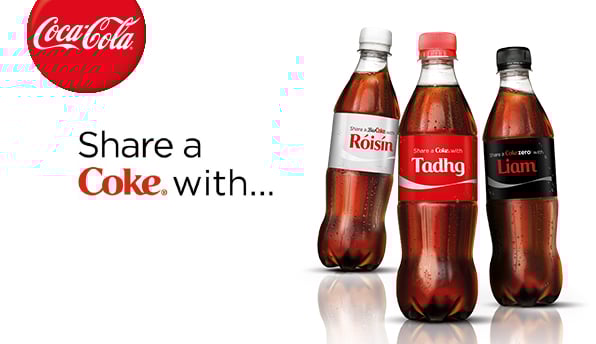
Coca-Cola® did an amazing job of this with their “Share a Coke” campaign by creating customized Coke® bottles with people’s names, which naturally was shared across social media platforms.
Here are some effective ways to drive UGC:
- Competitions, where customers enter to win by displaying your product in some way
- Review platforms, where customers share feedback about your product
- Social media hashtags, where users submit content using a branded hashtag
3. Build a loyalty program.
A loyal customer is a long-term customer, and who doesn’t want repeat business? A loyalty program provides an incentive for a customer to continue doing business with you through relevant offers and discounts. While building a customer loyalty program takes some planning and work, it pays off in repeat business, UGC, referrals, and retention.
There are a couple of things to consider as an ecommerce business when building out a loyalty program. For one, consider diversifying the ways in which customers can show loyalty, whether it be through repeat purchases, mentions on social media, or sharing your content. Also, think about how you will pay off their loyalty, be it through points, discount codes, or exclusive perks.
Generate Word-of-Mouth Marketing (WOMM)
Word-of-mouth marketing is one of the most powerful marketing tools out here. It’s based on the premise that people want advice from others like them. As buyers becoming more skeptical of marketing tactics from companies, the need for word-of-mouth marketing in your business becomes more apparent.
While you can make this to happen organically by providing a great customer experience, you can also encourage, and even create, forms of WOMM that are equally as effective.
Reviews
Remember how I just said that prospects trust companies less and less? Well, customer reviews help mitigate that mistrust because they come from people who are not invested in the success of your company — instead, they’re an authentic and oftentimes brutally honest review of your product and how it worked out for them.
Reviews serve as marketing tools for you because they include mentions of your product and oftentimes they do the selling for you … people think, “If it worked for them, it might work for me, too.” Encourage your customers to leave reviews however you can, and that post-purchase email we talked about above might be a good start.
Referral Marketing
When customers solicit their friends, family members, and co-workers to buy from you, that is a referral. Sure, this may happen naturally if they really enjoy your product, but you can ensure that it happens more frequently through a referral program.
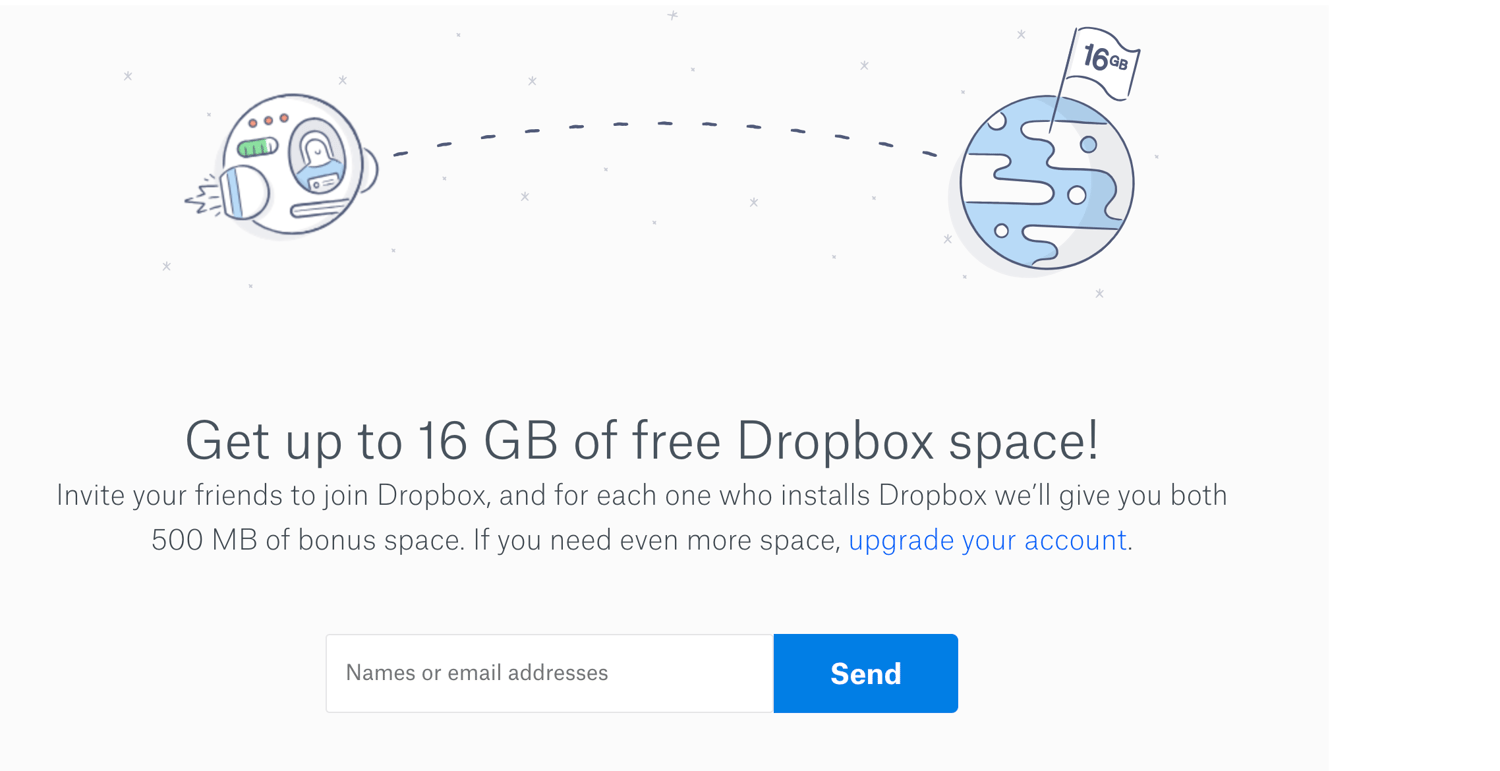
Simply ask your customers to refer others in exchange for something of value (e.g. discount, money, free gift) that you can offer to either your new customer, your existing customer, or both. Dropbox does a good job of this — they offer additional cloud storage space when you refer a friend to sign up.
Testimonials
You can use customer testimonials to get the word out about how great your product is. Testimonials are essentially tailored reviews because you typically produce them from interviews where you can ask specific questions that get to the points you want to address and share with prospects.
Being that you have an ecommerce store, some topics you might want to focus on for your testimonial interviews would be ease of the buying process, the level of customer support, and frictionless delivery and setup methods.
Case Studies
Case studies allow you to promote customers’ successes in a way that pushes prospects over the edge. They are meant to relate to your buyer persona, so you should interview customers that most closely represent your target audience. Case study best practice is to show a customer’s life before your product and how it has drastically improved since.
4. Invest in live chat.
Chatbots — you’ve heard about them, right? Well, they’re one of two ways to employ a live chat strategy. Depending on your business size, you can have a live person available to chat with potential customers who visit your store.
Whether you decide to go the bot or human route, live chat will prove especially effective while people are browsing your store so they can get answers right away and when they’re in the checkout process to mitigate any objections just before buying.
5. Cater to the shopping cart.
We discussed the reasons why people abandon their shopping cart above, and a lot of it has to do with trust in your business, in the product, or in the delivery system. You want to give customers every reason to want to buy from you without hesitation by confronting their objections head on.
Some ways to mitigate shopping cart abandonment are:
- Money-back guarantees
- A clear and simple return policy
- Superior delivery options
- Immediate access to customer support
6. Implement a responsive website design.
No matter which aspect of your ecommerce strategy you’re working on, it should include a responsive design. Your ecommerce marketing tactics will be viewable and easily maneuverable via any device (e.g. laptop, smartphone, iPad or tablet).
Meaning, in a world where people are always on-the-go and visiting websites and viewing ecommerce marketing materials via a variety of devices from an array of locations, your content will be easy to read and simple to navigate for all users. (Check out this post for some examples of successful responsive web design.)
Ecommerce Marketing Strategy
Now that you know the ins and outs of ecommerce marketing, let’s put it all together and review some tips for building a successful marketing plan for your online store.
Set goals based on industry benchmarks.
Depending on your industry, location, business size, and a multitude of other factors, there are some standards you can use to measure your goals against — those standards are industry benchmarks.
Consider goals like website visits, click-through rates, conversion rates, and customer acquisition cost and compare those to other ecommerce business in your field.
Break down your strategy into small tactics.
When building out a marketing plan for your online store, there are several paths you could follow — we listed many of them above. It can be tempting to chase after every single one, but that’s a sure way to not be effective at any of them.
We recommend that you focus on a couple key strategies first that you believe will have the most ROI — and are the most accessible to you — and create action items for each.
For example, say you decided that you wanted to focus on a paid strategy to drive users to your store. A few of your action items would be: set up a Google Ads account, determine your ad spend, create an ad group based on your target keywords, and monitor your account daily.
This may sound oversimplified — that’s because it should be. You don’t want to get lost in chasing the next “great ecommerce strategy” without executing on one thoroughly and allowing it to work for you.
Delight your new and long-term customers.
Marketing doesn’t stop after a sale is made. Once someone becomes your customer, you should continue to engage, nurture, and delight them.
This way, you’ll support your customers’ long-term success which, in turn, will boost loyalty. It’ll also make your customers want to share their positive experiences with your leads and target audience members through cause studies, reviews, testimonials, and word-of-mouth.
Ready, Set, Sell
Ecommerce businesses have several marketing tools at their disposal. Using digital and inbound marketing just the right way, you can create campaigns that are designed to help your online store attract customers and grow better.
Editor’s note: This post was originally published in February, 2019 and has been updated for comprehensiveness.

Facebook Ad Specs & Sizes in 2020: an Updated Guide
How many characters of text can News Feed ads have again? What about image dimensions for the Right Column sidebar?
Between various image sizes and character requirements, figuring out how to optimize your Facebook ads for the various page spaces and ad objectives available to you can get pretty confusing.
To take the headache out of preparing to run a Facebook ad campaign, here’s a handy cheatsheet of Facebook image ad sizes and dimensions for every type of ad you can purchase on Facebook — no matter what your ad’s objective or call to action is.
Paired with using an ads management tool, like HubSpot, you’ll be armed to run excellent social media campaigns.
Whether you’re running a campaign (or just thinking about it), this resource references everything you need to know to ensure that your ads will look their best across all placements and devices.
You can also look through this table of contents to find the ads you’re interested in.
Table of Contents
- Facebook Ad Image Size/Dimensions
- Standard Facebook Ad Specs
- Facebook Stories
- Audience Network Native Ads
- Sponsored Messages
- Facebook Carousel Ad Type
- Standard Carousel Image Specs
- Instagram Stories Carousels
- Instagram Feed Carousels
Most of the ads available to advertisers on Facebook share universal image dimensions, as explained above. However, there are specifics related to file type, character count, and image-to-text ratio that differ depending on where you place your ad.
The following is a bookmarkable key of Facebook image dimensions, sorted by the type of ad you might want to place.

Standard Facebook Ad Specs
Applies to: News Feed, Right Column, Instant Articles, Marketplace Ads
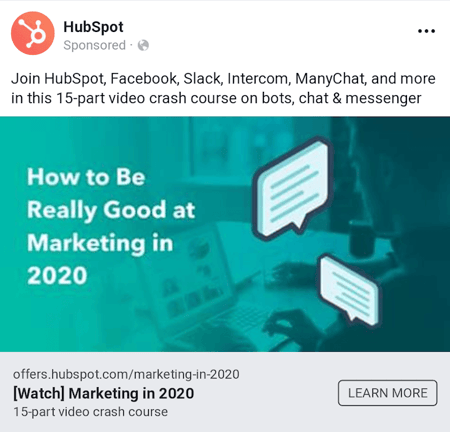
Standard Facebook image ads — such as the one designed for News Feed, above — should be uploaded as either JPG or PNG files with an image ratio of 9:16 or 16:9. In other words, the image’s height should be nine-sixteenths its width, or vice-versa.
- Image-to-text: 5:1 — If your image design includes text, keep it under 20% of the image to optimize the ad’s audience potential.
- Maximum headline: 25 characters
- Maximum text: 125 characters
- Recommended image resolution: 1,080 x 1,080 px (476 x 249 px minimum)
- Maximum link description: 30 characters
- Maximum video length: 240 minutes
- Maximum video file size: 4GB
Facebook Stories

Image ads posted as Facebook Stories last a total of five seconds or until the viewer swipes away from the Story. Your ideal image ratio is 9:16, which means the image’s height should be nine-sixteenths its width.
- Image-to-text: 5:1 — If your Facebook Story includes text, keep it under 20% of the image to optimize the Story’s audience potential.
- Minimum image resolution: Upload the highest resolution available
- Maximum video length: 120 seconds
- Maximum video file size: 4GB
Audience Network Native Ads
Native Ads on Facebook place your brand on the mobile News Feeds of users who have viewed sites and apps that are within your target audience’s network. These ads’ images should be uploaded as either JPG or PNG files with an image ratio of 16:9. In other words, the image’s height should be nine-sixteenths its width.
- Image-to-text: 5:1 — If your image design includes text, keep it under 20% of the image to optimize the ad’s audience potential.
- Maximum headline: 25 characters
- Maximum text: 125 characters
- Recommended image resolution: Upload the highest resolution available (398 x 208 px minimum)
- Maximum link description: 30 characters
- Maximum video length: 120 seconds
- Maximum video file size: 4GB
Sponsored Messages
Applies to: Sponsored Messages and Messenger Inbox
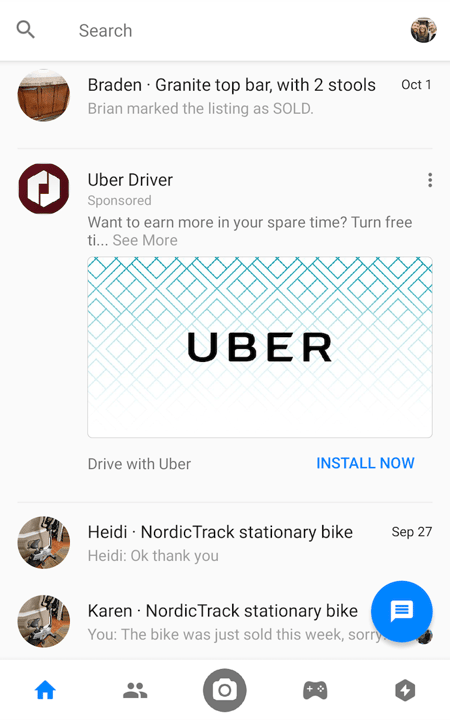
Sponsored Messages on Facebook, such as the ad by Uber, above — appear in your audience’s private inboxes in Facebook Messenger. Images should be uploaded as either JPG or PNG files with an image ratio of 9:16 or 16:9. In other words, the image’s height should be nine-sixteenths of its width, or vice-versa.
- Image-to-text: 5:1 — If your image design includes text, keep it under 20% of the image to optimize the Sponsored Message’s delivery potential.
- Maximum headline: 25 characters
- Maximum text: 125 characters
- Recommended image resolution: 1,200 x 628 px (254 x 133 px minimum)
- Maximum link description: 30 characters
Facebook carousel ads allow viewers to click through a rotating “carousel” of images all designed to elaborate on a special offer by the company paying for the ad. These ads display in most of the same places as standard Facebook ads: a user’s News Feed, the right column sidebar, through Instant Articles, and even in a user’s Facebook Messenger inbox.
Standard Carousel Image Specs
Applies to: News Feed, Right Column, Instant Articles, Marketplace, Native Network Ads

Standard Facebook Carousel ads — such as the one designed for News Feed, above — allow you to display two to 10 images in rotation all in one ad placement. Images should be uploaded as either JPG or PNG files.
- Maximum headline: 25 characters
- Maximum text: 125 characters (excluding Right Column)
- Recommended image resolution: 1,080 x 1,080 px
- Maximum link description: 20 characters (excluding Right Column, Messenger Inbox)
- Maximum image file size: 30MB
- Maximum video length: 240 minutes per card in a carousel (excluding Messenger Inbox)
- Maximum video file size: 4GB (excluding Messenger Inbox)
Instagram Stories Carousels
Instagram Stories can use carousel ads to show between two and three images or videos all in the same Story on Instagram.
Recommended image resolution: 1,080 x 1,920 px
Maximum video duration: 15 seconds per card in a carousel
Instagram Feed Carousels
Just like Facebook’s Carousel ad dimensions, Instagram Feeds can support between two and 10 cards per carousel, displayed on the homepage of a user’s Instagram feed. Images should be uploaded as either JPG or PNG files.
- Maximum text: Two rows of text (the rest will be truncated)
- Maximum number of hashtags in text: 30
- Recommended image resolution: 1,080 x 1,080 px
- Maximum image file size: 30MB
- Maximum video length: 60 seconds per card in a carousel
- Maximum video file size: 4 GB
So many ad specs, so little time. Bookmark this Facebook ads key for later and get to drafting your next eye-catching advertisement designed for you audience.
Editor’s note: This post was originally published in May 2015 and has been updated for comprehensiveness.

40 Remote Work Stats to Know in 2020
In 2020, workplaces are embracing remote work options more than ever before.
This is definitely apparent at HubSpot, where we have a quickly growing fleet of more than 300 full-time remote employees as well as partial remote options for those who work in our offices.
As someone who’d never really understood the perks of remote work, my time at HubSpot has allowed me to embrace this work style. While I primarily work in office, I usually spend one or two days a week working from home. During this time, I’m able to build out content strategies, take time for analytics reporting, and churn out hefty blog posts with limited interruption.
I’m not the only one who’s discovered the benefits of working from home. In fact, nearly half of my incredibly talented team works from a different state. This enables them to live closer to their families or stay in a state they love without relocating for work. As a team, it enables the in-office employees to benefit from the diverse ideas of out-of-office colleagues that we wouldn’t have had if our company didn’t allow remote work.
But, despite the perks and countless remote work testimonials, the idea of remote work can seem scary at first. Like with any emerging work style, those who’ve had more traditional, in-office job experiences might feel skeptical about remote work.
This skepticism is understandable. As a manager, you may wonder what your employee is doing when you can’t track them in person. As a job candidate applying for a remote role, you might worry about challenges such as communicating with your team or gaining valuable visibility.
While it’s good to address concerns of remote work as a boss or prospective employee, it’s also important to acknowledge that remote work isn’t going away any time soon. If anything, it’s expanding to more and more companies — especially with the growth of fast-paced telecommuting technologies, such as direct messengers or video chat software.
In this blog post, I’ll highlight 40 stats that you’ll need to know as remote work becomes even more common in the future. These figures will give you an idea of how the work style is growing, why employees are taking advantage of it, the opportunities it can provide management, and even a few challenges linked to it.
40 Remote Work Stats to Know in 2020
Remote Workforce Size
- In the U.S., 4.7 million employees (3.4% of the workforce) work from home at least half the week. (Global Workplace Analytics)
- Roughly 62% of employees between 22 and 65 say they work remotely at least occasionally, (Owl Labs)
- 44% of employees say that part of their team is full-time remote. (Buffer)
- While 30% of people report working remotely full-time, 18% work remotely one to three times per week. (Owl Labs)
Job Types of Remote Workers
- 18% of executives work remotely more than on-site. (Owl Labs)
- 35% of remote workers are individual contributors. (Owl Labs)
- 30% of people report working for a company that’s fully remote. (Buffer)
- 46% of C-suite members work remotely at least part-time. (Owl Labs)
- 55% of VPs work remotely at least part-time. (Owl Labs)
- New employees might work remotely less often at their company. Roughly 75% more on-site workers have worked in their positions for less than a year, (Owl Labs)
Remote Work Growth
- The amount of people who work remotely at least once per week has grown by 400% since 2010. (GetApp)
- 42% of employees with a remote work option plan to work remotely more often in the next five years. (Owl Labs)
- Between 2017 and 2018, telecommuting increased by 22% (FlexJobs)
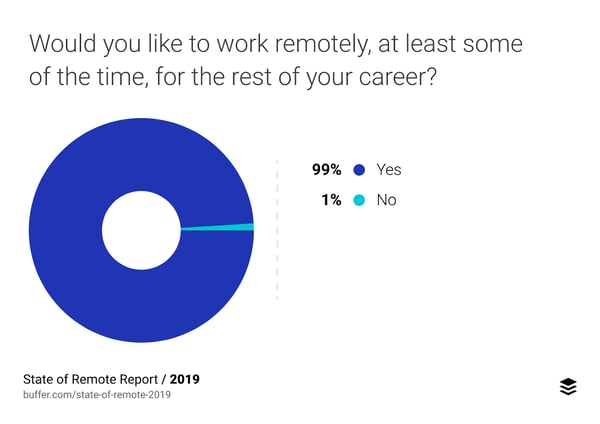
- If they could, 99% of people would choose to work remotely, at least part-time, for the rest of their careers. (Buffer)
- More than half of full-time in-office employees want to work remotely. (Owl Labs)
- 95% of people would encourage their friends or family to work remotely. (Buffer)
Recruiting and Job Retention
- 72% of talent professionals agree that work flexibility (which includes remote work options) will be very important for the future of HR and recruiting. (LinkedIn)
- 83% of workers, remote or on-site, say that a remote work opportunity would make them feel happier at their job. (Owl Labs)
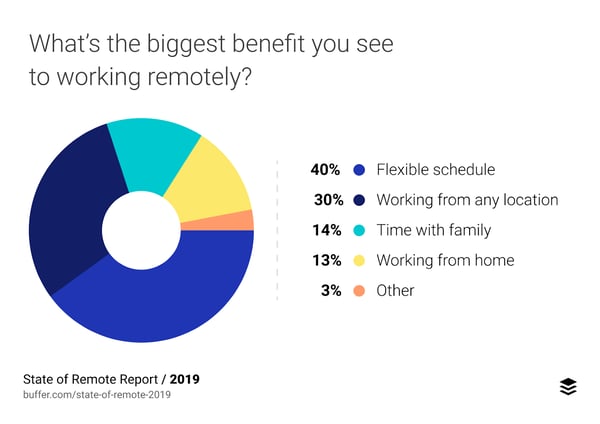
- 40% of people say that a flexible schedule would be the best perk of working remotely. (Buffer)
- 81% of employees say that the option to work remotely would make them more likely to recommend their company to job candidates and prospects. (Owl Labs)
- 74% of employees say that a remote work option would make them less likely to leave their company. (Owl Labs)
Remote Employee Productivity and Behaviors
- 77% of remote employees say they’re more productive when working from home. (CoSo Cloud)
- 76% prefer to avoid their office completely when they need to concentrate on a project. (Atlassian)
- 23% of remote workers say they work longer hours than they would on-site. (CoSo Cloud)
- 53% of remote workers say they’re less likely to take time off than they would be if they worked at their business’s location. (CoSo Cloud)
- 43% of remote employees take three weeks or less of paid vacation per year. (Buffer)
- Those with highly complex jobs that require little interaction with stakeholders are more productive when remote than in an office. (Springer)
- Email is the primary method of communication for remote workers, followed by instant messaging, and video chat. (CoSo Cloud)
- Although remote work enables employees to work anywhere, 84% of remote employees prefer to work from home. (Buffer)
Earnings and Benefits for Remote Work
- 74% of remote employees earn less than $100,000 annually. (Owl Labs)
- Despite the perk of remote work, less than 34% would take a pay cut of 5% to work remote fulltime while just 24% would take a pay cut of 10% for the same option. (Owl Labs)
- 69% of millennials will trade other benefits for flexible work options including remote work. (IWG)
- 75% of people say their companies will not compensate for the internet if they work remotely. (Buffer)
- 30% of remote employees say they save upwards of $5,000 annually without on-site work expenses and work travel. (CoSo Cloud)
- 71% of companies also do not compensate for the coworking spaces of remote employees. (Buffer)
- Businesses would save an average of $11,000 annually per half-time telecommuter. (Global Workplace Analytics)
Remote Work Challenges
- More than half of remote employees say they feel disconnected from in-office employees (CoSo Cloud)
- 22% of remote employees report that unplugging after work is their biggest challenge. (Buffer)
- 19% of remote employees report loneliness as their biggest challenge. (Buffer)
- Despite receiving confidential business data to their remote location regularly, less than half of remote employees say they receive proper internet security training. (GetApp)
Navigating Remote Opportunities
Whether you’re considering your first remote role or hiring remote team members, it’s important to keep the stats above in mind as the working world continues to evolve and embrace flexibility.
To learn more about how to be a successful remote employee, check out this blog post. For those interested in gaining visibility from home, we’ve also got a great list of tips from some of our own remote employees.
If you’re a manager trying to cultivate a solid work culture that embraces your remote employees, here’s a guide with more helpful advice.

How to Stand Out on Amazon, According to a Former Amazon Executive
Nowadays, Amazon is the largest retailer in the world.
Additionally, in September 2019, over 150 million mobile users accessed the Amazon app, making it the most popular shopping app in the U.S. By comparison, Walmart was in second place with a mere 76 million users.
However, if you work for a smaller ecommerce business, you’ve likely struggled against the Goliath that is Amazon. If your products or services don’t rank at the top on Amazon, it’s easy to get lost in the mix — but avoiding Amazon altogether isn’t a good strategy either, since the majority of consumers turn to Amazon first when shopping online.
To help you boost sales and exert brand control on Amazon, I sat down with James Thomson, former Business Head of Amazon Services who now consults brand executives on how to optimize their distribution strategy on Amazon marketplace. Thomson spent over five years at Amazon, and recently published the book Amazon Marketplace Dilemma: A Brand Executive’s Challenge Growing Sales and Maintaining Control.
Here, let’s dive into Thomson’s advice for selling “on” versus “to” Amazon, how small brands can succeed in the crowded marketplace, and the biggest lesson he learned as an Amazon executive.
1. In your book, Amazon Marketplace Dilemma, you mention this dilemma most brands face — to sell “on” or “to” Amazon. While I know it’s a complex topic, could you start by providing me with a sense for what determines whether a brand should choose one option over the other?
For many brands that have traditionally only wholesaled their products to retailers and/or distributors, the idea of wholesaling product “to” Amazon appears logical as that’s the only way brands know how to go-to-market.
However, for other brands that have some experience selling direct-to-consumer (B2C or DTC), selling “on” Amazon as the seller of record isn’t as much of a stretch for them.
Additionally, there are brands that have never sold direct-to-consumer, and find that Amazon’s fulfillment services offered to third-party sellers are more than adequate to entice the brands to try selling direct-to-consumer. As a result, the brands can make typically >50% margin by being the seller of record rather than just wholesaling to a retailer or distributor.
While there are at least two dozen considerations to evaluate whether to sell “on” vs. “to”, we start by looking at the trade-offs of how much control the brand has around pricing, branding, inventory levels, selection available in the catalog, and advertising activities on Amazon, and how much daily involvement the brand needs to have in order to manage the specific distribution option it selects.
If the brand is wholesaling products “to” Amazon, Amazon will control inventory levels, selection, retail pricing, branding, and may direct advertising spend decisions. If the brand is the seller of record, it has much more control over these same issues, including pricing (which we view as the most important short-term issue for the brand), and branding content (which we view as the most important long-term issue for the brand).
As for daily involvement, if the brand is wholesaling to Amazon, there is very little daily involvement by the brand beyond reviewing and filling purchase orders as Amazon submits them. If the brand is the seller of record, then the brand is dealing with all customer inquiries, handling inventory management/forecasting issues, listing creation and optimization issues, managing catalog issues related to duplicate listings, and typically filing plenty of service tickets with Amazon to address any outstanding account issues related to product reviews, financial payments, catalog issues, etc.
Fortunately, brands can outsource all of the day-to-day work to consulting agencies — there is a whole industry of such companies (including one that my business partner and I run, Buy Box Experts).
One important qualifier — if a brand is already wholesaling at least $10 million of product per year (wholesale prices) to Amazon, the brand isn’t going to have much success pivoting to becoming the seller of record itself, as Amazon will block the brand from doing this.
2. Nowadays, both small and large businesses sell products on Amazon — but I want to focus on small businesses and start-up ecommerce shops. What’s your advice for smaller brands, looking to succeed on the platform or stand out in a crowded marketplace?
For retailers that carry other companies’ brands, the process of adding Amazon as a sales channel is often very difficult because most brands are already on Amazon, and more likely than not being sold by at least a few sellers that are not bound by any minimum pricing policies implemented by the brands.
With low price usually driving the winning seller on a competitive Amazon listing, traditional retailers are at a disadvantage unless they also drop their retail prices.
If a retailer has exclusive access to a brand, and can get permission from the brand to be the exclusive reseller of the brand on the Amazon channel, that model can be productive.
Then, the retailer needs to learn how to manage an Amazon seller account to the level of performance required by Amazon (including answering all customer emails within 24 hours, 24/7/365; understanding how to handle inventory management to ensure no stock-outs on Amazon; developing careful P&L analysis for every single SKU sold on Amazon, and ensuring some basic profitability for each item sold).
Should a retailer decide to play on Amazon, one big change will be the need to invest in traffic-driving activities — either spending money on Amazon advertising, or sending traffic from outside Amazon to the Amazon listings (e.g., through email campaigns, or social media advertising).
Given that most product searches on Amazon are unbranded (a.k.a. people searching for “men’s running shoes”, not for “”Reebok men’s running shoes”), having your products show up on the first page of product search typically involves a lot more attention to driving traffic than what traditional brick-and-mortar retailers are used to.
3. You worked at Amazon from 2007 to 2013. I’m willing to bet 2007-Amazon looked vastly different than 2013 Amazon, and looks vastly different today, as well. Can you speak about any lessons you learned at Amazon — about innovation, culture, and/or what it takes for a company to “make it big”?
The most important lesson I learned at Amazon is the critical importance of understanding and focusing on the most important levers of growth.
If you don’t use data to develop a clear understanding of what key levers most impact one’s ability to grow one’s business, you’ll never have time to try all the levers.
At Amazon, our growth goals were often well over 40% per year, which is a level that requires a clear understanding of where to focus one’s time (that is, no one is going to ‘luck into’ that level of growth by standing around!). So being willing to test out a lot of ideas around the key levers helped me identify how to grow at seemingly impossible rates.
4. Amazon’s marketplace enables third-party sellers to sell another brand’s products. Do you think this poses a threat for bigger brands, or do you think it’s simply enabling more people to enter/compete in the ecommerce industry as a whole?
Practically anyone can show up with most any brand and sell it on Amazon (there are a few restrictions, but very few in general … I would estimate well over 90% of all brands that exist can be sold by anyone who has inventory to sell).
So, if you have Amazon recruiting literally hundreds of thousands of unauthorized sellers who aren’t held to any pricing policies from the brands, then price competition and erosion happens quickly, leading to lower prices — which is good for Amazon customers, but terrible for brands.
The bottom line is brands must control distribution much more tightly in order to avoid price erosion and channel management issues with authorized sellers that complain they are fighting against unauthorized sellers who aren’t held to same pricing policies.
So, yes, this is a huge threat to brands … yet brands have usually only themselves to blame: their sales teams are incentivized to “sell, sell, sell”, rather than to sell while also protecting distribution/branding.
This results in the brand’s own sales team selling to people who will divert product onto Amazon, messing things up for everyone else (yet the sales person still gets paid his/her commissions…). This issue of channel control is the central topic of our new book Controlling Your Brand in the Age of Amazon: The Brand Executive’s Playbook For Winning Online.
5. Are there any brands you think do particularly well on Amazon, and any you think should avoid Amazon altogether?
Apple and Sonos have done a very good job of controlling distribution, and hence tightened up pricing on Amazon. Almost every other national brand has some level of problems with unauthorized products showing up on Amazon.
As for brands that shouldn’t be on Amazon … that’s a trick question. In reality, any brand with a decent level of customer demand will find its way onto Amazon, and the question brands should be asking themselves is how does the brand plan to control branding on Amazon, and eventually control distribution on Amazon, so as to minimize prices on Amazon that are inconsistent with prices in every other channel where the brand is being sold.

Integrated Media Planning: What It Is and How to Adopt it In Your Marketing Strategy
A few months ago, while I was driving to the airport, I saw a billboard for Kim Kardashian’s company, SKIMS.
Then, a week or so later, I was watching Instagram stories, and I saw some influencers posting reviews for the new shapewear.
The next week, while I was watching E!, “Keeping Up With the Kardashians” came on, and Kim was shown modeling for a SKIMS photoshoot.
I had one of those moments where I thought “SKIMS is showing up everywhere!”
That’s because the company has an integrated media planning strategy.
A few months after these events, when I was shopping for shapewear for my wedding, guess what brand I thought of? (Spoiler alert: it was SKIMS.)
That’s why, as a marketer, having an integrated media plan is important for your marketing strategy.
In fact, 90% of customers expect consistent interactions across channels and 87% of retailers agree that an omnichannel marketing strategy is critical to their success.
Below, let’s dive into what an integrated media plan looks like and how to adopt it in your marketing strategy.
Integrated Media Planning
If you’re creating a marketing campaign, you know that success relies on knowing your audience so you can reach them on the right platforms and deliver the most effective messaging.
That’s where integrated media planning comes in. Essentially, integrated media planning is the process you’ll go through when you’re considering various media platforms you want to use in a marketing campaign. With an integrated media plan, you’ll use several forms of media, from traditional to digital platforms.
When you start this process, you have to understand the goals of your company, become an expert in the product, and truly understand the market.
Basically, an integrated media plan is a blueprint for a marketing campaign.
An integrated media plan answers questions like “Who is the target audience?” and “What medium will reach this audience?”
For example, if you’re targeting millennials, you might consider Instagram and Twitter for your media plan. However, if you’re targeting Gen X, maybe you’re thinking that a combination of radio and Facebook might work best.
Ultimately, an integrated media plan will use a multichannel approach. This means that your plan will include a mix of traditional and digital methods such as radio, TV, billboards, social media, streaming commercials, search engine marketing, email marketing, events, or partnerships.
However, you’re not just choosing between different channels, but also different types of media. For instance, you might include paid, owned, and earned media. Your marketing campaign might include a paid ad, earned media coverage on the news, or owned media in the form of social media posts.
Additionally, a media planner should consider when and how frequently content will show up. This might vary depending on the platform. Perhaps you’ll post to Instagram stories around 5-7 p.m. when your audience is home from work. Or, you’ll plan a radio spot for the morning, around 6-9 a.m. when your audience is commuting.
Either way, deciding when and how often a piece of content will appear is an important aspect of an integrated media plan.
Overall, it all boils down to your goals — what are you trying to achieve through your integrated marketing campaign? That’s how you’ll choose what channels you want to be present on.
Your integrated media plan will incorporate information gained from your research — i.e. the knowledge of your product, target audience, and the media landscape.
Your integrated media plan is a detailed strategy to achieve your goals.
So, you might be asking yourself, “How does a media planner make these decisions?”
A media planner might make this determination based on buyer personas, competitor analysis, reviews, and social listening.
But, what’s the process of creating an integrated media plan?
Below, we’ve outlined five steps to creating an integrated media plan:
1. Figure out your goals.
Before you can start planning your integrated media approach, you have to know your goals.
Just like any marketing campaign, you should have SMART goals written down so you can develop a strategy.
For example, perhaps you want to reach a certain amount of people in a certain amount of time. Or maybe you’re just looking to increase brand awareness among a new market.
No matter what it is, write down your goals and objectives, so you can track your performance.
2. Decide your target market.
If your company has a buyer persona, or perhaps even a few, then this might be easy for you. Or maybe you’re deciding between which persona you’re going to target for a certain campaign. Either way, your personas should guide your media plan.
However, if you don’t have a target buyer persona, then now is the time to create one. Your buyer persona will include demographic information such as income, education, and gender. But it should also include pain points and goals.
Understanding your target market means knowing what’s important to your audience, what their life is like, and what problems they have.
Ultimately, you should know who you want to purchase your product so you can deliver personalized content.
Also, your buyer persona might tell you what type of media your audience likes to consume and the type of content they like.
To make this process easier, think about your customer journey. What are the touchpoints? Figuring out this information should help you develop your integrated media plan.
3. Choose various media platforms to disseminate your campaign.
This is the bread and butter of integrated media planning. This is the time where you’ll decide where to distribute your marketing campaign.
Do you want to include social media, TV, radio, organic search, and blogging in your strategy?
Ultimately, you should make this decision based on research on your target market. You should have answered questions such as “Where does my audience want to consume content?” and “What type of content do they want to consume?”
For example, your audience might prefer short-form videos to long-form videos. Or perhaps they like reading a blog more than seeing a picture on Instagram. Either way, you should strike a balance between traditional and digital methods.
Ultimately, your integrated media plan should be audience-centric.
4. Produce the creative.
Once you know your goals, your target market, and most importantly, what type of content you’re going to create, it’s time to produce the creative for your campaign.
Write the copy, design the graphics, and take the pictures. Your creative elements should follow your brand guidelines and tell a story about who you are as a company.
To keep your workload easy, you might consider creating adaptable marketing assets that can be used for several channels.
5. Execute and analyze.
Now that it’s all said and done, it’s time to analyze your approach. Answer questions like, “Which channels worked best?” and “Did I strike the right balance between various media platforms?”
Once you’re armed with this information, you can incorporate it into your future campaigns.
However, don’t forget to let your strategy play out. Don’t switch it up so quickly that you don’t know how it performed over time. Some campaigns include both short-term and long-term strategies and goals, so it’s important to see the impact before changing it out.
The best marketing campaigns almost always include an integrated media plan. You should have a balance between digital and traditional marketing tactics. After all, the omnichannel experience is what customers expect and want. Marketing is all about delivering the right message, to the right people, at the right time, and that’s what integrated media planning is all about.

How to Use LinkedIn to Amplify Your Live Event Experience
Want more leads, connections, and exposure from the live events you attend? Wondering how to use LinkedIn to build rapport with people who follow the event? In this article, you’ll discover a strategy for using LinkedIn to build awareness for your business before, during, and after a live conference or trade show. Why Use LinkedIn […]
The post How to Use LinkedIn to Amplify Your Live Event Experience appeared first on Social Media Marketing | Social Media Examiner.
from Social Media Marketing | Social Media Examiner https://ift.tt/2W4YWzM
via socialmediaexaminer
How To Promote Your Business
Okay, okay, I’ll admit it — to waste time, I start a Google search query and let the suggestions do the rest, hoping to fall into a rabbit hole of interesting facts.
For instance, today’s lucky search query was “How many businesses”, and I ended up going with “…does Shaq own” (let’s just say, I was shocked to see the result.)
Here’s what I figured out: Shaquille O’Neal is the joint owner of over 150 Five Guys restaurants, 17 Auntie Annie’s Pretzels restaurants, over 100 car washes, 40 fitness centers, a mall, a movie theater, and a few Vegas nightclubs.
With over 30 million businesses just in the United States (and 300 owned by Shaq alone), it’s easy to slip into panic mode if you work for a small start-up. How are you supposed to attract customers when there’s so much competition?
You might feel like you’re constantly throwing darts at the wall and seeing what sticks in the realm of business promotion. Or, perhaps you’ve hit a plateau with traffic and you’re wondering how you can boost lead generation.
Let’s talk about how to promote your business.
Regardless of the motivation, we’ve provided some tools and tips to help you reach new customers and expand brand awareness. In the next section, we’re going to provide some tips you can use to promote your business.
1. Craft a brand image to stick out among the crowd.
Seth Godin once said, “A brand is the set of expectations, memories, stories, and relationships that, taken together, account for a consumer’s decision to choose one product or service over another.”
Essentially, a brand image is your identifier — how you stick in the heads of the public. It’s constructed from your business values, how you sell, and the feelings you want to evoke when customers interact with your products.
A brand identity is what your audience recognizes is unique to your business — whether it be reputation, a tagline, a logo, or a product. These factors work together to create your brand’s holistic identity.
For example, if you think about one of your favorite businesses, you can identify things about it, right? How the products make you feel, what the logo looks like, why you’re a customer, and what the business’s purpose is.
Take Spotify, a company with a strong brand identity. When I think of Spotify, I think of their green logo, their accessibility as a streaming service, how the audio quality keeps me a loyal customer, and their tagline: “Music for everyone.”
To create brand identity, think about how you want to create credibility, establish your business in your industry, and incorporate your mission into all your communication materials. You can use marketing tools like HubSpot’s branding resources to help you along the way.
Brand identity helps you stay in the mind of customers. If they forget, for instance, your company name, they can still identify you by different factors of your identity, like your logo.
2. Know your audience and what they respond to.
Having a good idea of your audience helps you identify their desires and challenges. Also, knowing your audience establishes brand loyalty and makes them more likely to be an advocate of your brand to others.
To find your audience, start by creating a buyer persona, if you don’t have one. Buyer personas are fictionalized versions of your ideal customer that identifies their challenges and desires. Additionally, you can look over data you’ve collected to gain a more holistic idea of how your audience responds to your business so far.
With tools like HubSpot’s marketing software, you can create surveys, segment your audience, and monitor the feedback and comments customers are leaving, all in one place. This keeps your data accessible, automated, and accurate.
Creating content with your customers in mind delights them, and delighted customers love to share their favorite brands with the world, promoting your business through word of mouth marketing. That starts with knowing your audience.
3. Start using social media to expand your reach.
I’ve found most of my current favorite brands on social media — and it’s usually from stumbling upon a post or tweet that makes me feel connected to the brand.
Social media marketing is important to include in promotion efforts because it’s how you can interact with your audience. Additionally, you can boost brand awareness, monitor competitor strategy and identify what works for them, and generate leads. If you don’t have a social media account, it’s a good idea to make one as soon as possible.
You might’ve already made some social media accounts, but are unsure of how to use them to promote your business. Keep in mind that different platforms are best for different business goals.
For example, Twitter’s audience is primarily millennials, impacts both B2B and B2C industries, and is best for customer service. Alternatively, LinkedIn has an older audience (working professionals), impacts the B2B industry, and is best for fostering professional relationships and developing business goals.
By knowing this information, ideally you’re able to correctly identify how each social network can help you achieve one subset of your overall marketing goals and reach your intended audience(s) on whichever platforms they prefer.
To organize your business goals, identify how you want social media to accomplish promoting your business and build a strategy to help.
Contents of a social media strategy should include unique content, a schedule, data collection, and determining which platforms you’ll focus on.
Once you find your audience on social media and cater to their interests with your content, you can engage with them on a personal level and begin to build your community. If you’re confused about how to do that, visit our crash course on social media marketing.
4. Make use of an email marketing strategy.
An email marketing strategy can be a vehicle for promoting exciting things about your brand to segmented audiences that have shown an interest in your brand. Email marketing shares (and gets the word out about) content your audience will see as valuable, such as exclusive offers, discount codes, and pre-sales for new products.
Similarly, on the lead-building side, email marketing can invite potential subscribers to exchange their information on a form to obtain valuable content, like an ebook for free. Then, you can nurture those leads by sending delightful content that helps your audience achieve their goals.
How do you get started preparing an email marketing strategy? The easiest way is to use a content management system (CMS) with tools that help you build and monitor email lists. For example, HubSpot’s email marketing software allows users to create and manage lists.
5. Engage with your audience to build community.
Engaging with your audience is one of the most effective ways to do audience research. What better way to know what makes your audience tick than to ask them?
Audience engagement can give you fruitful insights into how to make campaigns that will serve as effective promotion, while making your prospects feel connected to your brand.
There are a myriad of ways you can go about engaging with audiences. If you’ve been answering comments, asking questions that invite participation, and re-posting user-generated content on social media, you’re already off to a great start. These tactics can get you into the groove of communicating with audiences in a way that resonates with them.
You can also encourage email subscribers to leave a net promoter score of your business so you can spot ways to improve upon the customer experience, and ultimately lead to satisfied customers recommending your service to a friend.
In a similar fashion, try engaging with your industry to promote your business. Writing a guest post for a competitor’s blog and plugging your business is a great way to grow your audience.
And for those who don’t have stage fright, hosting a webinar about an industry topic or speaking at a local university about your career boosts your credibility and generates leads. (Remember LinkedIn — networking on the platform can help you find industry professionals and university contacts).
6. Optimize your content to get found.
Search engine optimization (SEO), in a nutshell, helps your business’s content get found on Google. Optimizing your website for search can bring it out of a traffic plateau and generate leads.
A great thing about SEO is that there are things you can do right now to improve it. For instance, one tactic you can do to improve SEO is adding alt text to images. Alt-text is a short description that tells Google what’s going on in the image.
Developing a robust SEO strategy is key to making sure your business is being found by the right audiences. For instance, if your business develops sales software, you want to be on the search engine results page (SERP) for those searching “sales software”.
SEO isn’t a quick fix to promote your business. It does take time to target keywords, create CTAs, and aim for featured snippets. Even so, optimizing content has a huge payoff. Plus, it’s 2020 — there’s SEO software tools to help you begin the process.
If you’re short on time but want a larger overview of SEO, (and how HubSpot learned to master it), check out these 13 critical SEO tips.
Strategies to promote your business are in reach, and with proper planning and execution, you can expand your reach to larger audiences. Not every business needs a Shaq in order to thrive — just patience, knowledge about your business and audience, and consistency.
Remember that not every success story is an overnight one. Your business grows over time, and so will your audience if you’re approaching them in the right way. I can’t wait for your business to be the one I fall in love with next.

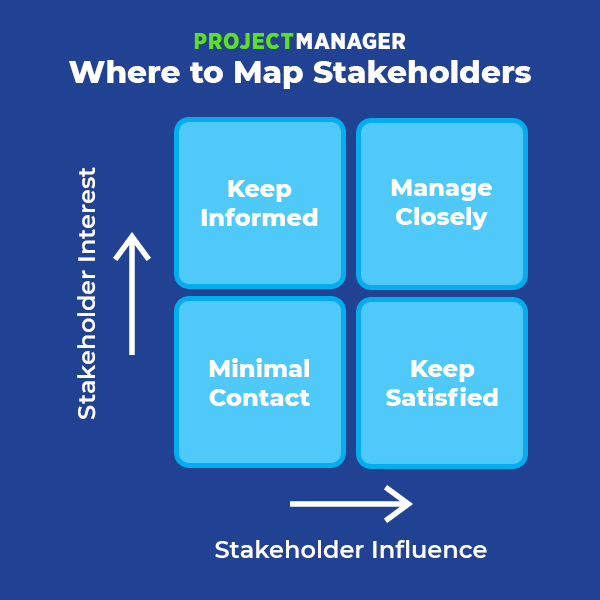
Stakeholder Analysis 101: Identification, Mapping & More
5 Remote Work Myths to Leave Behind in 2020
When you Google image search remote work, you’ll find photos that tell fascinating stories about the work style.
For example, you might find a relaxing image of a woman working with her laptop on the beach — without a care that sand or water could destroy her hard drive.

Or, you might discover a scene where a man logs into a team video chat after a treacherous climb to the top of a mountain.

As you get deeper into the results, the visual narrative gets more mystifying. You might even find a scene from sci-fi drama where a remote employee ventures to the moon just to avoid his colleagues.
But, as HubSpot Marketing VP Kieran Flanagan likes to point out in his tweets — this is not the reality of remote work:
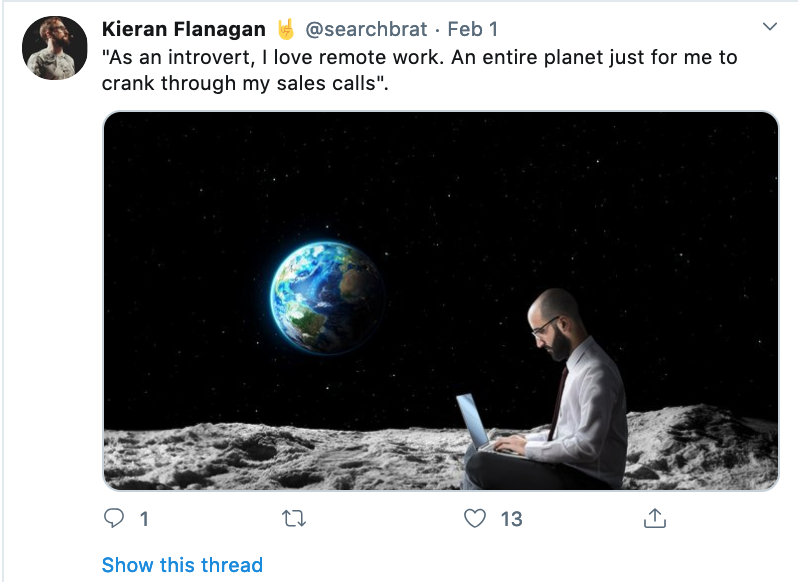
While some stock image companies might like to assume that all remote employees are introverts who work antisocially from the Moon, this is far from the truth.
And although more traditional employers might worry that remote employees aren’t as productive as their in-office counterparts, this work style is being implemented more heavily around the world because it provides so many benefits to employees and companies.
Not only do remote workers save companies money, but remote work opportunities increase job retention and allow employers to globally hire diverse or innovative employees that they couldn’t have otherwise due to location limitations.
Not to mention — for every myth, there’s almost always a research-proven benefit that debunks it.
To give employers and prospective remote employees an accurate look inside the workstyle, I asked a handful of colleagues within our growing remote workforce to reveal the biggest myths they’ve ever heard — and what the real story behind them is.
5 Remote Work Myths to Leave Behind
1. “Remote employees are lazy and barely do work.”
When you’re working remotely, your in-office colleagues and superiors usually have no clue what you’re doing at any given moment.
Because remote employees aren’t sitting next to bosses or colleagues, skeptics assume that they do less work than employees who can’t easily slack in an office setting.
Time and time again, this theory has been disproven. In fact, many remote workers say they actually work longer hours than office employees who have hard stops at the end of the day.
“Now that my office is in my house, I’ve found that I work longer hours but more flexible hours which has improved my quality of life,” says Tony Baum, a Colorado-based HubSpotter. “In addition, my performance has increased since I’ve started to work remotely now that there are fewer distractions in the office and I can focus on my work day-to-day.”
“Studies show that remote employees work longer hours than the average employee. I can attest to that personally,” adds Elle Fening, an Inbound Success Coach who’s held remote roles for more than 13 years.
“As the lines between home and work blur, it’s hard to know when to walk away from the office. It’s too easy to open up the laptop, work on a task, and find yourself still staring at your computer three hours later,” Fening says.
2. “Remote employees as lonely.”
Because remote employees don’t work on a floor filled with cubicles and other employees, people often think that they don’t like to talk to others or aren’t good team players. Meanwhile, some who are interested in working remotely worry that they won’t gain valuable in-person connections with other people.
“On paper, working remotely can seem really lonely — but it doesn’t have to be,” explains Lestraundra Alfred, a staff writer for the HubSpot Sales Blog.
“Working remotely, I’ve learned the importance of remaining in constant communication with your team about your wins, challenges, and priorities,” Alfred says. “Although you can’t necessarily walk a few feet to your colleague’s desk when you have a question, you don’t have to be an island of one — and being intentional about communicating with your team is a huge help.”
Ben Johnson, who works remotely in Freemium Acquisition, echoed Alfred’s statement.
“Before I started a remote role, many people warned me that working away from an office would make me a hermit,” says Johnson. “I’ve actually taken the remote opportunity to be more social — proactively scheduling lunches, coffees, and coworking with others. I’m meeting new people and having more regular meetups with friends.”
To stay visible and continue to socialize with employees, like Johnson and Alfred, you should take steps to connect with your team virtually, such as having video coffee chats or regular check-ins with team members. This facilitates a strong relationship with team members even if you aren’t in the office that often/
3. “You’ll have a way better work-life balance.”
When you envision someone working from home, you might imagine them doing a few work tasks, then taking on other home-life related tasks, such as taking care of their kids, cleaning the house, or cooking dinner for the family. In reality, successful remote employees sit at their desks during work hours and avoid home-life interruptions at all costs.
Rebecca White, a junior staff writer for the HubSpot Blogs, warns that “everyone around you” will think that working remotely means you have more time to manage your personal life.
“You still have a job to get done, but sometimes people in your life assume they can walk up and talk to you, hang out, or ask you to run errands,” White says.
So how do you fix this issue? White advises that remote employees be blunt and fully transparent with friends or loved ones.
“You have to be able to say, ‘I’m sorry, I’m at work right now, let’s discuss this when I’m not working,’ which can be hard to do,” White concludes.
4. “You can’t be a people manager if you’re remote.”
While traditional employers are skeptical of hiring remote employees that they can’t monitor in-office, imagine how they might feel about managers.
In fact, one of the biggest myths that HubSpot has disproved time and time again is that “remote employees can’t be managers.
Actually, a large chunk of our more than 300-person remote workforce is made up of mid to high-level managers.
Even on my small blog team, we have two full-time remote people managers who smoothly work with and supervise team members from their homes in different states. As we continue to increase our blogs annual traffic and churn out dozens of high-quality blog posts each week, it’s clear that these managers’ remote statuses aren’t hindering our performance. In fact, their expert insights actually help us work better and more effectively.
5. “You’ll have plenty of time for self-care if you work remotely.”
When you start out as a remote employee, you might be excited about what your flexible schedule will allow you to do.
For example, you might think to yourself, “Hey, I’ll actually use that gym membership.” or, “Maybe I’ll take more time for meditation when I’m off the clock.” If these thoughts have passed through your mind, think again.
Meg Prater, the HubSpot Blog’s Managing Editor, learned early on that the remote lifestyle is actually incredibly busy.
“I always thought I’d turn into a super-athletic woman when I became remote. I thought I’d go to yoga every day during lunch, take up running as a mid-morning break. It turns out, I sometimes forget to take a break long enough to refill my coffee cup — let alone run to a yoga class mid-day,” Prater reveals.
Prater adds, “I’ve been really trying to be better about making time for myself, but it’s been way harder to carve out that time than when I had a 9-to-5 in-office job with a hard stop.”
Christina Perricone, a marketing manager for the HubSpot Blogs, similarly echoed this sentiment.
“Work-life balance can become a distant goal when you start working remotely. Without hard time cut-offs, it’s very easy for work to bleed into every area of your life. At best, those lines become blurred. At worst, work becomes your entire life,” Perricone explains.
“I think this happens for two reasons,” Perricone adds. “First, the internal pressure to prove to your employer that you’re being productive. Second, an inability to set boundaries.”
As a remote employee, it can be extremely helpful to create set hard work and personal life schedules to ensure that you’re getting a proper balance of both. To make sure your schedule is respected by teams in other time zones or locations, it can be helpful to have a shared Google Calendar where you show your availability, working times, and off-the-clock hours. For more tips on how to improve remote work-life balance, check out this blog post.
Navigating Remote Work Myths
When it comes to remote work, there are plenty of studies and first-hand employee stories that debunk most of the worst myths out there.
As you’ve seen above, the myths surrounding “poor work ethic” or “less career opportunities” are incredibly false. As a remote employee manager or someone considering a remote workstyle, you’ll want to continue to do read up on this workstyle to discover real research-backed benefits and challenges related to it.
To learn more about successful work-from-home strategies, check out these tips from remote HubSpot employees, this guide to gaining company visibility, and this helpful list of remote work stats.
If you work from home part-time or full-time and want to create an effective workspace, scroll through this visual rundown of our favorite remote setups.

How Employees Can Improve Organic Reach and Engagement
Want more organic reach for your social media content? Have you considered working with select employees to expand your reach? In this article, you’ll discover how to identify and work with in-house influencers to improve organic reach and engagement for your social media content. Why Use Internal (In-House) Influencers? Among your brand’s internal stakeholders, you’ll […]
The post How Employees Can Improve Organic Reach and Engagement appeared first on Social Media Marketing | Social Media Examiner.
from Social Media Marketing | Social Media Examiner https://ift.tt/2VYJtAZ
via socialmediaexaminer
How to Promote Your Local Business
Last year, I decided that I wanted to invest in personal training.
As a lifelong sedentary person, I realized that I didn’t know how to start, so I went to the almighty Google machine.
I typed in “personal trainers Orange County,” looked at the top results, and examined the reviews.
Before scheduling any consultations, I narrowed down the options based on their fitness philosophy (seen on their website) and the most highly rated.
When searching for a local business, this approach and process isn’t unique.
In fact, 90% of consumers used the internet to find a local business in the last year.
That’s why, as marketers, our businesses have to show up when people are searching for local companies online.
Below, let’s review the top strategies to promote your business locally.
1. Advertise with local audience targeting.
Online advertising is one of the main ways to show up in local searches. In fact, you should use both social media and search engine advertising to promote your business locally.
With local advertising, you’ll have to set up location targeting and write copy that uses specific language targeted to your local audience.
And with marketing tools like HubSpot, you can use local audience targeting directly in your software.
With local audience targeting, you can choose a specific location to show your ad. This means using zip codes or geographic regions.
However, local audience targeting isn’t just about selecting a certain location. It’s also about using the right keywords and the right language to appeal to that audience.
For instance, you can use locations in your page titles and meta descriptions. Just adding the words “Orange County” in your description could mean the difference between a click and a scroll by.
Additionally, you should use tools like Google Trends to see which keywords are more popular in a given location. If you serve several locations, you might choose one keyword over the other.
In my example, perhaps the term “fitness instructor” is more popular than “personal trainer” in Southern California. If that’s the case, then personal trainers should adjust the language in their ads.
Alongside advertising, you might be investing in public relations as well. If so, don’t forget to have a local PR strategy.
2. Create a blog strategy catering to a local audience.
We’ve been fans of the blog for a long time at HubSpot. That’s because you can use your blog to attract the right audience and convert visitors who are interested in your product.
This is especially true for local businesses.
To start, blogging is an important SEO strategy to consider. By creating educational content, you can rank for local keywords and raise brand awareness.
The more content you have that ranks, the better.
Plus, with HubSpot’s marketing tool, you can get instant SEO suggestions for your blogs as you write them.
To further promote your local business, you can cater your blogging strategy to your local audience. This means that you can create blogs like “best places to eat in OC” if you have a restaurant.
Local guides and tips and tricks posts are popular among local audiences. When users are searching for a local business online, you want your blogs to appear on search results.
3. Post locally appealing content to social media.
So, in case I haven’t said it enough, posting local content is a great way to attract a local audience.
I’m repeating this idea because it’s that important, whether we’re discussing blog posts, search strategies, or social media.
I’ll say it again: The content you post should appeal to your local audiences.
In regards to social media, this means that you’re using the right hashtags for your area and tagging the locations in your posts.
Additionally, being active on social media can help you rank higher in search engines. The more active you are online, the easier it is for local audiences to find you.
Again, using a marketing tool like HubSpot can help you do this in one place.
4. Get set up with online directories.
Don’t forget to get set up with online directories. It’s perhaps one of the most important components of promoting your business locally.
This includes directories such as Google My Business, Yelp, Facebook, or Bing. Tools like Moz Local can help you get this done in one place.
With data aggregator tools, your local information will be sent out to several directories. Plus, they can help keep your data consistent.
Having a different address or phone number on your Facebook and Google will confuse your audience. When audiences are confused, they stop considering your company in their purchasing decision.
That’s why it’s so important that your name, address, and phone number (NAP) is consistent online.
Additionally, your online directory listings should include reviews. Reviews are one of the main factors of a user’s purchasing decision when looking at local businesses. Just think back to my search for a personal trainer. I only considered the highly rated trainers.
Plus, all of this helps with your local SEO. Being visible on directories and in reviews can help improve your search rankings, making it easier to find you online.
5. Be involved in the community.
While promoting your business locally can seem like a hard task, just being involved in your community can make a big difference.
Community events are a great way to get in front of your local audience.
For example, if there’s a local fundraiser, maybe you want to become a sponsor. Or perhaps you want to get involved with local charities. Or maybe you want to become involved with the local chamber of commerce.
These tactics can help you raise brand awareness locally and promote your business to your local audience.
6. Create a loyalty program.
Loyalty programs are a great way to keep people coming back for more.
When you create a customer loyalty program, it should be fun, and ultimately, deliver value to your customers.
Perhaps customers can get points and redeem rewards. Maybe they have to play a game to get points. Either way, they’re more likely to keep coming back.
People like to have fun and this will help them create a connection with your brand, which is important to retaining customers.
In fact, Sophia Bernazzani says “Studies show that customers who have an emotional connection to your brand tend to have a lifetime value that’s four times higher than your average customer. These customers spend more with your business, and therefore, should be rewarded for it. After all, you need them the most.”
Whether you’re a new or established business, you should consider creating a loyalty program to incentivize repeat customers.
7. Build an email list.
Once you’ve started to gain traction as a local business, either with your customer loyalty program or through local search marketing, you should start to grow your email list.
Email marketing can be vastly underrated, even though it’s still one of the most effective marketing channels.
When it comes to promoting your business locally, you can use segmented email lists to create campaigns targeted directly to your local audience.
If you haven’t started an email list yet, building an email list doesn’t have to be hard. Keep in mind that your emails should provide value to your audience.
Ultimately, you should be using the methods above to collect emails. For example, if you’re sponsoring a charity event, make sure you have a table and email sign up list. Or if you have a customer loyalty program, you should be collecting email addresses to send them rewards and exclusive deals.
To get started sending emails, make sure you have an email marketing tool like HubSpot.
8. Use traditional methods.
We would be remiss if we didn’t mention traditional methods can also be used to market your local business.
For example, you can contact your local press and get spots on the local radio show or in the local newspapers to raise visibility.
Additionally, traditional methods like direct mailers are great for promoting your business locally. With mailers, you can reach your local audience and build brand awareness.
Promoting your business locally can seem like a daunting task. But it doesn’t have to be. There are plenty of methods you can use to show up online and in the community to raise brand awareness on a local level.

What You Need to Know About Millennial Blog Readers
I’m a millennial.
Every time I think about making a big purchase, want to learn about new Twitter or Facebook updates, or even plan a trip, I do research. And I always take the same first step: I read a blog post I find on social media.
You may run a blog that’s struggling to gain millennial readers. Your problem might not be the content you’re posting, but how you’re executing and promoting that content.
For instance, when you write product roundups, are you including all of the necessary information? Are you writing technology demos for an audience that most likely grew up with technology?
Understanding millennial behavior is the key to learning how to cater to millennials blog readers. I use blogs for research, so I’d gravitate towards a blog that provides ample information in their product reviews and posts.
When writing for millennials, are you thinking about how your blog will benefit them? If not, we’ve collected some important stats about millennial blog readers that can help. Every audience is different. Here’s what to know about yours:
1. Millennials and ecommerce statistics
Ecommerce is a way to sell goods and services online. Millennials are engaged in ecommerce heavily, as shown by the statistics below. This is good for bloggers who post a lot of roundups or “Best of” content — your blog could be the place millennials turn to before they begin their buyer’s journey, so it’s important to remember to include the necessary information they need, such as price and links to purchase. Here are some statistics to support the case for ecommerce:
1. Millennials make up to 85% of online shoppers. (Source: Statista)
Takeaway: More than half of millennials are making purchases online, so make sure, when blogging for millennials, that you keep in mind that ecommerce posts or roundup posts are going to be most beneficial if they include links to purchase.
2. Over 70% of millennials and Generation Z are members of loyalty programs (Source: Oracle)
Takeaway: One way to drive millennials to your blog is to turn blog newsletters into loyalty rewards programs that give subscribers access to exclusive posts or content in exchange for signing up. That would entice a millennial to check out your content.
2. Millennials and technology statistics
Most millennials grew up with technology and know how to use it. This also goes for social media tools — 90% of millennials use social media.
For example, you can probably skip a full-page explanation of what an Instagram Story is. A one-to-two paragraph explanation would suffice.
1. 90% of millennials have a smartphone — 93% of whom use it to access the internet — and 53% own tablets. (Source: Pew Research)
Takeaway: Most millennials have a smartphone and probably use it to read your blog content. To make sure their experience is enjoyable make sure your blogs are optimized for desktop and mobile.
2. 75% of millennials watch video on social media daily. (Source: HubSpot)
Takeaway: If three-quarters of millennials love video content, and watching it on social media, there’s a fun post idea for you; Round-up funny or impactful videos you see on social media. The angle can be anything from “Videos on Facebook to Waste Time” or “Short Videos About Marketing Every Millennial Can Enjoy”.
You can also think about how to incorporate more of a tech focus in your blogs. Millennials are surrounded by technology and are quick to adapt to its advancements.
If you’ve been avoiding diversifying content, maybe that’s something that will pull millennial readers in. Maybe a thought leadership piece about your blog’s industry and its role in the tech industry is the home-run post you need to attract millennial readers.
3. Millennials and social media statistics
As marketers, we know the importance of social media as a business tool, but a large reason why it’s so successful as a business tool is how millennials have shaped the ecosystem to make social media part of their lifestyle.
If you’re blogging for millennials, you know they’re going to be on social media. Promoting the blogs across platforms could bring you a big boost in readership.
1. 90% of millennials can be found on Facebook. Source: HubSpot)
Takeaway: Millennials are obviously on social media, most notably Facebook. If you want more readers, consider creating a Facebook Business page and use their tools to increase readership.
2. 80% of millennial Pinterest users say that the platform helps them decide what they should buy. (Source: HubSpot)
Takeaway: Are your blog posts pinnable? Pinterest is a social media app that helps its users save and organize internet content they want to remember. Making posts that are pinnable exposes your content across more than one front, and keeps the name of your site in the minds of potential buyers.
4. Millennial web behavior statistics
Earlier, we talked about how millennials love to shop online. They also love to do research before committing to a purchase. One way you can leverage this in blogging is by giving them all the information they need to make that purchase.
1. Social media is the most popular form of entertainment for millennials, who spend an average of over two hours a day social networking. (Source: GlobalWebIndex)
Takeaway: To find entertainment, millennials go online. If you want your blog to engage millennials, don’t hesitate to add some fun into the mix. Meme roundups, a funny video, or personality quizzes add diversity to content, and, if posted on social media, have a better chance of catching the eye of a young adult.
2. 36% of millennials don’t trust social media advertising. (Source: Statista)
Takeaway: Millennials are skeptical of ads on social media websites, so to bring millennial readership to your blog, keep in mind that a percentage of your target audience is likely to not engage or trust a paid ad.
3. 78% of millennials trust online reviews for brands or products. (Source: Morning Consult)
Takeaway: If you’re posting a lot of thought leadership content, think about interviewing an industry professional advanced in their career or reach out for a guest post. Millennials would probably be drawn to reading about a product from a senior product designer rather than someone on the advertising team.
Millennials conduct extensive research online as part of the shopping process. From dresses to apartments, millennials stray away from traditional advertisements and instead look to friends, peers, and websites they deem credible. Becoming one of those credible blogs that offers millennials specs, functions, prices, and demos will earn you millennial fans.
5. Millennial lifestyle statistics
It’s important to think about how millennials live their lives, not just how they interact online. By knowing how their routines fit in with your blog, you can better optimize your content to make the millennial experience on your website one that’s more engaging for them.
1. 61% of Millennials are more likely to share brands they identify with on social media. (Morning Consult)
Takeaway: Think about how you can create an experience for millennial readers that connects them to your brand. How can you make a blog more visually engaging? Have you made it shareable?
Thinking about and implementing these elements in your blog will improve the readability for millennials, and word-of-mouth will probably earn you more millennial readers — especially if your blog has social media sharing buttons.
2. Millennial consumers show the strongest preference for video content from brands. (Source: HubSpot)
Takeaway: Videos capture the attention of browsers, and are more engaging than just text. Though blogs are usually long-form written pieces, you can break up the text by including video, or even shooting a few of your own videos to take the place of or enhance the body of a blog post.
Blogs have some characteristics that millennials are drawn to, like serving as a reference for future purchases, researching brands, or learning something new. If you are looking to gain millennial readership, think about the way they behave online, and if the posts you’re creating cater to the millennial audience.

Gen Z is Entering The Workforce: 30 Stats Marketing Managers Need to Know
It’s hard to believe Gen Z is already old enough to start working.
It seems like just yesterday that business experts were writing about how my own generation — millennials — was about to completely upend the workforce.
As I’ve watched journalists, researchers, and general social media users write about millennials and now Gen Z, I’ve found that they often say similar things. For example, although researchers have identified that each generation was more tech-savvy and career motivated than the last, we still hear myths saying that both age groups are “entitled and less motivated to earn money.‘
At this point, millennials have generally disproved the worst stereotypes related to our (lack of) ambition by becoming more educated than some generations before us, growing more frugal about our finances, and having higher expectations for our customer experiences.
Gen Z is falling within a similar cycle of critique as they prepare to enter the workforce. Just like with millennials, internet chatter argues that they’re “spoiled,” “dependent on their parents,” and “terrible with money.”
As a future Gen Z manager or colleague, it’s important for you to separate myth from reality.
If you’ve heard some of the more negative the rumors about Gen Z, you might be worried that their attitudes around work will hinder your company in the future. However, taking the time to research the generation will help you realize that — like most generational assumptions — these rumors are mostly sweeping generalizations. In fact, a number of credible sources actually predict that this generation will be more ambitious, well educated, humble, and even more innovative than past age groups.
To help you get an idea of how Gen Z talent could benefit your workplace in the future, here are 30 stats that you can keep in mind as they work their way into the labor force..
Gen Z Population
- In 2019, Gen Z outnumbered millennials, making up 32% of the world’s 7.7 billion-person population. (Bloomberg)
- Gen Z is expected to cause an influx of roughly 60 million job seekers in the next decade. (CSP.edu)
- By 2026, it’s expected that Gen Z will make up 82 million people within the U.S. consumer population. (Business Insider Intelligence)
- Although they’re interested in learning hard or technical skills, 37% of Gen Z worries that technology is weakening their interpersonal communication skills (CSP.edu)
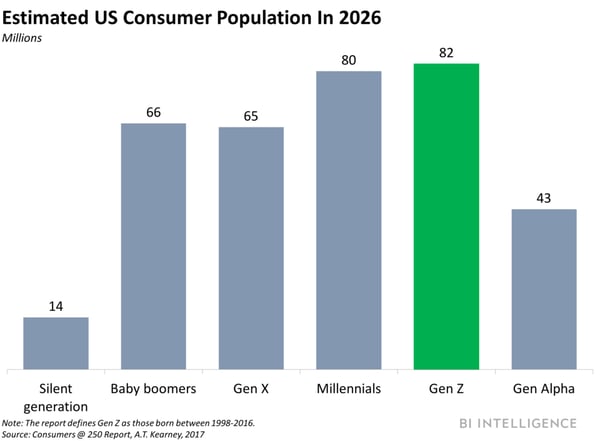
Source: Business Insider Intelligence
Skills and Strengths
- Over 76% of Gen Z recognizes that the skills needed in today’s workforce differ from the skills needed in previous workforces. (LinkedIn Learning)
- With the evolution of workstyles and emerging technology, 59% of Gen Z professionals think their jobs won’t exist in the same way in the future. (LinkedIn Learning)
- When it comes to discovering new skills, 62% of Gen Z will take classes or learn new skills if it makes them better at their job, while 59% will do the same if it will boost their salary. (LinkedIn Learning)
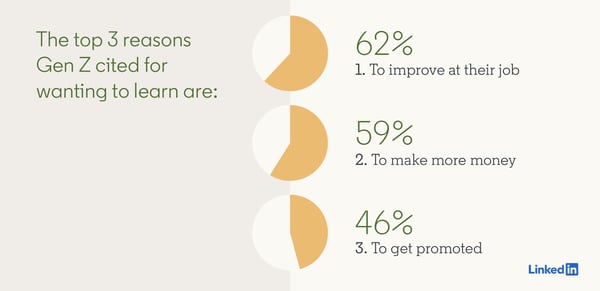
Source: LinkedIn Learning
- Although workplaces are putting more of an emphasis on hiring soft skill talent, 62% of Gen Z feels that hard skills will be more vital to getting a job. (LinkedIn Learning)
- 51% of Gen Z agrees that they’re more creative than previous generations. (Snapchat)
- 77% of the generation reports doing creative activities, such as painting when offline. Meanwhile, 48% say they regularly do creative activities, like meme creation, when online. (Snapchat)
- Despite their connection to social media, 51% of Gen Z prefers to communicate with coworkers, friends, and family face-to-face rather than through messaging. (2019 Yellow Recruiting Study)
- Nearly 60% of Gen Z wants to learn a new skill but doesn’t have the time. (LinkedIn Learning)
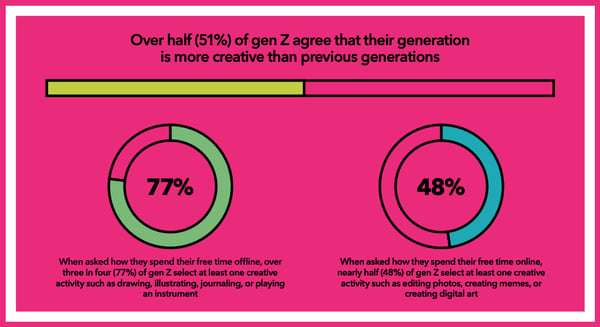
Source: Snapchat
Academic and Career Motivations
- Over 70% of Gen Z professionals say salary is a “top motivator” in their career.. (CSP.edu)
- When it comes to job benefit requirements, 70% of Gen Z calls health insurance a “must-have.” (CSP.edu)
- In 2018, roughly 10% of Gen Z was saving for college. (National Society of High School Scholars)
- 35% of Gen Z students expect at least one job offer by the time they graduate from college. (2019 Yello Recruiting Study)
- About 35% of the age group plans to start saving for retirement in their early 20s. (CSP.edu)
- 59% of Gen Z will learn new skills if they result in higher pay. (LinkedIn)
- Although Gen Z is career-motivated, only 49% counter job offers, while 70% of millennials will negotiate higher salaries. (2019 Yellow Recruiting Study)
- Nearly a quarter of Gen Z college students start their job search before their junior year. (2019 Yello Recruiting Study)
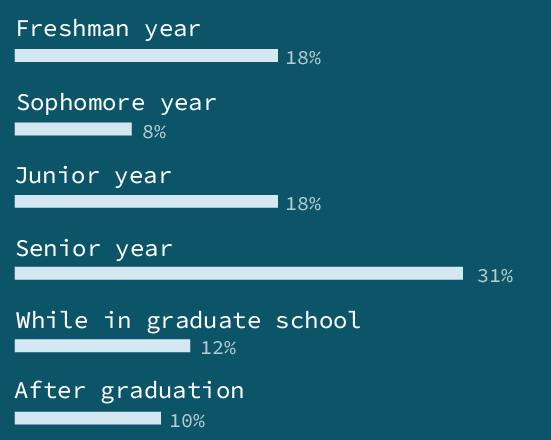
Source: 2019 Yellow Recruiting Study
- Only 38% of Gen Z says work-life balance is an important aspect of a job, while 58% even say they’ll work nights and weekends. (CSP.edu)
Culture and Diversity
- 48% of Gen Z identifies as racially or ethnically diverse. (Pew Research Center)
- When a form requires a person to select a gender, 59% of Gen Z thinks that the form should include an “Other” option. (Pew Research Center)
- Half of Gen Z says society isn’t accepting enough to people who don’t identify as men or women. (Pew Research Center)
- Despite Gen Z’s connection to technology and social media, more people in the age group report feeling lonely than previous generations (Cigna U.S. Loneliness Index)
Relevant Behaviors
- Only 23% of Gen Z expects text messaging to be an essential part of workplace communication. (CSP.edu)
- When it comes to interactions with their bosses, 40% of Gen Z wants daily communication. (CSP.edu)
- Less than 30% of Gen Z will share personal data, such as health, wellness, location, or payment information, online. (Institute of Business Management)
- More than half of Gen Z spends over 10 hours a day on an electronic device. (CSP.edu)
- While 49% say social media is an important part of their lives, 60% still worry it’s too public. (CSP.edu)
Drawing from the Gen Z Talent Pool
While Gen Z is still just stepping into the workforce, this age group’s versatility and adaptability might benefit employers in the long run. For example, while they’re technically and digitally advanced compared to past generations, they still place importance on critical marketing soft skills such as interpersonal communication and creativity.
Additionally, Gen Z is one of the most diverse generations with a major interest in learning. This not only means that Gen Z will take courses or feedback to better themselves, but they might offer companies a variety of new ideas and insights that could make them more competitive.
If you’re a marketing manager of future Gen Z colleagues, you should be ready to embrace their creativity, digital strategies, and youthful input, rather than worrying that the new generation will completely shake up all of the tactics you’ve created in the past.
To learn more about Gen Z, check out this blog post with a number of other relevant stats. Want to know more about how Gen Z compares to the millennial generation, here’s a guide to help you.

How to Make Your First Instagram Stories Ad: A Full Walkthrough
Want to create Instagram Stories ads but don’t know where to start? Wondering how to make attractive Stories ads without a design background? In this article, you’ll discover how to create, set up, and run an Instagram Stories ad in Ads Manager. What Makes an Effective Instagram Stories Ad First, let’s talk about the differences […]
The post How to Make Your First Instagram Stories Ad: A Full Walkthrough appeared first on Social Media Marketing | Social Media Examiner.
from Social Media Marketing | Social Media Examiner https://ift.tt/2TPgLzN
via socialmediaexaminer
Twitter, Facebook, or Instagram? Which Platform(s) You Should Be On
When you begin implementing a social media strategy for your business, one of the first questions you’ll ask yourself is this one — Should my business be on Twitter, Facebook, or Instagram?
Those three social media sites offer considerable opportunities to connect and engage with a network, increase brand awareness, and drive traffic to your site. But they’re also incredibly different in terms of purpose.
Ultimately, Facebook’s purpose is to connect people with their friends and family. People use Facebook to share photos, videos, and general updates on their lives.
Twitter, on the other hand, is used to share ideas, real-time information, and trending news. While people may also use Twitter to connect with friends and family, they largely use it for a bigger purpose — to connect to the wider world as a whole, and hear what’s happening (in 140 characters or less).
And then, Instagram is used to share photos and videos. People mainly use this app to post their “highlight reel” and follow influencers. This is where people become a part of a social media community.
Of course, this still begs the question — where does your business fit into all this? To explore the pros and cons of Twitter, Facebook, and Instagram, we’ve created a comprehensive breakdown of the three platforms.
Keep reading to figure out which platform is a better business investment for your company.
Twitter vs Facebook vs Instagram Users
Twitter vs Facebook vs Instagram Demographics
To start, let’s consider the potential demographic your business could reach on each platform.
The total number of U.S. adults who use Twitter is 24%. By comparison, Facebook undoubtedly reaches a wider demographic, with nearly 70% of U.S. adults on the platform. On the other hand, 37% of U.S. adults are on Instagram.
Twitter typically appeals to a younger demographic — 40% of Twitter users are between the ages of 18-29, while less than 20% of people ages 50 and up use the platform.
While Facebook also appeals to the 18-29 age group (attracting over 80%), it proves more popular for an older demographic, as well. 65% of people ages 50 and up use Facebook.
When it comes to Instagram, the largest demographic is similar to Twitter. In fact, 75% of Instagram users are 18-24.
In terms of mass appeal, then, Facebook wins by a landslide.
Twitter vs Facebook vs Instagram Engagement
It’s equally critical you determine quality over quantity — how long does each site’s audience stay on the platform? Or, alternatively, how many minutes per day do they spend on each?
Here’s a quick breakdown — roughly 46% of Twitter users are on the platform daily, and 81% of millennials check Twitter at least once per day.
Since Twitter is popular with journalists, politicians, and celebrities, many users turn to Twitter for trending news. In fact, 74% of Twitter users say they use Twitter to get their news.
Additionally, Twitter accounts for 16% of referrals to longer articles from social sites and 14% for shorter news articles.
With all this in mind, you might ask yourself — does your business have content that aligns well with Twitter’s fast-paced community? If you have quick, easily digestible business tips or news articles you’re eager to share with your audience, Twitter might be a better bet.
However, it’s important to note, Twitter is meant for quick, compelling 140-character statements that can quickly get buried under new Tweets. To build brand awareness, Twitter might be a good platform. However, its fast-paced nature might make it difficult for you to gain traction on a post for long.
In terms of long-term engagement, then, Facebook is a superior alternative. For instance, for every one million Facebook followers, brands can expect to receive about 700 likes, comments, and shares. Alternatively, for every one million Twitter followers, brands can expect about 300 interactions.
Additionally, people tend to check their Facebook an average of eight times per day, compared to just five for Twitter. If Facebook is more addictive by nature, it makes sense you might consider putting more effort into appealing to a Facebook audience, instead of Twitter.
On the other hand, when it comes to Instagram, users only check the platform six times a day. However, it’s important to note that accounts with fewer followers actually receive more engagements. In fact, accounts with 1,000-5,000 followers typically have a 5% engagement rate. On the other hand, accounts with over 1 million followers, average a 1.97% engagement rate.
With this in mind, no matter how many followers you have, if you can appeal to your audience with the right content, you’ll likely have better engagement rates than on Twitter and Facebook.
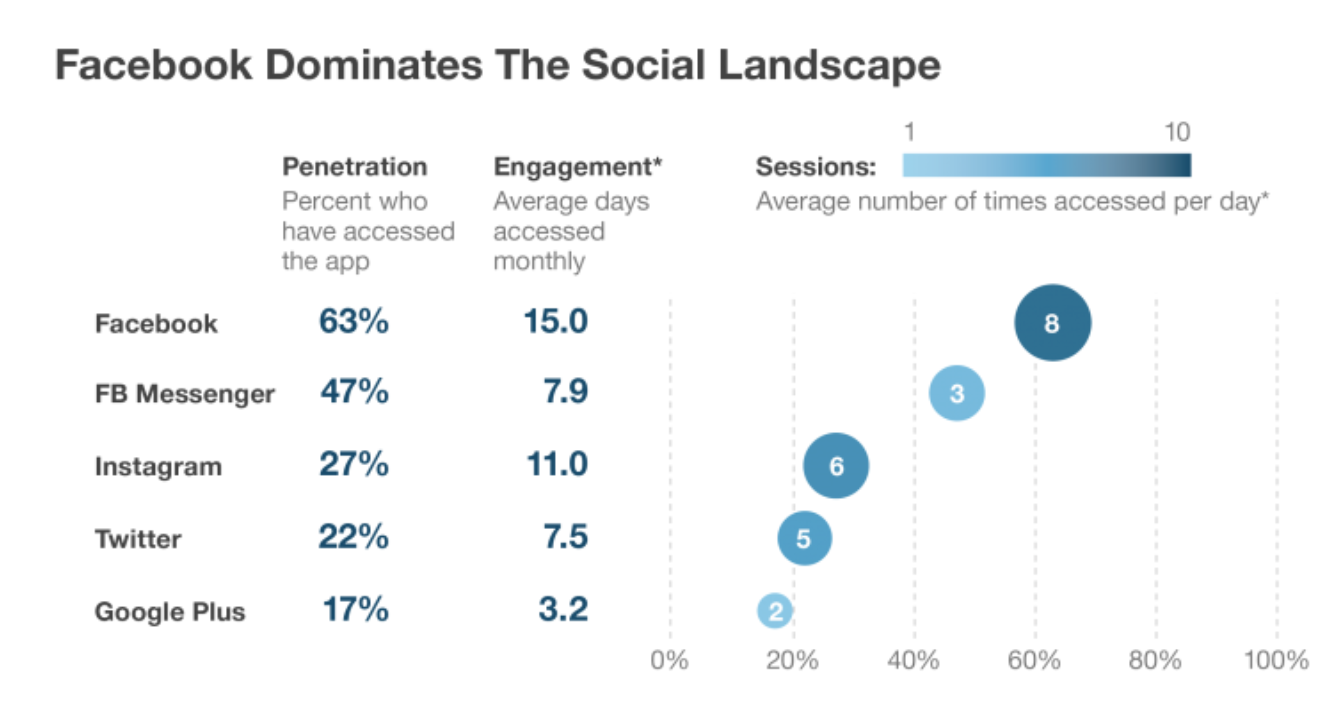
Twitter vs Facebook vs Instagram Usage
With less than 140 characters to convey your brand’s message, you might think of Twitter as your business’ “elevator pitch”. What do you want to get across to your audience quickly and succinctly?
While this might feel stressful, think of it this way — today, many of your consumers are oversaturated with content, and easily distracted. This attention-deficit lends itself well to Twitter’s platform, where you’re able to quickly engage with your consumers with less risk of losing their attention halfway through.
Alternatively, Facebook is your opportunity to engage more in-depth with an audience. You can create full business pages, share videos and images, and further incentivize prospects to engage with your brand by offering 10% off if they “like” your business page, for instance.
Then, with Instagram, you can truly create an interactive community. This is the platform where users are more likely to engage. People go to Instagram and expect to see influencers and follow brands they like.
When you consider their vastly different purposes, then, it makes sense to try both. Twitter can be seen as your initial handshake, while Facebook is that first full-length conversation.
Twitter Ads vs Facebook vs Instagram Ads
In general, advertising on Facebook and Instagram allows you to reach a larger audience. Since Instagram is owned by Facebook, they offer similar ad tools. Additionally, Facebook ads comes with some impressive targeting tools, so you’re able to narrow down salary, purchase behavior, hobbies, Facebook communities, and more.
Facebook advertising’s interface is relatively easy and intuitive for the user. Facebook ads can be relatively cheap, as well — in fact, Facebook boasts “Some people spend more on coffee each day than they do on their ad campaigns”. While it depends on the campaign you’re running, you can often set a budget as little as $2 to $3 per day.
Twitter also offers targeting capabilities, including purchase behavior, language, interest, and followers. However, Twitter advertising is typically more expensive than Facebook.
It may be worth the extra money, though — according to AdWeek, engagement rates for Twitter ads can be as high as 1-3%, much higher than Facebook’s average CTR of 0.119%.
Ultimately, it’s likely best to try Twitter, Facebook, and Instagram for a while if you’re unsure which one works better for your brand. Over time, you’ll gain valuable insights into how well your posts perform on these sites, enabling you to dedicate more time to one over the other. Since they’re free to use, there’s no harm in initially trying all three.
Once you see true, valuable engagement on one, you might then consider implementing an advertising strategy to turn that traffic into conversions.
Alternatively, try researching which platform most of your competitors use. If you work for a PR agency and most PR professionals use Twitter to promote their clients, it’s critical you also appear on the tool. On the other hand, if you work for a retail store and you find Facebook is often used for promoting retail products, it’s probably best to put effort behind Facebook.
Editor’s note: This post was originally published in February 2019 and has been updated for comprehensiveness.

25 of the Best Form Builder Tools for 2020
You’ve heard it before — forms are the gold standard when it comes to capturing leads, learning about industry trends, doing market research, and even just getting some customer feedback. It might be one of the older methods in the book, but old is gold.
Before we dive into the best form builder tools for 2020, though, let’s talk about what a form builder exactly is.
With no shortage of options, the best form builder apps tend to be quite similar and user-friendly. Whether you want to make a contact form, a sign-up form, or a survey, form tools are the easiest way to create web forms, with drag and drop questions, multiple form fields, and different color and structure options.
Once your responses start coming in, most forms will also import each entry into a spreadsheet or centralized database and send you notifications when people complete them.
Regardless of the form builder you choose, there are a few key steps you’ll want to follow when creating a form for the purpose of lead generation:
1. Identify goals of the form.
Are you aiming to generate sales leads, or are you merely planning to add contacts to your email list. Once you identify what you’re looking for from your prospects, you’ll be able to determine what information you’ll need to get from them on the form.
2. Pick a form builder tool.
Many online form builders are free or very affordable, but they might not have all the features you need. For example, some might not embed well on to the site you use because of your CMS. Meanwhile, others might not link up to your email marketing software or CRM. Figure out which tool is the best match for your business needs.
3. Include a name field.
This step is pretty self explanatory. As you begin creating a form, you’ll obviously want to get your visitor’s first and last name.
4. Request any demographic information you might need.
If you’re simply looking to add people to your email list, you probably won’t to need too much about them. But, if you’re sending out a form to generate leads or learn more about your target audience, you might want to ask a few more specific questions, such as age, gender, or location, to get a feel for who your prospects are.
5. Include an area where the user can identify a role.
Along with demographic information, you might want to find out information about your prospect’s role. This can give you added insight on the daily life of your prospect and signal how much buying or decision power they have within their company. For example, if a CEO fills out your form, they might be a stronger lead than an intern with no purchasing power.
6. Ask for contact information such as an email or phone number.
Obviously, you’ll need to get in contact with a prospect or lead at some point. However, keep in mind that you’ll want to ask for an appropriate amount of contact information. For example, if someone’s signing up for your marketing newsletter, they might just want to give their email. Meanwhile, if someone is interested in getting a demo of your product, they’ll be more likely to give their phone number or work address.
7. Include a company box.
Along with learning about a person’s role, you might also want to learn more about their company to get an idea of organizations that might be interested in your product or service. For this reason, include a form area where they can note where they work, where there office is located, and what type of business category their company falls within.
8. Ask about company size.
While a startup might not be able to buy an enterprise product, an enterprise company might want a more intricate or advanced product. Knowing the size of the company you’re going to try to sell to is important For this reason, it can be helpful to have the company size box on a form.
9. Create a follow-up email that’s triggered when forms are completed.
After someone takes the time to fill out your information, it looks polite, credible, and professional to send a thank you email or have a “Thank you.” appear on the screen. This shows the visitor that you value their information and have received their form.
Online Form Builder Tools
Form tools today usually offer many different features too, like progressive profiling, smart fields, and interactivity.
Easily build and embed forms on your site. Try HubSpot Forms for free!
Ultimately, there’s a form for each of your business’ needs and goals — and we’re here to help you pick the best-fit tool specifically for you.
1. HubSpot’s Free Online Form Builder
HubSpot’s online form builder is one of the most powerful form builder tools available. The tool combines the foundations of form creation with cutting-edge technology to give you much more capability than a normal online form builder can — and it’s also free.
Even though it’s one the more advanced form builder tools, you don’t need any technical expertise when you use HubSpot’s form builder. You can quickly create forms with the drag-and-drop form builder and convert anonymous website visitors into leads with unlimited forms, fields, submissions, and custom forms that all connect to your contact database.
Once someone fills your form out, they’re automatically routed to HubSpot CRM. Once they’re in your CRM system, you can set reminder tasks, call them, and send them one-to-one personalized emails, letting you better manage and nurture relationships with your contacts.
HubSpot’s form builder also has data enrichment for contact profiles and deep integration with HubSpot’s marketing hub, making it a good option for teams who want a single system to manage their forms, contacts, and marketing efforts.
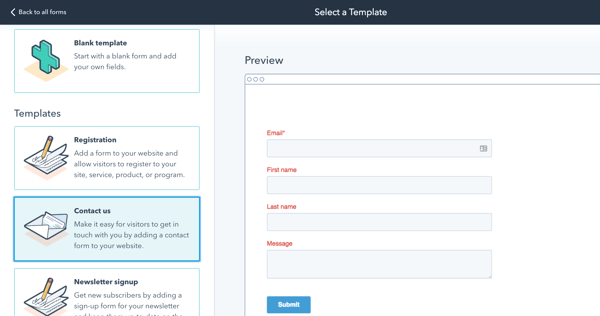

2. HubSpot’s WordPress Plugin
Have a WordPress site but still want to leverage HubSpot tools to generate leads? With HubSpot’s WordPress plugin, you can create forms, assign them within a workflow, and use them to generate landing-page leads. Contacts generated with your forms can also be stored in your HubSpot CRM.
The tool also makes the form creation process easy. Although it’s from HubSpot, you don’t need to leave your WordPress dashboard to get the same form-building experience that you can find on our Marketing Hub.

Source: WordPress.org
3. Gravity Forms
Another WordPress-powered plugin, Gravity Forms helps you create amazing forms with the help of multi-page/multi-step forms and a number of time-saving features.
With this tool, you have access to a variety of integration options and add-ons for email software, messenger platforms, payment options, and automation software. You can also create advanced forms, but, for non-techies, they can be a little complicated to set up.
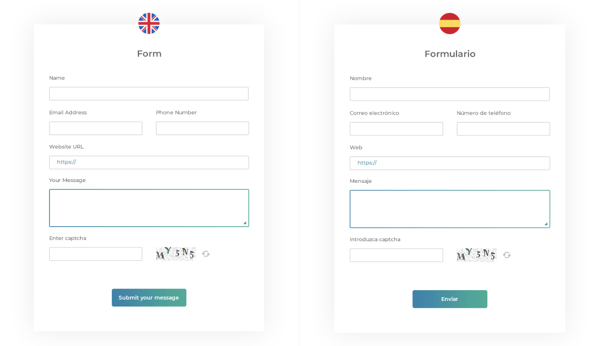

Source: WPML
4. Pabbly Form Builder
Pabbly Form Builder offers unlimited form submissions, file uploads, payment collection tools, users, storage, multi-page forms, conditional logic, and conversion rate optimization features.
The tool includes a highly customizable form builder that enables you to create, customize, personalize each form you build. You can adjust the spacing between different form fields, customize colors, shadows, borders, background, font styling, and much more.
Pabbly also offers multiple types of forms to embed on your website, sliding and pop-up forms you can use to capture leads for your business.
When it comes to organizing your form submissions, you can easily manage incoming submissions with a variety of pre-built filters, like “new” or “needs response”.
5. Paperform
Paperform is a powerful form builder with a modern UX that makes it easy to create a form in a matter of minutes. With a focus on customization, Paperform is a great solution for creating beautiful and advanced forms that suit your specific needs.
The tool features a wide range of question types, as well as conditional logic and calculation fields to help you create a smart form that interacts with your respondents in real-time. It also offers fully customizable elements, including media, typography and the ability to add custom HTML and CSS as needed.
Paperform also supports online payments and offers 1000+ app integrations to fully automate your workflows. Easily embed and share your forms, access advanced form analytics and set up automatic email responses.
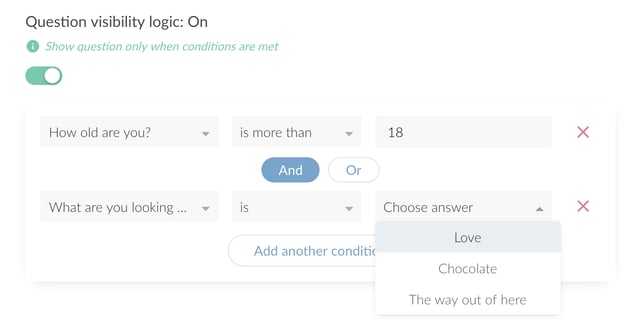
Source: Paperform
6. Forminator
Forminator is a WordPress plugin that allows you to create highly customizable forms using its drag and drop form builder. What makes Forminator unique compared to all the popular modern forms plugins out there is that it’s completely free. At this time, all features and integrations are included out of the box.
That’s not to say it lacks functionality either. Common premium form features such as polls, quizzes, frontend posting, calculations, and even accepting payments via Stripe and PayPal are all free. It is one of the most feature-rich free form plugins out there.
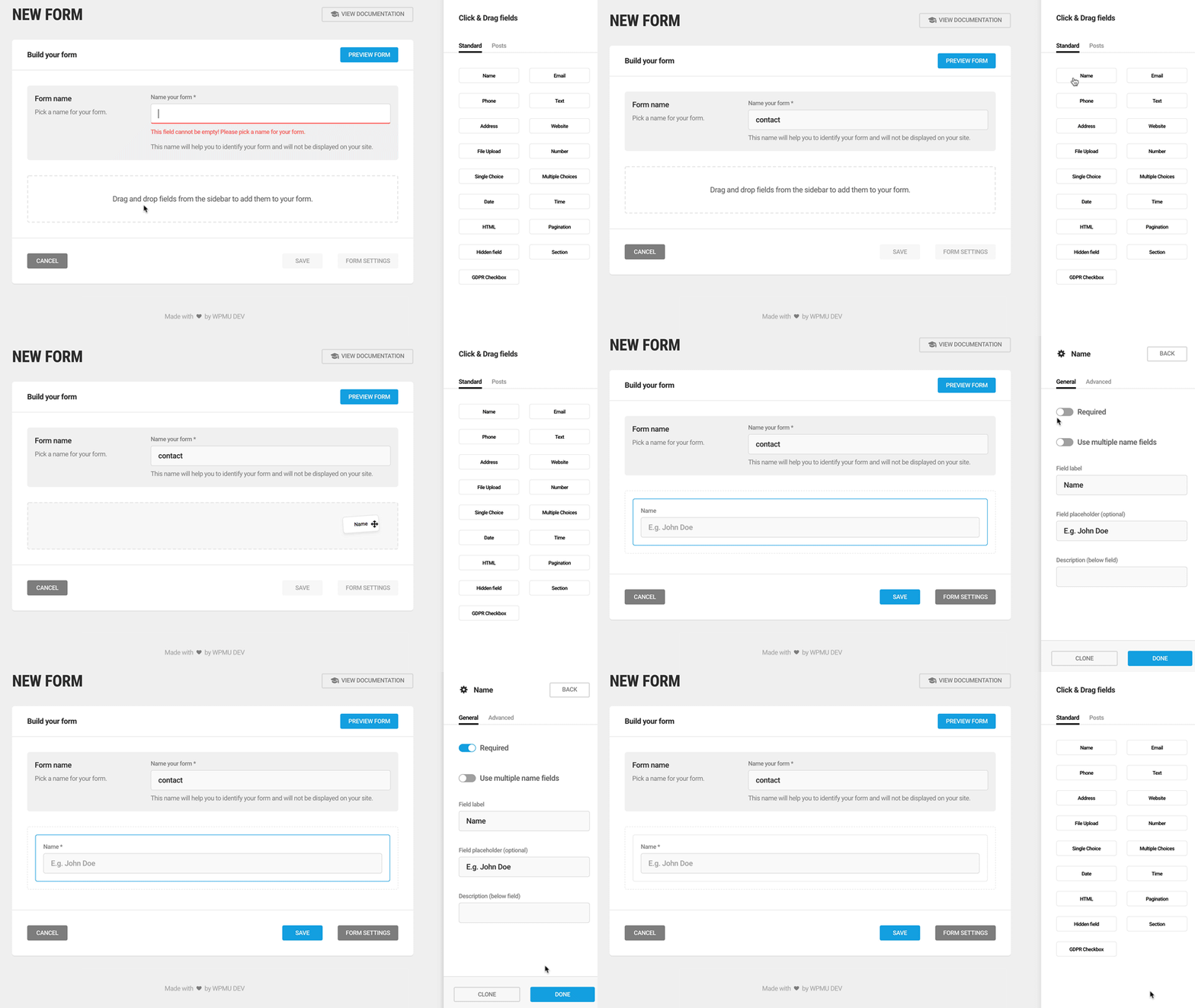
Source: WPMU DEV

7. Google Forms
Google Forms’ unique selling point is that it’s fast, free, and easy to use, with unlimited forms and entries. It’s also built into the Google Docs suite, so it automatically pulls your data into a Google Sheet for you to analyze.
While Google Forms’ design may not be customizable, this form tool is best for quick market surveys, rather than a professional survey or lead capture form placed on your website.
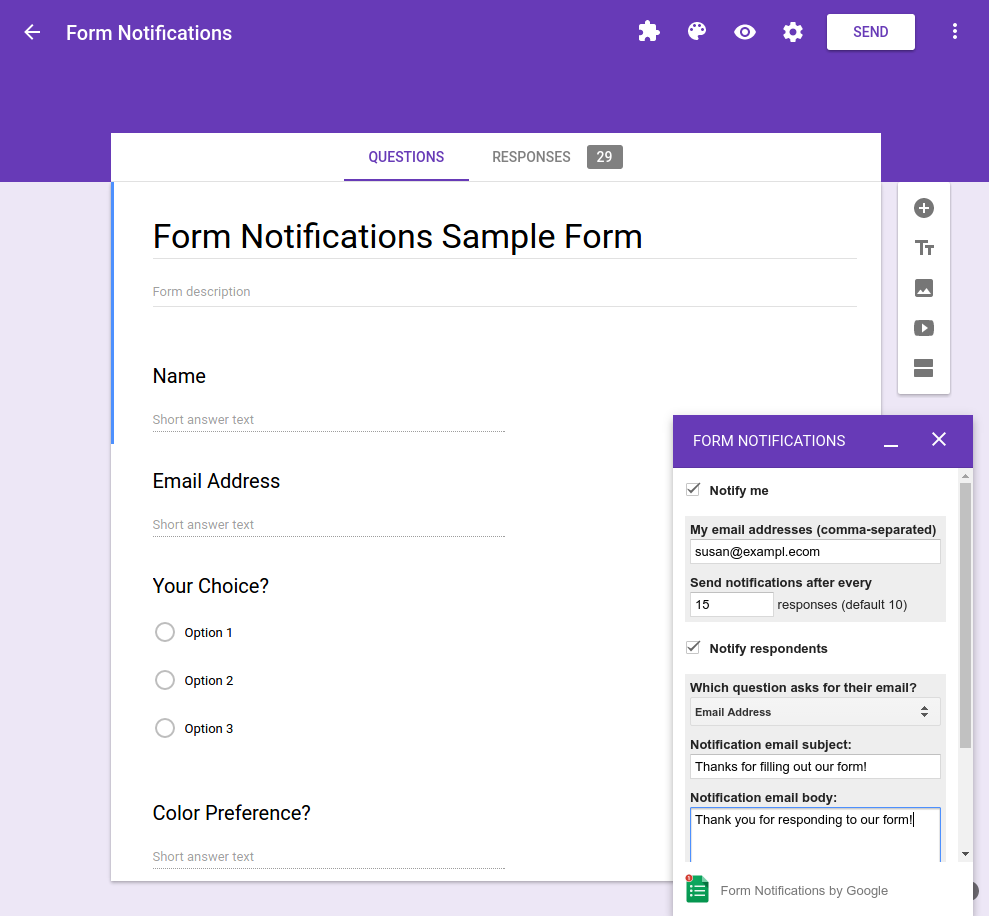
Source: Google
8. Ultimate Form Builder Lite
Ultimate Form Builder Lite is a free WordPress plugin. The tool includes five beautiful pre-designed form templates you can choose from. You can create as many forms as you want and you can also preview them before using them on your site. The forms are stored in a database that can be exported to .csv.
9. JotForm
JotForm is an online form builder with an intuitive visual editor, known for making form building faster than ever.
The tool has all the normal form building capabilities as well as unique fields to customize your own forms. It also integrates with almost every marketing platform.The free plan caps out at 5 forms, with up to a 100 entries per month.
Source: JotForm
10. Typeform
Typeform takes an innovative approach to the world of form building. With an intuitive design, the tool guides you through the form creation process one question at a time and makes the experience of building a survey fun and interactive.
Typeform is also great for customer surveys and user research — you can create and send standalone survey links out to your list. If you want to try something with an engaging, straightforward user experience, the tool is a solid option.


Image Source: Typeform
11. Microsoft Forms
Microsoft Forms is a simple, easy-to-use form creator that integrates with the Microsoft Office suite. With full customization options, users can quickly make surveys, feedback forms, quizzes, and lead forms.
Since Microsoft forms doesn’t integrate directly with an online CMS, the tool might not be the best option for lead generation. But the form builder can collect data in real-time and import all your responses in an Excel spreadsheet, so you can perform powerful yet simple analysis with Excel filters and pivot tables.
Source: YouTube
12. Form Crafts
Form Crafts is a basic form builder tool that has a user-friendly interface and simple design.
The WordPress plugin allows you to create moderately customizable lead capture forms, email sign-up forms, surveys, and feedback collection forms. One of Form Crafts’ best features is that it’ll send you email notifications about your lead generation process, so you don’t need to constantly monitor your results anymore.

Source: WordPress
13. FormTools
FormTools is a flexible form creator that focuses on feedback, data, insights, and beautiful form building.
The form builder tool allows you to create most types of forms and tracks your results on a visually appealing dashboard. FormTools also give you an option to integrate their app with a third party provider of your choosing, like Salesforce or Dropbox.
Source: Form Tools
14. Wufoo
Part of the SurveyMonkey family, Wufoo is one of the oldest form tools in the space. You can design some appealing online forms with it and it’s super easy to use.
The app also allows you to embed forms on your website, set up payment fields that are compatible with a number of payment processing services, and turn on automatic email notifications to alert you when someone fills out your form.


Source: WuFoo
15. Ninja Forms
Ninja Forms is a powerful WordPress form tool that’s used by wide range of marketers, from novices to gurus.
The tool is free, integrates quickly and easily with a number of different tools, and it can greatly boost your marketing efforts. Ninja Forms also offers unlimited forms, fields and submissions. But, sometimes, the tool lacks clear documentation and can be difficult to use when you want to customize your forms.

16. Cognito Forms
If you’re looking for a form builder with sound logic branches and robust payment fields, Cognito Forms is for you. The form tool also offers calculated fields, conditional logic, repeating fields, and more, making it easy and simple to create advanced forms.
Cognito Forms integrates with Stripe, PayPal, and Square and offers a free version that includes unlimited forms with 500 entries per month.

Source: Microsoft Store
17. FormStack
FormStack is mostly focused on building business and professional style forms. The tool’s best features include intelligent forms, built-in workflows, and seamless integrations with Google Sheets, PayPal, and MailChimp (and others through their API).
One of FormStack’s more sophisticated features is an A/B testing tool that can compare different versions of your forms and tell you what performs better.
The tool also offer electronic signatures and payments, and users can save their form drafts and return later to finish them.

18. FormSite
FormSite has all the essential features you need for cranking out some quick “prototypical” web forms. As one of the more basic form builders, it’s often used for simple contact or feedback forms.
The tool also has a number of pricing plans that can suit your specific business needs. The free version offers 5 forms each month with 10 results per form.
Image Credit: FormSite
19. Clearbit Forms
Clearbit Forms lets you leverage smart forms and flexible data enrichment technology to automatically collect specific user information. This lets you create shorter forms with less fields, and, in turn, produce happier customers (because who doesn’t love a short survey?)
With two plans designed for startups and enterprises, Clearbit can definitely meet your modern marketing needs.

Source: Clearbit
20. FormKeep
FormKeep is a tool unlike most on this list — it’s an easy-to-use tool that finds a happy medium between coded and drag and drop forms.
With FormKeep, you have the option to code your own form, style it according to your brand guidelines, and integrate it with Zapier to manage your submission data.

21. SurveyAnyPlace
SurveyAnyPlace has proven that surveys don’t have to be boring. With their gamification elements, interactive features, and incentives like coupon codes, you can make all your surveys and quizzes fun and enjoyable.
By leveraging SurveyAnyPlace’s unique approach to form building, you can easily collect leads, information, and insights from visitors.


Source: GetApp
22. Contact Form 7
One of the most popular WordPress plugins, Contact Form 7, has upwards of 5 million active installations on the CMS.
A free tool for everyone to use, it’s a super simple and basic form creator with a heavy focus on contact forms. But it’s also important to note that the tool has some limitations, especially with its customization options.

Source: WordPress
23. Conversational Form
An open source platform, Conversational Form lets you transform your web form into a simple chatbot.
By using a novel and clever way to gather data, this form builder is bound to drive user engagement. At the same time, though, due to its new entrance into the marketing space, it might be difficult to learn your way around the tool.
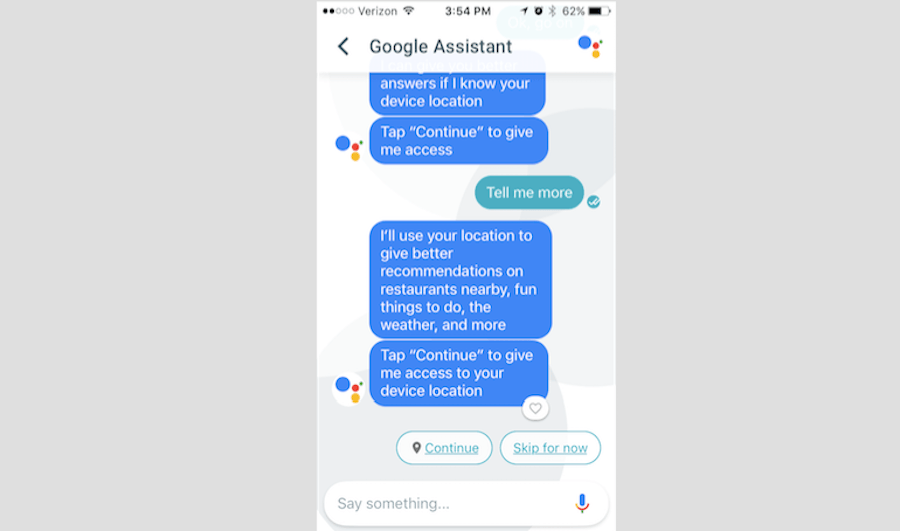

Source: Pagely
24. FormBakery
As one of the easiest drag and drop form tools out there, FormBakery lets you build professional forms in the most straightforward way possible.
For those looking to build a super simple form in under 5 minutes, the tool is a great choice. You can quickly customize forms with your own designs, with no coding necessary. If you’re looking to build a more advanced form, though, FormBakery may not be the right choice for you.

25. DeviceMagic
DeviceMagic is a mobile form solution on a mission to ditch all paperwork, automate lead generation processes, and enhance data collection.
Since the tool solely focuses on building mobile forms, it has a number of great benefits over other form builders, like quick and accurate data collection, lower operations costs, and less time wasted on administrative work.


Source: Device Magic
The options are endless for form builder tools.
Most form builders offer all the essentials needed to make a basic form, but your options start to narrow down when you want better customization and deeper data analysis. Ultimately, for you, the best form tool depends on your team’s purpose and particular business needs.
Editor’s Note: This post was originally published in April 2019, but was updated for comprehensiveness in March 2020.

Best Kanban Software of 2020

How to Persuade: The Science Marketers Need to Know
Do you want to persuade more people to take action? Wondering how the latest behavioral science can help your marketing? To explore how to be more persuasive in your marketing, I interview Jonah Berger on the Social Media Marketing Podcast. Jonah is a marketing professor at the University of Pennsylvania’s Wharton School and author of […]
The post How to Persuade: The Science Marketers Need to Know appeared first on Social Media Marketing | Social Media Examiner.
from Social Media Marketing | Social Media Examiner https://ift.tt/2InMQcC
via socialmediaexaminer