
Welcome to My Blog
These 9 Brands Take Personalized Marketing to a New Level
When I sit down to write an article, I have a pretty standard routine. I outline the story in our Content Optimization System (COS), copy and paste it into a Google doc, find a good photo to accompany it, do research, write, proofread, and carry it back over to our COS. It’s a weird series of steps that doesn’t necessarily work for everyone, but it does for me. They’re my very own personal blogging habits.
Those habits aren’t just limited to my writing process. I have morning, evening, and weekend routines, as if my entire life has become a series of established patterns. Knowing what those habits are, I learned during step four of the above, is a veritable goldmine for marketers.
I figured that out from a 2012 New York Times article called, “How Companies Learn Your Secrets.” Penned by Charles Duhigg, it was written largely as a follow-up to what became a public incident: An angry father marched into a Minnesota Target store, demanded to know why his teenage daughter received coupons for baby products, only to later find out that she was, in fact, pregnant.
The retailer, it turned out, was able to predict her pregnancy and subsequently personalize the promotions she received, thanks in large part to a ton of (completely legal) data collection and analysis. Creepy — or great marketing?
Today, we’re still asking ourselves that question. But, ultimately, it seems that there can be a good balance between knowing your customer way too well and solid marketing. In fact, in 2018, Harvard Business Review revealed that although people want to keep their information secure online, they still value personalized and meaningful marketing experience.
But how does personalized marketing work, and how have other brands put it into practice without coming off as creepy? Here are eight great examples of brands that nailed it in a way that came off as fun rather than intrustive.
9 Personalized Marketing Examples
1. Shutterfly
Shutterfly is a website and app that allows you to create canvases, photobooks, calendars, and even items with your own photos laminated on to them. While Shutterfly has gotten creative with personalized emails and subject lines, one unique thing it did recently was personalize item offerings on its app.
If you download the Shutterfly smartphone app, create an account, and give Shutterfly permission to access your photos, it will automatically identify photos with faces in them and place them on items that you can purchase from the app.
My colleague, Pamela Bump, recently discovered this while she was creating photo-books as holiday gifts for her family. In the example below, she noticed that the app placed photos of herself and one specific friend in particular on to items including mugs, holiday cards, and calendars.

The Takeaway
If you sell products that are personalized to begin with, it can be helpful to show your customer what they could look like before they buy them as well as photos or words related to their life that would look great on the product.
However, when you do this, be very careful that you get explicit permission to go through someone’s information to pull this data. When it came to Shutterfly, Pamela had already given the app permission to access her photos and connected the account to her Facebook account where she approved a number of other related permissions. If you don’t get proper permissions and pull appropriate personalization data, you could come off as untrustworthy or downright creepy.
2. Snapchat’s Bitmoji
In 2016. Snapchat launched an app called Bitmoji which allows users to design cartoonish avatars of themselves that can be featured as their Snapchat profile picture and or on the Snap Map, if permitted.
Since then, Snapchat has also launched an autogenerated daily Story in its Discover feed, called “Bitmoji Stories.”
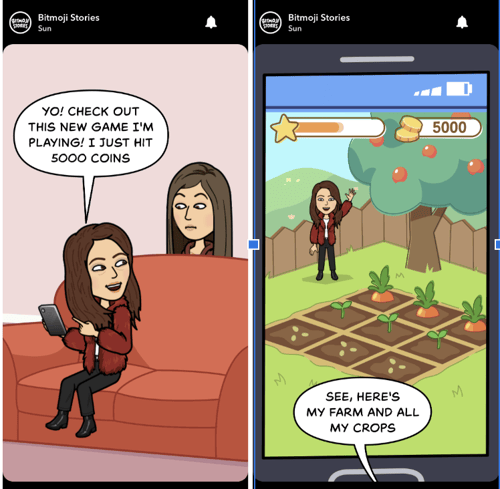
When you click into a Bitmoji Story, you can see a series of comic-book-like images that tell a story about your own Bitmoji avatar. If you’ve recently spoken to a friend with a Bitmoji attached to the app, you can also see your friends pop up in your daily Story.
Below is an example of a Bitmoji Story where Pamela Bump’s Bitmoji shows her cousin’s Bitmoji a new app:
The Takeaway
Because Bitmoji Stories appear in Discover, with all the other branded content and advertisements on Snapchat, the app company has found a great way to bring people to this particular area of the app — even if they aren’t interested in seeing branded content. While audiences are on this Discover page, they might find a brand or content that catches their attention and further interact with feed.
This is a great example of how an app creatively used personalization to bring traffic from one area of its app to another.
3. Target
To continue the above tale, we thought it might be helpful to share more information on how, exactly, the retailer pulled off the aforementioned personal prediction. As Duhigg explains in his article — which goes into much greater detail than I will here — every Target customer is assigned a Guest ID number after the very first interaction with the brand.
That ID is used to store the customer’s demographic information, ranging from ethnicity to job history, and to track buying behavior. And by doing the latter, specifically with those who had baby registries with the store, Target’s marketing analysts were able to form a “pregnancy prediction” score, which allowed them to determine which purchasing patterns indicated a customer was in the early expectant stages.
It was a game changer. “Once consumers’ shopping habits are ingrained,” Duhigg writes, “it’s incredibly difficult to change them.” That is, until, a major life event takes place, like finding out that a baby is one the way.
That’s when routines are forced to change. Suddenly, there’s a deadline, and people start to buy products that they never previously considered, like “cocoa-butter lotion” and “a purse large enough to double as a diaper bag,” the article says. Those are the behaviors that trigger Target’s pregnancy prediction score, prompting the customer to receive special deals on baby-related items.
The Takeaway
While this level of personalized marketing is admittedly fascinating, it could backfire. Duhigg summarized it well in his article:
Using data to predict a woman’s pregnancy, Target realized … could be a public-relations disaster. So the question became: how could they get their advertisements into expectant mothers’ hands without making it appear they were spying on them? How do you take advantage of someone’s habits without letting them know you’re studying their lives?”
That’s not to say that marketers should completely do away with personalization, as it’s effective when done correctly — personalized emails, for example, have a 6.2% higher open rate than those that aren’t. But in an era with growing concern over privacy and security, tread lightly.
Let your customers know that you understand them, without being intrusive. Curious to learn how to do that with your HubSpot Marketing and Sales software? Read more about how personalization tokens work here.
4. Vidyard
Last week, my colleague, HubSpot Academy Sales Professor Kyle Jepsen, forwarded me an email with the comment, “Taking personalization to a whole new level.” The video below followed:
Source: Vidyard
He wasn’t kidding. This particular brand could have just superimposed each recipient’s name onto the whiteboard in this video and kept the same script for each one. But it didn’t stop there — Cole, the gentleman speaking in the video, not only addressed Kyle by his first name, but also referred to his specific colleagues and the conversations he had with them.
The Takeaway
Considering that the average online reader loses interest after about 15 seconds, personalizing your mixed media content is an interesting and often effective approach. “I mean, clearly he made the video just for me,” Jepson said. “It’s an interesting case study.”
And while this sort of personalization is memorable, it’s also extremely time-consuming. So if you set out to create it, be absolutely sure you’re targeting the right people. There’s nothing worse than taking the time to produce something highly customized, only to find out you’ve sent it to someone who doesn’t have the decision-making power you need.
5. Coca Cola
Source: ShareaCoke.com
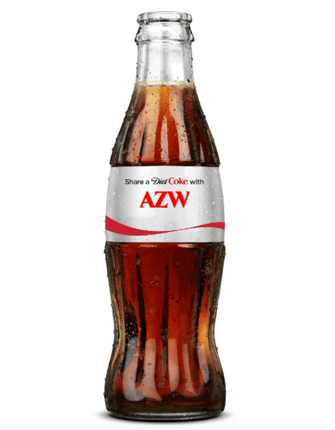
Back in 2011, Coca Cola launched its famous “Share a Coke” campaign in Australia, bringing it to the U.S. in 2014. It was an effort to reach millennials, in which each bottle contained one of the most popular first names assigned to that generation. Eventually, bottles contained semi-personal labels beyond first names, like “better half.” Today, according to Ad Age, over 800 first names are used.
According to that same source, Coke will soon be adding surnames to bottles, like Garcia and Thompson. “Last names give us an opportunity to invite more people into the campaign,” Evan Holod, Coca-Cola’s brand director told Ad Age. “It’s just a great way to up the reach.”
In addition to that effort, according CNBC, Coca-Cola Great Britain will soon be including the names of famous vacation destinations on bottles, like Hawaii and Miami. The goal of that initiative is “to remind people of the refreshment and great taste that only an ice-cold Coke can bring on a hot summer day,” read the official statement. Plus, those bottles will come with the chance to win a trip to those locales.
The Takeaway
Putting first names on Coke bottles was a successful move. In the U.S., it resulted in increased sales volume for the first time in roughly four years. Plus, it provides a cheap thrill — I know that I internally squeal with excitement when I actually find a bottle that says “Amanda.”
The last name move, however, could be a bit different. While there is the option to customize your own bottle labels at ShareaCoke.com — which allows you to write whatever you want, like a customized event hashtag or something like “congratulations” — it could be deemed as exclusionary to those with unique or hyphenated last names. For example, while my feelings aren’t hurt knowing that I won’t find a bottle labeled with “Zantal-Wiener,” I’m not about to pay $5 for a customized one, either. So when you set out to personalize a product, make sure it’s appropriately customized to reach the right segment of your audience, but isn’t restrictive, either.
6. Amazon
Amazon’s personalization efforts aren’t exactly new. Since at least 2013, its product curation and recommendation algorithm has made for headlines and case studies. And yet, every time I visit my Amazon homepage, I can’t help but scroll down and get a kick out of its recommendations for me. Have a look:
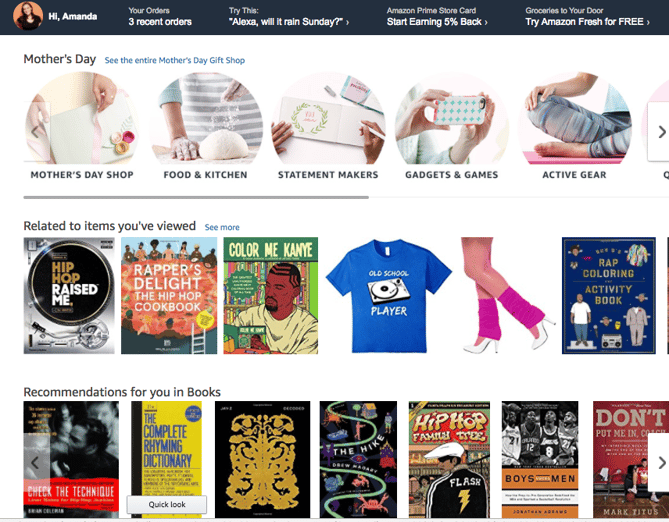
Those who know me are aware of my borderline obsession with hip hop, which is also the motivation for a lot of my online shopping behavior. Clearly, Amazon has taken notice. And as I continued scrolling down, the fitting personalization went on. There was a header reading “For a night in” with recommendations on what to stream on Amazon Prime — an activity that comprised the majority of my weekend. Its recommendations for dog and kitchen products were on point, as well. After all, those are the categories where I make the most purchases.
It’s not just me. When I asked my colleagues what their Amazon homepages looked like, they were equally pleased. Sophia Bernazzani, a fellow Marketing Blog staff writer (and self-proclaimed “cat mother of three”), had a plethora of personalized cat food recommendations, while Managing Editor Emma Brudner’s suggested Prime streaming titles came with the header, “Bingeable TV.”
“Amazon,” Brudner remarked, “You know me so well.”
The Takeaway
Here’s a personalization example where we don’t have a ton of complaints. As Brudner said, Amazon seems to know us pretty well, though I do question why, as per the image above, its algorithm thought I might like to buy a pair of leg warmers.
The nice thing about personalization of this nature, when it’s executed correctly, is that it often can lead to unplanned purchasing decisions. For example, the purpose of my most recent visit to Amazon was to check out its personalization features for this article. But then, I discovered that Rapper’s Delight: The Hip Hop Cookbook was in my recommended books. Did I buy something I don’t need? Sure. But I also was left delighted by the fact that it was brought to my attention with very little effort.
If you’re in the business of personalizing curated items or recommendations for your customers, remember: The best part about it, for the user, is the resulting discovery of new things that we like — whether it’s a book, a tool, or an article.
7. Spotify
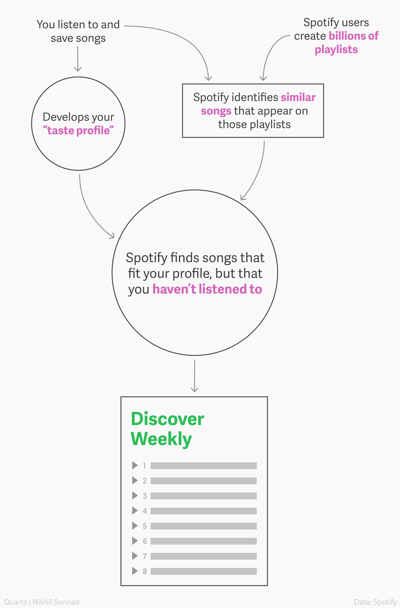
In 2015, Adam Pasick penned a story for Quartz explaining the “magic” behind Spotify’s “Discover Weekly”: A curated playlist of tracks that it thinks a given user will like. It’s carried out, like many other personalization and recommendation platforms, largely with the help of an algorithm that determines a user’s “taste profile,” based on listening behavior and the most popular playlists among the entire Spotify audience.
The technology behind it is from Echo Nest, a “music intelligence company” that was acquired, according to Pasick, by Spotify in 2014. Here’s a great diagram from the article that visually represents the process:
Source: Quartz
As much as I use Spotify — which is close to daily — I’ve never actually bothered listening to my Discover Weekly playlist. So after a colleague brought it to my attention, I decided to take it for a spin.
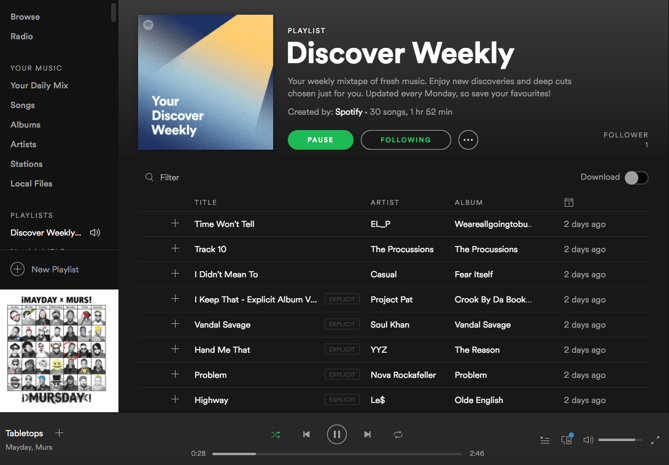
The results were hit-or-miss. There were a few new songs that I was thrilled to discover and plan to listen to again. But for the most part, my experience was similar to Pasick’s, who described many of the songs on his personalized playlist as “meh.”
But those behind Discover Weekly acknowledge that personalization isn’t a perfect science. They also have suggestions for how to make it better, like adding the Discover Weekly songs you like to your library, or skipping the ones you don’t — “If users fast-forward within the first 30 seconds of a song,”
Spotify Product Director Matthew Ogle and Engineering Manager Edward Newett told Pasick, “the Discover Weekly algorithm interprets that as a ‘thumbs-down’ for that particular song and artist.”
The Takeaway
Most personalization initiatives aren’t going to be perfect. Even with a great algorithm, they are, at best, very educated guesses as to what’s going to be applicable to your customers. For that reason, it might be best to take a conservative approach to your recommendations, especially in the earliest stages of any personalization efforts you make.
This is an area where small-batch testing can be helpful. When you want to try out a personalization project or algorithm, identify your most active users, and invite them to pilot out the technology. Listen carefully to their feedback — good and bad — and see what you can do to make it better.
8. Iberia Airlines
During the 2016 holiday season, Iberia Airlines customers received emails posing the question: If you could visit any vacation destination, what would it be, and who would you go with? To answer, customers were redirected to a microsite where they would fill in responses, as well as the email address of the person they wanted to travel with.
Not long after that, the friend would receive an email with a holiday greeting about the dream vacation — only, in order to view the card, that person had to click a link to view it in his or her browser.
It was that last step, Skift writer Brian Sumers explained, where “Iberia … put its advertising budget to work, using cookies [with the user’s permission] so the traveler’s friend would see banners across the web, suggesting the perfect Christmas gift.” That gift, of course, was the dream vacation.
Let’s say, for example, I sent one of these cards to a friend. She might subsequently see several ads while browsing that said things like, “It’s never too late to fulfill Amanda’s dream. Do it with a trip to Mykonos.”
The Takeaway
The idea is certainly a cute one — and around here, we’re suckers for a good holiday marketing campaign. But one of the most important items to highlight here is Iberia’s use of cookies, and the fact that the brand wasn’t sneaky about it. As per the video above, a clear request was made to the user to allow cookies, and that’s essential. Even the best customized marketing becomes less personal, and definitely less desirable if it’s carried out without the user’s agreement.
9. Twiddy
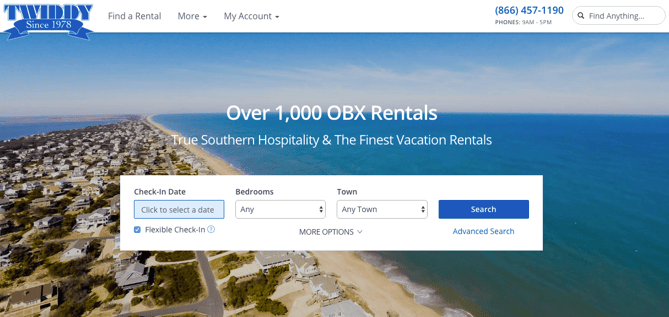
Having enough data is essential for marketing personalization — but knowing what to look at and how to use it is just as important. That’s what made a tremendous difference for Twiddy, a vacation rental company based in the Outer Banks.
“Unless we had a good way of looking at the data,” Marketing Director Ross Twiddy told Inc., “how could we make good decisions?”
One of the major pieces of information that Twiddy began to more closely examine was how rental volume and demand shifted from week-to-week. Noticing those trends allowed the company to start making “pricing recommendations” to homeowners, according to Inc., “on the basis of market conditions, seasonal trends, and the size and location of a home.”
The week after Independence Day was one that stood out to the team in particular, in that rentals showed a precipitous drop during that period.
Because Twiddy observed that trend (among others), it allowed the owners of its managed properties to start experimenting with pricing for that particular week as early as January.
Not only did it benefit the customer — setting more realistic prices for lower-demand periods actually increased the bookings made for them — but it was just one way that Twiddy was delighting its customers with helpful, actionable information. It paid off, too. Since the brand began to use this data to help homeowners with decisions like pricing, its portfolio increased over 10%.
The Takeaway
There’s a famous saying that goes, “Help me help you.” Data, in general, can be a tremendous asset to brands. And it doesn’t have to be about your customers’ behavior — it can be about the habits of their customers, like the vacationers that rented from Twiddy’s homeowner clients.
As long as it’s something that can be shared ethically — like objective buying or seasonal trends — share the data and insights with your customers that’s going to help make them more successful. That’s the type of thing that makes a brand remarkable, and can help benefit your business, too.
Get Personal
One of the fundamental purposes of any personalization effort is to let your customers know that you’re paying attention to them. But striking a balance between, “We think you might find this helpful” and “we’re watching you” isn’t a simple process, so be sure to do some careful research, planning, and testing before you jump into any large-scale customization initiatives.
Remember that while you might be a marketer, you’re also a consumer. When it comes to experiments like these, put yourself into the shoes of the customer and ask, “Is this delightful? Or is it just creepy?” If it leans toward the latter, find out what’s giving it that vibe, and try something different.
Editor’s Note: This post was originally published in December 2013 and has was updated for comprehensiveness in November 2019.


Messaging Matters: How to Attract Your Ideal Customers
Want to attract more of your ideal customers? Do you know which words and phrases resonate most with your prospects? To explore how to come up with the right messages to attract your preferred customers, I interview Jeffrey Shaw on the Social Media Marketing Podcast. Jeffrey is a brand message consultant who helps businesses attract […]
The post Messaging Matters: How to Attract Your Ideal Customers appeared first on Social Media Marketing | Social Media Examiner.
from Social Media Marketing | Social Media Examiner https://ift.tt/2ugzADh
via socialmediaexaminer
Why Website Indexation Is A Must-Have for Marketers
How much do you know about website indexation?
If it’s next to nothing, you’re not alone.
Website indexation is not something you do as a marketer, but a process the search engine carries out when you publish new content online. What marketers need to know is how to ensure you’re set up correctly for indexation.
An indexed website helps a site or page actually appear in search engine results — which is typically the first step to ranking and generating traffic.
Now that we’ve covered why an indexed website matters for SEO, let’s explore how you can prepare to index your own site, next.
What Does It Mean to Index Your Website?
In a nutshell, website indexing is a process search engines use to comprehend the function of your website and each page on that website. It helps Google find your website, add it to its index, associate each page with searched topics, return this site on search engine results pages (SERPs), and ultimately drive the right people to your content.
Think about how an index works in books: it’s a record of useful words and information that provides more context about a subject. That’s exactly what website indexing does in the context of search engine results pages (SERPs).
What you see on a search engine isn’t the internet. It’s the search engine’s index of the internet. This is important because not every page you publish online is guaranteed to get a search engine’s attention. As a website owner, you need to do a few things to get it added to this index.
Google indexes websites that have a few key components. Take a look at them below:
- Aligned with popular searches.
- Easily navigated to form the website’s homepage.
- Linked to from other pages on and off your site’s domain.
- Not being “blocked” from indexation from the use of specific metatags (More on that later).
This is because keywords are like a ping to the search engine: It tells Google what your content is about in a few words, which can be relayed back to search queries.
Having keywords is just one of the factors Google takes into consideration before indexing websites. Other necessities include not having “broken” pages or links, or a complicated web design that prevents a user from easily finding the page or understanding the question that page is answering.
In the next section, we’re going to look at why Google considers certain things when indexing websites and how to get your website indexed.
Having an indexed website makes sure your site is capable of appearing in a search engine’s results. If your website is about B2B networking, for instance, seeing keywords like “business-to-business” and “networking” on your site can help Google understand how your content relates to these searches. However, keep in mind that a content’s freshness (how recently it was published), as well as which other pages link into it, also play key roles in Google’s ability to find and index your site.
Now that you have a more thorough understanding of what website indexation is, let’s discuss how long the process takes, and how to get Google to index your site.
How long does it take for Google to index a website?
Google isn’t highly selective for indexing websites. In fact, it will index any site that meets the criteria.
Although it varies, it could take anywhere from a few days to a few weeks for Google to crawl a website. There are a couple of factors that slightly impact how quickly Google indexes a website, such as the popularity of the website, proper optimization, and the overall structure of the website.
Common mistakes can impact whether or not Google indexes a site.
To prepare, be patient, check your website design, and update the site if you feel it’s necessary.
What are website indexation best practices?
In general, the most common reason a website isn’t indexed is that it’s new. This could be the case for you, especially if you’ve covered your bases, ensured the page doesn’t contain a “noindex” tag, has a clear linking strategy, and easily relates to other pages on your site.
A site with a “noindex” tag will block Google’s ability to index a web page. One reason a web page might have this tag is if it’s only meant to be seen by certain subscribers, so Google won’t find it and present it as a search result to the masses.
Next, make sure your website is designed to be crawlable. Check to see if the build of your site is blocking a search engine’s ability to index. Google has a checklist about how to do that on their support website here, but a few general rules include creating a sitemap, telling Google about duplicate content, and using special tags that Google understands.
Finally, if you’ve recently migrated your site, that might be the reason why Google isn’t crawling the site you want. If your site was temporarily unavailable for a certain amount of time, it’s possible Google found crawl errors when indexing your site, and couldn’t complete the process.
Once your website is ready to be indexed by Google, here is what you need to do on your end.
First, you need to verify your website in Google’s Search Console. This means that you will confirm for Google that you are the website owner. Next, you will have to request Google to crawl the URLs of your website.
To combat migration/indexation issues, make sure that if your site has recently moved, you’re adhering to Google’s guidelines for moving a site so you can make sure your new address is indexed correctly in the search engine.
Remember, web pages that are broken — evident in a “404” error code — or hard for Google to read probably won’t be indexed.
Additionally, optimizing a website includes adding keywords into webpages, blog posts, and URLs, as well as archiving content. Our guide to SEO is a great deep dive into optimizing website content, as well as a refresher to check your work before requesting an indexation.
Having a website indexed involves a little bit of time and patience. By doing the work of optimizing the website’s content as much as possible before sending a request to Google, the process will go more smoothly.

How to Set & Achieve Marketing Objectives in 2020
In the content marketing industry, setting objectives can be a double-edged sword. On the one hand, constantly raising the bar can incentivize your team to sustain your growth rate over long periods of time. But on the other hand, it can also incentivize your team to prioritize your company’s needs over your customers’ needs.
You might be thinking that this is the nature of content marketing today — in order to grow, you need to stay laser-focused on hitting your numbers. And, sometimes, to hit your numbers, you need to do what’s best for the business, even if it’s not the best move for your customers.
But contrary to popular belief, solely focusing on the results doesn’t actually produce results. Focusing on serving your customers is what produces results. Tim Cook, Apple’s CEO, is famous for sparking this customer-centric movement. In 2015, he spoke at Goldman Sach’s Technology and Internet Conference in San Francisco, and a reporter asked him what were some of Apple’s biggest accomplishments from the past year. He responded, “We’re not focused on the numbers. We’re focused on the things that produce the numbers.”
In content marketing, one of the most influential things that produce the numbers is a passion for your craft. But, sometimes, we can get so obsessed with optimizing for results that we forget what actually generates the views and leads we desperately desire — compelling content.
In this blog post, we’ll show you how to set realistic marketing objectives that will help you craft audience-centric content, prioritize your customers’ needs, and hit your numbers, all at the same time. Read on to learn how to identify your marketing objectives’ purpose and process and why it’s just as important as the numbers you aim to hit.
What are marketing objectives?
Marketing objectives are the goals your team wants to achieve during a certain period of time. They’re usually a hard number or metric that serve as metaphorical finish line for your team to sprint towards. However, setting marketing objectives isn’t just limited to determining what you want to achieve. You also need to specify how you’re going to reach your goals and why you want to reach them.
In his insightful blog post about setting goals, Jay Acunzo, the founder of Unthinkable Media, reveals a subtle yet potent problem that has pervaded the content marketing industry over the years — traditional goal setting lets you measure what you do, but it doesn’t lend itself to gauging how you do it or why, which is what ultimately gives your work meaning and pushes you to hone your craft.
In marketing, you obviously need to aim for concrete targets. But, like we said earlier, only focusing on the results can sometimes incentivize you to take a course of action that prioritizes your organization’s needs over your customers’ needs.
To help you focus more on your purpose and process instead of just your results, Jay recommends considering two other things when setting a marketing objective — your hunger and aspirational anchor.
Your hunger is your current dissatisfaction with your work today or why you want to achieve your goal. Your aspirational anchor is your vision of your work in the future or how you’ll achieve your goal. These two things drive your motivation and keep you on track to create work that better serves your customers. And when you add your goal to the equation, you’ll be able to simultaneously produce customer-centric work and hit your numbers.
To learn how to set objectives that help you focus on the “why” and “how” behind your marketing initiative, check out the following example.
Marketing Objective Example
Hunger (Why) – Our blog educates our audience well but it doesn’t resonate emotionally with them enough.
Aspirational Anchor (How) – Run a blog that consistently resonates with our audience and that people look forward to reading every time they receive our email digest.
Goal (What) – Increase blog subscribers by 25% month over month this year.
With this goal setting framework, you can see how the “why” and “how” behind a goal incentivizes behavior that better serves customers and hits numbers at the same time.
For instance, in the example above, this blog team refuses to just do whatever it takes to boost their blog subscription. They want to craft emotionally resonant stories that their audience actually values, or content that’s worth subscribing to, and this is what will lead to their growth in subscribers and create long-term value for their business.
If this blog team didn’t identify their hunger or set an aspirational anchor, however, the only thing that would guide them toward the finish line is the finish line itself. And that could incentivize short-sighted behavior that helps them achieve their goal at the expense of prioritizing their audience’s needs over their own.
How to Set Realistic Marketing Objectives
(Hint: It’s by using the SMART goal framework.)
Now that we understand the “why” and the “how” behind setting marketing objectives, let’s go over how you can root the “what” in reality with the SMART goal framework.
SMART goals are realistic, quantifiable, and focused targets that you can easily aim for. If you’re wondering what SMART means, it’s an acronym that helps you clearly define your goals. Check out the framework below to learn more.
Specific
In terms of marketing, you should choose the particular metric you want to improve upon, like visitors, leads, or customers. You should also determine what each team members will work on, the resources they’ll have, and their plan of action.
Measurable
If you want to gauge your team’s progress, you need to quantify your goals, like achieving an X percentage increase in visitors, leads, or customers.
Attainable
Make sure that X-percentage increase is achievable in your specific situation. If your blog traffic increased by 5% last month, try to increase it by 8-10% this month, not 30%. It’s crucial to base your goals off of your own analytics, not industry benchmarks, or else you might bite off more than you can chew.
Relevant
Your goal needs to relate to your company’s overall goal and account for current trends in your industry. For instance, will growing your Facebook following lead to more revenue? And is it actually possible for you to significantly boost your organic reach on Facebook after their most recent algorithm change? If you’re aware of these factors, you’ll be more likely to set goals that are realistic, achievable, and beneficial to your company.
Time-bound
Attaching deadlines to your goals puts pressure on your team to accomplish them. And this helps you make consistent and significant progress in the long-term. If you don’t give yourself a deadline, accomplishing your goal will take too long to achieve long-term success. For example, which would you prefer? Increasing leads by 5% every month, leading to a 30-35% increase in half a year? Or trying to increase leads by 15% with no deadline and achieving that goal in a year?
Blending Hunger, Aspirational Anchors, and SMART Goals
By analyzing two different goal setting frameworks, we’ve learned how to identify the “why”, “how”, and “what” behind your marketing objectives . Now, we can blend the two frameworks to set a realistic goal that fulfills our customers needs first and helps us hit our numbers at the same time. Check out this example for more detail.
Specific (Include your hunger and aspiration)
Our blog educates our audience well, but it doesn’t resonate emotionally with them enough. Let’s start running a blog that can consistently resonate with our audience, that people look forward to reading every time they receive our email digest, and can attract more subscribers.
Measurable
Increase month-over-month blog subscribers by 25% this year.
Attainable
Last year, we increased month-over-month blog subscribers by 15%.
Relevant (Include your hunger and aspiration)
If we can craft emotionally resonant stories that our audience actually values, we can build deeper relationships with them, attract more subscribers who we can also build deep relationships with, and hopefully do business with them in the future.
SMART Goal
By crafting stories that consistently resonate with our audience and is worth subscribing to, we can increase our month-to-month subscribers by 25% this year.

How to Increase Your Organic Growth by Over 400%, According to the SEO Lead at Nextiva
Here’s a reality check for 2020 — only one-third of businesses make it to the 10 year mark.
No market demand, running out of cash, and getting out-competed are among the leading reasons businesses fail.
The good news? You don’t have to figure it all out on your own, because I’ve done a lot of the legwork for you.
When I served as the VP of Marketing at Sales Hacker (a publication and community for B2B salespeople), I uncovered strategies and processes that exploded our growth.
In fact, the results were outstanding: in just over a year, we were able to grow Sales Hacker’s traffic from 19,000 monthly organic sessions to over 100,000 monthly organic sessions.
That’s a 426% increase. As a result, Sales Hacker was acquired by Outreach, a sales engagement platform.
Now, I’m using that same exact process to lead SEO at Nextiva, and here is a snapshot of our organic keyword growth to prove that this really works:
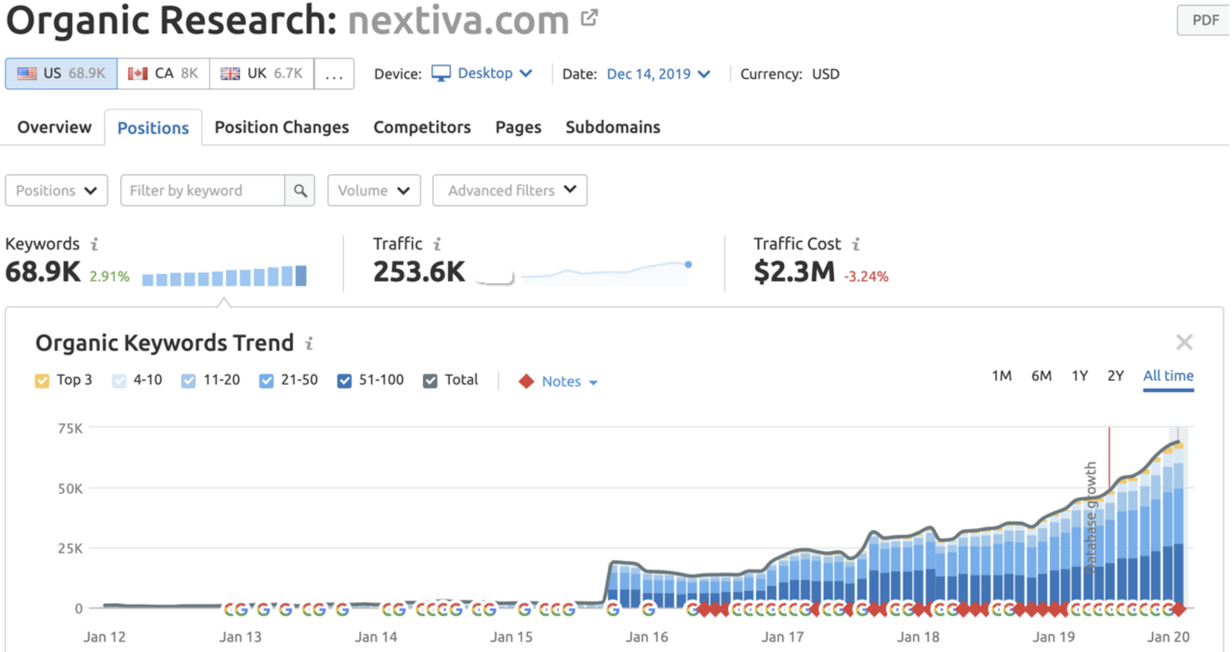
If you’re looking to skyrocket your organic growth with an efficient SEO strategy in 2020, check out the five proven steps I’ve taken with both Sales Hacker and Nextiva to achieve tremendous results.
First things first: why is it so hard to stand out in search?
The goal of owning search rankings is simple: organic presence means qualified traffic, which leads to conversions, which turn into sales. In fact, marketers who prioritize blogging efforts are 13 times more likely to see positive ROI.
That’s not to say blogging is the only way, or the best way to do it — but it’s what works best for us.
Creating content can have a powerful long-term impact, too: over its lifetime, one compounding blog post creates as much traffic as six decaying posts.
Of course, in 2020, most companies get the importance of blogging. Nowadays, 55% of marketers say blog content creation is their top inbound marketing priority.
Unfortunately, that leads to a new problem: the SERPs are getting a little overcrowded.
Keyword difficulty is rising. Almost every topic you can imagine already has dozens of guides and tutorials ranking against each other.
Most industries have become noisy, which makes it hard to stand out. Ultimately, it’s more important than ever to be intentional about your website and the content you publish.
Additionally, this viral tweet — which received commentary from several Google employees — suggests search results have gotten so competitive, personal websites have no chance of ranking anymore due to businesses going all-in on long-tail SEO, which takes away even the lowest search volume opportunities.
At Sales Hacker, we had an aggressive publishing schedule, with 4-5 new blog posts going live each week. They were all written by our community — we didn’t contract an agency or freelancers. Since we had more content than we could handle, we wanted to keep our contributors happy while ensuring all content was evergreen and actionable.
Let’s explore exactly what steps we took to achieve organic growth, and what you can do to stand out in 2020 and beyond.
1. Start with audience research.
When you need to take your results (such as traffic or leads) to the next level, it’s always a challenge. This challenge is easier to tackle when you already have a loyal audience — even if it’s a small one.
Why? Because you get to ask them what they like, what they dislike, and what they want more of. The thing is, we found that when people see you genuinely care about their interests, they’re more than happy to talk to you and share their insights.
The key to succeeding with audience research is setting strong goals for your research. This applies to surveys, interviews, and any other method you pick.
For instance, at Sales Hacker, I had the following five research goals on which I wanted to collect information:
- Brand messaging insight
- Audience development insight
- Content strategy insight
- UX and website navigation insight
- Email marketing insight
I set up 30-minute interviews with a sample of Sales Hacker’s audience: typically mid-to-senior-level sales roles, ages 25 to 44.
These are some of the questions I asked in these interviews, which you can implement into your own audience research process:
- What are your most common daily tasks?
- What are your top challenges in sales/business?
- How would you describe Sales Hacker to your grandma?
- Give us your best Sales Hacker Slogan.
- What is the main benefit of Sales Hacker?
- What is the main problem with Sales Hacker’s website?
- What would discourage you from subscribing to our email list?
- What type of content would you find helpful?
- What type of content is a waste of time?
These questions match my audience research goals outlined earlier. If you’ve set different goals, make sure to add interview questions that correlate with them.
Based on the answers I received from my recipients, I ended up with a list of topic clusters and understood the content types that were in highest demand.
I also learned that thought leadership content was the biggest loyalty driver, and that our audience would listen to our podcast if we launched one (which we did!).
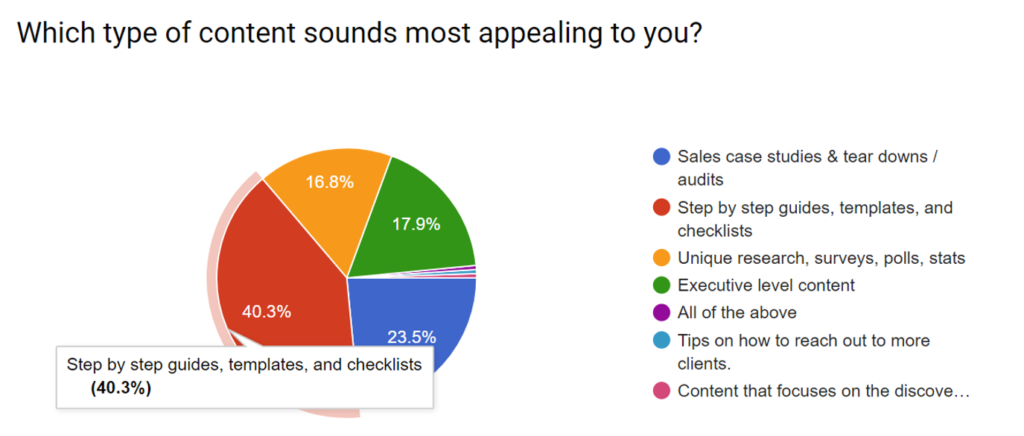
Takeaway: Build a list of audience research goals and corresponding questions you can ask in surveys and interviews. Analyze results so you can find the content to focus on.
2. Run an SEO site audit.
Why an SEO audit? Think about it like this — if search engines can’t read your content, you’ll struggle to reach your target audience. On top of that, 40% of people abandon a website that takes more than three seconds to load.
In other words, when you get your ideal readers to your website, you’ll want to make sure you don’t lose them right away.
An SEO audit involves crawling your website using a tool like Screaming Frog and then analyzing the data. Here are some things you should look for:
- Duplicate content
- Noindex pages or nofollow links
- Robots.txt file
- Improper redirects and redirect chains
- Broken media assets (video and audio files)
- Broken links
- URL structure
- Pages with long load times
Some of the issues I found with Sales Hacker was the lack of referring domains, non-optimized URLs, poor internal linking structure, poor site structure and navigation, and some branded search problems.
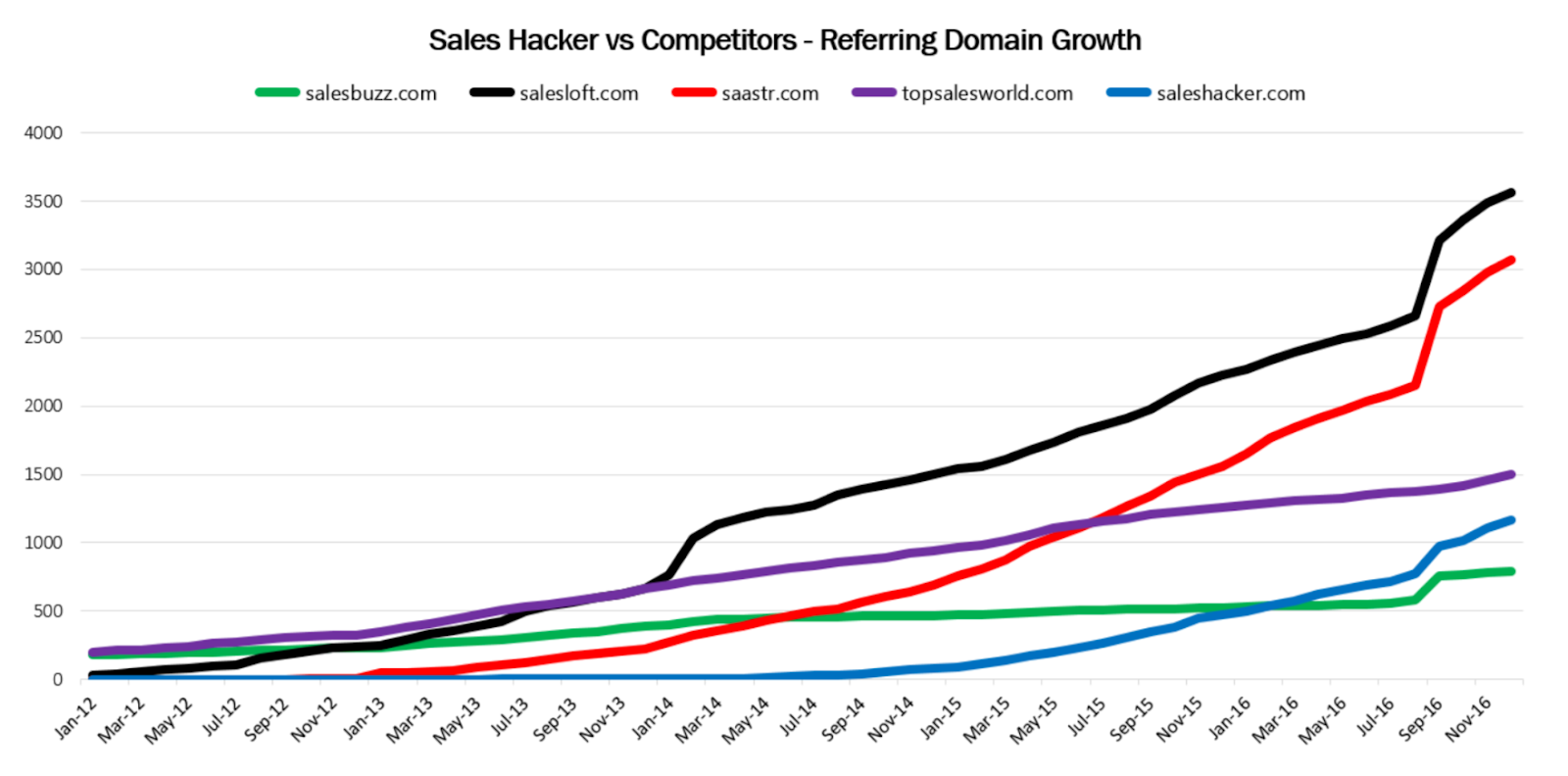
Once we had a list of issues, we tackled them one by one so we could set a strong foundation for our content creation and optimization going forward.
Takeaway: Download the SEO Audit kit which includes a guide and a checklist to work from. Alternatively, make a list of all the improvements you can make and start working on them as soon as you can.
3. Develop new content opportunities.
As I mentioned earlier, our audience research helped us identify the topics that help them progress in their sales careers the most. With these topics in mind, we looked for gaps in existing search engine results.
We did this for the topics we wanted to grow an authority in, including cold calling, best sales tools, channel sales, sales Excel templates, and more.
Here are some of the existing patterns we were seeing:
- Low-value round-ups
- Definition-based content
- Theoretical content
- Lack of focus on user intent
- Unengaged approach to sales templates
- Long introductions
I decided to go the opposite way and provide what our audience was asking for: getting to the point quickly with zero fluff, providing a great content experience, and offering mega-lists of tools and tips, with a highly actionable writing style.
This worked so well for us that we ended up earning a featured snippet for the’ channel sales’ topic, as well as some others, like BANT, customer success manager, and sales forecast modeling:
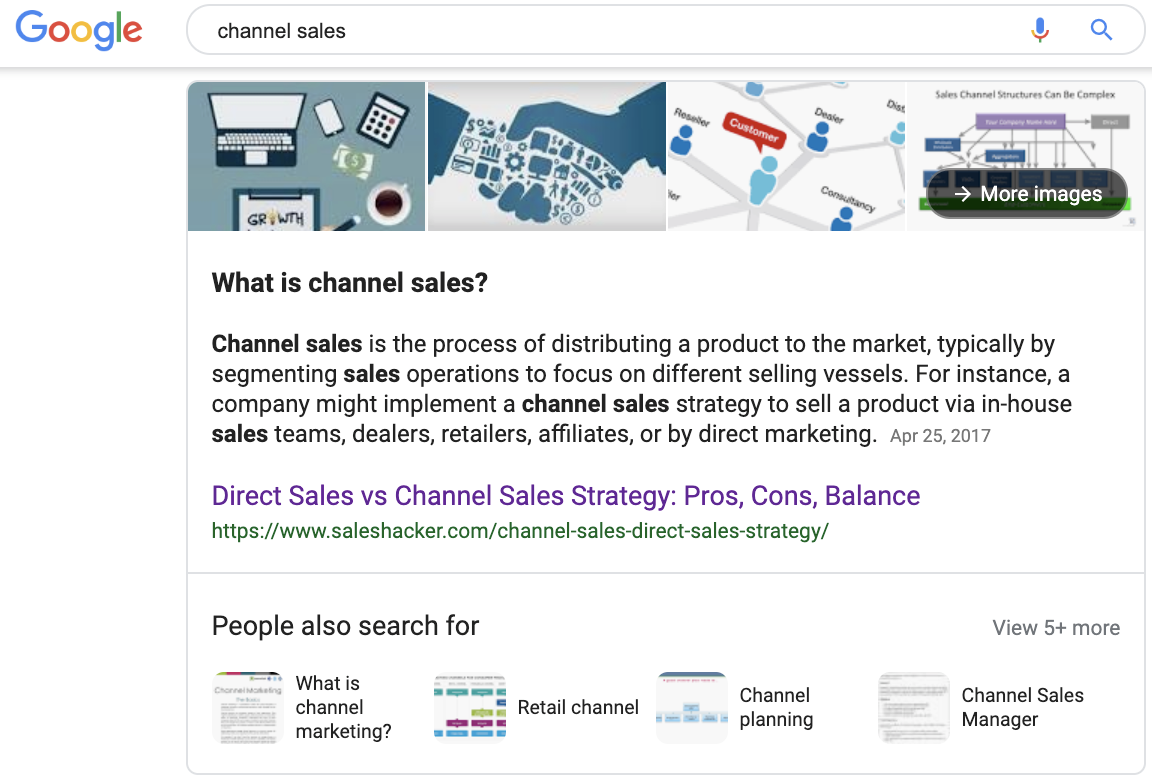
Takeaway: Based on the topics your audience is interested in, analyze the highest-ranking content on search. Brainstorm ways you can provide more values based on gaps that existing content has and on what your audience is looking for from you.
4. Update and optimize your existing content.
If you have an audience of any size, that probably means you also have a library of published content. Is it up to par? And is it serving your audience the best way it could?
Optimizing your past content is one of the most powerful ways to increase the mileage of the work you’ve already put into your blog.
We discovered that our audience doesn’t want to feel like we’re pitching them all the time, so the first thing we did was rework our content in a way that wasn’t sales-y, but to the point, actionable, and purely educational.
Some of our most successful updates have included:
- Making our lists longer and more comprehensive (example: best sales books)
- Building long-form guides on topics we’ve only touched on in the past (example: sales operations)
Here’s the before of the sales operations guide:
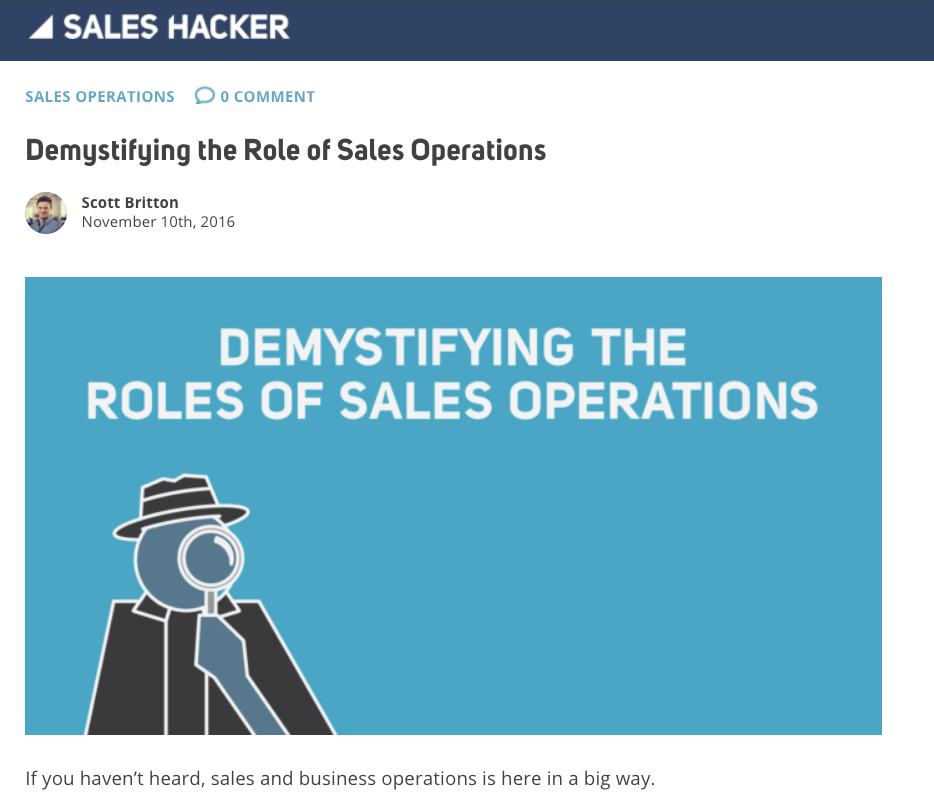
And here’s the after:
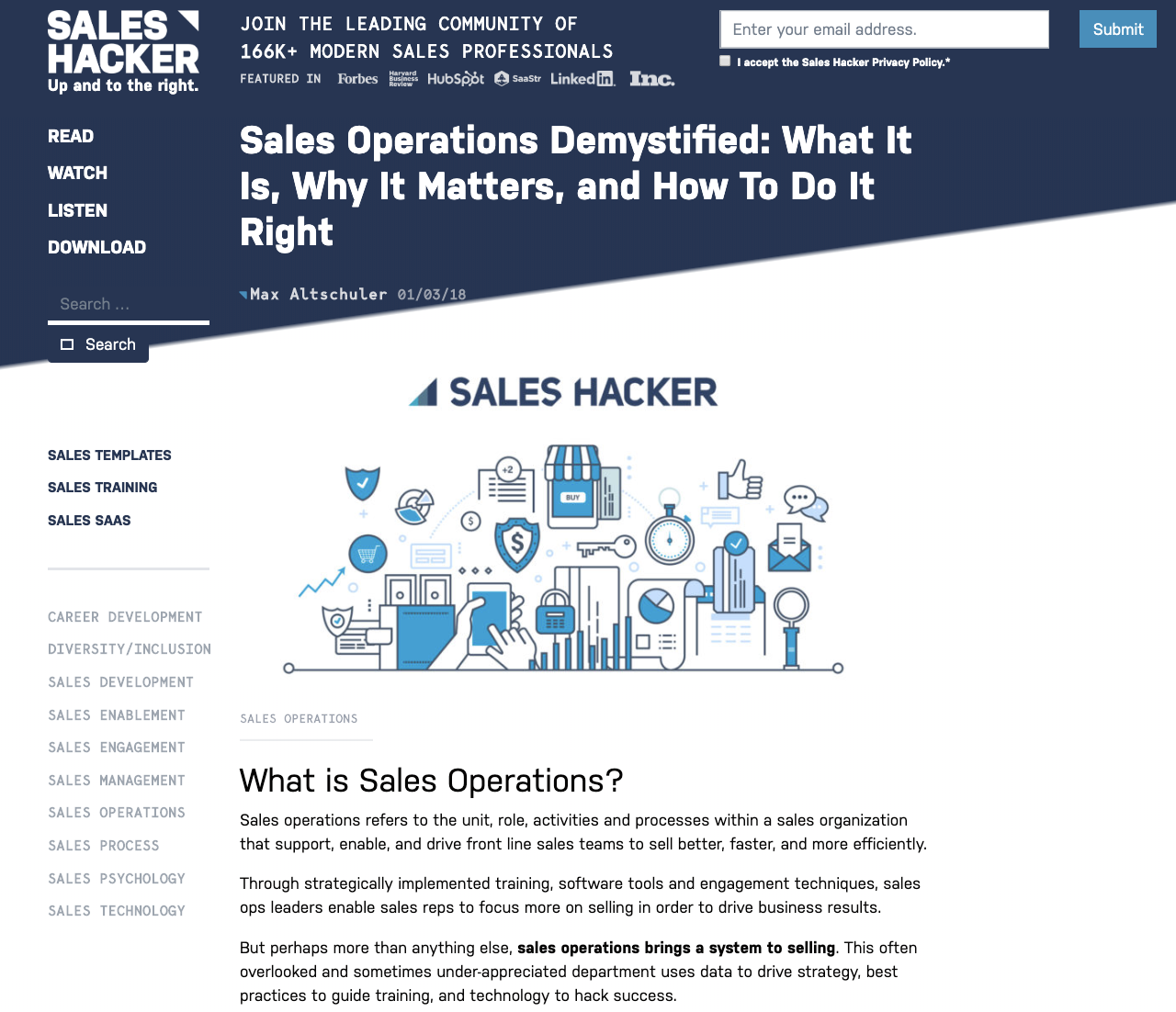
As a result, our existing content skyrocketed in search rankings.
Takeaway: Using Google Analytics, make a list of blog posts that are covering an evergreen, relevant topic, but get low search traffic. Update them one by one, starting with those that have historically had the highest conversion rate (for example, email signups) and work down from there.
Bonus: Use schema mark-up to own more search page real estate.
With zero click searches on the rise, it’s now up to savvy SEOs to find more ways to stand out in search results and fight for clicks.
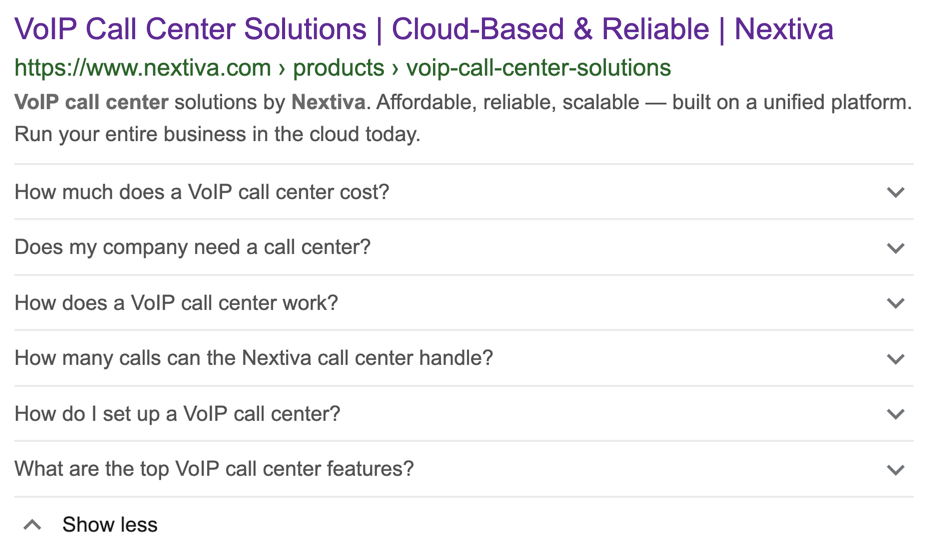
One way to do that is by using rich schema mark-up to enhance your content in search results. Google recently deployed FAQ schema which allows websites to have their webpage FAQs displayed directly in the search results.
For instance, check out how we’re optimizing VoIP Call Center in the search results for Nextiva. The FAQs themselves display right on the search page. This is a powerful tactic for stealing more clicks back from Google.
You can use the rich schema generator to help you with this.
5. Tailor your homepage and navigation to your audience.
I believe that Sales Hacker’s homepage re-design (which happened in July 2017) was a huge growth accelerator.
Right after I took over Marketing operations for Sales Hacker, this is what the homepage looked like:
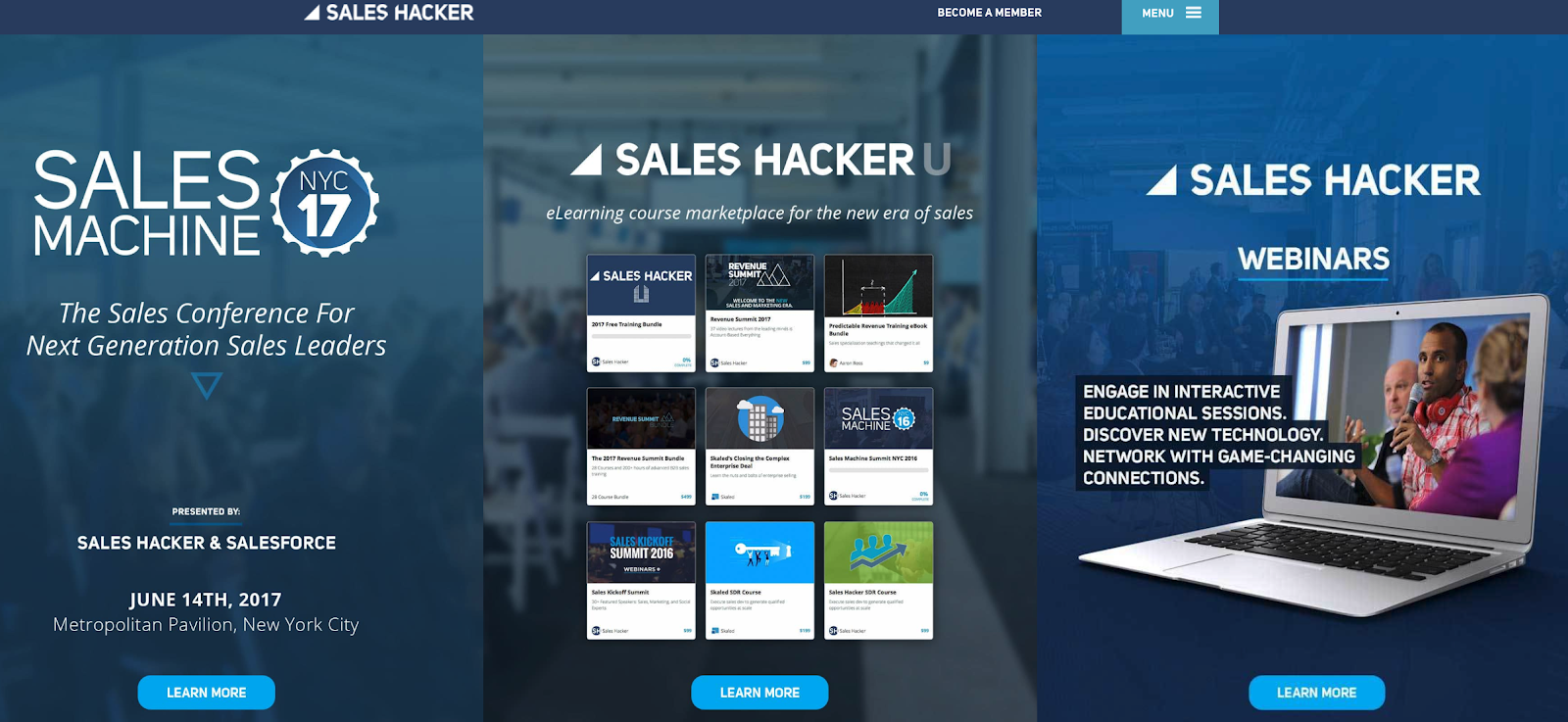
This version of the homepage likely made it difficult for people to take the actions we wanted them to, like finding the content they need or signing up for our email list.
The key approach to our homepage re-design, like with many other things we’ve done, was setting clear goals behind that process. In this case, these goals were:
- Showing people exactly what Sales Hacker is and what we do
- Making the process of signing up for the email list super simple
- Helping visitors find the content they want quickly and easily
- Showcasing social proof
- Improving internal linking
This obviously wasn’t just down to what the homepage looked like, but also our site structure and how we approached internal linking in general.
I’ve sketched a mindmap of the ideal new site structure with categories and subcategories. The taxonomy I had in mind would achieve the following:
- Increased engagement from natural site exploration from visitors
- The shortest possible path to the most important content on the site
- Landing page visibility from an increase of internal links pointing to them
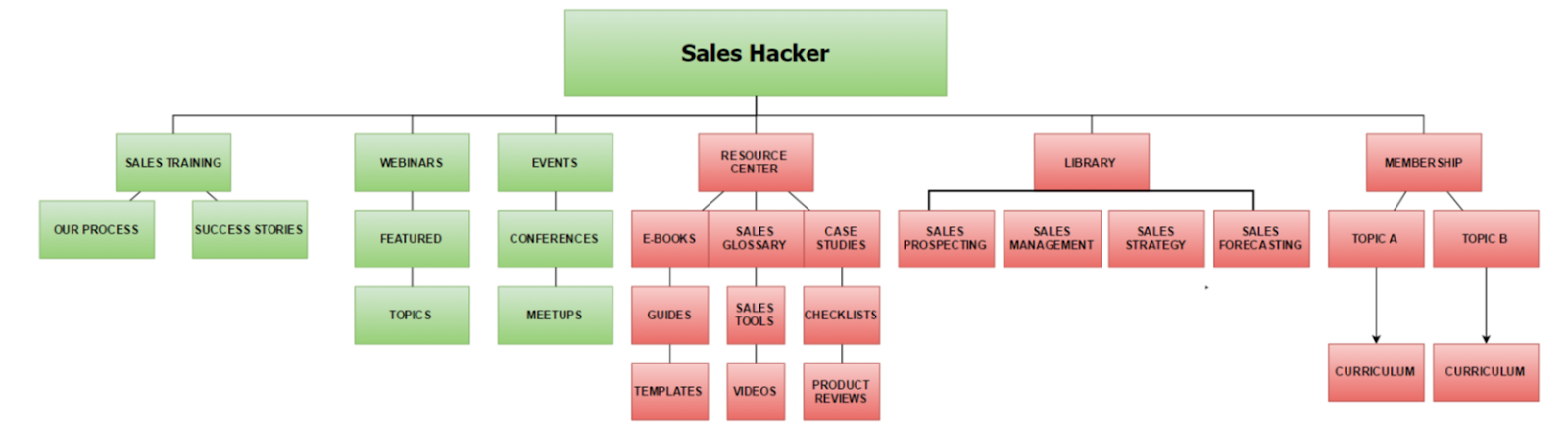
Takeaway: Identify the single most important actions you want your visitors to take (lead generation, sales, etc.) and organize your homepage in a way that makes those actions obvious and the path to them uncluttered. Use a tool or simply pen and paper to draw a map of journeys on your website you want your visitors to go through based on their interests. Apply this not only to your homepage, but to any menus and content categorization you have on your blog.
Over to You
This process won’t give you results overnight. In fact, while the homepage updates may show some instant results from a user behavior point of view, most efforts to improve your organic presence will take months to bring significant improvements.
Remember — these steps outline exactly what we did to go from low organic presence to a highly authoritative sales community hub, which we ended up selling. It took us over one year, but we made a persistent, intentional effort in places we knew mattered most.
Want to grow at a rapid pace? Start with your audience and listen to their feedback. This way, you can take the right actions to reach even more of your target readers and customers and take your business to the next level.

Is Negative SEO Hurting Your Traffic? What It Is & How to Avoid It
Back in the late ’90s (way back when), SEO was in its infancy.
It was almost like the Wild West — anything goes.
Since the rules were loose, both white hat and black hat SEO tactics began to develop.
While white hat tactics are an ethical way of improving your organic traffic and search rankings, black hat tactics go against guidelines set by search engines in an unethical way.
However, as the industry has rapidly changed and search engine algorithms improved, it’s become harder to use black hat SEO tactics.
And thus a new, unethical strategy was born: negative SEO.
Below, let’s learn more about negative SEO from what a negative SEO attack looks like and how to avoid it.
Wait, did you say negative SEO attack?
A negative SEO attack is when a competitor uses mostly off-page tactics such as building unnatural links or duplicating site content to negatively impact your search rankings. Sometimes a negative SEO attack will involve on-page tactics through hacking your site to modify content.
So, you might be wondering, “How does someone do a negative SEO attack?” Below, let’s review negative SEO tactics and how to avoid them.
1. Building unnatural links.
One of the ways that a competitor can use negative SEO to attack your site is by building unnatural or spammy backlinks. Basically, this means they’ll send thousands of spam links to your site and/or send fake link removal requests.
If they send low-quality links to your site, they’ll usually use an interconnected group of websites that are used solely to link back and forth to other sites.
Their goal is to get your site penalized by Google for spammy links.
The second method that a competitor using negative SEO might use to impact your backlinks is to remove your best backlinks. Usually, they’ll reach out to a site using your name and request they remove the backlink.
To avoid these tactics, it’s important to keep track of your backlinks profile. There are plenty of sites you can use to check your backlinks including Ahrefs or Monitor Backlinks.
With these tools, you can monitor when your site gains or loses backlinks. If you suspect a bad link has been added, you can try to remove it by contacting the webmaster and requesting they remove it.
If that doesn’t work, you can use Google’s disavow list. When you submit links to Google Webmaster Tools through a disavow list, this tells them that these links shouldn’t be counted when considering rankings for your site.
Another method you can use to detect unnatural links is to check your website speed. If your website is suddenly taking a long time to load, you’ll want to ensure it’s not because someone is sending thousands of requests per second to your server.
2. Distributing duplicate content.
When there’s duplicate content on multiple websites, Google filters the content which can result in a loss of rankings of your web pages. Duplicate content forces Google to choose which one of the identical pages should rank, and they might not choose the original page.
While some similar content is inevitable, several identical web pages might negatively impact your rankings.
If someone wanted to attack your site, they could take your site content and redistributes it on several websites.
To avoid this, you can use tools to track if your site content is duplicated. Sites like Copyscape.com can detect if the content on your site is being used anywhere else. If you’re worried about being targeted by negative SEO tactics, you might consider checking to make sure your content is duplicated on a regular basis.
3. Hacking your website.
While most of these negative SEO tactics are off-page, sometimes a competitor will hack your site and use on-page methods to impact your rankings.
They could hack and alter your code, so you can’t tell something’s wrong unless you’re looking at the code.
Another way they could hack your site is by editing your robots.txt file. This file tells a crawler how to interact with your site, including what pages not to crawl. If a hacker can access this, they can use your robots.txt file to tell Google to ignore your most important pages or the whole site.
One way to avoid this is to set up Google Webmaster Tools email alerts. These email alerts will tell you if your site is being attacked by malware, pages aren’t being indexed, or you get a manual penalty from Google.
Additionally, you can protect from hackers by using two-factor authentication, strong passwords, creating back up files, and antivirus protection.
4. Generating negative reviews.
While having a variety of reviews can actually help your SEO, an overwhelming amount of negative reviews can impact your business’s reputation.
One negative SEO tactic a competitor can use is to flood your site with negative reviews because they’re easy to manipulate.
To avoid this, you should monitor your reviews and make sure you use them as an opportunity to respond and interact with your audience.
If you’ve spotted a fake review from someone who’s misrepresenting their identity or the connection to your business, you can flag them right on Google.
5. Creating fake social profiles.
Another tactic a competitor can use to impact your rankings is to create fake social profiles in your company’s name. This is done to ruin your reputation and spread false information.
To avoid this, when you come across fake profiles report them as spam before they start to get followers.
You can also use tools to track your social media mentions so you’ll be informed when anyone mentions your name or site on social media. Most social media automation tools should have this capability, so you’ll be alerted when a fake social profile is created.
Although negative SEO can seem like a scary concept, generally most websites don’t have to worry about it. The important thing is that you monitor your SEO health on a regular basis to make sure you notice an attack before it impacts your site.

How to Explain Secondary Audiences to Anyone
When I was a child, I really wanted an Easy Bake Oven. Every time I saw a commercial for one, I was glued to the TV, marveling at the kids on the screen baking mini treats with their friends and parents. Seeing those ads, I knew they were made just for me.
In reality, though, the main — or primary — audience was my parents. I was the secondary audience.
As a child, I had no buying power, so I wasn’t going to be a good Easy Bake Oven consumer. I was the secondary audience for toy commercials. My parents, with the power to make purchase decisions, were ultimately the primary audience.
If you’re thinking: “But wait, aren’t primary audiences the customer to whom you’re marketing? If that’s the case, why wouldn’t toy commercials be for kids?” I hear you. And you’re right.
Secondary audiences are sometimes just as important to consider in your overall marketing strategy. If the toy manufacturers didn’t consider secondary audiences, for instance, I probably never would’ve gotten an Easy Bake Oven for my birthday.
Here, let’s explore why secondary audiences matter, as well as a few examples of secondary audiences.
Secondary audiences, explained.
Primary audiences and secondary audiences are both of major importance. If parents or caregivers aren’t convinced a toy seen in a commercial is a useful product, the toy isn’t going to be purchased.
The person with the buying power and influence to make purchase decisions will always make up the primary audience.
So, what makes up a secondary audience?
Think about secondary audiences in the context of a toy commercial: if a child begs for a new toy, the parent or caregiver may be convinced to eventually buy the toy — which is why convincing a secondary audience to be on board with your product or service can be just as important as convincing the primary audience.
Let’s go over another example of a secondary audience, next.
Examples of a Secondary Audience
The holiday season is a prime example to consider when thinking about marketing to secondary audiences.
How do you shop for loved ones when gift-giving? You usually ask them what they want and go from there, right?
In this scenario, the loved one is the secondary audience, and you are the primary one. This is because you are making a purchasing decision on behalf of the person influenced to own the product.
Holiday ads with copy similar to “Great as a gift!” or “Perfect for that special someone!” are most likely marketing towards a secondary audience rather than a primary one.
Amazon even took it one step further and used the holiday to segment secondary audiences:
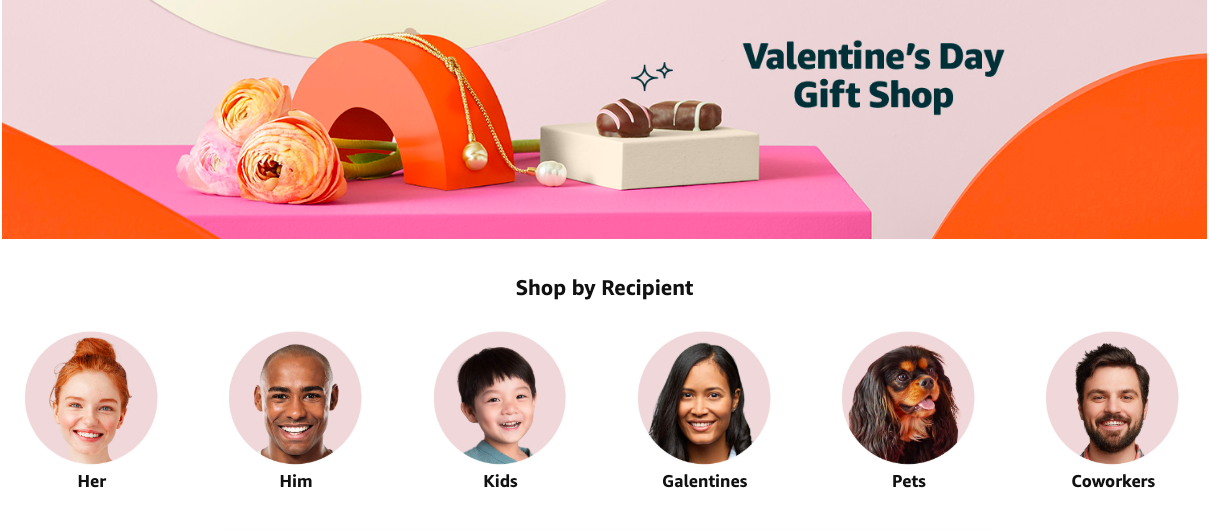
Amazon choosing to market to their secondary audiences in a segmented fashion shows an effort to personalize messages to the masses. Remember, secondary audiences, in some cases, begin the buyer’s journey for the primary audience. So, Amazon decided to make that journey easier.
Marketing to secondary audiences, then, is just as important as marketing to primary audiences. Primary audiences have the means in the decision-making process, and secondary audiences are customers who can influence that decision-making.
Businesses that can market to both audiences effectively have a better chance of boosting overall sales. Let’s distinguish between the two groups a little more, next.
Let’s say a business’s decision-makers were thinking about investing in a content management system to streamline the processes of the company, and asked their staff to present recommendations. In this scenario, the primary audience would be the decision-makers, and the secondary audience would be the staff.
An individual contributor who must convince their manager to purchase a specific software doesn’t have purchasing power, which means they’re not the primary audience. This person has influential power, so they’re a secondary audience.
Distinguishing primary and secondary audiences needs to happen to correctly market to both of them. Depending on the product, these audiences can influence the buying decisions of one another. Ultimately, marketing to secondary audiences can be incredibly beneficial in boosting overall revenue.

The 2020 Guide to Instagram Ad Costs
Do you remember in 2012 when Mark Zuckerberg bought Instagram for $1 billion?
It was a gamble. At the time of the acquisition, the platform was valued at half the purchase price, had 30 million users, and wasn’t generating revenue.
But as it turns out, Zuckerberg absolutely nailed it. Instagram blew up, and six years after the acquisition, Bloomberg estimated it was worth roughly $100 billion.
The application’s 100-fold increase in value was paralleled by an equally meteoric rise in popularity. Today, the platform has over 1 billion active users worldwide. People of almost every background and walk of life are represented on Instagram — making it prime territory for targeted advertising.
If you use Instagram regularly, you’re bound to have scrolled past advertisements. Maybe you’ve clicked on some — or perhaps you always breeze by them. They may seem obnoxious or impersonal, but the truth is a lot of careful consideration, effort, and money likely went into getting that advertisement on your feed in particular.
Ultimately, Instagram advertising is a fascinating process that involves competition, calculation, capital, and strategy.
Here, I’ll discuss how all those factors play into deciding how much you might end up paying for an advertisement on Instagram, so you can decide how to implement Instagram advertising into your overall budget spend in 2020.
As a social-media-savvy marketer, you should at least consider advertising on Instagram. It can be an accurate, effective means of reaching the right prospects at various stages in their buyer’s journeys. You can leverage the platform to raise brand awareness, guide consideration, or convert leads into customers.
If done right, your business stands to gain a lot from advertising on Instagram. But, how should you approach placing ads on the platform? What should your budget look like? And who should you be targeting?
You’ll need to answer those questions before coordinating your Instagram advertising campaign. But before you approach any of them, you have to understand how the platform calculates advertising costs.
How are Instagram Ad costs determined?
Instagram ads are bought on an auction bidding system that ultimately dictates their prices. An advertiser starts by establishing his or her campaign budget, and submitting a bid.
Budgets are exactly what they sound like — the total amount of money a company is willing to allocate for an entire campaign. A budget is structured either on a daily basis or by the total cost of a campaign lifecycle.
Bids are the maximum amount of money a company is willing to spend on each user that completes the ad objective. That objective could include anything from viewing a video to clicking on a website link to downloading a mobile application.
Ultimately, objectives always revolve around improving brand awareness, driving consideration, or converting potential leads.
In an auction, Instagram determines which advertisement will create the most value for its users and selects a winner on that basis. That value is determined by three primary factors:
- The size of the advertiser’s bid
- How likely a user is to complete the specific action the ad is optimized for, otherwise known as estimated action rates
- How likely users are to be interested in the ad itself, otherwise known as ad quality and relevance
The winner gets to place their ad in the space their competitors were vying for. That “space” could be based on factors like age range, gender, or time of day. Advertisers are charged on a cost-per-click (CPC) basis, and their ads remain posted until their budget runs out.
The amount of money it takes to win that auction is going to vary depending on demographics, time constraints, or strategic placement within the app. That variety of factors is another important aspect to consider.
What can make Instagram ad costs vary?
Age Range
Generation Z’ers, millennials, and boomers probably won’t engage with your ads in the exact same way. Different products and services are generally tailored toward different age ranges. A clothing brand selling pleated khakis and golf shirts will register more with mature prospects watching PGA Tour videos than 13-year-olds scrolling through SpongeBob memes.
Different age ranges’ financial situations and levels of disposable income also tend to vary. Additionally, they spend different amounts of time on the platform on average. That means certain age brackets will be more lucrative and, in turn, more competitive for Instagram ad placements.
Timeframe
Instagram ad prices fluctuate based on the time of day, day of the week, and time of year. There are specific times and days that work best for personal Instagram posts, and unsurprisingly, advertising prices follow similar trends. More users on the platform means more prospects to engage with your advertisement.
Cost-per-click also shifts as the year progresses. Different times of year come with different spending habits and industries of interest. Other companies could be less inclined to advertise during the dead of winter than the lead up to the holiday season. Circumstances change with the seasons — and Instagram ad costs typically follow suit.
Gender
In 2018, 51% of Instagram users were female, while 49% were male. In the United States, Though that difference may seem unremarkable, it can have some meaningful implications on how much Instagram ads cost. Remember — over a billion people use the application, so a 2% discrepancy isn’t trivial.
That difference — among other factors – partially accounts for slight cost discrepancies between Instagram ads targeting women and those targeting men. Though the gap in cost-per-click for men and women might be as small as a few cents, that price can add up quickly.
Ad Placement
The placement and type of advertisement within the platform impacts your Instagram ad’s cost-per-click. Ads in Instagram stories tend to be less expensive than feed placements.
However, some experts — including HubSpot Senior Marketing Manager, Jillian Hope — suggest designing unique ads for both stories and feed placements to get the most efficient results for your budget.
Ultimately, paying fair prices for ads that land on targeted prospects’ Instagram feeds or stories takes some finesse. There’s no definitive answer to how much Instagram ads cost.
You’re never going to go in completely sure of what you’re going to pay. The best you can do is understand the factors that could potentially shape the way you advertise on the platform and build your advertising strategy around them.

The Guide to Workplace Communication Channels You Didn’t Know You Needed
Emails and IMs and shared docs — oh my!
With all the different communication channels we use every day at work, it’s easy to miss their nuances. Sure, email seems like a good go-to, but it has its downsides. And what about Google Docs or Confluence pages? When should they be open vs. restricted?
Let’s be real: these are not questions that keep us up at night.
Nonetheless, choosing the right channel for the message is a great way to boost productivity and reduce the frustrations of working with others. That’s why we put together this handy-dandy guide to using email, chat, documents, and real-time communication.
You’ll notice a strong bias toward making information discoverable whenever it’s practical (and sometimes when it’s not) so as not to accidentally create information silos. But there’s no sense in overwhelming your colleagues with more information than they can absorb or need, either. So you’ll also find tips for walking the line between sharing and oversharing.
Communicating Via Email
Best for: Sharing content housed in shared docs or Confluence pages with the relevant people. That’s the ideal. But of course, we’ll still use email to forward articles to co-workers, communicate with people outside the company, etc. The main thing is not to use email for lengthly, in-depth discussions and decision-making – that’s a job for shared docs and pages.
For example:
- “Hey team, here’s that project brief I mentioned earlier. Please read through it in the next day or two and drop comments with your feedback. Thanks!”
And remember …
- If you find yourself in a long email thread, it’s perfectly acceptable to say, “Let’s move this conversation to Slack. I’ve created a room called <name> and invited you all” or “Let’s shift this to Confluence, I’ve moved all the content from this thread to a page”.
Here’s a handy-dandy email decision tree we made. Yeah, we mapped it all out.

Communicating Via 1-to-1 Chat
Best for: Quick discussions or questions with a single person. If you don’t need an answer urgently, let them know when you do need it so they can prioritize it appropriately. This is especially important when working with people several time zones away.
For example:
- “I can’t make the meeting, could you fill in for me?”
- “Hey, haven’t seen you in a while — how are you doing? How’s your evil cat? Did those scratches ever heal?”
And remember …
- Compose and send the whole message in one go. Don’t send “Hi!” and then wait for a response before sending the rest. This is distracting and time-consuming because now they have to wait for you to send the real message, and since their concentration is now interrupted, it’s hard for them to do much of value in the meantime.
Communicating Via Group Chat
Best for: Quick discussions or broadcasts to a group. Be mindful about sending messages that will trigger a pop-up notification for everyone in the room – e.g., the @here and @channel commands in Slack. Both should be reserved for things everyone really needs to know about right now.
For example:
- “Running late. My cat won’t come out from under the house.”
- “Anyone tried out that new JavaScript framework? Is it any good?”
And remember …
- There’s rarely a good reason to lock down chat rooms. Private rooms are just another silo, after all!
Communicating Via Shared Documents and Wiki Pages
Best for: Content that multiple people will collaborate on, or that is likely to change over time. If your work is in the early stages and you aren’t ready for feedback yet, put a prominent note or banner at the top of the page. Restricting access to the page often leads to the work being shared too late, when it’s hard to incorporate feedback. Plus, locked pages breed a culture of distrust.
For example:
- “Parental Leave Policy”
- “Platform Engineering team goals: FY19 Q3”
- “Photos of Atlassian cats”
And remember …
- Give your pages titles that convey context. “Project plan” might make sense in a certain page or folder hierarchy, but that information isn’t included when sharing the page with collaborators or notifying them of changes. So be explicit in titles, even if you end up repeating context from parent pages.
Communicating Via Internal Blog Posts
Best for: Internal announcements about point-in-time events and achievements that won’t be updated later. Yes, you could use email in such cases. But putting it on your intranet allows people to share their thoughts by commenting on the page. Nobody wants endless reply-alls of “Hooray!” and “+1!” cluttering their inbox.
For example:
- “Congratulations to Maria on her promotion to principal engineer!”
- “Cat-lovers club is meeting this Saturday (bring laser pointers)”
- “Jira 9.0 has shipped!”
And remember …
- When sharing, include a useful message so people can decide whether it’s relevant to them. “This is a wrap of our team’s experiment with remote work with lessons your team can learn from” is useful. “Check out this blog” is not.
Communicating In-person or Via Video Call
Best for: Anything that can be resolved faster by just talking, plus anything sensitive, difficult, or emotional. Being face-to-face is best so you don’t miss out on non-verbal signals like posture or facial expressions. If you’re spread across different offices, take advantage of all the recent advances in video calling. Tools like Zoom make it easy to fire up a video chat (even if you don’t have a Ph.D. in IT).
For example:
- “Do you have a few minutes to talk about the project’s scope? I’m not sure the discussion in Slack is getting us where we need to be.”
- “After yesterday’s incident, I’d rather you didn’t bring your cat into the office anymore.”
And remember …
- For quick, impromptu video calls, just take it right there at your desk. Jumping up to find a private room often takes longer than the conversation itself! The sound of you talking is no louder than any other conversations that happen in our work areas, so don’t stress about distracting your teammates. Putting your headphones on is considered polite, though.
There you have it! These guidelines help Atlassians be efficient and productive while upholding our “open company, no bullshit” value. Both of us (Penny and Sarah, your intrepid co-authors) have been with the company since we were just a few hundred people and can attest to how important open, smart communication practices have been as we’ve scaled. Now, as a team of a few thousand, these practices are more important than ever.
Each organization has its own unique culture around sharing information and using various communication channels. Use this guide as your starting point, and keep iterating to make your communication culture awesome.

How to Increase Your LinkedIn Engagement: 4 Tips
Want a highly engaged LinkedIn following? Looking for tips to spur engagement? In this article, you’ll discover how to cultivate a following on LinkedIn. #1: Prepare Key LinkedIn Profile Components to Make a Good First Impression People see your LinkedIn headline when you share a post, comment on someone else’s post, or send an invitation […]
The post How to Increase Your LinkedIn Engagement: 4 Tips appeared first on Social Media Marketing | Social Media Examiner.
from Social Media Marketing | Social Media Examiner https://ift.tt/37KawCd
via socialmediaexaminer
Banner Ads Explained in 500 Words or Less
Let’s talk about online advertising.
Specifically, banner ads.
You know the ones: when you’re scrolling through your favorite website, (Today, mine is The New Yorker), and are greeted with one of these beauties:

Banner ads, also called web banners, are ads displayed on web pages. Generally, they’re more image-based than other digital ads to catch the web browser’s attention. They usually contain an image or short animation, like a gif.
The goal of a banner ad is to drive traffic to a website. This happens when a browser clicks on the ad.
Also, if your banner ad is a potential customer’s first introduction to your brand, it could make-or-break their perception of your company. Plus, sizing can impact whether or not someone sees the ad at all.
Ad effectiveness can be impacted if a banner ad is too small or too large, but the correct size adds to the positive impression an ad could leave on a web browser.
So, we’ve got the basics. Now, let’s go over the proper sizes for banner ads:
The first two sizes, 300 x 250 and 336 x 280, are for medium-sized and large rectangles, much like the smaller ads on the sides of blogs. The leaderboard sizing (728 x 90) will look like The New Yorker ad from above, and the last two sizes are aimed to act as headlines or billboards on the top or bottom of a page.
Sometimes, finding the proper size for a particular ad requires experimentation. Remember that this isn’t one-size-fits-all.
Play around with sizes before committing to one — for instance, a medium rectangle might be switched in favor for a half-page ad.
Ultimately, ad size is critical. If well-sized, your ad will look natural, professional, and eye-catching — however, if it isn’t well-sized, it could look clunky or awkward on the page.
Can’t decide on an ad size? To combat that issue, when the ad is ready to go live, think about testing potential ad performance to see which size performs better with audiences. This is a great case for an A/B test, a process that puts different versions on a trial run to see which one customers interact with better.
Software, such as content management systems, help track metrics. HubSpot’s ad management software, for instance, can show you the ROI on different ads, which helps brands make informed decisions about which ad type to use.
Lastly, when creating ads, keep in mind that sizes aren’t the only key to incredible ads. It’s also good to focus on ad design, copy, call-to-action, and branding. These design details can take an ad from looking okay to outstanding.
Banner ads work online as they do in real life: they’re meant to catch a consumer’s eye and spark interest in a product or service. They’re intended to increase traffic and sell a product early in the buyer’s journey.
The right sizing can accomplish all of this. If an ad is visual and interruptive, there’s a great chance of having an effective ad — sizing shouldn’t disrupt that process. When planning out targeted sites for customers, think about the kind of ads that work best with the platform and go from there.

How to Automate Your Social Media Marketing Like the Pros
As a millennial, social media has been around since I was in elementary school.
Myspace was created when I was nine years old. YouTube was founded when I was 11. And Facebook became available to the public when I was 12.
Although using social media has been a daily habit for me since I was in high school, it wasn’t until I became a marketer that I understood the power of it.
When I worked for a marketing agency, I’d spend days thinking of the best content to post and writing copy for different platforms.
During that time, I learned about and used tools to manage social media for several clients, including social media automation software.
Below, let’s learn more about social media automation, including how to automate your posts and the best tools for social media automation.
Automating your social media can be useful for developing a content plan, so you’re always prepared.
However, it’s important to note that social media automation tools shouldn’t be used in any dishonest or unethical way. For example, automation tools shouldn’t be used to write your social media posts — they should just be used for scheduling, reporting, and content ideas.
Similarly, you should never use automation tools to buy followers. Not only is that dishonest, but it can also reduce your engagement rate.
These social media tools are meant to free up your time so you can engage and personally interact with your followers, have authentic conversations, and strategize about what you post and when.
So, now that we know more about social media automation, let’s go over how you can use these tools to automate your posts.
1. Look at social listening tools.
Many social media automation tools can be used for social listening. Essentially, social listening is the process of monitoring what people are saying about your brand or industry online.
With automation tools, you can see brand mentions across all platforms in one place. Additionally, you can follow certain keywords, topics, or hashtags to see what’s going on in your industry. Moreover, social media automation tools can be used to follow your competitors. What’s the latest news? What are people talking about?
Ultimately, social listening tools can help you come up with ideas for social media posts or even product ideas.
2. Use chatbots.
Another way to use social media automation tools is to create chatbots. Chatbots can be used with sites like Facebook Messenger to streamline your marketing, provide customer support, and improve the customer experience.
For example, you can create automated replies or suggested replies to customer questions or comments. When a customer asks for your hours, for instance, your chatbot can automatically respond.
Additionally, you can use a chatbot to let customers know that you’ll get back to them in a certain amount of time and provide resources.
Ultimately, a social media chatbot should help customers with small issues, but escalate larger issues to a human.
3. Gain valuable insights across several networks.
Most social media automation tools provide analytics that can be helpful to your social media strategy.
For example, after using and connecting these tools to your social platforms, you can use the analytics to determine the best time to post. You can answer questions like, “When does my audience interact more?” and “What’s my engagement rate?”
A large benefit to automation tools is that you can get analytics such as impressions, reach, and engagement on all your social media platforms in one place. These reports make it easier to compare the success of a campaign across different platforms.
4. Produce content curation ideas.
While not all automation tools provide content curation, some of them do. This means that you can choose industries or topics that you think your audience is interested in. Then, the software will curate content that you can share and post on your social media platforms.
Some automation tools might draft a social media post for you, however, those should just be used as a starting point. You should write all your own social media posts.
Additionally, using the tactics mentioned above should help you get to know your audience better, facilitating more content ideas.
5. Engage with your audience.
One of the most important benefits of social media automation tools is that they can help you engage with your audience across several platforms in one place.
With this type of software, you can monitor brand mentions, replies, and messages. With all of these gathered in one place, it makes it easier to connect with your audience and helps your team respond in a timely manner.
6. Achieve consistent scheduling.
Consistency is one of the best ways to earn your follower’s trust and improve your online presence.
With social media automation tools, you can keep a steady queue of posts. This can help you plan ahead and spend more time on creativity and less time on the tedious posting tasks.
Additionally, you can use this software to schedule posts in bulk. Many automation software can be used to input a spreadsheet of posts and schedule them.
These are just some of the top ways to use social media automation tools. However, a human should still be interacting with the community, and planning creative, exciting content.
Social Media Automation Tools
1. HubSpot
With HubSpot’s social media tool, you can save time and prioritize your social interactions. This tool was designed to make it easy to share content from your marketing campaigns to all your social media platforms.
Additionally, you can manually publish content directly to LinkedIn, Facebook, Instagram, or Twitter. By connecting your blog and social media accounts, your new blog content will be automatically shared as soon as it’s published.
Furthermore, this software will give you suggestions on the best times to post and help you develop a nuanced social media strategy.
2. Buffer
Buffer was designed with collaboration in mind. That means you can use this software to draft and coordinate with your team, so you can orchestrate brilliant social media marketing campaigns.
Additionally, you can assign social conversations to the person on the right team, avoid duplicate responses by seeing who else is viewing a conversation, and leave internal notes. Many of these tasks can be automated, from tagging a post to assigning it.
Moreover, your team can use saved replies to reduce the amount of time they spend answering common questions.
Plus, with its reporting and analytics features, Buffer will give your team recommendations on how to grow reach, engagement, and sales.
3. Hootsuite
Besides regular scheduling and report features, Hootsuite also provides content curation tools to help you come up with and post content ideas.
For example, you can use a content library to organize all your content. That means you can save time with pre-approved posts so the team member scheduling content has a pick of posts to choose from.
Additionally, with the Hootlet extension, you can instantly post and share content you find online while you’re browsing or reading content.
Plus, by creating a social listening stream with hashtags or keywords, you can find compelling content to share instantly.
4. Sprout Social
With Sprout Social, your social media team can solve the three basic problems with manual social media management: overflowing inboxes, missed messages, and time-consuming tasks.
Before you get started, you’ll learn how to leverage this tool with dedicated training and easy onboarding, so you can use the tools immediately.
Then, you can use the tools to manage and measure conversations that can improve your engagement rate and brand loyalty.
The collaboration tools are one of the best features because you can integrate your customer support platforms such as Zendesk, HubSpot, and UserVoice.
Ultimately, Sprout Social can eliminate engagement obstacles and achieve social success, from community management to customer support.
5. BuzzSumo
BuzzSumo is one of the best automation tools to help you find the content that will perform the best.
With the content discovery, content research, monitoring, and influencer tools, your team can generate ideas, create high-performing content, monitor your performance, and identify influencers to work with.
Additionally, BuzzSumo gives you content examples and helps you find the questions your audience is asking.
Overall, this is one of the best tools to help you improve your content on social media.
Social media automation is a great way to eliminate day-to-day tasks so you can spend more time interacting with your audience. However, these tools shouldn’t be used to avoid responding to or engaging with your followers.

Welcome to The New Decade of Marketing
Marketers, welcome to 2020.
This year begins the next decade of our profession. We can’t predict everything that will change in the next ten years, but we can take a look at what’s happening today and use it to better understand the change that is ahead of us.
Since 2010, the marketing world has changed … a lot. In the early 2010s, social networks were only starting to gain traction.
Facebook reached one billion users in late 2012. Instagram was launched in 2010. Snapchat didn’t exist until 2011.
Customer acquisition costs were low because we had new distribution platforms with hundreds of millions of users and only the early adopters within the marketing community trying to reach them.
Fast forward to 2020. Social networks have grown into a foundational aspect of our culture. Facebook has three billion active users. The competitive landscape is fierce — there are countless disruptions happening across every industry. The old guard is getting taken down by companies who provide a better experience from end to end.
Digital marketing channels are overflowing with noise — average customer acquisition costs have increased by 53% over the last five years.
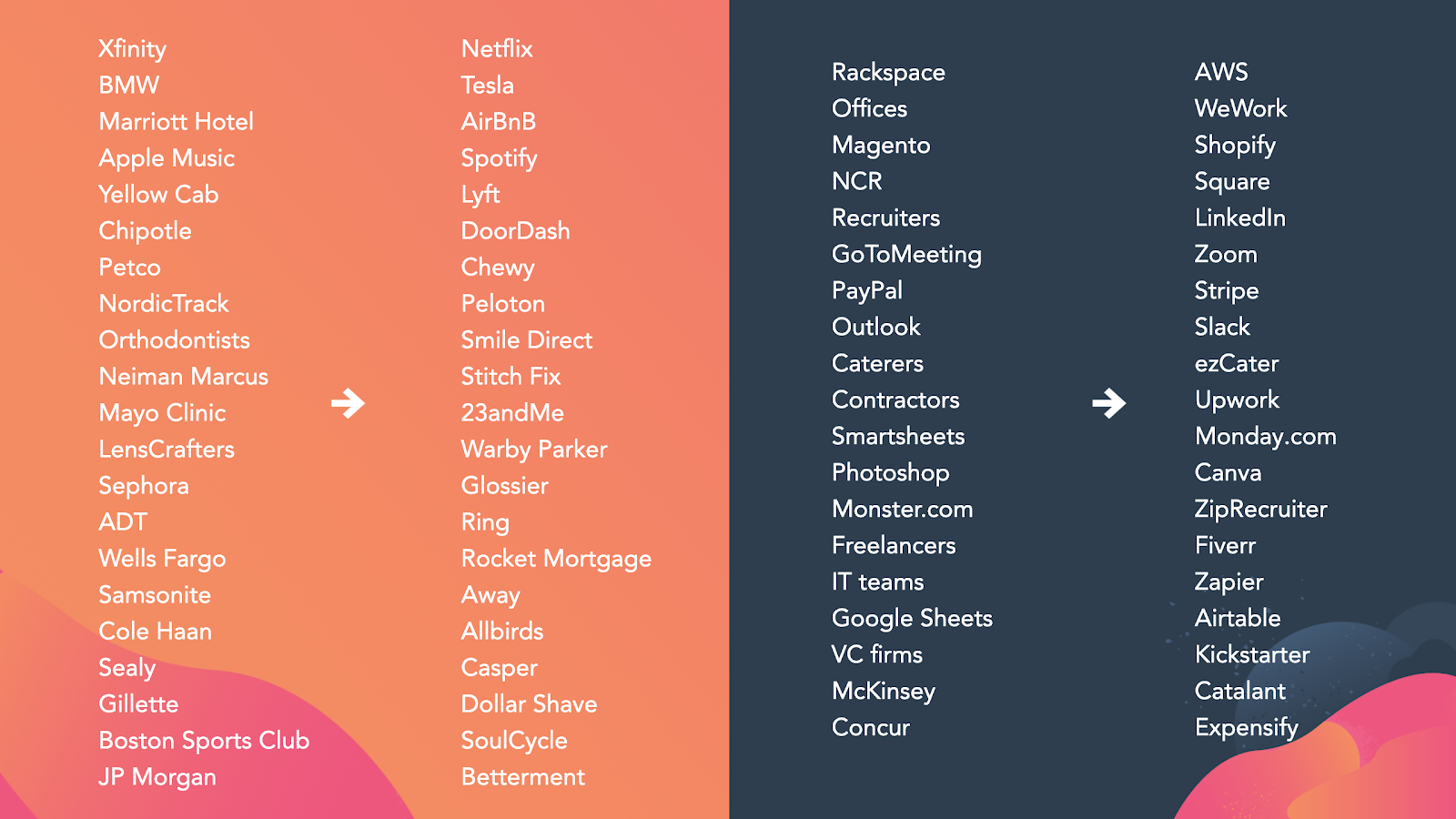
Buyers have changed, too. Ten years ago, businesses won because they sold a product 10 times better than the competition.
Today, businesses win and lose because of their customer experience.
Whether it’s downloading a piece of educational content as a prospect or filing a support ticket as a customer, your buyers want their experience with your company to be simple. More than simple — frictionless.
As marketers, we’re the architects of this experience. Every touchpoint we have with buyers is an opportunity to gain trust. Yet many of us only focus on a small part of the customer journey.
Close to 40% of marketers list their top priority in 2020 as generating leads. Only 5% listed customer retention as a focus area.
Today’s businesses need marketing strategies that support the entire customer lifecycle. Increasingly vocal buyers, easily replicable products, and eroding trust in businesses mean that a delighted customer base is more influential in driving growth than any marketer or salesperson.
Focusing on acquisition at the expense of retention is just one way many of us are missing out on a huge growth opportunity.
Ten years ago, closed-loop reporting was impossible for many marketers. Today, rich attribution is available to all, but not quite yet the norm. Currently, only 52% of marketers use some form of attribution reporting. We expect that number to rise this year, as more companies embrace a platform approach to their software, enabling robust integrations between systems of record and systems of engagement.
We hope this enables marketers to make better business decisions. One of the most important metrics to track is the return on investment of marketing activities. Only 35% of our respondents replied that it is “very important” or “extremely important” to understand the ROI of any given campaign.
That’s low, but I don’t think the outstanding 65% is avoiding it. They’re facing a technology barrier that’s preventing them from measuring their work. Most software that’s built for frontline marketers isn’t quite powerful enough to capture this, and software that is sophisticated enough requires heavy IT or developer support. That is starting to change.
Ten years ago, having a content marketing strategy really meant that you had a blog. This year, for the first time, video content has surpassed blog posts as the top content marketing investment. Video-based platforms like YouTube show no signs of slowing growth––it was the only bright spot in Alphabet’s recent earnings report. Even so, I still see video being used mostly in the decision stage of the buyer’s journey.
Marketers create case study videos, product reviews, and videos for the sales team to use, whereas blogging still dominates acquisition strategies. I encourage marketers to think about how we can use videos as an awareness tool — it’s a massive opportunity.
As we enter the next decade of marketing, only one thing is certain: more change is coming. To help marketers everywhere get a head start this year, we sourced innovative strategies from marketing managers, directors, VPs, and CMOs, at HubSpot, Litmus, and Crayon, and surveyed over 3,400 marketers across the globe. The resulting report is an in-depth look at the current state of marketing.
It outlines our efforts to connect marketing to business growth. And it emphasizes our commitment to the entire customer experience across marketing, sales, and customer support.
It’s a scary and exciting time for marketers everywhere. As you’re planning for the future, questions are inevitable. This report is here to help you answer them.
There are plenty of State of Marketing Reports out there, but this isn’t one of them.
This is Not Another State of Marketing Report, by HubSpot.

Maxslides – Crea presentaciones profesionales en PowerPoint con plantillas prediseñadas
Demo en español de Maxslides
Qué es Maxslides
Maxslides te brinda la posibilidad de diseñar tus propias plantillas en Power Point tomando como base la elección de diversos diseños previamente creados por Maxslides y a la vez sutilmente pensados para proyectos profesionales, con la versatilidad de que puedes personalizarlos y adaptados a tus necesidades. Ahorrarás horas de trabajo y planeación de cualquier presentación porque en tan solo 10 minutos puedes lograr crear plantillas con gran impacto visual y efectos.

Contiene más de 40 categorías listas para escoger y editar, como por ejemplo: Módulos de presentación sobre nosotros, visión y misión, quiénes somos, servicios que ofrece la compañía… Cada uno de estos módulos contiene 25 diapositivas animadas para diferentes propósitos. Maxslides será tu mano derecha en las presentaciones de webinars, seminarios, conferencias, promociones de productos… Las posibilidades de captar la atención e interés de tu público al producir brillantes y efectivas presentaciones en Power Point son ilimitadas.
Precios de Maxslides
Una vez compres la Versión Básica, podrás ampliar las funcionalidades del software con cualquiera de estas versiones:
BONUS EXCLUSIVOS SOCIALANCER
BONUS #1 – VideoTutoriales Detallados en español. Te explicaremos el proceso paso a paso para crear tus diseños y sacarle todo el rendimiento a Maxslides desde su adquisición.
BONUS #2 – Soporte en español. Contáctanos para lo que necesites y te ayudaremos.
BONUS #3 (Si compras la OTO1) – Paquete: Más de 65 Mockups. Obtén el Mockup con las características de soltar y arrastrar, 100% editable en Powerpoint
BONUS #4 (Si compras la OTO1) – Paquete: Más de 150 “Llamadas a la acción”. Obtén el botón de “Llamadas a la acción” gratis, listo para usar en formato PNG y PPT
BONUS #5 (Si compras la OTO2) – Más de 6000 Slides Project-X Templates
BONUS #6 (Si compras la OTO2) – Plantillas de proyectos para los seminarios
BONUS #7 (Si compras la OTO2) – 100 Personajes en SVG y PNG
from Socialancer https://ift.tt/2wudrST
via
5 Tips for Better Resource Scheduling

The 4 Reasons You Chose a Bad Company Name … Now What?
Picture the scene from the film The Social Network where a fast-talking Sean Parker (played by Justin Timberlake) glides into a lunch meeting with Mark Zuckerberg, Christy Lee, and Eduardo Saverin.
Sean confidently expresses how he envisions the company’s thrilling growth, impressing two out of the three start-up enthusiasts.
And then, right before his sudden departure, Sean offers a piece of advice to the crew, a recommendation that Eduardo passive-aggressively states was Sean’s biggest contribution to the company: “Drop the The. Just Facebook. It’s cleaner.”
Would The Facebook have been as successful as Facebook? Many will argue no. Sean’s influence led Mark to update the company’s name and further pivot the platform toward the minimalistic look we know today.
Many social networks have adopted a similar approach to naming their platforms. YouTube, Twitter, Twitch, and Instagram all mirror a short, one-word naming construct. Like Facebook, their names and branding remain memorable and engaging a decade later.
Of course, there’s no one-size-fits-all approach to naming a company. The naming patterns that work for a social network may not necessarily work for your company. However, regardless of industry, selecting your company’s name can make all the difference to its eventual success.
Here, let’s explore the components of a “bad” name, so you can ensure you avoid these mishaps if you’re currently in the naming stage with your own company (or the re-branding stage).
‘The Facebook’ and Other Bad Names
Mark’s decision proves that a change as little as ‘The‘ can have a huge impact on branding and strategy. However, Facebook isn’t the only company that made tweaks to its name. In fact, many companies we embrace today underwent complete name changes or rebrands.
Google, the most popular search engine in the world, had a very different early name. The search engine’s first name was BackRub, referring to the way the search engine analyzed backlinks. The name was short-lived and Google was trademarked on September 15, 1997.
On July 6, 2006, ‘Google’ became a newfound verb in the English dictionary. Merriam-Webster announced it added Google as a transitive verb, meaning “to use the Google search engine to obtain information about (someone or something) on the World Wide Web.”
Shaping the English language is true brand goals.
Let’s consider another example — would you take a sip of Brad’s Drink? Probably not. But most of us have tried a Pepsi. You guessed it, they’re the same soda. In 1893, Caleb Bradham developed a drink recipe after formulating a unique concoction of cola nuts and spices. Proud of inventing a unique beverage he believed to be a healthy cola alternative, Caleb named the recipe Brad’s Drink, after himself.
Five years later, Brad’s Drink was renamed Pepsi-Cola after the pepsin enzyme that supports digestion. The brand later shortened its name to Pepsi in 1961 — which sounds much more refreshing, in my opinion.
And finally, Dunkin’ Donuts decided to rebrand after 68 years with the same name. Originally named Open Kettle, founder William Rosenberg served donuts and premium cups of coffee. After a brainstorming session with executives, William renamed his restaurant to Dunkin’ Donuts in 1950.
In 2018, the company announced it would shorten its name to Dunkin’. The name change was one of many steps to transform itself into the premier beverage-led, on-the-go brand. “Dunkin’ is a shorter, simpler, more modern version of who we’ve always been,” explained Dunkin’ U.S. CMO Tony Weisman. By shedding Donuts, the brand redirected focus on beverages, where profit margins are much higher than donuts.
These accomplished brands found their former names limiting and sought to thrive with a brand refresh.
Names go beyond vanity — studies suggest that a name has a significant impact on a company’s bottom line. In fact, a report on behalf of the Society of Personal and Social Psychology, Inc. discovered stocks with easier-to-pronounce names performed up to 33% better those with names more difficult to pronounce.
What makes a name bad?
Defining what makes a “bad” name is just as complex as defining what makes a “great” one.
Names, like all words, vary in connotation and audience reception.
When brainstorming, it often feels that the “good” names have already been claimed. After all, over 627,000 new businesses open each year. This can make naming a business feel like a competitive, and almost impossible, process.
But this is the phase in the process where you can evoke your creativity and innovation. As you create, you must remain cautious of what will lead you toward selecting a name that you may later regret.
Here are the top four reasons you might end up with a “bad” name.
1. Not establishing your tone. Before diving into your brainstorm, it’s imperative that you select a tone that’s right for your brand and industry. The five tones that names typically fall under include modern, classic, playful, pragmatic, and emotional. Even Google learned quickly that their first choice, albeit playful, was not the right tone for the tech world at that time.
However, you can push your industry’s boundaries and select a tone that might stand out in your vertical. Apple, for example, selected an organic object as their name when the rest of the industry at the time was using tech-focused jargon and acronyms. If you do decide to go against the grain, be sure that the rest of your branding and marketing strategy strongly supports this direction.
2. Believing the shorter, the better. There’s a common misconception that a successful brand name should be short. This is not necessarily the case. In fact, locking down a short name may be costly, especially when securing domain names and social media handles.
For example, Uber’s first website was UberTaxi.com. In 2010, Uber purchased Uber.com from the owner, Universal Music Group. Still a new company, the rideshare start-up used equity to purchase the domain. Universal Music Group sold their stock back to Uber for a mere $1 million. Four years later, Uber’s worth was reported to be $17 billion.
Additionally, if you find that a similar business is already using the name or a similar name, you risk confusing your customers or possibly running into trademark conflict. Before deciding on a shorter name, be sure to conduct thorough research.
3. It’s complicated, literally. In the naming business, we encourage creatives to think outside of the box. In fact, story-driven business names allow for brands to connect with audiences and evoke connection. However, a name that is too complex can become problematic. A strong name is often easy to spell, hear, and pronounce. Complicated names will make it hard for customers to find you online, remember your brand, and share it with others.
In a report conducted by Prezi, 80% of consumers forget branded content after only three days. Consumers cited that there was simply too much content to retain. Make it easy on customers by brainstorming names that are easy to remember.
4. Loving a name too soon. Love is blind. And so is falling in love with a name early on in the process. Many times, we have a preference based on our assumptions, personal connection, or unconscious bias.
For instance, in the Summer of 2019, Kim Kardashian West renamed her Kimono shapewear brand to Skims after being accused of cultural appropriation. These are the real-world consequences of untested or misinformed name choices.
After brainstorming, it’s highly important to audience test. Audience testing will offer valuable insight into the names that will appeal to your target market. Your business may choose to run surveys through relevant forums, Facebook groups, and audience testing services to obtain relevant opinions on your business name ideas. As the results come in, you may discover that the name you initially loved does not have a positive connotation or resonates with key stakeholders.
The name you select is truly the cornerstone of your brand. It is your brand’s identity channeled in one or two words. A brand name is the foundation of your brand’s personality, therefore you must uncover one that reflects your company.
Now that you know what makes a “bad” name, you can move forward in selecting a strong business name — sans The.

4 Ways to Use TikTok for Business
Wondering how to use TikTok for your business? Looking for tips to increase your TikTok success? In this article, you’ll discover four ways your business can succeed on TikTok. Is Your Audience on TikTok? TikTok is the newest trend in social media with more than 1.5 billion downloads on the App Store and Google Play and more than […]
The post 4 Ways to Use TikTok for Business appeared first on Social Media Marketing | Social Media Examiner.
from Social Media Marketing | Social Media Examiner https://ift.tt/37y8wNn
via socialmediaexaminer
17 Truly Inspiring Company Vision and Mission Statement Examples
Think about those brands you purchase from over and over, even when there are cheaper options out there. Why do you choose the ones you choose?
Do you usually fly on a particular airline? Do you buy your coffee from the same place every morning? Do you recommend a specific restaurant whenever out-of-towners ask for suggestions? Well, there’s a good reason for it.
The reason we stay loyal to brands is because of their values. The best brands strive to combine physical, emotional, and logical elements into one exceptional customer (and employee) experience that you value as much as they do. Nowhere are those values more visible than in the company’s mission statement.
When you successfully create a connection with your customers and employees, many of them might stay loyal to you for life. This helps you increase your overall profitability while building a solid foundation of brand promoters.
But achieving that connection is no easy task. The companies that succeed are ones that stay true to their core values over the years and create a company that employees and customers are proud to associate with.
That’s where company vision and mission statements come in.
What is a Vision Statement?
A vision statement describes where the company aspires to be upon achieving its mission. This statement reveals the “where” of a business. Below are some vision statements from well-known companies to give you a sense of how a vision represents a brand.
Vision Statement Examples
- Alzheimer’s Association: A world without Alzheimer’s disease.
- Teach for America: One day, all children in this nation will have the opportunity to attain an excellent education.
- Creative Commons: Realizing the full potential of the internet — universal access to research and education, full participation in culture — to drive a new era of development, growth, and productivity.
- Microsoft (at its founding): A computer on every desk and in every home.
- Australia Department of Health: Better health and wellbeing for all Australians, now and for future generations.
- LinkedIn: Create economic opportunity for every member of the global workforce.
- Disney: To entertain, inform and inspire people around the globe through the power of unparalleled storytelling, reflecting the iconic brands, creative minds and innovative technologies that make ours the world’s premier entertainment company.
- Facebook: Connect with friends and the world around you on Facebook.
What is a Mission Statement?
If the above examples are vision statements, what’s a mission statement? A mission statement is, in some ways, an action-oriented vision statement, declaring the purpose an organization serves to its audience. It often includes a general description of the organization, its function, and its objectives.
As a company grows, its objectives and goals may be reached, and in turn they’ll change. Therefore, mission and vision statements should be revised as needed to reflect the business’s new culture as previous goals are met.
Both mission and vision statements are often combined into one comprehensive “mission statement” to define the organization’s reason for existing and its outlook for internal and external audiences — like employees, partners, board members, consumers, and shareholders.
With that in mind, what does a good mission statement look like? Check out some of the following company mission statements for yourself — and get inspired to write one for your brand.
Mission Statement Examples
- Life is Good: To spread the power of optimism.
- sweetgreen: To inspire healthier communities by connecting people to real food.
- Patagonia: Build the best product, cause no unnecessary harm, use business to inspire and implement solutions to the environmental crisis.
- American Express: We work hard every day to make American Express the world’s most respected service brand.
- Warby Parker: To offer designer eyewear at a revolutionary price, while leading the way for socially conscious businesses.
- InvisionApp: Question Assumptions. Think Deeply. Iterate as a Lifestyle. Details, Details. Design is Everywhere. Integrity.
- Honest Tea: To create and promote great-tasting, healthy, organic beverages.
- IKEA: To create a better everyday life for the many people.
- Nordstrom: To give customers the most compelling shopping experience possible.
- Cradles to Crayons: Provides children from birth through age 12, living in homeless or low-income situations, with the essential items they need to thrive – at home, at school and at play.
- Universal Health Services, Inc.: To provide superior quality healthcare services that: PATIENTS recommend to family and friends, PHYSICIANS prefer for their patients, PURCHASERS select for their clients, EMPLOYEES are proud of, and INVESTORS seek for long-term returns.
- JetBlue: To inspire humanity – both in the air and on the ground.
- Workday: To put people at the center of enterprise software.
- Prezi: To reinvent how people share knowledge, tell stories, and inspire their audiences to act.
- Tesla: To accelerate the world’s transition to sustainable energy.
- Invisible Children: To end violence and exploitation facing our world’s most isolated and vulnerable communities.
- TED: Spread ideas.
Best Vision and Mission Statement Examples From Real Companies
1. Life Is Good: To spread the power of optimism.
The Life is Good brand is about more than spreading optimism — although, with uplifting T-shirt slogans like “Seas The Day” and “Forecast: Mostly Sunny,” it’s hard not to crack a smile.
There are a ton of T-shirt companies in the world, but Life is Good’s mission sets itself apart with a mission statement goes beyond fun clothing: to spread the power of optimism. This mission is perhaps a little unexpected if you’re not familiar with the company’s public charity: How will a T-shirt company help spread optimism? Life is Good answers that question below the fold, where what the mission means is explained in more detail, with links to programs implemented to support it: its #GrowTheGood initiative and the Life is Good Kids Foundation page. We really like how lofty yet specific this mission statement is — it’s a hard-to-balance combination.
2. sweetgreen: To inspire healthier communities by connecting people to real food.
Notice that sweetgreen’s mission is positioned to align with your values — not just written as something the brand believes. We love the inclusive language used in its statement, letting us know that the company is all about connecting its growing network of farmers growing healthy, local ingredients with us — the customer — because we’re the ones who want more locally grown, healthy food options.
The mission to connect people is what makes this statement so strong. And that promise has gone beyond sweetgreen’s website and walls of its food shops: The team has made strides in the communities where it’s opened stores as well. Primarily, it provides education to young kids on healthy eating, fitness, sustainability, and where food comes from. The sweetlife music festival attracts 20,000 like-minded people every year who come together to listen to music, eat healthy food, and give back to a cause — the sweetgreen in schools charity partner, FoodCorps.
3. Patagonia: Build the best product, cause no unnecessary harm, use business to inspire and implement solutions to the environmental crisis.
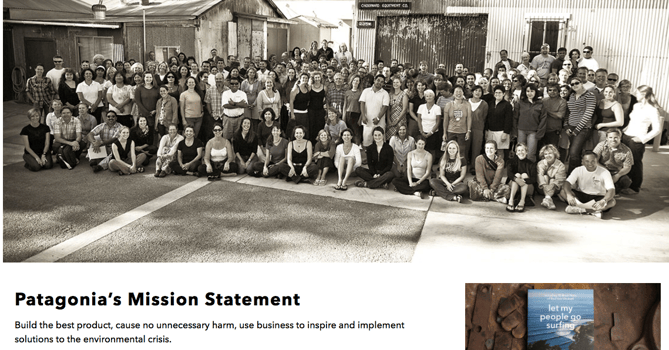
Patagonia’s mission statement combines both the values that bring them market success (building safe, high-quality products) and the values that contribute to a better world (philanthropic efforts to help the environment). For the people behind the brand, “a love of wild and beautiful places demands participation in the fight to save them.” In the name of this cause, the company donates time, services, and at least 1% of its sales to hundreds of grassroots environmental groups around the world.
If your company has a similar focus on growing your business and giving back, think about talking about both the benefit you bring to customers and the value you want to bring to a greater cause in your mission statement.
4. American Express: We work hard every day to make American Express the world’s most respected service brand.

Customers will never love a company until the employees love it first.
— Simon Sinek (@simonsinek)
April 16, 2014
The tweet above is from Simon Sinek, and it’s one that we repeat here at HubSpot all the time. American Express sets itself apart from other credit card companies in its list of values, with an ode to great customer service, which is something it’s famous for.
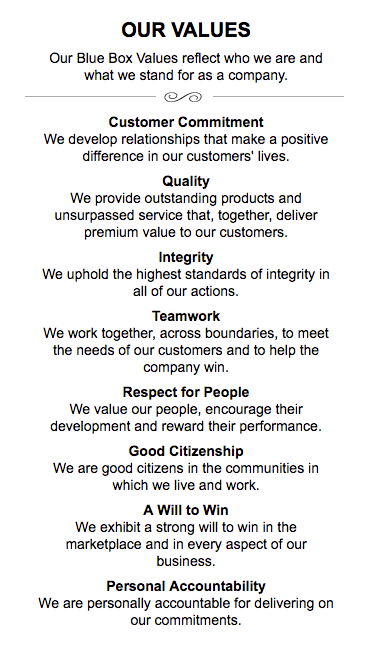
We especially love the emphasis on teamwork and supporting employees, so that the people inside of the organization can be in the best position to support their customers.
5. Warby Parker: To offer designer eyewear at a revolutionary price, while leading the way for socially conscious businesses.
Speaking of quirky, this “objective” statement from Warby Parker uses words that reflect a young and daring personality: “rebellious,” “revolutionary,” “socially-conscious.” In one sentence, the brand takes us back to the root of why it was founded while also revealing its vision for a better future.
The longer-form version of the mission reads: “We believe that buying glasses should be easy and fun. It should leave you happy and good-looking, with money in your pocket,” which further shows how Warby Parker doesn’t hold back on letting its unique personality shine through. Here, the missions statement’s success all comes down to spot-on word choice.
6. InvisionApp: Question Assumptions. Think Deeply. Iterate as a Lifestyle. Details, Details. Design is Everywhere. Integrity.

These days, it can seem like every B2B company page looks the same — but InvisionApp has one of the cooler company pages I’ve seen. Scroll down to “Our Core Values,” and hover your mouse over any of the icons, and you’ll find a short-but-sweet piece of the overall company mission under each icon. We love the way the statements are laid out under each icon. Each description is brief, authentic, and business babble-free — which makes the folks at InvisionApp seem like trustworthy, B.S.-free types.
7. Honest Tea: To create and promote great-tasting, healthy, organic beverages.
Honest Tea’s mission statement begins with a simple punch line connoting its tea is real, pure, and therefore not full of artificial chemicals. The brand is speaking to an audience that’s tired of finding ingredients in its tea that can’t be pronounced, and have been searching for a tea that’s exactly what it says it is.
Not only does Honest Tea have a punny name, but it also centers its mission around the clever company name. For some time, the company even published a Mission Report each year in an effort to be “transparent about our business practices and live up to our mission to seek to create and promote great-tasting, healthier, organic beverages.”
8. IKEA: To create a better everyday life for the many people.
The folks at IKEA dream big. The vision-based mission statement could have been one of beautiful, affordable furniture, but instead, it’s to make everyday life better for its customers. It’s a partnership: IKEA finds deals all over the world and buys in bulk, then we choose the furniture and pick it up at a self-service warehouse.
“Our business idea supports this vision … so [that] as many people as possible will be able to afford them,” the brand states.
Using words like “as many people as possible” makes a huge company like IKEA much more accessible and appealing to customers.
9. Nordstrom: “To give customers the most compelling shopping experience possible.
When it comes to customer commitment, not many companies are as hyper-focused as Nordstrom is. Although clothing selection, quality, and value all have a place in the company’s mission statement, it’s crystal clear that it’s all about the customer: “Nordstrom works relentlessly to give customers the most compelling shopping experience possible.”
If you’ve ever shopped at a Nordstrom, you’ll know the brand will uphold the high standard for customer service mentioned in its mission statement, as associates are always roaming the sales floors, asking customers whether they’ve been helped, and doing everything they can to make the shopping experience a memorable one.
10. Cradles to Crayons: Provides children from birth through age 12, living in homeless or low-income situations, with the essential items they need to thrive – at home, at school and at play.
Cradles to Crayons divided its mission and model into three sections that read like a game plan: The Need, The Mission, and The Model. The “rule of three” is a powerful rhetorical device called a tricolon that’s usually used in speechwriting to help make an idea more memorable. A tricolon is a series of three parallel elements of roughly the same length — think “I came; I saw; I conquered.”
11. Universal Health Services, Inc.: To provide superior quality healthcare services that: PATIENTS recommend to family and friends, PHYSICIANS prefer for their patients, PURCHASERS select for their clients, EMPLOYEES are proud of, and INVESTORS seek for long-term returns.
A company thrives when it pleases its customers, its employees, its partners, and its investors — and Universal Health Services endeavors to do just that, according to its mission statement. As a health care service, it specifically strives to please its patients, physicians, purchasers, employees, and investors. We love the emphasis on each facet of the organization, by capitalizing the font and making it red for easy skimming.
12. JetBlue: To inspire humanity – both in the air and on the ground.

JetBlue’s committed to its founding mission through lovable marketing, charitable partnerships, and influential programs — and we love the approachable language used to describe these endeavors. For example, the brand writes how it “set out in 2000 to bring humanity back to the skies.”
For those of us who want to learn more about any of its specific efforts, JetBlue’s provided details on the Soar With Reading program, its partnership with KaBOOM!, the JetBlue Foundation, environmental and social reporting, and so on. It breaks down all these initiatives really well with big headers, bullet points, pictures, and links to other webpages visitors can click to learn more. Finally, it ends with a call-to-action encouraging website visitors volunteer or donate their TrueBlue points.
13. Workday: To put people at the center of enterprise software.
Workday, a human resources (HR) task automation service, doesn’t use its mission statement to highlight the features of its product or how it intends to help HR professionals improve in such-and-such a way.
Instead, the business takes a stance on the state of enterprise software in general: There’s a lot of great tech out there. But at Workday, it revolves around the people. We love how confident yet kind this mission statement is. It observes the state of its industry — which Workday believes lacks a human touch — and builds company values around it.
14. Prezi: To reinvent how people share knowledge, tell stories, and inspire their audiences to act.
If you know Prezi, you know how engaging it can make your next business presentation look. According to its mission statement, the company’s clever slide animations and 3-dimensional experience aren’t just superficial product features. With every decision Prezi makes, it’s all about the story you tell and the audience that story affects.
15. Tesla: To accelerate the world’s transition to sustainable energy.
A car company’s punny use of the word “accelerate” is just one reason this mission statement sticks out. The main reason Tesla makes this list is because of how its mission statement describes the industry.
It may be a car company, but Tesla’s main interest isn’t just automobile sales — it’s promoting sustainable energy. And sustainable energy still has a “long road” ahead of it (pun intended) — hence the world’s “transition” into this market.
Ultimately, a mission statement that can admit to the industry’s immaturity is exactly what gets customers to root for it. And Tesla does that nicely.
16. Invisible Children: To end violence and exploitation facing our world’s most isolated and vulnerable communities.
Tenacity is hard to come by in the non-profit sector, and that’s what makes this mission statement so distinguished. Invisible Children is a non-profit that raises awareness around the violence affecting communities across Central Africa, and the company takes quite a confident tone in its mission.
The most valuable quality of this mission statement is that it has an end goal. Many companies’ visions and missions are intentionally left open-ended so that the business might always be needed by the community. Invisible Children, on the other hand, wants to “end” the violence facing African families. It’s an admirable mission that all businesses — not just non-profits — can learn from when trying to motivate their customers.
17. TED: Spread ideas.
We’ve all seen TED Talks online before. Well, the company happens to have one of the most succinct mission statements out there.
TED, which stands for “Technology Education and Design,” has a two-word mission statement that shines through in every Talk you’ve seen the company publish on the internet. That mission statement: “Spread ideas.” Sometimes, the best way to get an audience to remember you is to zoom out as far as your business’s vision can go. What do you really care about? TED has recorded some of the most famous presentations in the world, but in the grand scheme of things, all it wants is to spread ideas around to its viewers.
Here are 22 companies with really catchy slogans and brand taglines.
Editor’s note: This post was originally published in August 2014 and has been updated for comprehensiveness.
