
Welcome to My Blog
Is Email Marketing Dead? No, But These Practices Are
99% of people check their email every day.
With a statistic like that, it’s not hard to see why email marketing is a go-to for marketing campaigns. What’s confusing, though, is that sometimes, email marketing ROI can look a little bleak.
An un-successful email campaign in a world where opening emails is such a big part of people’s lives can be confusing, and brings up an important question:
Where is the gap between consumers checking their email constantly, but not clicking on your brand’s message?
Before you pull the plug on email marketing completely, consider this — 73% of millennials prefer email communication when receiving marketing material.
Ultimately, the problem may not be the marketing channel, but the message delivery.
So, is email marketing dead? Or, is there something that can be done to enhance the email marketing experience — for consumers and marketers?
In the next section, we’re going to answer that question and why a marketing strategy makeover might be necessary for a struggling brand.
There’s no need to hold a funeral: email isn’t dead, just outdated.
If your brand’s email marketing strategy is currently struggling with bringing in high ROI, it could be because your strategy hasn’t been improved to reflect how email currently works.
Ultimately, if you’re not catering to your audiences, or if you’re not using metrics to appropriately measure and improve your email campaigns, you’re likely missing out on ROI — not because email marketing is dead, but because your strategy is outdated.
To improve your email marketing ROI in 2020, here’s what to retire:
Email Marketing “Dead” Practices
1. Impersonal subject lines
Email marketing starts before readers even open the email. Subject lines can make or break open-rate, a metric that tracks how many subscribers open your emails.
A major component of a successful campaign is targeting the customer by creating content that identifies with their lifestyle. In email marketing, this begins with the subject line.
As a consumer, if I see an emoji in a marketing email’s subject line, I immediately open it as opposed to others, because to me, this shows that the sender took a little extra time to personalize the message.
For instance, here’s a look at the promotion emails I’ve opened and engaged with:
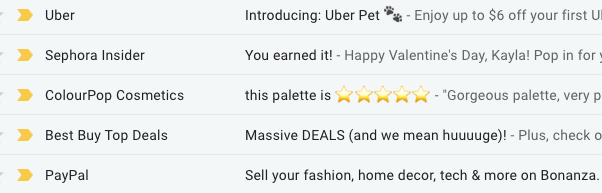
Personalizing marketing messages makes readers feel connected to what’s being sold. Generally, making a subject line personal can be as easy as noting the holiday season or asking a question to get readers thinking.
Think about what in your email is the “must-know” takeaway, and create a short subject line that taps into emotions to get subscribers clicking.
2. Ignoring GDPR standards
In a nutshell, GDPR means making sure the reader gives clear, unambiguous permission to receive marketing emails. Full compliance with General Data Protection Regulations (GDPR) ensures that sending marketing emails is legal.
GDPR was created so consumers know their data is protected and being used by brands they have trusted with personal information. They opt-in to emails they’d like to receive from brands they’re interested in.
This is good news for marketers because it means your email campaigns will only be sent to users who are genuinely interested in your marketing messages. It also ensures your email marketing messages are compliant with the law.
Email marketing software should be GDPR compliant. If not, it’s time to choose new software. HubSpot has a great guide about navigating GDPR, incorporating these rules into strategy, and why the email marketing tools from HubSpot already follow the standards.
3. Using templates that aren’t mobile-friendly
The world is mobile now. When I check my emails in the morning, I’m checking from my phone, where I prefer to check my email.
Emails that aren’t mobile-friendly are probably raising your bounce rate exponentially due to poor user experience. Because it’s so easy to click away from something that’s unappealing, emails optimized for mobile should be an important step in the design process.
Apple’s iPhone is the most popular method for opening emails, with Gmail in second place. For some audiences, marketing emails that are stellar for mobile should take priority over emails for desktop, so the majority of readers don’t get turned away from desktop-friendly templates.
For businesses using email automation software, check the mobile previews as well as the desktop previews when drafting your email design. If the template being used interrupts comprehension or is just plain ugly on mobile, it might be a good idea to switch to something else.
4. Poor email design
We’ve talked a little about design, but it’s really imperative to take time designing emails that delight readers.
Emails lately have gotten snazzy. From animations to GIFs, and even embedded full-length videos, businesses are dipping their toes into exciting email marketing efforts to pull readers in.
Emails that have quick loading time, bold CTAs, and colorful visuals typically perform best. Consider this email I received recently from Adobe:
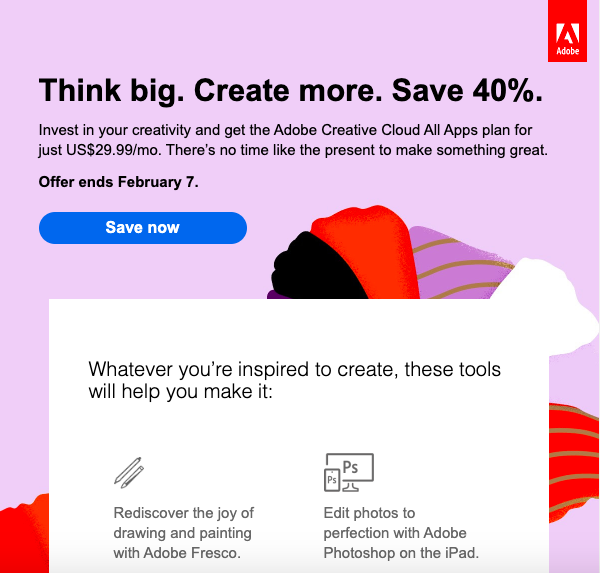
There are ways to include helpful information in emails without sacrificing the user’s experience, and it’s all about using visuals
Think about it — an email newsletter with an emoji in the title, a beautiful infographic, and a couple of lines of exciting copy before an engaging CTA is exciting to look at and read.
An email newsletter with long paragraphs, the same-old template and a CTA that hasn’t changed in years are … less than exciting, and probably leave readers clicking out of that email in favor of something that is.
Here are some examples of how email campaigns are stepping up design. In a nutshell, think about how every email can visually tell a story as much as words.
5. Not strategically using metrics
Tracking metrics helps fill in the gaps when looking at where to improve with marketing efforts. They break down the behavior of email subscribers.
There’s been a lot of talk about metrics, and that’s because metrics drive results. They are the numbers behind the campaign. Metrics tell marketers a plethora of important details.
Metrics collect data on how many people are interacting with emails, when they are, who they are, and for how long. All of this information is important to know when planning because they lead to important marketing decisions.
For instance, let’s say a marketer who checks email marketing metrics regularly notices that the bounce rate is high, meaning that readers are opening emails but not engaging with them. This can stem from a variety of issues, but knowing the bounce rate tells the marketer what to focus on improving for the next marketing email.
Metrics save time by reporting on what’s working and what isn’t. To begin tracking metrics, consider what email software you use. Many have reporting and tracking built into their tools, as well as information about how that data is collected and interpreted.
Ultimately, the reasons you may not be seeing results is not because email marketing is dead — it’s because of how you’re email marketing. So, before you turn away from email marketing as a whole, think about ways you can beef up your strategy to compete.

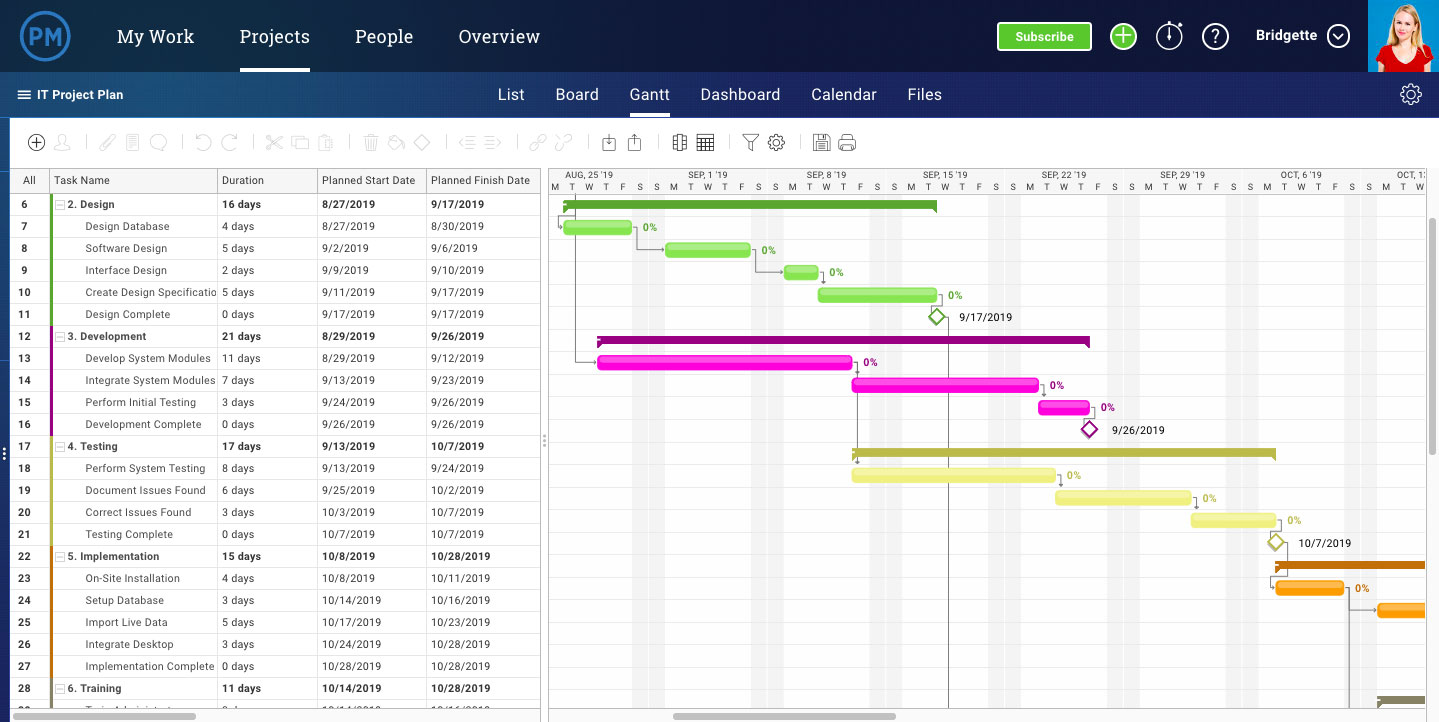
The Best Way to Make a Work Plan
How to Use Facebook Ads to Generate Sales and Leads Quickly
Do you need to accelerate your sales or leads? Have you considered using Facebook ads to meet your objectives? In this article, you’ll learn how to create Facebook ad campaigns that can greatly increase your chances of success. #1: Create Hot and Super-Hot Facebook Website Custom Audiences With the advertising goal of generating fast results […]
The post How to Use Facebook Ads to Generate Sales and Leads Quickly appeared first on Social Media Marketing | Social Media Examiner.
from Social Media Marketing | Social Media Examiner https://ift.tt/38GfOjO
via socialmediaexaminer
Here’s How to Add a Link to Your Instagram Story [Pro Tip]
Instagram Stories has extended the amount of time people spend in the app by approximately ten additional minutes. But, while that extra time means more attention and focus on your brand, it won’t translate to much if you can’t get that traffic back to your site.
If you have over 10,000 followers or you’re a verified user, you have an incredibly effective tool at your disposal — the swipe up link. This link enables you to post exciting content regarding a new product, service, or event, and then encourage those users to “swipe up for details.”
But with all that power comes some responsibility. How do you add a link to your story, and how can you use it to its fullest advantage? Let’s dive into that now.
How to Add Swipe Up to Instagram Stories
- Check to verify that you have 10,000 followers or a verified account.
- Find the link icon when you open your Instagram Story tool.
- Click this link icon.
- Copy the link you want to include to your device’s clipboard.
- Enter or paste a link in the spot provided in your Instagram Story.
- Click “Done” in the top right.
- Publish your Instagram Story.
- View your Story to ensure the link works correctly.
How to Add a Link to Your Instagram Story
I used HubSpot’s official Instagram account for these instructions, since my personal account isn’t verified (I also, you’ll be surprised to hear, don’t have 10,000 followers … ).
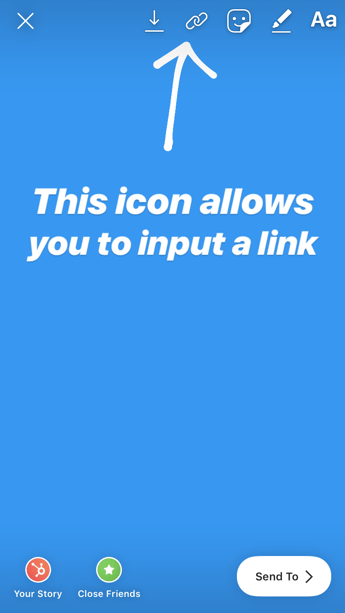
1. Take a photo or upload one to your Instagram Story, and then click the icon at the top right that looks like a chain.
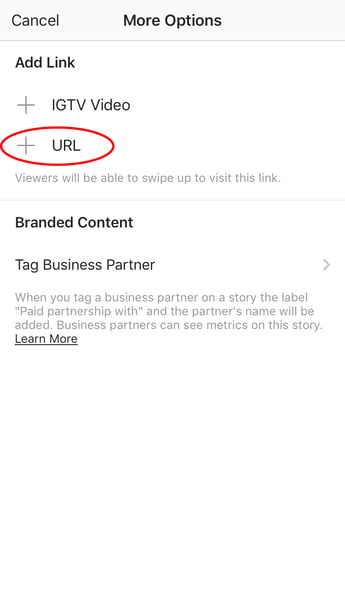
2. Here, click “+ URL” to add a link to a web page. If you were interested in linking your Story to your IGTV video, you could choose that option, instead.
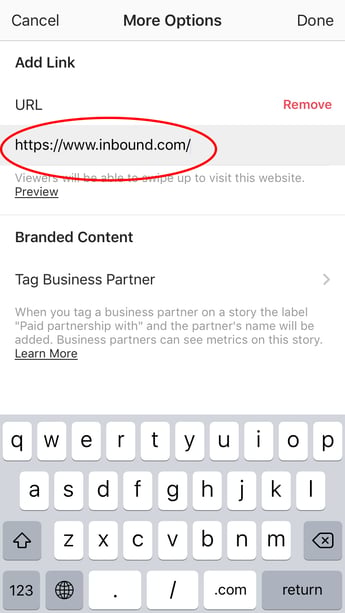
3. Type the URL into the text box. When you’re finished, click “Done” in the top right.
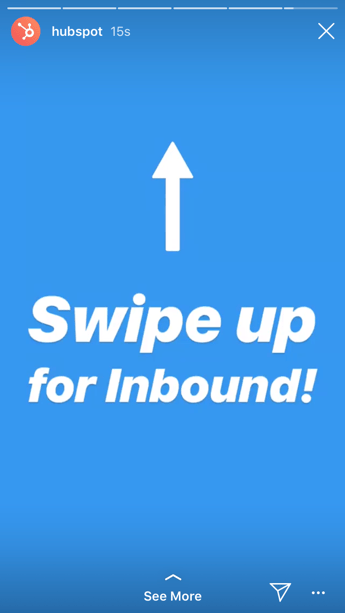
4. When you’re ready to publish, click the “+ Story” button at the bottom right of your Story. Now, your published Story has a “See More” swipe up link.
Instagram Swipe Up Link Examples
1. @Detoxinista Recipes
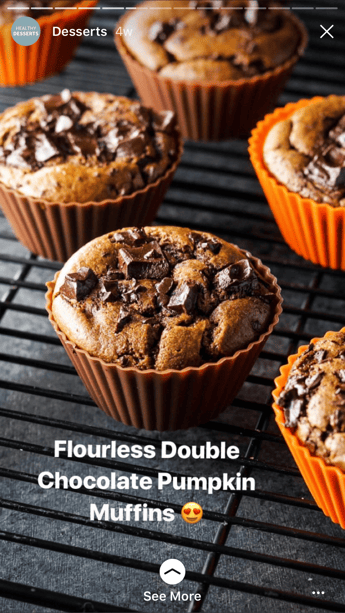
Food bloggers such as @Detoxinista use Instagram Stories’ swipe up link to embed recipes on the platform. They wisely post images of delicious-looking food, which incentivizes users to swipe up to learn how to make it themselves. The link isn’t a direct advertisement, but users are directed to Detoxinista’s website, where they can find her cookbook and become familiar with her brand.
2. @Alifedotowsky Clothing Items
If you’re a Bachelorette fan, you might’ve noticed the growing trend among Bachelor and Bachelorette contestants to become product influencers and embed swipe up links in their Stories. As a fashion and style blogger, Ali often takes pictures or videos of outfits she’s wearing, with swipe up links so users can buy the items online. She also often incorporates discounts if users swipe up, further incentivizing a user to purchase an item from a brand’s website.

3. @Popsugarfitness Summer Sculpt Series
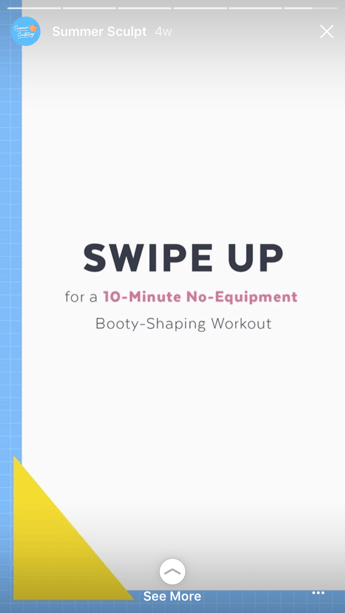
One of the most effective ways to use the swipe up feature is to offer your followers something of value, for free. @Popsugarfitness, for instance, introduced a Summer Sculpt series with a tempting offer — “Swipe Up for a 10-Minute No-Equipment Booty-Shaping Workout”. Who could say no to that? Ideally, as users obtain more value from your site, they’ll spend longer on it and become stronger brand advocates.
4. @Reebok Be More Human Campaign
Reebok created a powerful and timely campaign called “Be More Human”, celebrating women’s empowerment through fitness. On their Instagram Stories, they raise awareness for the campaign by showing famous women like Gigi Hadid or Danai Gurira, and when you swipe up, you learn more about Reebok’s campaign and how you can get involved. On the site there are opportunities to purchase t-shirts or donate money, but it’s evident Reebok is committed to staying focused on their messaging above all else, a noble pursuit.


Ads Coming to IGTV: What It Means for Marketers and Creators
Welcome to this week’s edition of the Social Media Marketing Talk Show, a news show for marketers who want to stay on the leading edge of social media. On this week’s Social Media Marketing Talk Show, we explore Instagram’s upcoming monetization program for IGTV and updated tools with special guest, Jenn Herman. We’ll also discuss […]
The post Ads Coming to IGTV: What It Means for Marketers and Creators appeared first on Social Media Marketing | Social Media Examiner.
from Social Media Marketing | Social Media Examiner https://ift.tt/320Sivk
via socialmediaexaminer
5 Ways to Increase Your Market Share
In 2007, Apple introduced the iPhone. The cell phone boasted a full touch screen, a slew of personalization options, and internet capabilities. These features were rare in the phone market before the iPhone, and having them all on one device was especially enticing.
Because of these innovative features, Apple built a reputation and loyal fan base in the first year of the iPhone’s release, earning the company a 3% market share.
Today, Apple has a 50% market share in the mobile phone industry. This means that half of phone owners globally own an iPhone.
As a business, knowing your market share tells you how you stack up against competitors. Ultimately, Apple needed to know its market share back in 2007, and continue to innovate and grow, to become a leader in the market today.
When we talk about raising market share, we’re talking about making informed marketing decisions that contribute to overall sales and customer retention. Here, let’s explore what it means to increase market share, and how you can do that, today.
What does it mean to increase market share?
To increase market share means increasing the effort you put into sales as a business, and using new or additional strategies to help you get there.
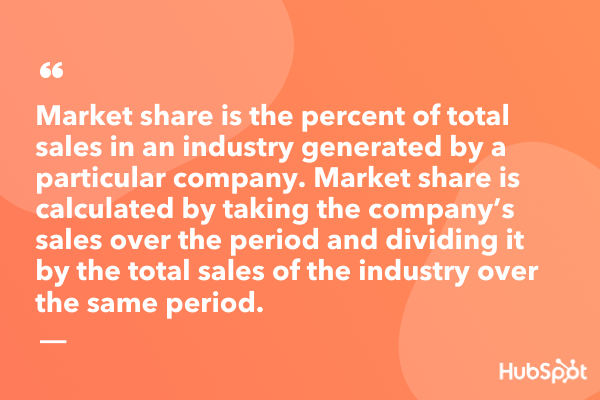
Market share is the percent of total sales in an industry generated by a particular company.
Simply put, market share is calculated by taking the company’s sales over a certain period of time, and dividing it by the total sales of the industry over that same period.
Basically, market share is how much you make as a company in the industry, and how that stacks up against others. So, to increase your market share, you need to make more sales than your competitors to increase your share in the industry.
Which is, of course, much easier said than done. How does one go about increasing market share? Let’s dive into that, next.
1. Find your niche and stick with it.
Your company should have a few characteristics that set it apart from the competition. For example, Apple’s logo and sleek design is seen on Apple’s entire suite of products.
Having that distinguishing brand characteristic — such as the Apple logo — enables people to more easily identify your company’s products across a line of similar-looking items. If your company is able to create a recognizable brand identity, while also producing higher-quality products or services than the competition (or products or services that serve a niche market), you’ll have a better chance of finding a larger piece of market share to capture.
For instance, I don’t know much about makeup, but I know a NARS blush when I see one because the design and logo of their products are so unique to the brand, and the quality of NARS products is undeniably good:
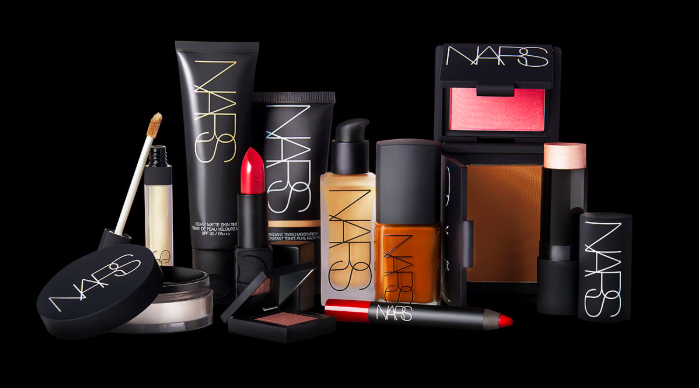
This strategy increases market share for a business that has found success with a previous launch. If a consumer sees your mark on a product, they will know what they’re getting, which informs their purchase decision.
As a marketer, you also want to consider which marketing materials can help you increase market share. For instance, do you have a popular eBook or YouTube series? Continue to work with those avenues more frequently to expand the reach those products get.
2. Innovate as society does.
Sony’s PlayStation owns 68% of the home console market share. Since 1994, Sony has been finding ways to innovate and update their video game consoles faster than their competition. These innovations are necessary to stay current in the industry and increase market share.
For reference, here is a 1994 PlayStation console:

And a 2014 PlayStation 4:

While some design elements have stayed the same, such as the logo and base system design, upgrades have been applied to match the times.
Take, for instance, the controller. They’re both similar, but while the PS4 controller is wireless, has a power button, and battery life, PS1 controllers don’t. PS1 power buttons are large and can be found on the side of the console, whereas much smaller PS4 power buttons can be found on the controller and on the console itself.
This is because as more advancements have been made in the gaming industry, Sony has adapted accordingly. The company has a keen eye on what gamers want as years pass, earning them a high market share.
If you fail to innovate in a way that’s reflected on the times, your business may fall behind and be forgotten. (RIP, outdated Aatari consoles).
3. Engage with customers.
Customers know what they want to see, so one way businesses can increase their market share is by asking them.
A carefully crafted survey sent out to loyal customers with questions about design, updates, and features can help you visualize tangible ways to improve your product or service, and in turn, increase your market share.
You don’t have to only use surveys, either. Engaging with customers on social media, such as in an Instagram story, works as well. Skincare company Glossier does this effectively:
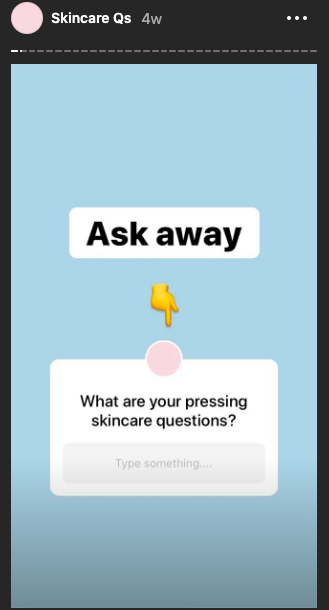
Going to the source to ask what customers will spend their money on is a good campaign strategy for increasing market share. It’s a low-cost way to conduct market research and learn more about your place in the industry based on consumer perception.
4. Think about an acquisition.
You can increase market share through the acquisition of a company that aligns well with your own products or services. This requires a bit of research, but will ultimately end up in potentially gaining a larger market share.
Companies usually acquire companies to gain a larger market share or expand their suite of products. For example, Microsoft owns LinkedIn and GitHub. While the former (LinkedIn) can lead to an increase in market share among social media revenue, the latter (GitHub) can lead to an increase in market share among Cloud OS revenue.
Acquiring a competitor involves choosing the right company — one that will be a positive addition to your suite of products or services.
5. Continue to delight customers.
Netflix is no stranger to creating loyal customers. The platform is constantly adding more original shows and tightening its algorithm to cater to its customers. This constant refining of the platform led to a 2014 report that Netflix had a 90% market share in the streaming service market.
Having such a large market share due to these updates has helped Netflix even as more streaming services have entered the market. Customers have found themselves not wanting to cancel their Netflix subscriptions because they’ve found such deep value in it.
In short, Netflix makes its customers happy. I know I’m certainly happy when I can turn on the Netflix app and see most of my favorites displayed without needing to scroll further.
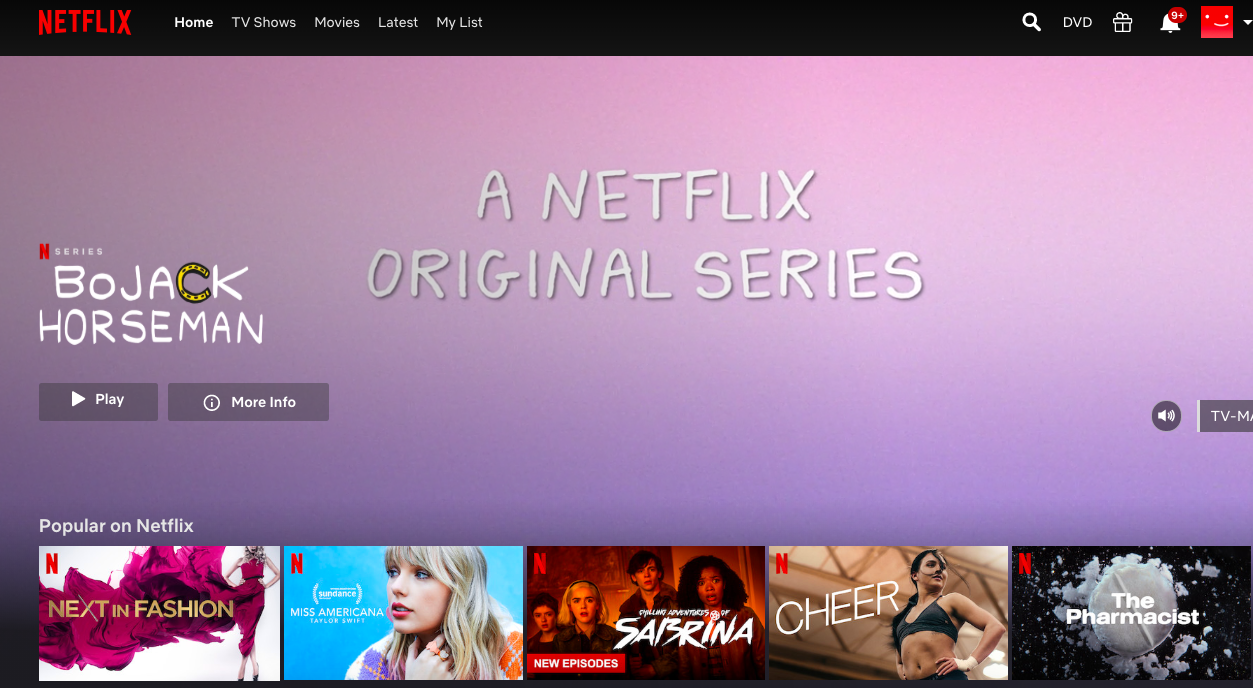
Netflix positioned itself as a leader in the industry. Don’t wait for customers to come to you for ideas — think ahead, not just of what they need, but what they’ll want as customer buying experience changes overtime.
In 2007, Apple completely revolutionized mobile phones and tripled their market share in a year. 13 years later, Apple is still a leader in the mobile phone market because of the ways they constantly improve their product and create loyal customers.
By looking at your market share and finding ways to increase it, you’ll find greater customer retention and a more stable position in your industry.

YouTube Stories: Success Tips From a Top YouTuber
Do you want to connect more often with your YouTube subscribers without releasing a full video? Are you taking advantage of YouTube’s Stories and Community tab features? To explore how to use YouTube Stories and the YouTube Community tab, I interview Evan Carmichael on the Social Media Marketing Podcast. Evan is a successful YouTuber with […]
The post YouTube Stories: Success Tips From a Top YouTuber appeared first on Social Media Marketing | Social Media Examiner.
from Social Media Marketing | Social Media Examiner https://ift.tt/2HptG5G
via socialmediaexaminer
5 Ways to Increase Your Market Share
In 2007, Apple introduced the iPhone. The cell phone boasted a full touch screen, a slew of personalization options, and internet capabilities. These features were rare in the phone market before the iPhone, and having them all on one device was especially enticing.
Because of these innovative features, Apple built a reputation and loyal fan base in the first year of the iPhone’s release, earning the company a 3% market share.
Today, Apple has a 50% market share in the mobile phone industry. This means that half of phone owners globally own an iPhone.
As a business, knowing your market share tells you how you stack up against competitors. Ultimately, Apple needed to know its market share back in 2007, and continue to innovate and grow, to become a leader in the market today.
When we talk about raising market share, we’re talking about making informed marketing decisions that contribute to overall sales and customer retention. Here, let’s explore what it means to increase market share, and how you can do that, today.
What does it mean to increase market share?
To increase market share means increasing the effort you put into sales as a business, and using new or additional strategies to help you get there.
Market share is the percent of total sales in an industry generated by a particular company.
Simply put, market share is calculated by taking the company’s sales over a certain period of time, and dividing it by the total sales of the industry over that same period.
Basically, market share is how much you make as a company in the industry, and how that stacks up against others. So, to increase your market share, you need to make more sales than your competitors to increase your share in the industry.
Which is, of course, much easier said than done. How does one go about increasing market share? Let’s dive into that, next.
1. Find your niche and stick with it.
Your company should have a few characteristics that set it apart from the competition. For example, Apple’s logo and sleek design is seen on Apple’s entire suite of products.
Having that distinguishing brand characteristic — such as the Apple logo — enables people to more easily identify your company’s products across a line of similar-looking items. If your company is able to create a recognizable brand identity, while also producing higher-quality products or services than the competition (or products or services that serve a niche market), you’ll have a better chance of finding a larger piece of market share to capture.
For instance, I don’t know much about makeup, but I know a NARS blush when I see one because the design and logo of their products are so unique to the brand, and the quality of NARS products is undeniably good:
This strategy increases market share for a business that has found success with a previous launch. If a consumer sees your mark on a product, they will know what they’re getting, which informs their purchase decision.
As a marketer, you also want to consider which marketing materials can help you increase market share. For instance, do you have a popular eBook or YouTube series? Continue to work with those avenues more frequently to expand the reach those products get.
2. Innovate as society does.
Sony’s PlayStation owns 68% of the home console market share. Since 1994, Sony has been finding ways to innovate and update their video game consoles faster than their competition. These innovations are necessary to stay current in the industry and increase market share.
For reference, here is a 1994 PlayStation console:
And a 2014 PlayStation 4:
While some design elements have stayed the same, such as the logo and base system design, upgrades have been applied to match the times.
Take, for instance, the controller. They’re both similar, but while the PS4 controller is wireless, has a power button, and battery life, PS1 controllers don’t. PS1 power buttons are large and can be found on the side of the console, whereas much smaller PS4 power buttons can be found on the controller and on the console itself.
This is because as more advancements have been made in the gaming industry, Sony has adapted accordingly. The company has a keen eye on what gamers want as years pass, earning them a high market share.
If you fail to innovate in a way that’s reflected on the times, your business may fall behind and be forgotten. (RIP, outdated Aatari consoles).
3. Engage with customers.
Customers know what they want to see, so one way businesses can increase their market share is by asking them.
A carefully crafted survey sent out to loyal customers with questions about design, updates, and features can help you visualize tangible ways to improve your product or service, and in turn, increase your market share.
You don’t have to only use surveys, either. Engaging with customers on social media, such as in an Instagram story, works as well. Skincare company Glossier does this effectively:
Going to the source to ask what customers will spend their money on is a good campaign strategy for increasing market share. It’s a low-cost way to conduct market research and learn more about your place in the industry based on consumer perception.
4. Think about an acquisition.
You can increase market share through the acquisition of a company that aligns well with your own products or services. This requires a bit of research, but will ultimately end up in potentially gaining a larger market share.
Companies usually acquire companies to gain a larger market share or expand their suite of products. For example, Microsoft owns LinkedIn and GitHub. While the former (LinkedIn) can lead to an increase in market share among social media revenue, the latter (GitHub) can lead to an increase in market share among Cloud OS revenue.
Acquiring a competitor involves choosing the right company — one that will be a positive addition to your suite of products or services.
5. Continue to delight customers.
Netflix is no stranger to creating loyal customers. The platform is constantly adding more original shows and tightening its algorithm to cater to its customers. This constant refining of the platform led to a 2014 report that Netflix had a 90% market share in the streaming service market.
Having such a large market share due to these updates has helped Netflix even as more streaming services have entered the market. Customers have found themselves not wanting to cancel their Netflix subscriptions because they’ve found such deep value in it.
In short, Netflix makes its customers happy. I know I’m certainly happy when I can turn on the Netflix app and see most of my favorites displayed without needing to scroll further.
Netflix positioned itself as a leader in the industry. Don’t wait for customers to come to you for ideas — think ahead, not just of what they need, but what they’ll want as customer buying experience changes overtime.
In 2007, Apple completely revolutionized mobile phones and tripled their market share in a year. 13 years later, Apple is still a leader in the mobile phone market because of the ways they constantly improve their product and create loyal customers.
By looking at your market share and finding ways to increase it, you’ll find greater customer retention and a more stable position in your industry.

Be Mine: A Brief History of Valentine’s Day Marketing
When I was in grade school, Valentine’s Day was one of my favorite holidays. There were cards. There was the possibility that your crush actually liked you back. And, there was the chocolate — so much chocolate.
Little did I know that the roots of this holiday bore little-to-no resemblance to my childhood experience of it. We were never taught that Valentine’s Day actually originated with an arguably gruesome ancient festival, where there was no chocolate or exchange of cute, red-and-pink cards.
But love it or hate it, those are the types of things we associate with the holiday today. After all, there’s a reason roughly 114 million Valentine’s Day cards are exchanged each year — it’s what’s become expected of us.
So how the heck did we get from an ancient Roman festival to a holiday that compels many of us to spend no less than $147 on celebrating it? That story, it turns out, is thousands of years old — but we’ll try to condense it.
How Valentine’s Day Began and Evolved
Ancient Rome

Source: Christie’s
The roots of Valentine’s Day are cited by some sources to lie in the ancient Roman festival Lupercalia, largely because it took place annually on February 15 — the day after what is today the observed date of Valentine’s Day — and involved some very primitive forms of courtship and matchmaking. But it was also ancient Rome that saw the famous execution of a St. Valentine on February 14, around 278 A.D. According to legend, he wrote a letter on the night before his execution to his jailer’s daughter, whom he had befriended, and signed it, “From Your Valentine.”
Over two centuries later, Pope Gelasius ordered that Lupercalia be replaced with the February 14 observation of St. Valentine’s Day. That set the tone, some believe, for the day’s forthcoming tradition of exchanging “love messages,” perhaps in remembrance of St. Valentine’s farewell letter.
The Romans are also credited with constructing the idea of Cupid — a god of love often depicted with arrows that, as the legend goes, inflict love upon those who are hit by them. The Roman version of Cupid was adapted from Eros, a god of passion and fertility in Greek mythology. It seems that no one is quite sure when cupid became associated with Valentine’s Day, but the fact that both have origins in ancient Roman culture suggests that there may have been some very early overlap between the two.
Shakespeare (and Chaucer) in Love

Source: Internet Archive
When NPR’s Arnie Seipel set out to explore the history of Valentine’s Day, he found that it first became romanticized by classic authors like William Shakespeare in the late 16th century, and Geoffrey Chaucer in the 1300s.
Chaucer
Dartmouth English professor Peter Travis cites Chaucer’s epic poem The Parliament of Fowls, which was one of the first literary references to St. Valentine’s Day, or “Seynt Valentynes day,” as Chaucer spelled it. One such mention is made, Travis explains, alongside the line, “Now welcom somer, with thy sonne sonne, That hast this wintres weders over-shake.” In other words, when we celebrate love in the coldest depths of winter — in February, for instance — it’s so heartwarming that it makes summer feel less far away.
Shakespeare
Some literary historians credit Shakespeare for the permeation of love into popular culture with his composition of “Sonnet 18” — said to be written between 1593-1601 — a.k.a., “Shall I compare thee to a summer’s day?” It’s unclear when or how this particular work became associated with Valentine’s Day, but like Chaucer, Shakespeare compares love to the seasons.
“While summer days may fade and fall into” colder months, writes Shakespeare analyst Lee Jamieson, “his love is eternal.”
Of course, Saint Valentine’s day is alluded to outright in Hamlet — written between 1599-1601 — when the character Ophelia recites a song about a young lady’s experience with the holiday, which includes lyrics like, “Tomorrow is Saint Valentine’s day,” and, “To be your Valentine.”
The 17th Century and Beyond

Source: American Antiquarian Society
By the 1700s, it’s said that Valentine’s Day made its way from Europe to the United States, which aligns with the establishment of the North American colonies between 1607-1770. It became traditional, according to HISTORY.com, “for friends and lovers of all social classes to exchange small tokens of affection or handwritten notes.” That was more common in England, however, where the Industrial Revolution began earlier and eventually included the production of “fancy valentines [that] were extremely expensive to import.“
It’s said that one American woman, Esther Howland, was so intrigued when she received her first English valentine greeting in 1847, that she became infatuated with the idea of manufacturing them in the U.S. She was an early entrepreneur, and instinctively believed that there could be an American market for these formal, English-style greetings. After procuring materials like high-quality paper and lace from her father, a stationer, she created what many credit as the earliest American Valentine’s Day greeting cards.
Today, Howland is still honored with the nickname “Mother of the American Valentine,” with many citing her work as the start of a multi-million-dollar industry. But it didn’t happen overnight — let’s take a look at how her work paved the way.
A Brief Timeline of Valentine’s Day Marketing
1714
Charles II of Sweden begins communicating with flowers, by assigning a different message to each type. This tradition allegedly assigned love and romance to the red rose, setting the stage for this flower to be exchanged during the later, commercialized era of Valentine’s Day. However, it remains unclear if a specific brand is responsible for first marketing flowers as part of Valentine’s Day gift-giving.
1822

Source: The Chocolate Journalist
In England, where Valentine’s Day had by now already been celebrated with the exchange of gifts and cards for many years, the Cadbury chocolate company sells the first heart-shaped box of chocolates.
1849
In Massachusetts, Howland produces a dozen sample Valentine’s Day cards and sends them off with her brother to distribute during a sales trip for their father’s company — S.A. Howland & Sons — hoping to earn $200. Instead, he returns with 25X that amount, indicating a much higher-than-expected demand.
Here’s an example of a card Howland created around this time.

1850
The first print advertisement for Howland’s cards appears in the Worcester Spy.
1866

Source: Evan Amos
Conversation candies are developed, when Daniel Chase — brother of New England Confectionery Company (NECCO) founder Oliver Chase — uses vegetable dye to print words onto confections.
1870
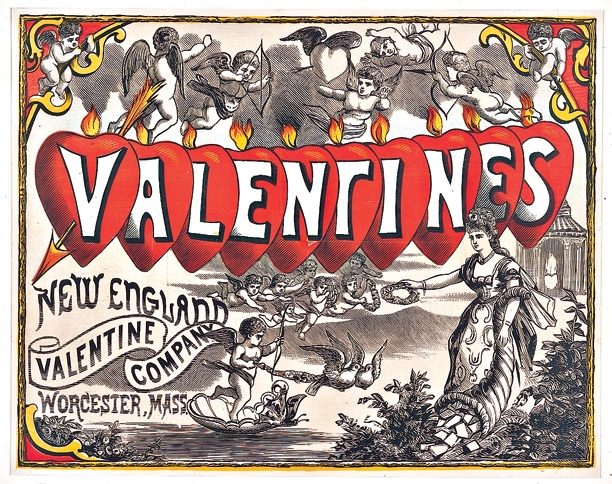
Howland incorporates her booming card business as the New England Valentine Company, operating out of her home via an assembly line that was largely comprised of her friends.
1879
Source: Viintage
The New England Valentine Company moves operations from Howland’s home to a Main Street factory in Worcester, Massachusetts. That same year, the company publishes the Valentine Verse Book, which contained 131 “verses” that people could cut out and paste inside of cards that came without a greeting — or those with a greeting that the buyer didn’t like.
1880 – 1881
Howland sells the New England Valentine Company to the George C. Whitney Company.
1888

Source: Worcester Historical Museum
Whitney has acquired at least 10 competitors, including Berlin and Jones, which had become New York City’s “largest manufacturer of Valentines.” Ten years later, the company moves to large-scale headquarters on Worcester’s Union Street.
1894
The Hershey Chocolate Company is founded, bringing what was previously “a European luxury product” to the U.S.
1902
Conversation candies become heart-shaped.
1906
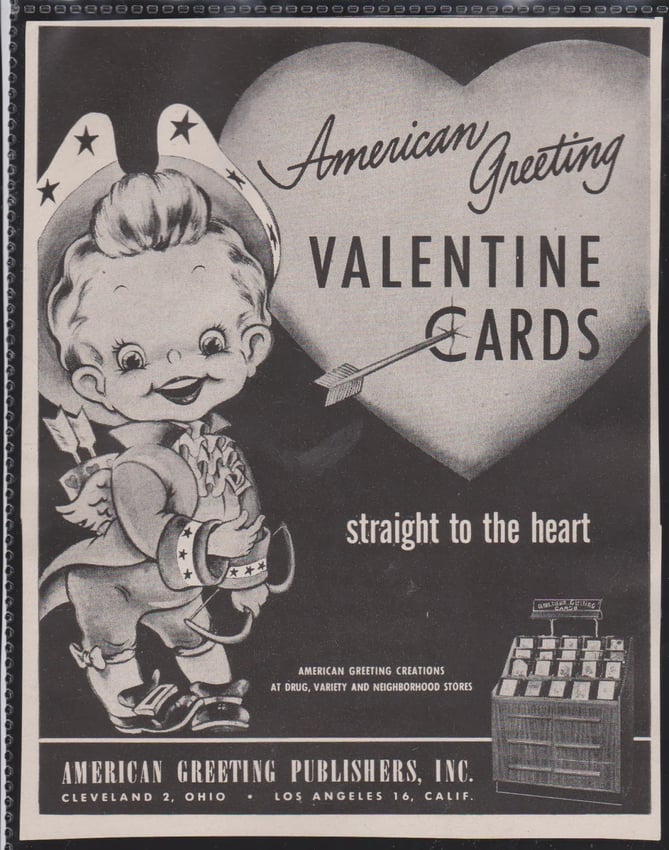
American Greetings is founded, eventually becoming one of Whitney’s chief competitors.
Source: Vintage Recycling
1907
The Hershey Chocolate Company introduces its Hershey Kisses candy product. Interestingly enough, the product was allegedly named Kisses because whenever a piece of chocolate was dropped on the conveyer belt at the Hershey factory, it sounded like a kiss.

1910
That January, a massive fire destroys much of Whitney’s headquarters. However, most of the Valentine’s Day products had already been shipped for the season, having little impact on that particular holiday.
Source: Period Paper
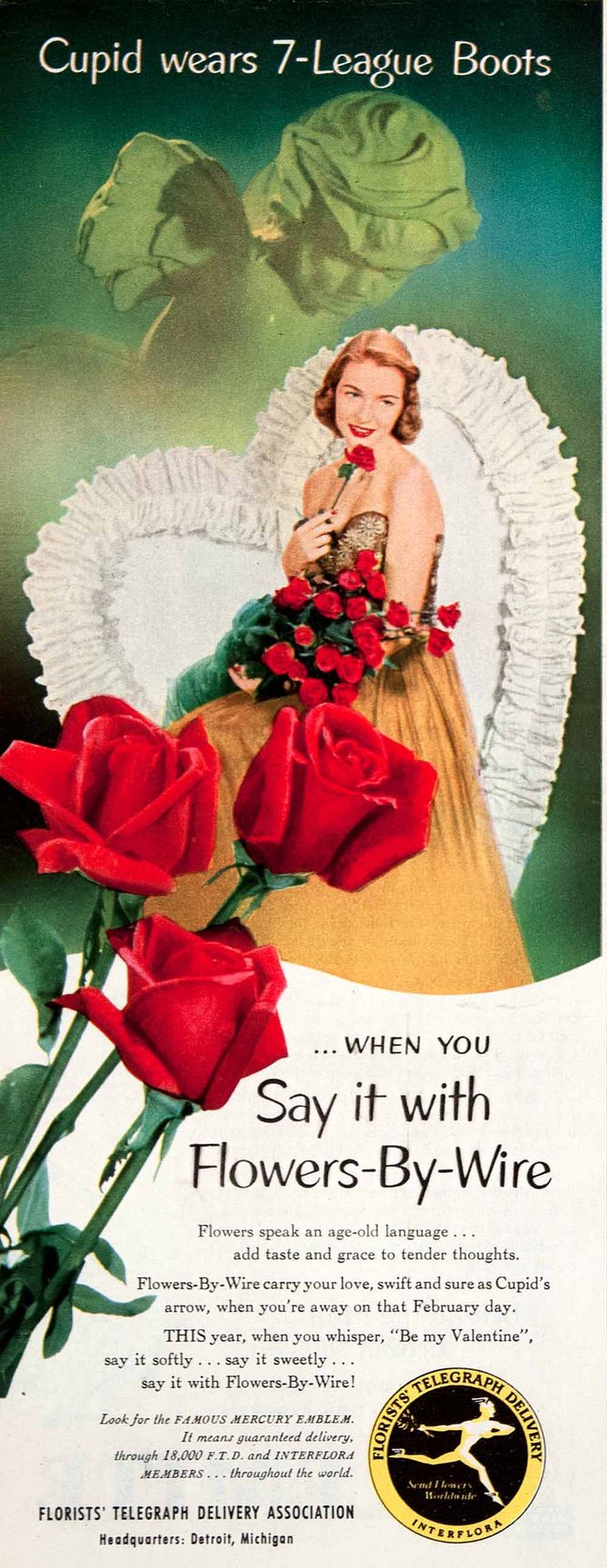
That same year, Hallmark is founded. Meanwhile, 1910 also saw the creation of Florists’ Telegraph Delivery — today known as FTD — which pioneered the remote ordering and delivery of flowers, providing a way to send them to far-away loved ones.
1913
Hallmark produces its first Valentine’s Day card.
1948
Source: Vintage Ads
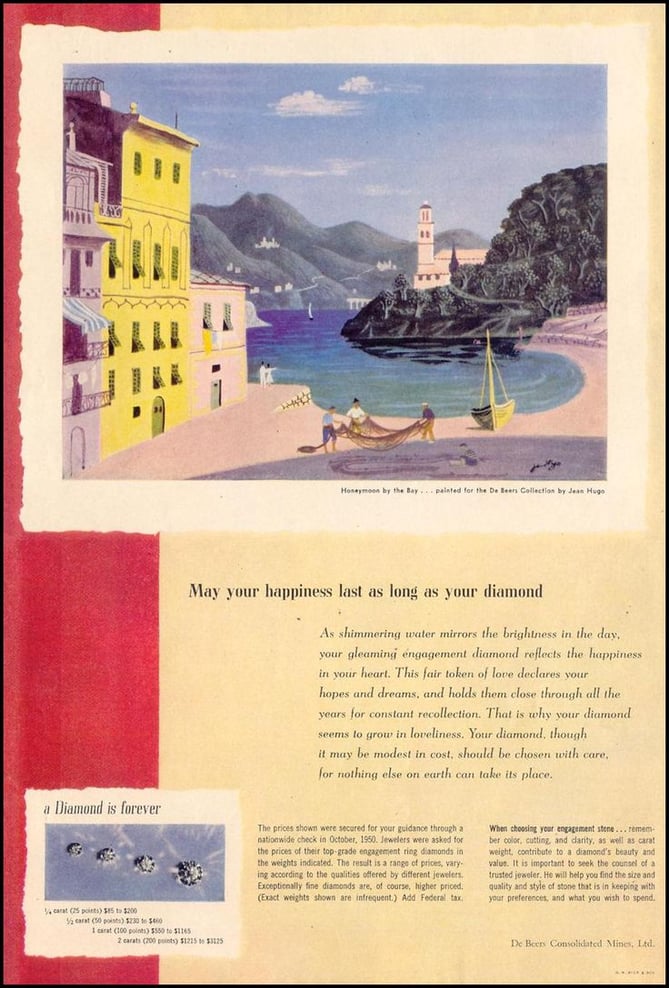
The De Beers diamond company launches its “A Diamond is Forever“ campaign, sending the message that gifting high-end jewelry can be used as an expression of love.
1985
In the ’80s companies like Hallmark began launching more Valentine’s Day related commercials. In 1985, one commercial, which dubs Hallmark as “The Valentine’s Store” shows off all of the cards and heart-shaped products you can buy for your loved one in their locations.
1986
As if Kisses weren’t romantic enough based on their name, Hershey’s enforced them as a Valentine’s Day staple with one slight design tweak. The company began packaging Kisses candies in pink and red foil specifically for Valentine’s Day.
2004
As marketers continued to embrace new media, we saw an influx of high-quality and insanely high-budgeted commercials mark the holiday from the ’80s until now. One of the most iconic and beautifully shot commercials was a mini-romance drama, called “Le Film,” promoting Chanel No. 5 perfume.
In the ad, a man falls in love and runs away with a starlet, played by Nicole Kidman. In the end, she returns back to her life of fame. As she walks down the red carpet, he notes all the things he’ll remember about her, including the smell of her Chanel No. 5 perfume.
2005
Valentine’s Day begins to go digital. On February 14, 2005, YouTube — which originated as an online dating site — makes its debut. Co-founder Steve Chen still credits its invention as the brainchild of “three guys on Valentine’s Day that had nothing to do.”
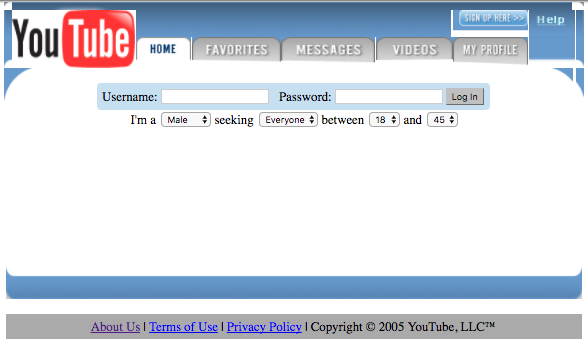
Source: Wayback Machine
2013
Ride sharing company Uber rolls out “Romance On Demand,” allowing users to send flowers on Valentine’s Day via the app. This initiative would continue to progress, with on-demand skywriting becoming available the following year.
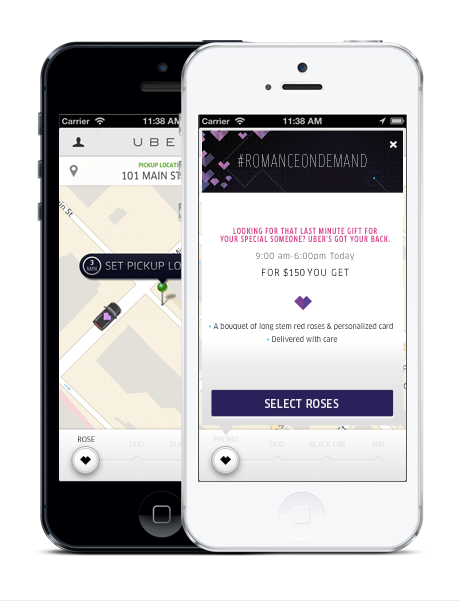
Source: Uber
2016
Well aren’t you accurate today, @netflix #HappyValentinesDay pic.twitter.com/pUK05gQ8Rs
— Tiffany Bukowski (@TheTiffy)
February 14, 2016
NetBase, a social media analytics platform, releases a Valentine’s Day Sentiment Analysis, measuring how people engage with and discuss the holiday on social media. In total, it measured nine million mentions of Valentine’s Day, with the vast majority of them mentioning a specific brand — Netflix. The top hashtag was #happyvalentinesday.
2017
In the earlier years of the Google Doodle, Google used Valentine’s Day to spread awareness of a rare species. In 2017, a series of Google Doodles shown in the days leading up to Valentine’s Day highlighted the stories of pangolins, the only mammal species with scales, as they give each other Valentine’s Day gifts or serenade their mates. Here’s one example:

While, at this point, Google didn’t need to market themselves with Doodles, this shows an early example of a brand that used its platform to creatively market another cause on the holiday.
2018 to Present Day
In recent years, we’ve seen Valentine’s Day marketing go completely digital with an emphasis on social media marketing. With these new opportunities, smaller companies that don’t have Hallmark’s budget can easily spread awareness of their own brands during the holiday. Here’s one example of an Instagram post which highlighted a fine Italian restaurant ahead of Valentine’s Day:
While these real dog’s mimicking Lady and the Tramp grabbed attention, especially from the animal lovers on Instagram, this post’s caption encourages audiences to interact with the brand. To learn more about this marketing campaign and eight others from recent years, check out this blog post.
What Marketers Can Learn from Valentine’s Day Marketing
Like so many other holidays, Valentine’s Day has experienced a transition into pop culture that has shaped the way it’s perceived, discussed, and celebrated. Sure, it’s often accused of being nothing more than a money-making marketing holiday — just look at these numbers compiled by HISTORY.com. But next time you hear someone label Valentine’s Day as “Hallmark holiday,” you’ll have a wealth of historical information to respond with.
From our hearts to yours, Happy Valentine’s Day. We’ll be keeping an eye on its continued evolution.
Click here to see more of our favorite modern Valentine’s Day campaigns.
Editor’s Note: This blog post was originally published in February 2017, but was updated in February 2020 for comprehensiveness and freshness.

The Ultimate Guide to Crowdsourcing
When Charlie Jabaley, co-founder of the artist management and marketing firm Street Execs, released one of his first client t-shirt designs, the euphoric high he felt in the morning plummeted to a heartbreaking low by night.
He had only sold a total of eight t-shirts.
With famous clients like 2 Chains and Travis Porter, Jabaley’s pressure to succeed was already stifling. But this failed merchandising campaign had just jacked it up to suffocating. Instead of freaking out and sulking about his woes, though, Jabaley took a step back and breathed in some well-needed fresh air.
He decided to frame this embarrassing flop as an opportunity to learn. And after some deep reflection and analysis, he dug up a silver lining that would eventually lead to a multi-million dollar model for merchandise design.
The silver lining Jabaley plucked from the shambles of his failed campaign was realizing he needed to focus on his customers more. More specifically, he needed to understand their true preferences.
So rather than following the standard formula of merchandising — which was designing products based off a whim, buying hoards of inventory, and then marketing them — he broke conventional thinking by reverse-engineering the process.
Before he bought inventory, Jabaley would post merchandise designs on Instagram and use follower behavior and feedback to help him scrap unpopular designs and turn popular designs into merchandise.
By following his new method, Jabaley knew exactly what his customers wanted and what they were willing to buy, allowing him to solely focus on creating products that had proven demand, avoid wasting precious cash on unwanted inventory, and unload a huge amount of risk off the merchandising process.
Eventually, Jabaley’s method for determining which merchandise designs would sell, and which would not, helped him produce his first merchandising hit — a Dabbing Santa sweater that generated $2.1 million in only 30 days.

Charlie Jabaley isn’t the first person to inform his product design using the public’s opinion, though. It’s actually a method that iconic brands like Budweiser, Pepsi, and Oreo have leveraged for years — a method called crowdsourcing.
Table of Contents
- What is crowdsourcing?
- Crowdsourced Marketing
- Crowdsourcing Examples
- How to Crowdsource
- Crowdsourcing Sites
- Crowdsourcing Jobs
What is crowdsourcing?
When businesses crowdsource, they ask the public for ideas, information, and opinions to help them craft better products and services. By crowdsourcing, companies can tap into a huge group of people’s expertise and skill sets, ensuring diversity of thought, expedited production, and cost-cutting, since they don’t need to hire new, in-house employees.
Companies who crowdsource usually break massive projects into individual tasks, which allows them to assign hundreds or thousands of people small jobs that they can work on by themselves.
To help you fully grasp the concept of crowdsourcing, here are some concrete examples of the practice in action.
1. Waze
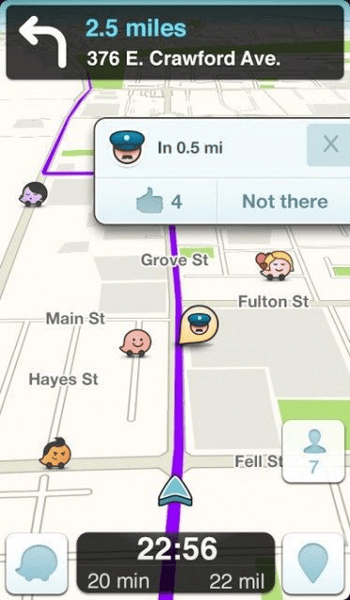
Waze is a community-based GPS traffic and navigation app. Their users, which has grown to over 90 million around the globe, report real-time traffic and road information, like police cars, accidents, road hazards, traffic jams, and the cheapest gas stations near your route. All of this crowdsourced information allows users to help each other reach their destinations promptly and safely.
2. Unsplash
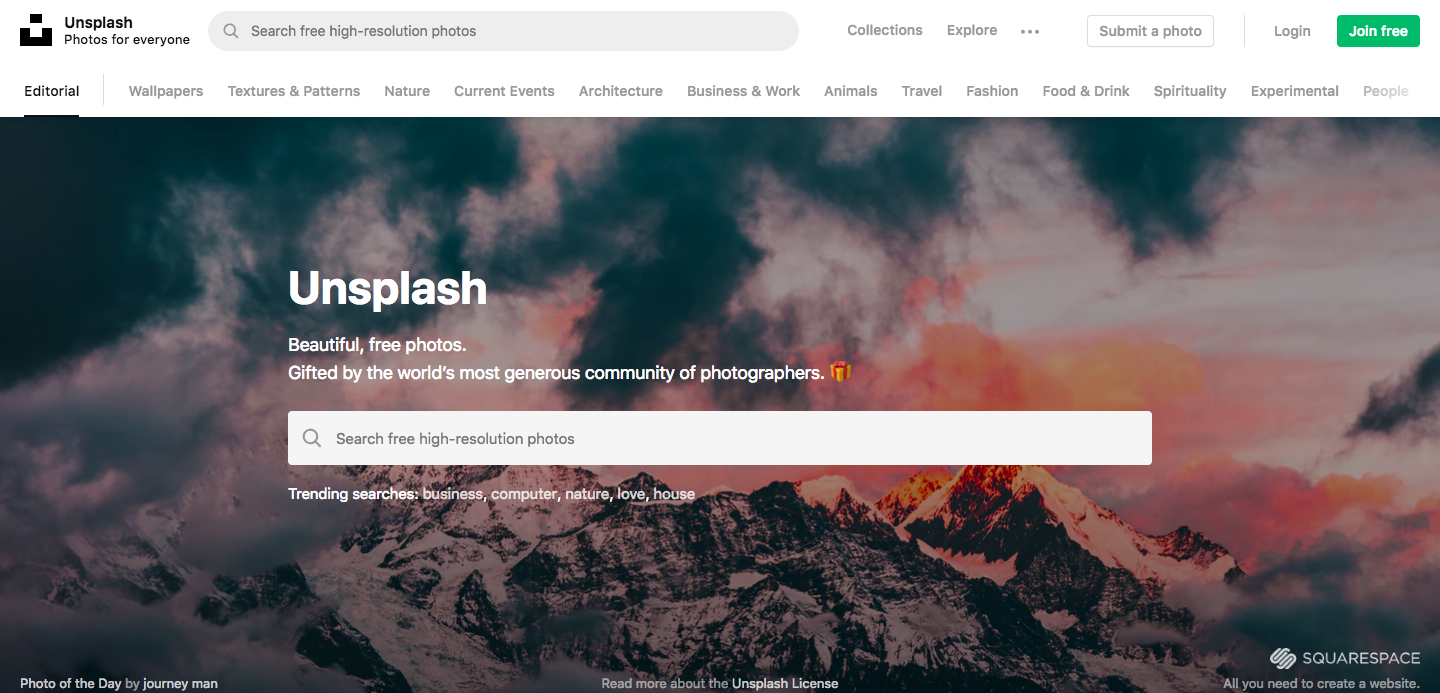
What started out as Mikael Cho’s fun side project on Tumblr, taking half a day and $19 to create, eventually turned into his flailing startup’s top referral source and became its own standalone company — Unsplash.
Unsplash experienced hockey-stick growth because its service offered the ultimate remedy for a huge pain point in the content marketing space — free, unlicensed stock photos. And by using their initial boom in buzz and traffic to convince photographers to contribute free photos to their library as a way to market their art, Unsplash has successfully fostered a community of over 110,000 photographers, built a library of over 850,000 photos, and generates more than nine billion photo impressions per month.
3. Contently’s Freelance Rates Calculator
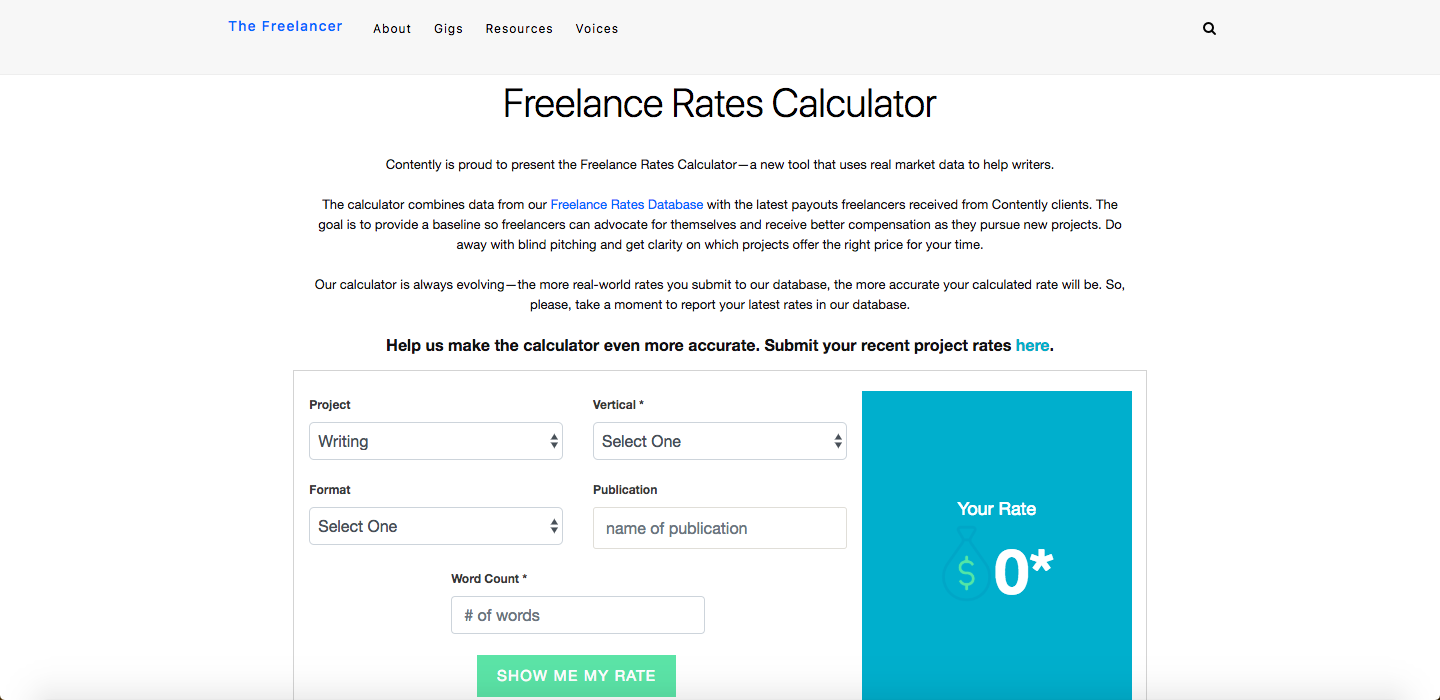
Contently, a content creation platform that also connects brands with freelance talent, built a freelance rates calculator to provide more transparency across the industry and help freelancers better negotiate their rates.
By combining their public freelance rates database, where freelancers anonymously submit the rate they received from various companies, with their platform’s own internal data, Contently has crowdsourced precious information from freelancers in order to help the entire freelance community earn a fair rate in the future.
4. Doritos’ Crash the Super Bowl
“Time Machine” is arguably one of Doritos most memorable commercials, but you might be surprised that it had a budget of $300 and only took six hours to make. Well, that’s because it was created by an aspiring filmmaker who entered the spot into Doritos’ annual Crash the Super Bowl contest in 2014, and won the whole thing.
Frito-Lay, Dorito’s conglomerate, ran Crash the Super Bowl every year from 2007 through 2016, awarding the winner with a huge cash prize and airing their commercial during the Super Bowl. And by offering such a can’t-miss opportunity, which allowed them to tap into tens of thousands of people’s creativity, Doritos could associate some of the most unforgettable Super Bowl ads with their brand.
5. Airbnb
Airbnb is a popular travel website that acts as a broker for vacation rentals. In fact, 2 million people stay in an Airbnb every night. Its entire business model is based on crowdsourcing.
Anyone who wants to rent out a room or their entire apartment or house, can put up a listing on Airbnb. Then, people who are looking for a place to stay can go online and choose a rental from the listings.
All of the listings on Airbnb are crowdsourced from its audience. Without individuals who rent out their homes, there’d be no site.
6. PepsiCo
To do this day, one of the best examples of crowdsourcing is the “Do Us a Flavor” campaign by PepsiCo for its Lay’s brand. In fact, starting in 2012, PepsiCo has held a “Do Us a Flavor” contest in numerous countries every few years.
With this contest, consumers can suggest ideas for new chip flavors. The brand has received millions of ideas for the contest throughout the years.
To promote the contest, Lay’s will use social media to gather submissions and garner votes from the public. This contest has resulted in flavors such as “Cheesy Garlic Bread,” “Kettle Cooked Wasabi Ginger,” and “Southern Biscuits and Gravy.”
1. Design the job.
Once you’ve decided that you want to use crowdsourced material in your marketing campaign, you need to decide what the job will be.
Will you have consumers design an ad? Or perhaps they’ll help you create a new product, like Lays? Either way, your marketing team needs to design the job.
This means that you’ll have to decide what you want your audience to do, and create an avenue for them to submit their entries. Once you know what you want them to create, you’ll have to come up with the rules, terms, and reward for winning the contest (if it’s a contest).
If you aren’t sure what you want your audience to do, there are a lot of jobs that you could use crowdsourcing for, including:
- App development
- Copywriting
- Editing
- Ad design
- Product creation
- Photography
- Transcription
2. Create the promotional materials.
Now that you’ve created the job and the terms of service so to speak, it’s time to get the word out there about your job. But before you start posting on social media, you’ll want to create the creative assets to promote the campaign.
For example, Lays used Facebook to promote the “Do Us a Flavor” campaign. The company changed its profile and cover photo to advertise the campaign. Additionally, there were several posts on social media and its website that went over the rules.
Before you can promote your campaign, you’ll have to create these materials. Write your social media ads, create your images, write the press release for your website, etc.
3. Choose a promotional strategy.
So, you have the job all figured out, you’ve created your assets, and now you have to decide how you want to promote the campaign.
This means choosing the best channel(s) to communicate with your audience. Will you be posting your assets on your website? If so, will it be on the home page?
Then, you’ll want to decide which social media channels you want to promote the campaign on. You should use your social media metrics and buyer persona to figure out where your audience is. If you mostly have a Gen Z audience, for example, perhaps you’ll want to promote on Tik Tok. On the other hand, if you have a millennial audience, Instagram might be the best place.
Overall, it’s important to make sure you’re communicating with your audience where they’re at.
4. Manage the results.
Now that you’ve started your campaign, the results should start pouring in.
To manage the submissions, make sure you have a system in place. For example, will you have one or a team of employees responsible for saving and organizing submissions?
Or perhaps you’re having your audience email submissions to a dedicated email.
Either way, having a system in place will help you keep everything organized so it’s easy to pick a winner when the time comes.
5. Produce the final project.
The time has come. You’ve received all the results and now it’s time to pick a winner. Typically with crowdsourced campaigns, the winner is determined by a public vote.
If you’re going with a vote, make sure you set up polls and surveys so your audience can vote.
Once the winner is chosen, it’s time to promote the final campaign. For example, if you were choosing a new logo, you can start using the logo right away on social media, your website, and promotional materials.
If you’re a freelancer looking for work or a brand looking for talent, or you’re looking for crowdfunding, check out the following crowdsourcing sites.
1. Fiverr
Fiverr is a freelance service marketplace that empowers freelancers. Instead of being a platform where freelancers search for jobs posted by brands, Fiverr is a place where brands search for freelancers with the expertise and skills for which they’re looking. Most freelancers on Fiverr offer skills and expertise in graphic design, digital marketing, writing & translation, video & animation, music & audio, programming & tech, business, and lifestyle.
2. Upwork
Similar to Fiverr, Upwork is a freelance service marketplace where freelancers create profiles, and then brands can hire them for short-term tasks, recurring projects, or full-time contract work. Most freelancers have skills and expertise in web development, mobile development, design, writing, administrative work, customer service, sales, marketing, accounting, and consulting.
3. CrowdSource
Trusted by brands like Target, Coca-Cola, and Major League Baseball, CrowdSource has trained, tested, and qualified a community of over 200,000 freelancers who can provide copywriting, content moderation, data entry, and transcription expertise and skills. Brands can also search for freelancers by the agency, marketing, publishing, retail, and service provider industries.
4. Contently
Contently is a content creation software that connects enterprise brands with freelance talent, so they’re constantly on the lookout for freelancers who can fulfill their clients’ needs, as well as their own.
If you’re a freelance creative looking for gigs with some big brands, you can register as a freelancer on Contently’s platform and create a free portfolio. You’ll need to get approved and complete their training before you can work with any of their clients, but once you do that, you’ll be apart of their freelance network.
If you’re a brand looking for freelancers to help you craft original stories, check out Contently’s platform here.
5. Skyword
Similar to Contently, Skyword is a content creation software that also connects enterprise brands with freelance talent. If you’re a videographer, writer, photographer, or designer, you can create a portfolio that Skyword’s clients will have direct access to.
If you’re a brand looking for freelance talent, check out Skyword’s platform here.
6. Kickstarter
One of the major forms of crowdsourcing is crowdfunding. Crowdfunding is when consumers fund a project or venture by donating money to the cause.
Kickstarter is one of the most popular crowdfunding sites where any creator can connect with possible crowdfunders. This means that they can post their project and anyone can donate.
Typically with crowdfunding, the people who donate money become stakeholders and might be able to work with the creator as crowdsourced talent, and get a benefit of the proceeds.
7. Patreon
Another way for content creators to get crowdfunding is through the site Patreon.
Patreon is essentially a membership platform that allows content creators to have subscribers. Subscribers pay a monthly fee for the content — providing the creators the money they need to produce their project.
Typically, the patrons of a project get a lot of perks and exclusive rewards for being a subscriber.
Crowdsourcing Jobs
If you’re interested in working a crowdsourced job, check out the following gigs you could find in each of the job categories below.
Marketing
- Writing
- Videography
- Design
- Photography
- Animation
- Web development
- Mobile development
Editing Jobs
- Copy editing
- Content evaluation
- Content moderation
- Proofreading
Administrative
- Virtual assistant
- Customer service
- Usability testing
- Audio transcription
- Social media post categorization
- Image and video processing
- Image categorization
Data Jobs
- Data entry
- Data research
- Data categorization
- Data processing
- Data verification and clean up
Research Jobs
- Information gathering
- Price checking
- Product display checking
- Business location verification
- Web research
- Google searching
- Odd Jobs
- Making deliveries
- Cleaning
- Dog walking
- Survey taking
Crowdsourcing is an innovative way for marketers to get their audience engaged with their campaigns. It’s also one of the only ways consumers get to interact with a brand and help make important product decisions.
Editor’s note: This post was originally published in February 2019 and has been updated for comprehensiveness.

The 10 Best Keyword Research Tools to Find the Right Keywords for SEO
Let’s get right down to it: The key to successful SEO is concentrating on long-tail keywords.
Although these keywords get less traffic than more generic terms, they’re associated with more qualified traffic and users that are typically further down their path of intent.
The good news is that choosing the right long-tail keywords for your website pages is actually a fairly simple process — one that’s made all the more simple and quick when you use the right tools to perform your keyword research.
Download our free SEO template here to organize your keyword research into an actionable plan for your site.
In this post, we’ll cover the nine best tools out there for performing keyword research for your website content. Before we get started though, let’s briefly go over two important things to consider as you do your research: relevance and (if applicable) location.
Keyword Relevance
Relevance is the most important factor to consider when choosing the right keywords for SEO. Why? Because the more specific you are, the better.
For instance, if you own a company that installs swimming pools, it’s likely that you’d attract more qualified prospects by targeting a keyword such as “fiberglass in-ground pool installation,” rather than “swimming pools.” That’s because there’s a good chance that someone searching for “fiberglass in-ground pool installation” is looking for information on installation or someone to perform the installation … and that could be you!
Sure, optimizing for “swimming pools” has its place. But there’s no doubt that this keyword will attract a much more generic audience that may not be looking for what you have to offer. Go for the relevant, long-tail keywords instead.
Location-Based Keywords
Another major factor to consider when optimizing for the right keywords is location-based searches. When looking for contractors and services in their specific area, search engine users will usually include their location in the search. So, “fiberglass in-ground pool installation” becomes “fiberglass in-ground pool installation in Boston, MA.”
If you operate in one geo-location, you may want to consider adding location-based keywords to all of your pages, since traffic from other locations isn’t going to be very much help to you. If your business operates in several geo-locations, it is also a wise choice to create a separate web page dedicated to each location so you can make sure your brand is present when people are searching for individual locations.
Now, how do you choose the right keywords for your business? We certainly don’t recommend guessing, for obvious reasons. Instead, there are many ways to research and find long-tail keywords that are right for your business.
Here are nine awesome free and paid keyword research tools you can use to quickly and easily identify strong long-tail keywords for your SEO campaign.
Free Keyword Research Tools
1. Google Keyword Planner
Google has a few tools that make it easy to conduct keyword research, and their free AdWords tool called Keyword Planner is a great place to start — especially if you use AdWords for some of your campaigns. (Note: You’ll need to set up an AdWords account to use Keyword Planner, but that doesn’t mean you have to create an ad.)
When you input one keyword, multiple keywords, or even your website address into Keyword Planner, Google will spit out a list of related keywords along with simple metrics to gauge how fierce the competition is around each one and how many searches it gets on both a global and local search level.
It’ll also show you historical statistics and information on how a list of keywords might perform — and it’ll create a new keyword list by multiplying several lists of keywords together. Since it’s a free AdWords tool, it can also help you choose competitive bids and budgets to use with your AdWords campaigns.
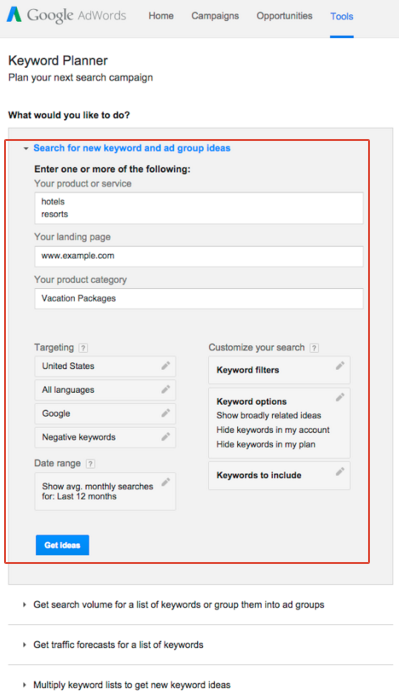
Image Credit: Google
Unfortunately, when Google transitioned from Keyword Tool to Keyword Planner, they stripped out a lot of the more interesting functionality — but you can make up for it somewhat if you take the information you learn from Keyword Planner and use Google Trends to fill in some blanks.
Which brings me to the next tool …
2. Google Trends
Google Trends is another free tool from Google. It lets you enter multiple keywords and filter by location, search history, and category. Once you enter that information in, it’ll give you results that show how much web interest there is around a particular keyword, what caused the interest (e.g., press coverage), and where the traffic is coming from — along with similar keywords.
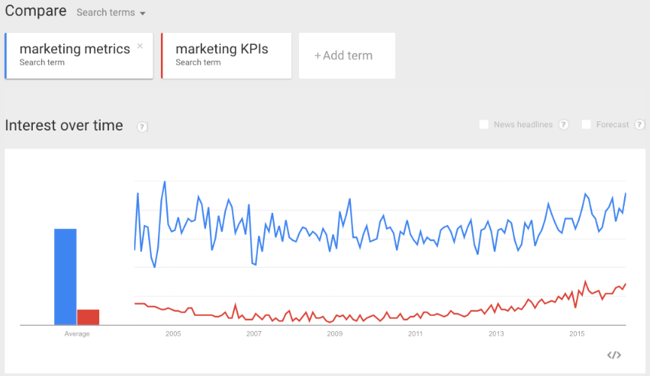
The best part about Google Trends is that it doesn’t just give you static keyword volume numbers like most keyword research tools. Instead, it generates colorful, interactive graphs that you can play with, download, and even embed on your website. It’ll also give you more dynamic insight into a keyword with information like relative popularity of a search term over time.
Interestingly, its data doesn’t include in repeated queries from a single user over a short period of time, which makes results cleaner. It also groups together searches that it infers to mean the same thing, like misspellings.
One way to use Google Trends? If you’re trying to decide between two keyword variations for your latest blog post title. Simply perform a quick comparison search in Google Trends to see which one is getting searched more often.
3. Keyword Tool.io
Keyword Tool is pretty rudimentary online keyword research tool, but if you’re just looking for a list of long-tail keyword suggestions related to one you already have in mind, then it can be useful. It’s also totally free — to use the most basic version, you don’t even need to create an account.
What Keyword Tool does is use Google Autocomplete to generate a list of relevant long-tail keywords suggestions. The search terms suggested by Google Autocomplete are based on a few different factors, like how often users were searching for a particular term in the past.
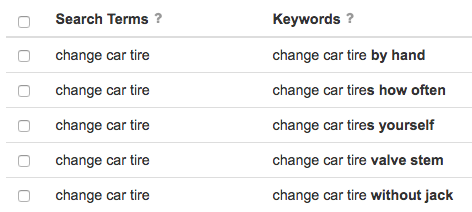
This type of suggestion tool can help you understand what people are searching for around your topics. For example, bloggers might use a tool like this to brainstorm blog post titles that’ll do well in search.
Again, all the free version does for you is generate other keyword suggestions in alphabetical order — it doesn’t tell you anything about search volume or cost-per-click (CPC). To get that information, you’ll have to upgrade to Keyword Tool Pro. The Pro version will also let you export the keywords and use them for content creation, search engine optimization, CPC/PPC, or other marketing activities.
Best Keyword Research Tools
- Term Explorer
- Moz’s Keyword Difficulty Tool
- SEMrush
- Ahrefs
- Accuranker
- HubSpot
- Serpstat
Paid Keyword Research Tools
4. Term Explorer
Price: $34/mo. for Basic; $97/mo. for Pro; $499/mo. for Agency
Term Explorer offers probably the deepest research reports of any keyword research tool on the market. From one single seed term, you can get over 10,000 keyword variations.
Best of all, the tool does a great job of keeping the results as relevant as possible and pulling through lots of supporting metrics with them.
It’ll give you data for all the results on page one of search engine results pages (SERPs), including the number of results, link strength, trust score, and keyword difficulty. To help you get a handle on your competitors, you can use the tool to research domain age, page ranking, and links, as well as the word count, page rank, links, outbound links, and the number of keyword occurrences in title, URL, and headers for individual webpages. You can also export all this data into a CSV for your own analysis.
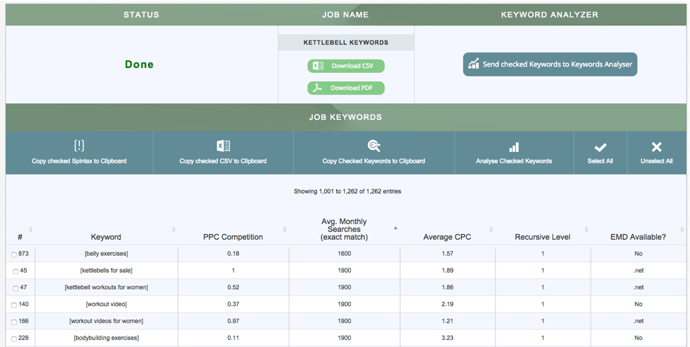
Image Credit: Term Explorer
Note: If you only plan on using it a few times a day, there is actually a free version of this tool that’ll do five tiny keyword jobs and five keyword analyses per day, with no queue priority.
5. Moz’s Keyword Difficulty Tool
Price: $99/mo. for Standard; $149/mo. for Medium; $249/mo. for Large; $599/mo. for Premium
The keyword difficulty tool from Moz is one of the most useful components of their paid suite. It’s a fantastic resource for analyzing the competitiveness of a keyword and for unearthing low-hanging fruit.
When you input a keyword into this tool, it’ll find the top 10 rankings for that keyword. Then, it’ll assign that keyword a “Difficulty Score” based on the pages that currently rank for that word. You can look at search volume data for your keywords, then pull up the SERP to see the top 10 results for each term.
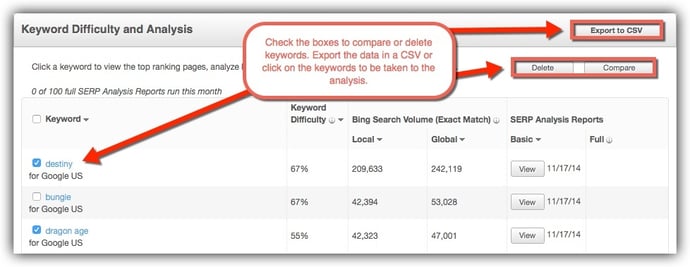
Image Credit: Moz
Want to do some competitive keyword analysis? You can use the tool to see who else is ranking for your targeted keywords, along with information like each site’s page authority and the number of root domains linking to their page.
You can also export all this data into a CSV for your own analysis.
6. SEMrush
Price: $69.95/mo. for Pro; $149.95/mo. for Guru; $549.95/mo. for Business
SEMrush is a competitive research tool that lets you keep an eye on on your competitors’ keywords to find opportunities to bump them out for a top position in Google’s and Bing’s organic search results. You can compare a number of domains against one another to evaluate the competitive landscape, including their common keywords and positions in Google’s organic, paid, and shopping search results.
Position tracking is kind of like a sophisticated version of Google Trends, letting you see a keyword’s position in SERPs and analyze the history of rises and drops. Their colorful, visual charts are also super helpful for more quickly understanding trends and analyzing results.
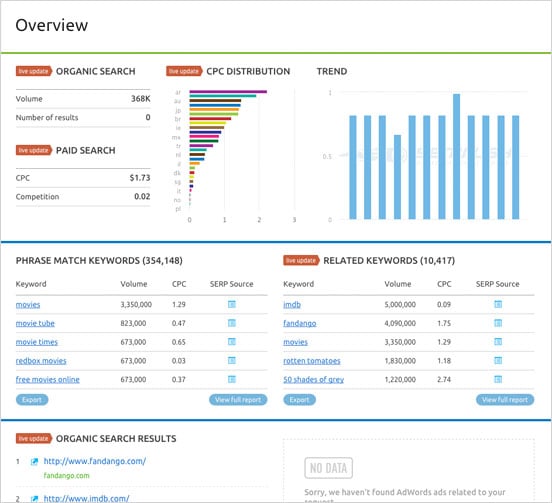
Image Credit: SEMrush
7. Ahrefs
Price: $99/mo. for Lite; $179/mo. for Standard; $399/mo. for Advanced
Ahrefs Keywords Explorer is similar to SEMrush, but with some extra bonuses and a much more intuitive design.
For example, it’s able to estimate how many searches become real page visits. Not all of them do so, since Google gives instant answers for some queries. With Clicks and Clicks Per Search metrics, you’ll figure out traffic-generating keywords and skip dead-end options.
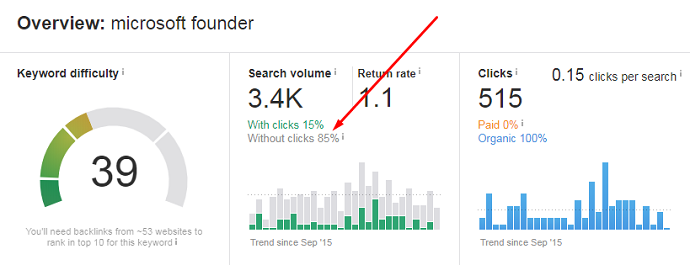
When it comes to the number of relevant keyword suggestions, Ahrefs goes the extra mile. It runs the biggest database – 5.1 billion keywords for over 200 countries – which means it can detect opportunities other tools could be missing.
Ahrefs can also help you with competitive research. Their Site Explorer tool lifts the veil on competitors’ keyword strategies, while Content Gap lets you compare competitor keywords with your own to identify your might-have-beens.
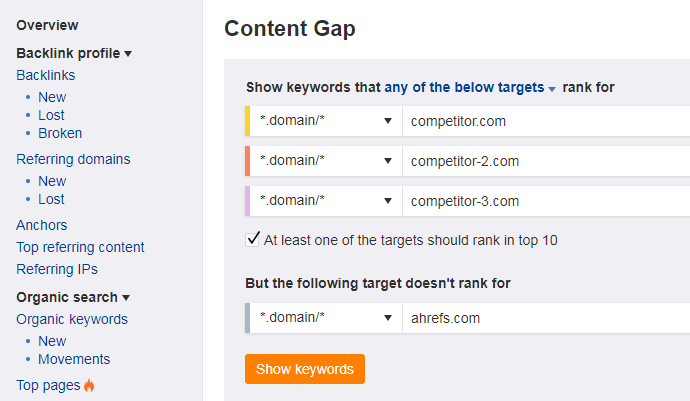
Ahrefs will also email you about even the smallest ranking progress of your competitors. Backlinks have a direct impacton ranking, and backlink research is one of Ahrefs’ strongest muscles.
Brian Dean, founder of Backlinko, say that Ahrefs is his #1 go-to tool for backlink analysis: “I’ve tested over 25 link analysis tools and none come close to Ahref’s in terms of index size, freshness, and overall usability.”
8. Accuranker
Price: $19.95/mo. for Beginner; $29.95/mo. for Pro 300; $44.95/mo. for Pro 600; $74.95/mo. for Pro 1K
Accuranker is a keyword rank tracking tool with a key differentiator: It’s lightning fast while being extremely precise. So if you’re used to spending hours monitoring the rank progression of your keywords, this’ll end up saving you a ton of time.
Other advantages of this tool? It has built-in proxies to get a quick glance at whose ranking within the SERPs for any given keyword. If you plan to report keyword metrics to your manager or your team, you’ll like its scheduled weekly reports feature.
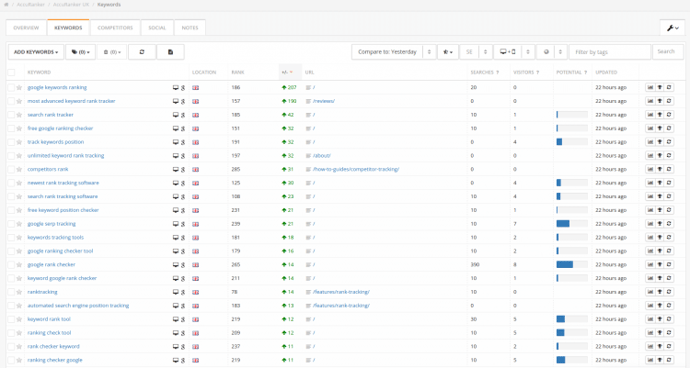
Image Credit: Accuranker
It’s also one of the best rank trackers out there that offers highly localized search engine rankings for your keywords. So if you’re marketing your business to an international audience, it’s a great tool for analyzing which pages are ranking in different countries.
Finally, it has integrations available with Google Analytics, Google Search Console, Social Monitoring, and YouTube so you can keep an eye on statistics and estimated search traffic for your keywords straight from your AccuRanker dashboard.
9. HubSpot
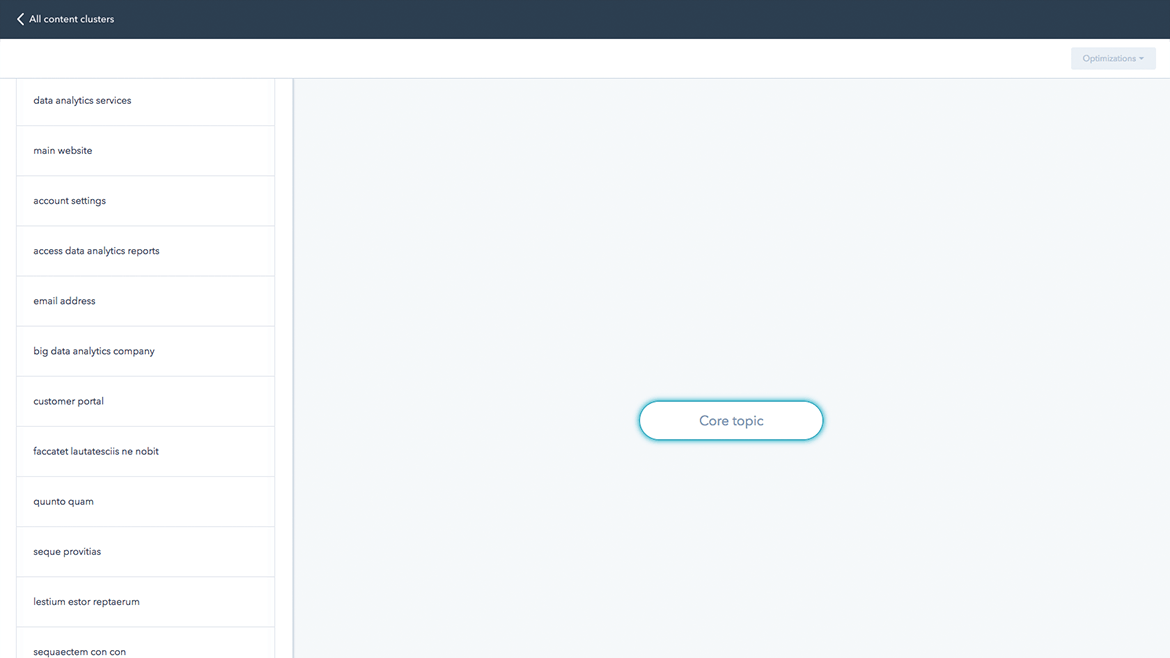
HubSpot also has its very own Content Strategy tool within the Marketing Hub. The Content Strategy tool helps you identify and research topics, find keywords or subtopics to go after, and ultimately help grow your content presence for generating more organic traffic over time.
If you’re a HubSpot customer, you can access the Content Strategy tool, click on Content > Strategy.
10. Serpstat
Price: $69/mo. for Lite, $149/mo. for Standard, $299/mo. for Advanced, $499/mo. for Enterprise
Serpstat provides you with a list of historically profitable keywords used by competitors to make them rank high in search results. It also figures the value of your keywords using different factors, like number of search results and cost-per-click.
The software will offer suggestions for more suggestive keywords as well as provide long-tail keywords, which are low-volume keywords related to your business. Plus, if your business is international, you can adapt keywords to different countries in the tool’s database.
Finally, with Serpstat, you can check the relevancy of your webpages and analyze the trends that might be attractive to browsers.
Serpstat will be extremely useful to you if you want full analyses of keywords that work well for competitors. It’s also a great tool for making sure your page has a lower chance of losing a favorable ranking on SERPs.
Now that you know about all these great tools, get out there and start discovering your best keywords for SEO.
What tools and methods do you use to find long-tail keywords? Share your favorites with us in the comments below.


Starting a Freelance Business: A Step-by-Step Guide
So, you’re in the business of starting a business.
You’re looking for the freedom and flexibility that comes with only answering to yourself.
You’re planning to take life by the reins and your industry by storm.
In other words, you want to get your own freelance business going.
Starting a freelance business is an exciting prospect. Perks like setting your own hours and pursuing your passion are certainly attractive — but a lot of effort, strategy, and planning goes into earning those benefits.
It’s a tough road with a lot of confusing twists and turns, so it helps to have a map.
Let’s explore some key points you’ll have to address using a roadmap to starting a freelance business.
1. Understand what you want out of your business.
Before you set your big freelance business plans in motion, you need to know a lot about yourself and why you’re starting your business in the first place.
Ask yourself some of the following questions — Why are you doing this? Is it to be your own boss? To set your own hours? To pursue your passion? All of the above?
And how much time and effort are you willing to put in? Is this going to be a side hustle? Are you going to keep your day job?
You need to know the answers to all of these questions — and quite a few more — before you can really commit to starting your own freelance business. You can’t actually know what you’re doing if you have no concept of why you’re doing it in the first place.
2. Have a solid picture of your personal financial situation.
The idea of dropping everything to pursue your passion on your own terms is starry-eyed daydream material. That’s why you need to be careful.
It’s easy to romanticize the image of you walking out of your office with a big smile on your face, knowing that you’re about to do what you’ve always wanted without anyone to answer to.
It’s a lovely concept, but you can’t get carried away. You need to ground yourself, and understanding your personal finances is a crucial part of that.
Familiarize yourself with personal and business-related expenses and understand how long your savings can sustain you. Take a good hard look at your financial situation, and identify a point where you might jump ship if things don’t go according to plan.
Take all of that into account and use it to set a monthly income target. There are a lot of helpful resources online — like the Boundless Freelance Target Income Calculator — that can walk you through the different factors you must consider when calculating how much you’ll need to make.
Understanding your personal finances will help you get a clear picture of what you can expect going forward, and give you a concept of how to handle the issues that are going to arise.
3. Make sure you’re really in it.
If you want to succeed as a freelance business owner, you have to be all the way in. You need to find and maintain a special kind of motivation.
You have to ask yourself some burning questions, including — Am I ready to commit as much as I possibly can to this? Is this exactly what I want to do? Do I have a comprehensive plan? Do I genuinely believe in that plan? Am I willing to fail?
When it comes down to it, you have to believe in yourself, believe in your business, understand it might not pan out, and know you’re willing to stay the course to successfully start a freelance business.
4. Set measurable goals.
You’ll need to set benchmarks to make sure your business is making progress and that you, personally, are staying the course. It’ll also help your confidence to know that you’re consistently reaching milestones you’ve set for yourself.
Make sure the goals you’re setting are SMART — specific, measurable, attainable, relevant, and time-based. Also be sure to set different kinds of goals — specifically short-term, long-term, and ongoing.
A short-term goal may be something like getting your website up and running with a certain number of monthly visitors within three months.
A long-term goal could be reaching a target in annual revenue within three years.
Lastly, an ongoing goal might be dedicating a specific number of hours to client outreach each week.
Make sure these goals are reasonable and outline a solid trajectory for your business. Keep careful track of them to have a better understanding of what you’re doing well, and what you could be doing better.
5. Sort out the business-end of the business.
You’ll want to handle the nitty-gritty administrative and legal ends of your freelance business before really getting started.
That could mean taking steps like formally organizing a business entity, getting a picture of your tax exposure, and familiarizing yourself with what your business contracts might look like.
You should also have a plan in place for cash management. How and when money comes can be unpredictable in freelancing. You should have some concept of how you intend to maintain enough cash to stay afloat.
Additionally, consider building infrastructure that helps you manage your sales, marketing, and customer service. A CRM is a great way to do that. Consider adopting one and letting it serve as the backbone for a lot of your business operations.
The main point I’m getting at here is that there’s a side to starting a freelance business that isn’t particularly fun or exciting. But you won’t get to enjoy the fun and exciting stuff without addressing it first.
Be sure to work out aspects like accounting, how your business is going to function on a day-to-day basis, and how you’re going to save and manage your money before really launching into your freelance business.
6. Start figuring out your buyer personas.
As per HubSpot’s own definition, a buyer persona is “a semi-fictional representation of your ideal customer based on market research and real data about your existing customers.”
In other words, it’s the kind of person you think you’ll be selling to.
You’ll want to start by conducting general research about your target audience. Get a feel for who your customers and prospects are. You should consider reaching out to those people for surveys and interviews. This will help you understand what kind of buyer is right for your business.
From there, you’ll want to whittle down your base a bit. Pick out commonalities among the potential buyers you’ve identified. This could include considering factors like demographics, how they like to be contacted, behaviors, and interests.
Once you’ve identified trends within your audience, develop personas based on the different patterns you see. For instance, if you’re a caterer, you may notice that 40-to-50 year old women booking their childrens’ birthday parties or other family events make up a significant portion of your business. Use that information to develop a buyer persona specific to those qualities.
Give that group a name and boom! You have a buyer persona.
That’s a very high-level overview of the process, if you’d like a more in depth perspective on how to go about developing one of these personas, check out this article.
7. Determine pricing.
When determining pricing, it’s important to consider how you plan on charging clients.
Will you be hourly? Will you charge a flat fee? Will you use project quotes? It’s important to settle on how you’ll be making money before you start actually making it.
Once you’ve landed on your pricing structure, start figuring how much your services are going to cost. You can start by researching industry averages. You should be able to find some solid figures online. Sites like Payscale and Glassdoor are good places to start.
Additionally, take a look at How to Calculate Hourly Rate for Freelance Marketers & Consultants for some initial estimates.
It could also help to reach out to other professionals in your space to see what they charge and how those price points are working out for them.
Bear in mind, this isn’t an exact science. Finding the right price for your services will probably take some trial-and-error. You should keep experimenting until you get it right.
8. Create and maintain an online presence.
You’re going to need to get a website up and running as soon as possible. That’s going to be your first point of contact with a lot of your customers.
Having a great-looking website that’s easy to navigate assures potential customers that your business is legitimate and professional.
A well-structured, visually appealing website can also distinguish you from other freelancers in your space. You can use it to give your prospects a picture of your services, portfolio, and pricing.
Additionally, you’ll want to establish a solid social media presence. Outreach through social networks is becoming essential to any kind of business — and freelancers are no exception.
A robust social media presence is incredibly important when it comes to engaging with existing customers to keep them interested in your business.
Create and develop profiles across a variety of social networks. The more likes and followers you can gather, the more trustworthy and established your business will look.
9. Network, network, network.
You can’t conduct business without contacts. That’s like trying to drive a car without gasoline. But networking is much easier in theory than in practice.
It takes a lot of energy, and it’s often difficult to know where to begin. There’s no doubt it’ll be tough, but the success of your business could hinge upon whether or not you put in the effort to network effectively.
You should start by identifying where your target buyers are hanging out — both online and offline. Then, you can use that information to develop a marketing and networking strategy that meets them where they are.
Attend local meetings relevant to your industry to make personal outreach to potential prospects and fellow professionals in your space. It also helps to stay active on online forums about the areas your business covers.
Be sure to use social media to keep consistent contact between you and your potential buyers, as well as you and your fellow professionals.
Like I said, you can’t conduct business without contacts, and it’s not easy to establish those relationships. It’s also difficult to maintain those connections once you have them, but don’t get discouraged.
If you make smart, dedicated efforts to reach and connect with prospects and fellow professionals, you should be able to establish a productive network for your business.
Take a look at How to Master Non-Awkward, Effective In-Person Networking for more networking tips.
10. Market yourself effectively.
You should develop a solid content marketing strategy. Blogging is an essential part of that process. When you do, be sure to write content that is generally relevant to your field — not just specific to your own business.
You want to establish yourself as a thought leader in your industry. That can give you the kind of credibility your business needs to stand out.
You want to show that your business is legitimate. The best way to do that is to demonstrate that you really know what you’re talking about when it comes to your area of expertise.
You’ll also want to write up content offers to attach to your blogs to convert website visitors into leads. A content offer is an asset like a whitepaper or an eBook with information relevant to your field.
You can use content offers to attract and log contacts. In order for a reader to download your content offer, have them fill out a contact form. In doing so, you’re identifying that reader as a potential lead.
You should also be actively promoting content on social media — and it doesn’t always have to be your own. You can actively post other thoughtful content from other outlets in your industry. By doing this, you can let your followers know that you’re staying educated about and on top of industry trends.
Your content marketing strategy can shape your reputation. If you create and promote enriching content that your readers will get a lot out of, you’ll stand out as an authority in your industry.
11. Maintain relationships and boost your reputation.
One of your first priorities will always be preserving the client relationships you establish. You have to do everything in your power to delight your customers and keep them close.
This means keeping consistent contact and providing exceptional customer service.
Positive word of mouth can be a huge boost when starting a freelance business. Happy customers can provide that, and even happier customers will go out of their way to offer it.
If you can, get testimonials from those kinds of clients to display on your website.
And it should go without saying, but everything on this means nothing if you don’t do your job well. Do good work. Put in as much effort as you can. Be professional and consistent with what you do. And keep your customers happy.
12. Stay persistent when unexpected difficulties arise
You must be prepared to stay the course, if you want to make it. Odds are you won’t see stellar results right away, and it will probably take a lot of time and effort before you do.
You have to set yourself up for success and do everything you can deliver on the goals you set for yourself. You’ll hit snags. Some things won’t go well. You’re bound to deal with at least a few hard times.
In spite of all that, you have to be professional, persistent, and do all you can to best serve your customers. That’s going to put you in the best possible position to make it.
It’s not going to be easy. But if your head and heart are in the right place, it’s going to be worth it.

How to Rise Above Marketing Mediocrity, According to Ann Handley
Ann Handley is a Wall Street Journal bestselling author, and has been named by IBM as one of the seven people shaping modern marketing.
She’s also the world’s first Chief Content Officer, and is a LinkedIn influencer with almost 400K followers.
Needless to say, I was thrilled when she agreed to speak with me about the current and future trends in marketing at the 2019 Conex in Toronto.
Along with marketing trends, we also talked about new approaches marketers can use to solve old problems. Because, while much has changed in marketing over the last few years, one thing remains consistent — businesses still need to connect with their audiences.
Here, let’s explore Ann Handley’s take on pathological empathy, “snackable” content, and rising above marketing mediocrity.
Have Pathological Empathy For Your Consumer
One of the key concepts Handley has pioneered is “pathological empathy.”
Rather than simply segmenting customers by their behaviors or demographics and trying to appeal to them on those grounds, Handley wants marketers to get under their skin: “When I say pathological, I mean really understanding, sort of getting inside their skin … to get a sense of who are they and how can you best engage with them emotionally.”
Ultimately, engaging with a consumer on an emotional level is one of the most sure-fire ways to guarantee a successful marketing campaign. (I dare you to watch Android’s “Friends Furever” video, the most-shared video ad of 2015, without tearing up.)
This next-level empathy opens the door to a new approach to content creation. Handley poses the question this way — “How do we create the kind of marketing content, assets, campaigns that will actually touch their hearts … and maybe open their minds?”
Slow Down
In order to build pathological empathy, you need time. However, in a fast-paced marketing environment where everything moves at the speed of light, time is the most precious and limited commodity.
Counterintuitively, this only proves Handley’s point:
“I’m on a mission to get marketers to slow down. Instead of approaching their job with an ‘as-soon-as-possible’ mindset, I think it’s much more valuable at certain key strategic moments to slow down.”
Handley says that by slowing down the marketing process at these strategic moments, marketers can better execute on building relationships and converting leads.
“I think what we’re missing is that opportunity to say, ‘All right, what are the moments where we really need to think more strategically? Where should we slow down to fuel faster growth later?'”
Speak to Your Audience as Peer-to-Peer, Not Brand-to-Target
In addition to slowing down the marketing process at critical points, Handley suggests that marketers speak to their audiences from a peer-to-peer perspective, as opposed to brand-to-target.
While marketers instinctively want to talk about what sets their brand and products apart, that’s not a message that can connect with customers.
Handley told me, “We love our products and services and we understand on an implicit basis what value they bring to your customers or your prospects. But I think that we don’t always communicate that as effectively as we could. We’re not always leading with our hearts. We’re not always touching people in a way that will engage them emotionally.”
Next time you’re constructing a web page or writing landing page copy, you might ask yourself — Would I, and my colleagues, like it designed this way? Would we keep reading? Would we click the link?
Of course, you’ll want to A/B test and use focus groups to ensure you’re meeting your audience’s needs, but it doesn’t hurt to consider your own opinions and interests, or the opinions and interests of friends and family, when creating and promoting marketing materials.
Be a Resource for Your Audience
Handley told me marketers should be a resource to their prospects and offer them value. Part of this shift requires connecting with customers personally. You might try social media, but alternatively, consider putting a twist on an old marketing stand-by — the email newsletter.
As Handley says, “Newsletters are vastly undervalued and they’re a huge opportunity that we’re not doing well.”
Handley mentioned that, unfortunately, most marketers tend to focus on the “news” aspect of a newsletter, and forget the “letter” part of the equation.
The “news” aspect means marketers use their newsletters as a distribution strategy and focus on providing updates about their own brand — but they fail to use the “letter” portion to engage with and connect to their audience.
Handley notes that when writing newsletters, marketers tend to speak in the plural, but their audience is one person at home or on their phone. Handley says that by simply writing their newsletters as if they are talking to one person, marketers can go a long way toward building that personal connection.
Handley says, “The person who was sitting on the other end of that email … It’s one person. They’re not sitting there with a thousand other people. So why do we communicate to a thousand people? That’s because we’re still thinking about it as news and not as a letter.”
Don’t Create “Snackable” Content
Video is another area where marketers are misreading the situation and losing out on chances to meaningfully connect with consumers. Handley pushes back on the notion of “snackable content,” and the idea that consumers are demanding it more.
“Our impulse as marketers has been to make it shorter and shorter and shorter to try to get people more involved. But from a consumer standpoint, I don’t think that that’s what our customers want.”
Rather, Handley thinks that this demand for shorter content was always there but never supplied.
She told me, “I don’t think they want shorter and shorter and shorter. They don’t want lighter and more snackable … The way that we as consumers are consuming content has been to think about the value that it gives us.”
Handley cites Netflix as a prime counterexample that disproves the idea that consumer attention spans are getting shorter, or that “snackable” content is king.
“In a world of snackable, why does somebody sit down for hours at a time to watch the last season of Stranger Things? It’s because we want to — we want it on our terms, number one. But secondly, we have all the attention span in the world if it’s something that we care about.”
Handley doesn’t think viewers’ attention spans are getting shorter or that they are seeking out shorter content. Instead, viewers are just more discerning about what content they consume.
That suggests marketers shouldn’t shy away from longer video pieces, as long as these videos are about something that can connect with their target audience.
Rise Above “Marketing Mediocrity”
Businesses that fail to connect with customers fall into what Handley terms “marketing mediocrity.” Handley says it’s critical for businesses to rise above it. But how does a business know if their marketing is mediocre?
“If people are not interested in you, if they are not here for you, if they are not thinking, ‘I can’t wait to see what they come out with next,’ then that’s a problem.”
Handley says marketers should ask themselves what would happen if they went away.
How would your email list react?
Would any of your audience members write your team to ask where you went?
Handley relates a personal story about her bi-weekly newsletter to drive the point home: “I usually mail Sunday mornings and I had a busy week … [s]o I didn’t mail until Sunday afternoon at four o’clock. And I got so many emails from people saying, are you okay? What happened? And so that to me was, it wasn’t just personally gratifying. [T]he big lesson there is … if you didn’t show up, would people say, ‘Hey, what happened?'”
Do Less and Obsess
In 2020, there are innumerable changes happening in the world of marketing. I asked Handley what her single most important piece of advice to marketers would be, and she told me, “do less and obsess.”
Handley suggests that marketers “do less and obsess” and focus on the fundamentals, and “create less with more intention.”
Handley also has some thoughts about content calendars. Handley suggests that marketers “do less that has more impact” rather than strictly abiding by a content calendar.
“I think content calendars are amazing … I’m just saying, don’t let it run your strategy.”
In the Future, a Customer’s Experience Will Dictate Your Strategy
Finally, I asked Handley if she has any ideas on how we’ll be consuming content 10 years from now. While she thinks video is here to stay, she rejects the idea that the word is dead.
“I hate binary choices like that. It’s not a matter of words or images. It’s both. To your question, what does this mean for us five years from now? think it’s a better integration and, and perhaps more interactivity.”
Handley’s seemingly counterintuitive advice is based on marketing fundamentals, some of which today’s marketers might be forgetting as they become more enmeshed with new technologies.
It’s easy to get caught up in current trends, but knowing your target audience and creating an experience they can truly enjoy remains the paramount goal of marketers. By taking a step back from today’s hot new marketing trend, we can get a better sense of how to use new technologies and strategies to deliver a valuable experience to our customers.

9 Valentine’s Day Marketing Campaigns to Inspire You
Love, flowers, chocolate, bla bla bla …
Where are the marketing results?!
Okay, probably not what your Valentine’s date cares about. But if you’re a marketer, you might be interested in merging the most lovey-dovey of days with your marketing. But how?
Well, these companies have figured out some creative ways to leverage the warm and fuzzies (or unadulterated rage and crushing loneliness … whatever) that Valentine’s Day instills in people. If you don’t have a marketing campaign planned for the 14th, maybe some of these will inspire you to get in on some last-minute Valentine’s Day action. Pun totally intended.
9 Effective Valentine’s Day Marketing Campaigns
1. Frankie & Benny’s “Lady & the Tramp” Instagram Post
Last year, the Italian restaurant chain Frankie & Benny’s referenced romantic scenes from notable films like “Lady and the Tramp.”
In a cute Instagram post, two real dogs are seen on a classy date at Frankie & Benny’s holding the same strand of pasta in their mouths. This mimics a class scene from Lady and the Tramp where two dogs kiss after accidentally eating the same strand of pasta.
The carousel post then highlights actual photos from iconic movies like, “When Harry Met Sally.” In the post’s caption, it encourages Instagram audiences to guess which movies are being referenced.
While the real dog’s mimicking Lady and the Tramp grabbed attention, especially from the animal lovers on Instagram, this post’s caption and other photos encourages audiences to interact with the brand by guessing which movies are being referenced.
This is both a fun way to boost brand awareness, and leverage the holiday to gain engagement on social media.
2. Panera’s Engagement Offer
In 2018, Panera tweeted that customers who got engaged in one of their restaurants on Valentine’s Day could win free wedding catering from the chain.
The tweet included a short and simple video which announced the promotion and showed two Panera employees cheering, as if they were witnessing a proposal.
Love is in the air. This Valentine’s Day, get engaged at a Panera and we might cater your wedding, for free. #PaneraProposalSweeps https://t.co/mpL5VbjSOd pic.twitter.com/VPRzu0QLNd
— Panera Bread (@panerabread)
February 9, 2018
This is a quick and sweet way to leverage the holiday and social media to gain foot traffic into a physical business. Although Panera is a giant corporation, this campaign strategy is so simple that smaller businesses could create something similar with a tweet, short video, and offer that drives foot traffic.
3. Facebook Messenger Heart Feature
Just before Valentine’s Day in 2018, Facebook Messenger’s Twitter announced that if you shared that you were “In a Relationship” with a friend you were messaging, celebratory hearts would rain down in your Messenger thread with that person.
It’s not official until it’s #FacebookOfficial. Update your relationship status on Facebook and shower bae with ❤️❤️❤️on Messenger. Also customize your chat emoji, color and more! pic.twitter.com/P6oy35fHmp
— Messenger (@messenger)
February 13, 2018
Although a small business probably can’t add a major feature to their product just because of a holiday, this is a good example of how you can theme something related to your product, such as your website, around a holiday temporarily.
Another thing that’s interesting about this campaign is that Facebook is using a competing social platform, Twitter, to announce this new feature. This slightly undermines Twitter, which also allows direct messaging but with less interactive features.
4. “Adults Meal” – Burger King
Burger King is no stranger to poking fun at its biggest competitor, McDonalds. This was no different before Valentine’s Day 2017 when they created an “Adult Meal” alternative with a similar box shape to McDonalds’ kids’ meal.
In the ad, Burger King explains that Kids’ Meals are for kids. But, on the night of Valentine’s Day, Burger King customers can buy an adult meal with an “adult toy.”
This campaign is pretty cheeky. However, it’s edgy mission and subtle comments about its competitor’s product make it memorable and funny.
5. “Romance On Demand” – Uber
On-demand car service company Uber launched a Romance on Demand campaign in most of the cities where they operate. Take a look at the short, cute video they shot to explain the campaign:
If you didn’t watch the video, the gist of the campaign is this: You can request roses be sent to a special someone by selecting the “rose” in their app. You set the delivery location, and a black car arrives at that location with a driver totally suited-up to deliver a bouquet of roses.
Uber is a startup that’s figured out a way to create a campaign that delights its audience and drives additional revenue for its business — all without a tremendous resource investment. I mean, their drivers are already on the road, ready to take customers; but if there are Uber customers who don’t need a ride but totally need to send some flowers, and send them with style … well, let’s just say transporting roses at a premium price isn’t much different than transporting people. Except the margins are way better for Uber. Pretty impressive stuff.
And even better, they’re using inbound tactics to get the word out there! They launched the Romance on Demand campaign on their blog, via social channels with the hashtag #romanceondemand, with that adorable video you might have watched up above, and even by establishing local partnerships in the cities where they’re running the campaign to enter participants into a drawing to win some extra goodies. This is a low cost, high return campaign for Uber that totally aligns with its customer persona — high convenience and high style.
6. “Whose Heart do You Love” – MegaRed
MegaRed is a type of krill oil supplement sold in nutrition stores. If you don’t know already, fish oil is an excellent dietary supplement for those concerned with heart health, so it makes sense that its Valentine’s Day campaign theme is “Whose heart do you love?” Here’s how it works.
MegaRed is relying heavily on Facebook to facilitate this campaign, in which visitors can request free samples of their supplements through their Facebook app. What’s totally endearing about this campaign is that you can request the supplement for “The heart of someone you love.” In other words, you can give someone you love — whose heart you want to keep in tip-top shape — a free sample of their product. Even better? If you choose to give the free sample to a loved on, MegaRed will give you a free sample, too. And the love doesn’t end there: If they can reach 100,000 free samples given away, they’ll donate $100,000 to the National Coalition for Women With Heart Disease.
Aside from the great feeling this campaign instills — I mean, promoting heart health is kind of hard to argue with — I love their use of social media to get the word out there. For instance, on Twitter, MegaRed is seeing celebrities like Joy Bauer and Toni Braxton posting about the campaign. Pretty impressive. And on YouTube, there’s this fun, short, touching video that will, forgive me, but totally touch your heart:
This campaign is being handled by an agency, but one thing that made my heart smile is a quote from MegaRed’s CMO, Jennifer Steeves-Kiss, to the New York Times. “We want to start making digital and social a significantly greater priority for us,” she said. “People are spending four to five hours a month online researching supplements if they’re supplement enthusiasts,” Steeves-Kiss shared, and additionally, they are in the middle of an acquisition by a company whose executive are “great proponents” of social and digital marketing.
We can’t help but smile at seeing the adoption of inbound methods by brands that have millions to spend on traditional advertising methods!
7. “Show Your Love for the Jersey Shore” – The State of New Jersey and the SBA
The State of New Jersey, along with the Small Business Association, are running a pro-business campaign called “Show Your Love for the Jersey Shore.” The call-to-action for the campaign? To spend your vacation dollars — particularly on Valentine’s Day — at the Jersey Shore. It’s being promoted on Facebook, Twitter, via email, and via live events in partnership with destination marketing organizations. Information about special promotions being offered by shore businesses will be shared socially, too, so if you’re looking for something to do tomorrow, check it out 😉 For instance, you might be interested in …
Doo Wop with the one you love this Valentine’s Day at @countbasiethtr. bit.ly/UEXOPf
— New Jersey Tourism (@Visit_NewJersey)
February 9, 2013
I know I sure would be!
The goal of the campaign is to show that the Jersey Shore is open for business after the devastation of Hurricane Sandy. The problem some shore businesses are facing is the perception that businesses aren’t recovered from the storm. While there’s still much more recovery to be done, there are some businesses that are, indeed, ready to accept tourists. They just need the word to get out there.
Director of Jenkinson’s Aquarium, Cindy Claus, told NorthJersey.com, “I think so many people see on the news that we got hit by the storm. They see all the destruction, and yes, there’s a lot of destruction and a lot of sadness, but there’s a lot of businesses that were able to get opened. And you need to come back because that’s the only way these businesses are going to survive.” The aquarium was able to open back up on February 1, and is hoping this campaign will help get the word out there that they’re welcoming visitors with open arms.
Whether the campaign works or not remains to be seen, but it’s fantastic to see federally funded institutions finding a way to, essentially, newsjack as a way to aid the shore community — particularly affected businesses — in attaining their previous levels of visitors.
8. Scribbler Valentine’s Day Campaign
Scribbler, a UK-based personalized greeting card service, has won my heart because of its celebration of content in its Valentine’s Day campaign. Using their blog, they’ve asked their audience to share what their definition of “love” is. All you do is visit their blog, and answer these three questions:
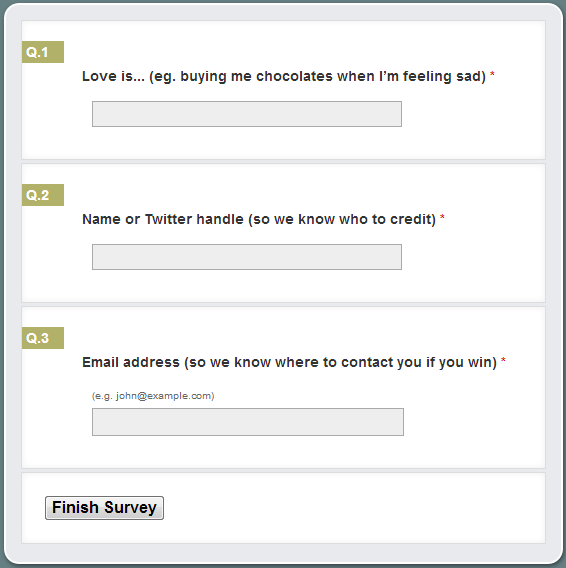
Or, you can tweet your response to the Scribbler Twitter account. The winner will get a free iPad mini, and the best answers will be compiled in their Valentine’s Day ebook. To inspire people, Scribbler is also using Facebook and Twitter to post some of the best answers that are coming their way. This campaign is fantastic for a few reasons:
- It’s a simple way to generate leads that can be nurtured later.
- It’s a simple way to get people aware of and engaged with their social channels to expand their reach.
- It’s a simple way to crowdsource content.
This campaign is an excellent idea for anyone trying to expand the top of their funnel — campaigns with a low time commitment but high level of delight are great ways to make new fans that you can later nurture into customers.
9. UncommonGoods Email Marketing Campaign
When I stumble across good email marketing, I get excited. When I stumble upon lovable email marketing, I swoon. Take a look at the lovely email ecommerce company UncommonGoods sent last week to remind/enable/capitalize on last-minute shoppers:
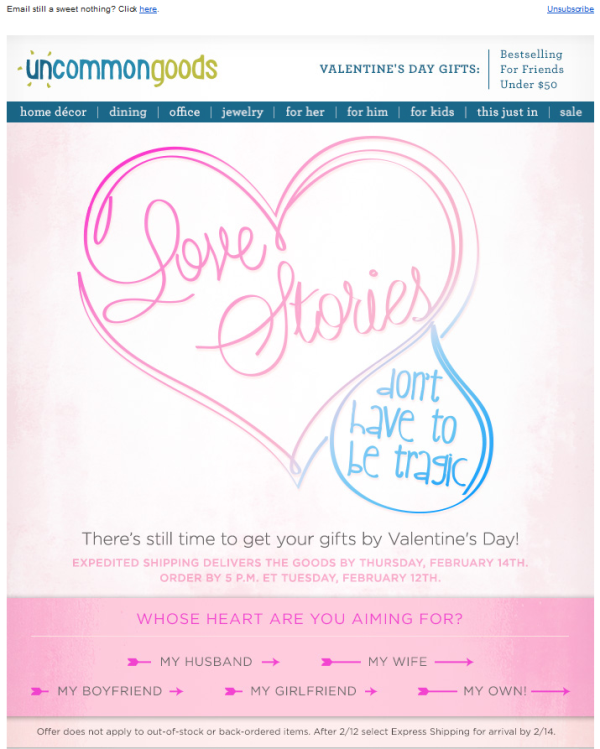
First of all, one of the great things about all of UncommonGoods’ emails is their attention to detail. For instance, they tied the Valentine’s Day theme into more than just the design and theme of the email campaign: Take a look at the little tiny text at the top left of the email to see what I mean. Instead of just saying, “For an HTML version of this email, bla bla bla,” they said, “Email still a sweet nothing? Click here.” Love is in the details, as they say.
But the layout of the email also makes taking action super easy for the recipient. Notice how they’ve divided up the gifts, essentially, by persona. “Whose heart are you aiming for?” they ask — at which point you can click on the person you need to shop for, and be brought to a landing page with content that aligns with your need.
But you know what takes all this to the next level? The fact that UncommonGoods finds a way to incorporate blogging into all of this! If you visit UncommonGoods from this email, you’ll see the following (pay particular attention to the orange call-out):
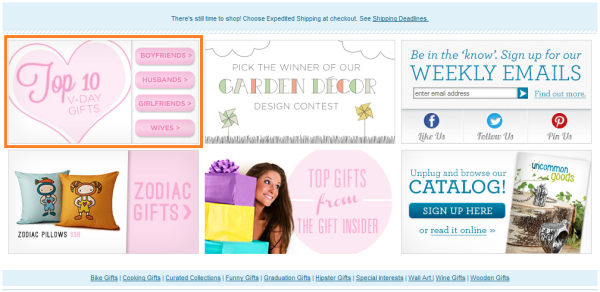
Not only does the design from the email align with design on the website, but when you click on the parts of that little box — let’s say you’re looking for gifts for your girlfriend — you get taken to a blog post of the top ten gifts for girlfriends, with a picture of that gift, a fun and well-written description of that gift, and a CTA to make the purchase next to each gift.
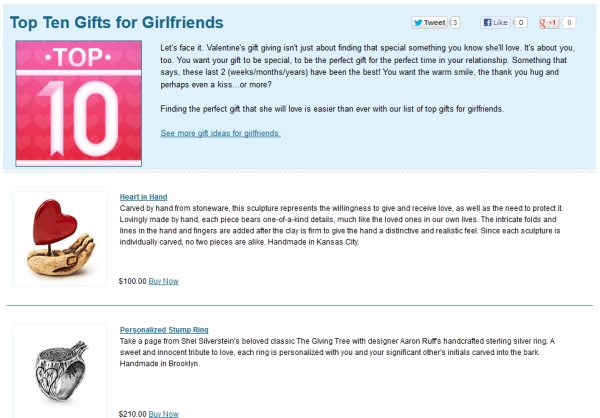
Nothing like integrating your marketing channels to sweep a marketer off her (or his) feet!
Valentine’s Day Campaign Takeaways
Editor’s Note: This blog post was originally published in Feb. 2013, but was updated for comprehensiveness on January 30, 2020.

7 Email Cadence Best Practices for Better Email Marketing Campaigns
By 2022, an estimated 330 billion emails will be sent and received each day — making it one of the largest digital communication channels.
Emails can include everything from details about pressing, work-related crises to e-cards from your aunt on random holidays like Arbor Day.
But email’s practical use extends beyond the personal — it can also be one of the most effective ways for businesses to convert leads into buyers. An email campaign is an effective strategy for turning a prospect’s interest into hard sales.
These campaigns can be massive assets, but they shouldn’t be structured arbitrarily. In all likelihood, you can’t send single, catch-all email blasts to your contacts whenever you feel like and expect your prospects and customers to be receptive to them. There’s much more to the email campaign process than drafting up an email and hitting send.
One of the most crucial components of the email campaign process is email cadence: the pulse, pace, and playbook of a successful email campaign. Let’s take a deeper dive into what an email cadence is and establish the fundamental principles of structuring a successful one.
The success of an email campaign can hinge upon the effectiveness of its cadence. If you can get the right emails to the right customers at the right time, you can get a lot of mileage out of your email marketing efforts.
That being said, if your cadence is too intrusive, obnoxious, or directionless, you can lose out on opportunities to guide leads through their buyers’ journeys. If potential customers feel pestered or confused by constant, irrelevant newsletters and promotions, they probably won’t stick around to hear what you have to say.
Here are some best practices to employ to ensure your next campaign’s email cadence is the best it can be.
1. Understand your goals.
What do you want out of your email cadence? You need to understand where you’re trying to lead your prospects and customers. Are you looking to improve traffic to your blog? Drive ecommerce sales? Schedule meetings? Close deals?
An email cadence is designed to guide buyers from point A to point B. You can’t do that if you have no idea what “point B” is. Your ultimate goal will dictate the strategy behind your cadence. If you’re trying to do something like increase traffic to your blog, you can stand to lose more subscribers than you would if you were trying to court a group of sales leads into scheduling demos.
If you’re sending emails purely for the sake of sending emails, your cadence is going to be aimless and haphazard. And you’ll waste a lot of time and resources on email campaigns that go nowhere.
2. Try to understand each customer’s mindset.
The whole point of having an email cadence is to hone in on messaging that’s going to resonate most with a specific customer at a given point in time. That means one-size-fits-all, “throw everything at everyone,” impersonal emails won’t cut it. You need to send your recipients something relevant to who they are as a customer. That often means understanding where they are in their buyer’s journey.
The buyer’s journey is the process buyers go through to become aware of, evaluate, and ultimately decide to purchase a new product or service. It’s divided into three stages: Awareness, Consideration, and Decision.
You can’t expect to target buyers in all three of those stages with the same message and have it immediately register with them, across the board. Different stages — and engagement levels within those stages — warrant different messages.
Additionally, through the wonders of automation, coordinating this kind of strategy is possible. Several kinds of email and marketing automation software allow you to set up the proper infrastructure to tailor email content and timing to suit different leads’ behavior and interests.
3. Personalize when you can.
Think back on all the targeted emails companies have sent you over the years. How inclined have you been to click through ones addressed to “valued customer,” or “to whom it may concern?” I don’t think it’s outrageous to assume the answer is “not often.”
Why would your customers be any different? A successful cadence relies on your leads clicking through your emails and progressing through their buyer’s journey. If you’re sending impersonal mass-email blasts, crossing your fingers, and hoping for the best, your prospects may wind up suspended in buyer’s limbo.
Fortunately, there’s a variety of email software that allows you to personalize your subject lines and email content to cater to specific leads.
4. Don’t be too shy.
When planning an email cadence, you shouldn’t err too much on the side of “I don’t want to bother you.” It’s easy to get anxiety about losing leads by coming off as obnoxious or intrusive, but you have to understand there’s a difference between being pushy and being professionally persistent.
If you’re not consistently sending out emails, you’re missing out on sales opportunities. A big part of email marketing is keeping your prospects and customers engaged. If a lead only gets an email from you once every two months, you might become an afterthought.
Email cadences are a matter of strategically striking while the iron’s hot. You can’t do that if you’re too reluctant to strike at all.
5. Don’t be too aggressive.
Even though you shouldn’t be too passive, you don’t want to be overly aggressive. There’s a movie from the 80’s called Say Anything. It has an iconic scene where the main character stands outside his love interest’s window and serenades her by blaring a song called “In Your Eyes” by Peter Gabriel from a boombox he’s holding over his head. She swoons over it, and they ride off into the sunset together on a lawnmower ( … for some reason).
It’s romantic and compelling. But, if he did that twice a day, every day — playing similar, anthemic 80’s rock songs on her front lawn — she’d be over it pretty quickly. He’d have to take his lawnmower and Peter Gabriel cassettes somewhere else.
That’s essentially what sending emails too frequently in your cadence is like. If your leads are receiving obtrusive, daily reminders and promotions from you, they’ll unsubscribe from your mailing list.
6. Hone in on the right frequency for your business.
There’s no magic figure when it comes to email frequency. It’s going to vary from business to business. It may take some time to get the right feel for how often you should be sending your emails.
Studying your industry averages for email frequency can provide a solid place to start. A prominent fashion brand routinely sending out new promotions and coupons probably isn’t going to have the same email frequency as a midsize B2B SaaS company looking to set meetings with decision-makers.
Email frequency isn’t an exact science. It’s probably going to take some trial-and-error before you find one that best fits both your business and customers’ interests.
7. Give your subscribers autonomy.
Always give your subscribers the option to control their own email frequency. Giving them this kind of autonomy can keep them from unsubscribing from your mailing list outright if your email frequency seems like a bit too much for them. Include a link to allow them to update their email preferences as they see fit at the end of your emails.
Customers don’t always approach email frequencies in absolutes. Even if they’re overwhelmed by how many emails you’re sending them, they still might want to keep hearing from you. Give them the freedom to pump the brakes. If they don’t have the flexibility to do that, they’ll probably just cut you off.
You should always be putting the customer first. Their personal interests take precedence over what you might believe to be your preferred email cadence.
Finding your ideal email cadence might not happen with your first series of automated emails. Still, there are certain actions you can take to take to put yourself in the best position to find the one that works best for your business.
Your main priority should always be your prospects and customers’ interests. Try to understand where they’re coming from, where they stand in terms of buying your product or service, and what they might want out of you and your business, and cater your email cadence around that.

How HubSpot Uses Long-Form Video to Build a Brand
Nowadays, video is an undoubtedly powerful marketing tool — in fact, 85% of businesses use video for their marketing efforts, and 88% of video marketers report that video gives them a positive ROI.
At HubSpot, our marketing team uses video for a variety of reasons: to engage with our audience on social platforms, to educate our audience on YouTube, and to inspire our audience with quarterly campaigns.
These videos vary in length. Some are as short as 30 seconds, while others span 10-20 minutes.
Which brings us to the question — is long-form or short-form video better for a brand?
Of course, your video length largely depends on your content, your platform, and your audience. An Instagram Story video should be much shorter than a YouTube video because of the audience’s expectations of the platform.
To investigate the nuances of video length and how long-form video can help you build a brand, I spoke with Kyle Denhoff, HubSpot’s Head of Global Acquisition Campaigns, and Diego Santos, Marketing Manager at HubSpot.
Here, we’ll explore the benefits of long-form video to help build a brand by investigating two HubSpot Marketing team case studies.
Case Study One: Use Long-form Video to Explain Complex Topics
Diego Santos, Marketing Manager at HubSpot, has used long-form video in his Facebook Live educational video series #MartesEnVivo, as well as in his re-branded YouTube series #UnMejorMarketing for HubSpot’s Spanish-speaking audience (you can read more about these campaigns here).
Santos told me — “Long-form videos can be a great way for your brand to explain complex topics and develop educational and thought leadership content. Most companies opt for shorter content forms, so longer videos can help you to stand out from competitors and position yourself and your brand as a real expert.”
Santos adds, “Not everyone is willing to watch a 10min+ detailed video, so you need to focus on finding the right audience and optimizing their engagement, rather than looking for a big reach of people that will watch for a few seconds but then drop off.”
Of course, this is easier said than done. To help you figure out how to find the right audience, Santos suggests you:
- Create serialized content, so an audience can learn to expect a certain topic from your brand at the same time, and on the same platform, consistently.
- Publish on platforms where videos can live longer, such as YouTube or your own blog.
- Add value throughout the video, and don’t extend the video unnecessarily.
- Do keyword research and add captions to help the video’s discoverability.
For instance, take a look at this five minute, 41 second YouTube video Santos and his team put together to explore the topic of buyer personas:
While the video is too long to attract a large audience, its content will match a searcher’s intent if they’re looking for in-depth information on buyer personas. Additionally, they’ve used keyword research to optimize the post for YouTube search.
Case Study Two: Use Long-form Video to Create a High-quality Brand Campaign
Last quarter, Kyle Denhoff and his team launched Advertising, A Look Behind the Screens. There are four videos, about three minutes each, that include interviews with experts from LinkedIn, Google, Facebook, and HubSpot.
To explore why they chose to use longer-form video for the campaign, I spoke with Denhoff. He told me: “There is a constant debate within marketing teams about where to invest. Should you invest in brand marketing or performance marketing? Historically, companies that invest heavily in brand marketing produce beautiful videos to tell their story. Then, they use advertising to promote videos to reach new audiences.”
He adds, “Alternatively, on the performance side, brands focus on creating direct response offers, such as templates, guides, reports, and infographics that provide an audience immediate value in the form of education.”
“When creating Advertising, a Look Behind the Screens we said, ‘Why can’t we provide a direct response content offer with the production value of a brand campaign?'”
Denhoff told me, “We decided to use video as a format to tell a unified story across multiple brands. Partnering with Google, Facebook, and LinkedIn, we felt that a minimal and approachable video style would allow us to unify multiple brands under a single creative concept. Overall, we felt high-quality video would help us portray a level of professionalism and trust.”
Undoubtedly, long-form video provides some unique benefits to a marketing campaign. First, it enables your brand to tell the full story, especially when interviewing experts in the industry.
Second, it allows your brand to prove its educational value more than short-form content. With three to four minutes minimum, you can teach your audience much more about a concept than you could in 30 seconds.
Of course, there’s a trade-off to long-form video. You likely need higher-quality video to keep your audience engaged if it’s a longer video, compared to a quick 20-to-30 second clip that can seem a little more improvised and casual. Additionally, you need to make every second count, or you’ll quickly lose your audience’s attention.
Denhoff adds, “Using video, we could focus on the people at each company instead of various graphics or illustrations. This allowed our experts to share their unique expertise and personality with our audience, and made these technology brands seem more approachable.”
“Additionally, we felt that video allowed us to share a ton of information in a shorter period of time compared to other content formats such as a long-form blog post. We were able to provide marketers with tactical advice about digital advertising, across all platforms, in just 15-minutes.”
Ultimately, with longer video, you’re asking more of your audience (in terms of time and attention span). That’s okay, as long as you deliver enough value to make the time-investment worthwhile, and as long as you feel you have a unique story to tell.

Is A Media Mix Right for Your Brand?
Undoubtedly, your marketing team uses a variety of mediums to execute your marketing messages on a daily basis. In fact, I’m willing to bet a typical campaign includes at least three.
Those mediums — including social media, email, and paid advertising — are part of what’s called a business’s media mix, a process that can be helpful for businesses that need a little organization. They’re also especially helpful when planning out future campaigns.
Additionally, making decisions such as timing and design are more informed when looking at previous campaign metrics.. A media mix looks at these numbers and how they contribute holistically to a campaign.
Think about the last campaign you saw from one of your favorite brands. What did they do differently that really clicked with you? By incorporating a media mix into your yearly planning, you can find that one thing that really clicks with your audience.
A media mix is another term for an overview of the channels businesses choose to execute their marketing strategies on. Ultimately, media mix optimization is the process of analyzing the performance of those channels.
That was a brief overview of how media mixes fit into marketing. Now, it’s time for a little bit of a deep dive into how to optimize a media mix, and what that model looks like.
Media Mix Optimization
Media mix optimization provides businesses with an understanding of how their messages are coming across to customers. It allows a brand to invest more time and money into marketing strategies that are best suited for their audiences.
Marketers might consider optimizing their media mix if they want to gain some helpful insight into what time and capital is needed to target their audience in a way that gives customers a personalized experience.
But, while media mix optimization is a powerful opportunity for methodizing data collection online, it’s not the best strategy for marketers who employ a lot of traditional marketing techniques, since you can’t really measure the success of a billboard or newspaper ad.
However, to make guided decisions such as what font to use in creative design, when to publish social media posts on various channels, or where to invest resources, this method can be helpful.
Optimizing a media mix means looking at the analytics and ROI of various marketing strategies. This can be anything from engagement data of social media platforms to views on the newest commercial.
That’s where media mix modeling comes in. If media mix optimization is the “What,” modeling is the “How”. Every model can and should look different, depending of the goals or the mix of that specific business.
Media mix models can be used to analyze the relationship between a dependent variable and an independent variable. For instance, let’s say a business has a question like, “How did paying for a sponsored tweet affect overall blog traffic?”
The business’s media mix model should then accurately depict how a dependent variable — like overall blog traffic — relates to an independent variable, such as investing in Twitter.
For businesses still deciding if a media mix optimization is a good idea for them, we’ve put together tips to refer to when creating a media mix model. Let’s explore those, next.
Tips for Optimizing Your Media Mix
These tips are meant to get the ball rolling when modeling your list. You don’t have to do everything on this list to be successful, but paying mind to these items will guide your experience creating a media mix.
1. Collect personal level data.
What it means to collect personal level data is to focus on analytics that will help provide an accurate picture of how customers engage with a media mix.
Analytics software is expansive and offers an array of tools for use. If you’re in the market for one, HubSpot has a post on some pretty great SEO tools for analyzing webpage performance. When creating the media mix model, don’t focus on all metrics if they aren’t helpful towards your main goal.
Having too many metrics can be confusing and lead to inaccurate data. The best plan is to have an idea of which metrics need to be tracked so they can be right at the beginning. A normal media mix optimization process takes six months to a year, so collecting the right information at the beginning contributes to getting the most accurate information overall.
2. Make sure data can be analyzed online.
This tip is why media mix optimization might not be the optimal strategy if you use traditional marketing methods. As stated above, it’s difficult to measure the results of a billboard or newspaper ad.
For that reason, consider adding more online marketing channels into your campaign strategy so results can be justifiably measured. It’s a huge risk spending copious amounts of money on a billboard that might not yield a great boost in sales.
By migrating some marketing campaigns online, you have a more accurate ROI to inform future decisions. Email marketing, AdSpend, conversions, social media engagement, and lead generation can all be broken down into data online. Having a gap in a media mix, like billboard return, will lead to inaccuracies.
3. Choose the right platform.
Marketing teams that use CMS or analytics software are already ahead of the game. Software like this is essential to optimizing a media mix because it can give you numbers that would otherwise take some time to figure out manually.
A brand can analyze its media mix with the use of platforms that collect engagement data in real-time and compile that data into tracking reports..
Look for a platform that can give a holistic view of results across the board, so results will maintain consistency. It’s also good to choose a software that specializes in the marketing channels being used at the time.
Because optimizing is measuring a lot of different data at once, stick to as little systems as possible. For businesses that are in the market for a CMS, HubSpot’s offers tools that are easy to use for brands of any size.
4. Be able to analyze the data.
We’ve been talking a lot about the kind of data and analyzing that needs to be done in a media mix optimization, but another important factor is being able to interpret and understand that data.
It’s no secret that in the marketing world, there are an abundance of processes and acronyms floating around. While first getting into the groove of understanding them and what they mean can be intimidating, it’s important to know the data being collected and how to use it to your advantage.
For instance, if a marketing team had especially high click-to-open-rates for weekly newsletters, that’s useful information to infer that the next campaign could benefit greatly from an email-marketing rollout. Alternatively, if a marketing team has no idea what a click-to-open-rate is, those numbers aren’t going to be helpful — just a little confusing.
Reading data to understand its usefulness is just as important as collecting it.
5. Think about public perception.
Knowing how the public perceives your brand can help fill in some interpretation gaps during the modeling process. In the media mix model, think about how to fit in customer opinion. That way, the numbers will have some customer opinions to define them.
There’s a couple of ways to do this. To gain a public opinion, the quickest way is to visit social media and search. Take note of the positive things, the negative things, and what people are saying. Using that knowledge, create a survey and ask customers to give a net promoter score (NPS).
An NPS asks customers how likely they are to recommend a business to a friend. Knowing this will aid in figuring out how a business fares among the competition in the market. It will also assist in future marketing endeavors.
For instance, if customers fill out your survey and ask for more personalized Instagram stories, your team could take that knowledge and include it in your next campaign.
This method ultimately gives the media mix optimization reigns to the customer.
Media mix optimization can help your marketing team figure out which distribution channels will best promote an upcoming campaign, and can ultimately help strengthen your marketing strategy as a whole.

How to Advertise on Quora
Looking for a new online source of leads and customers? Have you considered advertising on Quora? In this article, you’ll learn how to discover if your audience is on Quora and how to run Quora ads to reach them. Why Marketers Should Consider Quora Ads Depending on your company’s sales cycle, you may need to […]
The post How to Advertise on Quora appeared first on Social Media Marketing | Social Media Examiner.
from Social Media Marketing | Social Media Examiner https://ift.tt/2uCPAQ8
via socialmediaexaminer