
Welcome to My Blog
What You Need to Know About Creating a ‘Do Not Reply’ Email
During my summer break in 2009, I was sitting on my couch, watching Disney Channel, and eating a snack — chips and salsa to be exact.
Well, chips and a one gallon Tupperware full of my aunt’s famous spicy salsa.
While I’m watching TV, all of a sudden, I accidentally drop the entire gallon of cold salsa on my lap.
That decision — the one to bring an entire gallon of salsa to the couch, instead of dishing out one serving, was a really bad idea.
For a marketer, having a ‘do not reply’ email is just as bad of an idea.
While you won’t spill an entire gallon of salsa on your lap, do not reply email addresses can damage your reputation, impact email deliverability, and put your emails in the dreaded spam folder.
Below, let’s review everything you need to know about do not reply emails — what they are, the best alternative, and email best practices.
While brands might want to use a do not reply email for things like receipts, confirmations, or reminders, these can have adverse effects on your email marketing.
Below are just a few reasons why you should avoid do not reply emails.
1. Negatively influences email deliverability: Email deliverability is the rate at which your email actually makes it into your recipient’s inboxes. To have successful email marketing campaigns, your emails need to be delivered. However, do not reply emails usually end up in spam folders since email providers use filters to prevent spam messages. Additionally, it’s frustrating for your audience to receive one-way communication.
2. Dissuades two-way communication: Two-way communication is the best way to learn about your audience and encourage engagement with your brand. Plus, communication with your customers impacts brand loyalty and overall customer experience. With do not reply emails, you’re effectively telling your customer to “talk to the hand.” How can you improve your customer experience or measure the success of your email marketing if your customers can’t respond to you? Spoiler alert: You can’t. Additionally, when your audience can’t add you to their address book, your emails are more likely to end up in the spam folder, which impacts email deliverability.
3. They aren’t compliant: According to GDPR and CAN-SPAM laws, customers need to be able to request information about the data collected about them and opt-out of your messages with a reply email. Do not reply emails can prevent both of those things from happening, which would make your emails non-compliant and punishable by a hefty fine.
So, now that we know why do not reply email addresses are a bad idea, what should you do instead? Below, let’s dive into alternatives to creating a do not reply email.
To create this email address, all you need to do is follow these simple steps:
- Log in to your email
- Add user
- Add email address
- Add account
- Type in the alias name
- Click save
Setting up an email alias should be easy with your email service provider. For example, at HubSpot, the free email marketing tool can help with this.
Creating an email alias instead of using a do not reply email is important because it can help:
1. Foster communication: When subscribers give you their email address, they’re trusting you with their data, so you should reciprocate and trust them with yours. When customers have questions or suggestions or comments, they should be able to reach out. This type of communication will help you get to know your audience and improve your customer experience. Additionally, you want to encourage engagement with your emails so your email marketing campaigns succeed.
2. Keep subscriber lists up-to-date: Receiving auto-responder emails such as “message delivery notification” or “message failed to send” can help you keep your subscriber list up to date. With this information, you can delete inactive emails, and improve your email deliverability in one fell swoop.
3. Improve email deliverability: We can’t stress this enough: email deliverability is important for the success of your email marketing campaigns. With an email alias, your emails are less likely to go to the spam folder. Plus, your audience can save these email addresses to their contacts, so you don’t go to the promotion folder.
Do Not Reply Email Best Practices
While you shouldn’t use do not reply email addresses, you can still successfully send transactional messages to your audience in an efficient way.
Below, let’s jump into the five best practices while sending these messages.
1. Switch to an alias.
Instead of using a do not reply email, set up an email alias instead. Email aliases are going to be easier to monitor because the replies won’t get sent one person’s inbox. With an email alias, several employees and teams can monitor the replies, so messages get responses in a timely manner.
2. Interact with your customers and increase engagement.
When customers respond with a request, make sure you reply. To do this, you might need to have several team members monitor your email aliases.
Listen to your audience and send them resources to make their lives easier. This could mean that you create resources such as blog posts or knowledge base articles around commonly asked questions.
Additionally, by engaging in a helpful conversation with your audience, you’ll get to know them better, and have a pulse on what their pain points are.
Two-way communication is the best way to increase engagement, improve your customer experience, and build brand loyalty.
3. Filter out unnecessary responses.
Typically, email service providers can filter out unnecessary emails. For example, you should be able to set up a filter that sorts emails containing words like “message delivery notification” or “automated response” to your trash, spam, or another folder of your choice.
If you want to keep your contact list up to date, you might filter these messages to an “Updated Lists” folder that team members go through to update your subscriber list.
4. Set up an autoresponder.
An autoresponder could let your customers know that you got their email and will get back to them within a certain amount of time.
In this email, you can include helpful information such as contact information for support, or an email address for urgent communication.
Additionally, you might want to include resources, such as FAQ or blogs, to answer common questions.
5. Adjust the reply-to email address.
If you decide to go with the personalized approach to email aliases, and you included an executive leader’s name in the email alias, you probably don’t want that person to have to monitor the replies.
That’s why you can set up a different reply-to email address in your email service provider. Replies can go to a certain team member or another email alias that’s monitored by your team.
Although it might be tempting to use a do not reply email address, it’s important to encourage conversation with your audience. This could help you improve the customer experience and get to know your audience, which should improve your overall email marketing campaigns.

How to Write a Case Study: Bookmarkable Guide & Template
Earning the trust of prospective customers can be a struggle. Before you can even begin to expect to earn their business, you need to demonstrate your ability to deliver on what your product or service promises.
Writing a case study is a great way to do that.
Sure, you could say that you’re great at X, or that you’re way ahead of the competition when it comes to Y. But at the end of the day, what you really need to win new business is cold, hard proof.
One of the best ways to prove your worth is through a compelling case study.
Below, I’ll walk you through what a case study is, how to prepare for writing one, what you need to include in it, and how it can be an effective tactic. To jump to different areas of this post, click on the links below to automatically scroll.
What Is a case study?
A case study examines a person’s or business’s specific challenge or goal, and how they solved for it. Case studies can vary greatly in length and focus on a number of details related to the initial challenge and applied solution.
In professional settings, it’s common for a case study to tell the story of a successful business partnership between a vendor and a client.
Whether it’s a brief snapshot of your client’s health since working with you, or a long success story of the client’s growth, your case study will measure this success using metrics that are agreed upon by the client you’re featuring. Perhaps the success you’re highlighting is in the number of leads your client generated, customers closed, or revenue gained. Any one of these key performance indicators (KPIs) are examples of your company’s services in action.
When done correctly, these examples of your work can chronicle the positive impact your business has on existing or previous customers.
To help you arm your prospects with information they can trust, we’ve put together a step-by-step guide on how to create effective case studies for your business — as well as free case study templates for creating your own. Get them using the form above, and then get creating using the steps below.
How to Write a Case Study
- Determine the case study’s objective.
- Establish a case study medium.
- Find the right case study candidate.
- Contact your candidate for permission to write about them.
- Draft and send your subject a case study release form.
- Ensure you’re asking the right questions.
- Lay out your case study format.
- Publish and promote your case study.
1. Determine the case study’s objective.
All business case studies are designed to demonstrate the value of your services, but they can focus on several different client objectives.
Your first step when writing a case study is to determine the objective or goal of the subject you’re featuring. In other words, what will the client have succeeded in doing by the end of the piece?
The client objective you focus on will depend on what you want to prove to your future customers as a result of publishing this case study.
Your case study can focus on one of the following client objectives:
- Complying with government regulation
- Lowering business costs
- Becoming profitable
- Generating more leads
- Closing on more customers
- Generating more revenue
- Expanding into a new market
- Becoming more sustainable or energy-efficient
2. Establish a case study medium.
Next, you’ll determine the medium in which you’ll create the case study. In other words, how will you tell this story?
Case studies don’t have to be simple, written one-pagers. Using different media in your case study can allow you to promote your final piece on different channels. For example, while a written case study might just live on your website and get featured in a Facebook post, you can post an infographic case study on Pinterest, and a video case study on your YouTube channel.
Here are some different case study mediums to consider:
Written Case Study
Consider writing this case study in the form of an ebook and converting it to a downloadable PDF. Then, gate the PDF behind a landing page and form for readers to fill out before downloading the piece, allowing this case study to generate leads for your business.
Video Case Study
Plan on meeting with the client and shooting an interview. Seeing the subject, in person, talk about the service you provided them can go a long way in the eyes of your potential customers.
Infographic Case Study
Use the long, vertical format of an infographic to tell your success story from top to bottom. As you progress down the infographic, emphasize major KPIs using bigger text and charts that show the successes your client has had since working with you.
Podcast Case Study
Podcasts are a platform for you to have a candid conversation with your client. This type of case study can sound more real and human to your audience — they’ll know the partnership between you and your client was a genuine success.
3. Find the right case study candidate.
Writing about your previous projects requires more than picking a client and telling a story. You need permission, quotes, and a plan. To start, here are a few things to look for in potential candidates.
Product Knowledge
It helps to select a customer who’s well-versed in the logistics of your product or service. That way, he or she can better speak to the value of what you offer in a way that makes sense for future customers.
Remarkable Results
Clients that have seen the best results are going to make the strongest case studies. If their own businesses have seen an exemplary ROI from your product or service, they’re more likely to convey the enthusiasm that you want prospects to feel, too.
One part of this step is to choose clients who have experienced unexpected success from your product or service. When you’ve provided non-traditional customers — in industries that you don’t usually work with, for example — with positive results, it can help to remove doubts from prospects.
Recognizable Names
While small companies can have powerful stories, bigger or more notable brands tend to lend credibility to your own — in some cases, having brand recognition can lead to 24.4X as much growth as companies without it.
Switchers
Customers that came to you after working with a competitor help highlight your competitive advantage, and might even sway decisions in your favor.
4. Contact your candidate for permission to write about them.
To get the case study candidate involved, you have to set the stage for clear and open communication. That means outlining expectations and a timeline right away — not having those is one of the biggest culprits in delayed case study creation.
Most importantly at this point, however, is getting your subject’s approval. When first reaching out to your case study candidate, provide them with the case study’s objective and format — both of which you will have come up with in the first two steps above.
To get this initial permission from your subject, put yourself in their shoes — what would they want out of this case study? Although you’re writing this for your own company’s benefit, your subject is far more interested in the benefit it has for them.
Benefits to Offer Your Case Study Candidate
Here are four potential benefits you can promise your case study candidate to gain their approval.
Brand Exposure
Explain to your subject whom this case study will be exposed to, and how this exposure can help increase their brand awareness both in and beyond their own industry. In the B2B sector, brand awareness can be hard to collect outside one’s own market, making case studies particularly useful to a client looking to expand their name’s reach.
Employee Exposure
Allow your subject to provide quotes with credits back to specific employees. When this is an option to them, their brand isn’t the only thing expanding its reach — their employees can get their name out there, too. This presents your subject with networking and career-development opportunities they might not have otherwise.
Product Discount
This is a more tangible incentive you can offer your case study candidate, especially if they’re a current customer of yours. If they agree to be your subject, offer them a product discount — or free trial of another product — as a thank-you for their help creating your case study.
Backlinks and Website Traffic
Here’s a benefit that is sure to resonate with your subject’s marketing team: If you publish your case study to your website, and your study links back to your subject’s website — known as a “backlink” — this small gesture can give them website traffic from visitors who click through to your subject’s website.
Additionally, a backlink from you increases your subject’s page authority in the eyes of Google. This helps them rank more highly in search engine results and collect traffic from readers who are already looking for information about their industry.
5. Draft and send your subject a case study release form.
Once your case study candidate approves of your case study, it’s time to send them a release form.
A case study release form tells you what you’ll need from your chosen subject, like permission to use any brand names and share the project information publicly. Kick off this process with an email that runs through exactly what they can expect from you, as well as what you need from them. To give you an idea of what that might look like, check out this sample email:
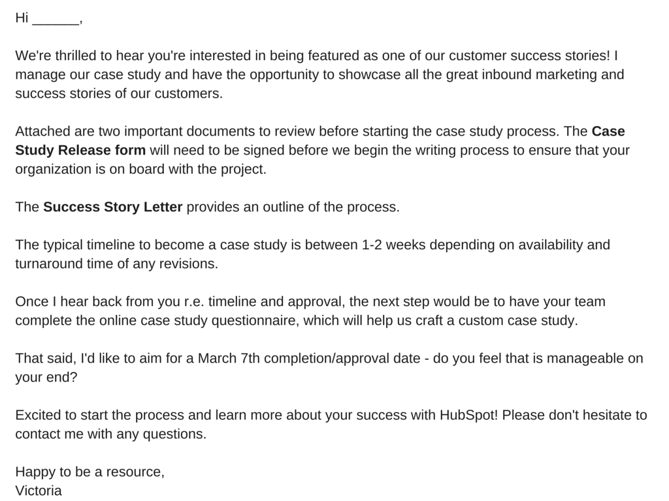
You might be wondering, “What’s a Case Study Release Form?” or, “What’s a Success Story Letter?” Let’s break those down.
Case Study Release Form
This document can vary, depending on factors like the size of your business, the nature of your work, and what you intend to do with the case studies once they are completed. That said, you should typically aim to include the following in the Case Study Release Form:
- A clear explanation of why you are creating this case study and how it will be used.
- A statement defining the information and potentially trademarked information you expect to include about the company — things like names, logos, job titles, and pictures.
- An explanation of what you expect from the participant, beyond the completion of the case study. For example, is this customer willing to act as a reference or share feedback, and do you have permission to pass contact information along for these purposes?
- A note about compensation.
Success Story Letter
As noted in the sample email, this document serves as an outline for the entire case study process. Other than a brief explanation of how the customer will benefit from case study participation, you’ll want to be sure to define the following steps in the Success Story Letter.
The Acceptance
First, you’ll need to receive internal approval from the company’s marketing team. Once approved, the Release Form should be signed and returned to you. It’s also a good time to determine a timeline that meets the needs and capabilities of both teams.
The Questionnaire
To ensure that you have a productive interview — which is one of the best ways to collect information for the case study — you’ll want to ask the participant to complete a questionnaire prior to this conversation. That will provide your team with the necessary foundation to organize the interview, and get the most out of it.
The Interview
Once the questionnaire is completed, someone on your team should reach out to the participant to schedule a 30- to 60-minute interview, which should include a series of custom questions related to the customer’s experience with your product or service.
The Draft Review
After the case study is composed, you’ll want to send a draft to the customer, allowing an opportunity to give you feedback and edits.
The Final Approval
Once any necessary edits are completed, send a revised copy of the case study to the customer for final approval.
Once the case study goes live — on your website or elsewhere — it’s best to contact the customer with a link to the page where the case study lives. Don’t be afraid to ask your participants to share these links with their own networks, as it not only demonstrates your ability to deliver positive results, but their impressive growth, as well.
6. Ensure you’re asking the right questions.
Before you execute the questionnaire and actual interview, make sure you’re setting yourself up for success. A strong case study results from being prepared to ask the right questions. What do those look like? Here are a few examples to get you started:
- What are your goals?
- What challenges were you experiencing prior to purchasing our product or service?
- What made our product or service stand out against our competitors?
- What did your decision-making process look like?
- How have you benefited from using our product or service? (Where applicable, always ask for data.)
Keep in mind that the questionnaire is designed to help you gain insights into what sort of strong, success-focused questions to ask during the actual interview. And once you get to that stage, we recommend that you follow the “Golden Rule of Interviewing.” Sounds fancy, right? It’s actually quite simple — ask open-ended questions.
If you’re looking to craft a compelling story, “yes” or “no” answers won’t provide the details you need. Focus on questions that invite elaboration, such as, “Can you describe …?” or, “Tell me about …”
In terms of the interview structure, we recommend categorizing the questions and flow into six specific sections that will mirror a successful case study format. Combined, they’ll allow you to gather enough information to put together a rich, comprehensive study.
Open with the customer’s business.
The goal of this section is to generate a better understanding of the company’s current challenges and goals, and how they fit into the landscape of their industry. Sample questions might include:
- How long have you been in business?
- How many employees do you have?
- What are some of the objectives of your department at this time?
Cite a problem or pain point.
In order to tell a compelling story, you need context. That helps match the customer’s need with your solution. Sample questions might include:
- What challenges and objectives led you to look for a solution?
- What might have happened if you did not identify a solution?
- Did you explore other solutions prior to this that did not work out? If so, what happened?
Discuss the decision process.
Exploring how the customer arrived at the decision to work with you helps to guide potential customers through their own decision-making processes. Sample questions might include:
- How did you hear about our product or service?
- Who was involved in the selection process?
- What was most important to you when evaluating your options?
Explain how a solution was implemented.
The focus here should be placed on the customer’s experience during the onboarding process. Sample questions might include:
- How long did it take to get up and running?
- Did that meet your expectations?
- Who was involved in the process?
Explain how the solution works.
The goal of this section is to better understand how the customer is using your product or service. Sample questions might include:
- Is there a particular aspect of the product or service that you rely on most?
- Who is using the product or service?
End with the results.
In this section, you want to uncover impressive measurable outcomes — the more numbers, the better. Sample questions might include:
- How is the product or service helping you save time and increase productivity?
- In what ways does that enhance your competitive advantage?
- How much have you increased metrics X, Y, and Z?
7. Lay out your case study format.
When it comes time to take all of the information you’ve collected and actually turn it into something, it’s easy to feel overwhelmed. Where should you start? What should you include? What’s the best way to structure it?
To help you get a handle on this step, it’s important to first understand that there is no one-size-fits-all when it comes to the ways you can present a case study. They can be very visual, which you’ll see in some of the examples we’ve included below, and can sometimes be communicated mostly through video or photos, with a bit of accompanying text.
Whether your case study is primarily written or visual, we recommend focusing on the seven-part outline, below. Note: Even if you do elect to use a visual case study, it should still include all of this information, but presented in its intended format.
- Title: Keep it short. Develop a succinct but interesting project name you can give the work you did with your subject.
- Subtitle: Use this copy to briefly elaborate on the accomplishment. What was done? The case study itself will explain how you got there.
- Executive Summary: A 2-4 sentence summary of the entire story. You’ll want to follow it with 2-3 bullet points that display metrics showcasing success.
- About the Subject: An introduction to the person or company you served, which can be pulled from a LinkedIn Business profile or client website.
- Challenges and Objectives: A 2-3 paragraph description of the customer’s challenges, prior to using your product or service. This section should also include the goals or objectives the customer set out to achieve.
- How Product/Service Helped: A 2-3 paragraph section that describes how your product or service provided a solution to their problem.
- Results: A 2-3 paragraph testimonial that proves how your product or service specifically benefited the person or company, and helped achieve its goals. Include numbers to quantify your contributions.
- Supporting Visuals or Quotes: Pick one or two powerful quotes that you would feature at the bottom of the sections above, as well as a visual that supports the story you are telling.
- Future Plans: Everyone likes an epilogue. Comment on what’s ahead for your case study subject, whether or not those plans involve you.
- Call to Action (CTA): Not every case study needs a CTA, but putting a passive one at the end of your case study can encourage your readers to take an action on your website after learning about the work you’ve done.
To help you visualize this case study outline, check out the case study template below, which can also be downloaded here.
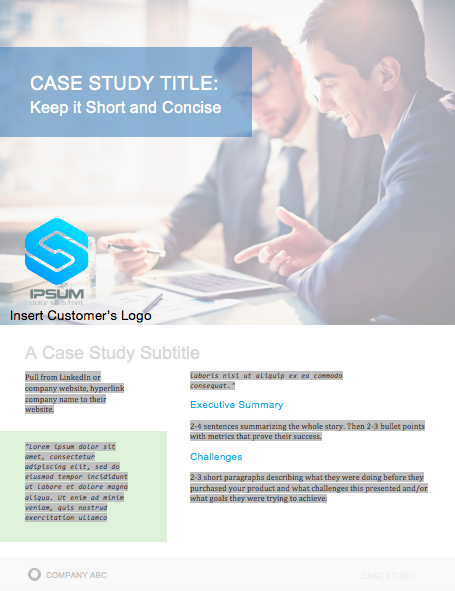
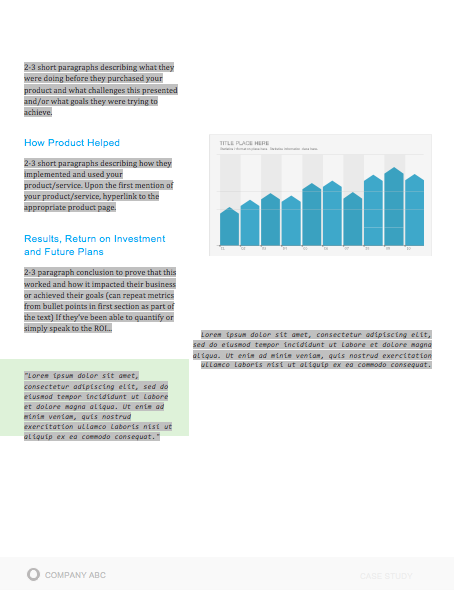
When laying out your case study, focus on conveying the information you’ve gathered in the most clear and concise way possible. Make it easy to scan and comprehend, and be sure to provide an attractive call-to-action at the bottom — that should provide readers an opportunity to learn more about your product or service.
8. Publish and promote your case study.
Once you’ve completed your case study, it’s time to publish and promote it. Some case study formats have pretty obvious promotional outlets — a video case study can go on YouTube, just as an infographic case study can go on Pinterest.
But there are still other ways to publish and promote your case study. Here are a couple of ideas:
Gated Behind a Blog Post
As stated earlier in this article, written case studies make terrific lead-generators if you convert them into a downloadable format, like a PDF. To generate leads from your case study, consider writing a blog post that tells an abbreviated story of your client’s success and asking readers to fill out a form with their name and email address if they’d like to read the rest in your PDF.
Then, promote this blog post on social media, through a Facebook post or a tweet.
Published as a Page on Your Website
As a growing business, you might need to display your case study out in the open to gain the trust of your target audience.
Rather than gating it behind a landing page, publish your case study to its own page on your website, and direct people here from your homepage with a “Case Studies” or “Testimonials” button along your homepage’s top navigation bar.
Business Case Study Examples
You drove the results, made the connect, set the expectations, used the questionnaire to conduct a successful interview, and boiled down your findings into a compelling story. And after all of that, you’re left with a little piece of sales enabling gold — a case study.
To show you what a well-executed final product looks like, have a look at some of these marketing case study examples.
1. “New England Journal of Medicine,” by Corey McPherson Nash
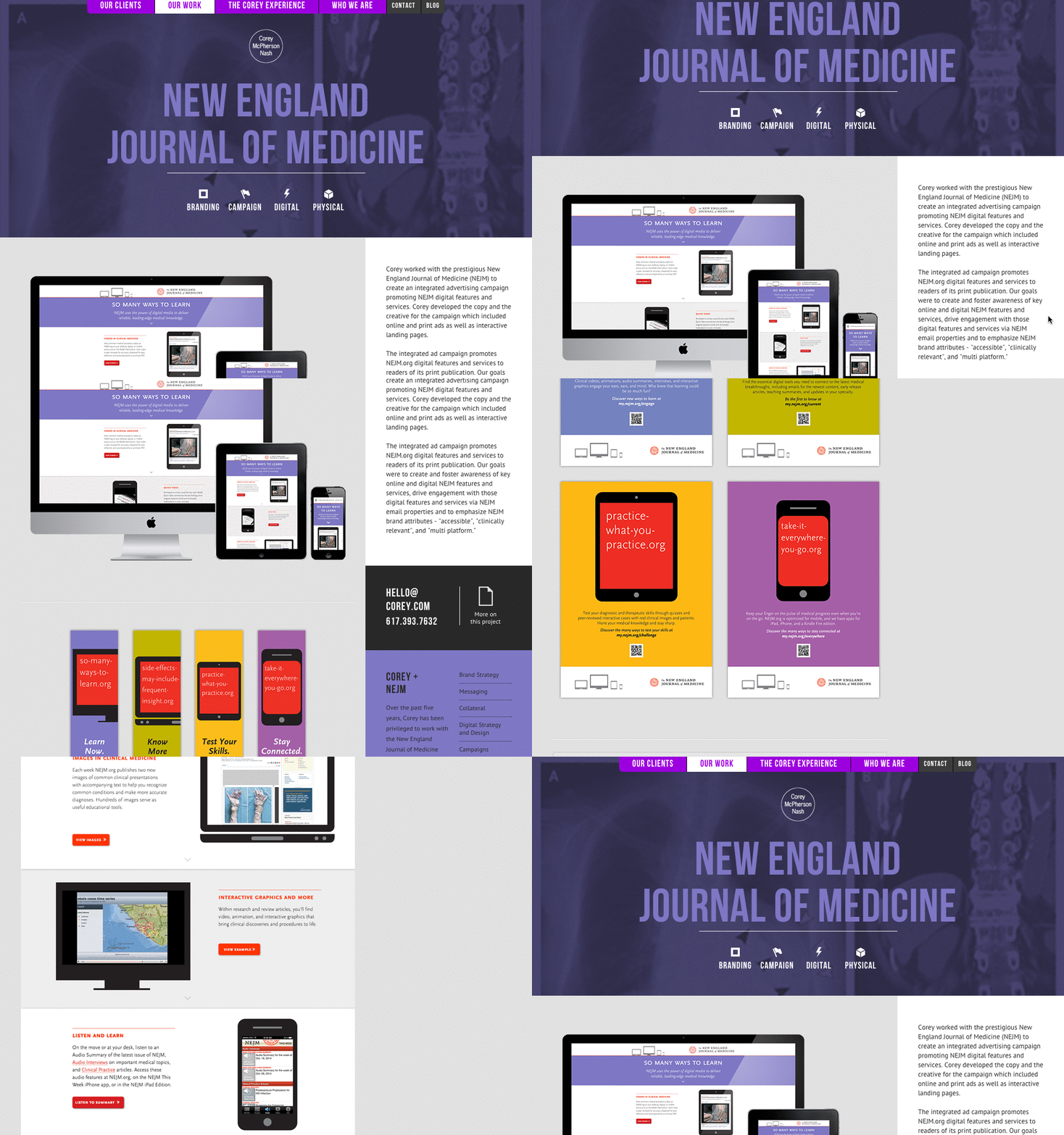
When branding and design studio Corey McPherson Nash showcases its work, it makes sense for it to be visual — after all, that’s what they do. So in building the case study for the studio’s work on the New England Journal of Medicine’s integrated advertising campaign — a project that included the goal of promoting the client’s digital presence — Corey McPherson Nash showed its audience what it did, rather than purely telling it.
Notice that the case study does include some light written copy — which includes the major points we’ve suggested — but really lets the visuals do the talking, allowing users to really absorb the studio’s services.
2. “Shopify Uses HubSpot CRM to Transform High Volume Sales Organization,” by HubSpot
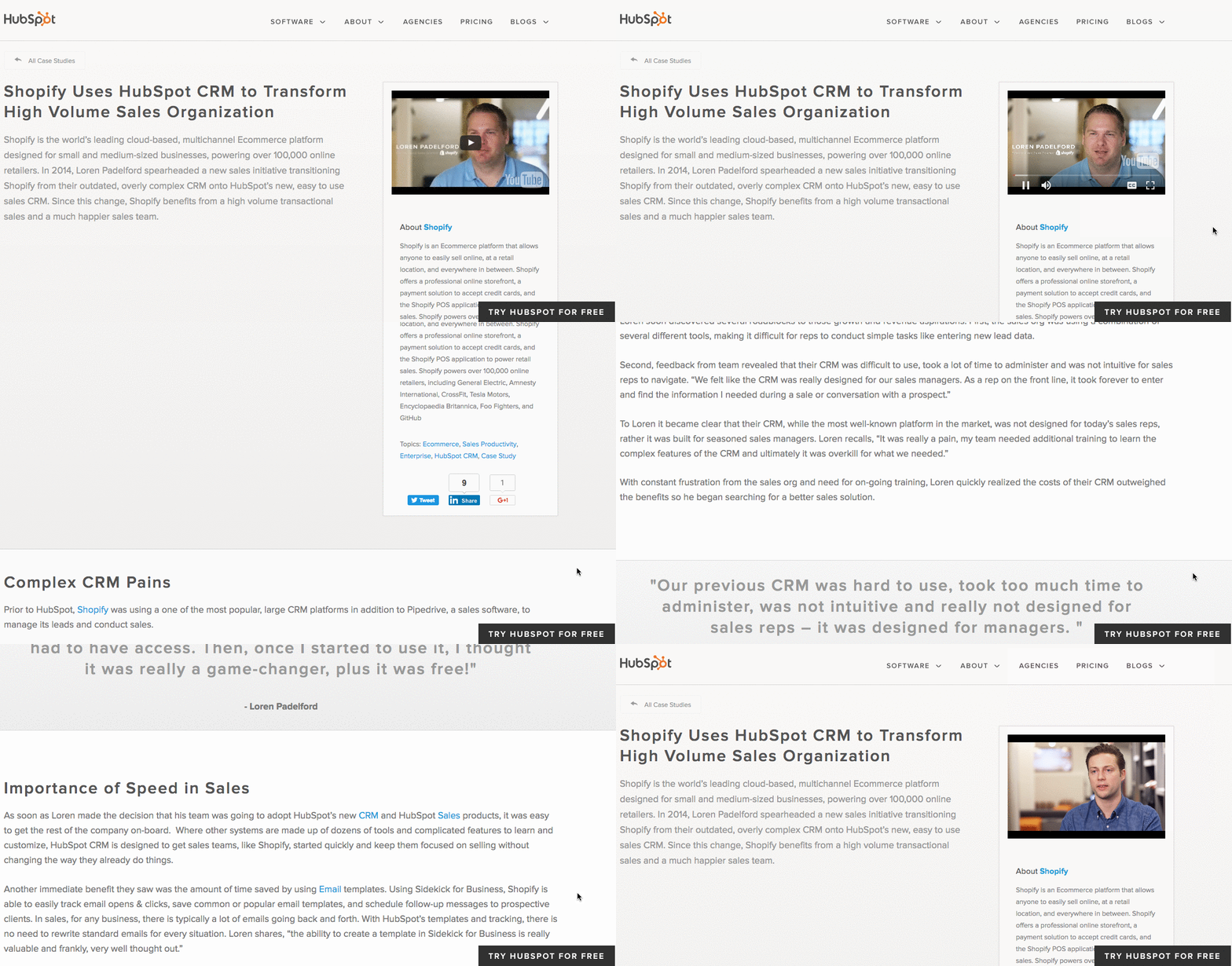
What’s interesting about this case study is the way it leads with the customer. This reflects a major HubSpot credo, which is to always solve for the customer first. The copy leads with a brief description of why Shopify uses HubSpot, and is accompanied by a short video and some basic statistics on the company.
Notice that this case study uses mixed-media. Yes, there is a short video, but it’s elaborated upon in the additional text on the page. So, while case studies can use one or the other, don’t be afraid to combine written copy with visuals to emphasize the project’s success.
3. “Designing the Future of Urban Farming,” by IDEO
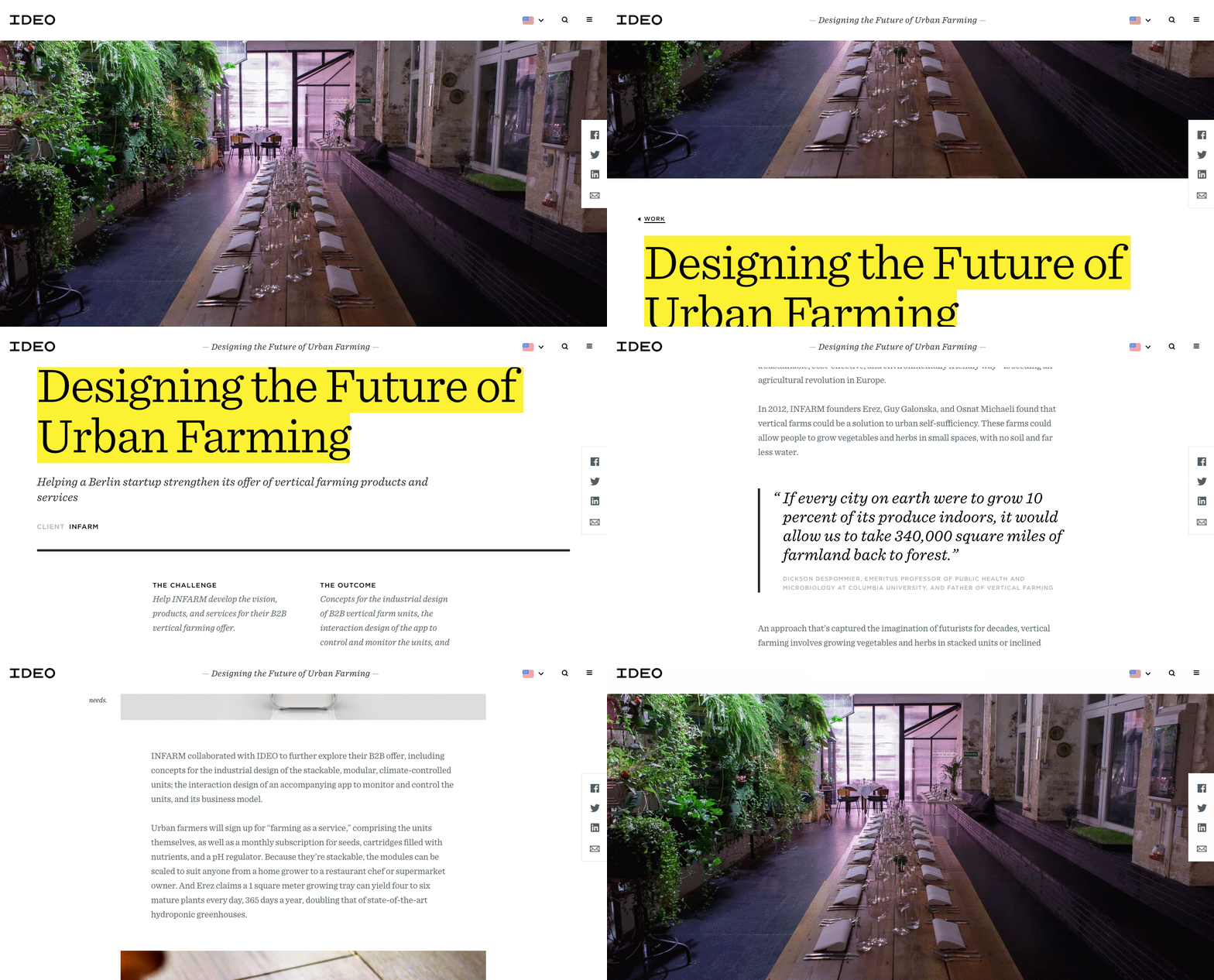
Here’s a design company that knows how to lead with simplicity in its case studies. As soon as the visitor arrives at the page, he or she is greeted with a big, bold photo, and two very simple columns of text — “The Challenge” and “The Outcome.”
Immediately, IDEO has communicated two of the case study’s major pillars. And while that’s great — the company created a solution for vertical farming startup INFARM’s challenge — it doesn’t stop there. As the user scrolls down, those pillars are elaborated upon with comprehensive (but not overwhelming) copy that outlines what that process looked like, replete with quotes and additional visuals.
4. “Secure Wi-Fi Wins Big for Tournament,” by WatchGuard
Then, there are the cases when visuals can tell almost the entire story — when executed correctly. Network security provider WatchGuard is able to do that through this video, which tells the story of how its services enhanced the attendee and vendor experience at the Windmill Ultimate Frisbee tournament.
5. Rock and Roll Hall of Fame Boosts Social Media Engagement and Brand Awareness with HubSpot
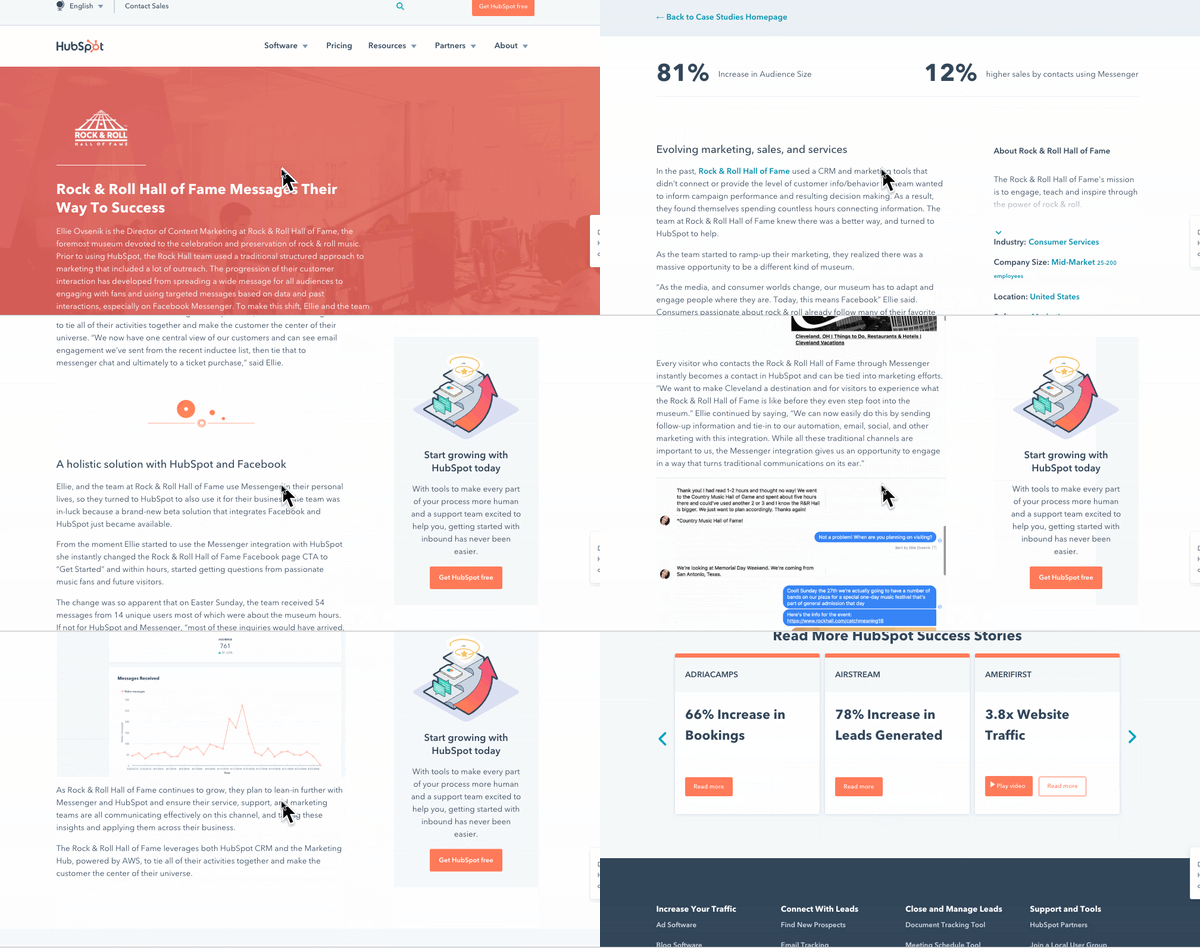 In the case study above, HubSpot uses photos, videos, screenshots, and helpful stats to tell the story of how the Rock and Roll Hall of Fame used the bot, CRM, and social media tools to gain brand awareness.
6. Small Desk Plant Business Ups Sales by 30% With Trello
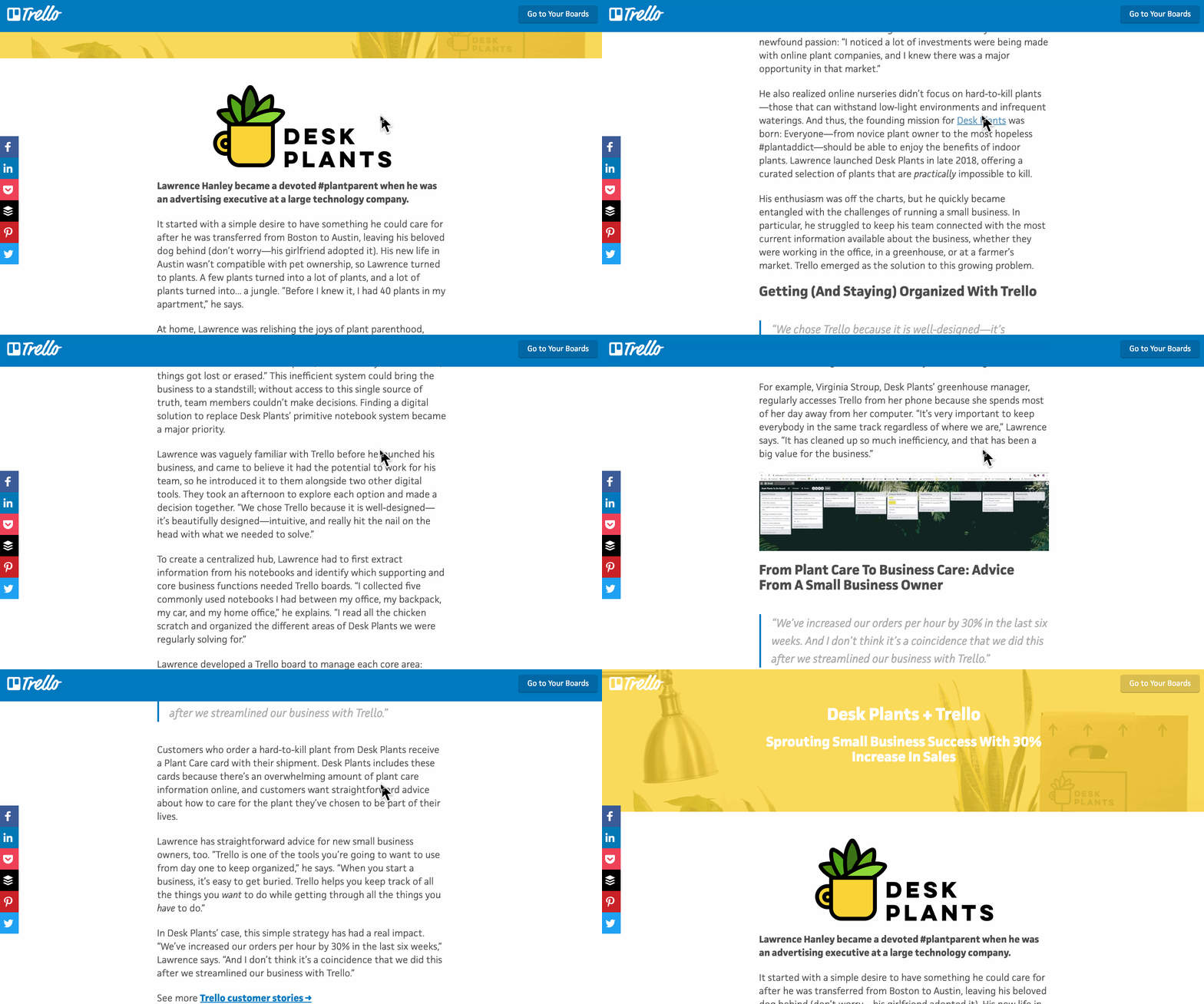
This case study from Trello is straight forward and easy to understand. It begins by explaining the background of the company that decided to use it, what their goals were, and how they planned to use Trello to help them.
It then goes on to discuss how the software was implemented and what tasks and teams benefited from it. Towards the end, it explains the sales results that came from implementing the software and includes quotes from decision-makers at the company that implemented it.
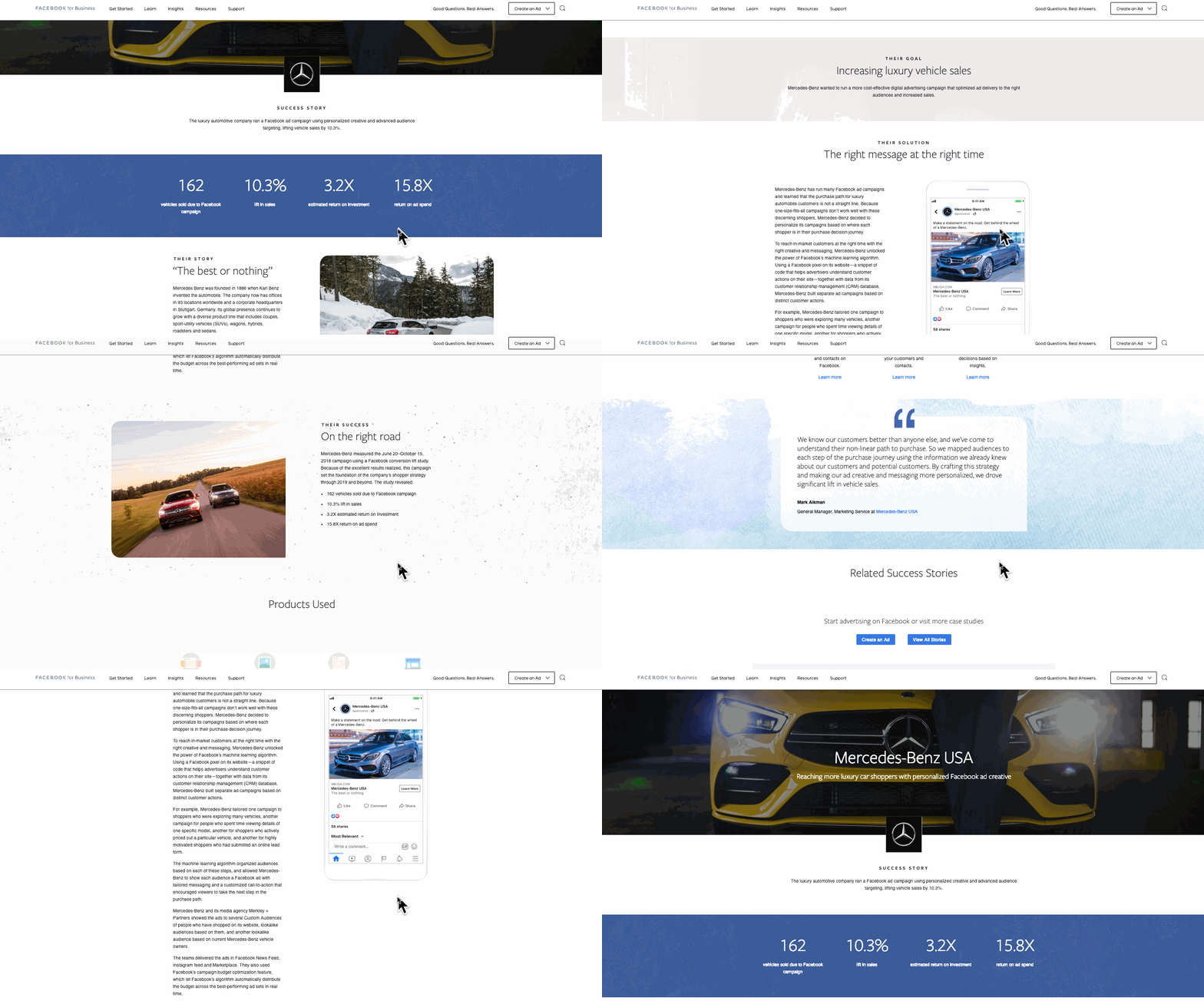
7. Facebook’s Mercedes Benz Success Story
Facebook’s Success Stories page hosts a number of well-designed and easy-to-understand case studies that visually and editorially get to the bottom line quickly.
Each study begins with key stats that draw the reader in. Then it’s organized by highlighting a problem or goal in the introduction, the process the company took to reach their goals, and the results. Then, at the end, Facebook notes the tools used in the case study.
Showcasing Your Work
You work hard at what you do. Now, it’s time to show it to the world — and, perhaps more important, to potential customers.
But before you show off the projects that make you the proudest, make sure you follow the important steps that will help ensure that work is effectively communicated, and leaves all parties feeling good about it.
Want to learn as you write your case study? Listen to an audio summary of this post below.
For an easy way to get started, grab your free case study template below, and go create a case study that makes your subject proud of their success.
Editor’s Note: This blog post was originally published in February 2017 but was updated for comprehensiveness and freshness in February 2020.

How to Repost on Instagram: 4 Ways to Reshare Content From Other Users
Most social media feeds are almost distractingly busy — full of photos, videos, and text updates from friends and brands you follow. Instagram is different — you can only look at one post at a time.
And while Instagram’s simple, clean interface makes to easy to focus on users’ beautiful photography and interesting videos, it also leaves something to be desired: the ability to easily repost other users’ content.
But fear not: for every problem, the internet has afforded a solution. We tested out four different ways to repost content on Instagram in a few simple steps. All of these methods are free, but some require you to download an app from the iOS App Store or Google Play first.
Disclaimer: Pursuant to Instagram’s Terms of Use, you must first reach out to the Instagram user whose content you want to reproduce and obtain written permission to do so. You can do this by commenting on the image and asking, or by sending them an Instagram Direct Message, which can be accessed by tapping the paper airplane icon in the upper right-hand corner of the app.
How to Repost on Instagram
To repost someone else’s Instagram post, you first have to obtain that person’s permission to re-use their content. Then, you can use an external app such as Repost for Instagram, Instarepost, or DownloadGram. You can also take a screenshot of the photo with your mobile device.
Using Repost for Instagram
1. Download Repost for Instagram.
Download Repost for Instagram for either iOS or Android. Both devices are compatible with this app, which integrates directly with Instagram so you can share content from other Instagram users from your mobile device.
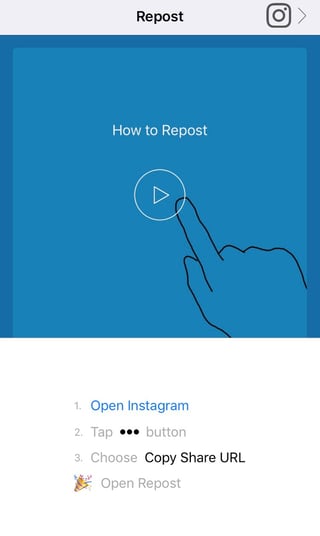
2. Identify a photo or video to repost.
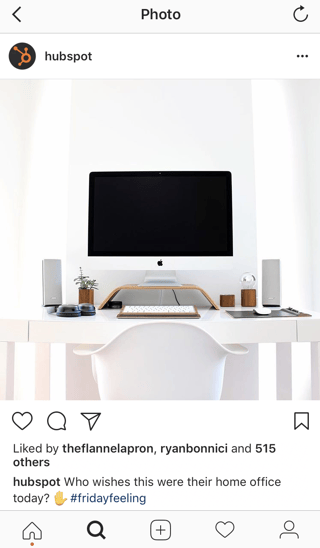
Open your Instagram app and find a photo or video you’d like to repost from your own Instagram account. Tap your chosen photo from the original poster’s photo gallery to see its full view, as shown below.

(Psst — do you follow HubSpot on Instagram?)
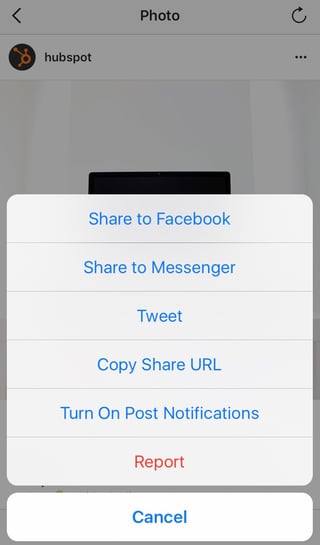
3. Copy the post’s share URL to your clipboard.
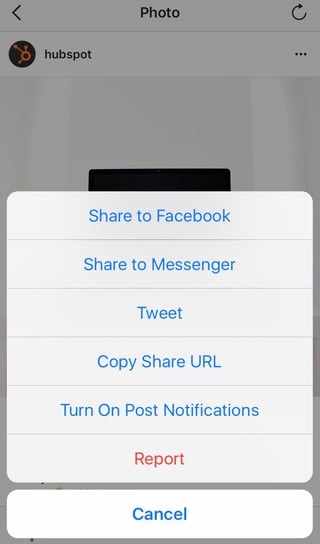
Once you’re on the photo’s or video’s landing page, tap the “…” icon in the upper-righthand corner of the post. Then, tap “Copy Share URL” (the button will look the same on Android devices).
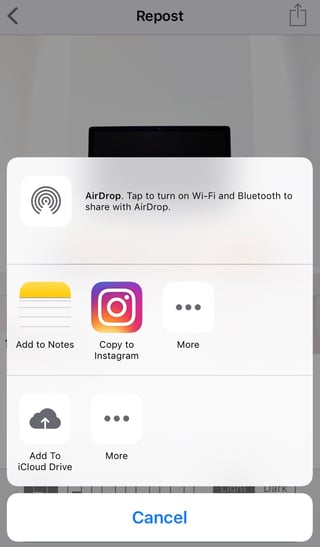
4. Open Repost for Instagram.
Once the photo is copied to your phone’s clipboard, open Repost for Instagram. The post you copied will automatically be on the app’s homepage, as shown below.

Tap the arrow on the righthand side of the post. There, you can edit how you want the repost icon to appear on Instagram.

Tap “Repost.” Then, tap “Copy to Instagram,” where you can add a filter and edit the post.
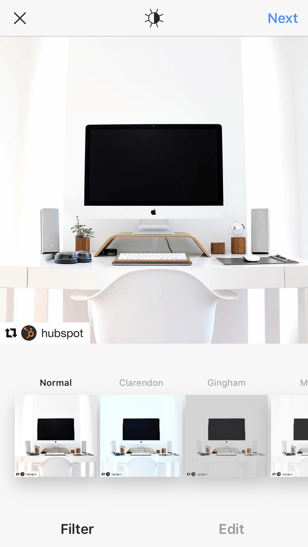
5. Edit the post’s caption and share your repost.
Tap “Next.” If you want to include the original post’s caption, tap the caption field and press “Paste,” where the original caption will appear with a citation that credits the original poster with your reposted photo.
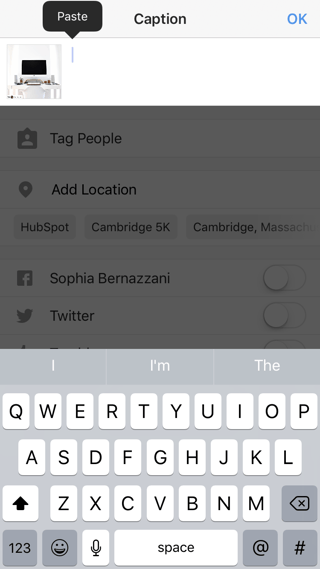
When you’re ready to share the post, tap “Share” as you would a regular Instagram post. Here’s how the post appears on your Instagram profile:

Using InstaRepost
1. Download InstaRepost.
Download InstaRepost for iOS or Android devices to share content from other Instagram users from your own Instagram account via your mobile device.
2. Give InstaRepost access to your Instagram account.
Open InstaRepost, log in using your Instagram credentials, and authorize it to access photos, friends, and similar content associated with your Instagram account.
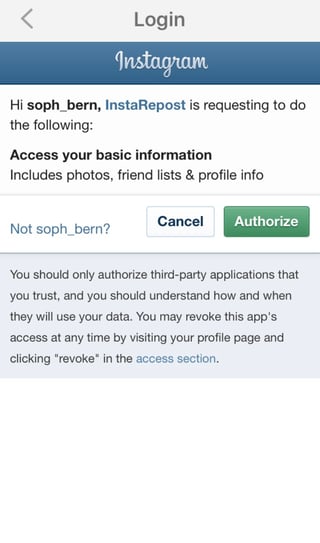
3. Use InstaRepost to look up the original poster’s username.
InstaRepost will only show you a small selection from your Instagram feed. If you know what post you’re looking for, tap the magnifying glass icon on the bottom toolbar of the InstaRepost app to access the Explore tab. Enter the username of the person whose photo you want to repost.
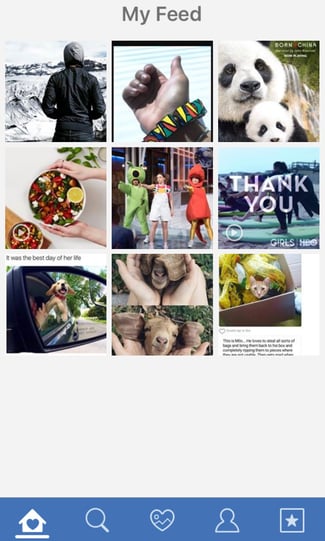
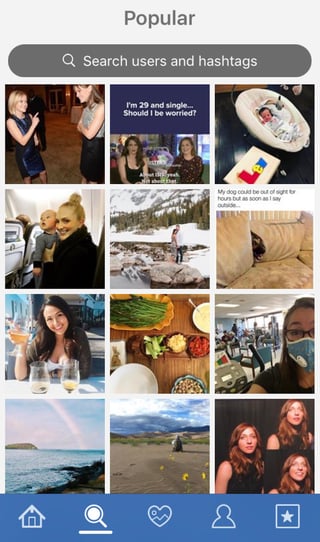
4. Save the photo to your phone’s camera roll.
Once you’ve found a post you want to reshare, tap the arrow in the lower righthand corner. Then, tap “Repost,” then “Repost” again. This will first save the photo your mobile device’s native camera roll, where you can retrieve it in the Instagram app.

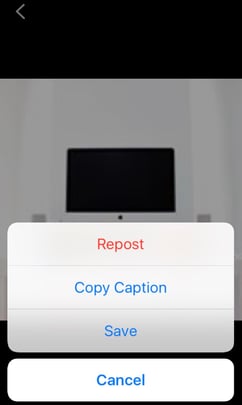
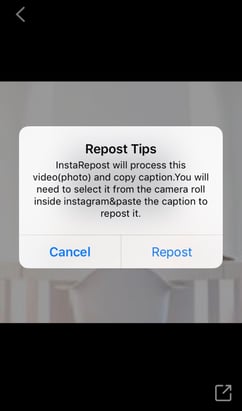
Navigate to your Instagram app and tap “Library.” You’ll see the post saved to your phone’s camera roll. Tap the photo to pull it into Instagram.

5. Add a filter and a citation, and share your repost.
Add a filter and edit the post as you would any other. Then, select “Next” and tap the caption field to paste the original caption. The repost won’t automatically include a citation, so we suggest adding one by typing “@ + [username]” to credit the content’s original poster. Then, press “Share.”

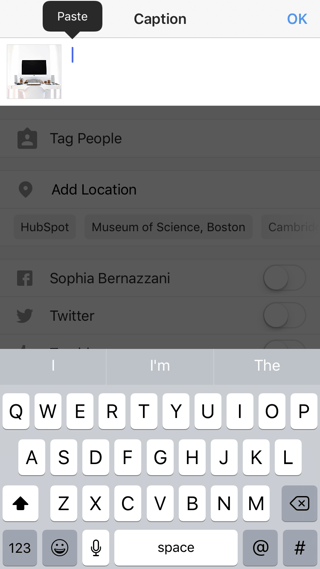
Here’s how the post appears on your Instagram profile:

Using DownloadGram
DownloadGram lets Instagram users download high-resolution copies of Instagram photos and videos to repost from their own accounts. Luckily, there isn’t an app you need to download to repost using this process. Here’s how to do it:
1. Open Instagram and find a photo or video to repost.
Open your Instagram app and find the post you want to repost. Tap the “…” icon in the upper righthand corner of the post and click “Copy Share URL” (this button will be the same for both iOS and Android mobile devices).

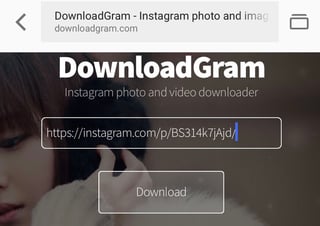
2. Paste the post’s share URL into DownloadGram.
Open your mobile internet browser and navigate to DownloadGram — or simply, downloadgram.com. Paste the URL into the text box that appears on the website’s homepage. Then, tap “Download.”
Tap the green “Download Image” button that appears further down DownloadGram’s homepage.

3. Download the post.
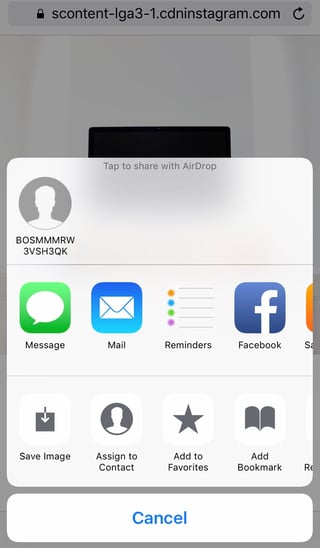
You’ll be directed to a new webpage with the content ready to download. Tap the download icon — the box with an upward-facing arrow, as shown below — then tap “Save image.”

4. Open Instagram and find the photo or video in your camera roll.
Return to your Instagram app. The image will be saved to your phone’s native camera roll, so edit it as you would any other Instagram post.

5. Add a caption and share your repost.
The repost won’t include a citation, so we suggest adding one by typing “@ + [username]” to credit the original poster with the photo or video. Then, press “Share.” Here’s how the post appears on your Instagram profile:

Taking a Screenshot
This method doesn’t require any or other websites to repost on Instagram. It’s worth nothing that this method only works for reposting photos, not videos. Here’s how to do it:
Find a photo on Instagram you’d like to repost, and take a screenshot with your phone.
- For iOS: Press down on the home and lock buttons simultaneously until your screen flashes.
- For Android: Press down on the sleep/wake and volume down buttons simultaneously until your screen flashes.
Tap the new post button in the bottom-center of your Instagram screen. Resize the photo so it’s properly cropped in the Instagram photo editor.
Edit and filter the post like you would any other Instagram post. Keep in mind that your phone will take a screenshot of everything on your screen, not just the photo you want to repost. So, be prepared to crop the sides of the screenshot to capture just the image you want to share with your followers.

The repost won’t include a citation, so we suggest adding one by typing “@ + [username]” to credit the original poster with the photo you’re reposting. Then, press “Share.” Here’s how the post appears on your Instagram profile:

Now that you’ve learned how to repost on Instagram, you can diversify your profile with content sourced from friends, family, and brands. Use the methods above — being sure to cite the source of the original post — to quickly and easily reshare your favorite content.
Looking for more ideas for sourcing and creating Instagram content for your brand? Download our free guide to using Instagram for business here.

The 8 Most Common Leadership Styles & How to Find Your Own
“A good leader should always … “
How you finish that sentence could reveal a lot about your leadership style.
Leadership is a fluid practice. We’re always changing and improving the way in which we help our direct reports and the company grow. And the longer we lead, the more likely we’ll change the way we choose to complete the sentence above.
But in order to become better leaders tomorrow, we need to know where we stand today. To help you understand the impact each type of leader has on a company, I’ll explain eight of the most common types of leadership styles in play today and how effective they are.
Then, I’ll show you a leadership style assessment based on this post’s opening sentence to help you figure out which leader you are.
1. Democratic Leadership
Commonly Effective
Democratic leadership is exactly what it sounds like — the leader makes decisions based on the input of each team member. Although he or she makes the final call, each employee has an equal say on a project’s direction.
Democratic leadership is one of the most effective leadership styles because it allows lower-level employees to exercise authority they’ll need to use wisely in future positions they might hold. It also resembles how decisions can be made in company board meetings.
For example, in a company board meeting, a democratic leader might give the team a few decision-related options. They could then open a discussion about each option. After a discussion, this leader might take the board’s thoughts and feedback into consideration, or they might open this decision up to a vote.
2. Autocratic Leadership
Rarely Effective
Autocratic leadership is the inverse of democratic leadership. In this leadership style, the leader makes decisions without taking input from anyone who reports to them. Employees are neither considered nor consulted prior to a direction, and are expected to adhere to the decision at a time and pace stipulated by the leader.
An example of this could be when a manager changes the hours of work shifts for multiple employees without consulting anyone — especially the effected employees.
Frankly, this leadership style stinks. Most organizations today can’t sustain such a hegemonic culture without losing employees. It’s best to keep leadership more open to the intellect and perspective of the rest of the team.
3. Laissez-Faire Leadership
Sometimes Effective
If you remember your high-school French, you’ll accurately assume that laissez-faire leadership is the least intrusive form of leadership. The French term “laissez faire” literally translates to “let them do,” and leaders who embrace it afford nearly all authority to their employees.
In a young startup, for example, you might see a laissez-faire company founder who makes no major office policies around work hours or deadlines. They might put full trust into their employees while they focus on the overall workings of running the company.
Although laissez-faire leadership can empower employees by trusting them to work however they’d like, it can limit their development and overlook critical company growth opportunities. Therefore, it’s important that this leadership style is kept in check.
4. Strategic Leadership
Commonly Effective
Strategic leaders sit at the intersection between a company’s main operations and its growth opportunities. He or she accepts the burden of executive interests while ensuring that current working conditions remain stable for everyone else.
This is a desirable leadership style in many companies because strategic thinking supports multiple types of employees at once. However, leaders who operate this way can set a dangerous precedent with respect to how many people they can support at once, and what the best direction for the company really is if everyone is getting their way at all times.
5. Transformational Leadership
Sometimes Effective
Transformational leadership is always “transforming” and improving upon the company’s conventions. Employees might have a basic set of tasks and goals that they complete every week or month, but the leader is constantly pushing them outside of their comfort zone.
When starting a job with this type of leader, all employees might get a list of goals to reach, as well as deadlines for reaching them. While the goals might seem simple at first, this manager might pick up the pace of deadlines or give you more and more challenging goals as you grow with the company.
This is a highly encouraged form of leadership among growth-minded companies because it motivates employees to see what they’re capable of. But transformational leaders can risk losing sight of everyone’s individual learning curves if direct reports don’t receive the right coaching to guide them through new responsibilities.
6. Transactional Leadership
Sometimes Effective
Transactional leaders are fairly common today. These managers reward their employees for precisely the work they do. A marketing team that receives a scheduled bonus for helping generate a certain number of leads by the end of the quarter is a common example of transactional leadership.
When starting a job with a transactional boss, you might receive an incentive plan that motivates you to quickly master your regular job duties. For example, if you work in marketing, you might receive a bonus for sending 10 marketing emails. On the other hand, a transformational leader might only offer you a bonus if your work results in a large amount of newsletter subscriptions.
Transactional leadership helps establish roles and responsibilities for each employee, but it can also encourage bare-minimum work if employees know how much their effort is worth all the time. This leadership style can use incentive programs to motivate employees, but they should be consistent with the company’s goals and used in addition to unscheduled gestures of appreciation.
7. Coach-Style Leadership
Commonly Effective
Similarly to a sports team’s coach, this leader focuses on identifying and nurturing the individual strengths of each member on his or her team. They also focus on strategies that will enable their team work better together. This style offers strong similarities to strategic and democratic leadership, but puts more emphasis on the growth and success of individual employees.
Rather than forcing all employees to focus on similar skills and goals, this leader might build a team where each employee has an expertise or skillset in something different. In the longrun, this leader focuses on creating strong teams that can communicate well and embrace each other’s unique skillsets in order to get work done.
A manager with this leadership style might help employees improve on their strengths by giving them new tasks to try, offering them guidance, or meeting to discuss constructive feedback. They might also encourage one or more team members to expand on their strengths by learning new skills from other teammates.
8. Bureaucratic Leadership
Rarely Effective
Bureaucratic leaders go by the books. This style of leadership might listen and consider the input of employees — unlike autocratic leadership — but the leader tends to reject an employee’s input if it conflicts with company policy or past practices.
You may run into a bureaucratic leader at a larger, older, or traditional company. At these companies, when a colleague or employee proposes a strong strategy that seems new or non-traditional, bureaucratic leaders may reject it. Their resistance might be because the company has already been successful with current processes and trying something new could waste time or resources if it doesn’t work.
Employees under this leadership style might not feel as controlled as they would under autocratic leadership, but there is still a lack of freedom in how much people are able to do in their roles. This can quickly shut down innovation, and is definitely not encouraged for companies who are chasing ambitious goals and quick growth.
Leadership Style Assessment
Leaders can carry a mix of the above leadership styles depending on their industry and the obstacles they face. At the root of these styles, according to leadership experts Bill Torbert and David Rooke, are what are called “action logics.”
These action logics assess “how [leaders] interpret their surroundings and react when their power or safety is challenged.”
That’s the idea behind a popular management survey tool called the Leadership Development Profile. Created by professor Torbert and psychologist Susanne Cook-Greuter — and featured in the book, Personal and Organizational Transformations — the survey relies on a set of 36 open-ended sentence completion tasks to help researchers better understand how leaders develop and grow.
Below, we’ve outlined six action logics using open-ended sentences that help describe each one. See how much you agree with each sentence and, at the bottom, find out which leadership style you uphold based on the action logics you most agreed with.
1. Individualist
The individualist, according to Rooke and Tolbert, is self-aware, creative, and primarily focused on their own actions and development as opposed to overall organizational performance. This action logic is exceptionally driven by the desire to exceed personal goals and constantly improve their skills.
Here are some things an individualist might say:
I1. “A good leader should always trust their own intuition over established organizational processes.”
I2. “It’s important to be able to relate to others so I can easily communicate complex ideas to them.”
I3. “I’m more comfortable with progress than sustained success.”
2. Strategist
Strategists are acutely aware of the environments in which they operate. They have a deep understanding of the structures and processes that make their businesses tick, but they’re also able to consider these frameworks critically and evaluate what could be improved.
Here are some things a strategist might say:
S1. “A good leader should always be able to build a consensus in divided groups.”
S2. “It’s important to help develop the organization as a whole, as well as the growth and individual achievements of my direct reports.”
S3. “Conflict is inevitable, but I’m knowledgeable enough about my team’s personal and professional relationships to handle the friction.”
3. Alchemist
Rooke and Tolbert describe this charismatic action logic as the most highly evolved and effective at managing organizational change. What distinguishes alchemists from other action logics is their unique ability to see the big picture in everything, but also fully understand the need to take details seriously. Under an alchemist leader, no department or employee is overlooked.
Here are some things an alchemist might say:
A1. “A good leader helps their employees reach their highest potential, and possesses the necessary empathy and moral awareness to get there.”
A2. “It’s important to make a profound and positive impact on whatever I’m working on.”
A3. “I have a unique ability to balance short-term needs and long-term goals.”
4. Opportunist
Opportunist are guided by a certain level of mistrust of others, relying on a facade of control to keep their employees in line. “Opportunists tend to regard their bad behavior as legitimate in the cut and thrust of an eye-for-an-eye world,” Rooke and Tolbert write.
Here are some things an opportunist might say:
O1. “A good leader should always view others as potential competition to be bested, even if it’s at the expense of their professional development.”
O2. “I reserve the right to reject the input of those who question or criticize my ideas.”
5. Diplomat
Unlike the opportunist, the diplomat isn’t concerned with competition or assuming control over situations. Instead, this action logic seeks to cause minimal impact on their organization by conforming to existing norms and completing their daily tasks with as little friction as possible.
Here are some things a diplomat might say:
D1. “A good leader should always resist change since it risks causing instability among their direct reports.”
D2. “It’s important to provide the ‘social glue’ in team situations, safely away from conflict.”
D3. “I tend to thrive in more team-oriented or supporting leadership roles.”
6. Expert
The expert is a pro in their given field, constantly striving to perfect their knowledge of a subject and perform to meet their own high expectations. Rooke and Tolbert describe the expert as a talented individual contributor and a source of knowledge for the team. But this action logic does lack something central to many good leaders: emotional intelligence.
Here are some things a diplomat might say:
E1. “A good leader should prioritize their own pursuit of knowledge over the needs of the organization and their direct reports.”
E2. “When problem solving with others in the company, my opinion tends to be the correct one.”
Which Leader Are You?
So, which action logics above felt like you? Think about each sentence for a moment … now, check out which of the seven leadership styles you embrace on the right based on the sentences you resonated with on the left.
| Action Logic Sentence | Leadership Style |
| S3 | Democratic |
| O1, O2, E1, E2 | Autocratic |
| D2, D3, E1 | Laissez-Faire |
| S1, S2, A3 | Strategic |
| I1, I2, I3, A1, A2 | Transformational |
| D3 | Transactional |
| D1 | Bureaucratic |
The more action logics you agreed with, the more likely you practice a mix of leadership styles.
For example, if you agreed with everything the strategist said — denoted S1, S2, and S3 — this would make you a 66% strategic leader and 33% democratic leader. If you agreed with just S3, but also everything the alchemist said, this would make you a 50% transformational, 25% strategic, and 25% democratic leader.
Keep in mind that these action logics are considered developmental stages, not fixed attributes — most leaders will progress through multiple types of leadership throughout their careers.

Pilot Study – How to Make It Work
4 Marketing AI Predictions for 2020, According to Experts
According to Gartner, 80% of technology will be built on an AI foundation by 2021.
As AI becomes more prominent across industries, it’s also impacting marketers in subtle ways that might not be obvious to them yet.
While this technology was once described as “over-hyped,” marketers now use a handful of AI-powered tools in their day-to-day tasks.
For example, AI tools help content strategists define SEO and keyword strategies, perform SEO-related tasks like fixing duplicate content, and self-optimize mobile pages.
Aside from SEO, AI can assist marketers in tasks like drafting email subject lines and creating basic social media content. Meanwhile, this technology also helps with important, but time-consuming tasks, like deduplicating contacts and recording market intelligence data on both customers and competitors.
And although the technology is still rather new, the list of tasks it can complete is steadily growing.
At that Marketing AI Institute, we track more than 1,500 AI companies with combined funding of more than $6 billion.
As the institute’s director, I’ve spent years studying the AI market while working with some of the brightest AI minds in marketing. Aside from researching and consulting on AI strategies, I’ve also used AI tools throughout my marketing career. Through these experiences, I’ve gained insights into the opportunities that AI could realistically provide for marketers now and in the near future.
While AI has already subtly crept into the day-to-day lives of many marketers, it’s likely to have even more of an impact on them in the future. According to McKinsey, AI is expected to have up to $2.6 trillion worth of business impact in sales and marketing alone.
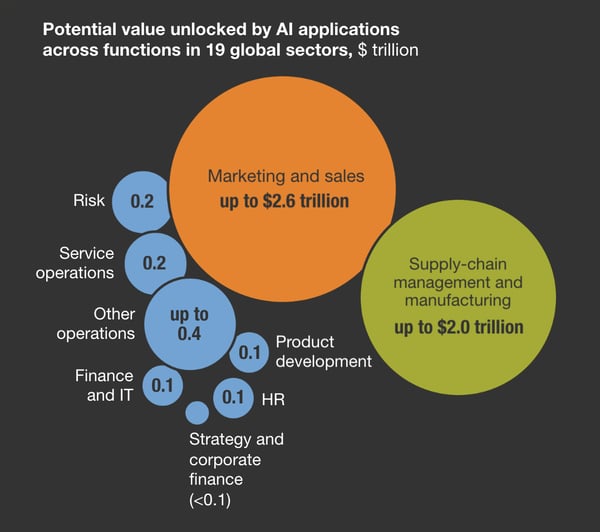
Source: McKinsey
Despite all of the positivity around AI, many marketers are still might be skeptical about which technologies are actually useful, and which could turn out to be overpriced hype. After all, in the past, there have been a number of outlandish and inaccurate AI predictions or claims. These false statements — which many AI experts call “snake oil” — have made it hard to distinguish which AI facts are actually real and which are lies told to gain media attention.
To determine where the true opportunities lie with AI in this stage of its development, it’s important to do research to learn more about the tools and current strategies that other marketers are using. You’ll also want to look at research-backed trends to keep certain tactics on your radar in case they might be beneficial to you in the future.
To help you better understand where AI is going and how you could leverage it to build a competitive strategy in the future, I’ve used my research and professional experiences in the AI space to compile a list of four key trends to watch in the next year.
4 AI Predictions for 2020
1. Content marketers will have to adopt artificial intelligence.
No. Artificial intelligence can’t write compelling long-form content just yet. But, although bots aren’t able to create long narratives, books, scripts, or detailed online articles, AI can still streamline a number of content marketing tasks. According to Jeff Coyle, Co-Founder and Chief Product Officer of MarketMuse, this trend will only continue in 2020.
“This will be the year that brands begin to seriously use artificial intelligence to build a competitive advantage,” says Coyle. “Right now, many companies are still exploring AI and its potential. But the technology is already having a huge impact on content marketing.”
“The brands using AI tools are already seeing outsized benefits, like huge traffic gains and better search rankings,” Coyle adds.
While AI tools help marketers in drafting light content such as social media updates, online ad content, and email subject lines, Coyle says that many companies are using AI to analyze thousands of ranking opportunities in seconds, identify gaps in their strategies, and create content that skyrockets search traffic.
As a marketing professional who’s done much research on the topic of AI, I believe him. In our own report on the top 25 AI use cases marketers value, analyzing existing content for gaps and opportunities tops the list.
We aren’t alone in thinking that AI tools will be vital to content marketing strategies. The Content Marketing Institute similarly says that text mining AI tools can help marketers by analyzing online content to identify keywords, phrases, and other variables that link to higher traffic. After an AI tool makes connections between topics and traffic, marketers can create a strategy that leverages those topics.
“In 2020, the market is going to wake up to the fact that if you’re not using AI to optimize your content marketing, you’re going to fall behind,” Coyle concludes.
2. Consumers are going to demand more personalization.
With 64% of consumers expecting personalized shopping experiences based on the interactions they’ve had with a brand, many marketers are taking notice.
In fact, when we talk to senior-level marketers at the Marketing AI Institute, they’re highly cognizant of the need to hyper-personalize content and experiences for consumers.
While it was once extremely hard to create these experiences with older marketing techniques and technology, AI has opened the door for more pin-pointed personalization opportunities.
Right now, AI is primarily used “to help us get tasks done,” says Nick Edouard, Chief Product Officer at PathFactory, an AI-powered B2B marketing platform.
While AI helps marketers “scale faster, write better, and find or mirror target audiences more easily,” Edouard says that he expects leaders in 2020 to say, “That’s great, but how can we use AI to enable our buyers? How can we use it to help them find what they need at every stage of the customer lifecycle? How do we make this about our customers and not just us as marketers?”
“These are increasingly important questions to ask, especially for B2B companies, as people already expect relevant, personalized, always-on experiences in every aspect of their lives,” says Edouard.
We’re already seeing heavy AI personalization in the marketing industry. For example, many tools allow brands to send marketing emails with names and personalized information in them based on contact list information. In retail, consumers regularly get emails or ecommerce site recommendations for certain products based on what they’ve already purchased.
But, personalization isn’t just a popular trend. It’s a revenue generator, A recent study from Monetate notes that 79% of retailers and 75% of general businesses report ROI from personalized marketing.
With evolving technology and our ability to capture data on prospects and customers, it’s not shocking to think that AI-based personalization trend will grow stronger in the near future. In 2020 specifically, expect AI to start being used more and more to create solid one-to-one personalization,
3. AI is going to continue to enable and help SEO strategists.
“AI is not only transforming how marketers take business impact to a whole new level. It’s also helping them elevate and advance their careers,” says Krish Kumar, COO and CRO at BrightEdge, maker of BrightEdge Autopilot, which uses AI to automate SEO tasks.
Kumar predicts that marketers are going to reap huge benefits from AI in the coming year, thanks to its ability to automate time-consuming SEO tasks.
“For example, this type of self-driving technology can automatically self-connect website pages, self-optimize mobile pages, and auto-fix duplicate content,” says Kumar.
One example of a company that’s majorly leveraging AI for SEO is Campbell’s. Kumar notes that the soup company uses AI-powered SEO automation to compress 75,000 images in a single day. This allows the brand to rank on page one of SERPs for 4,000 keywords within just a few weeks.
The best part?
AI is helping human SEO marketers, rather than making their jobs obsolete. At companies like Campbell’s, AI technology allows SEO experts to get results that aren’t possible without machines. Not having to worry about this mountain of SEO-related tasks frees them up to work on more intensive projects.
Because it is so beneficial to web traffic and results, expect the investment into AI-powered SEO tools to grow.
4. AI will fit more naturally into the daily lives of marketers.
While AI and automation have already yielded results, cut time out of marketers days, and streamlined a number of outdated processes, small to medium-sized businesses are still hesitant to use these technologies because they worry that working with them and getting up to speed on how each technology or tool works will be added work in itself.
However, as AI technology and tools evolve, they’re getting easier to access, providing smoother user experiences, and becoming a more natural fit into the every-day marketer’s life.
In 2020 and beyond, “The best AI-powered tools are going to interact with marketers in a way that feels more human,” says Bart Frischknecht, VP of product strategy a Vennli, an AI-powered content intelligence tool.
While many AI tools currently collect data and offer insights that the marketer then has to dive into, Frischknecht says that AI will eventually shift to just offering a marketer a list of improvement suggestions or solutions.
One area where we’re already seeing a shift in AI’s capabilities is PPC advertising. Some AI tools will just collect data about how a PPC ad is doing and provide predictive analytics to the marketer, who can then adjust the budget. However, other more advanced AI tools can now analyze how the ad is doing, offer marketers suggestions on how to prevent wasted spend, and then allow them to choose one of those solutions directly from a dashboard.
“It’s going to feel more human when AI automatically takes care of tasks so that marketers can focus on marketing, rather than on wrangling the tool,” says Frischknecht.
In 2020, expect AI-powered marketing tools to start becoming so natural to your work that you don’t even know they’re AI. As John McCarthy, one of the fathers of AI, once said, “As soon as it works, no one calls it AI anymore.”
Navigating AI in 2020 and Beyond
Want to make these predictions actionable? We recommend you take the following steps in 2020 to navigate AI in the new year.
- Understand the basics of AI. You don’t need to be a rocket scientist to understand AI and its impact, but you should develop foundational knowledge about AI in order to help you vet new opportunities. To get started, check out this glossary to find simple definitions of common AI terms.
- Start looking for use cases. When it’s time to start thinking about AI-based projects, you can use use-cases to see what’s already been done with the technology. To find the right use cases, you’ll need to evaluate all the tasks you do in a day, then assess which ones are valuable to automate with AI.
- Experiment. There are plenty of AI technologies you can start getting your hands dirty with, starting today, and experimentation is one of the best ways to develop your knowledge. Google’s free AI tools are a good place to start.
Want to take on all three tips at once? Artificial Intelligence and Machine Learning in Marketing: Live from MAICON, will teach you how to apply AI in marketing using a holistic framework and begin conversations around piloting AI in your business.

5 Facebook Video Stats You Need to Know in 2020 [Infographic]
Video marketing is now one of the core pillars of content strategy. It’s an incredibly powerful means of communicating your brands identity and values, while building rapport and more meaningful relationships with your customers and prospects.
Nowadays, marketers are seeking increasingly creative ways to leverage video to deliver memorable ad campaigns across multichannel platforms.
The latest data shows that the use of Facebook video is expanding at an unprecedented pace and scale — and, with it, the opportunities for video marketers.
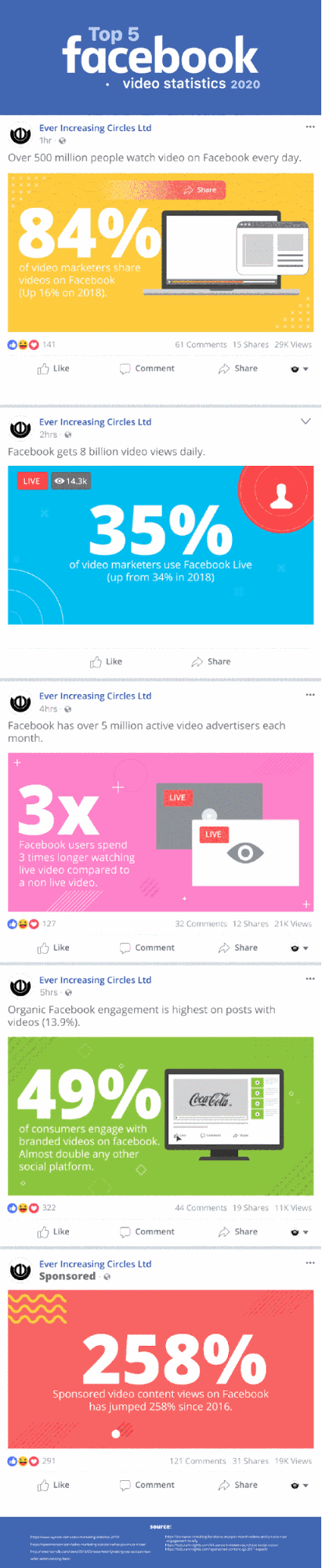
The following is just a handful of Facebook video marketing statistics that are worth bearing in mind:
- There are 8 billion daily video views on the platform
- Users spend three times longer watching live videos than standard uploaded content
- 84% of marketers promote videos on Facebook
- Facebook Live is now used by 35% of video marketers
To learn more about Facebook video and how you might leverage it for your own marketing strategy in 2020, take a look at the infographic Ever Increasing Circles created, below:

How to Build Facebook Custom Audiences for Special Ad Category Groups
Are you trying to run ads to people for services that Facebook restricts due to possible discrimination? Have restrictions on audience targeting impacted your ability to reach leads and customers? In this article, you’ll discover whether your ad belongs in a restricted Special Ad Category, learn what targeting restrictions apply, and find out how to […]
The post How to Build Facebook Custom Audiences for Special Ad Category Groups appeared first on Social Media Marketing | Social Media Examiner.
from Social Media Marketing | Social Media Examiner https://ift.tt/2OIGQPx
via socialmediaexaminer
17 Clever Print Ad Examples To Complement Your Digital Campaign
You would think print advertising is void of innovation today, but that’s actually not the case.
In fact, many brands are finding new ways to merge the digital and physical world through magazine and newspaper ads.
To give you a sense of how businesses today are incorporating print ads into their digital strategy, we’ve collected 17 print ads that’ll make you rethink the word “traditional.”
Click here to download more examples of exceptional advertising campaigns.
17 Interactive Print Advertisements That Are Still Innovative Today
1. Glacial
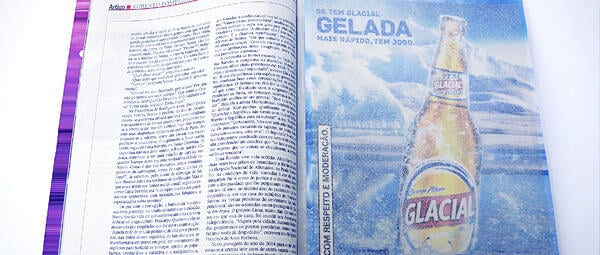
If you’ve ever wanted to speed up the beer-cooling process, you’ll understand the allure of this print ad from Glacial. You soak the ad in water, wrap it around the bottle, and put it in the freezer. The print ad was made with salt particles, which reduce the freezing point of water.
2. Nivea
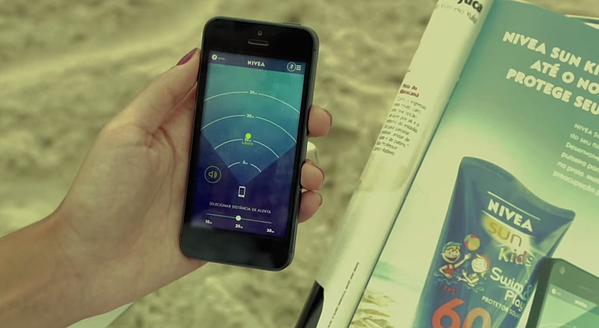
This print ad won the Mobile Grand Prix at Cannes in 2014. The ad includes a wristband you could attach to your children as they run around the beach. The app lets you set a distance and receive alerts if your children wander beyond the limit.
3. UTEC
UTEC, an engineering and technology university, wanted to recruit more students. Instead of placing the smiling faces of young graduates on a billboard, it created an ad that pulled moisture out of the air in Lima, Peru, which sees very little rain each year.
4. Motorola
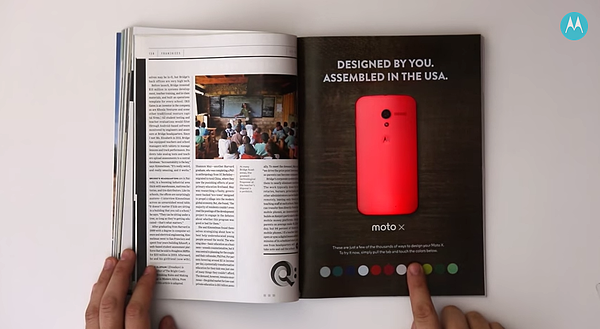
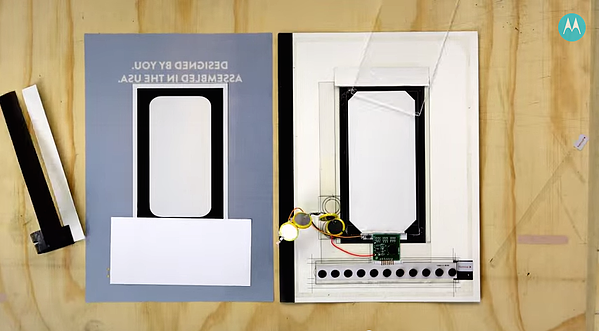
The brand teamed up with Wired to promote the Moto X’s customization. People could change the color of the phone by pushing buttons.
5. Kontor Records
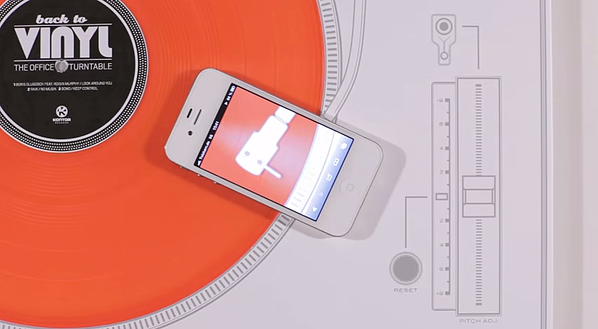
Kontor Records wanted to get the attention of creative advertising professionals. Instead of mailing out the latest CD, it sent a vinyl record via email to its mailing list with a paper turntable that could be played with an iPhone.
6. Peugot
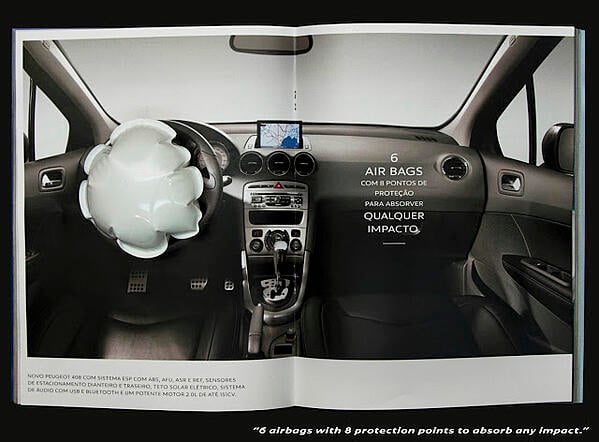
This print ad for the car brand features a one-page interactive print ad with a front view of the car that asked people to hit the ad. The spread following it included a mini air bag that inflated when hit.
7. Lexus
In 2013, Lexus released an ad that, when placed over an iPad, revealed the car in action with different backgrounds and music.
8. Lladro Lighting
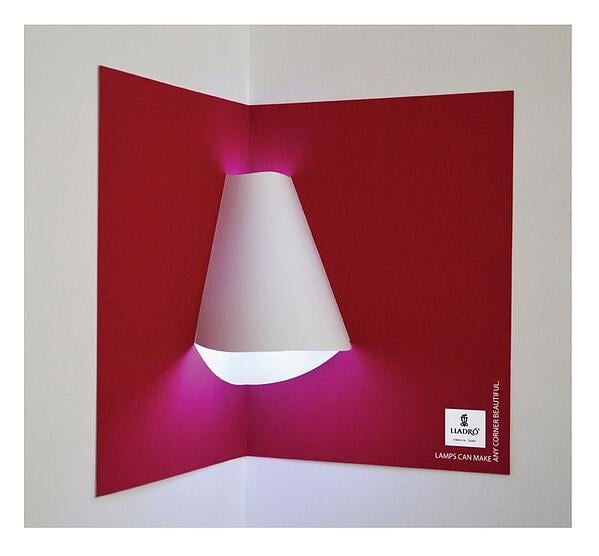
Why advertise lamps when you can give people an ad that transforms into a lamp? Lladro print ads act like a pop-up book, allowing people to create their own lamp shape by mounting the paper in a corner.

9. Reporters Without Borders
While freedom of the press is guaranteed in countries like Norway, Sweden, and the United States, not all countries make the same promise to its reporters.
That’s why Reporters Without Borders, a non-profit organization, created an interactive print ad to discuss the importance of the freedom of the press.
The campaign featured large portraits of three controversial world leaders against the freedom of the press. To interact with it, readers could scan the QR codes placed at the bottom of the ad. Once activated, journalists began talking about the dangers of being a reporter.
10. Volkswagon
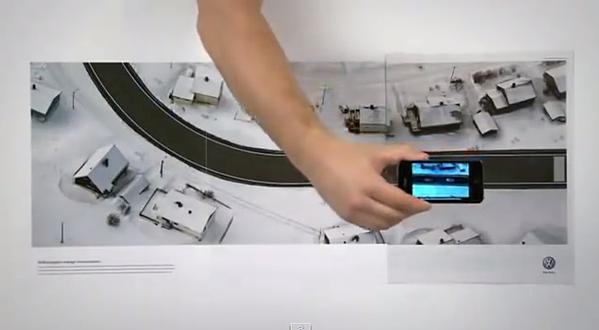
Volkswagon published a three-page spread so readers could take a test drive. You could download an app and can try out different features, including the “Lane Assist” mode that would cause the phone to vibrate when it got too close to one side of the road.
11. Sonera
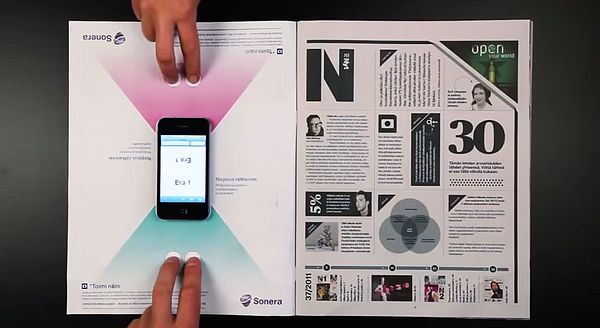
The telecommunications company highlighted its 4G wireless speed with a print ad that served as the game board for an iPhone game.
12. C&A
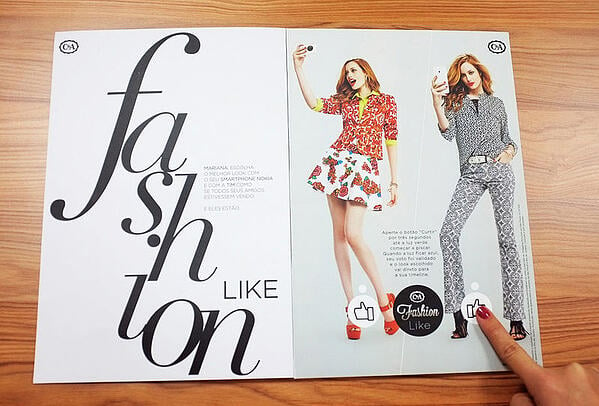
Fashion retailer C&A published a print ad in customized magazine editions that were linked to a person’s Facebook account. Readers could Like their favorite looks on Facebook by pressing the button in the ad. The data was then sent to a leaderboard in the store.
13. Nivea
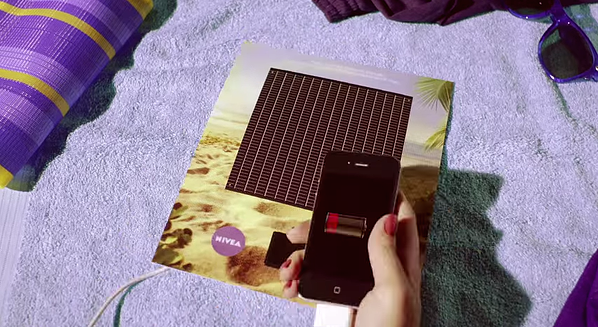
To promote its sunscreen products, Nivea created a print ad with a solar panel that could charge a cell phone.
14. Shikun & Binui Solaria
An Israeli energy company launched this print ad to promote green energy. The print ad just seems like a simple black-and-white drawing. However, when you hold it up to sunlight, vibrant colors appear.
15. CW Network
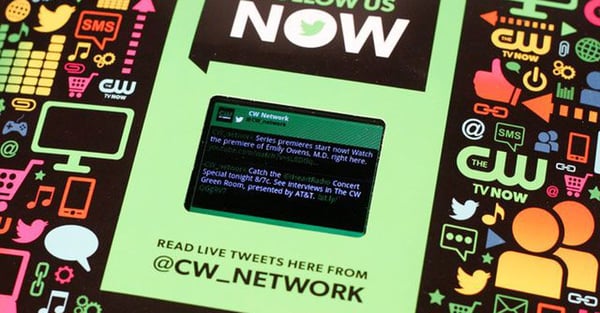
The CW published this print ad in Entertainment Weekly in 2012. The ad featured a LCD screen that is updated with videos from the network and a stream of live tweets.
16. Lipton
When tourists and locals are walking around in the heat of the summer, they probably want to cool down. Lipton took advantage of that in its interactive print ad at a bus stop.
Lipton’s ad, known as the “Cool Down Stop,” had a button that passersby could press. Once pressed, users were lightly misted with cold water — a nice break from the heat.
This print ad cleverly associated a refreshing mist with Lipton drinks.
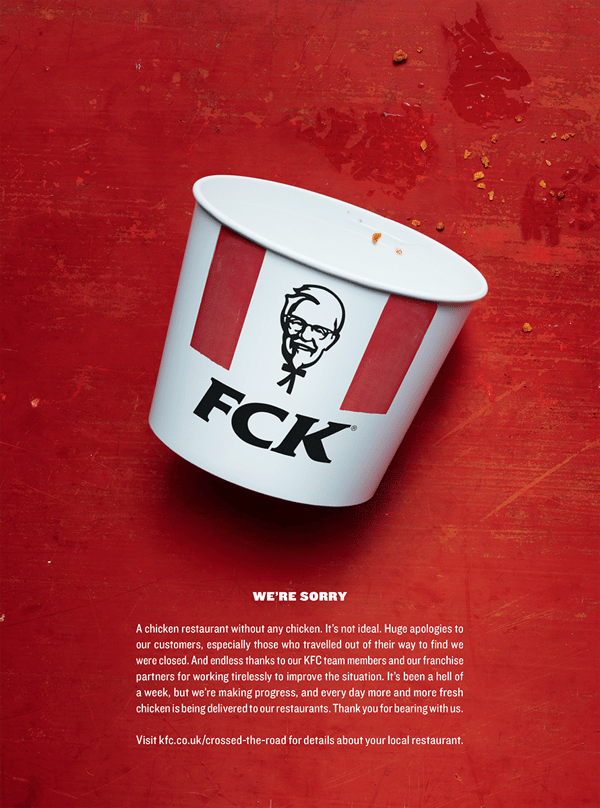
17. KFC
When Kentucky Fried Chicken ran out chicken to serve at its restaurants — a PR nightmare — the company had to apologize to the public.
Instead of posting an apology on social media, its media and marketing agencies decided to focus on a print ad that worked in conjunction with a website page online where readers could get more information.
The print ad was a genius move, using humor and humility to relate to its customers with its apology.
Digital content has been the strategy of choice for marketers for more than a decade now, but that doesn’t mean print ads are extinct. It just means brands must be much more creative with the stories they tell on paper.
Ready to revamp your approach to advertising? Try HubSpot’s ad product for free below.
Editor’s note: This post was originally published in March 2015 and has been updated for comprehensiveness.

How to Make a Construction Schedule
Super Bowl Ads Were Short This Year: Here’s Why That Worked
Each year, it seems like most of the Super Bowl is consumed by ads.
But this year, when the Super Bowl ended before 10:30 PM EST, some big-game party-goers wondered, “Were there fewer ads this year?”
In reality, the game ended at a decent hour because the Kansas City Chiefs smoothly took down the San Francisco 49ers without entering overtime. Additionally, with over 50 commercials, this year’s Super Bowl aired more ads than the 2019 game — which only hosted 42 ads.
However, in recent years, ads of 30-seconds or less have become the norm. So, although there were more ads this year, many of them were on the extremely-short side.
This isn’t shocking. Each year, Super Bowl ad slots get more and more expensive. This year, advertisers paid $5.6 million for 30-second slots. This increased from roughly $5.1 million in 2019.
Although keeping an ad under half a minute obviously saved companies millions of dollars, this time limit posed unique challenges for brands that purchased shorter slots.
To be considered successful, these short ads would need to grab attention from audiences in 30 seconds or less. These brands also had to create content that would memorably stand out in a chaotic stream of other insanely high-priced ads.
If you’re a video marketer, you’ve probably had to deal with similar time-crunches when creating content on a smaller scale.
For example, when it comes to in-stream or digital video advertising, the shorter your video is, the cheaper it will be.
Even if you’re highly skilled in creating videos that are 30-seconds or less, you might also worry about the research-backed fact that the average viewer only pays attention to online content for eight to 12 seconds.
This year, while many brands that bought Super Bowl ad slots of 30 seconds or less relied on quick celebrity cameos, extreme stunts, nonsensical humor, and insanely expensive special effects to grab attention, some companies actually delivered bite-sized commercials that boosted brand awareness with clever, informative, or incredibly memorable storylines.
So, how did they do it?
To help inspire you as you build a short-form video advertising strategy, here’s a list of some of the best 2020 Super Bowl ads that were 30-seconds or less.
7 Effective Super Bowl Ads That Were 30 Seconds or Less
1. Hulu: “Tom Brady’s Big Announcement”
In a classic example of newsjacking, Hulu enlisted the help of the New England Patriots Quarterback Tom Brady, to highlight some of the platform’s newest features. Aside from presenting the benefits of a Hulu subscription, the commercial also aims to intrigue viewers who wonder, “Will Tom Brady return to the Patriots next season?”
Since Tom Brady and the Patriots lost the playoffs, rumors have swirled about whether or not the long-time quarterback would return to the team now that his contract is up. Some have also suggested that Brady, one of the oldest NFL quarterbacks ever, would soon retire.
Although Brady doesn’t give any specific announcements about his future in the Hulu ad, he gives a speech that makes viewers suspect that he will be returning to the NFL in some way next season.
The commercial begins with Brady somberly walking on to a dark football field to the sad musical overlay of the piano.
“They say all good things must come to end, so to my teammates, my family, and my friends — you deserve to hear this from me,” a narration says as you begin to think Brady will announce something important having to do with his career.
Suddenly, the music shifts to a peppy hip-hop style as Brady shockingly says, “Hulu doesn’t just have sports.”
“According to the script they just gave me, Hulu has your favorite cable channels, plus the greatest shows, movies, and originals of all time. So it’s time to say goodbye to TV as you know it,” he adds.
Just when you think that this is just a Hulu commercial, Brady looks at the camera and says, “But me? I’m not going anywhere.”
This is a great example of how Hulu leverages a news topic that rumors had been swirling around. Although Hulu didn’t have Brady make a specific announcement, the brand reinvigorates the questions and excitement around the news topic while still highlighting its product’s best features.
2. Mountain Dew: “As Good As The Original?”
While Hulu’s ad leverages news topics, Mountain Dew’s Super Bowl ad plays up nostalgia with a 30-second comedic spoof of the 1980 horror film, The Shining.
In the spoof, Breaking Bad‘s Bryan Cranston plays the crazed character Jack, a role famously held by Jack Nicholson. Meanwhile, Tracee Ellis Ross of Black-ish plays Jack’s terrified wife.
In the scene which is spoofed, Jack walks down a hallway into a bedroom looking for his wife while armed with an ax. He then creepily approaches an ensuite bathroom that his wife’s hiding in, pleasantly knocks on the door, then smashes a hole in the wood. He iconically sticks his face through the hole, stares at his wife with crazy eyes, and says, “Here’s Johnny!”
In the spoof, Bryan Cranston walks towards the bathroom door and says, “Come out, come out wherever you are, I’ve got Mountain Dew Zero Sugar, with the same refreshing taste as the original.”
As Cranston smashes the door, you see an overdramatic Tracee Ellis Ross screaming in the bathroom as Cranston looks at her and says, “Here’s Mountain Dew Zero!”
Ellis Ross suddenly stops screaming, grabs the drink, and says, “Well, I am thirsty.”
The commercial ends with text saying, “As good as the original. Maybe even better?”
This commercial is a great use of how brands can leverage metaphors and nostalgia to tell the story of their products. Both the spoof and Mountain Dew Zero aim to be “As good as the original.” This type of ad shows a skeptic viewer that a new product or brand extension is as good or better than a product they’ve come to know and love, similarly to how they appreciate a classic horror film.
3. Olay: “#MakeSpaceForWomen”
Olay used it’s 30-second time slot to tell a space-themed story aimed at empowering women and poking fun at today’s outdated gender stereotypes.
The commercial, which depicts three women known for their achievements, views on equality, and activism suiting up to go to space. On the spaceship for, “Mission Make Space for Women,” sits comedian and A Little Late with Lilly Singh host Lily Singh, best-selling author and former Busy Tonight host Busy Philipps, and retired astronaut Nicole Stott.
Meanwhile, Taraji P. Henson, star of the NASA biopic Hidden Figures, monitors the flight from Mission Control.
Although the commercial is peppy and empowering, it begins by acknowledging how the news still discusses female success in an outdated way. The ad opens with award-winning journalist Katie Couric reading, “Is there enough space for women in space?” off of a prompter. She then turns to the camera crew and says, “Who wrote that? Are people still asking that question?”
As MIssion Make Space for Women lifts off, Henson says, “When we make space for women, we make space for everyone.”
From the spaceship, Singh and Philipps announce that for each tweet with the hashtag #MakeSpaceForWomen, Olay will donate $1 to Girls Who Code, a non-profit that aims to empower women in STEM.
When a company, like Olay, targets an audience of a certain gender or demographic, creating ad content and philanthropic campaigns that empower the demographic adds credibility behind the company’s mission. While some viewers might have just known Olay as a women’s skincare line, they might watch this ad and recognize that the company cares about and wants to empower its female customers.
If your brand’s target audience includes subgroups or genders that could be under or misrepresented, take a note from Olay, and identify inclusive marketing strategies that acknowledge your audience’s strengths and unique qualities. Not only will this give viewers the idea that you care about your customers, but it will also help people in different groups relate more emotionally to your content.
4. Cheetos: “MC Hammer: Where it All Began”
Like Mountain Dew, Cheetos also plays up nostalgia in its short and sweet Super Bowl ad. But, instead of mimicking something that already happened, Cheetos interjected its product into an unseen moment in pop culture history.
How did Cheetos do this? In the ad, MC Hammer gets the idea for the “U Can’t Touch This” melody while eating a handful of Cheetos. He starts humming it, reaches out to play it on piano, sees the cheesy Cheeto crumbs all over his fingers, and simply says, “Wait. I can’t touch this.”
Suddenly, he gasps and his eyes open wide with inspiration as he’s stumbled upon the chorus to his now-iconic song, “U Can’t Touch This.”
Yes. Recreating MC Hammer’s life will be impossible without the budget to hire the artist himself. But, aside from the great celebrity cameo more brilliantly tells a short fictional story.
Storytelling is a great tactic that allows your viewer to get intrigued and engaged by memorable content. While you probably can’t afford to tell a story with a celebrity star in it, take a note from Cheetos and use your content to tell an interesting story that centers around your product. To learn more about storytelling, check out this helpful guide.
5. WeatherTech: “Lucky Dog”
As surprising as this sound, an advertisement doesn’t always need to discuss exactly what your product does. In fact, you can use your prized slot to tell a story about something your company, brand, or leadership is passionate about. While this type of ad won’t highlight your product directly, it shows audiences another side of your company and makes your brand look like it’s run by actual humans, rather than emotionless executives fueled by power or money.
One great example of this strategy was the below ad from WeatherTech.
After the CEO of WeatherTech’s dog was diagnosed and treated for a near-lethal form of cancer, WeatherTech used its Super Bowl slot to highlight the University of Wisconsin Veterinary Hospital, the organization that saved the dog.
The commercial, which is narrated from the perspective of the dog is incredibly heartwarming and makes both the organization and WeatherTech look like companies that care about their clients.
“Hi. I’m Scout, and I’m a lucky dog. It’s not because I have this big stick or because I was on the WeatherTech Super Bowl commercial last year. It’s because I beat cancer,” says the dog at the opening of the commercial. “I’m alive thanks to cutting edge technology at the University of Wisconsin’s Veterinary School of Medicine.
As the ad ends, it shows a video clip of Scout frolicking on the beach as another narrator concludes with, “Pets make a difference in our lives. You can make a difference in theirs. Donate now at WeatherTech.com/donate.”
6. Pop-Tarts Fixes the Pretzel Commercial
While most of the ads on this list tell a narrative story, Pop-Tarts’ aired an ad that humorously overemphasizes aspects of traditional TV commercials. This goofy ad spoof was positions their new Pretzel Pop-Tart as an innovation to traditional pretzels.
To add over-embellishments, Pop-Tarts enlisted Queer Eye’s outgoing stylist Johnathan Van Ness to host the commercial.
Like traditional infomercials, the ad highlights a pain point and shows how the new Pretzel Pop-Tart serves as a solution — but in an incredibly eccentric way.
The commercial opens in black and white as a woman struggles to eat ginormous pretzels. Van Ness begins a narration that asks, “Are you tired of your pretzels not being Pop-Tarts Toaster Pastries? Are you strugs [struggling] to snack?”
The commercial shifts from black and white to color as Van Ness appears on screen to help the woman who’s struggling to eat pretzels. He says, “Pop-Tarts fixed that for you,” in reference to her pretzel dilemma. Then, he starts highlighting the new Pop-Tarts Pretzel flavor.
Although every Super Bowl is filled with innovative ads that aim to be memorable with a deep storyline, Pop-Tarts chose to be unique by revitalizing a traditional ad style.
With this goofy Pop-Tarts commercial, the brand demonstrates that it can’t hurt to still leverage the traditional “problem/solution” ad format — as long as the content is still interesting, humorous, or eye-catching to viewers.
7. Planters: “Baby Nut”
When it came to Planters, the nut brand decided to attract attention with a bizarre two-part series of 30-second ads that culminated during the Super Bowl.
In the first ad, which circulated days before the sporting event, Planters’ 104-year-old top-hatted mascot — Mr. Peanut — finds himself hanging off a cliff branch with two men. The men fight over who will let go to save Mr. Peanut. But, Mr. Peanut shockingly and heroically jumps off the branch to save them. He falls to his death and explodes on impact.
Odd right? The ad series only got weirder. In the Super Bowl commercial, friends of Mr. Peanut cry as he’s buried during a funeral. As the Kool-Aid Man sheds tears over the grave, the dirt pile turns into plants as a reincarnated “Baby Nut” emerges in a tophat. With the same grown man’s voice as Mr. Peanut, Baby Nut says, “I’m back,” before asking for his monocle.
This is pretty bizarre, but the commercial isn’t that far off from rebranding trends we’ve seen recently in the media. For example, bloggers have called Baby Nut a “Baby Yoda rip off,” referencing how The Mandalorian revamped the Star Wars franchise when one character discovered “The Child” — a baby member of Yoda’s species.
While the Baby Nut announcement did gain some online scrutiny, the commercial is still effective because its bizarreness makes it memorable. Even though some criticized the ad, many viewers enjoyed the weirdness. In fact, some publications report that it “divided” social media.
Ultimately, when we look back on past Super Bowl ads, we won’t just remember the ads that followed a standard format or fit into a narrative norm. We’ll also remember the weirder ads and the brands that created them.
How to Capture Viewers in 30-Seconds or Less
Drawing attention from audiences in just seconds might seem like a daunting task, but the brands above have proven that it certainly is possible.
And, although you can’t put all your ad dollars into special effects and celebrity cameos, there are scalable strategies that you can learn from. Here are just a few:
- Make a statement: WeatherTech and Olay used their ad slots to discuss causes that their brands were passionate about. This makes your brand look more relatable and like it cares about its customers.
- Don’t be afraid of traditional formats: As Pop-Tarts showed us, there’s no harm in creating a traditional ad format that shows a problem and how your product can solve it.
- Embrace emotions: Whether it’s laughter, empowerment, or even confusion, ensure that your content leaves viewers with some sort of feelings. This will help them connect more emotionally to your content, product, and brand.
Want to learn more about how you can affordably leverage some of the most common Super Bowl ad strategies, check out this blog post.

500 Atlassians Worked Remotely for a Week — Here’s What We Learned
Like most companies, Atlassian has a mixture of people who are working from home full-time (like me) and those who grab an ad-hoc day when the plumber is coming or they can’t stop sneezing. But our collective WFH muscles got a major workout recently when 500 of us went remote during the week-long gap between moving out of one office space and into another.
I talked to colleagues in several departments at Atlassian and dug into my own bag of tricks to bring you this collection of tips for working from home. And because working from home came with a few surprises, I’ll also share some little-known facts and a classic blooper – don’t miss these if you’re thinking of transitioning to full-time remote work.
Working From Home Tips
1. Dedicate a work space and make it your own.
Yes, this tip is at the top of every other list of working from home tips you’ve ever read. There’s a reason for that. When you work from an office, your commute helps your brain shift into “work mode”. At home, you can create that same mental shift by dedicating a spot for working.
“I have a separate desk at home that is pretty much only used for work,” says Miles, a marketing manager. “This helps me focus because I think of that area as a mini office.” If you’re short on space and have to use your couch or kitchen table, no worries. Just be consistent.

Trick out your home office space on the cheap, with the help of flea markets and a bit of DIY ingenuity.
Don’t just stop once you’ve acquired a desk, though. Give your space some personality with wall art, framed photos, a desk lamp to die for, or an essential oil diffuser if that’s your jam.
2. Pace yourself.
Y’know how running to the office kitchen to refill your coffee “real quick-like” typically results in a 10-minute hallway convo about your big new project? I didn’t understand the value of interludes like that until I went remote. At first, I would blast through my tasks for the week in about three days because there were so few interruptions. Sounds great, except I’d be completely out of gas by Thursday. And Fridays were, umm, less than productive.
Your work week is a marathon – not a sprint. I quickly learned to sprinkle a few 5-10 minute pace breaks throughout the day, away from my desk if possible. For my teammate Claire, her furry friend makes all the difference. “I take my dog for a walk before I start work, at lunch, early afternoon, and after I’m done for the day. It’s a great mental break.” Not to mention healthy.
Do ten push-ups or hold yourself in plank pose. Pick up your guitar. Make your grocery list. Your stamina (and your team) will thank you.
3. Be brutally self-aware.
While some people (me included) absolutely love working from home, others love the idea of working from home… only to find the reality doesn’t suit them. And that’s ok. “It’s tough to get started, and it’s tough to set things aside when I’m done for the day,” says Jim, a developer on the Bitbucket team. “I also feel isolated from the rest of the team.” That’s a common sentiment, so don’t be afraid to own it.
If transferring back into an office isn’t an option, self-awareness will help you find your WFH groove. Develop some strategies for staying connected to your team and understand what will help you focus vs. what will distract you. Have an open, on-going dialog with your team and check in with yourself regularly. Conversely, if you love working from home, take the time to reflect on why and make the most of those aspects.
4. Stock your kitchen with food you can be proud of.
For those of us who’ve been spoiled by posh perks like company-provided meals, providing your own coffee and breakfast and lunch and snacks is quite an adjustment. A few days into his week of remote work, customer support analyst Orpheus (who is every bit as cool as his name suggests) lamented his lack of grab n’ go gnoshables: “Folks who work from home need a snack food budget.”
Regardless of who pays, the logistics are on you. If your lunch game involves anything more complicated than warming up last night’s leftovers, you’ll need to build prep and clean-up time into your workday routine. For maximum efficiency, pick up a full week’s worth of supplies each Monday morning (unless a daily walk to the store is your pace break of choice). Choose brain-boosting superfoods like almonds, broccoli, berries, beans, eggs, and salmon. Remember, working from home tends to be more sedentary than office-based work, so skip the Oreos.
5. Dress as if you were going to the office (almost).
Full-blown business attire probably isn’t necessary, but do make yourself presentable. You’re going to end up on a lot of video calls, for one thing (more on that later). More importantly, getting dressed is another important part of the mental shift into work mode. But don’t stop there. Establish a morning routine that is as close as possible to your routine when you’re going into an office. Here’s mine:
- 6:00 – Wake up, brush teeth, exercise.
- 7:00 – Get kids up, brew coffee, shower, get dressed (including hair and make-up), unload the dishwasher, help my daughter do her hair, curse at the stray Legos I inevitably step on.
- 8:00 – Take my son to preschool.
- 8:30 – Start work.
Rituals allow us to make transitions with minimal mental and emotional turbulence. Yours might be totally mundane like mine, or you might mix it up by working for an hour before you shower and dress. The important thing is to find a routine that works for you and step through it consistently. “The routine of physically getting ready for work is one of the most important things I did to make my week of working from home productive”, says Cameron, who leads an engineering group of more 250 people.
6. Get over your hang-ups around video conferencing.
Many of us have scars from struggling with video calls in years past – the struggle was real. That may explain why people new to working from home, and their teammates in the office, are often skittish about vid chat. The good news is that now you can jump into a video call in a matter of seconds using Skype, Google Hangouts, Zoom, BlueJeans, or similar services.
“Being comfortable with quick video chats saves a lot of time compared to trading emails or instant messages,” says dev tools marketer Alyss. That face-to-face interaction also does wonders in terms of building relationships with co-workers. However, be prepared to coach your co-workers a little as they learn to embrace the impromptu video call. Their instinct will be to go find an empty conference room, which just wastes time.
If you walked over to their desk in person, you’d have the conversation right there and been done in under a minute. Nobody would think twice about distracting people at neighboring desks because ambient noise is just part of being in an office. Video calls should be treated the same way. Once my teammates got accustomed to that idea, it made working as a distributed team a lot easier.
And while we all want to present an aura of perfect professionalism, I encourage you not to stress about it overly much. There will be a time when the doorbell rings or your cat walks across your laptop, right in front of your camera. My kids sometimes pop into view on evening calls with people across the Pacific and I allow it because they seem to enjoy the extra glimpse into my world. (Your mileage may vary, of course, but we can all thank “the BBC guy” for breaking some serious ground on our behalf.)
And now, a few surprising things about working from home full-time …
Although I felt I’d done my homework before going remote, there was still a lot to learn. If you’re considering going fully remote, take these tidbits into account.
There’s a good chance your boss would rather keep you on as a remote worker than replace you.
Recruiting, interviewing, and on-boarding new employees is a lot of overhead. Many managers feel having an established teammate go remote is far less disruptive on the whole – especially if you’re crushing it lately.
Supporting remote employees is not trivial from an HR and tax perspective.
In the U.S., a company must have a tax entity set up in every state in which they have a full-time employee. For this reason, many companies restrict full-time remote work to states where they already have offices. Benefits administration gets complicated because many insurance carriers operate regionally instead of nationally. And it’s just good business sense to adjust remote employees’ salaries to be in line with where they’re living.
Figuring all this out takes time away from work HR could be doing that might benefit more people. So if you meet resistance from your employer about going remote, don’t assume they’re trying to be evil. They’re just trying to be practical.
There are hidden costs to remote work.
You’ll need the fastest, strongest internet connection money can buy. You’ll be paying for (and taking the time to procure) all your coffee, snacks, and meals. Your utility bill will go up because you’re no longer tuning the heat and/or air conditioning down during the day and you’re keeping more lights on. For most people, however, these new costs will be offset by the fact that you’re not gassing up the car or paying bus fare as often.
Sharing a workspace with a roommate or partner feels less isolated, but has its own challenges.
My husband works remotely too, and when we moved, we made sure to buy a home with an office we can share. It was a great way to start the transition to remote work. Soon, however, he was working almost exclusively from his recliner.
We could never agree on what temperature the room should be, and we both tend to be vocal participants in meetings. So now we work in separate rooms and send chat messages to each other even though we’re 50 feet apart. Which is kind of pathetic, but there it is.
Extroverts actually do quite well as remote workers.
The key to staying in the loop and feeling connected when you’re the one remote member of your team is initiating communication. ABC, baby – always be communicating. We extroverts tend to do this instinctively anyway. Interpersonal interaction is our default setting. So we get a “two birds, one stone” synergy bonus.
Getting everyone to take the meeting via video is kind of awesome.
When only one person joins remotely, it’s easy to (unintentionally) leave them out of the discussion and harder for them to contribute. But when everyone dials in, even if it’s from their desk at the office, we’re all in the same boat and on our best behavior. We raise our hands to speak. We wait until the other person is done talking before chiming in. We’re less likely to let one person dominate the conversation.

All-remote meetings + Halloween = good times.
Besides: you know who enjoys being the one giant head on the TV during meetings? Nobody.
This working from home thing isn’t for everybody.
Although I’d love to tell you the WFH week was universally loved, it wasn’t. Max from marketing said it was “only the best week ever”, while Mary, a product owner, missed the higher level of social interaction and felt like the week was something she “just had to get through”. For others, it was a big empathy-builder. “Be mindful of our remote colleagues and how easy it is for them to feel (or be) left out,” says Adam from technical account management.
Your experience working from home will involve plenty of twists, turns, fails, and wins. Be patient as you and your team adjust, expect the unexpected, and just roll with it. At least you can rest easy knowing you won’t be the first remote worker whose toddler makes an unplanned cameo on international television.
This article was originally published on Atlassian.com and republished with permission.

5 Reasons Your Facebook Ads Manager Account Could Get Shut Down
Want to make sure your Facebook ads account isn’t shut down? Are you sure you’re not violating Facebook’s ad policies? In this article, you’ll discover common reasons why Facebook ads accounts are suspended and learn how Facebook’s tools can help you better monitor your account’s status. #1: Repeated Declined Payments If you consistently have payment […]
The post 5 Reasons Your Facebook Ads Manager Account Could Get Shut Down appeared first on Social Media Marketing | Social Media Examiner.
from Social Media Marketing | Social Media Examiner https://ift.tt/2HmSbkh
via socialmediaexaminer
Event Invitation Emails: How to Create One that Rocks
Running a successful event can be stressful, especially when you have so much to coordinate, including the agenda, the venue, and the speakers
Email event invitations, however, shouldn’t be stressful.
If you’re struggling when deciding what to include in your email event invitation, consider what you’d like to see in an invite — probably information about the agenda, venue, and speakers, right?
Answering the questions your audience will have about your event is a great place to start when writing an email invitation. The rest comes easily, as long as you consider good look at design, inclusive language, and personalization depending on your recipients.
Event invitation emails are helpful because they inspire interest for the event, makes emails personalized, streamlines the process of messaging.
If you’re looking for ideas about how to write an amazing event invitation, keep reading.
How to Write an Email Invitation For an Event
Remember, not all event invitations need to be snazzy, high-budget, high-time investment productions. In fact, effective email invitations can be made in about 20 minutes.
Use this section as a base-level cheat sheet for ideas to implement in your next email campaign.
Before you hit “Schedule,” or “Send,” think about if you can answer the “So what?” question audiences will ask after seeing your invitation in their inbox.
To create a stellar email invite, you have to make sure it’s personalized to the reader, instills curiosity, and effectively communicates what the event will entail.
1. Answer the 5 “W’s”.
First thing’s first, tell your audience what’s happening. In school, some of us learned about the 5 W’s — who, what, when, where, and why.
This is a good rule of thumb when writing an email invite. If you can point to your email and identify all five, you’re off to a great start.
Take this email, for example:
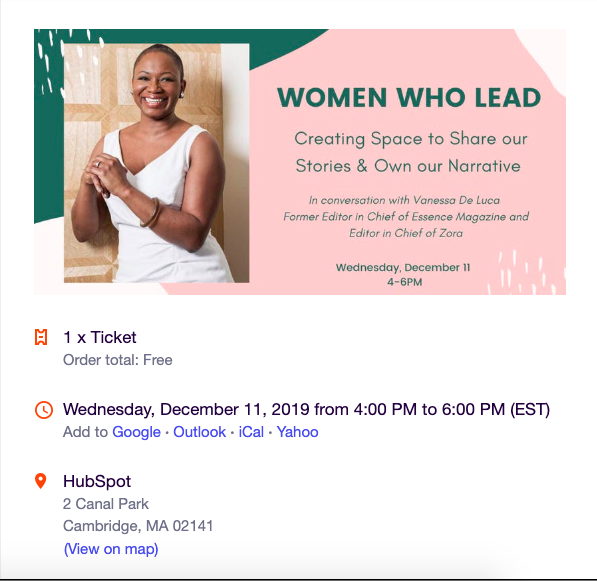
This is a wonderful event email because it answers the five questions:
Who: Vanessa De Luca
What: A seminar called “Women Who Lead”
When: December 11th, 4-6 PM
Where: HubSpot
Why: To have a conversation that emphasizes creating space for women to share and own their narratives.
By reading this email, I wouldn’t have any follow-up questions about event logistics. I know exactly when and where I need to be, and what the event will be about. Notice how this email isn’t the flashiest or most animated, but it gets the job done and still has personality.
2. Remember that less is more.
You need to cover all your bases in email invites, but remember not to crowd your email with details. If you find yourself struggling to fit the time of the event in your email, you probably have too much other information.
You don’t want to make it confusing to read, which might turns readers away from your event. I wouldn’t want to attend an event that comes with a poorly organized email — since I’d assume the event could be poorly organized, as well.
To consider the “less is more” sentiment, take a look at this email from Starbucks about their Happy Hour, which are special times where Starbucks Rewards members can enjoy specialty drinks at lower prices:
This email still answers all base questions without needing paragraphs to explain. So if your event is a recurring one or something low-key, forego the extra words and set up the email as more of a reminder to RSVP.
3. Don’t forget a CTA.
I’m not sure what we were doing before adding calls-to-action (CTAs) to event invitation emails, but it’s a good thing we’re not in that world anymore. Take this sample email I made using HubSpot’s email software:
As a consumer who forgets nearly everything that’s not on her calendar, I need a CTA that automatically adds an event to my calendar. Additionally, it makes it easy to RSVP, since all it takes is a click of a button
As a marketer who cares about click-to-open-rates and tracking those who clicked on the CTA, it means being able to measure those results in a content management system to think about ways to improve for the next event email.
Including a CTA is a win for both sides — as a marketer, it gives you metrics to track click-through rates, and consumers will appreciate the delightful user experience.
4. Make the design enjoyable.
Before you finalize your email, think about whether you’d attend the event based solely on the design. If the answer is no, you probably need to put more effort into the aesthetic of your email.
You might be pulling a blank on how to design a beautiful email, and that’s okay. Keep these guidelines in mind:
- Stick with your branding — Start by choosing the colors that match your brand and incorporate them into your email. Colors go a longer way than traditional black and white text.
- Choose a template — As someone who knows little about coding and equally as little about design, templates have become a lifesaver. Websites like Canva or Mailchimp have an array of templates you can use to create your email, like this template from Canva:

- Play with simple elements — Simple things, like shapes and sizes, really help an email’s design. Refer to the image above and how it uses circles and cylinders to fill negative space in an interesting way.
Thinking of elements like these can brighten up an email, as well as experimenting with sizes of text. If you’ve found you want to take up more space in your email, make the font sizes bigger and incorporate shapes or designs like stripes running across the header.
5. Consider your language.
Always, always check the language of your email. Think about the vibe your message sends, and if it’s the right one you want to convey. You’re communicating your event details, but you’re also conveying your brand.
Double-check elements like your CTA: Is it more inviting than the standard, “Learn more!” that has become routine in emails? What about your text? Does it drop playful language where applicable?
For instance, this INBOUND email is a great example of laid-back language. The language is more conversational than formal.
When you use conversational language, the reader feels more connected to your invite, like you already know them.
6. Think about the details.
When you’re done designing your email, think about little details that will delight your invitees. Have you created a thank you or follow up email? Have you made the subject line something that will captivate subscribers?
Little details like subject lines can be more emotionally engaging to your audience. Ultimately, audiences will be delighted if you show in your invite that you had them in mind. Some people open emails based on the subject line, so it can also make or break your email performance.
If your event location is difficult to find, consider including directions in the bottom of the invite. An event that includes some kind of map or directions in the invite tells me that the sender took people’s commutes into consideration, like this one:
You can include directions by adding a Google Maps screenshot into your email, or using email marketing software to embed a Maps feature into your template.
Your event is set to go off without a hitch, and your email event invitation should, too. If you use online software to create an email, you can pull off a professional, flawless design in less time than you think.
By focusing on the important information, honing in on simple yet effective design elements, and making the language pop, your email invite will set itself apart from others in a way that’s inviting and delightful for readers.
Don’t forget to scroll through your own inbox for inspiration, too!

Facebook Messenger Changes Bot Policies: What It Means for Marketers
Welcome to this week’s edition of the Social Media Marketing Talk Show, a news show for marketers who want to stay on the leading edge of social media. On this week’s Social Media Marketing Talk Show, we explore changes to business tools for Facebook Messenger with Kelly Noble Mirabella and YouTube’s Q4 2019 earnings reports […]
The post Facebook Messenger Changes Bot Policies: What It Means for Marketers appeared first on Social Media Marketing | Social Media Examiner.
from Social Media Marketing | Social Media Examiner https://ift.tt/2S9Ndxi
via socialmediaexaminer
15 Ads That Prove Nostalgia Is a Powerful Marketing Tactic
Nostalgia marketing is the advertising equivalent of comfort food.
In a time when most marketing focuses heavily on the future, it transports us back to a simpler place where our current problems don’t matter and the hustle and bustle of modernity just melts away. Instead of anticipating the next great thing, nostalgia marketing urges us to focus on the things we already know are great.
We know at a gut level that nostalgia gives our lives a feeling of meaning and continuity, but you may be surprised to learn it can also make us looser with our wallets. A study published in the Journal of Consumer Research found that nostalgic feelings made participants more willing to spend money on consumer goods and services.
It would appear that advertisers have caught on. Over the past five years, nostalgic ads have been popping up left and right — with millennials as their main target.
Although these ads are getting more common, marketers have known that millennials would be a nostalgia-fueled generation for some time now.
Even in 2015, when many millennials were still young adults, nostalgia was a hot topic in publications like Digiday.
“Millennials are coming of age in an age of economic turmoil — a difficult job market,” Cassandra McIntosh, a senior insights analyst at Exponential, told Digiday. “Therefore, they end up romanticizing simpler times much more — even those times they weren’t around for.”
To give you inspiration for your own nostalgic campaigns, we selected 15 examples of advertisements that use nostalgia marketing. Watch them and see if you get the telltale bittersweet pangs associated with nostalgic feelings.
Examples of Nostalgic Ads
1. Motorola Razr
In the early 2000s, prior to smartphones, one of Motorola’s most popular cellphones was a tiny, flat flip phone called the Razr. Despite its number-based keyboard and a small screen, people loved it for it’s design and simplicity.
In 2019, Motorola gained buzz when it re-introduced a new and improved Razr which featured a folding touchscreen when opened.
In the commercial announcement, you see an old-school Razr lifting off of a table and flying through the air as its old layers peel off to reveal a new design. The phone then opens to reveal the Android-like touch screen.
2. Nintendo
Many children of the ’80s and ’90s remember playing Nintendo-based video games with their siblings. But, for the children growing up with siblings, many also remember the sad feelings related to growing apart or drifting away from a relative. This commercial highlights both of those memories by telling the story of two Nintendo-loving brothers who grow apart, argue as teenagers, and then happily reunite as adults to play the new Nintendo Switch together.
This commercial not only reminds people of what it was like to grow up with siblings, but it also reminds you of the great fun you had playing video games as a child. Then, because the brothers connect and chat virtually as the play Switch games at the end, it shows how Nintendo’s technology has evolved to connect old friends and relatives all around the world.
3. Australia Tourism Board
Instead of promoting a traditional ad that simply showed off Australia’s most beautiful destinations, Australia decided to disguise a tourism ad as a star-studded trailer for a fictional reboot to the ’80s film, Crocodile Dundee.
As those who watched the original Dundee series get excited by clips from the film, starring Chris Hemsworth and Jason Sudeikis, its revealed that Hemsworth tricked Sudeikis into a tourism ad. Despite the trickery, Hemsworth and Sudeikis still both agree that their trip to Australia was still the best vacation they’d ever taken.
This was a clever way to embrace the television and movie reboot trend of 2018 and 2019, while still highlighting the best Australia has to offer for tourism. Because it features actors who are popular in the present day, it’s also hilarious for both people who followed the Dundee films or either of the main characters in the fake reboot.
4. Spotify
In 2016, music-streaming service Spotify unveiled a new spokesperson — er, spokes-dragon — in a 30-second ad produced by Wieden + Kennedy New York.
Falkor and his boy companion Atreyu (now a heavily bearded 44-year-old man) are both characters from the beloved 1984 fantasy film The NeverEnding Story. W+K even got the original actors to reprise their roles (Noah Hathaway as Atreyu and Alan Oppenheimer as the voice of Falkor).
The pair appear just as the film left them over 20 years ago: gliding through the clouds while the movie’s dramatic theme song plays in the background. “I can’t believe people still listen to this song!” Atreyu exclaims. His dragon agrees, they share a laugh, and the two speed off into a grainy, ’80s quality CG sky.
5. Freia
The tagline of Freia, a Norweigan chocolate company, is “Et lite stykke Norge” (A little piece of Norway). This spot for the company produced by SMFB Oslo fully encapsulates the sentiment in a simple, joyful way.
The plot follows a Norweigan expat in New York navigating a hectic life as a fashion stylist. When he returns home to his apartment one evening, he finds a half-eaten bar of Freia chocolate in his otherwise empty fridge. After just one bite, he’s inspired to hop on a plane back to Norway to visit his father and soak up the majestic landscape of his homeland. The ad ends with the stylist discovering a modest hair salon for sale in what is presumably his hometown.
The message is clear: A taste of Freia chocolate is inherently connected to Norway, no matter where in the world you may be.
6. Adobe
Bob Ross — the beloved ’80s painting guru who passed away in 1995 — experienced an unexpected resurgence in popularity in 2016. After Netflix added his classic TV show, The Joy of Painting, to its streaming lineup, Ross became a trending topic on Instagram. Adobe took notice, and decided to pay homage to the late painter in a series of tutorial videos promoting their new Adobe Photoshop Sketch for the iPad Pro.
Authenticity was central to this nostalgic campaign. Adobe and agency Lekker Media collaborated with Bob Ross Inc. to make sure every detail was accurate, right down to the brand of clothing Ross wore on his show. Children’s book illustrator Chad Cameron, who plays Ross in the series, channels the artist’s relaxed, unpretentious demeanor perfectly.
“Bob’s wish was to inspire as many people as possible to be creative and to share it with others,” Joan Kowalski, media director at Bob Ross Inc., told Adweek. “Adobe’s ‘Joy of Sketching’ series reminds us that a company as big as Adobe shares in that hope.”
7. Oikos
Although it originally aired from 1987-1995, Full House has become a nostalgic childhood symbol to multiple generations thanks to syndication. But before Netflix revived the show with a 2016 reboot, Dannon reunited a few of the show’s stars in an ad for Oikos, the company’s line of Greek yogurts.
John Stamos is joined by his former cast members Bob Saget and Dave Coulier in this Y&R Vinizius-produced spot. The trio doesn’t explicitly reprise their Full House roles, but the dynamic is undeniably reminiscent of their days on the sitcom.
8. Nike
In 1973, Billie Jean King won a tennis match against male player Bobby Riggs, which was coined “The Battle of the Sexes.” The historic tennis game was the first time a female tennis player was matched against a male.
In and before the late 1950s, men were seen as superior athletes and breadwinners in society. Prior to the tennis match with King, who was only 25, even Riggs said that he could beat a woman at his age of 55.
King’s tennis match win proved Riggs wrong. It also proved that men and women could compete equally on the tennis field and in other sports. On a bigger scale, it further empowered women, who were often stereotyped as wives, homemakers, or secretaries at the time. With King’s win, it became harder to ignore that gender stereotypes were false and that women could win and even lead amongst men.
During the match, King wore an iconic pair of blue Adidas tennis shoes. Years later, to celebrate the 45th anniversary of King’s win, Adidas launched a limited edition line of BJK shoes with the female tennis legend’s face and initials on each pair.
To announce the shoe line, Adidas launched a series of simple commercials showing Billie Jean King spray-painting piles of shoes blue. Here’s an example of one of the ads:
To further promote the line, Adidas also had booths at the U.S. Open tennis match where fans could bring any brand of shoes and have an artist paint them blue with Adidas’ special BJK logo.
According to Adidas, the overall campaign led to a 20% boost in tennis shoe sales. And, now that the campaign is over, people are auctioning off these limited edition shoes on eBay for upwards of $1,000.
9. Tesco
Nothing screams nostalgia like old home movies. In this extended holiday ad from British grocery chain Tesco, we watch a family grow and age over the years through the lens of their Christmas home videos. Set to a poignant theme, the ad is intended to stir up fond holiday memories for viewers.
“We wanted to show what a real Christmas is all about — not a perfect, airbrushed one — but the ones we recognize from our own lives,” David Wood, Tesco’s U.K. marketing director, told Adweek. The ad was produced by Wieden + Kennedy, London.
10. Microsoft
Although Microsoft’s Internet Explorer is no more, this 2013 spot for the web browser earned viral recognition and a Webby Award nomination.
“You might not remember us,” the ad’s narrator begins, “but we met in the ’90s.” The commercial goes on to highlight all things ’90s — fanny packs, Tamagotchi, bowl haircuts — even the Oregon Trail PC game makes an appearance.
Column Five Media, the creative agency behind the ad, set out to create a nostalgia-driven viral ad that would reintroduce Internet Explorer to ’90s kids. “The idea of a brand like Internet Explorer being forward-thinking enough to make such a story-focused, Gen Y-centered commercial was pretty newsworthy,” the agency wrote in a behind-the-scenes blog post. “Focusing that story on ’90s nostalgia, which we knew was popular with Gen Y and not yet fully realized in video form, is what made [the ad] shareworthy.”
11. Chili’s
Chili’s ads are usually characterized by close-up shots of glistening hamburgers, sizzling bacon, and french fries still glowing with fryer oil. So this 2016 ad produced by Boston-based agency Hill Holliday was a departure from the casual dining chain’s typical go-to formula.
The commercial depicts the Chili’s origin story through a series of retro vignettes. We see the laid-back founders playing ring toss, lounging on the hood of their car, and — of course — flipping classic Chili’s burgers in their first restaurant. The ad taps into traditional Americana — a form of nostalgia for small town American life, middle class values, and neighborhood restaurants where everyone knows your name.
12. Apple
Apple regularly features celebrities in their advertising, but they made a notably nostalgic casting decision for this iPhone 6s spot. Everyone’s favorite sweet-toothed Muppet, Cookie Monster, might have switched to a more balanced diet, but he appears whipping up a batch of his favorite chocolate chip cookies in this ad.
TBWA/Media Arts Lab is the agency behind the ad, and they even released a series of “bloopers” featuring the beloved childhood character.
13. Target
The nostalgic force is strong in this Target video promoting Star Wars: The Force Awakens merchandise. As part of a larger campaign to encourage fans to share their Star Wars memories online, Deutsch LA produced this two-minute compilation of Star Wars fans’ home movies.
In the video, young fans dressed as little Princess Leias, Luke Skywalkers, and Han Solos brandish lightsabers and give their best Chewbacca impressions, all while the classic Star Wars theme plays in the background. The result is an endearing campaign that’s sure to resonate with longtime fans and new converts alike.
14. Bacardi
For their 150th anniversary back in 2012, Bacardi released a series of print and television ads showcasing the brand’s party-starting heritage. The trip down memory lane was intended to give the company a shot of authenticity, reminding consumers that Bacardi has stood the test of time.
The goal according to Leo Premutico, co-founder of WPP agency Johannes Leonardo, the agency behind the ad, was “to depict a moment in time that lives in history” and offer “an eye to what’s next, an exciting future.”
15. McDonald’s
When McDonald’s removed antibiotics and artificial preservatives from their chicken this year, they wanted an ad campaign that not only informed consumers about these changes, but also tapped into nostalgia surrounding their famous nuggets.
“There’s an undeniable level of nostalgia tied to the McDonald’s brand and its food,” Britt Nolan, Leo Burnett USA‘s chief creative officer, told Adweek. “We set out to capture that relationship in a sincere, simple way that today’s parents can relate to and feel good about sharing with their own kids.”
How to Nail Nostalgia
The key to nailing nostalgia is to understand what motivates your audiences, how they were raised, and where their deepest interests lie. To do this, do a little research or develop buyer persona’s that grew up in certain generations to learn what makes them think.
To learn more about building and analyzing your buyer persona, check out this helpful guide. For more great advertising inspiration, here’s a roster of 2019 Clio Gold-winning ads.
Editor’s Note: This blog post was originally published in September 2016, but was updated for comprehensiveness and freshness in February 2020.

February 07, 2020 at 09:36AM
#exito #stevejobs #apple #tiempo #mentor #lider #iphone #ipad #macbbok #macbookpro https://ift.tt/38asf7c
Developing Loyal Fans: The Future of Marketing
Do you want loyal fans for your business? Want to know how to build a fanbase of loyal customers? To explore how to develop loyal fans, I interview David Meerman Scott on the Social Media Marketing Podcast. David is a marketer, speaker, and best-selling author. His latest book is called Fanocracy: How to Turn Fans […]
The post Developing Loyal Fans: The Future of Marketing appeared first on Social Media Marketing | Social Media Examiner.
from Social Media Marketing | Social Media Examiner https://ift.tt/2OuXPVl
via socialmediaexaminer