
Welcome to My Blog
Process Optimization: Get More From Your Processes
How to Research like HubSpot’s Research Team
In college, research was always my favorite part of writing papers. I don’t know why, but finding data to back up my hypotheses always gives me a thrill.
But, even though I love research, it’s not exactly my forte — and I know I’m not alone.
Conducting market research is a necessity for both B2B or B2C companies. It enables you to use hard data to back up theories and predictions about customer behavior. This data can influence how you structure a campaign, and how you interact with customers.
However, when researching for marketing purposes, it can be tricky to know where to start, and how to keep going when you get stuck.
If you find yourself striking out during the research process, we’ve got you covered. Here, we’ve collected tips from HubSpot researchers about their research processes to make sure you feel confident collecting and analyzing data for your next campaign or report.
Tips from HubSpot Researchers
In 2019, HubSpot’s VP of International Operations, Nataly Kelly, wrote, “Data is incredibly powerful. It can inform, persuade, and reinforce. However, it can also mislead. We all bring our own biases to the table when we interpret data, and that can often lead to drawing an inaccurate conclusion.”
Keep this in mind while researching — it’s a good reminder that data is useful when it’s accurate, but presenting inaccurate data can ultimately harm your marketing strategies.
1. Take a variety of perspectives.
According to marketing research co-op Meg Kartham, “When conducting any type of research, it is important to take a variety of perspectives, whether that be industry or region.”
What this means is that you must think about as many outcomes as possible, especially if you’re conducting global research. Think about it — is a survey about nationwide customer satisfaction useful if you’re only surveying the Midwest?
Consider a survey conducted by HubSpot to measure International Net Promoter Scores (NPS). NPS measures customer satisfaction with our CRM. Some assumptions HubSpot researchers made included the assumption that some global norms that are different from those in the U.S. might’ve impacted the scores internationally.
For instance, when asked to rate customer service on a scale of 1-10, did you know that in Germany, 1 is the highest rating, rather than 10? Additionally, in some European countries, giving the highest score is almost unheard of. An A+ is considered 8-9, rather than 10.
When creating surveys, try to make one that can be universal to as many audiences as possible to make data collection easier. Alternatively, do research on global differences and take those into account when measuring results.
2. Research for your audience.
Research uncovers your target audience and provides insight into what kind of marketing you can do to reach them. As campaign manager Kyle Denhoff said, “Research helps inform the Campaign Brief that becomes the most important document of your campaign.”
That is why, when researching, Denhoff suggests to begin with understanding your audience. When building campaigns, Denhoff has found that covering as many bases as possible helps to give a rounded view on how to reach delight customers.
Behind the Screens is a four-part mini interview series about digital advertising that brings industry leaders from Google, Facebook, and LinkedIn together to educate business on how to use digital ads to their advantage. Because HubSpot is devoted to helping businesses grow better, it is probably in the interests of our customers to engage in a series like this one.
We know that because of the work done beforehand. Preparation for this series employed Denhoff’s team to collect as much prior knowledge as possible, a technique he points to as successful.
“Gather insights from various sources including customer calls, keyword research, and social media audience insights,” he said. “Giving your team a clear picture of the audience you are creating for and the challenge you are trying to help them solve.”
3. Make research relevant.
When researching, Kartham suggests personalizing the research as much as possible. If you’re sending out a survey, respondents should only be asked questions that are relevant to the study.
Alternatively, a survey with the goal of measuring brand engagement on social media probably wouldn’t benefit from asking the respondents whether or not they use video in their marketing materials. It’s critical you ask only the most relevant questions in a survey since too many questions will cause respondents to exit the survey without finishing it.
By making research relevant, you can ensure that the results you receive help you answer your research question. All of the answers should aide in proving or disproving your hypothesis.
4. Broaden areas of study.
In 2018, HubSpot researchers wanted to find research on how customers use email subscriptions. When Associate Product Manager of Subscriptions, Tyler Scionti, and his team began the research process, they found there was a gap in this subject.
Though Google is vast with research about how to get email subscribers, there’s seldom about what to send subscribers. There was a need for this information so the team decided to collect it by analyzing data from emails. So began the research process and a challenge to collect data on a subject that has less than stellar findings.
“I decided to collect as much data as I could in an objective way and let the data bring forth a conclusion rather than my own ideas affect the data,” Scionti said. “This helped me write an objective report and gave my team great food for thought on the state of our product.”
In a dataset that focused on how customers use their email subscriptions, it’s probably not important to gather data about how many subscriptions customers have — instead, it’s probably more important to analyze data based on open rates by contacts, so the team focused on the latter.
By keeping an open scope in data collection, Scionti’s team was able to deepen their knowledge about the product as well as refer to a large amount of relevant research. This was an aide in developing email subscriptions further and can be a good method to use if you don’t know where to start in your research.
5. Make it easy to follow.
Let’s say you’ve finally completed the hard task of collecting all of this market research. When analyzing and interpreting that data for a presentation, you’ll want to make sure you’re presenting it in a way that’s easy to follow.
Kartham said that when organizing results, “Presenting and sharing research in an easy to read and understanding fashion is needed.”
This is especially necessary if your research topic is something known as less-than-glamorous. For instance, a framework about how consumers respond to brands on social media, while a thrilling and interesting topic to me, might not be the most engaging topic to professionals who aren’t social media enthusiasts.
That being said, when presenting research, it should be given in a way that’s easy to follow. Research won’t transfer well to those who might need background information on the functions of different social media channels.
Information that seems like simple math to some might look like the most complicated level of calculus to others, so organizing research that reads like you’re explaining it to a grandparent is essential.
For instance, in the branding framework mentioned above, the University of Virginia team in partnership with the leader of HubSpot’s Market Research and Competitive Intelligence team, Mimi An, does a great job of providing visuals to represent complicated numbers and survey answers.
Keeping these tips in mind can help you elevate your process of collecting research and interpreting data. Another tip when researching is to read over research reports in topics similar to yours. Seeing how they formulate data can give you pointers and inspiration when collecting your own.

The Unsung Relationship Between Customer Experience & Marketing: Delivering the Brand Promise
If I asked you what marketers identify as the number one most exciting business opportunity in 2019, I bet most of you would guess “social media”, “mobile-first experiences”, or even “video marketing”.
However, the Annual Digital Trends report by Econsultancy and Adobe revealed a surprising truth — marketers actually identified “optimizing the customer experience” as the most exciting business opportunity.
Clearly, marketing plays a critical role in defining, communicating, and managing the customer experience.
Here, we’re going to explore how customer experience and marketing intersect, who owns customer experience, and marketing best practices for supporting an organization’s customer experience.
Delivering experiences that delight customers takes a planned, proactive, and holistic strategy that spans the customer journey and lifecycle. A Walker study on customer experience identified personalization, ease, and speed as the critical elements of a winning customer experience.
Customer experience does not stop after the sale — in fact, some of the most powerful opportunities to create loyalty and drive repurchasing and referrals are experiences with service and support after the sale is made.
HubSpot’s Flywheel model offers a modern view of how companies can evolve by putting customer experience at the center of the organization’s focus.
The “delight” stage powers the “attract” stage of the inbound methodology, because of course customers talk to others about their experiences, and word-of-mouth recommendations are one of the most powerful ways to attract new customers.
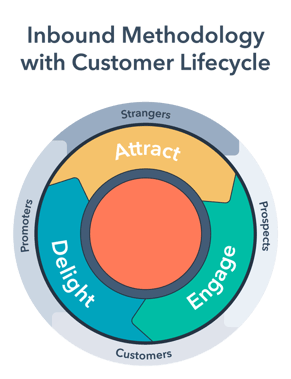
Ultimately, what it means to provide an exceptional customer experience is continually evolving, and you’ll need to work with both your sales and services teams to ensure you stay up-to-date on an ideal customer experience.
Who Owns Customer Experience?
Has your company defined who “owns” customer experience? Is it Sales? Marketing? Customer service? A 2018 study by PWC on Customer Experience made it clear — responsibility for delivering a winning CX belongs to the entire organization.
Additionally, in a recent Digital-IQ report released by PwC on winning digital strategies, 65% of respondents see customer experience as critical to advancing business performance.
The advent of digital marketing gives marketers the tools to interact with buyers at the individual level — through channels and touchpoints at every stage of the lifecycle. So where is the unique role for marketing in managing customer experience?
While the entire organization is responsible for experience delivery, marketing is often best positioned to listen to, analyze, and advocate for customer needs.
By delivering reliable, fact-based insights about customer experience, marketing helps overcome the siloing of departments, which is a major detractor to a consistent CX approach.
Let’s explore the four marketing best practices for supporting your organization’s customer experience strategy, now.
1. Listen to customers at scale — and share the insights.
Conversations data: Marketing that makes a meaningful impact on the customer’s experience requires effective analysis and interpretation of conversational data. Data is not only used for targeting marketing campaigns, but also for improving the customer experience.
Segmentation: Digital marketing automation platforms make it easy to track and act upon data. Data such as customer history, behaviors and interests make it possible to develop segments to better target customers, as well as provides insights on how to deliver a better experience.
KPIs: Key performance indicators such as conversion rate, churn, retention rate, and patient satisfaction scores should be identified, monitored, and tracked in a manner this is highly visible to all teams. These shared insights drive change and reinforce progress, identify areas for improvement, and support a culture in which everyone is responsible for delivering an exceptional experience.
2. Know the voice of the customer.
Direct customer feedback is foundational for understanding and improving experiences. Traditional research methods such as satisfaction surveys, focus groups, and interviews continue to play an important role in assessing satisfaction and capturing the voice of the customer.
However, digital technologies are providing new ways to supplement this information. Tools such as social listening, live chat, and website analytics provide opportunities to keep a pulse on customer feedback in real-time.
Additionally, sales and service delivery teams can capture customer feedback through observation, field reports, complaint logs, etc.
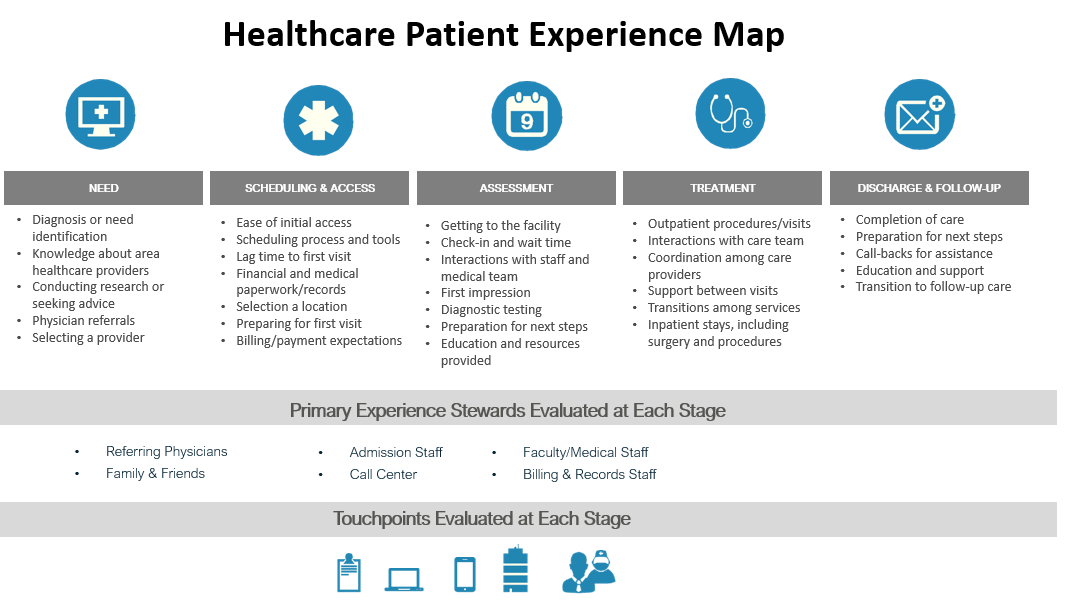
Regardless of what method is used, following a journey or experience map can ensure you are capturing feedback about the holistic experience rather than siloed stages.
For instance, take a look at the healthcare journey map, below, from Endeavor Management — which shows a wide range of activities, all of which are taken into account when capturing direct feedback.
Ultimately, marketing’s role is to work across departments and stages of the lifecycle to consolidate feedback, identify themes, and use the voice of the customer to bring about change.
3. Collaborate cross-functionally to foster change.
Unfortunately, it’s all too common for marketing teams to take responsibility for attracting prospects and generating leads, but then have little involvement after qualified leads are handed to sales — leading to a disjointed customer experience.
Instead, marketing teams can bring the results of listening at scale to collaborate on making business processes more customer-centered. When marketing develops insights about customers, this knowledge gives teams a common objective basis for working together on changes to improve the customer experience.
Simply put, marketing teams can support the customer experience by creating meaningful, valuable content for the buyer journey and identifying buyer segments and personas to target.
Additionally, the insights from listening at scale can have much broader impact when shared and used it as a springboard to identify bottlenecks, solve problems, and redesign processes in customer-focused ways. Perhaps your marketing team can create workshops or brainstorming sessions cross-departmentally to generate solutions and obtain buy-in for change.
Of course, it’s difficult for marketing to bring about change without executive buy-in. One way that marketers can engage and obtain support from executive teams is to calculate the ROI of improvements to the customer experience. Satisfaction and Net Promoter Score (likelihood to recommend) are two popular KPIs. Others include churn rate, resolution time, or conversion rates.
4. Invest in automation.
To successfully create an ideal customer experience, you’ll want to consider both marketing and sales automation software. Here’s a brief description of the two:
- Marketing automation focuses on growing traffic and increasing conversion rates. Tools provide insight on customer needs by tracking their website usage, downloads, analytics, etc. Marketing and sales automation tools can improve the customer experience by providing personalized, targeted connections based on needs and lifecycle stage.
- Sales automation provides insights on prospects with tools such as sales process sequences, quote workflows, and rep performance updates.
For marketers, marketing automation facilitates an improved customer experience by providing clients with the right information at the right time.
For instance, automation drastically shortens follow-up time. This is critical because research has shown that responding to a lead within five minutes dramatically increases a company’s chances of making contact with them — yet over half of today’s companies don’t respond within even five days.
Marketing automation not only improves the overall customer experience, but is critical to lead generation.
Ultimately, to create an exceptional customer experience you’ll need collaboration from all three of your organization’s departments — marketing, sales, and service. However, as a marketer, it could be your responsibility to lead the way by ensuring when you’re collecting research for your marketing efforts, you’re sharing the results with sales and service while also remaining open to their feedback.
If you’d like to learn how to better align your marketing and sales departments overall, take a look at The Ultimate Guide to Sales and Marketing.

How to Write Persuasive Instagram Ads, Captions, and Bios
Want more clicks and engagement on Instagram? Looking for tips on writing that converts? In this article, you’ll find techniques for creating compelling Instagram ads, captions, and bios that deliver results. #1: How to Write Instagram Ad Copy That Converts Instagram ads are a powerful way to promote your products, drive sales, and grow your […]
The post How to Write Persuasive Instagram Ads, Captions, and Bios appeared first on Social Media Marketing | Social Media Examiner.
from Social Media Marketing | Social Media Examiner https://ift.tt/353S07s
via socialmediaexaminer
How to Research like HubSpot’s Research Team
In college, research was always my favorite part of writing papers. I don’t know why, but finding data to back up my hypotheses always gives me a thrill.
But, even though I love research, it’s not exactly my forte — and I know I’m not alone.
Conducting market research is a necessity for both B2B or B2C companies. It enables you to use hard data to back up theories and predictions about customer behavior. This data can influence how you structure a campaign, and how you interact with customers.
However, when researching for marketing purposes, it can be tricky to know where to start, and how to keep going when you get stuck.
If you find yourself striking out during the research process, we’ve got you covered. Here, we’ve collected tips from HubSpot researchers about their research processes to make sure you feel confident collecting and analyzing data for your next campaign or report.
Tips from HubSpot Researchers
In 2019, HubSpot’s VP of International Operations, Nataly Kelly, wrote, “Data is incredibly powerful. It can inform, persuade, and reinforce. However, it can also mislead. We all bring our own biases to the table when we interpret data, and that can often lead to drawing an inaccurate conclusion.”
Keep this in mind while researching — it’s a good reminder that data is useful when it’s accurate, but presenting inaccurate data can ultimately harm your marketing strategies.
1. Take a variety of perspectives.
According to marketing research co-op Meg Kartham, “When conducting any type of research, it is important to take a variety of perspectives, whether that be industry or region.”
What this means is that you must think about as many outcomes as possible, especially if you’re conducting global research. Think about it — is a survey about nationwide customer satisfaction useful if you’re only surveying the Midwest?
Consider a survey conducted by HubSpot to measure International Net Promoter Scores (NPS). NPS measures customer satisfaction with our CRM. Some assumptions HubSpot researchers made included the assumption that some global norms that are different from those in the U.S. might’ve impacted the scores internationally.
For instance, when asked to rate customer service on a scale of 1-10, did you know that in Germany, 1 is the highest rating, rather than 10? Additionally, in some European countries, giving the highest score is almost unheard of. An A+ is considered 8-9, rather than 10.
When creating surveys, try to make one that can be universal to as many audiences as possible to make data collection easier. Alternatively, do research on global differences and take those into account when measuring results.
2. Research for your audience.
Research uncovers your target audience and provides insight into what kind of marketing you can do to reach them. As campaign manager Kyle Denhoff said, “Research helps inform the Campaign Brief that becomes the most important document of your campaign.”
That is why, when researching, Denhoff suggests to begin with understanding your audience. When building campaigns, Denhoff has found that covering as many bases as possible helps to give a rounded view on how to reach delight customers.
Behind the Screens is a four-part mini interview series about digital advertising that brings industry leaders from Google, Facebook, and LinkedIn together to educate business on how to use digital ads to their advantage. Because HubSpot is devoted to helping businesses grow better, it is probably in the interests of our customers to engage in a series like this one.
We know that because of the work done beforehand. Preparation for this series employed Denhoff’s team to collect as much prior knowledge as possible, a technique he points to as successful.
“Gather insights from various sources including customer calls, keyword research, and social media audience insights,” he said. “Giving your team a clear picture of the audience you are creating for and the challenge you are trying to help them solve.”
3. Make research relevant.
When researching, Kartham suggests personalizing the research as much as possible. If you’re sending out a survey, respondents should only be asked questions that are relevant to the study.
Alternatively, a survey with the goal of measuring brand engagement on social media probably wouldn’t benefit from asking the respondents whether or not they use video in their marketing materials. It’s critical you ask only the most relevant questions in a survey since too many questions will cause respondents to exit the survey without finishing it.
By making research relevant, you can ensure that the results you receive help you answer your research question. All of the answers should aide in proving or disproving your hypothesis.
4. Broaden areas of study.
In 2018, HubSpot researchers wanted to find research on how customers use email subscriptions. When Associate Product Manager of Subscriptions, Tyler Scionti, and his team began the research process, they found there was a gap in this subject.
Though Google is vast with research about how to get email subscribers, there’s seldom about what to send subscribers. There was a need for this information so the team decided to collect it by analyzing data from emails. So began the research process and a challenge to collect data on a subject that has less than stellar findings.
“I decided to collect as much data as I could in an objective way and let the data bring forth a conclusion rather than my own ideas affect the data,” Scionti said. “This helped me write an objective report and gave my team great food for thought on the state of our product.”
In a dataset that focused on how customers use their email subscriptions, it’s probably not important to gather data about how many subscriptions customers have — instead, it’s probably more important to analyze data based on open rates by contacts, so the team focused on the latter.
By keeping an open scope in data collection, Scionti’s team was able to deepen their knowledge about the product as well as refer to a large amount of relevant research. This was an aide in developing email subscriptions further and can be a good method to use if you don’t know where to start in your research.
5. Make it easy to follow.
Let’s say you’ve finally completed the hard task of collecting all of this market research. When analyzing and interpreting that data for a presentation, you’ll want to make sure you’re presenting it in a way that’s easy to follow.
Kartham said that when organizing results, “Presenting and sharing research in an easy to read and understanding fashion is needed.”
This is especially necessary if your research topic is something known as less-than-glamorous. For instance, a framework about how consumers respond to brands on social media, while a thrilling and interesting topic to me, might not be the most engaging topic to professionals who aren’t social media enthusiasts.
That being said, when presenting research, it should be given in a way that’s easy to follow. Research won’t transfer well to those who might need background information on the functions of different social media channels.
Information that seems like simple math to some might look like the most complicated level of calculus to others, so organizing research that reads like you’re explaining it to a grandparent is essential.
For instance, in the branding framework mentioned above, the University of Virginia team in partnership with the leader of HubSpot’s Market Research and Competitive Intelligence team, Mimi An, does a great job of providing visuals to represent complicated numbers and survey answers.
Keeping these tips in mind can help you elevate your process of collecting research and interpreting data. Another tip when researching is to read over research reports in topics similar to yours. Seeing how they formulate data can give you pointers and inspiration when collecting your own.

An Introduction to Workforce Management

How We Prioritized Which Review Sites We Care About at HubSpot
HubSpot CEO Brian Halligan has said it many times: More businesses die each day from overeating than from starvation. They spread themselves across so many different priorities that it becomes impossible to gain major traction with any of them.
The same is true when it comes to managing customer reviews for your business. There are so many different places a business can be reviewed today that keeping them all in order can feel a bit like a game of Whac-a-mole. (A few examples would be G2, Gartner Peer Insights, and Capterra.)
This was the problem we faced at HubSpot. If we tried to give the same care and attention to every single review site, we’d only have a minimal impact on each site. While it was important for us to read and consider every piece of feedback, it was also crucial for us to understand which sites were going to have the most impact in moving HubSpot’s mission forward: helping millions of organizations grow better.
However, how exactly could we determine which sites were likely to have the greatest impact? We needed to figure out which sites were wholesome brand-builders and which were just tasty distractions.
This is why I developed HubSpot’s “Customer and User Review Scoring Algorithm”. I designed the algorithm so we could objectively consider dozens of different criteria that assess the importance of various third-party sites. With this algorithm, we could determine how to focus our efforts over the coming months.
The Components of the Customer and User Review Scoring Algorithm
I realized that, for our specific business (as an inside sales-based SaaS company), there were three primary scores necessary to gain a full perspective of the review sites in our orbit:
- Health Score: How positively is HubSpot currently represented on this site?
- Sales Enablement Score: How important is this site to sales enablement?
- Acquisition/Visibility Score: How important is this site to the acquisition of new users or the general perception of HubSpot and its products?
For each score, I chose a variety of criteria I could measure (see below) and scored each site against the criteria. I was then able to weigh the criteria against each other so that criteria we deemed more important would have a greater influence over the score.
For example, we determined that our review rating (out of 5) on each review site was more important than the overall number of reviews we had on each site.
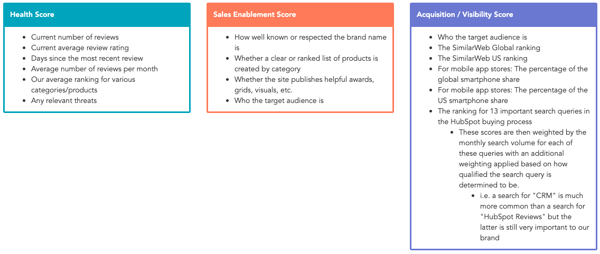
See above all of the criteria I used to create each score, and click here to see an example Google Sheets template of the scoring rubric.
Leveraging the Customer and User Review Scoring Algorithm
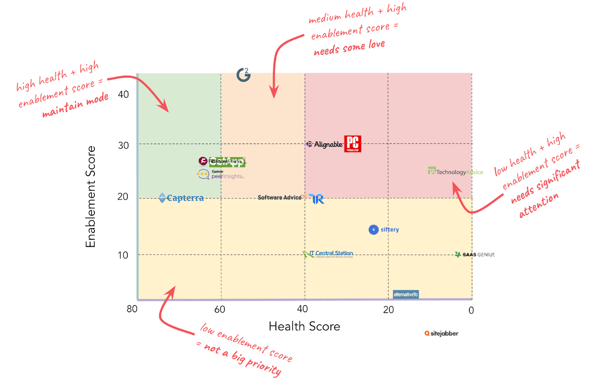
To truly understand each score and how the different review sites stacked up against each other, I plotted the data on two different grids. This process allowed us to see the Sales Enablement Score and Acquisition/Visibility Score each plotted against the Health Score.
The grids below represent what this looked like for HubSpot a couple of years ago. The colors of the grid correspond to how much attention should be devoted to improving HubSpot’s health on the given site (see the corresponding notes in red).
The Sales Enablement Grid — English Focused
 The Acquisition/Visibility Grid — English Focused
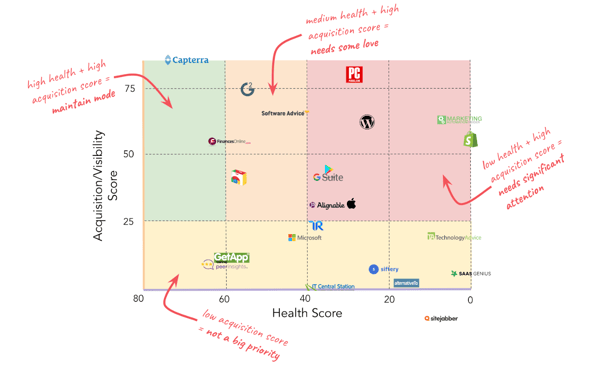
Armed with objective data and these handy grids, I was not only able to better direct my own review-oriented efforts, but I was also able to gain much better alignment and buy-in from other teams that leverage or impact customer reviews.
As a result of the campaigns that came out of this research, we were able to drive hundreds of five-star reviews, bring up our star rating on our goal sites, and influence countless deals.
If you’re looking to spin your business’s flywheel and acquire new customers, then a positive online reputation is a must-have. Approaching these reviews can feel a bit intimidating simply because of the sheer volume of websites, but fear not! Armed with this scoring system you can boil down the ocean and focus your attention purely on what matters.
Check out this template to get started today!

How to Let Facebook Automatically Present the Best Ad Text: Multiple Text Options
Want Facebook’s AI to show the right ad text to the right audience? Wondering how multiple text options can help improve your conversions? In this article, you’ll learn how to use Facebook’s Multiple Text Optimization feature so you can effortlessly customize your Facebook ads for different people. About Multiple Text Options in Facebook Ads Multiple […]
The post How to Let Facebook Automatically Present the Best Ad Text: Multiple Text Options appeared first on Social Media Marketing | Social Media Examiner.
from Social Media Marketing | Social Media Examiner https://ift.tt/38nAPzG
via socialmediaexaminer
5 Secrets of Creating Click-Worthy Social Media Cards
Before my blog writing days at HubSpot, I was working at a marketing agency where I was in charge of social media posts for our clients.
One time, I was posting a blog on Facebook, but it kept aggregating the wrong image.
Frustrated, I went to Google to find the answer: social media cards.
I found out that on Twitter, businesses using Twitter cards get 89% more favorites, 18% more clicks, and 150% more retweets.
That’s when I knew I had to learn more about social media cards.
Below, we’ll review what social media cards are and how to create them. Then, we’ll look at social media card design and examples to inspire your strategy.
Additionally, if you don’t want to create a social card for every page on your website, you can make a default card that’ll appear on any page that doesn’t have a social media card installed.
So, what exactly are the benefits of using social media cards?
1. Improves visual branding: With social cards you design, you’re in control of how your brand is represented visually on every social media post.
2. Boosts engagement rates: As mentioned above, users are more likely to engage with posts that use social media cards.
3. Increases social media referrals: Since more users are clicking on your posts, you’ll get more traffic to your site from social media.
4. Makes you unique: Social cards help your posts stand out in social media feeds since you can design unique cards that don’t look like anything the competition is posting.
Before you get started designing your social media cards, don’t forget to optimize the images so they’re the right size. Each social media platform has different specs and requirements.
If you aren’t well-versed in graphic design, or don’t have a graphic designer on your team, it’s best to use a tool to help you create these. For instance, you can use something like Canva or AnyImage.
However, to create social cards without a tool, all you need to do is add open graph meta tags to each of your web pages. Open graph tags are code that you’d put on your website backend that communicates the right title, image, and description with social media platforms. It’s social cards with no frills.
1. Choose a graphic design tool.
Before you get started designing, you have to decide if you want to create your social media cards on your own or using the help of a tool.
If you create the cards on your own, you can use something like Photoshop or Illustrator.
However, if you’re going to use a tool to help you with the design, you can use something like Canva or AnyImage.
With Canva, you’ll have more creative control of what your social card looks like. You can choose the design and get a little fancy with it. On AnyImage though, all you need to do is upload the image you want, input your copy, and then it’ll make a social media card for you.
2. Look at templates.
Once you know what tool you’re going to work in, you can look at the templates that they’ve created. Canva has plenty of social media card templates to choose from to help you get started.
If you aren’t using Canva, you can look up examples online (or peek the ones we have listed below), as a starting point.
3. Decide the aesthetic.
If you’re going to design more advanced social media cards, you’ll want to think about the aesthetic you want to display. Since a major benefit of social media cards is the visual branding, you can ensure your cards are branded, unique, and make your company stand out.
Think of the answers to questions like, “Does this match our current branding?” and “Is this how we want to represent our company?”.
4. Write your copy.
One of the most important elements of social media cards is ensuring the proper title and description pop up on a user’s newsfeed.
Before you really get to designing, make sure you write your title and description.
5. Select an image.
Another crucial element of a social media card is guaranteeing the right image shows up for your post.
For that to happen, you have to choose the image you want displayed.
6. Combine your creative assets.
Now it’s time to put it all together. You’ve chosen a template that matches your aesthetic, an image, and written your copy.
Mix it all together and you have a social media card.
Social Media Card Design
In order to design a social media card, you’ll have to decide if you want to create a graphic that includes an interesting image, branding, and graphics or just an image. The examples below include both.
Here are a few tips to create click-worthy social media cards:
1. Use branding.
The social cards you design should set you apart from your competitors. Ideally, users would know it’s your post just from the branding and imaging.
Below, LinkedIn uses a branded image for its social media card promoting its new blog on the hiring season.
Feeling overwhelmed with all the holiday commitments and office celebrations? Here are some tips to help navigate the holidays at work: https://t.co/aVk5zgMKWt pic.twitter.com/E1IqOLv2VU
— LinkedIn (@LinkedIn)
December 4, 2019
2. Choose engaging images.
This is true of all social media posts, but especially if you’re only going to use an image (minus any graphics) with your social media card.
The image you choose should be engaging and interesting enough that people stop scrolling and want to learn what the post is about.
Below, you’ll see an example from HubSpot. There’s an interesting image of coworkers, plus HubSpot branding around the corners.
Finding the right candidate is not easy. Here’a a simple hiring process that you can use at your agency, no matter its size. https://t.co/oECG3P2eBj pic.twitter.com/9ol6WoULkC
— HubSpot (@HubSpot)
December 6, 2019
3. Include graphics.
Using graphics can set you apart from the competition. Most brands use real imagery, so if there’s a fun, unique, interesting graphic, it might make people stop scrolling to see what it’s about.
In this example, Kidsguide Magazine includes a fun holiday graphic to promote its holiday sponsors.
4. Write compelling copy.
Copy isn’t easy to write. However, if you spend the time to ensure your copy is compelling and interesting, people will take notice.
Below, Larry Kim uses compelling copy to display what you should say during a job interview. It’s succinct, but also delivers interesting information. Also, notice how he used graphics to make this post stand out.
👨💼Things you should say During a Job Interview pic.twitter.com/vlMSsgCULI
— Larry Kim (@larrykim)
December 6, 2019
5. Make it unique.
Most social media posts look the same. That’s why your copy, image, and branding should be unique.
If a post looks like something you haven’t seen before or the image is interesting, people will see that and want to click on your post.
Below, HubSpot Life uses a unique image to promote an article by its Chief People Officer, Katie Burke.
When was the last time you examined your company’s #candidateexperience? @katieburkie shares why you should think about doing so ASAP in her latest @Inc article: https://t.co/eFI4zUv9zi
— HubSpot Life (@HubSpotLife)
December 5, 2019
Social Media Card Examples
1. In this example, Barker Social posts a Forbes article using a Twitter card. They’ve made sure the right image, photo, and description appear.
Here’s some timeless “old-school” #marketing techniques that are viable in the modern age, and how almost any business can utilize and benefit from them – https://t.co/kFzvHpN69u via @Forbes
— Barker Social (@Barker_Social)
December 6, 2019
2. Here, LinkedIn uses a Twitter Summary card to post to its blog. They’ve even designed a special image just for this post. This is an excellent example because they wrote copy on the image and used branding to set it apart from other posts on the newsfeed.
Go into peak hiring season with the tips you need to stand out and find the #job meant for you: https://t.co/EC0OlEJ8ek #InItTogether
— LinkedIn (@LinkedIn)
September 23, 2019
3. In this example, Barker Social Marketing created a special image for a Facebook post about Instagram. There are graphics and branding included on the image. Additionally, it showcases the accurate title and description.
4. Here, Barker Social created a social media card image including branding and graphics. It’s purposefully designed so it stands out and makes its posts look unique when users scroll on their feed.
If you don’t know how to hone in on your value proposition, here are three ways to create added value that can be easily integrated into your business plan today: https://t.co/O6SllMeykd #marketing #businesstips
— Barker Social (@Barker_Social)
December 5, 2019
Social media cards are the only way to ensure your social media posts are branded and portray the accurate information. With social cards, you can easily use the proper meta tags on every web page.

13 Creative Stunts People Used to Land Their Marketing Dream Jobs
If you want a creative job in a competitive industry, sometimes the traditional resume and cover letter combo just doesn’t cut it.
To get the attention of a hiring manager at a top agency, you’ll need something that highlights your assets, proves your intense interest in the agency, and differentiates you from a crowd of people trying to do the exact same thing — all without seeming too over-the-top, gimmicky, or creepy.
No sweat, right?
For your inspiration and amusement, we’ve put together a list of seven creative approaches used by real job seekers in the marketing and advertising industries. While flashy stunts alone aren’t likely to land you the job, they just might help you get your foot in the door. Check out the marketing stunts below.
7 Creative Stunts People Used to Land Their Marketing Dream Jobs
1. Creating a Video Resume
Video resumes aren’t new, but they’re still fairly rare in the job-seeking world. But, back in 2012, this strategy was even more unique and non-traditional. At this point, one European created a detailed and well-edited video resume which listed all of his qualifications, skills, accomplishments and out-of-office hobbies.
Aside from just adapting a resume bullets into video form, the candidate also added a touch of humor, such as videos of him working out at the gym, and edits embellishing some of his skills.
This candidate nicely highlights all of the key factors that make him unique in a short and sweet video. Not only is the content fun to watch, but it also teaches you nearly everything you need to know about the man.
Another great takeaway is that this man identified a new and unique way to present himself and his creative background. Sometimes, it’s beneficial to consider a less-traditional application strategy that will present you in a better way than a standard cover letter or CV.
2. Giving Out Candy Bar Resumes
Applying for a job can feel more sour than sweet, but according to one Redditor, you can actually leverage delicious candy to get a job.
In 2013, a Reddit user who goes by elilanger posted a photo of a candy bar that his friend Nick gave to a company he was interviewing with. When the interviewer looked at the back of the candy bar, the health and nutrition facts were actually replaced by the candidate’s skills and experience. According to the Reddit thread, Nick got the job because of the creative candy bar resume.

Image Credit: Reddit
This candy bar resume a creative way to subtly add a very memorable touch of extra effort to a job application or interview experience. A hiring manager might find it funny, delicious, and creative and it will be hard for them to forget you as they’re making their decision.
3. Making a Lego Ad
To get attention from an ad agency she was applying to, an Imgur user who goes by Pastlightspeed made a LEGO version of herself and a series of LEGO-themed ads that showcased her skills and experience. For example, one ad noted how many pieces her lego character had, as well as her actual educational background.

Image Credit: Imgur
Then, another ad showed the LEGO doll and gave brief details about her as it would about any other LEGO character.

Image Credit: Imgur
According to the Imgur user, her creative advertisement-based resume earned her a job at an agency.
In this example, the candidate created content that a company, like an advertising agency would want to see when making a hiring decision. Rather than waiting for the company to ask her for her portfolio, this candidate made an ad to demonstrate her design and copy skills, as well as her creativity.
4. Auctioning Yourself on eBay
In 2011, a UK job-seeker named Josh Butler posted an eBay listing with his resume in the product description area, his expected salary where the price is usually shown, and notes about how he planned to work hard for the company that hired him. The listing was simply titled, “JOSH BUTLER WANTS A JOB.”
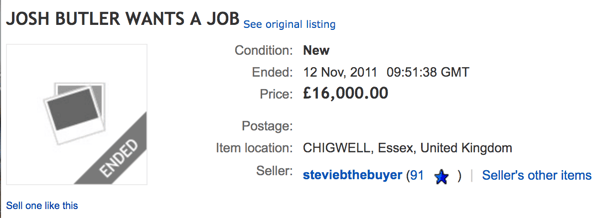
According to Butler, the listing actually resulted in a number of job interviews.
While this stunt took place over eight years ago, you can still take a note from the candidate by similarly finding creative ways to leverage today’s more prominent online platforms for your own job search.
5. Writing a Cover Letter Rap
Writing a cover letter can feel daunting, tricky, and even dull. But, when one job applicant named Chase Zreet applied for a copy writer position at Sprite, he wrote a rap and created a rap video in place of a cover letter.
With lyrics like, “Can I — Can I write for Sprite? My lines are nice and my scripts are tight,” Zreet shows off his creativity, love of Sprite, and copywriting skills directly related to the brand he’s applying to work for.
Because Zreet raps about how he’s followed Sprite, his skills, and his accomplishments, he smoothly answers all of the questions that the average cover letter would but in a much more memorable way.
If you’re applying for a job in a creative field, odds are that your hiring manager might be looking for memorable application assets that show off your creative range. Brainstorming unique content like this could demonstrate how tactical and creative you are while making you stand out in the job application pool.
6. Posing as the “Fearless Girl” Statue
Recently, State Street embraced female entrepreneurs by placing a statue of a brave girl and positioning it so it stared in the eyes of Wall Street’s bull statue. This represented female empowerment in a field once dominated by men. The statue was titled “Fearless Girl.”
The “Fearless Girl” statue was not only motivational, but it also inspired a successful stunt from one female job candidate. The candidate painted herself gold, wore a gold dress, and was photographed staring up at the McCann Bristol offices.
She then posted the images as well as a description of why she wanted to work at the company on social media. These posts got attention, and retweets, from the company, which ultimately hired her.
Here’s a Twitter post where McCann gushes about how the woman was one of their best applicants:
Is this the best job application ever? Adorned in gold, fearless advertising graduate Jade Delaney recreates #FearlessGirl outside our offices #FearlessBristolGirl @McCann_WW @Campaignmag pic.twitter.com/11HW5lCFGl
— McCann Bristol (@McCann_Bristol)
May 9, 2018
7. Pretending to be a Prospective Client
August Laustsen, a young art director from Denmark seeking an agency gig in Sweden, was having difficulty landing an interview. Despite sending his resume to all the big agencies in Stockholm, he couldn’t seem to even get a call back. Instead of throwing in the towel, Lausten devised a sneaky and brilliant way to get some agency attention.
“The thing is, when you’re looking for a job in another country, it’s impossible to get through if you don’t have any connections,” Lausten said to Adweek. “None of the CDs [creative directors] knew me, or any of the work that I had done, so I knew I had to take it a step further to get their attention.”
Lausten contacted a number of Swedish agencies pretending to be the marketing director of a firm looking to hire a new agency. He called his fictional firm EMERIH (Yep, that’s “Hire Me” spelled backwards), and set up a website revealing his true intentions as a job seeker.
So did the fake prospect stunt work out? Agencies received Lausten’s bold move “very positively,” and according to his website, he’s now employed as an art director at Round&Round in Stockholm.

Image Credit: August Lausten
8. Brewing a Custom Beer Resume
If there was ever a foolproof formula for ensuring your resume doesn’t end up at the bottom of the pile, it’s probably this:
Resume + Beer = “Resum-ale”
Looking to start his job search off with something memorable (and tasty), graphic designer Brennan Gleason decided to brew up a custom beer and design the packaging himself. Each bottle in the four-pack was printed with a portion of his resume, as well as a QR-code to view his full resume online.
“As I was nearing the end of University, the time approached where I needed to start getting my name out there,” Gleason wrote on Behance. “I wanted a resume that would both show off my work, but more importantly who I was and what I loved. I brewed up a nice Blonde Ale, and while that was fermenting I set out to create a packaging design that would reflect my personal identity.”
According to his Dribble account, Gleason currently works for Vancouver-based agency Domain7.
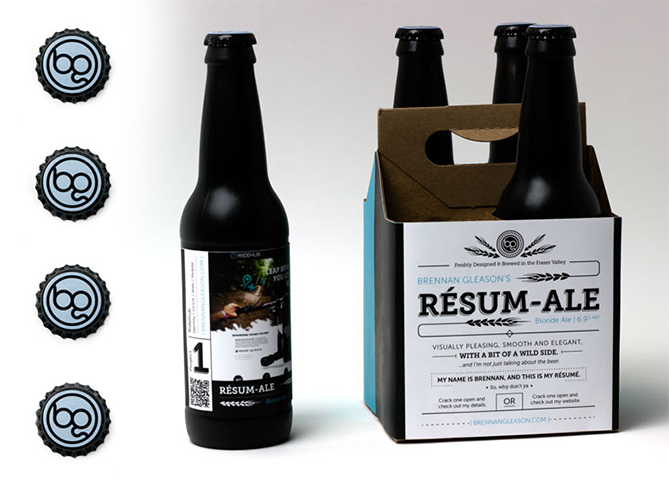
Image Credit: Brennan Gleason
9. Personally Delivering Donuts
When 25-year-old Lithuanian marketer Lukas Yla moved to San Francisco, he knew he’d have to do something unconventional to break into the extremely competitive marketing and tech scene.
His solution? Dress up as a Postmates delivery courier to personally deliver donuts to the companies he admired — with his resume attached, of course. In October 2016, Yla made over 40 donut deliveries across the Bay Area, dropping off treat-filled boxes emblazoned with some catchy copy: “Most resumes end up in the trash. Mine — in your belly.”
Yla admits the sugary stunt was “a bit odd,” but it ended up earning Yla some much-deserved viral attention . More importantly, the move scored Yla multiple interviews (although according to his LinkedIn he’s still on the search for the perfect marketing gig).
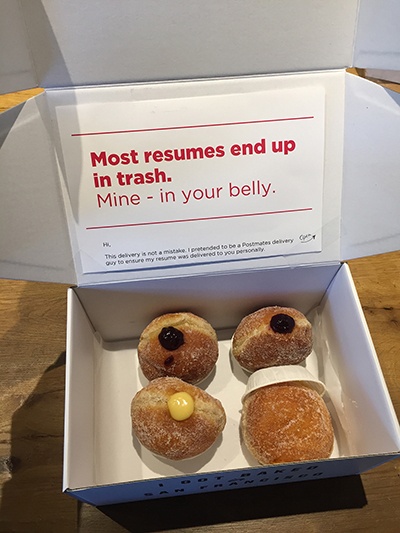
Image via Adweek
10. Buying a Billboard
After Pasha Stocking was laid off from her job as a marketing and sales director in Connecticut back in 2009, she took all the usual steps to find a new job: sending resumes to prospective employers, going to job fairs, and even registering with temp agencies. After toughing it out in a harsh job market for eight months without any big leads, she knew it was time for something big.
Stocking took $2000 out of her savings and purchased a massive billboard overlooking a busy highway in Bridgeport, Connecticut. She kept everything straightforward and uncomplicated: just a picture of herself, a link to her website, and copy that plainly spelled out her ultimate objective — “HIRE ME!”
While the billboard didn’t end up getting Stocking any offers she seriously considered, it did lead her to start her own print advertising company, specializing in — you guessed it — billboards.
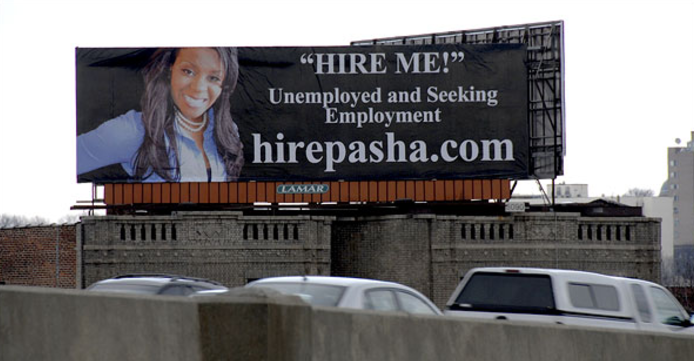
Image Credit: The New York Times
11. Hacking an Agency’s File-Sharing System to Deliver a Resume
As the Chief Creative Officer at 72andSunny, Glenn Cole has witnessed his fair share of stunts from eager agency job seekers. But what has really stood out to him over the years?
“I’ve had a couple of people hack personal accounts to get my attention, which I find really clever,” Cold told Fast Company. In one instance, a prospective candidate hacked the agency’s internal file-sharing service and sent an email containing their resume to every creative director at 72andSunny. The email appeared to be sent from Cole himself.
While the bid for attention impressed Cole, the candidate ultimately wasn’t offered a job (although Cole says they’re still on the agency’s radar for future positions).
Disclaimer: We don’t recommend hacking a prospective employer to get attention.
12. Writing a “Hire Me” Song
With a Marketing degree from Bentley University and several unpaid internships under his belt, Alec Biedrzycki still wasn’t getting job offers in his field. So he picked up his guitar and wrote a song about it.
“Hire Me” is a three-minute music video Biedrzycki created back in 2009 to use in place of a traditional resume and cover letter. While alternative video resumes are more common today, they were still relatively unheard of when he started sending his song out to employers.
Did the video really help Biedrzycki break into the industry? “I … was jobless and discouraged post-graduation due to the 2008 market crash,” Biedrzycki said. “My career didn’t really start until I launched this in 2009. Connections were made, interviews were set up and I eventually landed a job at an agency later that year. Launching this made me feel like I could pursue a career in marketing, even if the odds were against me.”
Today, Biedrzycki is a Principal Tech Partner Marketing Manager at HubSpot.
13. Buying Google Ads for Advertising Executives’ Names
When Alec Brownstein was searching for a new job in 2010, he stumbled upon an unlikely opportunity for self-promotion.
“I was doing a little bit of research on who I wanted to work for, and of course I was using Google, and I noticed when I Googled their names, that there were no sponsored links at the top, no ads there,” Brownstein said to CBS News. “And as someone who Googles myself sort of embarrassingly frequently, I realized if someone were to put someone at the top of my result, I would notice it.”
So Brownstein went ahead and purchased the top result for “Ian Reichenthal,” a creative director at Young and Rubicam. It cost him 15 cents.
Sure enough, Reichenthal saw the ad after Googling himself, called Brownstein, and ended up hiring him.
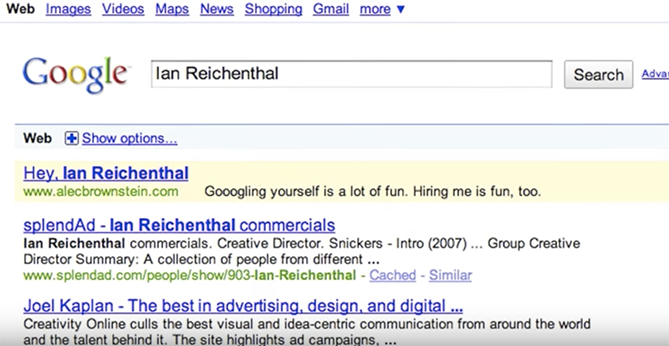
Image Credit: Alec Brownstein via YouTube
Tips for a Memorable Job Application
The main goal of any job application, cover letter, or hiring-related asset is to standout from the competition. Regardless of what you submit to a hiring manager, make sure it’s both appropriate for the job you’re applying for and extremely memorable.
Want to learn more about creating a memorable job application? Here from a person who landed their dream job in this post.
Editor’s Note: This blog post was originally published in April of 2017, but was updated in November 2019 for comprehensiveness.

19 Brilliant Examples of Holiday Marketing Campaigns
Every year, as soon as Halloween is behind us, it seems like the floodgates open. Without warning, there are holiday marketing campaigns everywhere, with countless businesses rushing to cash in on a spending frenzy. There are holiday emails, social media posts, and TV ads — oh, my.
It might seem like holiday marketing is out of control. But some brands do it very, very well.
How? Well, these brands create campaigns that actually delight customers instead of adding to holiday “noise.” They evoke emotions and promote sharing, sometimes even connecting people with their loved ones, or partnering with a charitable organization.
Great holiday marketing campaigns come in many different shapes and sizes. Check out 15 of our favorites below, and use these ideas to fuel your own holiday marketing ideas.
19 Brilliant Examples of Holiday Marketing Campaigns
1. Walkers: All Mariah Carey Wants for Christmas
While the holiday season is a time for caring and sharing, Walkers shows musician Mariah Carey doing the exact opposite. After filming a music video for her famous song, “All I Want for Christmas Is You,” Mariah Carey gets angry with an elf for taking her Walkers chips. To fend him off, she sings a highnote which makes him block his ears and let go of the chips.
This is a hilarious commercial because it shows that the only thing you might not want to share on Christmas is Walkers products. It also shows prospects how even stars, like Carey, enjoy the brand.
2. Coca-Cola Canada: Peace on Earth … Or at Least in the Mall
When it comes to shopping malls during the holidays, it seems that people are highly divided. There are some who can’t get enough of the buzz and the decor (guilty), and some who want to stay as far away as possible.
Wherever you stand on the topic, Coca-Cola Canada found a clever way to brand the “mall-during-the holidays” experience by showing how our favorite beverages can bring us all together, even during tense times. Here, the company uses a video — shared across social media — in which two people fighting over a jacket are able to find peace by enjoying Coca-Cola products together.
This installment is just one of the latest in the Coca-Cola company’s legendary holiday marketing campaigns — I mean, who doesn’t love the annual debut of the Coke-drinking polar bears?
3. REI: #OptOutside
Last year, REI made waves with its announcement that it would close the doors to its retail locations, headquarters, and distribution centers on Black Friday, the day after Thanksgiving in the U.S. Instead, REI invited its community to join employees in taking Black Friday off from work — and from shopping — to do what they love most: being outside.
This year, REI is back with the #OptOutside campaign in full force. It’s getting attention from some pretty big names, including the National Parks Foundation, which is putting its own spin on the #OptOutside movement.
The campaign is even motivating other brands to add a charitable element to the movement. Outdoor Research, for example, will donate $10 to Paradox Sports for every Instagram post containing both the #OptOutside and #OutdoorResearch hashtags.

Source: Outdoor Research
4. Macy’s: Santa Girl
After seeing Santa in the Macy’s Day Parade, a young girl decides that she wants to have his job when she grows up. But, after telling people she wants to be Santa and dressing like him in red Macy’s clothing, bullies start teasing her.
As she doubts herself and hides in her room, her parents cover their red pickup truck in Christmas lights. Then, they wake her up and drive her all over the neighborhood as if she is Santa.
This commercial emphasizes the Christmas spirit as the main character regains her belief in herself and Santa. It also lightly tackles gender norms by telling the story of a girl who wants to be a fictional character, and also take on a role that’s been traditionally held by a man throughout history.
5. WeWork: #wwgiftguide
It might seem tricky for B2B brands to pull off delightful holiday marketing. But WeWork, a provider of co-working and office spaces around the world, has disproved that perception with its #wwgiftguide campaign.
It kicked off with an article in Creator, WeWork’s magazine for entrepreneurs, titled “Holiday Gift Guide: Best Gifts with a Personal Touch.” Over the course two weeks, there were four segments of the guide published, each with a different theme — “gifts with a personal touch,” “gifts to get the party started,” “gifts for the family,” and “gifts for the digital nomad,” to name a few.
Our favorite part? Each gift guide features products from WeWork member companies, helping to support the community of creators for which it’s known. And to help promote the campaign, the stories have been shared across social media with the hashtag #wwgiftguide, encouraging people to share what they’re gifting this holiday season.
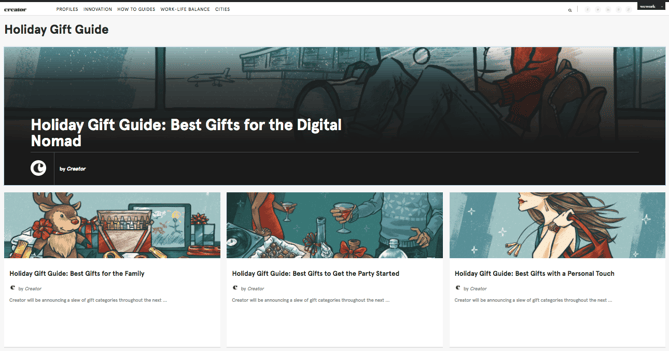
Source: creator
6. HotelTonight: Visit, Don’t Stay
During the holidays, time with family is inevitable — whether you like it or not.
But HotelTonight has a plan to help, by making it easy for holiday travelers to visit family without staying with them. The solution? An easy-to-book hotel room, using the brand’s website.
The campaign is widespread across social media. First, there’s a Facebook contest, in which followers can share a story of their worst/funniest holiday family memory in the comments.
Then, followers on Twitter are invited to participate in the conversation, using the #HotelTonight hashtag.
Ready for the holidays? Grandma’s inflating your air mattress & checking it twice. Maybe this year you should visit, not stay. #HotelTonight pic.twitter.com/gWZUU8T8qg
— HotelTonight (@HotelTonight)
November 22, 2016
The campaign also uses quirky, chuckle-worthy print and audio ads, like this gem that invokes nostalgia of our own wacky relatives.

Source: AdWeek
One of our favorite parts of this campaign is that it’s multi-faceted. It takes a single idea — that we aren’t crazy about some of our relatives, but can’t be rude about it — and executes the message across a variety of formats.
7. Dollar Shave Club: Holiday Shave Set
Sometimes, we enjoy some good, snarky marketing. Maybe that’s why we can’t stop giggling at this video promoting Dollar Shave Club’s Holiday Shave Set: the gift that other gifts can’t handle.
It’s a great example of a simple, funny video perfect for social media. This snowman on a sweater was too jealous to handle the awesomeness of the Holiday Shave Set — hence, the hair dryer. It shows how brands can incorporate the familiarity of cheesy holiday traditions like wearing ugly sweaters into their own marketing, while simultaneously demonstrating how their products or services can spice up the standard holiday monotony.
8. Hinge: See What We’re Thankful For
This holiday season, what are you thankful for? Back in November, dating app Hinge sent around an email posing the same question to its members, using the opportunity to talk about its recent rebrand and subsequent growth — something for which Hinge itself has enormous gratitude, according to the email.
The timing for this sort of marketing is impeccable. The holidays are notorious for the sentimentality they invoke among the masses, and the desire to spend them with “someone special.” (In fact, ads that capitalize on sentimentality have been shown to score 50% higher in emotional appeal, no matter what the season might be.)
Hinge used this email to harness the holiday spirit and redirect attention to an app that helps people find meaningful relationships, instead of, well, shorter-term alternatives.
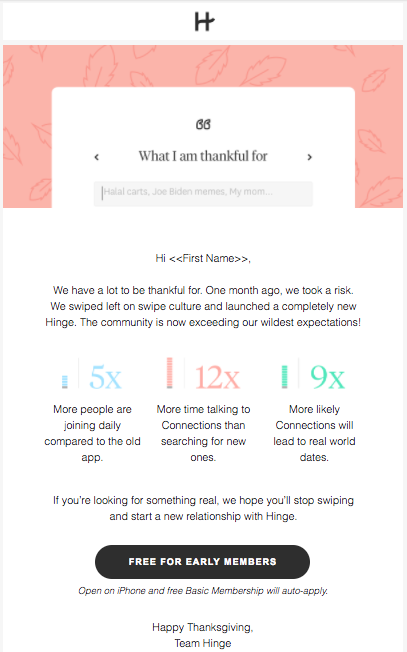
[Click here to see the full email]
9. Lagavulin: Nick Offerman’s Yule Log
This one is an oldie but a goodie. Actor, writer, and humorist Nick Offerman loves his whisky. He’s sung about it before, and last holiday season, he joined his favorite whisky brand, Lagavulin, to film a 45-minute video of — wait for it — Offerman sitting in a leather chair next to a crackling fire, drinking whisky and looking calmly at the camera. Where do we sign up for that gig?
“This is smart branding on Lagavulin’s part,” Kristina Monllos wrote for AdWeek. “Creating an extended ad that can serve as a conversation starter — should consumers swap the traditional Yule Log video for Offerman’s at parties — will also get everyone talking about the brand.”
Since the video was initially released, a new 10-hour version of it became available. Consider it our gift to you.
10. BarkPost: Yappy Thanksgiving Eve
Holidays are traditionally a time to be spent with family. For many of us, that includes our dogs.
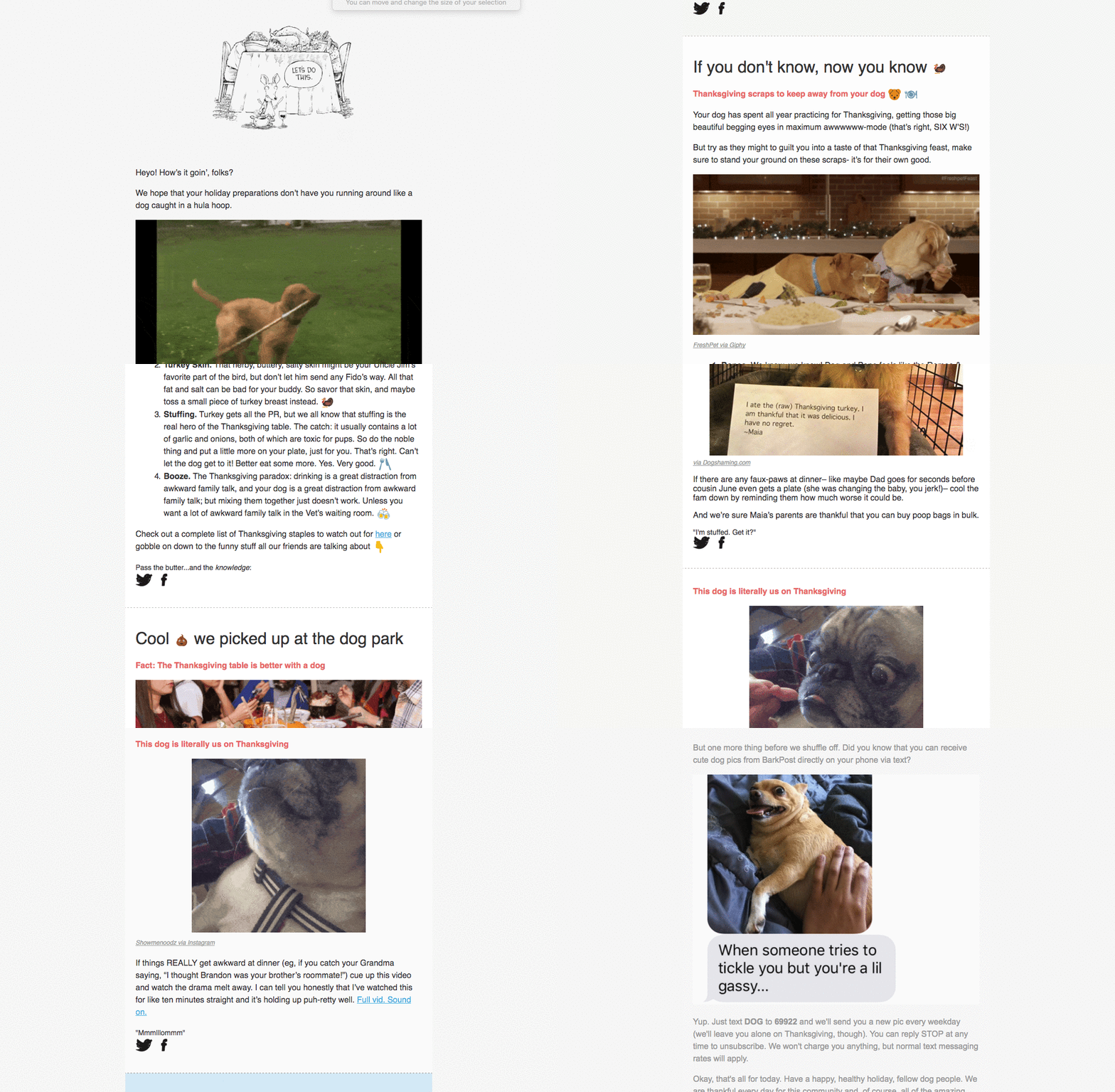
BarkPost is no stranger to marketing campaigns that help “dog ruvers” include their furry friends into day-to-day life. In November, the pet-friendly brand showed how to do that at Thanksgiving, with a clever email that included holiday-themed cartoons and videos, feeding safety tips, and other holiday survival techniques — which, of course, involve your dog.
Plus, check out that adorable call to action at the bottom of the email: “Stop getting cute dogs in your email. Unsubscribe.” I mean, who would want to unsubscribe from that?
11. Edeka: Wihnachtsclip – #heimkommen
Remember that sentimental value of holiday marketing that we mentioned earlier? Well, here’s a tear-jerking example for you from German supermarket Edeka. Its 2015 holiday TV advertisement “Wihnachtsclip – #HeimKommen” — which translates from German to “Christmas Carol – #Homecoming” — is all about realizing what really matters around the holidays: spending time with family and the people you love.
In the ad, an elderly man prepares to spend yet another Christmas alone, since his kids usually cancel their planned visits last minute. Then, the ad shows his various grown children receiving letters saying their father has passed away. When they arrive at home, though, they’re surprised to be greeted by their very alive and very healthy-looking father. He says, “How else could I have brought you all together?”
Other than the delicious-looking meal they share at the very end, there’s no hint that Edeka is a supermarket — but you can bet the video is emotional and shareworthy. The ad garnered 33.5 million views on YouTube within a week of posting.
This year, Edeka is at it again with its “#Zeitschenken — EDEKA Weihnachtswerbung” ads (which translates to “#Time — EDEKA Christmas Advertising”), this time showing how the frenzy around holidays can keep us from remembering the most important thing of all — spending them with the people we love.
12. Kool-Aid: All I Really Want for Christmas feat. Lil John
In a music-video styled ad, rapper Lil John quietly sits down to drink a glass of Kool-Aid as the Kool-Aid man smashes through his wall. At that moment, the bass drops as a festive musical video begins showing Lil John rapping in front of a family Christmas gathering. The video goes on to show Lil John, the Kool-Aid Man, and Santa dancing along with shots of holiday food, presents, and Lil John’s Christmas list.
By launching a full-fledged music video with a prominent rapper, Kool-Aid both entertains prospects and demonstrates how “Kool” their brand is. Along with being humorous and entertaining, this ad also reminds you that you can still drink Kool-Aid during a time of the year where you’re mostly thinking about hot beverages.
13. HubSpot: #HolidayHub
Microsites are a great way to highlight a specific campaign or target a specific buyer persona. Here’s an example of a holiday-themed microsite HubSpot created, highlighting our #HolidayHub campaign and targeting ecommerce customers. (Check out a few more ingenious microsites in this blog post.)
The site is filled with holiday marketing resources, which isn’t a far cry from the type of content we publish to our normal website — except this time, it’s themed. Plus, who doesn’t love a countdown?
The animated snow effect was created using HTML5 Canvas and JavaScript. You can learn how to implement an animated snow effect on HubSpot’s Design blog. Alternatively, you could create an animated GIF to create a feeling of animation — Here’s a beginner’s tutorial for creating an animated GIF in Photoshop.
14. Samsung Galaxy: Unwrap The Feels
Samsung has had a bit of a tumultuous year. But now, the brand is seeking to bring some holiday cheer to the masses with the gift of its Gear VR.
We’ve anticipated that virtual reality would become an increasingly important marketing device, especially when it comes to brands creating an experience for consumers. With technology from products like Gear VR, people can create their own experiences from the comfort of their own homes.
Samsung is building on that for the holidays with this video that shows relatives gifting their loved ones with the freedom to experience anything — and the feelings that come with it. Watch as the different recipients show a broad range of reactions, from elation, to shock, to wonder.
Samsung also incorporated a social media sweepstakes into the campaign. For a chance to win a Galaxy S7 Edge and a Gear VR, Twitter users were invited to tag a friend with the hashtags #GalaxyS7edge, #GearVR, and #sweepstakes, along with a few words on why that person deserved the gift of virtual reality.
Tag a friend + why they deserve a #GalaxyS7edge + #GearVR w/ #sweepstakes. You both may win. Happy holidays. Rules: https://t.co/hNpt6Onhlz pic.twitter.com/cukTVfg82j
— Samsung Mobile US (@SamsungMobileUS)
November 21, 2016
15. Sonos + Spotify: #PlaylistPotluck
One great way to celebrate the holiday season is with an event. And with events typically come music. Spotify is aware of that tradition, which is why it created #PlaylistPotluck.
It started with a partnership with Sonos. The brands got together to turn playlists into something like a potluck in which everyone contributes something to bring the event together (the tagline of the campaign is “One home. One host. Everyone brings a dish.”) Only, instead of contributing food or drink, everyone contributes a tune to a collaborative playlist.
Oh, look. That feature is available with Spotify!
The idea is delightfully interactive. Instead of using traditional invitations, guests RSVP to the potluck by adding songs to the collaborative playlist. And the cherry on top? Both brands also partnered with the PBS series “Mind of a Chef” for a televised holiday special, in which various celebrity chefs will be using the feature for their own meals.
What we love about this campaign is the fact that it incorporates several different elements and media formats to make it cohesive — a speaker system, a music-streaming app, and a televised special. Plus, if you participate, you’re entered for a chance to win your very own dinner party, hosted by a world-renowned chef. Bon appetit — and rock on.
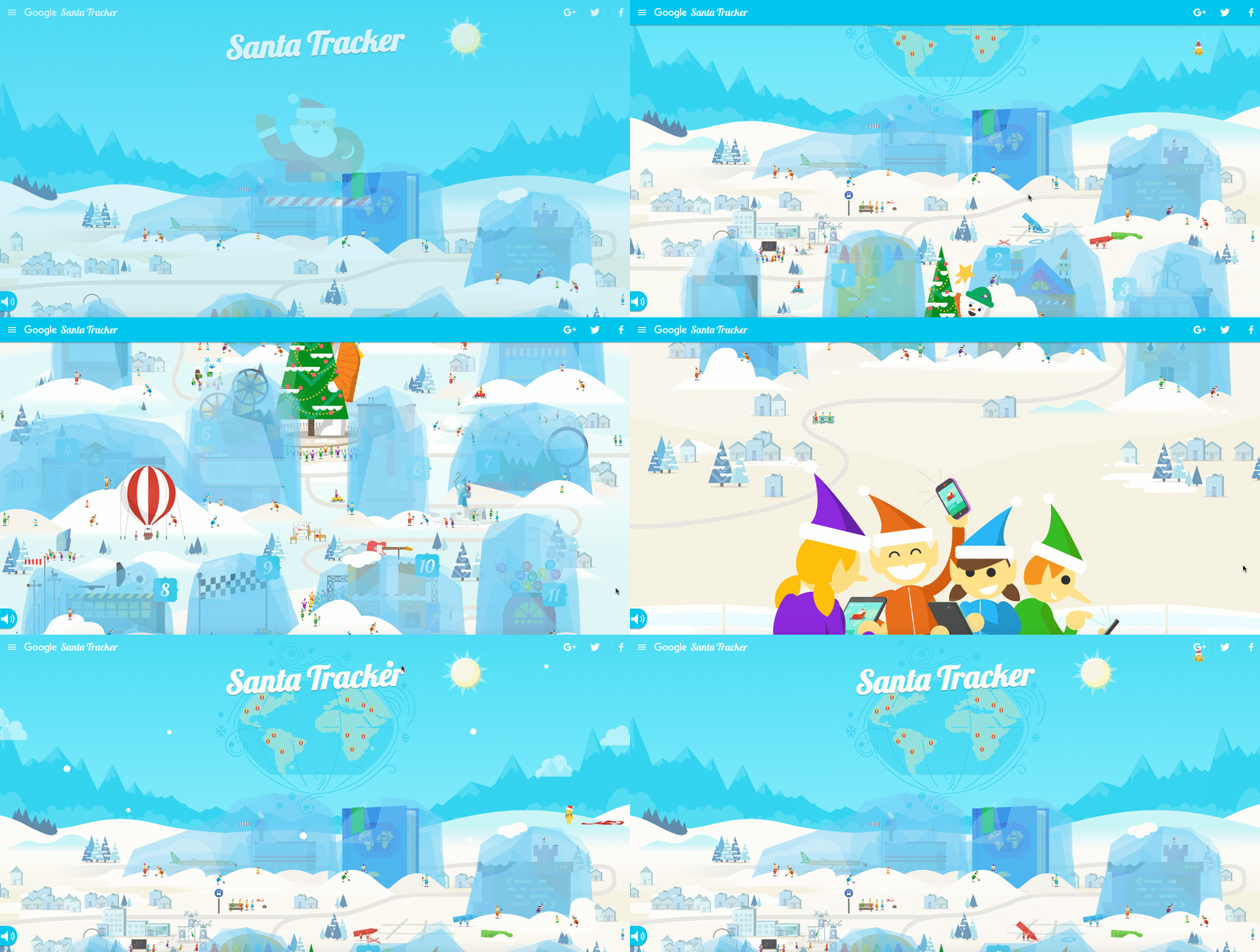
16. Google: Santa Tracker
While Google’s Santa Tracker has been around for a few years now — and we recommend checking out the back story here — its features have evolved over time. This year, for example, “Santa’s dashboard,” a virtual display of the technology that powers his global travels on Christmas Eve, will debut.
It’s hard to narrow down what makes the Santa Tracker so delightful, but if we had to summarize it, we’d say this — it combines the holiday wonder of a belief in Santa with real-life technology. What a wonderful way to teach kids about the web, while also allowing them to be kids. (Although, we adults certainly appreciate it, too.)
This year, Google has even introduced a B2B element of the Santa Tracker by sharing the code with developers and releasing other elements of the tool as open source. Why make all of that information public? To inspire developers to create their “own magical experiences based on all the interesting and exciting components that came together to make Santa Tracker,” writes Google’s Developer Programs Engineer Sam Thorogood.
Up until Christmas Eve, visitors can have a peek at the “North Pole,” to see what Santa’s elves are up to as the holiday approaches.
17. John Lewis: #BusterTheBoxer
When U.K. department store John Lewis debuted its 2016 holiday ad, Buster the Boxer won the hearts of audiences around the world. (My colleague, Karla Cook, wrote more about the ad here.)
What really delights us about #BusterTheBoxer — which was turned into a promotional hashtag — is that John Lewis didn’t stop at a TV commercial for its holiday marketing. By dedicating an entire section of its online shop to Buster and his friends, the brand created an interactive experience.
Check out the video below. It provides a 360° user experience to explore Buster’s garden, where the very trampoline being promoted in the original ad was installed. We’re looking forward to seeing more 360° video used in marketing — this season, and beyond.
18. H&M: Come Together
One look at H&M’s YouTube page, and it’s clear that this brand knows how to use video marketing to its advantage. H&M’s holiday marketing is no exception. Its latest holiday video, directed by Wes Anderson and starring Adrien Brody, made headlines almost immediately upon its release. Twenty-four hours after its premiere, it was still the #1 trending video on YouTube.
The video takes viewers through the experience of a train conductor and passengers faced with severe weather-related travel delays. Nineteen minutes after the conductor calls in a request for an emergency supply of festive materials, the passengers — all donning H&M apparel, of course — make way to the cafeteria car, which has been transformed into a winter wonderland.
We’re particularly fond of this ad’s subtlety. Rather than screaming, “Here are the new winter items in our catalogue,” H&M managed to incorporate its fashions into the storyline of a video that had very little to do with apparel. Remember: Holiday marketing doesn’t have to be in-your-face as much as on-brand and memorable.
19. Heathrow Airport: The Heathrow Bears Return
In 2018, an adorable holiday commercial from Heathrow Airport shows the journey of two grandparent teddy bears as they decide to pack up, leave their sunny home, and go visit their teddy-bear grandchildren for Christmas. At the end, you see the bears reunite with their family in London’s Heathrow Airport.
For many, these bears are both nostalgic and relatable. They remind you of the bears you might have played with as a child and the average grandparents. At the end, when you see the teddy bears join their family, you might also remember the happiness you felt when your grandparents came and brought you gifts or hugs during the holidays.
This commercial is a sequel to a similar commercial the Heathrow launched a year before, titled “Coming Home for Christmas”. This ad follows the bears riding and exiting the plane to meet up with their family at a Heathrow Airport Gate:
This series of commercials has all the great aspects of an ad campaign becuase its relatable, nostalgic, and incredibly heartwarming.
Go Forth and Be Merry
Out of all the things that we appreciate about these campaigns, there might be one thing we like the most — the fact that they put the fun back in holidays. This season, don’t let the stress get to you. Have a laugh or a cry with these examples, and please, be merry.
From our family to yours, happy holidays.
Editor’s Note: This post was originally published in December 2015 and was updated in December 2019 for freshness, accuracy, and comprehensiveness.

Preparing for California Consumer Privacy Act (CCPA): What Marketers Need to Know Now
Welcome to this week’s edition of the Social Media Marketing Talk Show, a news show for marketers who want to stay on the leading edge of social media. On this week’s Social Media Marketing Talk Show, we explore the California Consumer Privacy Act and what processes and technology all businesses need to have in place […]
The post Preparing for California Consumer Privacy Act (CCPA): What Marketers Need to Know Now appeared first on Social Media Marketing | Social Media Examiner.
from Social Media Marketing | Social Media Examiner https://ift.tt/33WPKgX
via socialmediaexaminer
How to Define a Workflow Process

5 Examples of Truly Unique Company Culture
When I start a job search, a huge factor that notates whether or not I send in an application is a company culture I can see myself contributing to and thriving in. I am totally one of the candidates who won’t apply to a company with a negative reputation.
Companies are defined by the values and protocol set in place. This is what a company culture is. They describe how company beliefs are reflected in the experience of employees and customers.
HubSpot’s culture code is available online as a commitment to our value of transparency. Other companies (Spotify, Hootsuite, Asana) with transparency as a part of their culture have done the same, showing that culture works in implementation, not just establishment.
If you’re looking for inspiration for your company culture or are working to define one of your own, check out what these companies are doing to make their employees and customers receive a positive experience.
1. Google
At Google, the spark of ideas is key. Employees, affectionately dubbed ‘Googlers,’ are encouraged to be creative. Innovation is a big company goal, and because of this, Google has the X lab.
This is a lab space where employees can experiment and failure is accepted as a learning experience necessary for growth. Without this fear of doing something wrong, employees can feel empowered to strive for higher goals and feel supported along the way.
Googlers can enjoy the flexibility of choosing how they work and offices with video games and nap areas. Common spaces like kitchenettes and various meeting rooms bring employees together and encourage productivity with in-office food options and breakout spaces.
A unique feature of Google’s culture is the program ‘Googler to Googler.’ This is focused on team development and working together; Googlers get the chance to educate each other in skill-building from yoga to team management.
2. Netflix
Netflix is another company where culture immersion starts during the interview process — candidates who make a splash display empathy and a track record of working well in teams. Candidates who have great achievements but negative attitudes might be passed over for one enthusiastic about joining a new team who is seen as a natural fit.
Ownership through flexibility is also important to the streaming service. Providing employees with unlimited vacation time is a way Netflix encourages not only a flexible work schedule but sets in place the expectation that unique perks will be respected.
Another quirk about Netflix’s culture is its extreme honesty policy. To prioritize respect in the workplace, the company believes that if you wouldn’t say something to a colleague in person, you shouldn’t say it in private. This builds trust in work relationships, for example, those with coworkers and managers.
3. Amazon
The biggest focus at Amazon, in terms of company culture, is producing an excellent experience for the customer. To achieve this, Amazon imposes high standards into everything culture-based. What do I mean by this?
Employees are encouraged to deliver their best performance. To aide with this, Amazon has a “two-pizza” rule: Teams should be small enough to be fed with two pizzas. This approach helps managers create a more personal relationship with their team, provide adequate support, and maintains company productivity.
Further, the high expectations from customers influence the drive from employees to build high-quality experiences. What’s more, this approach attracts potential employees who see themselves in the company’s brand and want to deliver the best service possible to customers.
4. Buffer
At Buffer, culture is made up of personal development, humility, listening, and transparency. The company has a policy of providing honesty to their employees and customers and encourages them to do the same. Buffer also promotes employee skill-building and a supportive environment for innovation.
Buffer employees can expect a culture that is huge on transparency, from employee salaries being posted on their website to encouraging open employee/manager relationships. The company is also huge on being gratuitous. Valuing positive collaboration and hard work solidifies a workforce where employees feel valued.
Though self-improvement isn’t a culture aspect unique to Buffer, it’s a huge part of it. Buffer believes prime employees don’t throw themselves into work. Instead, they believe the best employees balance a healthy workload with their drive to improve their skill sets in and outside of work. This could be personal goals, like fitness, or professional goals, like team management.
Buffer has a commitment to listening to their employees to provide the best work atmosphere possible, promoting the practice of listening to understand rather respond. Similarly, they put the same emphasis on listening to providing a positive customer experience.
5. Zappos
Have you heard the story of the Zappos employee who spent 10 hours on the phone with a customer? This is an outcome of the culture Zappos has put in place for their company. From the interview process to day-to-day functions, the company is devoted to like-minded employees driven by customer experience.
At Zappos, immersion into the culture starts the moment candidates are picked up from the airport for their in-person interview. Future Zapponians are the ones who have high marks from social interactions. From the driver to the interviewer, almost every interaction a potential employee has is evaluated for personality.
Another unique part of the culture at Zappos has to do with accepting an offer. New employees work at the company for a month, of which a week is spent (no matter the role) in the call center. At the end of the month, the new hire can either accept their offer and continue their role or walk away from the role with $3,000 for their time and no further questions, helpful towards employee retention.
Zappos values the ideas of their employees, supporting a culture that fosters thought leadership and a positive environment to work in. This means flexible dress codes, hours, and the encouragement to share ideas among supervisors and employees.
When implementing or redefining a company culture, choose the one that your company can follow from day one. For example, most companies cannot provide an office ping-pong table at launch. But, a startup can implement a promise to employees that their health is of high priority to increase productivity, and encourage team runs or yoga classes from day one.
Keep in mind that no culture is perfect, even the above examples. Some of them have addressed fault and divides in their company cultures. Make sure that above all else, you listen to your employees and take their ideas into account.
The biggest perks in investing in a company code are seeing the retention of employees and happy customer experiences. A culture that focuses too much on glitz and glamour may lose sight in what’s really important to their beliefs, so make sure that yours is reasonable, yet effective.

IT Risk Management Strategies and Best Practices

Convertri – La herramienta todo en uno para crear páginas de venta rapidísimas con mayor potencial de conversión
Demo de Convertri en Español
Ques es Convertri
Convertri es probablemente uno de los software más intuitivos del mercado para diseñar páginas web orientadas a necesidades específicas de marketing. Desde su editor puedes construir cualquier página con la facilidad de solo soltar y arrastrar elementos.
Ningún otro sistema ofrece tanta flexibilidad para diseñar páginas web que se adapten totalmente a tu marca ya que no tiene filas ni columnas sino un espacio limpio para que acomodes los elementos justo donde tú quieres. En menos de 10 minutos podrás tener un sitio totalmente diseñado.
Aunque si lo prefieres, hay una docena de plantillas pre diseñadas muy fáciles de personalizar.
Permite añadir pop-ups, botones de necesidad de urgencia, formularios, videos, vincularlo con los mensajes de Facebook y todo lo que requieras para aumentar tus conversiones.
Los sitios web son responsivos pero no solo eso, es posible que versión móvil tenga elementos que no estén en la versión de escritorio. Recuerda que, de acuerdo al dispositivo, la experiencia de usuario cambia.
Además, Convertri tiene plantillas exclusivas para diseñar sitios móviles.
Con la herramienta Dynamic Text Replacement puedes copiar en todas las páginas que quieras los fragmentos de texto o palabras clave que ya sabes que te funcionan, con esto te evitas hacer dos veces el mismo trabajo.
Como nada en un e-commerce es tan importante como el funnel de ventas, Convertri tiene una arquitectura tecnológica que permite que las páginas se carguen más rápido, lo que mejora la experiencia de usuario.
Uno de los grandes aciertos de Convertri es que desde la herramienta ofrece todo para construir sitios web: el hosting, el editor de páginas y la posibilidad de integrar un carrito de ventas.
Además, con la licencia Agency puedes diseñar landing pages y funnels para clientes sin necesidad de que ellos tengan cuenta de Convertri. Esto lo administras a través de subcuentas.
Es posible crear integraciones individuales para cada cliente y Convertri se encarga de los procesos engorrosos como configurar contraseñas. El acceso se da con un correo electrónico
Convertri en Imágenes
Precios de Convertri
BONUS EXCLUSIVOS SOCIALANCER
from Socialancer https://ift.tt/2LvwqRH
via
How HubSpot Uses Influencer Marketing to Build Authentic Relationships and Reach New Audiences
What do you picture when you think about influencer marketing? At first thought, I picture a lifestyle blogger holding a popular tea, makeup, or activewear brand in an Instagram post. (Perhaps I need to mix up my Instagram following … 🤔)
However influencer marketing looks to you, it has taken the marketing industry by storm. Almost 50% of customers say they follow influencers’ product or service recommendations, and over 70% of businesses say the quality of traffic from influencers is better than from other sources.
Why is influencer marketing effective? Because it taps into word-of-mouth marketing and social proof, two of the strongest influencers (literally) of shopping behavior and brand trust. Today, customers rely on the recommendations of friends, family, and people they admire more than the brands or companies themselves.
Regardless of how influencer marketing works, it doesn’t always look like what you scroll past on Instagram or YouTube. In fact, here at HubSpot, we’ve adopted a pretty unique approach to influencer marketing, and it’s yielded some amazing results — and relationships.
How HubSpot Uses Influencer Marketing
I recently talked to Carolyn Kim, Partnerships Manager at HubSpot. She told me more about how HubSpot utilizes influencer marketing and how she’s working to set the company apart from other brands.
“Influencer work isn’t about identifying someone who’s popular or famous or maybe has the same audience,” Kim shares. “It’s about building real relationships. That’s what makes sense for building a corporate culture and building partnerships between companies.”
From her point-of-view, humans and relationships are what every company has in common, regardless of what it sells or who its customers are.
“Humans are what and who exist between companies,” Kim says. “This approach to influencer marketing works well for executives and founders — building relationships that are all about strategizing, high-fiving, and believing that we all have the same mission to grow and provide value to our customers.”
An important part of Kim’s job is figuring out how to activate these relationships. The answer is simple: “Conversations are what really matters … the ability to speak honestly and transparently to the world around you,” Kim says. She’s been working on a handful of exciting projects that connect HubSpot leaders to leaders with similar values and audiences.
Another way that HubSpot has activated these relationships is by publishing thought leadership content developed by external influencers. These influencers are typically directors and entrepreneurs from leading companies like HubSpot.
How HubSpot Redefines Influencer Marketing
I also talked to Kim about what influencer marketing isn’t. “The word influencer — like networking — need to be redefined and better used,” she commented. “Influencer marketing works because you have relationships. No one became popular because they had relationships with nobody. They were loved and understood by many, and that’s what gives them influence.”
Influencer marketing is no longer simply working with folks in an effort to name-drop or be associated with certain individuals. “Customers can smell that stuff,” Kim explained. “It’s insincere and truly only picked up as authentic by those who are inauthentic.”
To attract customers with HEART (HubSpot’s Culture Code), HubSpot only works with promoters, ambassadors, and connectors who display HEART. “Traditional influencers and promoters tend to ask, ‘What do I get out of this?’ Kim said. “They don’t add value; they take it away.”
Instead of paying someone to influence your customer base, companies should support each other in an effort to influence each other’s customers. “Partnership is simply the mindset that we have things in common, and stand to only gain from supporting one another,” she shared.
So, how can other companies get started with this approach to influencer marketing? Kim shared a bit of advice with me.
Before anything, know who you are as a person, brand, and/or group. Chat with your leadership team to better understand what you stand for as a company and what goals for building influencer connections.
With this information, you’ll be able to identify other like-minded people with whom you can connect and build relationships. Whether you make one-on-one connections or hold dinner parties as Kim does, the key is to build genuine, authentic associations.
“When you make this genuine effort, you learn to trust each other’s interests and intentions, and you’re able to build the same goals that provide true value to your customers,” Kim explained.
Influencer marketing is all about talking to people with a purpose. Decide what your purpose is, and start connecting with like-minded people. Both your company and your customers will benefit greatly.

Facebook Ad Trends: What Marketers Need to Know
Are you keeping up with changing Facebook ad trends? Wondering which Facebook ad placements you should focus on? To explore what marketers need to know about the latest Facebook ads trends, I interview Rick Mulready on the Social Media Marketing Podcast. Rick, a Facebook ads expert, is the host of The Art of Online Business […]
The post Facebook Ad Trends: What Marketers Need to Know appeared first on Social Media Marketing | Social Media Examiner.
from Social Media Marketing | Social Media Examiner https://ift.tt/2Lr54Mm
via socialmediaexaminer