
Welcome to My Blog
4 Tests That Boost Pinterest Ad Conversions, According to a PPC Expert
In Q2 of 2019, Pinterest reportedly hit 300 million monthly active users.
The social media platform, which encourages users to share and pin image-based posts to boards for inspiration and entertainment purposes, is also seen as a place prospective customers can go to research various products.
While some Pinterest users pin posts about tourism activities to vacation idea boards, others looking for ideas for decorating their house or office might create boards related to home inspiration.
Because Pinterest emphasizes imagery and creative inspiration, it’s a great place for brands with visual marketing strategies — like tourism, dining, fashion, or home improvement.
Through the Pinterest Ads Manager, brands can also create, launch, and test pay-per-click ads.
Pinterest is a great place for branded content, but as a PPC strategist who’s helped brands experiment with and scale efforts on this platform, I know how tricky it can be to run a successful pay-per-click strategy there.
Because people on Pinterest want to be inspired and prefer to visualize items being used in real life, ads with promotional captions and basic product shots probably aren’t going to cut it.
You might have to think more creatively to run successful PPC ads on Pinterest, but you should still take this platform seriously if you’re trying to experiment with new ways of promoting your products.
Why? Pinterest receives more than 2 billion searches per month, and roughly 600 million of them are done using Pinterest Lens tech.
Lens, launched in 2017, is like a reverse Google Image Search. When using the Pinterest app or desktop site, you can take or upload a photo of something — such as a chair. Then, you can search for it and get directed to pins with that chair or a similar furniture item that might have a similar color or shape.
The images below show how the Lens works and what kinds of results it might send a user:

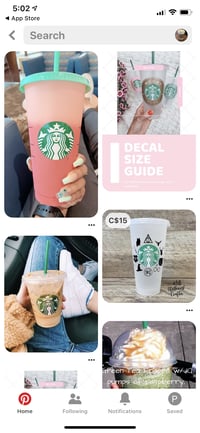
The Lens feature provides new opportunities to brands as people use it to find more information about the products they like or have seen in real life. In fact, many Lens searches relate to products across categories like:
- Retail
- Beauty and fashion
- Food
- Travel
- Auto
If you’re targeting anyone under 60 years old with your campaign, odds are that a portion of those people will find themselves on Pinterest as they research and look for inspiration for their next purchase.
But just running campaigns and hoping for success isn’t enough. You always need to find a way to experiment with, track, and improve on your performance.
As you’re building out your Pinterest marketing strategy, there are two major areas that I would test first: Audience targeting and A/B testing.
Like any online ad strategy, identifying effective target audiences and posting quality content will have a major impact on how well you are going to do on Pinterest.
How do you know which audiences to target or what content is considered good? You run experiments.
Below, I’ll walk you through four Pinterest advertising experiments that focus primarily on audience targeting and image testing. I’ll also highlight the results I gained from testing Pinterest ads for Fun & Function — a brand that sells toys and products designed for children and young adults on the autism spectrum.
Targeting Your Pinterest Ads
Running ads on Pinterest is similar to runnings ads on other online platforms, like Facebook. This means you’ll similarly want to identify and leverage your target audience.
To help you with audience targeting, the Pinterest Ads Manager allows you to upload contact lists. When you launch an ad, you can then select this list in your targeting settings and Pinterest will show the content to users that created an account with a matching email address. You can also direct your ad to be shown to a group of Pinterest users that share similar demographics and interests with people on your contact list.
For further audience targeting, you can also use place a Pinterest tag code on your own website. A tag code, formerly called a Pinterest Pixel, is a unique piece of JavaScript that allows Pinterest to track purchase behavior information about your own website visitors.
With the data Pinterest’s tag code collects, the Ad’s Manager can create more lists of people that you can target your ads to.
Like Google Ads, the Pinterest Ads Manager also allows you to target different audiences with keywords or create ad groups (or a group of multiple ads) for each PPC campaign.
Below, I’ve highlighted two experiments you can do to find out which audience targeting strategies will work best for your ads.
Experiment 1: Target ads using remarketing lists.
Fun & Function wanted to bring in more revenue, grow audiences, and target prospective buyers beyond Google and Facebook. Since the toy brand already had remarketing lists — or lists of contacts that had shown interest in buying its products — I knew that targeting these contacts and similar audiences on Pinterest was the smartest first move.
Remarketing lists include people that have done something to show interest in your product. For example, these lists could include contacts of prospects who’ve called you, people who’ve abandoned carts, previous customers, or marketing email subscribers.
When it comes to targeting an audience on Pinterest, it’s usually most effective to leverage and upload remarketing lists. This allows you to send an ad to people who’ve shown interest in your product, which could remind them to purchase it or make them want to research it more thoroughly.
When I began working with Fun & Function’s Pinterest ads, I uploaded these remarketing lists:
- Site Visitors for 30 days and 60 days
- Visitors Starting Checkout in the past 30 and 60 Days
- Purchasers in the past 30 and 60 days
By building and uploading the email and contact lists above, we were able to increase conversions on Fun & Function’s Pinterest ads by 30%.
When running this list experiment, we found that the Purchasers list, noted above, helped us upsell more products to Fun & Function’s previous customers. For precise targeting, we also could use lists to automatically exclude people marked as “Purchasers” from ads targeted at people on “site visitors” or “visitors starting checkout” lists.
Once you populate your own lists, I would start to test ads for each audience and see which group drives better performance. As you get started, you should also remember that people come to Pinterest to be inspired and research for future purchases. They’re not always in the purchase mindset right away.
Let any test you run last for at least 30 days, which should give even the smallest brand an opportunity to see how Pinterest works for their brand.
Experiment 2: Test relevant keywords.
Once you’ve experimented with remarketing lists, move on to testing keyword targeting.
If you’ve run PPC ads on search engines like Google or Bing, take your best-performing keywords and use those as your first list of words or phrases you’re going to use for Pinterest ad targeting.
Sometimes, when you target ads with just keywords, you might find that one keyword creates a large audience size. Having too large of an audience might mean that your ads are being seen or clicked on by people who might not be that interested in your product. It also might mean you pay more for an ad that’s less effective because it’s sent out to so many people.
To zone in on the most effective target audience, rather than promoting your post to the biggest audience, test out ads that use marketing targets, such as keywords and remarketing lists. This should shrink down your list size and give you a more specific group of people to go after.
Again, let tests run for 30 days. Testing different remarketing lists and keyword audiences is the best way to determine what’s going to work for your brand on Pinterest.
Images and Creative Assets
Experiment 3: Test content that works well on Facebook Ads
Pinterest and Facebook are very similar in that they both use images and videos as their primary ad format.
If you’ve already used Facebook Ads, you should identify which imagery is already doing well on that platform. Then, bring those assets and strategies over to Pinterest. Use those images and videos in your first round of ads and see how they perform.
Your audience on Pinterest and Facebook might be very similar. But, sometimes your Facebook assets may not work on Pinterest. For example, one of the key differences you’ll notice between Facebook and Pinterest ads is how lifestyle imagery and product shots perform.
If you haven’t worked with visuals before, lifestyle imagery incorporates a product into scenes from daily life, while product shots are usually just photos of a product.
Need a visual example of lifestyle imagery? In this Target pin, the store uses lifestyle imagery by showing its products naturally within a room.
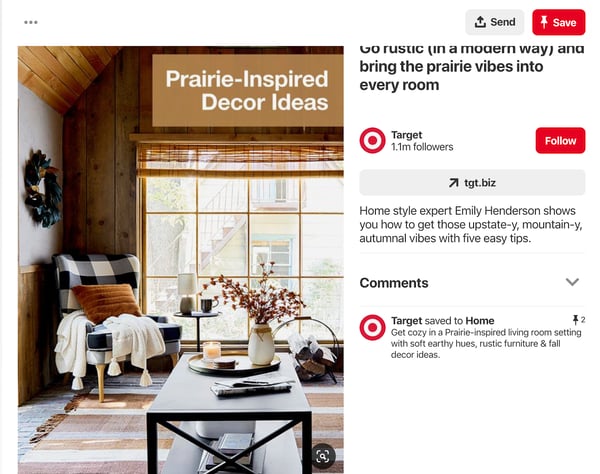
When it comes to lifestyle versus product shots, Facebook users will engage with ads that feature a product shot. However, we’ve found that lifestyle images do a lot better on Pinterest.
If your Facebook assets aren’t engaging on Pinterest users, try the opposite approach where your Pinterest ads contain imagery that’s completely different from what you’ve used on Facebook.
Experiment 4: A/B test different types of images.
The tests you do related to audience targeting should also be complemented with the testing of images and other creative assets — like videos or infographics. Pinterest is a visual platform after all.
When I began doing A/B tests for Fun & Function, we wanted to determine which types of images we should make more of going forward.
To run our Pinterest-based A/B test, we created a series of ads that each promoted one of Fun & Function’s cheapest or best-selling items. For each product, we uploaded four images into an ad group: two product shots and two lifestyle images.
We then showed all the Pinterest ad variations to users who abandoned their Fun & Function shopping cart or people who already bought a similar item. We found that lifestyle images produced 50% more conversions and revenue than ads with a product shot.
Aside from product versus lifestyle imagery, here are a few other creative asset tests you can run with your Pinterest ads:
- Aspirational images: These images show people achieving something or completing tasks. Away — a luggage company — does a great job of showing off this type of imagery.
- Single people vs. groups of people in images: On some platforms, people might be drawn to ads with multiple people in them over ads showing just one person. When you run A/B tests, consider making an ad group with a few images with a varying number of people.
- Story and non-story based images for carousel ads: Test out carousel ads that have photos that work together in a sequence against carousels that have less connected imagery.
- Short brand awareness videos vs. longer video formats: Some people prefer to see a quick video while other groups might enjoy longer-form more. Determine which preference your target audience has by testing these two formats.
Monitoring Your Pinterest Experiments
The key to successful Pinterest advertising is to test and see what works well for your brand. So, as you plan and launch each experiment, pay careful attention to the key performance indicators (or KPIs) that are important to your company. These success metrics could include micro or macro conversions, web traffic, or ROI rates.
As mentioned above, run each experiment for at least 30 days. This will give you enough time to get valuable results and actionable learnings from each test.
Even when you are hitting your KPIs and enjoying what Pinterest has to offer. Don’t settle and slow down. Continue building on your momentum and test out your audiences and assets.

How to Create a Market for Your Product When There Isn’t One
I’m on the floor in this tiny office above a bar in Mountain View, fiddling with the wifi router and thinking to myself — “Wow, so this is what it’s like to be a CEO!”
Like a lot of you reading this, we had dreams of being a big, successful tech company, but in order to do it, we needed to create a new category of business.
There are a few reasons you might think you want to do this:
- Take advantage of a new trend.
- Identify and corner a new type of buyer.
- Combine multiple markets.
- Reboot an old market.
Oh, and one more — it’s lucrative. According to Harvard Business Review, “Companies that were instrumental in creating their categories accounted for 53% of incremental revenue growth and 74% of incremental market capitalization growth.”
And my company, Gainsight (like a lot of would-be category creators) was eager to receive those benefits right away.
But we also saw the big drawback. If you’re thinking about category creation, you’ve already thought of it, too — there are no customers.
Fast forward five years later, and I’m not fixing Gainsight’s wifi anymore. Instead, I’m skimming this article and find Gainsight mentioned in the same breath as category creators such as Drift, Slack, and HubSpot. It makes me ask myself, How did I get here?
We did not do everything right, and the things we did do right, we didn’t always do right the first time. But looking back, there were five things we did that helped create our customer success category. Let’s dive into those strategies now, so you can emulate them yourself.
Five Strategies to Create a Product Category
1. Get the name right.
So you’re creating a product category — what’s the name going to be? Names matter, so it’s a tricky business. A rose by any other name might smell just as sweet, but it won’t sell just as sweet.
We looked at seemingly countless options, ranging from customer analytics to customer insights and even customer artificial intelligence.
We also listened to pretty much everyone, too. There has been a widely accepted belief in B2B that analysts are the defining voice for new categories. With their two-by-twos and expert analysis, these firms have built very successful businesses offering advice to companies on product positioning, naming, and overall strategy.
However, without any disrespect to the analyst community, the world is changing. Customers have more voice, and technology has enabled companies such as G2 and TrustRadius to give these customers a medium by which to validate categories and brand leadership.
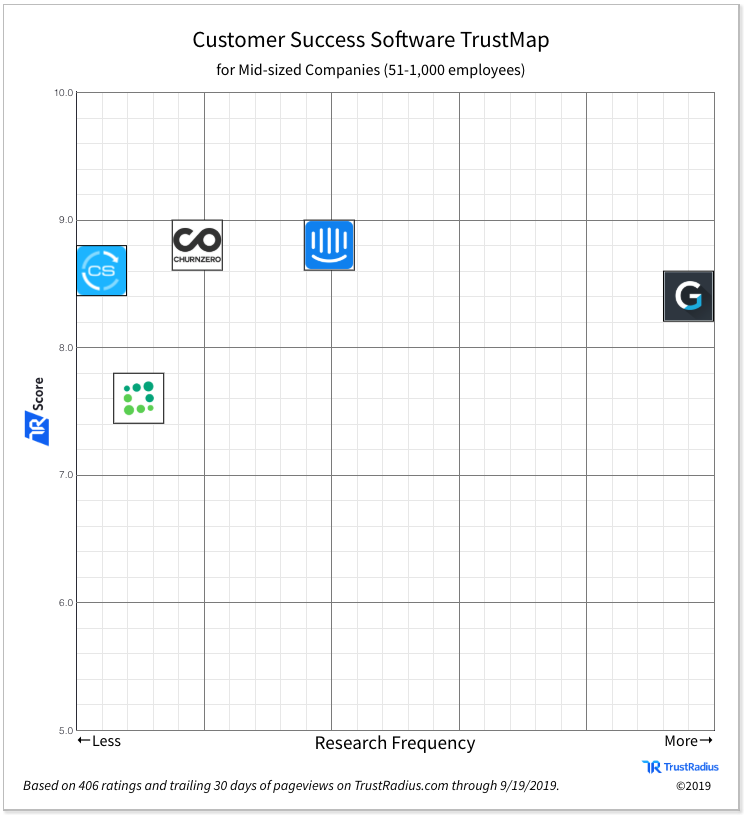
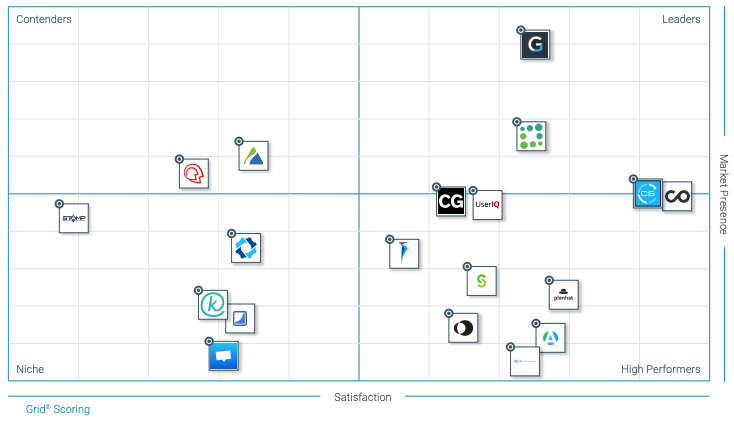
At the end of the day, it’s the customer who defines the category. Beyond simply validation, best-of-breed companies work collaboratively with their customers to define processes, standardize metrics, and settle best practices. Whether organically through ongoing engagement with customers or more formally through advisory committees, categories are not created in silos.
At the time, there was a job that existed called Customer Success Manager. It was under-resourced and maybe a little under-appreciated, but it was real. These CSMs would meet online in a LinkedIn Group and in person in offices across the Bay Area. They had a ton of passion and energy when they connected with each other.
Ultimately, we listened to them. It was the right call for us, and it’s likely the right call for you.
Takeaway:
- Listen to the customer or people who interact regularly with your target audience when choosing a product or company name
2. Separate your community brand from your company brand.
When Anthony Kennada (our former CMO) had the idea to put on an event for CSMs, we were still in the process of rebranding from Jbara to Gainsight. So we decided to call the conference Pulse, a micro-brand that we still operate today, which has become synonymous with the customer success community and Gainsight’s thought leadership.
The choice to separate the more community-driven brand from the technology was motivated by necessity, but also proved to be prescient — the community needed to grow regardless of whether or not they bought Gainsight. We decided we weren’t going to talk about Gainsight in the early days of Pulse.
And it was tough, because you want all your actions to fuel your funnel, and figuring out how to talk to finance or the board about that choice can be really hard.
However, in the end, we’ve seen a ton of growth in the conference overall. This year, we drew nearly 6,000 people to Moscone Center and another 1000+ to events in London, New York, Atlanta, Seattle, Boston, and Sydney:
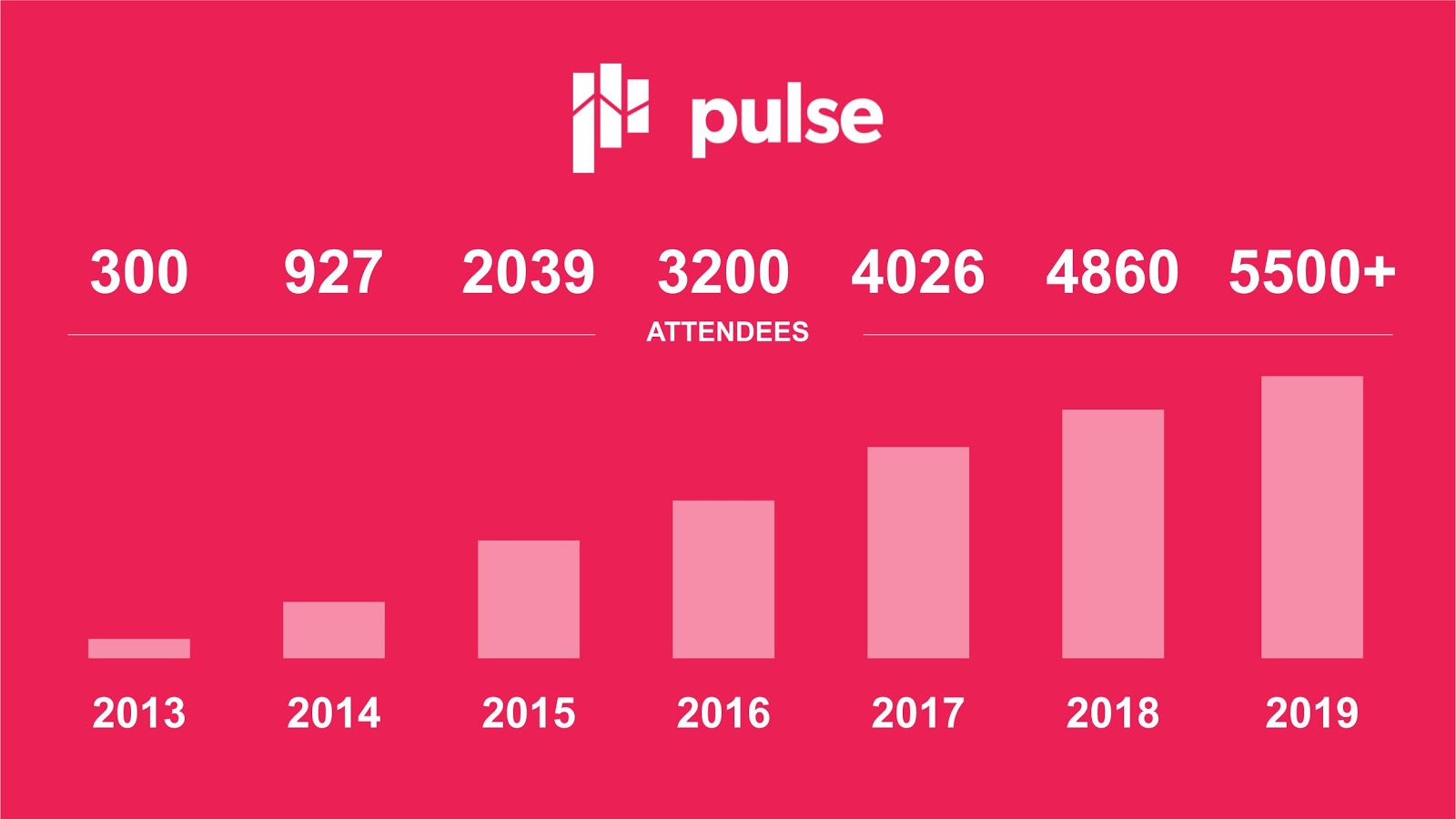
Customer success is a self-sustaining community now, and we find the Pulse audience is actually a lot hungrier for product-focused content at our events. But in the early days of category creation, that wasn’t be the case.
Three takeaways:
- Separate your community brand from your company brand.
- Momentum is everything!
- The community is your “product” too!
3. Evangelize.
Want happy enterprise customers?
You gotta get on jets, folks
You gotta go there https://t.co/VdvxT4WOnP
— Jason ✨😊✨ Lemkin 🦄 (@jasonlk)
January 11, 2019
As Jason Lemkin says, you gotta get on jets. We talked, we listened, we visited as many companies, customers, prospects, and partners as humanly possible.
It’s a muscle we exercised early and I still (proudly) spend more time with customers than many CEO’s I know.
We spent endless hours doing webinars, podcasts, blogs. We literally wrote the book on customer success. That was instrumental for the category, and for Gainsight. But like Pulse, we kept the focus on the person, not the product.
But the ultimate value in all this effort had less to do with what we were able to say to our growing community, and everything to do with what they had to say to us.
All this facetime (especially with customers) infused their voice deeply into our product, our culture, our evangelism. It gave us an unbeatable advantage.
Three takeaways:
- Meet your customers (in-person, if possible).
- It’s about the people not the product.
4. Be authentic at scale.
People like doing business with people they trust, admire, and like. Your executive team ought to be the public expression of the company’s purpose and values. For me, that means being vulnerable — and I would encourage you to try it, too.
We’ve been pretty transparent about Gainsight’s purpose, to be living proof that you can win in business while being human-first. Our values are the foundation for who we are and how we choose to work with each other, our customers, and our community.
Social media gives you a great opportunity to do this at scale. One of our values is Childlike Joy, and we’ve made no secret of it — whether it’s our carpool karaoke videos, my weird fixation on parody hip-hop songs, or even just being intentionally more open.
Three takeaways:
- Blur the lines between culture and community.
- Spend more time in person
- No shame (as displayed in the hip-hop song)!
5. Focus on long-term results.
You don’t need me to tell you that the category creation play is not about getting quick wins. It takes a lot more patience to go-to-market this way than it does to try to disrupt an established industry.
But we also know how tempting it can be to chase those quick wins at the expense of long-term strategy, especially when board meetings come every quarter, not every five years.
One of the biggest advantages we had was strong alignment between our Product teams and our Customer Success teams. It doesn’t matter what category you’re trying to create — you need to deliver on your customers’ desired outcomes, and you need to do it with your product, not just your focus on good customer success.
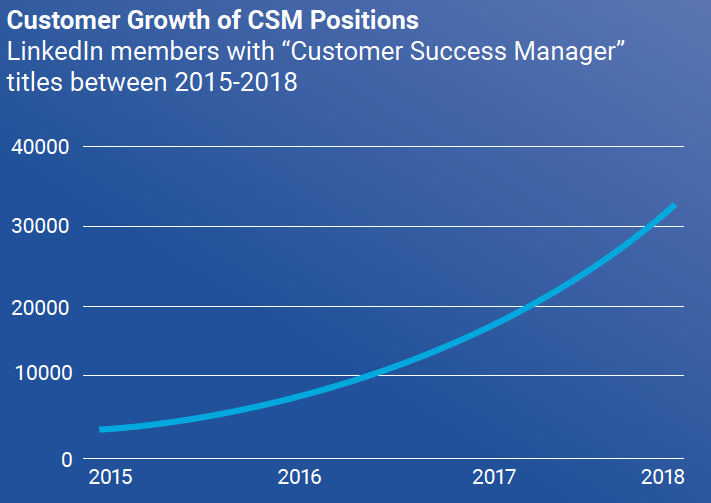
For us, the process paid off. There are 32,479 true CSMs in the world today. That’s over 100% growth each year for the past three years, and there are currently 71K open new jobs, 45% of which are outside the U.S. Nowadays, customer success is one of the fastest-growing careers.
Three takeaways:
- Product and Success together.
- Scale sales carefully.
Be patient—it can happen for you, too.
Gainsight is to customer success industry in 2016
AS
HubSpot was to the marketing industry in 2012 (or something like that)
— Brian Halligan (@bhalligan)
May 11, 2016

How to Improve Your Facebook Ads During a Holiday Season
Do you run seasonal Facebook ads during Christmas, Hanukkah, or any other holiday season? Wondering how to run more successful holiday ad campaigns? In this article, you’ll discover how to warm up an audience and deliver holiday-themed Facebook advertising campaigns. Why Seasonal and Holiday Ad Campaigns Matter For many businesses, seasonal campaign performance can be […]
The post How to Improve Your Facebook Ads During a Holiday Season appeared first on Social Media Marketing | Social Media Examiner.
from Social Media Marketing | Social Media Examiner https://ift.tt/363gZZJ
via socialmediaexaminer
How to Run a SWOT Analysis for Your Business [Template Included]
A SWOT analysis is a useful technique to evaluate a new project or objective your business faces, or your business as a whole.
Essentially, a SWOT analysis is a roadmap for how you should move forward with your business, which opportunities you’re missing out on, and which challenges you should tackle.
It’s an effective method to maximize opportunities while minimizing negative factors associated with a given project or objective. Plus, it lets you unbiasedly evaluate your business’s strengths and weaknesses, which is key to avoiding unnecessary errors down the road from lack of insight.
Here, we’ll provide a SWOT analysis template, and conduct SWOT analyses on major brands Apple and Starbucks. When you’re done reading, you’ll have all the inspiration and tactical advice you need to tackle a SWOT analysis for yourself.
What is a SWOT analysis?
A SWOT analysis is a method used to evaluate your business’ Strengths, Weaknesses, Opportunities, and Threats. Using a SWOT analysis helps you identify areas your business can improve and maximize opportunities, while simultaneously determining negative factors that might hinder your chances of success.
You know a SWOT analysis is important, but, how do you conduct one?
There are four steps you’ll want to take when evaluating your business as a whole, or your product in particular. Before you start, you’ll need to figure out what you’re evaluating with your SWOT analysis. Creating a social media program, launching a new product, or considering a brand re-design are all good reasons to conduct a SWOT analysis.
Use this SWOT Analysis Template.
To visualize your SWOT analysis, it’s helpful to make a table. Here, I’ve created a sample using a simple Google Doc table — feel free to use the model yourself, or create your own as it suits your needs.
Make a SWOT Analysis Table

Use the four staps below as a references when filling in your table.
1. Identify your strengths.
Let’s say you want to use a SWOT analysis to evaluate your new social media strategy.
If you’re looking at a new social media program, perhaps you want to evaluate how your brand is perceived by the public — is it easily recognizable and well-known? Even if it’s not popular with a widespread group, is it well-received by a specific audience in particular?
Next, think about your process: is it effective, or innovative? Is there good communication between your marketing and sales to ensure both departments use similar vocabulary when discussing your product?
Finally, evaluate your social media message, and in particular, how it differs from the rest of the industry. I’m willing to bet you can make a lengthy list of some major strengths of your social media strategy over your competitors, so try to dive into your strengths from there.
2. Identify your weaknesses.
If you’re examining a new social media strategy, it’s critical to foresee any potential negative factors that could mitigate your success.
Start by asking yourself these questions: First, if I were a consumer, what would prevent me from buying this product, or engaging with this business? What would make me click away from the screen?
Second, what do I foresee as the biggest hinderance to my employees’ productivity, or their ability to get the job done efficiently? What derails their social media efforts?
When identifying weaknesses, consider what areas of your business are the least profitable, where you lack certain resources, or what costs you the most time and money. Take input from employees in different departments, as they’ll likely see weaknesses you hadn’t considered.
3. Consider your opportunities.
This is your chance to dream big. What are some opportunities for your social media strategy you hope, but don’t necessarily expect, to reach?
For instance, maybe you’re hoping your Facebook ads will attract a new, larger demographic. Maybe you’re hoping your YouTube video gets 10,000 views, and increases sales by 10%.
Whatever the case, it’s important to include potential opportunities in your SWOT analysis. Ask yourself these questions: What technologies do I want my business to use to make it more effective? What new target audience do I want to reach? How can the business stand out more in the current industry? Is there something our customers complain about that we could fix with our social media strategy?
The opportunities category goes hand-in-hand with the weaknesses category. Once you’ve made a list of weaknesses, it should be easy to create a list of potential opportunities that could arise if you eliminate your weaknesses.
4. Contemplate your threats.
It’s likely, especially if you’re prone to worrying, you already have a good list of threats in your head.
If not, gather your employees and brainstorm: what obstacles might prevent us from reaching our social media goals? What’s going on in the industry, or with our competitors, that might mitigate our success? Is there new technology out there that could conflict with our product?
Writing down your threats helps you evaluate them objectively. For instance, maybe you list your threats in terms of least and most likely to occur, and divide and conquer each. If one of your biggest threats is your competitor’s popular Instagram account, you could work with your marketing department to create content that showcases your product’s unique features.
SWOT Analysis Examples
The template above helps get you started on your own SWOT analysis.
But, if you’re anything like me, it’s not enough to see a template. To fully understand a concept, you need to see how it plays out in the real world.
Here are two examples of SWOT analyses on major corporations, Apple and Starbucks. The list of strengths and weaknesses is not exhaustive, and I’m sure you could add some yourself, but hopefully, it’s enough to inspire your own SWOT analysis.
Apple’s SWOT analysis
Here’s how we’d conduct a SWOT analysis on Apple.
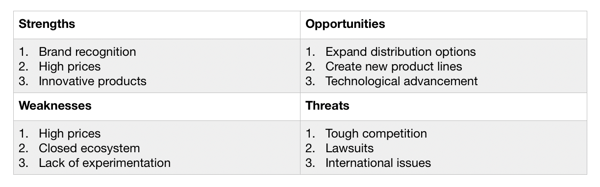 First off, strengths. While Apple has many strengths, let’s identify the top three:
- Brand recognition
- High prices
- Innovative products
Apple’s brand is undeniably valuable, and was named the world’s most valuable brand by Forbes. Since it’s easily recognized, Apple can produce new products and almost ensure a certain degree of success by virtue of the brand name itself.
This degree of recognition lends itself to Apple’s ability to sell products at extremely high prices. For instance, in 2016, Apple sold 78 million iPhones, the average cost of which was $695. In comparison, Samsung sold their smartphones for $500 less. And yet, 92% of the profits in the smartphone category for 2016 went to Apple. Often, people don’t care about price as much as they care about brand recognition.
Lastly, their innovative products: Apple didn’t earn its reputation for nothing. They create highly innovative products, which are often at the forefront of the industry.
Next, let’s look at three of Apple’s weaknesses.
- High prices
- Closed ecosystem
- Lack of experimentation
While the high prices don’t deter Apple’s middle and high class customer-base, they do hinder Apple’s ability to reach a lower-class demographic.
Apple also suffers from its own exclusivity. Apple controls all its services and products in-house, and while many customers become loyal brand advocates for this reason, it means all burdens fall on Apple employees.
Ultimately, Apple’s tight control over who distributes their products limit their market reach.
Lastly, Apple is held to a high standard when it comes to creating and distributing products. Apple’s brand carries a high level of prestige, but that level of recognition inhibits Apple from taking risks and experimenting freely with new products that could fail.
Now, let’s take a look at opportunities for Apple.
It’s easy to recognize opportunities for improvement, once you consider Apple’s weaknesses. Here’s a list of three we came up with:
- Expand distribution options
- Create new product lines
- Technological advancement
One of Apple’s biggest weaknesses is its distribution network, which, in the name of exclusivity, remains relatively small. If Apple expanded its network and enabled third-party businesses to sell its products, it could reach more people globally, while alleviating some of the stress currently put on in-house employees.
There are also plenty of opportunities for Apple to create new products. Apple could consider creating more affordable products to reach a larger demographic, or spreading out into new industries — Apple self-driving cars, perhaps?
Finally, Apple could continue advancing its products’ technology. Apple can take existing products and refine them, ensuring each product offers as many unique features as possible.
Finally, let’s look at threats to Apple.
Believe it or not, they do exist.
Here are three of Apple’s biggest threats:
- Tough competition
- Lawsuits
- International issues
Apple isn’t the only innovative tech company out there, and it continues to face tough competition from Samsung, Google, and other major forces. Many of Apple’s weaknesses hinder Apple’s ability to compete with the tech corporations that have more freedom to experiment, or that don’t operate in a closed ecosystem.
A second threat to Apple is lawsuits. Over the last few years, Apple has faced a bunch of lawsuits, particularly between Apple and Samsung, and so far it has only won one case. These lawsuits interfere with Apple’s reputable image, and could steer some customers to purchasing elsewhere.
Finally, Apple needs to improve its reach internationally. It isn’t number one in China, and doesn’t have a very positive relationship with the Chinese government. Then, in India, which has one of the largest consumer markets in the world, Apple’s market share is low, and the company has trouble bringing stores to India’s market.
If Apple can’t compete globally the way Samsung or Google can, it risks falling behind in the industry.
Starbucks SWOT Analysis
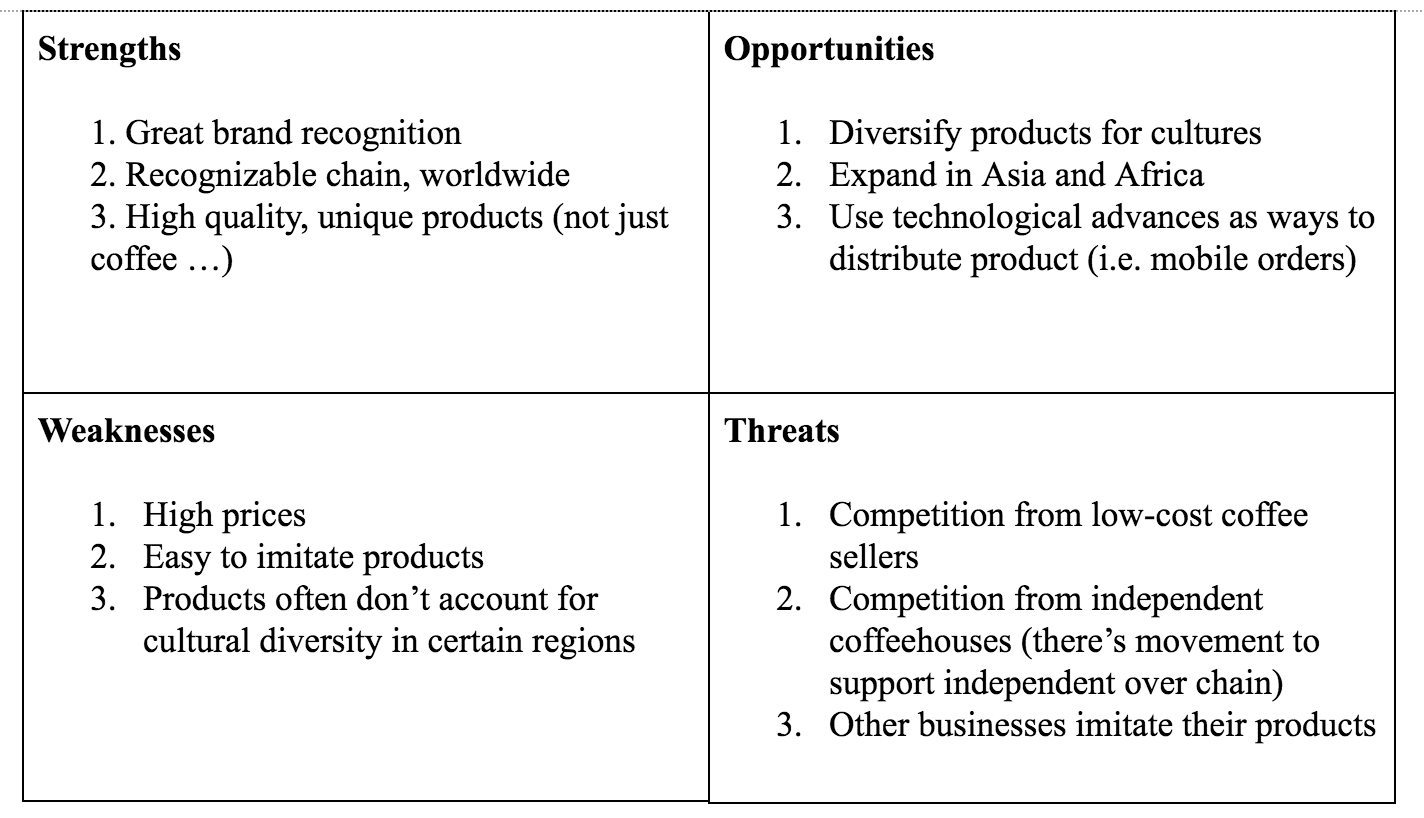
Now that we’ve explored the nuances involved with a SWOT analysis, let’s fill out a SWOT template using Starbucks as an example.
Here’s how we’d fill out a SWOT template, if we were Starbucks:
Dine-In Thai Restaurant SWOT Analysis
Some small-business marketers may have difficulty relating to the SWOT’s of big brands like Apple and Starbucks, so here’s an example of how a restaurant might visualize each element:
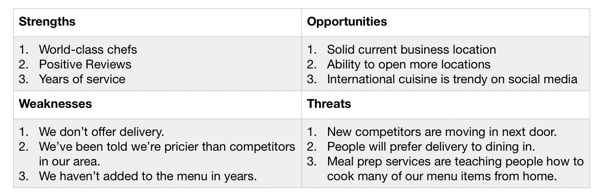 While a Thai or any other restaurant might not be as worried about high-level lawsuits like Apple, the small business might be more worried about competitors or disruptors that might enter the playing field.
Local Boutique SWOT Analysis
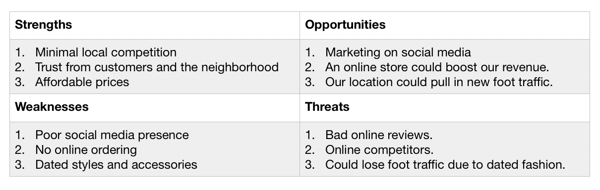
In another small-business example, a local boutique might be well known in its neighborhood, but it also might take time to build an online presence or get its products in an online store. Because of this, some of its strengths and opportunities might relate to physical factors while weaknesses and threats might relate to online situations.
When to Use a SWOT Analysis
Ultimately, a SWOT analysis can measure and tackle both big and small challenges, and opportunities, and both big and little strengths and weaknesses.
While the examples above focus on businesses in general, you can also use a SWOT analysis to evaluate and predict how a singular product will play out in the market.
Hopefully, our SWOT template will supplement your market research and business analysis, and provide fair insights into how to optimize your products for bigger payoffs, and less hurdles.

How to Explain Banner Ads to Anyone

Sometimes, when it comes to advertising, we feel as talented as Don Draper in Mad Men — one of the best (fictional) advertisers in the game. However, advertising has evolved since the 60s, and that’s partly thanks to how expansive the internet has gotten with commerce.
Banner ads, for example, weren’t around until recently. But for prime ad placement, banner ads are the way to go and have cemented their importance in revenue gain for marketers.
So what exactly are banner ads and how do they work? We’ve got a simplified version you can use to explain them to anyone.
Banner ads fall into the category of digital advertising, one of the most lucrative ways to generate revenue. In fact, in 2019’s first quarter, revenue from digital ads reached a landmark high of over $28 billion.
A great banner ad grabs the reader’s attention and invites them to learn more about what’s being advertised. They’re bright, welcoming, and don’t have much text, instead using images or multimedia to convey a message. Check out this banner ad as an example:
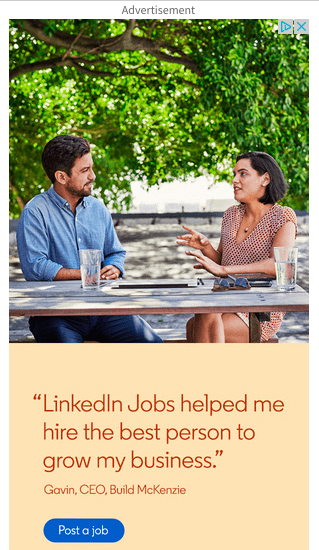
LinkedIn’s banner ad was found in the sidebar of a webpage I was browsing. It was large enough to catch my eye and inviting enough to make me linger on the ad.
This is a great banner ad because the description is a quote from a C-suite professional, making LinkedIn look reputable to business owners searching for new talent. The high-quality visual proves that the service cares about seeming professional. Lastly, the CTA has text that leads you to act instead of saying “Click here to find out more!”.
Banner ads are lucrative because of programmatic advertising, a term that describes how advertisers place ads. The software of these programs matches ads with the interests of website browsers.
To illustrate, let’s say LinkedIn’s ad team wanted to use Google Ads as their programmatic advertiser. Google Ads would then sell LinkedIn a sidebar space on websites professionals are more likely to visit, such as Investopedia. This ensures more potential for overall revenue earned for LinkedIn.
Let’s look at how much LinkedIn likely paid for their ad, and how much banner ads are going to cost you in cost per impressions (CPM) and cost per action (CPA) for popular advertisers. Recall that impressions are how many browsers saw an ad, and actions are those who clicked.
As websites gain popularity, their prices for ads are going to rise. While these are the most popular advertisers, this list isn’t exhaustive. Check out our ultimate guide on advertising to find out more options for the cost of banner ads.
Now that you have an idea of average banner ad price tags, let’s get into how to make them stand out, and get into examples of excellent ones.
Standard Banner Ads Sizes
Because banner ads are flexible with their display, there’s corresponding sizes that come with it. Most importantly, there are five sizes to keep in mind when formatting your banner ad; the ones that are top-performing with click rates.
- 336 x 280: This will give you a large rectangle
- 300 x 600: This is half of a webpage
- 300 x 200: This will display a medium-sized rectangle
- 320 x 50: This is a mobile header banner
- 728 x 90: This will give you an optimized header
The ad templates for Google AdWords and Bannersnack will automatically format your banner ads to the correct sizes, so you won’t need to worry about cropping and optimizing.
Having the correct sizes for your banner ads help you format the visual aids of your ad. For instance, a GIF will probably not be the best choice for a 320 x 50 ad on mobile, especially if the file is a little larger than usual.
Best Banner Ads
It’s crucial to know the necessary sizes for your banner ads — but it’s not your only consideration. In order to make sure your banner ad is effective to target audiences, we have some tricks to keep in mind while you’re designing yours.
Let’s say you have all the tools for creating your banner ad in place. While the actual execution of the design is up to you, it’s important to incorporate these elements in your ad to make sure it’s effective, and not just something that crowds up a webpage.
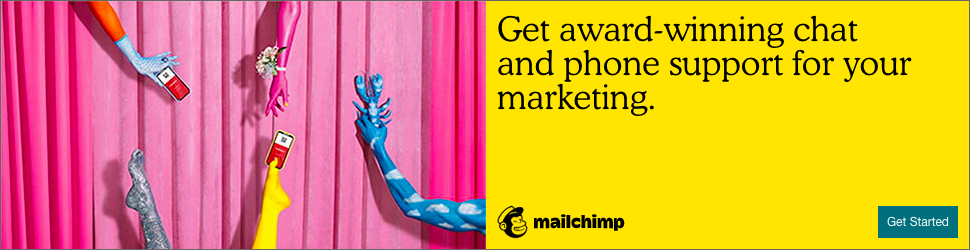
To illustrate steps, let’s use this 300 x 200 banner ad from Mailchimp on Entrepreneur’s website.
1. Incorporate a CTA.
A call-to-action (CTA) is what invites prospective buyers into discovering more about your product or service. This is what gets them to click on the ad and interested in learning more. Mailchimp’s CTA is the blue “Get Started” button at the bottom of their ad.
A bright, eye-catching CTA points your target audience in the right direction, and linking to your product page is a good way to get clicks on your website.
2. Add your brand.
If your logo isn’t visible, how will people know what your business is? Mailchimp’s logo is at the bottom of the ad in a clear spot. The logo doesn’t have to take up the entire ad or interrupt the flow of the rest, it just has to be recognizable among the rest of the ad’s imagery.
3. Make sure to use keywords.
Using keywords and action items will not only optimize your ad for search engines but has a better chance of browsers interacting with your ad because your service sounds right for them. Mailchimp uses words like “award-winning,” “support,” and “get started.”
If I were looking for marketing tools to make my life easier, award-winning software that offers support sounds right up my alley. If getting started is as easy as clicking a button, there’s no reason not to at least check it out.
4. Use high-quality visuals
To keep your ad professional, any visual elements, such as images or GIFs, should be high quality. While moving images are a way to keep ads interesting, static images are just as effective.
Mailchimp’s imagery is fun and gets the point across. Their logo is also a way to convey imagery, making sure their brand stays in their audience’s memory.
5. Keep things simple
A crowded ad is nothing but a nuisance to web browsers. An effective ad has minimal text, one or two images, and a CTA. Mailchimp’s ad is one sentence and includes large text.
Some banner ads don’t even have text or images at all, just a logo and a CTA. Though your ad doesn’t need to be that minimalist, it doesn’t need to have as much information as you may think. If your ad has more than one short sentence, it may be too much.
Let’s look at some excellent uses of banner ads and why they’re effective.
Banner Ads Examples
1. Pottery Barn
This desk ad from Pottery Barn is a good example of how a little goes a long way. Using a showroom photo to highlight the practicality of desks, it gives way to how easily their furniture could fit into a space.

With the logo, an engaging call to action, and a simple design, all five points of an incredible banner ad are covered, and it’s effective. For students browsing Amazon or professionals building their home office, this ad would be an excellent cater to them.
2. Blue Bloods
CBS’s banner ad for one of their shows has an awesome CTA. “Try 1 Week Free” entices the audience to check out their new streaming service, CBS All Access.

Using a show that’s already popular, and having all episodes streaming, pulls in binge watchers. This ad also incorporates the show’s logo and star. It also gives viewers all the information they need without appearing too crowded.
3. SEMrush
Popular SEO extension SEMrush used the small rectangular banner ad choice, which is not only pocket friendly, but useful for ads that don’t require a lot of information to get the point across.

In this ad, SEMrush lets you know exactly what their service provides in less than 20 words. Keywords “UX,” “SEO,” “Time,” and “Page Speed” are all golden here. They’re effective in grabbing the attention of companies looking to heighten their analytics.
4. Chevy
Providing all the specs of a car on a banner ad isn’t possible without the ad looking too busy. Chevy chose to play with text in order to keep the information there without being overwhelming. Moreover, they chose essential information and wording to make sure the impact would be as great as it can be.

Chevy also made it a point to incorporate color into the most important words. The discount on this car and the CTA are both in yellow, bringing the attention straight to those two elements of the ad.
5. The New Yorker
Minimalism goes a very long way, and The New Yorker knows this.

The magazine has a promotion going on that includes a free tote bag with a subscription. Imagery of both products a new subscriber will receive is a good way to use imagery, and the price here is bolded, meaning it’s of importance.
You’ve probably interacted with a ton of banner ads with minimal knowledge of them. The truth is that they’re a great asset to boosting visits to your site and expanding your audience. Not that complicated, right?
For more resources on how to advertise for your business, check out our post about how to run Facebook ads.

The Ultimate Guide to Amazon Advertising
I’m willing to bet, whenever you have marketing strategy discussions with your team, you typically discuss the same three or four social platforms — Facebook? Check. Instagram? Check. Pinterest? Check.
But — what about Amazon?
In 2018, Amazon launched “Amazon Advertising”, (formerly Amazon Marketing Services, or AMS), as a search advertising solution for Amazon vendors.
Similar to pay-per-click ads on Google, sellers only pay when shoppers click on ads.
If you’re already not utilizing AMS, your team should consider it. According to Amazon, “76% of Amazon shoppers use the search bar to find an item, and search advertising is a way for brands to stand out among the competition.”
While Amazon owns significantly less market share than Google and Facebook, Amazon’s advertising revenue skyrocketed by 250% in the third quarter of 2018 compared to the third quarter of 2017.
Additionally, some industry experts predict that the long-standing advertising duopoly of Google and Facebook will turn into a triopoly as soon as next year, with Amazon charging right behind these established incumbents.
As Allie Decker, a content creator on the HubSpot pillar team, writes, “Today’s consumers don’t just use Amazon to buy stuff. They also use it to check prices (90% of consumers use Amazon to price check a product), discover new products (72% of consumers visit Amazon for product ideas), and start product searches (56% of consumers visit Amazon before any other site).”
To help you get started advertising on Amazon, we’ve created this simple guide that fleshes out each type of ad you can run on Amazon and some of their best practices. Read on to learn how to advertise on the ecommerce platform in 2020.
Amazon Advertising Strategy
Even though we’ll be describing five unique types of Amazon advertisements that all have different best practices, here are three general tips for shaping a successful Amazon advertising strategy:
1. Determine your goals.
Whether you want to drive more sales or boost brand awareness, Amazon allows you to align your targets with your goals. For instance, you can deem your Advertising Cost of Sales (ACoS) as your metric of success if you’re focusing on driving more sales. Alternatively, you can deem impressions as your metric of success if you’re focusing on boosting brand awareness.
2. Choose the right products to advertise.
Advertising your most popular products gives you the best chance to convert clicks into purchases. You should also make sure these products are in stock and priced competitively.
3. Craft clear, concise, and compelling product detail pages.
Amazon ads can entice shoppers to visit your product detail pages, but the product detail page is what will ultimately turn those shoppers into customers. To craft a persuasive product detail page, consider including accurate and descriptive titles, high-quality images, and relevant and useful product information.
Amazon Sponsored Ads
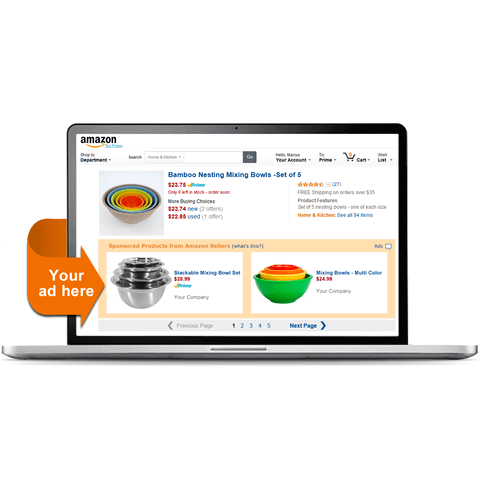
Amazon Sponsored Product Ads are pay-per-click, keyword-targeted display ads for individual products that appear on the search results and product detail pages. With Sponsored Product Ads, there are three types of keywords you can bid on if you decide to leverage manual targeting — broad, phrase, and exact.
Broad keywords can include words before and after the target keyword, like “white hand mixers”, if you sell hand mixers. Targeting these keywords will expose your ads to the greatest amount of traffic.
Phrase keywords focus on how the sequence of the words you use changes the context of a query. For example, “stainless steel hand mixer” indicates you sell hand mixers. But “hand stainless steel mixer” indicates you sell stainless steel mixers, but not necessarily stainless steel hand mixers.
Exact keywords are the most constraining type of targeted keyword — a shopper’s search query must contain the exact keyword for your ad to show up and no words can come before or after the keyword. For example, if you choose to target exact keywords, you can target an ad for “hand mixer”, but it won’t show up for the query “electric hand mixer”.
Using Sponsored Product Ads, you can also use automatic keyword targeting, which leverages an algorithm to target the most relevant keywords for your product ads.
To gauge the performance of your ads, Sponsored Product Ads offers a reporting tool that displays your ads’ clicks, spend, sales, and advertising cost of sales (ACoS).
Amazon Sponsored Ads Best Practices
Targeting
With Amazon Sponsored Product Ads, you can find keywords that have low conversion rates and flag them as negative. This way, Amazon will stop showing your ad to shoppers who search for those queries. Ensuring you flag certain keywords as negative is critical — even if these keywords have a high click-through-rate, their low conversion rate means they’re probably not reaching the right type of shoppers.
Bidding
Available in Manual Targeting ad campaigns, you can leverage Bid+ to boost the odds of your ad appearing at the top of search results. You can only use Bid+ on ads that are eligible to appear at the top of search results, but when you do, you can increase your default bid by up to 50%, keeping your top performing campaigns competitive, without having to constantly adjust your bids manually.
Amazon Headline Search Ads (a.k.a. Sponsored Brand Campaigns)
-12.png)
Currently known as Sponsored Brand Campaigns, this type of Amazon advertising allows you to promote keyword-targeted ads of multiple products above, below, and alongside search results.
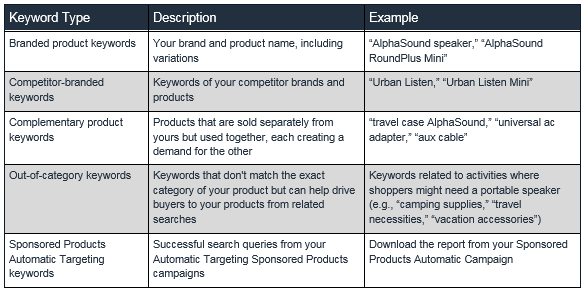
Using Sponsored Brand Campaigns, you can target three types of keywords — branded product keywords, complementary product keywords, and sponsored products automatic targeting keywords.
Branded product keywords are a combination of your brand name and a product you sell.
Complimentary product keywords are a bundle of two individual products that influence the demand for each other and can be sold together (like ketchup and mustard).
Sponsored products automatic targeting keywords are search queries that you’ve already experienced success with while running automatic targeted sponsored product campaigns.
Sponsored Brand Campaigns also lets you feature up to three unique products in your ads, customize your ads’ image, headline, and landing page, and even tests these elements.
Below is an image from Amazon that details the keywords that you can use for your sponsored brand campaigns:
To determine how much you pay for Sponsored Brand Campaigns, Amazon uses a pay-per-click, auction-based pricing model, so you’ll never pay more than you bid per click. In addition to manual bidding, you can choose automated bidding, which will optimize your ads for conversion.
If you want to know how well your advertisements are performing, Sponsored Brand Campaigns offers a reporting feature that displays your ads’ clicks, spend, sales, estimated win rate for keywords, and ACoS (Advertising Cost of Sales).
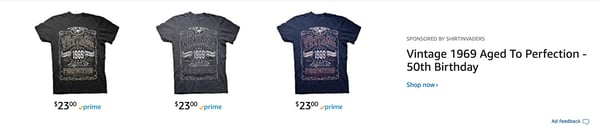
Below, Shirt Invaders promotes three of their T-shirts. Clicking on each of the shirts goes specifically to the product page. However, clicking on the “Shop Now” button below the copy takes you to its Amazon Store:
Sponsored Brand Campaigns Best Practices
Ad Creative
It’s a good idea to feature three top-performing products in your Sponsored Brands Campaign to increase the amount of clicks and sales your ads generate.
Amazon also recommends including your product’s top benefit in your ad’s headline because mobile shoppers can only see the ad’s main image and headline.
Additionally, when describing your product, try not to claim your product is “#1” or a “Best Seller” — your ad won’t get approved.
Testing
To run the most accurate and fruitful tests, consider only changing one variable at a time, run them for at least two weeks, and anchor the success of your tests to business goals.
Landing Page Design
With Sponsored Brands, you can direct shoppers to your Amazon store or a customized product page. Consider testing how different product pages convert visitors into customers, as well as the order in which your products appear.
Amazon Product Display Ads
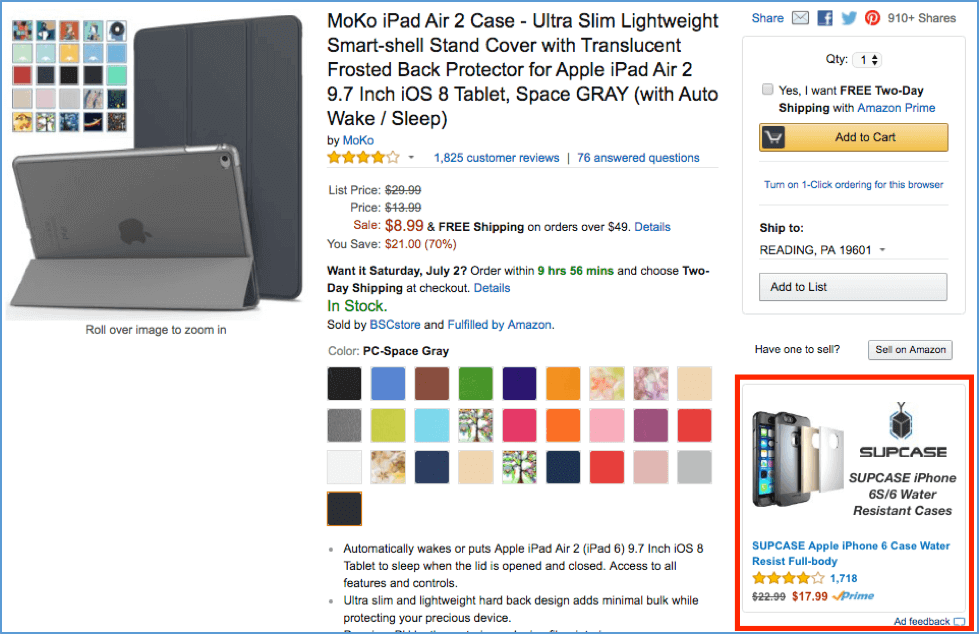
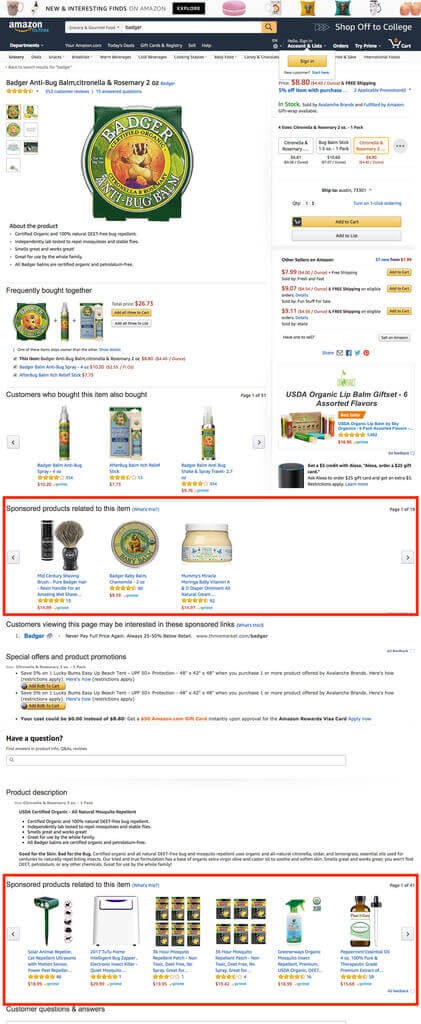
Product display ads are pay-per-click ads that appear on product detail pages, customer review pages, on top of the offer listing page, and below search results.
You can also place these ads on abandoned cart emails, follow-up emails, and recommendations emails. Their main objective is to cross-sell or upsell your customers.
Using product display ads, you can use two types of campaign targeting: product and interest. Product targeting is a contextual form of targeting, so you can target specific products and related categories. Interest targeting is a behavioral form of targeting, so you can target shopper interest and reach a larger audience.
Product display ads also let you choose which in-category detail pages you want to advertise on, customize your creative, and offers a reporting tool that displays your campaigns’ clicks, spend, sales, advertising cost of sales (ACoS), detail page views, spend, units sold, total sales, and average cost-per-click (ACPC).
Amazon Product Display Ads Best Practices
Targeting
Use product targeting on competitor pages, complementary product detail pages, and your own product detail pages to cross-sell and upsell similar products. Using product targeting on related categories also extends your reach to sections of Amazon’s catalogue that are related to your products.
Ad Creative
When crafting your headlines, Amazon allows you to include phrases like “Exclusive”, “New”, “Buy Now”, and “Save Now”, but making claims like “#1” or “Beat Seller” will get your ad rejected.
Amazon Native Ads
Amazon Native Ads are ads that you can place on your brand’s own website. There are three types of native ads: recommendation ads, search ads, and custom ads.
Recommendation ads are ads you can place in product article pages on your website. These ads are dynamic, so Amazon will populate your most relevant product recommendation based on your web page’s content and visitors.
-9.png)
Search ads are ads that populate on your website based off keywords that your customers search for on Amazon or on your website.
-8.png?width=600&name=pasted%20image%200%20(3)-8.png)
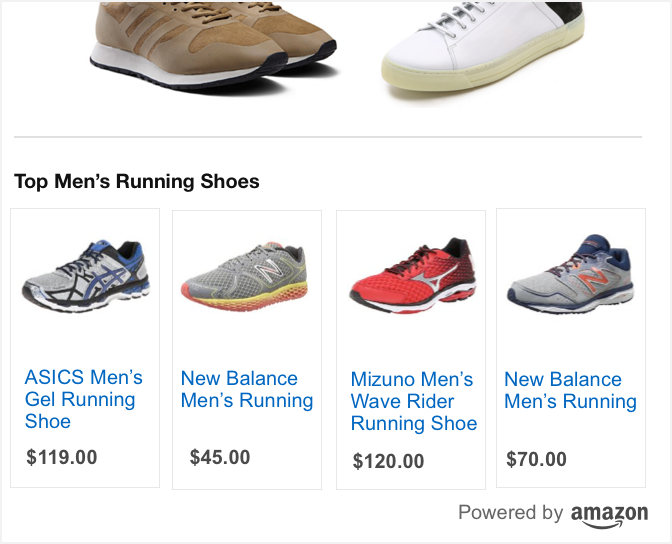
Custom ads allow you to select your own assortment of products you’d like to promote and place them on your product article posts.
Amazon Native Ads Best Practice
Just like a call-to-action on a blog post, make sure your native shopping ads are extremely relevant to the pages you place them on. This way, when your website visitors finish reading your post, the ads are a natural next step and can lead to more conversions.
Amazon Video Ads
Amazon Video Ads are ads that you can place on Amazon-owned sites like Amazon.com and IMDb, Amazon devices like Fire TV, and various properties across the web. You can buy Amazon video ads regardless of whether you sell products on Amazon or not, and you can set your ad’s landing page as an Amazon product page, your own website, or any other web page on the internet.
-7.png)
If you want to work with Amazon’s video ad consultants, you can sign up for their managed-service option, but to be eligible, you usually need to spend a minimum of $35,000 on video ads.
Amazon Stores
Users can promote their brand or product on your own multi-page Amazon Store. Using Amazon’s templates or drag-and-drop tiles, you can showcase your brand’s products or portfolio of work.
With Amazon Stores, brands get an Amazon URL and can view traffic analytics, which enables them to keep track of sales, traffic sources, and ad campaigns.
Additionally, creating an Amazon Store is free.
Amazon Stores Best Practices
Once you create an Amazon Store, you can use the analytics tool to find the top performing keywords which have converted to sales. Additionally, the analytics tool will let you know which products sell.
This lets you know which products you might want to consider for a paid ad campaign. Plus, it also shows what potential buyers are interested in.
Below is an example of an Amazon Store:
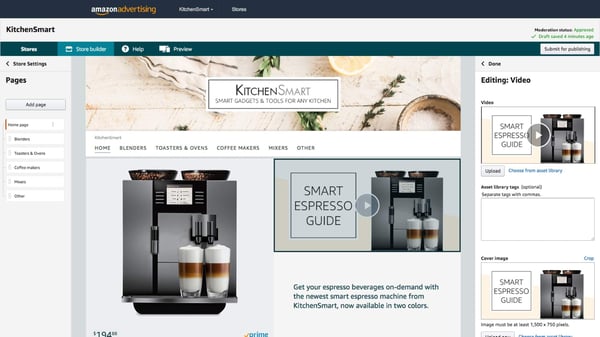
When you create an Amazon Store, the best practices are similar to best practices of any landing page — use clear photos, easy-to-read captions, and clear pricing. Additionally, make sure you showcase your highest performing products. Or you could opt to introduce new products on your Store as well.
Before you craft your Store, come up with the products you want to feature on your navigation. Then, list all your products that you will showcase on those pages. Lastly, gather the clear, professional photos of your product, write your captions, and list your prices.
Ultimately, selling on Amazon can be an impactful marketing strategy for ecommerce brands. As consumers continue to lean into online shopping, Amazon advertising can play a large role in your online sales.
Editor’s note: This post was originally published in February 2019 and has been updated for comprehensiveness.

The Best Gantt Chart Software of 2019
The Ultimate Guide to Advertising in 2019
When you hear the word advertising, what comes to mind?
Do you think of banner ads on your favorite website? Super Bowl commercials? How about the billboards along the highway or posters in the subway stations?
While most of us have a pretty good idea of what advertising looks like, it’s a little harder to nail down exactly what it means — and how to do it well.
From the printing press to pop-up ads, advertising has certainly changed with the times. Despite this, though, the need for advertising hasn’t changed, and neither have the techniques and best practices that make for quality advertising. That’s what we’ll cover in this guide.
Whether on a billboard or the back of a restaurant menu, advertising can go to work for your company in a variety of ways. Here’s how:
- To raise awareness for your brand
- To drive potential customers to your business
- To promote sales for both new and existing products
- To introduce a new product or service to the market
- To differentiate your product from your competitors’
Advertising can also be executed in various ways. Radio commercials, billboards, branded t-shirts, and social media endorsements all count as advertising. Here are the different formats and channels that advertisers have been using for years:
- Print advertising and posters
- Newspapers and magazines
- Outdoor ads and billboards
- Public transit ads
- Sponsorship of TV shows and events
- Radio
- Sponsored web content
- TV commercials
- Online pop-ups and search engines ads
- Social media ads
Advertising can look like many different things. Below, we’ll cover how to advertise on these mediums.
Marketing includes a number of different channels, such as social media, email marketing, public relations, SEO, and paid advertising.
Alternatively, advertising is just one part of marketing.
A company’s overarching marketing strategy will typically include an advertising plan. The advertising zooms in on the specific process of creating and publishing the persuasive messages to get customers to take action.
A Brief History of Advertising
Advertising is one of the oldest segments of business, save for currency and trade. Once products and services arose, so did the need to make them known.
The oldest confirmed piece of advertising dates back to 3,000 B.C. Technically, it was a print ad from ancient Egypt promoting the capture and return of an escaped slave. Incidentally, the ad also mentioned the slave owner’s shop — a rug business — which inherently advertised his storefront, too. The slave was never caught, but the rug owner did discover a brand new method of bringing in traffic: advertising.
Let’s fast-forward about 4,000 years. Here’s a brief look at the past five centuries of advertising:
1472: The first poster advertisement is placed on church doors in London.
1650: The first newspaper ad — a reward for 12 stolen horses — is published. (What’s with the reward-based advertisements?)
1704: The Boston News-Letter prompts its readers to place ads in its paper.
1870: The Powers style of ad copy is born. This style packed a punch — it was short, to-the-point, truthful, and convincing. Powers said the focus should be on why the consumer should buy your product or service — a message that still resonates for good reason today.
1880: Postcards become one of the hottest new ways to reach customers.
1893: Retailer Sears, Roebuck, & Co. joins the mail-order bandwagon by issuing their own catalog. 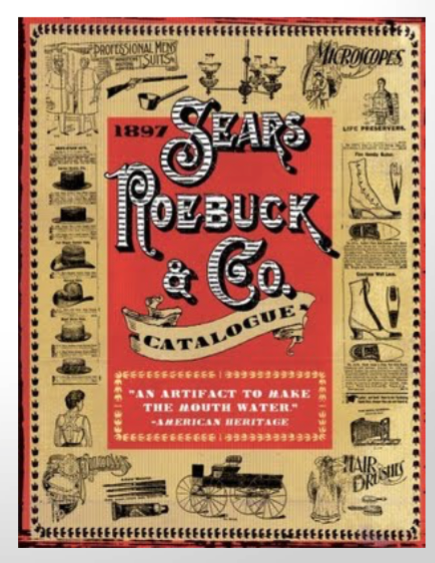
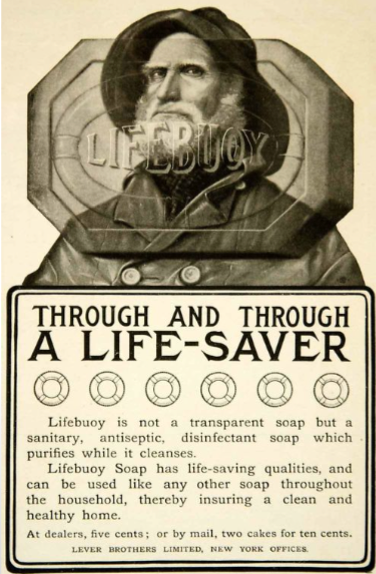
1902: Unilever creates the “longest client-agency relationship in advertising history” when it hires J. Walter Thompson Company to advertise its Lifebuoy Soap.
1902: Mellins Food advertises its brand on 25 airship flights, becoming the first brand to take this approach.

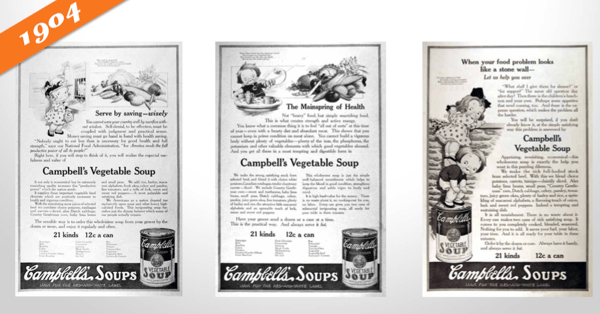
1904: The Campbell’s Kids are created, piloting the change in advertisement focus from a single ad to an entire campaign.
1922: Radio ads are born, and businesses purchase 10 mins for $100. Two years later brands would increase their investment by sponsoring an entire radio show, a concept that would eventually become known as “sponsored content.”
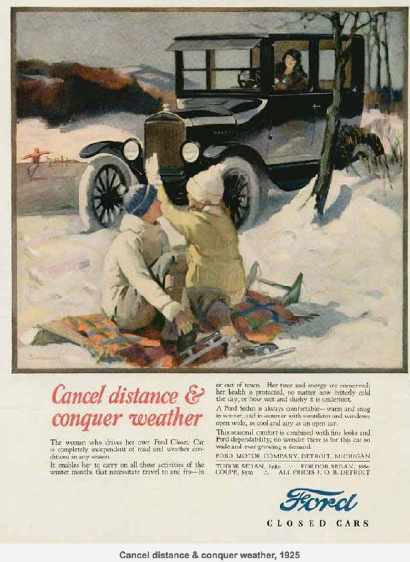
1925: Advertisers start to appeal to emotions, focusing on what pleasure customers would receive from their product or service. This old Ford ad exemplifies this perfectly.
1975: VCRs are introduced, and consumers begin to record shows and, therefore, skip advertisements.
1990: Computers become more popular and accessible at home, with over 5 million homes connected to the internet.
1994: The first email spam campaign launches. Banner ads are also introduced.
1995: Search engines like Yahoo! and Alta Vista are born. Ask Jeeves and Google would follow in 1997 and 1998, respectively.
2005: YouTube and Facebook (for college students only) launch.
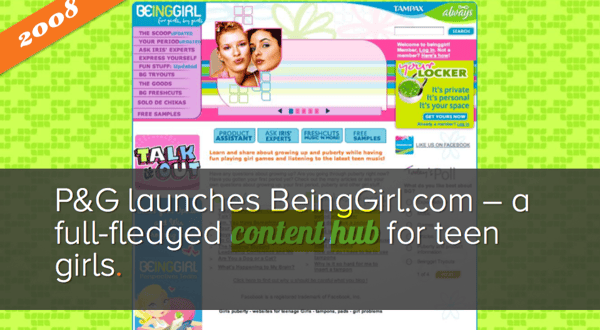
2008: Brands start to realize the importance of having an online presence for their potential customers. Procter and Gamble pilot the concept of the content hub with BeingGirl.com.
2012: Online videos reach 169.3 million viewers.
2013: Sites like Pinterest and Instagram join the social network scene.
History teaches us that advertising is an ever-changing concept, just like shopping habits and how and where consumers spend their time. Whereas almost 140 years ago, postcards were the newest form of advertising, brands today are building chatbots for Facebook Messenger and integrating artificial intelligence into their marketing and sales platforms.
Things in the advertising world move fast.
The Modern Era: How to Advertise Online
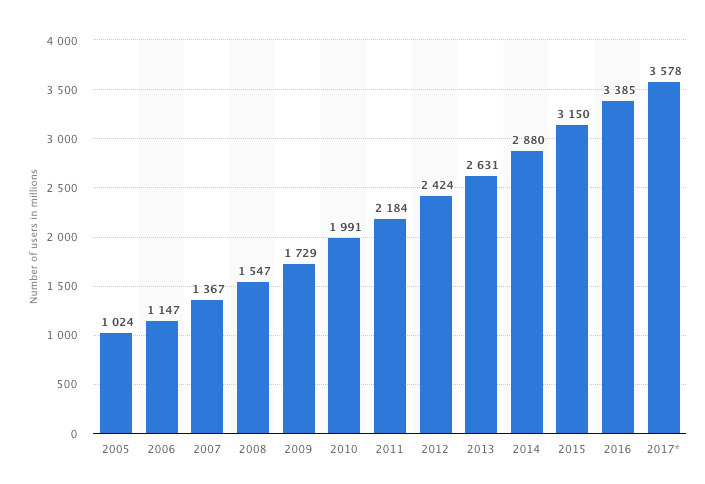
As of today, there are almost 4 billion people using the internet. This number is up 300% from 2005. Point being, internet usage is skyrocketing, and it’s not stopping.
 If you’re not advertising online, you’re behind the curve, my friend. Not only does the internet offer you direct access to more than half the global population — including more than half of your target audience — but it also provides so many different channels on which to advertise.
Marketers now have the flexibility to reach their target audiences on multiple fronts, in multiple ways, for multiple budgets. Their are also a number of tools (many of which are free) that can help you execute your advertising strategy.
Here are the most common ways to advertise online:
Paid Search Advertising
Whether Google, Yahoo, or Bing, all search engines have their own paid advertising. This is referred to as pay-per-click, or PPC, and involves bidding on keywords and placing ads at the top or sides of search results.
When someone performs a query using one of those search engines, advertisers have the ability to display ads above organic search results. That’s what makes PPC so powerful — it gives your advertisements prime real estate in front of people already searching for relevant topics.
Featured Resource
Here’s an example on Google:
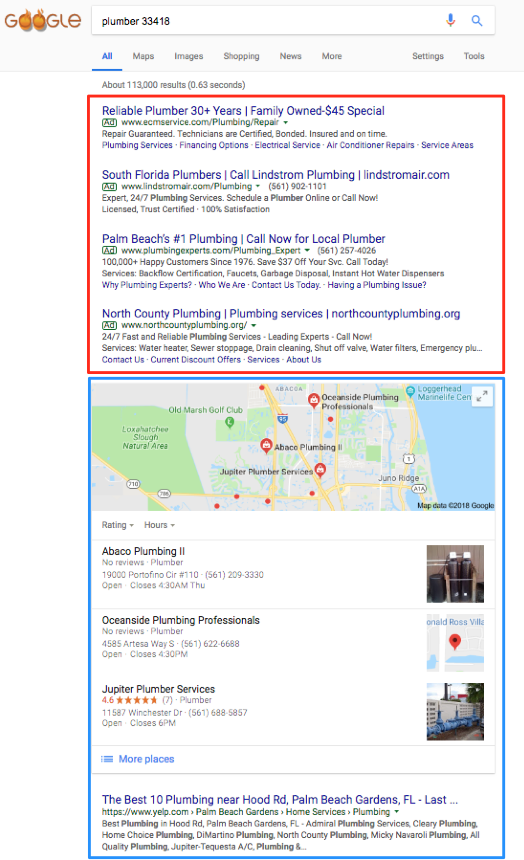
The top four listings in the red box are advertisements. The lower portion, in the blue box, are organic search results that come up as a result of search engine optimization.
Check out our guide to PPC for more information.
Social Media Advertising
Social media platforms know how valuable their content is, and that’s why they offer the option to sponsor or boost posts. Social ads put your message in front of your target audience and encourages them to engage, click-through, and buy. More and more, social media sites are prioritizing ad space over organic content because, well, it brings in more revenue.
If you’re a budding business or new brand, consider running some social media advertisements. These will not only advertise your products and services but also promote your social media pages and grow your following.
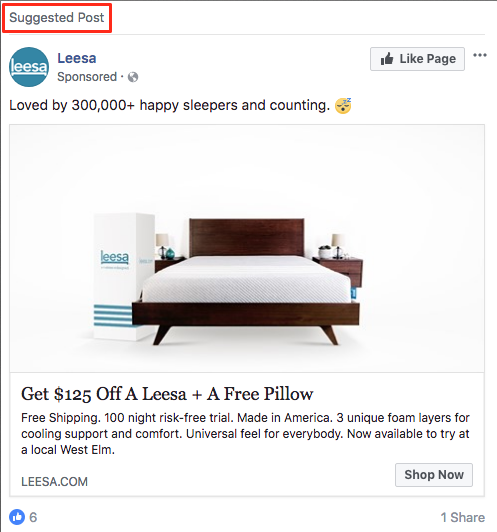
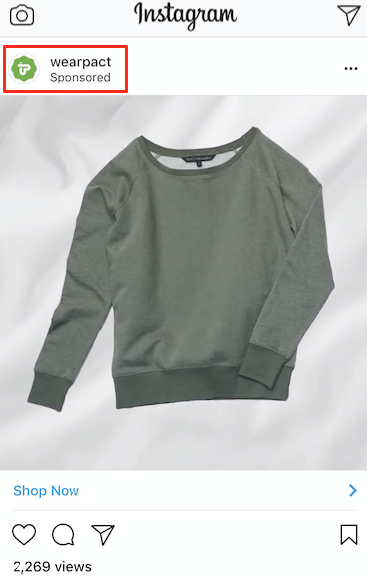
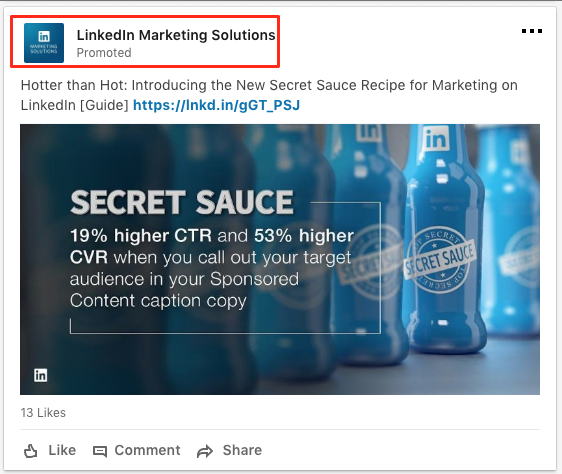
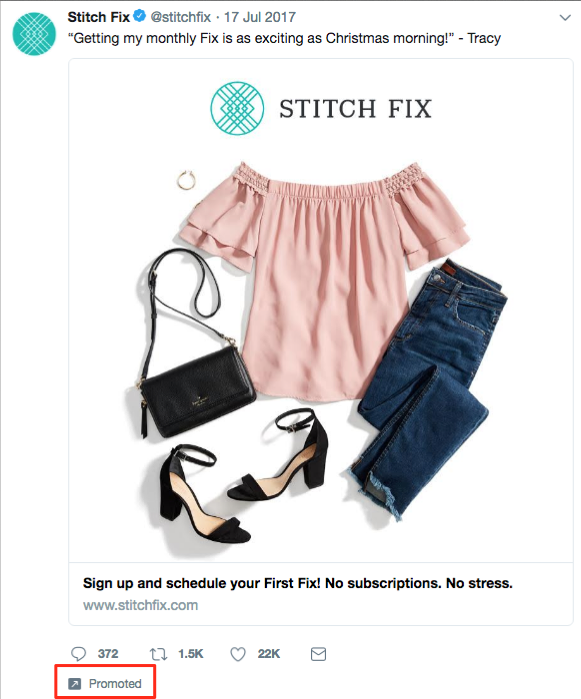
Platforms like Facebook, Instagram, LinkedIn, and Twitter each have their own version of ads like these.
Here’s how they appear on their respective feeds:
Featured Resources
- The Essential Guide to Social Media Advertising
- The Future of Facebook Advertising
- How to Advertise on Instagram
- How to Run Successful LinkedIn Ads
Native Ads and Sponsored Content
Sponsored content has been around since 1922, when brands would sponsor entire radio shows. Today, sponsored content refers more to native ads and blog or article content subsidized by brands.
Have you ever read a Buzzfeed article that heavily referenced or recommended a certain product or service? It was likely sponsored by a certain brand.
Check out this article, 10 Reasons To Put Away Your Phone On Your Next Trip, promoted by agoda, a hotel or destination booking site. Does it blatantly promote agoda’s services? No. It’s primary purpose is to entertain and inform, although agoda is referenced a few times throughout the content.
At the top, the byline reflects agoda’s sponsorship, just before the content starts. And, as you scroll down the page, another ad sits within the content.
Sponsored content is a great way to promote your brand in content your audience is already familiar with.
Banner and Display Ads
Banner and display ads are an extension of search ads and follow a similar PPC model. But instead of a text-based ad, consumers see a more visual advertisement.
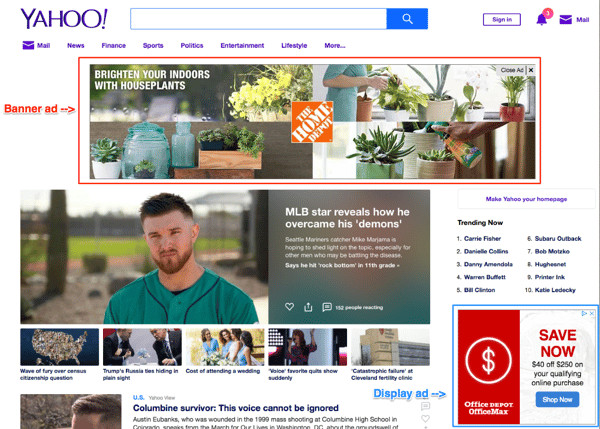
Banner ads are typically the horizontal boxes on top of a web page, whereas display ads are smaller in nature and shown on the side (like in the screenshot above).
Read our 10-step guide to creating banner ads for more information.
Whether you opt for traditional print ads in magazines or subway stations or choose online promotion on social media or search engines, there are a few rules that make for great advertising. Below are some advertising best practices to apply to all your ads.
Advertising Best Practices
There are a lot of best practices, tips, and tricks when it comes to advertising. It’s an art that’s been perfected over the years, and with the rise of modern advertising and new media, best practices continue to manifest.
In this section, though, we’re going to cover five famous advertising concepts that still work today — regardless of what advertising method or medium you’re using.
When used correctly, these advertising techniques will do wonders for your brand and products.
Appeal to Emotions
While you may not consider the ASPCA a business, their unforgettable Sarah McLachlan commercial is the perfect example of using emotional appeal to entice people to take action.
For most of us, the images in that commercial are hard to watch — we may even turn away. But since it tugs at our heartstrings, we’re more likely to donate to animals in need after seeing the horrors they’re going through.
Studies show that people rely on emotions, rather than information, to make brand decisions. Emotional responses to ads influence a person’s intent to buy more than the actual ad content.
Whether you try to evoke happiness, sadness, fear, or anger, appealing to emotions can help your target audience feel your message — not simply read or hear it.
Create Positive Associations
When consumers associate your product with a feeling of happiness, state of achievement, or accomplished goal, they’re more likely to take notice, remember your product or service, and make a purchase.
Actually, you’ve probably been on the receiving end of this before without even realizing it. Have you ever seen your favorite celebrity or Instagram influencer posing with a product or brand and found that you wanted to be, do, or look the same? Companies create this subconscious connection in advertising hoping that you associate your positive feelings with the product or service they’re promoting.
Catchy songs like “Nationwide is on your side” is an example of helping people associate friendliness with the Nationwide brand. Coca-Cola has a brand advertising campaign that associates their product with friends, family, and fun. When you consider what refreshments to serve at a party or bring on a picnic, Coca-Cola wants you to think of them.
As you create your advertisements, consider what feelings, desires, or goals with which you want your brand to be associated. Weave these feelings or goals into your advertisements through stories or videos. Look for influencers who align with your brand’s core values and demeanor and include them to promote positive association.
Establish a Bandwagon Effect
People want to fit in. It’s human nature. Neither you nor I are immune to it.
And it’s this base human desire that makes the bandwagon effect so effective. People don’t want to be left out. They find value in their peers’ opinions, and they certainly don’t want to be the only ones not using the latest and greatest product.
Brands like Maybelline understand this concept well and use it to their advertising advantage. One tube of their top-selling mascara is purchased every two seconds, a statistic that establishes social proof and further supports their claim of “America’s Favorite Mascara.”
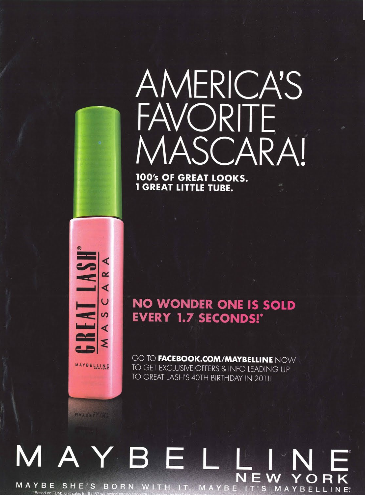
Use customer testimonials, survey data, or shareable content to advertise your brand as one worth following or buying into. Take another approach by promoting a discount for sharing your brand with a friend or family member — so your audience will do the selling for you. Either way, use your advertising to create an inclusive environment people will want to join.
Focus on Benefits Over Features
Features and benefits are two very different things. Features are the details of the product or service you’re selling, such as the measurements of a couch or the ingredients of a protein bar. Benefits, on the other hand, explain why a person should buy a couch or protein bar from you and how their life would, well, benefit from such a purchase.
Advertising should focus on the benefit your product or service brings, not explain what you’re physically selling.
Consider how Southwest Airlines advertises. Instead of explaining, line by line, what a Business Select ticket offers, Southwest paints a picture of what life would be like if you made a purchase. In this advertisement, they focus on the benefits.
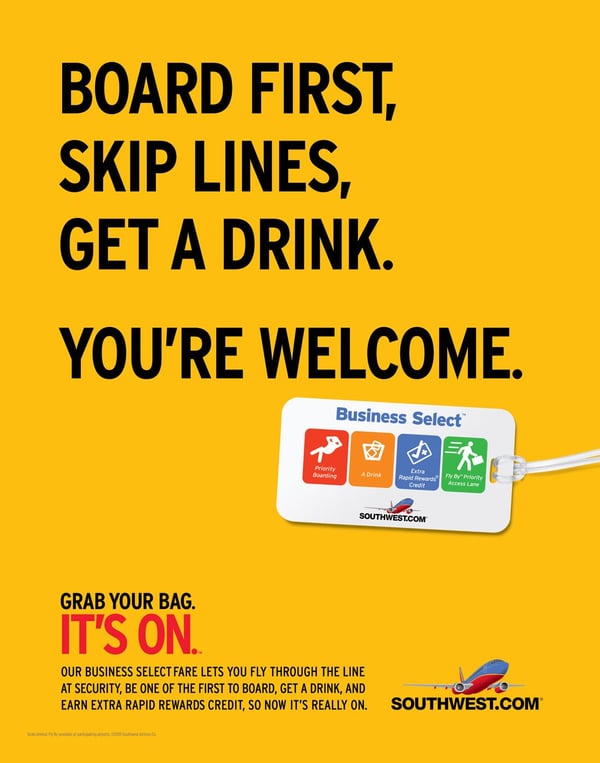
Rather than wasting precious ad space on your product specifications or service details, talk about the ways a purchase might positively impact your customers. If you do it right, your creative, benefit-packed advertisement would then inspire them to research the features on their own.
Use Storytelling
Not unlike our desire to fit in is our penchant for a good story. Storytelling helps paint a bigger picture of a brand or company, not simply promote a single product or service. Also, when stories resonate with someone, it’s far easier to motivate him or her to take action.
Storytelling is the one technique you should try to infuse in all your advertising. In fact, if you haven’t started crafting your brand’s overall story, you should definitely do so. Research shows that stories that illustrate a brand as “necessary, believable, and integral” are the most effective for engaging and influencing consumers.
Dove employs storytelling in its campaign partnership with Operation Homefront. The videos feature real stories of military men and their families being reunited. The advertisements don’t directly promote Dove products but instead tell the Dove brand story (and pull on a few heartstrings, too).
Determining your brand story will help you learn how to best discuss your brand in all marketing efforts, not just advertising.
Next, let’s take a look at some of the most memorable ad campaigns, a few of which put these best practices in action.
Five Memorable Ad Campaigns
The best advertisements are the best teachers. Whether it’s the copywriting, design, medium, or target audience, well-executed campaigns can always teach you something new about advertising or positioning. (Consider Westinghouse Electric’s “We Can Do It” ad…)
Here are five campaigns that left a noticeable mark on advertising history:
Nike: Just Do It
In the late 1980s, Nike launched their “Just Do It” campaign.
At the time, Reebok was outselling Nike, and Nike needed to act fast to compete against the sneaker conglomerate.
But it wasn’t just the three-word phrase that earned global attention. Their new ad campaign also focused on real people wearing and working out in their products, as opposed to simply featuring clothes and sneakers themselves.
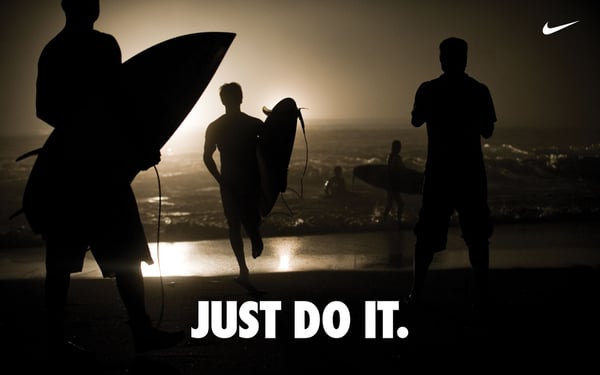
This powerful combination of people plus product helped Nike go from $800 million in 1988 to $9.2 billion just 10 years later.
The Absolut Vodka Bottle
Did you know Absolut’s “Bottles in the Wild” ad series is the longest uninterrupted campaign in history? The campaign was Absolut’s attempt to grow their name internationally, especially throughout the United States. It featured the Absolut bottle in different cities and countries worldwide.
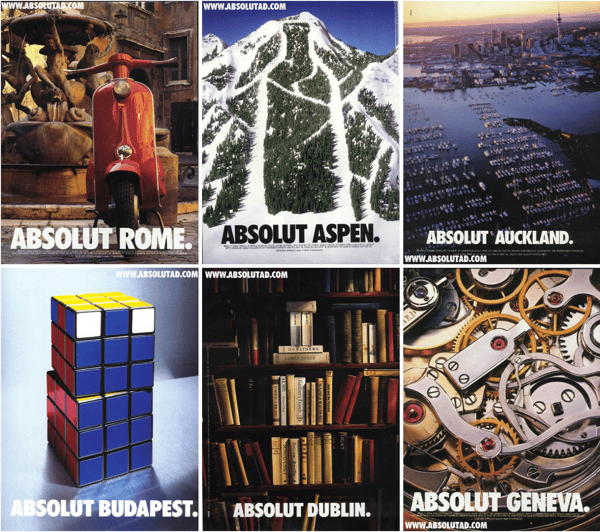
It launched in 1985 and ran until 2000 — lasting an impressive 25 years.
Absolut’s campaign helped grow the company from a tiny slice of the vodka market share (2.5%) to over half the U.S. imported market share.
To this day, the Absolut brand is the fourth largest spirit company, thanks to their focus on the overall story, not just the product itself.
Miller Lite
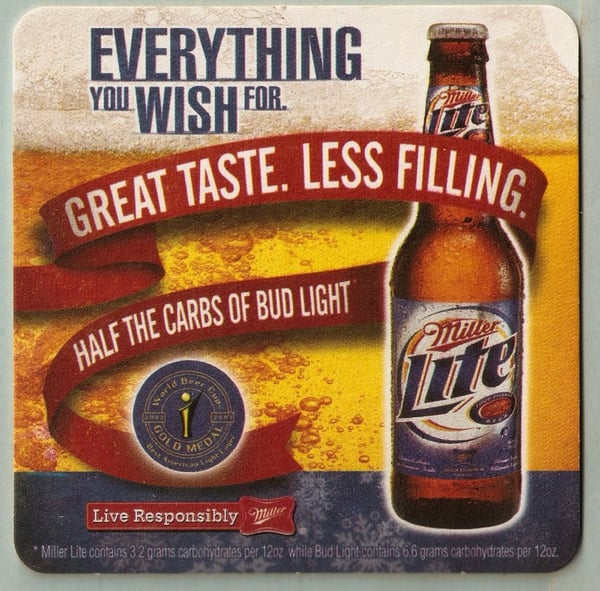
The folks at Miller Lite used differentiation to reach their goal: to get “real men” to willingly drink light beers. With their “Great Taste, Less Filling” campaign, they maintained a leading position in the light beer market for several decades after this first campaign aired.
Volkswagen
Though Volkswagen has officially discontinued its production of Beetles, its iconic “Think Small” campaign will be forever ingrained in advertising history.
Doyle Dane & Bernbach (DDB) advertising agency knew it had to change the mind of consumers if it wanted to compete with industry leaders. So, VW admitted that though the Beetle was, in fact, tiny, it was still a force to be reckoned with and worth a purchase.
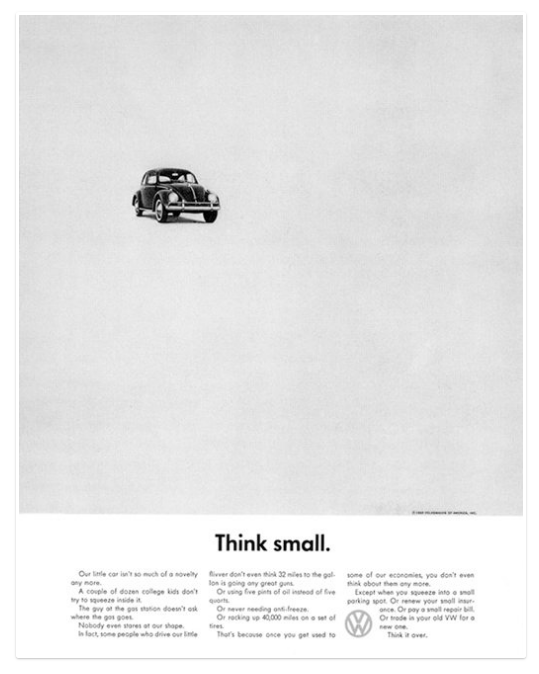
Authenticity and honesty went a long way in this seemingly small campaign.
Dos Equis
With its edgy, cool, and sophisticated aesthetic, it’s no surprise “The Most Interesting Man in the World” campaign put Dos Equis on the map.
This campaign created a positive association between the Dos Equis beer and the feeling of sophistication and poise. Sales quickly jumped by 22% after the campaign launched.

Even more impressive was how Dos Equis found success in a time when craft beers grabbed a foothold in the market and imported beer took a 4% hit. This campaign was major component of that success.
To learn how to grab the attention of your audience, learn from the professionals. These campaigns are a great example of how brands have used real stories, real people, and real talk to grow their businesses.
Advertising Helps You Grow Better
Equipped with a dense, dynamic history, advertising is an incredible tool to add to your marketing tool box.
Between print ads, radio sponsorship, TV commercials, and social media promotion, the opportunities to advertise and promote your brand are endless.
To best connect and engage with your audience, speak your customer’s language, appeal to their emotions, and tap into their desire to be a part of a community, create a clear and authentic brand story to illustrate how your brand aligns with their values.
By applying these tried and true practices to your advertising, you’ll build a magnetic brand that attracts customers, establishes a following, and generates revenue.
Do this and your brand will grow into a household name that stands the test of time — just like advertising itself.

How to Plan Your Instagram Posts [+ Free Instagram Planning Templates]
When you’re not following a plan on social media, it’s easy to forget to post regularly.
Additionally, creating image and video-based content that’s meant to drive revenue for your business can seem far away from your bottom line.
However, nowadays, 71% of businesses are on the platform — to compete with other companies in your industry, then, it’s critical you have a solid Instagram strategy in-place, particularly if your intended audience uses the app.
Fortunately, once you have an ideal plan for your Instagram content, you’re able to create content more intentionally and ultimately drive more results for your team and your organization.
In this post, we’ll cover everything from determining what kind of content you want to post, to picking a content theme. Then, we’ll get into the details of planning individual posts.
Type of Content to Post on Instagram
Regardless of which kind of content you decide to post, it should always be content that attracts your ideal audience. Think beyond your product, service, or office — what does your ideal customer actually care about, and what motivates them to follow a business account on Instagram?
Want 30 days’ worth of Instagram post ideas? Download this calendar of ideas & accompanying templates.
If you know your audience is interested in consuming bite-sized education on social media, you might use Instagram to share industry tips and tricks. Videos or well-organized captions can be useful vehicles for providing your audience with well-researched information for their benefit, rather than the benefit of your business.
If your product or service lends itself to being photographed, consider sharing photos or videos of real customers using it. You can lighten your own content creation load by relying on user-generated content, too. Have your customers send in photos of your product in-action.
Here’s an example of how Beats by Dre uses Instagram to showcase customers using their products:
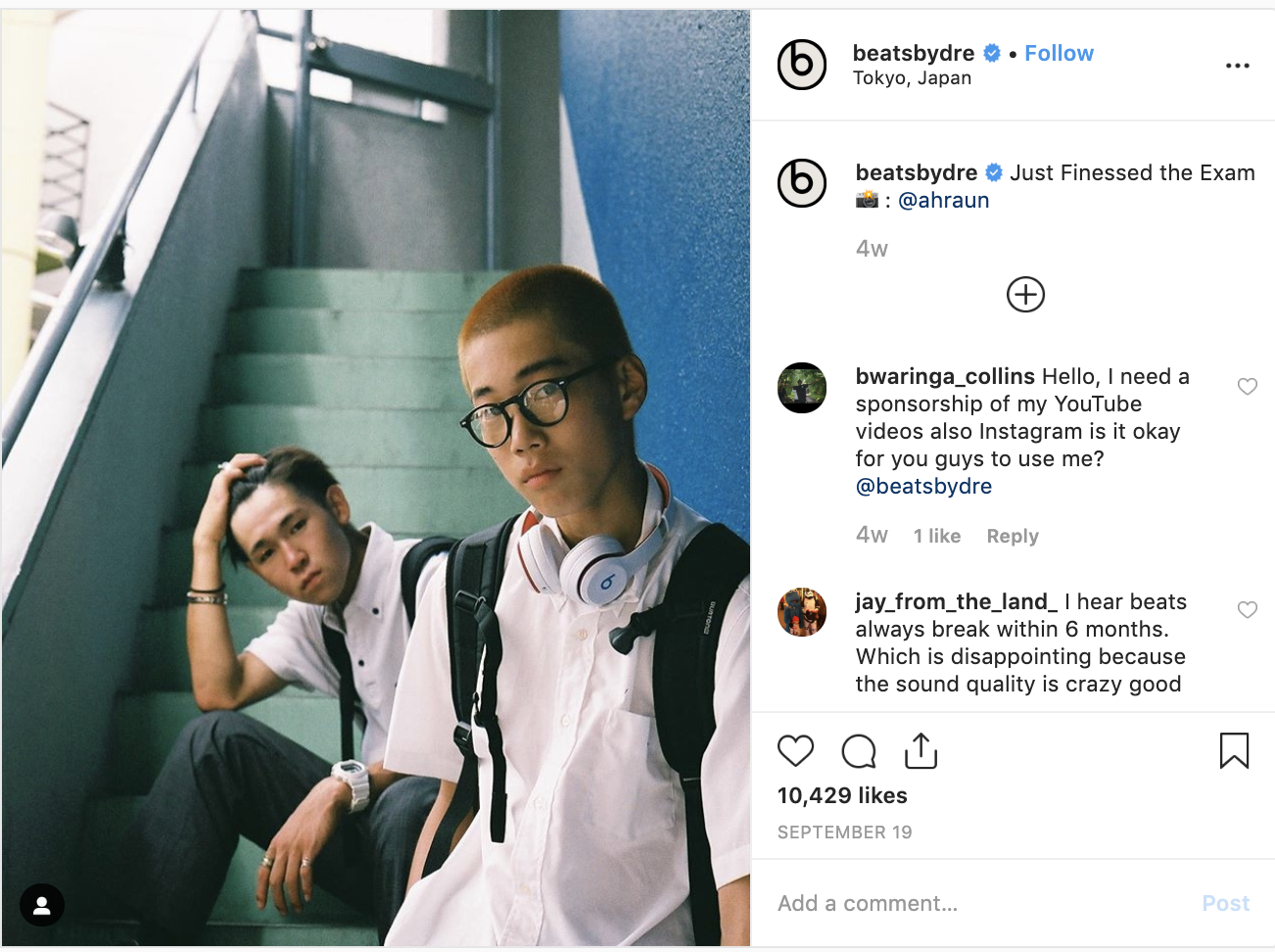
Still, there’s no need to make these product or service posts promotional. Instead, the value for your Instagram following would come from drawing personal connections with real stories about how others have successfully used your product.
However, if your audience isn’t consuming education on Instagram and your product or service isn’t easily photographed, you can take a more aesthetically-focused route, posting images and videos that people would simply love to consume. These may not drive a significant number of conversions, but a visual-first Instagram can amass a large amount of followers.
The key with the aesthetically-pleasing route is to check in frequently to make sure your posts are driving actual value (perhaps in the form of brand awareness or community among your followers) for your business.
If you’re unsure of the type of content you want to post or the kind of content that will succeed for your brand, pick the one that you believe your audience will be most interested in seeing — product-agnostic education, product-centric and usage-focused content, or aesthetically pleasing content — and try it consistently for a month.
Then, try another type for the following month and compare engagement rates. How many people are liking and commenting on your content? How many followers did you gain each month? What other business outcomes, if any, were impacted by your Instagram posts?
In addition to deciding the general topics you’ll post on Instagram, you’ll want to experiment and decide on which content formats you’ll post. For example, if you take an educational approach, experiment with videos versus text-focused images, and various lengths of captions.
Alternatively, if your educational content lives on your blog, knowledge base, or in another library, consider using Instagram posts to point people to those resources rather than squeezing too much information into one Instagram.
For example, HubSpot Academy’s Instagram often promotes in-depth courses that HubSpot Academy produces rather than trying to dive into the details in the caption, image, or video itself. The account keeps followers interested by sharing short clips and tips from the courses, too:
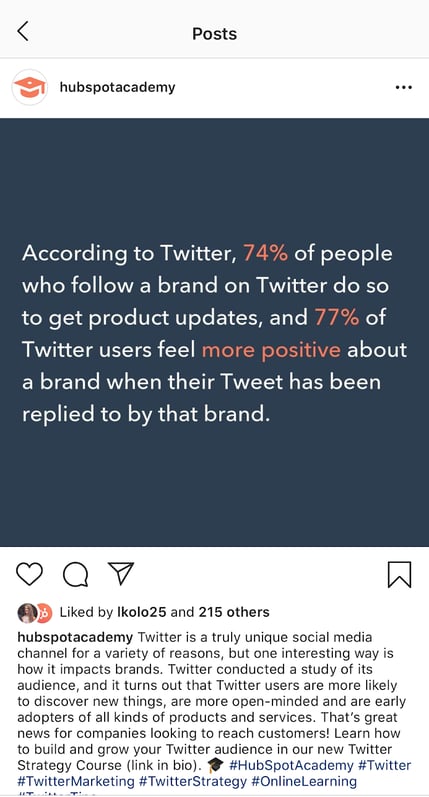
Additionally, we’ve put together this downloadable calendar of creative content ideas if you’re not sure what type of content to try first.
Your Instagram’s Visual Theme
Once you’ve decided on the type of content you want to post, you’ll want to select a visual theme for your posts.
Aesthetic consistency will help you in several ways:
- When an Instagram user finds your business’s account, the images will appear coordinated and well-thought-out.
- Your followers will begin to sense pattern in your content and pause when they see your post as they scroll because they recognize that pattern.
- When you’ve pre-selected a go-to font and color scheme, it takes some of the planning pressure off of you. There are fewer decisions to make for each new post.
If you use Adobe Spark, you can download our free Adobe Spark Instagram templates to get started on creating a new post with a template rather than starting from scratch. You’ll also get access to the previously-mentioned calendar of content ideas.
To establish visual consistency across your posts, pay attention to the colors in your photos, the filters you use, the fonts you use in your images, and, if you’d like, the pattern of content types you’re posting.
- Colors: Keep your brand colors top-of-mind when creating Instagram posts. Pick a few colors that complement your primary brand color and ensure that the most prominent color in each of your posts is one of those colors.
- Filters: When using filters, do so lightly, as over-editing can dilute the quality of your photos. If you decide to use filters, use the same one or two across all posts.
- Fonts: Select one font to use whenever you want to overlay text on photos or videos. Since Instagram is a friendly platform, aim to use an easy-to-read, sans-serif font and keep it the same across all posts. Use the same couple of font colors, too.
- Content Pattern: To create a visual pattern for your overall feed, make sure that every third post has a certain background color. Since Instagram has three columns in the grid view, you’ll end up with a column that shows you thoughtfully plan your posts. You might consider using a white background with the same font style and color to share an industry tip for every third post, for example.
Tools for Making the Most of Your Instagram
In order to stay organized, we recommend using two types of tools — a post scheduling tool, and a tool that allows you to link to several different places from your Instagram bio.
By using a post scheduling tool, you’ll be able to plan out as far in advance as you’d like, ensuring you have a steady stream of content ready to be posted even when other projects pop up in your day-to-day work. Posting consistently is important for follower retention and will give you more opportunities to experiment and figure out which posts get the most engagement.
Scheduling your posts also allows you to visualize which types of posts you have coming out and swap posts if need be. You can see the weeks for which you’ve planned enough content and those during which there are still empty slots.
You can also use a spreadsheet like this one (download for free here):
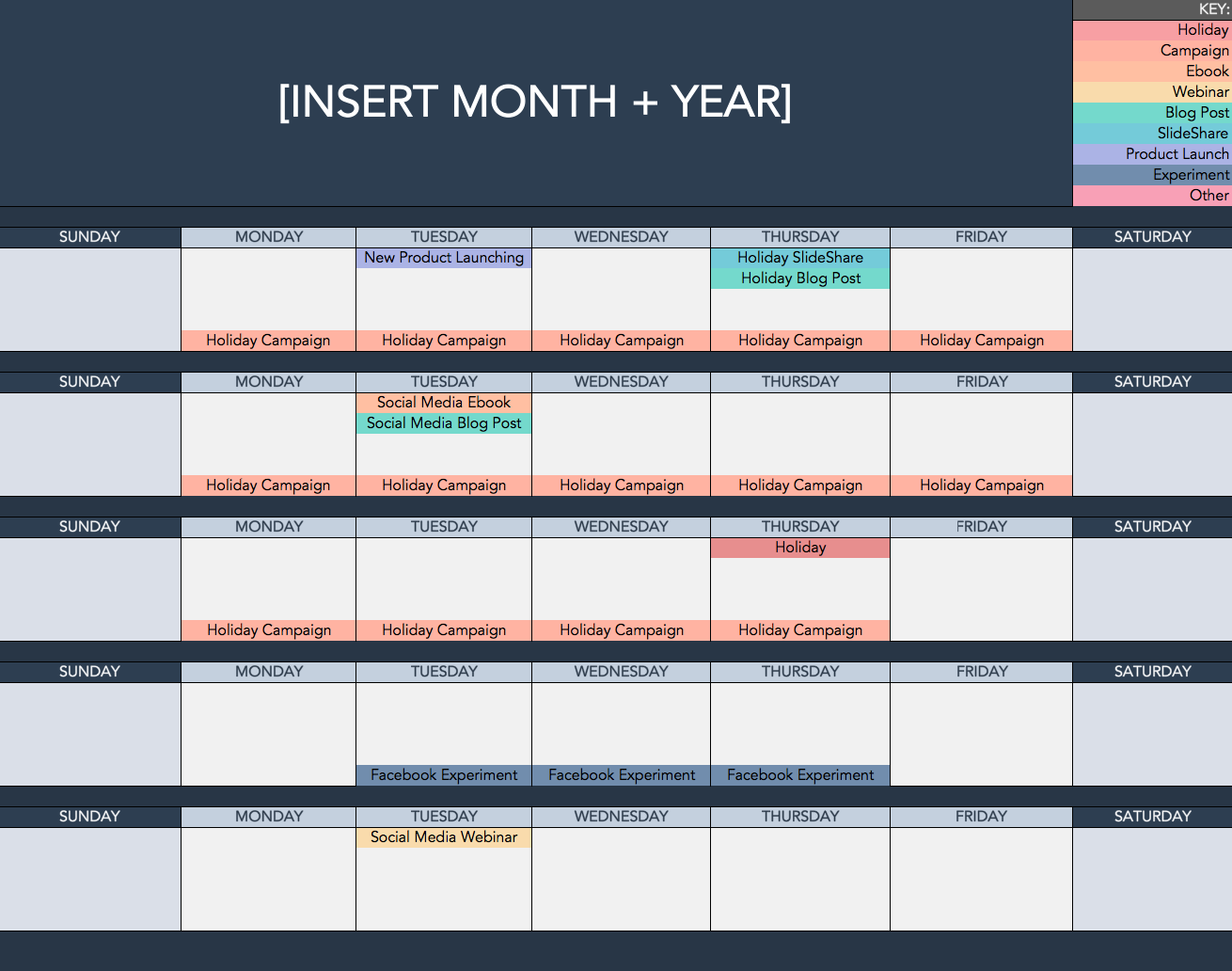
Examples of post scheduling tools: HubSpot Social Tools, Later, Buffer, Hopper
Since Instagram only allows you to place one hyperlink in your bio at the top of your profile, we also recommend investing a few dollars per month in a tool that lets you create one landing page that links out to several other pages.
Then, in individual posts, you can reference clickable links available at the link in your bio, which provides a much more user-friendly experience than having your followers copy a URL manually into their browser, toggling between apps.
Examples of post scheduling tools: Linktree, Lnk.Bio, Link In Profile
Planning Process
Once you’ve decided on the content type and visual theme that you’ll use on your brand’s Instagram account, it’s time to start planning posts.
Create a spreadsheet with the following columns (or download our free, pre-made spreadsheet along with planning templates for all of your other social media channels, too):
- Date of publication
- Time of publication
- Image caption
- Image file name or a link (if it has been uploaded to the web)
- The link that you’ll add to your bio when the post goes live (or add to a Linktree-type multiple links tool)
- Campaign/Goal: What is the goal for this post? Are you trying to amass more followers? Drive sign-ups for your product, a free trial, a consultation, or another next step toward becoming a customer? Whatever it is, an articulated goal will help you make sure that each post exists for a purpose — you won’t be creating a dead end for your followers, but rather an opportunity for continued engagement with your account, brand, or product.
When you’re done, it should look like this:
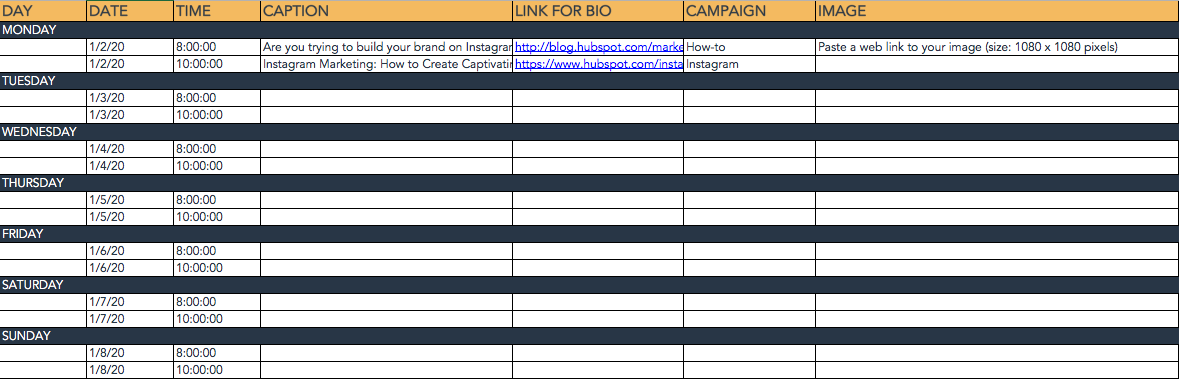
A hint — duplicate the spreadsheet tab for Instagram Stories, as well, to leverage Instagram’s other avenue for engaging with your followers. Stories are best used for interactive content like polls and quizzes, sharing lots of photos or videos from live events, and more casual, friendly updates.
Once you have your spreadsheet ready to go, decide on your frequency. We recommend ramping up to posting around three times per week.
Post at least once a week to establish a reliable posting pattern for your followers. You’ll risk losing followers if people feel that they’re not consistently seeing interesting or helpful content from your account.
To ensure you establish that consistent pattern, set dates and times for posting first. For example, if you decide to post every Monday, Wednesday, and Friday, fill in the date and time column with the next month’s Mondays, Wednesdays, and Fridays.
Then, add a recurring event to your calendar for post planning for the following two to four weeks. Set a recurring, 10-minute calendar invitation at your selected posting times to reference your spreadsheet and quickly post whatever you’ve planned if you’re not using an automated scheduling tool. With the planning sheet handy, you’ll be able to simply copy and paste captions and links, and you can then locate the image easily.
When slotting specific posts into your spreadsheet, begin in whichever column you’d like. You could start by evenly splitting the rows into separate campaigns and then filling in the caption or image link for each post later.
If you already have a repository of photos that you can post, though, you might start pasting the links into the Image File Name/Link column and fill in the other columns afterward.
You’ll also want to start creating more visual content for future posts. Consider repurposing event images that your company has taken, soliciting photos of your employees or customers using your product, or simply creating visually-appealing text graphics like this one on a tool like Canva or Photoshop.
Upload each photo to a centralized folder and make use of a standardized naming convention so that it’s easy to find the file you’re looking for. If you’re not using a post scheduling tool, you’ll likely have to post directly from your phone.
To easily access photos with their file names from your phone, you can upload photos to a Google Photos album on your computer and then use the Google Photos app on your phone to directly download the content prior to posting.
Finally, decide on your caption for each post. The ideal caption style depends on your audience and the type of content you’re sharing. For example, aesthetics-focused content may perform best with a quirky, short, and clever caption, while education-focused content may be most likely shared and liked if the caption includes a couple of concise, clear tips.
Make sure to include three to five thoughtfully planned hashtags in your caption or in a comment on your own post to ensure it gets in front of new audiences. You’ll want to include a mix of branded hashtags (eg. #HubSpotAcademy or #OnlineLearning) and trending hashtags so that your post is seen by more people.
You can research the hashtags you might want to use by typing them into Instagram (head to the ‘Search’ tab and then tap ‘Tags’) to see how much volume they get. Prioritize the higher-volume ones.
By taking a thoughtful approach to planning your Instagram content, you can ensure that your posts deliver value to your followers, convert those followers into leads or product users, and expand the reach of your brand’s messaging to new audiences.

6 Social Media Marketing Attribution Models and Tools to Help Marketers
Do you want a better way to track your social media marketing conversions? Looking for tools that can help you better measure attribution? In this article, you’ll discover six attribution models and tools that can help you. Why Attribution Matters to Marketers One common challenge for marketers is performing in-depth analytics. You’re most likely marketing […]
The post 6 Social Media Marketing Attribution Models and Tools to Help Marketers appeared first on Social Media Marketing | Social Media Examiner.
from Social Media Marketing | Social Media Examiner https://ift.tt/2JcPu5R
via socialmediaexaminer
The What, Why, & How of Social Bookmarking
As a marketer, you usually wear a lot of hats at your company. SEO expert? Check. YouTube aficionado? Check.
When I was working at an agency, it was important to learn everything I could about SEO and drive results for our clients. But I was no SEO expert.
In order to keep our SEO tactics competitive, I kept this SEO definitive guide bookmarked so I could come back to it whenever I was strategizing for a client’s SEO.
If you’ve ever come across a valuable article or website that can help improve your skills as a marketer, you probably want to save it and come back when you can dedicate more time to it.
With social bookmarking, you can save those articles or resources you want to revisit in one central location.
Below, let’s review what social bookmarking is, why it’s useful, and how to use social bookmarking sites.
Bookmarks can be public, private, or shared with specific groups. Social bookmarking sites can also be used like social search engines. You can search and browse to see popular and recently added web pages. Users can comment and vote for web pages they like, making it easy to see what articles are most valuable.
1. Pocket
Price: Free; paid options available
Pocket is a social bookmarking site that lets you save articles, videos, or stories from any publication or web page. With the paid version of Pocket, you can annotate, highlight, and add notes to pieces you’re reading.
A unique feature of Pocket is that you can pick up right where you left off. It saves your place and brings you right to the section of the article you were reading before closing out. Additionally, articles are saved in Pocket even if the web page or article gets taken down. You will still have that article in your database.
2. Digg
Price: Free
Digg is a news aggregator site that features articles in science, technology, and current events. With each article, you can like, bookmark, or share on social media. You can also publish your own articles on Digg to share with the community. Additionally, Digg curates content by top stories, so you can see what’s trending online.
3. Pinterest
Price: Free
Pinterest is a social media network that operates like a social bookmarking site. You can create boards and save content (called pinning) to come back to later. For example, if you are getting married, you can have a “Wedding Hair” board and save pins that you find for different hair styles.
A unique feature with Pinterest is that they collaborate directly with sellers, so you can buy the products you find directly through Pinterest. Users enjoy Pinterest because they can save content and ideas for parties, events, recipes and gifts.
4. Mix
Price: Free
Mix is a social bookmarking site where you can save content for later. To get started, you choose things you’re interested in, such as travel, pop culture, or food, and then it curates content for your feed.
Additionally, you can also follow people you know or coworkers so the articles they save show up on your feed. This is a great way for colleagues to share resources and see what coworkers recommend reading. With your profile, you can create collections to organize your saved posts by category.
5. Scoop.it
Price: Free; paid options available
Scoop.it is a social bookmarking site that specializes in researching and publishing content for individuals and businesses. A unique feature is how Scoop.it works with businesses.
You can publish on your websites and blogs, newsletters, and social media directly through Scoop.it. It will aggregate curated content for you across multiple WordPress blogs. Additionally, the private hubs allow employees to share articles privately. Scoop.it will also suggest content for you based on your previous interaction.
6. Medium
Price: Free; paid options available
Medium is an online publishing platform and social bookmarking site where you can publish and save posts to read later. On Medium, you can favorite different topics, writers, and publications to personalize your feed. Below an article, you can clap for it (like favoriting it), and find out more about the author and organization associated with the piece.
7. Slashdot
Price: Free
Slashdot is similar to Reddit in that it is designed as a social news site. It features news stories on current events and industries include entertainment, science, and technology. Users can comment and save each story. Stories are tagged, so you can filter through and search for stories on a particular topic.
In addition to these seven social bookmarking sites, there are also plenty more options to consider. Below is our list of honorable mentions:
1. Dribbble
2. Reddit
3. We Heart It
4. Folkd
5. A2Z Bookmarks
6. Feedly
7. Crazybacklink
8. Skybacklinks
9. Zypid
10. Metafilter
11. BizSugar
12. Flipboard
13. Sociopost
14. Disqus
15. Trendiee
16. Blinklist
17. BibSonomy
18. Diigo
19. SiteBar
20. Pearltrees
How to Use Social Bookmarking Sites
1. Content Curation
As a marketer, especially in social media, one of your duties is to curate content to share with your audience. People look to your brand for resources and expertise in your industry. With a social bookmarking site, you can save articles or resources you find online so you never run out of content to share with your audience. Social bookmarking saves time and gives you the ability to schedule content ahead of time.
For example, below is content I have curated on my personal Pinterest page for recipes. If any of my followers are looking recipes (especially keto or low-carb), I have an entire board dedicated to curating content in that category.
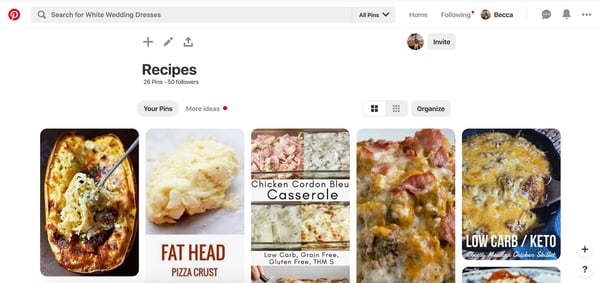
2. Organize and Save Resources
A benefit to social bookmarking sites is that you can organize and save content that you want to revisit later. As a marketer, it’s important to keep track of resources that help you develop professionally. Using a site where you can keep these resources organized is helpful, so you won’t lose valuable content.
3. Tag Content
With most social bookmarking sites, you can “tag” content, meaning you can label it. For example, if there’s a blog post that is about YouTube SEO strategies, you can “tag” that content as “YouTube.” Then, when you want to go back and look for that article or you need resources for YouTube, you have a section in your social bookmarking account tagged YouTube. This keeps the resources you save organized and readily available.
4. Share Resources
Another way to use social bookmarking tools is to share content with your team. As a marketer, if you find an article about social media strategy, you can tag the content as “Social Media” so your social media team can find it. Plus, if everyone on your team has access to the social bookmarking site, they can regularly check in to find the resources they need. This is helpful for employees to continue developing their career and also share things they learn with their colleagues.
For example, in Pocket, you can “tag” content. On the left-hand side of your profile, you can click the “Tags” category to pull up specific articles.
5. Build Backlinks
Social bookmarking sites can be a great addition to your link building strategy. You can use your profile to bookmark resources on your website. However, you shouldn’t only add bookmarks to your site.
Use social bookmarking as you normally would, bookmarking other resources you come across, but sprinkle in a post or two from your own site. While social bookmarking shouldn’t be your sole link building strategy, it can round out your current strategy.
6. Promote Your Mentions
Besides bookmarking articles on your own site, you can also use social bookmarking to link to articles or blog posts that mention your company. However, your social bookmarking profile should contain a variety of self-promotion versus unbranded content.
7. Drive Traffic to Your Site
Social bookmarking sites can drive traffic to your site. If people bookmark your post and vote for it, it will show up in searches, and lead to traffic to your site.
Besides sharing your own posts on your social bookmarking profile, you also want other people to bookmark your content. To make this easy for users, you can add social bookmarking buttons to your blog so readers can bookmark your content with the click of a button.
In the example below, writer Nicole Peeler drives traffic to her website through the content she creates on Medium. Below her post, she has her website, her Medium profile, and the organization profile linked. If users like her post, they can easily find out more information with the links below the article.
8. SEO
Search engines often list results from social bookmarking sites. When a site is bookmarked on a social bookmarking site, a link is made and indexed by search engines. This earns credibility with search engines. Content that is voted for and bookmarked a lot by users on social bookmarking sites tends to show up higher in search engine results.
Social bookmarking can help develop your team and keep your marketing skills sharp in an evolving industry. Plus, it can also be used as a strategy for your team to gain more traffic and credibility with Google.
Want to learn more about improving your skills as a marketer? Check out our list of online marketing classes.

15 Examples of Experiential Marketing Campaigns That’ll Give You Serious Event Envy
Work events are really hit or miss. Let’s be honest: How many times have you found yourself anxiously fidgeting with a paper napkin in the corner of a stuffy networking happy hour?
Here’s the thing: It’s not the event itself that prevents you from coming back the following year. It’s the experience you remember having. In this blog post, we’ll look at some of the best experiences brands have ever offered their customers.
I have a big problem with generic trade shows and industry conferences. That’s why I was not only relieved, but surprised and delighted, when I attended a holiday party that featured a live, interactive version of an arcade game.
An entire room had been curated to look like a video game setting, and people were dressed up as characters from it. There was a giant, real-life scoreboard, boppy electronic music, and best of all, there was no tedious small talk.
It wasn’t just another tired work event … it was an experience. And in our line of work, that sort of thing has a name: experiential marketing.
While a surprising number of people haven’t heard of the concept, it’s kind of a big deal — there’s an entire three-day summit dedicated to it, and 65% of brands that use it say that it positively correlates with sales.
But what is it, exactly? And how has it been used effectively? We found 11 of the coolest experiential marketing campaigns that really break down how it works, and how you can apply those lessons to grow your business.
Experiential Marketing
Experiential marketing, also called “engagement marketing,” is a marketing strategy that invites an audience to interact with a business in a real-world situation. Using participatory, hands-on, and tangible branding material, the business can show its customers not just what the company offers, but what it stands for.
Experiential marketing might sound a bit like event marketing, which makes sense — experiential campaigns do tend to be event-centric. But there are also times when they have nothing to do with a specific event, as you’ll see from the examples we picked.
When an engagement marketing campaign is event-centric, it’s dedicated less to the type of event — like a concert, festival, conference, etc. — and more to interactions between the brand and the customer. (If you already have an event in the works, check out this guide to adding experiential elements to it.)
Why Experiential Marketing Matters Today
According to Forbes, experiential marketing can bolster a lasting connection between customers and a brand. It can also allows you to collect vital data about participating consumers which can then help you improve your strategy.
These campaigns can take an integrated approach. The primary purpose is to experience a brand in a tangible, offline way, but you’ll still want an online dialogue around it. When you consider that 49% of folks create mobile video at branded events — 39% of which is shared on Twitter — it makes sense to incorporate a digital element. A branded hashtag, for example, can get people talking about the experience.
11 of the Coolest Experiential Marketing Examples We’ve Ever Seen
1. Refinery29: 29Rooms
For about three years now, lifestyle brand Refinery29 has hosted the 29Rooms event: What it calls “an interactive funhouse of style, culture, & technology.” As the name suggests, it consists of 29 individually branded and curated rooms — and attendees can experience something different in each one. The rooms are designed and created with brand partners, who range from personalities like artists and musicians, to consumer-facing companies like Dunkin’ Donuts, Dyson, and Cadillac.
Each year, 29Rooms has a different theme, with this year’s being “Turn It Into Art.” Attendees, it seems, are encouraged to enter each room and use the surroundings to create something — one room, for instance, invites participants to put on punching gloves and hit punching bags that each produce a different sound when contacted to create a symphony of sorts. A truly hands-on experience, indeed.
Takeaways for Marketers
- Go nuts, but keep it on-brand. An experience should be memorable, but relevant to the people attending.
- Partner with creators like artists and musicians to create experiences, especially if they are recognizable within the region where you’re trying to build or augment an audience.
2. Red Bull: Stratos
If you were online October 14, 2012, you probably came across a live stream of the “Stratos” jump.
Red Bull has been at the forefront of extreme sports coverage for almost as long as the brand has existed. But in 2012, the company brought its content marketing to new heights — a world-record height, actually.
Affectionately named Stratos, Red Bull’s superterrestrial marketing campaign featured Felix Baumgartner, a skydiver from Austria who partnered with Red Bull to set the world record for highest skydive.
That record: 128,000 feet, about 24 miles above Earth’s surface. Gulp.
To pull off this amazing stunt, Red Bull housed Felix in a small communication capsule and sent him up to the stratosphere using a large helium-filled balloon. And what’s truly remarkable is that his ascent and preparation to jump, alone, allowed him to break another record before landing safely back on Earth (spoiler alert): Red Bull streamed the entire event online, and saw the highest viewing traffic of any live stream ever broadcast on YouTube — at just over 8 million viewers.
Want to see that experience again? Check out Red Bull’s recap video below. I won’t lie, I indulged in a rewatching as I wrote this article.
Takeaways for Marketers
- Don’t underestimate the power of suspense when hosting an event your audience can own a piece of themselves. Being able to witness something new, and maybe a little scary, is such a personal experience. And the better the result, the longer your audience will remember and reminisce over it.
- Oh, and if you can put your brand in the record books while you’re at it, that’s pretty cool too.
3. Lean Cuisine: #WeighThis
It’s disconcerting how many commercials today tell women to change something about themselves. Sitting on the couch and watching TV for just two minutes, I had already lost count of the number of times that message came up.
That’s why it’s so refreshing to see brands like Lean Cuisine, whose marketing used to center solely on weight loss, stray from diet-centric messaging. And its #WeighThis campaign is a great example of just that.
As part of the campaign, Lean Cuisine curated a gallery of “scales” in New York’s Grand Central Station, and invited women to “weigh in.” But here’s the catch: The scales were actually small boards where women could write down how they really wanted to be weighed. And rather than focusing on their weight in pounds — or anything pertaining to body image — the women opted to be measured by things like being back in college at 55, caring for 200 homeless children each day, or being the sole provider to four sons.
What’s particularly cool about this experience is that none of the participants actually interact with a Lean Cuisine product. No one was interrupted, asked to sample something, or stopped to answer questions. In fact, no one was really asked to do anything — the display itself was enough to make people stop, observe, and then voluntarily interact.
Lean Cuisine figured out what message it wanted to send: “Sure, we make stuff that fits into a healthy lifestyle. But don’t forget about your accomplishments. That matters more than the number on the scale.” But instead of blatantly advertising that, it created an interactive experience around the message.
Still, the experience was clearly branded, to make sure people associated it with Lean Cuisine. The company’s Twitter handle and a branded hashtag were featured on the display in large text, which made it easy for people to share the experience on social media. And that definitely paid off — the entire #WeighThis campaign led to over 204 million total impressions.
Takeaways for Marketers
- Don’t interrupt — especially if you’re trying to grab someone’s attention in New York City, like Lean Cuisine was. If you create an experience that provides value to the people who pass by it, they’re more likely to participate.
- Figure out the message you really want to your brand to send — that may or may not be directly tied to an actual product, and it might be something that your brand hasn’t said before. Then, build an experience around it.
4. Volkwagon: Piano Staircase
Smile, you’re on piano camera!
In 2009, Volkswagen caught people at their most musical by turning a subway staircase in Stockholm, Sweden into a giant piano when nobody was looking. The next day, each step produced the sound of a different piano key as people climbed up and down the stairs. The campaign was a part of “The Fun Theory,” which suggests people are more likely to do something if it looks fun (I happen to agree).
For Volkswagen, however, the message of fun goes a bit further than just catching people discovering a musical staircase on their way to work.
As the automotive industry started to take big leaps into environmentally friendly products, Volkswagen wanted to help make people’s personal habits healthier to go along with it. According to Volkswagen — and its partner, DDB Stockholm, an ad agency — “fun is the easiest way to change people’s behavior for the better.”
According to the video below, 66% more people chose the stairs over the escalator at that particular subway terminal, as a result of Volkswagen’s piano staircase.
Takeaways for Marketers
- With every marketing campaign you launch, find the “fun” factor. It’s easy to get caught up in how much your brand helps solve your customer’s problem. But what about them, as people, would also bring them enjoyment?
- Once you find your campaign’s “fun” factor, find the “good” factor. Hosting an experience is your chance to make an impact on your community, not just the users of your product.
5. Google: “Building a Better Bay Area”
Corporate philanthropy is definitely on the rise. Between 2012-2014, 56% of companies increased charitable giving, and Google is no exception. But when the search engine giant gave away $5.5 million to Bay Area nonprofits, it let the public decide where that money would go — in an unconventional, interactive way.
Google allowed people to cast their votes online, but they also wanted to involve the Bay Area community in a tangible way. So they installed large, interactive posters — in places like bus shelters, food trucks, and restaurants — that locals could use to vote for a cause.
Source: Google
In the video below, the narrator notes that this experience reaches “people when they had the time to make a difference.” That’s a big thing about experiential marketing: It allows people to interact with a brand when they have the time. Maybe that’s why 72% percent of consumers say they positively view brands that provide great experiences.
And that concept works in this experience because it takes advantage of a “you’re-already-there” mentality. In San Francisco, finding people waiting for the bus or going to food trucks is pretty much a given. So while they were “already there,” Google set up a few opportunities:
- To learn about and vote for local nonprofits
- To interact with the brand in a way that doesn’t require using its products
- To indirectly learn about Google’s community outreach
With the help of the online voting integration — and a branded hashtag: #GoogleImpactChallenge — the campaign ended up generating 400,000 votes over the course of about three and a half weeks.
Takeaways for Marketers
- Create a branded hashtag that participants can use to share the experience on social media. Then, make sure you’ve integrated an online element that allows people to participate when they learn about it this way.
- Keep it local! It’s always nice when a large corporation gives some love to its community — in fact, 72% of folks say they would tell friends and family about a business’s efforts like these.
- Remember the “you’re already there” approach. Find out where your audience is already hanging out and engage them there, instead of trying to get them to take action where they don’t usually spend their time.
6. Misereor: Charity Donation Billboard
When was the last time you used cash to pay for something?
Tough to remember, right? We’re kind of a species of “mindless swipers” — globally, an estimated 357 billion non-cash transactions are made each year. And knowing how often we whip out our cards, German relief NGO Misereor decided to put our bad habit to good use with its charitable giving billboard.
It was what they called SocialSwipe. Set up in airports, these digital posters would display images of some problems that Misereor works to resolve — hunger was depicted with a loaf of bread, for example.
But the screen was equipped with a card reader, and when someone went to swipe a card — for a small fee of 2€ — the image moved to make it look like the card was cutting a slice of bread.
Even cooler? On the user’s bank statement, there would be a thank-you note from Misereor, with a link to turn their one-time 2€ donation into a monthly one.
Needless to say, this experience required a lot of coordination — with banks, airports, and a mobile payment platform. Because of that, the experience couldn’t just be a one-time occurrence. The people who interacted with it were later reminded of it during a pretty common occurrence: receiving a bank statement.
Takeaways for Marketers
- Visually represent the impact of participating in the experience. People interacting with this display were shown exactly where their money was going — like slicing bread for a hungry family. (Infographics work nicely here, too — check out our templates.)
- Partner with another brand to create an even better experience. In this instance, Misereor worked with Stripe.com for the payment technology, and with financial institutions to get a branded message on users’ bank statements. (And stay tuned — we’ll talk more about the value of co-branding here later.)
- Don’t be afraid to nurture your leads. Even if you don’t use something like a branded hashtag to integrate the experience with an online element, find a way to remind someone that they participated.
7. Guinness: Guinness Class
One of my favorite types of marketing is the “aspirational” kind — or as the Harvard Business Review defines it, marketing for brands that “fall into the upper-right quadrant.” Think: luxury cars, haute couture, and private jets. Things we aspire to own.
It’s that last one — private jets — that set apart the Guinness Class experience. For a few weeks, ambassadors dressed in Guinness-branded flight attendant uniforms entered bars across the U.K., where they surprised unsuspecting customers with a chance to win all kinds of prizes.
In order to participate, bar-goers had to order a pint of Guinness. After doing that, they would shake a prize-generating mobile tablet that displayed what they won. They could win everything from passport cases to keychains, but one player per night would get the ultimate prize: A free trip to Dublin — via private jet, of course — with four mates.
What we like about this experience was its ability to associate Guinness with something aspirational, like traveling by private jet. And according to Nick Britton, marketing manager for Guinness Western Europe, that held the brand up as one that doesn’t “settle for the ordinary.“
That’s important — and can be tricky — for a brand that’s nearly 257 years old: to maintain its authenticity, while also adapting to a changing landscape and audience. But Guinness didn’t have to change anything about its actual products in this case. Instead, it created an experience that addressed changing consumer preferences — for example, the fact that 78% of millennials would rather spend money on a memorable experience or event than buy desirable things.
Takeaways for Marketers
- Think about the things your target audience might aspire to, and that you’d like to associate with your brand. Then, build an experience around that.
- If you do require a product purchase in order to participate in the experience, make it convenient. In this case, people had to buy a pint of Guinness to win a prize, but they were already in a bar that served it.
8. GE: Healthymagination
Think experiential marketing is just for B2C brands? Think again — 67% of B2B marketers say that events make for one of the most effective strategies they use.
That’s why it made sense for GE to invite industry professionals to experience its Healthymagination initiative. The point of the campaign was to promote global healthcare solutions, especially in developing parts of the world.

Source: agencyEA
To help people see the impact of this initiative, GE worked with agencyEA to create “movie sets” that represented different healthcare environments where Healthymagination work took place: a rural African clinic, an urban clinic, and an emergency room. The idea was that doctors would share their stories — live, in front of 700 attendees — that illustrated how GE’s healthcare technology played a major role in each setting.
When people measure the success of experiential marketing, one thing they measure is how much of a dialogue it prompted. And that makes sense — 71% of participants share these experiences. In GE’s case, the point ofHealthymagination was to get people talking about a pretty important, but uncomfortable issue: Access to healthcare in impoverished parts of the world.
But when you create a way for people to become physically immersed in the issue, it also allows them to acknowledge a topic that isn’t always easy to talk about. And that can have quite an impact — this particular campaign, in fact, won a Business Marketing Association Tower Award.
But fear not: That concept also works for not-so-serious, but equally uncomfortable discussion topics. Just look at how well it worked for Charmin.
Takeaways for Marketers
- Experiential marketing does work for B2B brands. Think about who you’re selling to, and create an engagement that would not only attract that audience, but also present an opportunity for them to experience your product or service first-hand.
- Get uncomfortable. If your business centers around something that’s difficult or “taboo” to talk about, creating an experience around it can prompt a conversation. But make sure you keep it respectful — don’t make people so uncomfortable that they have nothing good to say about your brand.
9. Facebook: Facebook IQ Live
Facebook — who also owns Instagram — has always understood how much data it has on how people use these platforms. For that reason, it created the Facebook IQ Live experience.
For this experience, that data was used to curate live scenes that depicted the data. Among them was the IQ Mart: A “retail” setting that represented the online shopper’s conversion path when using social media for buying decisions. There was also a quintessential Instagram cafe, chock full of millennial-esque photo opportunities and people snapping them — latte art and all.
The campaign wasn’t just memorable. It also proved to be really helpful — 93% of attendees (and there were over 1500 of them) said that the experience provided them with valuable insights on how to use Facebook for business.
But what makes those insights so valuable? Momentum Worldwide, the agency behind Facebook IQ Live, puts it perfectly: “When we understand what matters to people … we can be what matters to them.” In other words, we can shape our messaging around the things that are important to our target audiences.
And by creating this experience, Facebook was able to accomplish that for its own brand. In creating this experience, it also created a positive brand perception for a few audiences — including, for example, the people who might have been unsure of how to use the platform for business.
Takeaways for Marketers
- Build an experience for people who aren’t sure about how they would use your product or service. Find ways for them to interact with your brand in a way that creatively spells out how it can benefit them.
- Bring your data to life. We love numbers, but creating a live installment that illustrates them can help people understand exactly what they mean. And since 65% of people think that live events help them understand a product, this setting is a great place to do it.
10. Zappos: “Google Cupcake Ambush”
To help promote its new photo app, Google took to the streets of Austin, Texas, with a cupcake truck in tow. But people didn’t pay for the cupcakes with dollars — instead, the only accepted currency was a photo taken with said app.
And really, what’s better than a free-ish cupcake? We’ll tell you what: A free-ish watch or pair of shoes.
That was the answer from Zappos, anyway. That’s why the brand playfully “ambushed” Google’s food truck experience with one of its own: A box-on-feet — strategically placed right next to Google’s setup, of course — that, when fed a cupcake, would dispense a container with one of the aforementioned goodies.
In order to reap the rewards of the Zappos box, people had to have a cupcake. So while only one brand came away from the experience with an epic sugar high, both got plenty of exposure. And since 74% of consumers say a branded experience makes them more likely to buy the products being promoted, Google and Zappos both stood to gain new customers from this crowd.
But what we really like about this example is how much it shows the value of experiential co-branding. Because Google and Zappos pursue two different lines of business, they weren’t sabotaging each other, but rather they were promoting each other (which is what happens when you pick the right co-marketer).
Takeaways for Marketers
- Use experiential marketing as a co-branding opportunity.
- Pick a partner with an audience that would be interested in your brand, but might otherwise be difficult to reach.
- Make sure your partner would benefit from your audience, too — you want the experience to be a win-win-win: for you, your co-brand, and the consumer.
- When you do pick a marketing partner, build an experience that requires an “exchange” of each brand’s product or service. That way, the audience is more likely to interact with both of you.
11. Docker: Docker Dash
Docker is a software platform that allows developers to make and run apps on different operating systems — a technology known as “containerization.” By some standards, it’s not the sexiest product you can buy. By an enterprise’s standards, it’s not even the easiest product to understand. Enter: Docker Dash.
In partnership with Jack Morton, Docker used its developer conference, DockerCon 2017, to nurture its core enterprise market with a unique product demo called Docker Dash. What made it so unique? It wasn’t a demo — it was a game. And conference guests weren’t guests — they were players.
Docker Dash was a live video game-style simulation of Docker’s application platform, and it recruited 5,000 of its enterprise attendees to create an app together by solving a series of fun challenges inside the game. Each challenge presented in Docker Dash allowed the “players” to engage a feature of Docker’s product and ultimately complete their app. It was a fun, collaborative way to show enterprise software developers why Docker is invested in the containerization market and the value these people can get from Docker’s product.
Docker Dash got the attention of more than 3.6 million people — those who watched and posted about the event from social media, in addition to those who attended DockerCon in person.
Takeaways for Marketers
- Conference hosts thrive on attendees who network with one another. By creating opportunities for your attendees to collaborate and play together, you allow them to share their ideas — making for more educated customers as a result.
- “Gamify” your brand. Give people the ability to play and compete for something, and you’ll instill in them a sense of accomplishment that makes them more passionate about your industry.
12. Vans: House of Vans
Recently, Vans hosted House of Vans pop-up locations at skateparks within major cities like NYC and Chicago. This gave skateboarders a place to meet up, connect, listen to live music, and shred.
Vans also used these skatepark-based popups to promote the launch of their new shoe line which honored David Bowie.
With Vans being a leading shoe line of skateboarders, pop-ups in and near skateparks seem like a natural fit for an experiential marketing experience.
Takeaways for Marketers
- Identify your audience’s hobbies and embrace them. In the example above, Vans knew that they had a big skateboarding audience, so they crafted an event to reward them while intriguing other skateboarders.
- Similarly, if you know you have audiences based in certain locations, go to where they are for your experiential campaign. This will provide less friction and make your audiences feel like you are literally meeting them where they are.
13. Rick & Morty: Rickmobile
To promote the return of the animated Adult Swim series Rick & Morty, Cartoon Network sent a car around the country shaped like Rick, a main character and mischievous time-traveling grandfather on the show. By marketing primarily on social media, the company was able to get the campaign to go viral.
People began following where the Rickmobile was via a live destination page on the adult swim site.
When the Rickmobile hit major cities, people flocked to it to take a picture with Rick’s face and enter the mobile where they could purchase products related to the TV show.
Takeaways for Marketers
- It’s okay to embrace social media to create anticipation and excitement around your pop-up or experience, just as Adult Swim and Cartoon Network did.
- Embracing weirdness, like that of a giant cartoon head driving around the country, can be a helpful way to make your event shareable or intriguing — even to people who might not follow the content or company that you’re promoting.
- If you can work in product sales, consider it. In this example, the network not only promoted the television show, but it also sold products related to it. So, essentially, people directly paid for aspects of a large scale ad.
14. Coca-Cola: FIFA World Cup VR Experience
In Zurich, during the FIFA World Cup, Coca-Cola placed a VR experience in front of a train station. With the experience, you could stand in front of a screen and see a popular soccer player next to you. You could then practice a soccer move with the athlete or compete in your own mini soccer tournament.
Takeaways for Marketers
While VR isn’t accessible to many marketers, this experience did have a few scaleable strategies associated with it.
- To give your attendees an experience of value, consider hosting an expert who can answer questions or give tips related to your marketing campaign.
- Embrace major events. If you know a city or area will be highly populated due to a game or another event, consider placing a pop-up there that somehow relates to that audience or the event itself.
15. Build-a-Bear: Doc McStuffin’s Bear Hospital
Recently, to promote its new Doc McStuffins bear line, Build-a-Bear launched popup “clinics” across the UK where children could bring their torn bears to staff dressed like doctors. Then, the doctors would repair the bear.
Even if a bear wasn’t damaged, children could also bring it for a checkup where a staff member would pretend to give the bear a physical. Alternatively, parents could also buy new Build-a-Bears at the pop-ups.
When children were waiting for their bear to be seen, they could also play with Build-a-Bear toys, color, or watch children’s TV in a waiting area.
Roughly 8,000 children attended the event with their parents and it was incredibly well-received.
Takeaways for Marketers
- If you sell an item that families or children will want, consider aiming your experiential campaigns at the children rather than the parents with purchasing power.
- You can also take a note from Build-a-Bear by honoring and rewarding customers for buying your older products. For example, although the brand was promoting its new Doc McStuffins bear, the clinic allowed children to get their old bears fixed as well as purchase a new bear.
Clearly, taking some very calculated risks worked out pretty well for these companies. So when it comes to creating an experience with your brand, don’t be afraid to think outside of the box — and don’t be afraid to work together on it with someone else.
Invest some time into thinking about the ways people could interact with you, even if it seems a little nutty. If it’s aligned with what you do and executed thoughtfully, people will be talking — in the best way possible.

The Video Game Industry Is Growing: Here Are 4 Ways Brands Are Reaching Gamers
Nearly 70% of Americans play some type of video game each day.
And, with the growth of live streaming, mobile gaming, AR, and VR, this number could get even bigger.
While Twitch.tv, the leading live-streaming platform, hosts millions of users that air video feeds of themselves gaming, many smartphone users also find themselves tapping into multiple mobile games per day.
Right now, it seems like there’s a video game or gaming platform for everyone. And as many of these games and game systems are beginning to use emerging technology, marketers are getting even more aggressive in this space.
Although big companies are looking at in-game marketing tactics more than ever, the interest in reaching gamers actually isn’t that new. In fact, video game marketing precedes some of today’s most popular video game consoles. While brand awareness strategies have evolved in this space, they’ve nearly always been there.
On top of the opportunities that emerging media might offer marketers in the video game industry, gaming audiences also mirror target audiences of many consumer-facing brands. This means video gaming platforms could be a great place for brands to connect with their target audiences.
Gamers are primarily millennials, evenly split in gender, and have aged with the gaming industry. While they were children when the earliest, less-sophisticated games came out, millennials have become very tech-savvy and have embraced today’s more innovative gaming platforms.
Because of their age, millennials also able to make both big and small purchasing decisions in their households. At this point in their lives, millennials can buy or lease a wide range of products, from soft drinks to mobile devices, to cars. This is one reason why marketers zone in on mediums where this age group is prevalent, such as the gaming space.
Along with newer gaming content, millennials also respond well to games that make them feel nostalgic. One example of this was the successful release of the Nintendo Switch, a game system modeled after the 1980s Nintendo. Within 21 months of its launch, 8.7 million Switch units were sold — making it the fastest-selling gaming console of all time.
As marketers read about the possible opportunities associated with video game marketing, they might wonder how brands are actually using this medium to promote products. They also might be asking, “Is this strategy even accessible to me?”
In this post, I’ll discuss the evolution of video game marketing, show a few examples of how brands are innovating in the space today, and note some tactics that marketers might want to consider if gaming does become more accessible in the far-term.
While in-game promotion probably won’t be viable for most brands in the short-term, another new platform, such as a viral social media site, might inspire you to get creative with your marketing techniques. Even if marketers can’t replicate the strategies below today, they can still use the campaigns as examples of how companies thought outside the box to engage audiences on a new or emerging platform.
To give some added perspective on how much the gaming industry has changed, I’ll start by noting some of the earliest video game marketing examples.
A Brief History of Video Game Marketing
In the early 1990s and 2000s, big brands zoned in on young gamers by creating branded video games. Two memorable companies that did this were Chex Mix and Burger King.
Chex Mix’s Chex Quest (1996)
In 1996, as children were starting to play video games on their parents’ PCs, Chex decided to engage its young audiences by placing a CD-ROM game called Chex Quest at the bottom of Chex Mix boxes.
In the intergalactic game, players controlled a space hero called “Chex Man” as he fought off green aliens who would cover their enemies with goo. The game featured multiple levels of difficulty and challenges, including an alien-filled maze. To maintain Chex Man’s strength and health when fighting off aliens, players needed to search for and direct him to foods like fruits and boxes of Chex Mix.
On a deeper level, the game told a commercial-like story of how heroes and astronauts are fueled by healthy breakfasts, like Chex Mix. This game was not only creative, but it also won many prominent advertising awards. In 1996, the video game won a Golden Effie for Advertising Effectiveness. It also won the Golden Reggie Award for Promotional Advertisement in 1998.
Burger King’s Branded Games (2006)
Ten years after Chex Quest, Burger King also identified that its audiences enjoyed gaming. In 2006, the restaurant chain began its first foray into the game world by including one of three branded Xbox games — PocketBike Racer, Sneak King, or Big Bumpin’ — in value meals. Customers could also buy the games for $3.99 each.
Each branded game, or advergame, featured the Burger King mascot along with a burger-related theme. Essentially, all of the games, which were created by the ad agency Crispin Porter & Bogusky, were like interactive advertisements that entertained players and reminded them of Burger King.
For example, in Sneak King, players would step into the role of “The King,” who looks like Burger King’s mascot. Gamers then had to deliver Burger King meals to other characters. While the game entertained players, it also highlighted Burger King’s menu options and brand in great detail, similarly to a commercial.
Within the first weeks of Sneak King’s launch, approximately 2.7 million copies of the advergame were sold, making the campaign an ROI success and a win for Crispin Porter & Bogusky. The campaign also won a Clio Award after Burger King claimed it lifted the chain’s overall sales.
Here’s a trailer for Sneak King:
The Current State of Ads in Gaming
Games and consoles have changed drastically since Chex Quest and Sneak King. Not only do video games look more visually stunning, but many online games and Wi-Fi-powered consoles connect players and strangers from all around the world.
As the gaming space has evolved, so has video game marketing. While reaching gamers used to require marketers to create an entire branded video game, big brands are now able to re-work traditional strategies, like influencer marketing, product placement, and native advertising to fit into the gaming space.
Twitch Streaming
Twitch.tv, which was purchased by Amazon in 2014 and now has over 15 million daily active users, allows people to air a picture-and-picture stream of their computer or game console screen along with a webcam video of themselves.
If a person’s Twitch profile gets a large number of views and subscribers, they can apply to be verified as a Twitch Partner. Once they’re verified, Twitch will give them a small percentage of its advertisement revenue based on their stream’s views and the account’s subscriber counts.
Because of this picture-and-picture format, Twitch quickly became thought of as the social platform for gamers. Since this platform launched, normal people have earned major revenue and gained a huge online following just by streaming themselves playing popular video games.

When it comes to marketing on Twitch, there are two major options: One is to advertise and the other involves starting or sponsoring a stream.
While Twitch has been growing its advertising program since being purchased by Amazon, it recently began asking advertisers to commit upwards of $50,000 in ad spend per campaign. While Digiday reports that Twitch reps seem confident about advertising ROI, this is definitely a hefty cost for most companies.
Because advertising is quite expensive on Twitch, many brands have experimented with starting their own streams. Here are just three notable examples:
Wendy’s
Wendy’s first Twitch stream, which won a Gold Clio, followed an avatar dressed as Wendy who appeared on the online battle game, Fortnite.
At one point in Fortnite’s online storyline, players were prompted to hunt cattle and transport beef to freezers at nearby restaurants. Once they did this, the players would earn coins.
When the Wendy’s team heard that Fortnite players were being encouraged to put beef in freezers, the chain tasked its marketing agency, VMLY&R, in creating an avatar that looked like Wendy. Wendy’s and its marketing firm then launched a Twitch stream where the avatar began to break into restaurants and destroy freezers:
Like a commercial, native ad, or advergame, the goal of the campaign — aside from engaging new audiences — was to remind Twitch audiences that Wendy’s makes an effort to serve the freshest, best tasting beef to its customers.
During the stream, mentions of Wendy’s on social media went up by 119%. The stream was also viewed for a total of 1.52 million minutes with a quarter of a million viewers.
The campaign also allowed Wendy’s fans to interact with her avatar and the stream, which led other Fortnite players to start smashing freezers as well. Viewers of Wendy’s stream also began tweeting about it or posting in the feed’s comment thread. Because of engagement like this, it made Wendy’s company values, brand, and live stream incredibly memorable to gaming audiences.
This campaign led Wendy’s and VMLY&R to win gold medals at the Clio Awards and the Cannes Lions International Festival of Creativity.
According to one Cannes Lions Jury Chair PJ Pereira, the creativeness of this campaign might have opened the door for new marketing opportunities in the future.
“[Making Fortnite Fresher] was setting up a new trend instead of being the apex of a previous trend,” Pereira told Ad Age.
By hosting a nine-hour Twitch stream that followed its mascot playing Fortnite, Wendy’s interacted with gamers in a unique new way.
Old Spice
In 2015, Old Spice launched a stream that followed a dopey avatar named Nature Man who was “contractually obligated” to do what Twitch viewers told him to do as he walked around a computer-generated forest. As Twitch viewers commented with commands for the avatar, an Old Spice rep that was controlling him would make him fulfill these tasks.
At certain points of the Old Spice event, viewers told Nature Man to do things like chop down trees, fight multiple bears, and eat random birthday cakes. Here’s a quick highlight reel:
Although Old Spice’s live stream wasn’t directly about its products, it was still very in line with the brand’s 2015 commercials, which argued that its body spray “smelled as good as nature.”
In and before 2015, live streaming was still very experimental. But, like Wendy’s, Old Spice identified that many young male audiences were gaming on Twitch and decided to create an experimental campaign to engage them. This strategy seemed to work, as the stream received 2.6 million total views.
Totino’s
During a campaign called, “Live Free, Couch Hard,” Totino’s partnered with Twitch influencers to market its pizza rolls through various Twitch streams. In one of the Totino’s streams, which was produced with the help of its marketing firm, 72andSunny, a handful of Twitch stars with millions of subscribers tried to play video games on a couch that moved around like a bucking mechanical bull machine.
During Totino’s stream, viewers could watch the influencers attempt to play video games while also commenting to say which direction the mechanical couch should move next. Viewers could also comment with an emoji that looked like a pizza roll face created just for the event.
Here’s a highlight reel that one of the influencers posted on their stream after the event:
According to a post from Jason Donaldson, a senior writer for 72andSunny, the stream was watched for a total of 1.8 million minutes and it was the number one trending discussion topic on Reddit during the event.
Technically, the focus of Totino’s stream was on the notable gamers riding a mechanical couch, rather than on playing one specific game. However, the food company does a great job of identifying alternative content that gamers will still watch and subscribe to — even if they aren’t getting specific game tips.
Gamer Sponsorship
For years, brands have embraced influencer marketing on various social platforms and in many media campaigns. In sports, you might see an athlete wearing running sneakers from a shoe company. In the makeup industry, you might see a vlogger giving a sponsored tutorial for a new lipstick. Now, as gaming has gotten more interconnected and social, influencer marketing is also starting to thrive in the video game industry.
As online gamers grow a following, brands now seek them out for endorsements or sponsored content. Here are a few examples:
Xfinity Comcast Sponsors Evil Geniuses
Along with sponsoring single gamers, big brands have also sponsored a number of online gaming teams.
Many of these teams successfully compete in ESports, a gaming category that includes online sports, competitions, or battle-oriented games.
In many major ESports games, players can compete individually or join a team. As they get better at a game, their game ranking amongst other online players will go up. Those who gain high rankings on ESports games often get recruited to better-performing teams or can even get sponsored by brands, similarly to real-life athletes.
Since 2016, Xfinity Comcast has sponsored an ESports league called Evil Geniuses. This league, which is now incorporated as its own company, is made up of top-performing gamers who’ve gained expertise and high rankings in ESports games like Call of Duty, Halo, Starcraft, and Rocket League.
As part of the sponsorship, the Evil Geniuses, which has a major gaming industry following, received a decked out Xfinity Comcast gaming studio. The Xfinity logo has also been placed on Evil Geniuses’ official website and added to uniforms that players wear on Twitch streams or at gaming events.
Evil Genius’s Twitter account also regularly mentions Xfinity or the sponsored gaming studio on its social media accounts.
Coca-Cola Sponsors Alex Hunter
For over 20 years, thousands of people around the world have been playing EA Sports’ FIFA World Cup video game series. The ESport game series releases a new World Cup game every year, which allows people to virtually play soccer with others around the world. Like other ESports games, players that get great scores will rise up in online rankings and might gain a following from fellow gamers.
Recently, a highly-ranked player from the 2018 FIFA video game, Alex Hunter, got sponsored by Coca-Cola. As part of his sponsorship, Hunter endorses Coca-Cola at real-life gaming events and dresses his avatar in all red. Hunter’s avatar was also featured in a Coca-Cola commercial where a child’s avatar offers him a Coke before he goes to play a virtual soccer game.
Product Placement
McDonald’s Products in Splatoon 2: Splashfest
Splatoon 2: Splashfest, a Nintendo Switch game created for all ages, opens by giving gamers a choice between two items, such as ice cream or cake. Each of the items that gamers can choose from has a hard color background. At the beginning of each game, users lock in the choice they want to make and get a paintball gun filled with paint that matches the background color of the item they chose.
In the recent Japanese release of Splatoon 2: Splashfest, there was a blatantly obvious product placement from McDonald’s. Gamers were asked to start the game by choosing between McDonald’s Chicken McNuggets or French Fries. The McNuggets were associated with red paint and the French Fries were associated with purple.
Here’s a quick video (in Japanese) where the hosts discuss which item they think is better to ramp up players before they make their choice.
During the game, 71% of those players joined the French Fry team, but the Nugget team surprisingly covered the field with more paint. It’s not clear how many people were playing the game, however Splatoon 2 sold over 2 million copies by 2019.
This is a great example of a product placement because it feels natural to players and allows them to think about and weigh the differences between two main products rather than just one.
Mobile Gaming Ads
Outside of PC or console-based video game marketing, brands are also putting major advertising dollars into mobile game ads.
While most people might think that mobile gamers find ads annoying because they block the entire game, research shows that mobile game players are actually more receptive to ads than users of other mobile apps.
When I heard about this, I was pretty surprised myself. So, I conducted a quick survey using Lucid software to see if people were actually interacting with ads.
Out of a sample of 265 people, 70% said they’d tapped on an ad in a mobile phone game before.
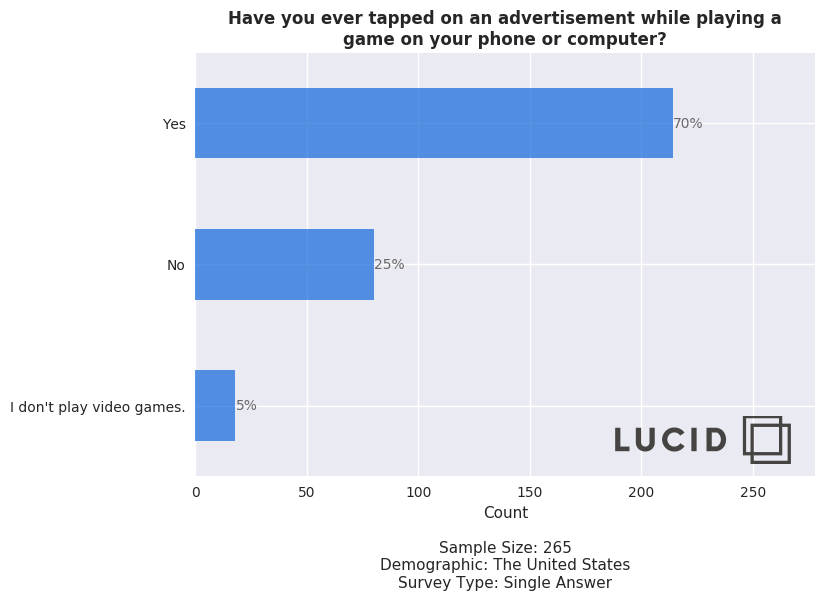
This Survey was conducted with Lucid Software
Right now, there are a few major ad strategies related to mobile games. One is a standard native ad that links to a business’s website. Another is an interactive ad that lets viewers tap and interact with the content in some way. Lastly, big brands like Starbucks are also beginning to experiment with location-based ads in AR games.
Here are a few examples of mobile game ad types that you might regularly see:
Interactive Mobile Ads
Disney
While Disney makes a host of mobile games related to their films, they have also invested millions of dollars into mobile game advertising. In one ad, which they launched to promote the film, “Pirates of the Caribbean: Dead Men Tell No Tales,” viewers were prompted to look for and tap a series of items as they watched the film’s trailer. Tapping on the ad sent them to more video-based content.
While the ad is no longer available to view online, AdColony’s Jude O’Connor described the interactive storyline in a post from The Drum,
“During the trailer, the user was prompted to play a search game and find objects within the trailer itself, tap the screen and it was almost like a playable ad experience,” said O’Connor. “Then, when they were able to find additional pieces it unlocked new content, additional trailers for them, character content at the end of the video. The user then became part of the experience.”
AdColony, the agency which created the ad for Disney, does not specify results related to the ad, but has noted that it was a success. Here’s a Creative Showcase piece where the company goes into detail about what might have made the ad so effective.
Disney’s interactive mobile game ad strategy is smart because those playing video games want to be interactively entertained. While a standard ad might bore them, something interactive might interest them while in a gaming mindset.
Native Ads
Apple
Apple runs ads for Apple Music on a number of smartphone and tablet games. This ad is pretty simple and shows mobile gamers the Apple Music logo, an animated music symbol, and a description of the service that says, “Enjoy over 50 million songs. Always ad-free.” At the bottom of the ad is a CTA that says “Listen on” followed by Apple Music’s Apple Store Icon. Users can tap on the ad to be directed to Apple Music’s app store page,

Like many effective mobile ads, Apple’s design simply explains exactly what the service its selling does without overwhelming mobile viewers with too many words or visuals.
Tully
Tully, a financial advising and savings app and service, launched a simple and semi-interactive ad for mobile games. In the ad, you can swipe left to see the benefits of using Tully and screenshots of how the app works. At the bottom, you see a quick description of what the app does, it’s five-star App Store rating and a CTA button that says “Download.”
Tully’s mobile game ad is an example of how an ad can be simple but still interactive. Even though this ad probably didn’t take as much time to design as a more intricate interactive ad, it still allows the viewer to engage with it by swiping through different pages of it to learn more.
Augmented Reality Ads
Starbucks
As video games like Pokémon Go combine AR and geo-location to create a new style of mobile gaming experience, brands have also experimented with AR in-game ads. To date, a great example of this was Starbucks — which sponsored Pokémon Go locations.
In 2016, when Pokémon Go was going viral, the coffee chain teamed up with the game’s developers to mark 7,800 of its physical locations into Gyms or PokéStops on the AR map. When players entered a Starbucks Gym or PokéStop, they saw an ad for a limited-edition Pokémon Frappuccino.
Photo from Pokémon Go
Although Starbucks did offer a more traditional in-game beverage ad to players who arrived at its Gyms and PokéStops, the chain more importantly pulled in significant foot traffic from gamers before even revealing the beverage in the Go app.
By sponsoring Pokémon Go locations, Starbucks creatively leveraged an AR platform to entertain its customers and pull new audiences into its physical store.
Navigating Gaming and Emerging Mediums
While marketers shouldn’t just shift all of their resources to start their own version of Chex Quest, it can’t hurt to keep up with new mediums that might provide opportunities in the far future. While gaming might not be one of them, a new social media platform might be a great place to experiment with interactive content or other strategies that engage new audiences.
The examples above demonstrate how brands identified their audiences, learned about the platforms they were using and aimed to meet them on those platforms. As media continues to evolve, marketers at all company sizes will want to keep thinking of new strategies that will meet their prospects where they are — even if those audiences are on a somewhat newer platform.

Creating Branded Content on Instagram: What Marketers Need to Know
Thinking of partnering with other businesses to create Branded Content on Instagram? Wondering how to get started? In this article, you’ll discover how to set up, create, and analyze branded content posts on Instagram. What Is Branded Content on Instagram? Branded content posts were first introduced on Facebook and have now moved over to Instagram […]
The post Creating Branded Content on Instagram: What Marketers Need to Know appeared first on Social Media Marketing | Social Media Examiner.
from Social Media Marketing | Social Media Examiner https://ift.tt/2o84sTA
via socialmediaexaminer
Fixed Cost: What It Is & How to Calculate It
“Business is personal — it’s the most personal thing in the world.”
These are famous words by Michael Scott from the TV show, The Office. And although this quote conflicts with the universal belief that business isn’t personal, Michael’s point of view is perfect when learning about a business’s fixed costs — or those costs that don’t change as a company grows or shrinks.
To identify and calculate your business’s fixed costs, let’s start by looking at the ones you’re already paying in your personal life. Then, we’ll explain how a business manages its own fixed costs and review some common fixed cost examples.
What Is a Fixed Cost?
Fixed costs are those costs to a business that stay the same regardless of how the business is performing. These costs are known as fixed costs to distinguish them from variable costs, which do change as the company sells more or less of its product.
Fixed Cost Formula
- Identify your building rent, website cost, and similar monthly bills.
- Consider future repeat expenses you’ll incur from equipment depreciation.
- Isolate all of these fixed costs to the business.
- Add up each of these costs for a total fixed cost (TFC).
- Identify the number of product units created in one month.
- Divide your TFC by the number of units created per month for an average fixed cost (AFC).
Consider your personal routine. As a single adult, your expenses would normally include a monthly rent or mortgage, utility bill, car payment, healthcare, commuting costs, and groceries. If you have children, this can increase variable costs like groceries, gas expenses, and healthcare.
While your variable costs increase after starting a family, your mortgage payment, utility bill, commuting costs, and car payment don’t change for as long as you’re in the same home and car. These expenses are your fixed costs because you pay the same amount no matter what changes you make to your personal routine.
In keeping with this concept, let’s say a startup ecommerce business pays for warehouse space to manage its inventory, and 10 customer service employees to manage order inquiries. It suddenly signs a customer for a recurring order that requires another five paid customer service reps. While the startup’s payroll expenses go up, the fixed cost of a warehouse stays the same.
Average Fixed Cost
Keep in mind you have to keep track of your business’s fixed costs differently than you would your own. This is where average fixed cost comes into play.
Average fixed costs are the total fixed costs paid by a company, divided by the number of units of product the company is currently making. This tells you your fixed cost per unit, giving you a sense of how much the business is guaranteed to pay each time it produces a unit of your product — before factoring in the variable costs to actually produce it.
Let’s revisit the ecommerce startup example from earlier. Assume this business pays $5,000 per month for the warehouse space needed to manage its inventory, and leases two forklifts for $800 a month each. And last month, they developed 50 units of product.
The warehouse and forklift costs remain unchanged regardless of how many products they sell, giving them a total fixed cost (TFC) of $5,000 + ($800 x 2), or $6,600. By dividing its TFC by 50 — the number of units the business produced last month — the company can see its average fixed cost per unit of product. This would be $6,600 ÷ 50, or $132 per unit.
Fixed Cost Examples
So far, we’ve identified a handful of fixed cost examples since considering the costs we already pay as individuals. A home mortgage is to a lease on warehouse space, as a car payment is to a lease on a forklift.
But there are a number of fixed costs your business might incur that you rarely pay in your personal life. In fact, some variable costs to individuals are fixed costs to businesses. Here’s a master list of fixed costs for any developing company to keep in mind:
- Lease on office space: As long as your business operates in the same building, your rent cost doesn’t change.
- Utility bills: Your heating or cooling bill might fluctuate as seasons change, but it is generally not affected by business operations.
- Website hosting costs: When you register your website domain, you pay a small monthly cost that remains static despite the business you perform on that website.
- Ecommerce hosting platforms: Ecommerce platforms integrate with your website so you can conduct transactions with customers. They typically charge a low fixed cost per month.
- Lease on warehouse space: Warehouses are paid for the same way you’d pay rent on your office space. They do not change in price as you store more or fewer products inside, but can have storage and capacity limits.
- Manufacturing equipment: The equipment you need to produce your product is yours once you buy it, but it will depreciate over its useful lifetime. Depreciation can become a fixed cost if you know when you’ll have to replace your equipment each year.
- Lease on trucks for shipment: Truck leases work the same way as a car payment, and will not charge differently depending on how many shipments you make.
- Small business loans: If you’re financing a new business with a bank loan, your loan payments won’t change with your business’s performance. They are fixed for as long as you have a balance to pay on that loan.
- Property tax: Your office space’s building manager might charge you property tax, a fixed cost for as long as your business is on the property.
- Health insurance: Health insurance costs might be a variable cost to an individual if they add or remove dependents from their policy, but to a business, the recurring costs to an insurer are fixed.
Calculating your fixed costs isn’t always the most fun part of growing your business. But knowing what they are, and when you’ll pay each one, gives you the peace of mind you need to serve and delight your customers.

LinkedIn Events Relaunches: What Marketers Need to Know
Welcome to this week’s edition of the Social Media Marketing Talk Show, a news show for marketers who want to stay on the leading edge of social media. On this week’s Social Media Marketing Talk Show, we explore LinkedIn’s relaunch of Events, new LinkedIn page features, and Facebook Stories ad updates with special guests, Amanda […]
The post LinkedIn Events Relaunches: What Marketers Need to Know appeared first on Social Media Marketing | Social Media Examiner.
from Social Media Marketing | Social Media Examiner https://ift.tt/2J3MA3r
via socialmediaexaminer
101 Blog Post Ideas Straight from the HubSpot Brain Trust
We all know blogging is an ultra-important asset to your business when it comes to building traffic and reputation. The hidden dark side, though, is how hard it is coming up with topics that will give you that ultra-good traffic.
If you’ve hit a roadblock when it comes to the content on your blog, don’t sweat it.
An age-old question between marketers is “What do you blog about?“. It can quickly feel like your company has blogged about everything under the sun.
To help, we polled fellow HubSpotters — who know a thing or two about blogging — and we’ve created a list of 101 ideas to keep your queue filled.
Multimedia
1. Create a roundup of all the best GIFs on the internet marketers can relate to
2. Make a parody song that describes your office culture
3. Recap your latest company event with photos and/or videos
4. Post a product demo;
5. Write a post explaining a social media channel
6. Make a video that highlights your industry and write a post about it
7. Start a podcast and transcribe each episode on the blog
8. Record an interview with a colleague and conduct a corresponding writeup
9. Upload a photo diary of how your company celebrates culture
10. Share a cartoon that represents your company
Research
11. “ We Asked People About [insert topic], Here’s What They Said “
12. Research unusual holidays (ex: National Burger Day) and create a roundup your favorites
13. Make an infographic about your analytics and break down the pros and cons of each
14. Research the most popular social media channel and break down their numbers
15. Discuss the importance of knowing your lead data from a business standpoint
16. Share the most popular apps among a target audience and what that means for your business
17. Make a list of tools that are the best for you IT team
18. Explain your knowledge base and why it matters
19. Do an in-depth case study about delighting customers and examine the results
20. Based on the past, what are your predictions for the industry’s future?
21. “Here are our failures, and what we learned from them”
Community Engagement
22. Highlight local rockstars in your field
23. Interview a local business owner
24. Create a survey about your business’s ecosystem
25. Make a post that celebrates your user-generated content
26. Spotlight a “client-of-the-month”
27. Discuss the most practical uses for your product
28. Use employee stories to inspire your audience
29. Ask for guest posts from network members
30. Run a product/service giveaway
31. Throw a community-based event and recap it
Instructional (Guides and How-to)
32. A list of ‘musts’ for a career in your field
33. Interview an industry heavy-hitter about their tips for business
34. Post a series on landing your dream job
35. Write a roundup about “What I Wish I Knew When I First Started.”
36. How to gain the right skillset to advance in your career
37. The hardest part of your job — and how you tackle that
38. Tips to handle burnout
39. Write an ultimate guide
40. Create a pillar page
41. Bust common myths about your field
42. Demo how to use a specific social media channel
43. Write about how to collect data from webpages
44. Recommend the best tools for completing certain daily tasks
45. Offer the benefits of a current trend your company has mastered
46. Relate your content to a current celebrity
47. Write a post about how to give an incredible speech under 20 minutes
Multichannel Integration
48. Discuss social media trends
49. Explain how your most recent Facebook Live session delighted customers
50. Rank the top social media channels for your brand
51. Dive into a social network’s latest update
52. Explain how you use Instagram Stories to grow your engagement
53. Spotlight a brand killing it among multiple social channels
54. Rate five of the best Twitter polls in the right place at the right time
55. Find the best memes for content marketing on Twitter and Instagram
56. Discuss how your brand uses LinkedIn to connect with your community
57. Share your top analytics services and explain why they’re great
58. Write about how you engage millennials
59. Explain how YouTube is an asset to your business
60. Take a stance on a recent blog post from your favorite news-sharing site
61. Round up recent news in your industry
62. Share great quotes from an ebook in a roundup
Thought Leadership
63. Describe what your mission statement means to you
64. Dive into how a company boosted their blog traffic exponentially
65. Break down what an ideal company culture would look like
66. Write about ways your company is focusing on diversity and inclusion
67. Explain diversity and why it matters
68. Come up with a list of company outings for remote teams/employees
69. Describe how your team combats burnout and provide helpful tips to avoid it
70. Create a list of industry trends to keep an eye on
71. Compare and contrast different topics about marketing, business, or your industry, such as different types of advertising
72. Post a recap of breaking industry news
Content Marketing
73. Create a post dedicated to one or more FAQs
74. Invite a guest blogger to contribute
75. Create an office playlist and share the tracklist
76. Profile a co-worker or manager
77. Interview a customer
78. Run a contest
79. Write about your day-to-day workflow
80. Describe your career in five words and provide helpful advice to others
81. Compile a list of the best movies that depict your field
82. Invite your audience to join in with a quiz on your blog
83. Embrace popular holidays and make a themed post about them
84. Post a “Year-in-Review” about lessons learned throughout the year and what it means for your readers
85. Round up brands using IGTV brilliantly
86. A roundup of ways your team conducts successful content marketing
Miscellaneous/Fun
87. Have your team weigh in about if they work while traveling
88. Interview questions that help finalize decisions
89. Resources most helpful to SMBs
90. List of books that inspire professionals in your industry
91. “What has changed about our workflow habits over the years?”
92. Compile a list of weekly/monthly aspirations
93. Give your favorite historic moment about your industry
94. Your grade sheet on measuring quality product launches — and how it works in action
95. Explain common acronyms in your workplace or industry
96. Talk about a fun day at the office recently
97. Give a short history of your company
98. A peer-curated list of hobbies outside of work
99.Share highlights from a recent conference
100. Examine a recent movie trailer and how their marketing should be noted
101. Come up with a staff bonding event and recap how it went
Because it’s easy to get wrapped up in the day-to-day of your industry, it’s also easy to run into the same types of blog posts. Blogs are important for SEO and lead generation, so picking the “right” topics is a crucial step in marketing planning.
Remember to mix it up and have fun with blogging it doesn’t have to be the most formal part of your website. Blogs are an asset to your business, not a hindrance, and these post ideas are some of our favorites as HubSpotters.
For more interesting content ideas, check out our ultimate list of tips here.

What California’s New Data Privacy Act Means for Marketers
Disclaimer: This blog post is not legal advice for your company to use in complying with U.S. data privacy laws like CCPA. Instead, it provides background information to help you better understand CCPA. This legal information is not the same as legal advice, where an attorney applies the law to your specific circumstances, so we insist that you consult an attorney if you’d like advice on your interpretation of this information or its accuracy.
In a nutshell, you may not rely on this as legal advice, or as a recommendation of any particular legal understanding.
Nowadays, marketers rely on the information they receive from consumers to make decisions on what type of content their audience prefers to receive, and in what form.
There isn’t anything inherently wrong with using information to create a better, more personalized marketing strategy.
In fact, when done well, it can largely benefit the consumer — for instance, when I’m scrolling through Instagram, I like to see content from some of my favorite brands, like HelloFresh. By staying up-to-date on their products and offerings, I’m able to make better purchasing decisions.
However, marketers get into murky (or even illegal) territory when they misuse the information their consumers have provided. If a consumer fills out a form on your website, for instance, she’s letting your company have access to that information — and your company alone. She is not agreeing to share that same information with third-party sources.
In 2017, we covered What is the GDPR? And What Does it Mean for the Marketing Industry? Here, let’s dive into what The California Consumer Privacy Act (CCPA) means for you as a marketer, and how it differs from GDPR.
CCPA Requirements
As mentioned above, the California Consumer Privacy Act was approved by California’s State Governor back in 2018, but won’t go into effect until January 1, 2020.
Ultimately, the law applies to any companies that conduct business in the state of California, and have one of the following criteria:
- Has revenue of $25 million or higher
- Receives information of over 50,000 consumers, households, or devices annually
- Derives 50% or more of its annual revenue from selling consumers’ personal information
It’s important to note — the law stretches beyond businesses that have physical brick-and-mortar shops in California. That means if you’re a marketer for an ecommerce business that sells to residents living in California (and you have one of the three criteria listed above), you’ll still be affected by the law.
If you’re wondering where this is coming from, here’s a little backstory — in 2018, you might remember scandals erupting as a result of companies misusing consumers’ personal data. The congressional hearings that followed these scandals pointed out that any personal information shared on the internet can technically be subject to misuse and theft.
As a result of these hearings, California legislature moved to protect Californians’ right to privacy by implementing this new data privacy act.
What the CCPA Means for Marketers
Now, you might be thinking — okay, but I’m not the CEO of my business, I’m a marketer. What does this law mean for me?
If the CCPA applies to your business, this means whenever you collect your consumers’ personal information — whether it be for a social media campaign, email survey, or something else — you’ll need to disclose what information you’re collecting, and how you’ll be using your consumers’ personal information.
Additionally, you need to give your consumers the right to opt-out of having their information sold to third-parties, and you need to let consumers view and delete the information you’ve collected about them.
There are a few additional differences between GDPR and CCPA that are worth noting.
One main difference is, GDPR focuses on data related to the EU consumer, while the CCPA considers data related to both the CA consumer and the household. Additionally, the CCPA only considers data provided by the consumer, as opposed to data sourced from third-parties.
Additionally, there are differences in penalties — GDPR’s penalty for companies that violate their regulation is up to $20 million or 4% worldwide turnover, whichever is greater.
In comparison, CCPA’s penalty is up to $2,500 per violation or $7,500 per intentional violation, plus an additional $100-$750 per incident to the affected individuals.
There’s also a difference in the type and scope of data collected. GDPR applies to all data collected about EU citizens. The CCPA, on the other hand, applies only to data collected directly from, and about, California consumers.
If you’re unsure whether the CCPA will affect your business, you’re not alone — a recent ESET survey found 44% of respondents had never heard of the CCPA, only 11.8% didn’t know if the law applied to them, and 34% of executives weren’t sure if they’d need to change how they capture and process data to comply with the law.
Fortunately, if you’re a marketer who’s already done the work to ensure you comply with GDPR regulations, it shouldn’t be too difficult to additionally comply with CCPA. For more information, check out our web page designed to help you prepare for the CCPA.
